
1
A Review of the Applications of Phase Change Materials in Cooling, Heating and Power 1
Generation in Different Temperature Ranges 2
Kun Du, John Calautit, Zhonghua Wang, Yupeng Wu* and Hao Liu 3
Department of Architecture and Built Environment, Faculty of Engineering, The University of Nottingham,
4
University Park, Nottingham, NG7 2RD, UK
5
*Corresponding author: Tel: +44 (0) 115 74 84011; emails: [email protected],
6
7
Abstract 8
Latent heat thermal energy storage is an attractive technique as it can provide higher energy 9
storage density than conventional heat energy storage systems and has the capability to store 10
heat of fusion at a constant (or a near constant) temperature corresponding to the phase 11
transition temperature of the phase change material (PCM). This paper provides a state-of-the-12
art review on phase change materials (PCMs) and their applications for heating, cooling and 13
electricity generation according to their working temperature ranges from (-20℃ to +200℃). 14
Four working temperature ranges are considered in this review: 1) the low temperature range 15
from (-20℃ to +5℃) where the PCMs are typically used for domestic and commercial 16
refrigeration; 2) the medium low temperature range from (+5℃ to +40℃) where the PCMs are 17
typically applied for heating and cooling applications in buildings; 3) the medium temperature 18
range for solar based heating, hot water and electronic applications from (+40℃ to +80℃); and 19
4) the high temperature range from (+80℃ to +200℃) for absorption cooling, waste heat 20
recovery and electricity generation. Different types of phase change materials applied to each 21
temperature range are reviewed and discussed, in terms of the performance, heat transfer 22
enhancement technique, environmental impact and economic analysis. The review shows that, 23
energy saving of up to 12% can be achieved and a reduction of cooling load of up to 80% can 24
be obtained by PCMs in the low to medium-low temperature range. PCM storage for heating 25
applications can improve operation efficiency from 26% to 66%, depending on specific 26
applications. Solar thermal direct steam generation (DSG) is the most common electricity 27
generation application coupled with PCM storage systems in the high temperature range, due 28
to the capability of PCMs to store and deliver energy at a given constant temperature. The 29
recommendations for future research are also presented which provide insights about where 30
2
Keywords: phase change materials (PCMs); energy storage; latent thermal storage; heating; 1
cooling; power generation 2
3
1.
Introduction
4Nowadays, with the rapid growths in world population and economy, the world energy demand 5
and consumption have increased enormously which led to a wide variety of harsh 6
environmental impacts [1]. Higher usage of conventional fossil fuels is the main underlying 7
cause of global warming and immense damage to environment due to the greenhouse and 8
harmful pollutants emitted during their combustion. According to the data from the 9
International Energy Agency (IEA) [2], the primary energy production has increased by 49% 10
over the past 20 years resulting in an increase of carbon dioxide (CO2) emissions by 43%.
11
Engineers and scientists all over the world are motivated to solve these challenging issues by 12
developing new technologies to decrease the dependence on fossil fuels and improve the energy 13
use efficiency, and simultaneously avert from environmental hazards, expensive power 14
generation and establishing new power generation plants [3]. 15
As a potential solution for energy conservation storing the excess energy to fill the gap between 16
energy supply and demand, using PCMs has received much attentions. Thermal energy storage 17
with PCM is a promising technology based on the principle of latent heat thermal energy 18
storage (LHTES) [4], where PCM absorbs or releases large amounts of energy at a certain 19
temperature during the phase change transition period (charging and discharging process), with 20
a high heat of fusion around its phase change temperature range [5], as shown in Fig. 1. 21
According to the experimental results of Morrison and Abdel-Khalik [6] and Ghoneim [7], the 22
mass of rock (sensible heat storage) was 7 times larger than paraffin 116 wax (latent heat 23
storage & PCM), 5 times larger than medicinal paraffin (LHS&PCM) and 8 times larger than 24
Sodium Sulfate Decahydrate (Na2SO4∙10H2O, latent heat storage & PCM) to absorb equal
25
amount of thermal energy. Currently, the application of PCM has been widely developed in 26
different fields including, heating and cooling of domestic buildings [8], solar power plants [9], 27
solar drying systems [10], photovoltaic electricity generations [11], refrigerators [12], waste 28
heat recovery [13] and domestic hot water systems [14]. 29
3 1
Fig. 1. Schematic diagram of the phase change transition of PCM [15]
2
Applications of PCMs within specific temperature ranges have been widely reviewed by many 3
researchers [3, 10, 16-25]. Kasaeian et al. [23] reviewed the applications of PCMs and nano-4
PCMs in buildings for cooling, heating and air-conditioning/ventilation at a relatively low 5
temperature ranging from 10 °C to 40 °C. Agyenim et al. [24] conducted a review of theoretical, 6
experimental and numerical studies of PCMs within three temperature ranges that were 7
classified as 0-65 °C for domestic heating and cooling, 80-120 °C for absorption cooling, and 8
over 150 °C for direct steam electricity generation. Oró et al. [25] completed a review of the 9
applications of PCMs at temperatures lower than 20 °C. Liu et al. [26] reviewed PCM energy 10
storage systems for concentrated solar thermal power plants where PCM has a relatively high 11
melting temperature of up to 300 °C. However, no one has reviewed the application of PCMs 12
covering the temperature ranges from the freezing temperature range to the high temperature 13
range, summarised the classifications of PCMs and applications in these different temperature 14
ranges and discussed the performance improvement, environmental impact and cost of PCM 15
applications. 16
This paper reviews and discusses the application of phase change materials for heating, cooling 17
and electricity generation within the four working temperature ranges, shown in Fig. 2. The 18
low temperature range from -20°C to 5°C is for the applications of domestic refrigerators and 19
commercial refrigerated products (Section 2), the medium-low temperature range from 5°C to 20
40°C is for the applications of free cooling, building passive heating and cooling, solar 21
absorption chiller, evaporative and radiative cooling, and air conditioning systems (Section 3), 22
the medium temperature range from 40°C to 80°C is for the applications of solar air heaters, 23
solar stills, solar domestic hot water systems, and electric devices (Section 4), and the high 24
temperature range from 80°C to 200°C is for the applications of solar absorption cooling, on-25
site waste heat recovery, off-site waste heat recovery, and solar thermal electricity generation 26
4
enhancement techniques employed on phase change thermal storage systems for each of the 1
four temperature ranges are reported and summarised. Moreover, an analysis of the 2
environmental impact and economics of the PCM applications is also carried out. Finally, a 3
summary of the findings and the potential future research needs are presented in Section 6. 4
5
6
Fig 2. Classification of the reviewed applications of PCMs in defined temperature ranges
7 8
2.
Applications of PCMs in the low temperature range from -20°C to 5°C
9This section reviews the applications of phase change materials in the low temperature range 10
from -20°C to 5°C, including PCMs integrated into domestic refrigerators for operation 11
performance improvement and integrated into refrigerated products for enhanced thermal 12
protection. Freezers integrated with PCM storage were reported to provide energy saving up to 13
12% and COP improvement up to 19% [27, 28]. Although the cost of a PCM cold storage tank 14
was higher than traditional storage options, the potentials of PCM cold storage were significant 15
in energy savings, CO2 mitigation, and economical savings [29].
5 2.1 Domestic refrigerators
1
PCMs are incorporated into a domestic refrigeration system on the condenser side as heat 2
storage, and on the evaporator side or compartment as cold storage to improve the operation 3
performance. Fig. 3 shows a schematic diagram of PCMs integrated into domestic refrigerators, 4
where PCMs are placed on the evaporator, the freezer internal wall surface and the condenser 5
heat dissipation tubes. 6
7
8
Fig. 3. Three typical solutions of PCMs incorporated in domestic refrigerators: a) at evaporator side; b) at
9
container enclosure; c) at condenser side [30-32]
10 11
A condenser in a domestic refrigerator is a heat exchanger which is utilised to reject heat of 12
compression to the ambient air and the more heat removed from the condenser, the better 13
refrigeration cycle achieved. Incorporation of PCM into the condenser enhances the heat 14
transfer by the extending of the heat rejection process to the compressor off time, resulting in 15
a lower temperature in the condenser. The shape-stabilized phase change materials (such as 16
PCMs containing with Linear Low Density Polyethylene (LLDPE) [33], epoxy [34], Poly-17
Hexadecyl Acrylate (PHDA) [35], etc.) are developed to solve the problem of leakage and 18
deformation, where PCMs are contained in thermoplastic elastomer poly to keep the shape in 19
a solid state. The shape stabilized paraffin exhibits the same performance of pure paraffin and 20
up to 80% of its latent heat, but the heat storage performance is still limited by low thermal 21
6
Cheng et al. [27] experimentally studied the performance of Shape Stabilized Phase Change 1
Materials (SSPCMs) with a peak phase change temperature of 30.5°C mounted around the 2
condenser tubes of a refrigerator as shown in Fig. 4. It was found that the condenser midpoint 3
temperature and outlet temperature were decreased by 2.3℃ and 6.5℃, respectively and an 4
energy saving of 12% was achieved as compared to a standard refrigerator. Further on, Cheng 5
et al. [28] numerically investigated the performance of the SSPCM in a cold storage evaporator 6
(CSE). It was concluded that the increase in ambient temperature and the reduction of freezer 7
temperature could improve the coefficient of performance (COP) by 19%. 8
A series of experiments to investigate the COP enhancement of a refrigeration system 9
incorporating PCMs were conducted by Wang et al. [36], where the PCM materials were 10
separately placed between the compressor and condenser (PCMA), between the condenser and 11
expansion valve (PCMB), and between the evaporator and compressor (PCMC) as shown in 12
Fig. 5. The melting temperatures of eutectic PCMs are 21°C for PCMA and PCMB and 8°C 13
for PCMC. It was found that PCM integrated in PCMA configuration could be seen as an extra 14
condenser, and the COP was improved by 6% due to a lower temperature and pressure in the 15
condenser. For the PCMB configuration, the COP was increased by 8% due to higher sub-16
cooling effect caused by a lower phase change temperature. 17
18
19
Fig. 4. Schematic diagram of refrigerator with PCM incorporated to the condenser [27]
7 1
Fig. 5. Considered PCM locations in the refrigeration system[36]
2 3
The evaporator in a domestic refrigerator works based on either free or forced convection, with 4
problems on low heat transfer rate and higher energy consumption on forcing internal air 5
circulation [37]. PCMs incorporated into the evaporators can enhance the conduction heat 6
transfer rate from the evaporator to the PCMs in addition to the natural convective heat transfer 7
rate to the ambient air. Azzouz et al. [38] numerically investigated the performance of a 8
refrigerator coupled with a latent thermal storage system. When PCM with a melting 9
temperature between -9°C and 0°C was integrated into the evaporator of a domestic refrigerator, 10
it was predicted that the COP could be increased by up to 15% and the compressor work 11
frequency was reduced therefore increasing the lifespan of the refrigerator. In their later 12
investigation [30], a 5-9 hours continuous operation period without external electrical supply 13
was achieved, when coupling PCMs within the refrigerator (Fig. 6a). It was found that the 14
continuous operation period of water cold storage based refrigerator was longer than eutectic 15
PCM based refrigerator with the increase of ambient air temperature, shown in Fig. 6b. 16
The energy saving effect of PCMs integrated in the evaporator was investigated by Yusufoglu 17
et al. [31], by testing three alternative PCMs with melting points of -2.5°C, -3.6°C, and -4.4°C, 18
respectively, on two types of conventional refrigerators. It was found that the best energy 19
saving effects were 8.8% and 9.4%, respectively. Moreover, it was concluded that increasing 20
8 1
Fig. 6. a) Household refrigerator equipped with PCM slabs on evaporator; b) Cool storage capacity of the
2
system for different thermal loads [30]
3 4
PCMs mounted on freezer enclosures can absorb the heat from door openings and maintain a 5
homogeneous temperature distribution, and consequently reduce the on-time of the compressor 6
and its energy consumption. Gin et al. [32] investigated the performance of a refrigerator, when 7
PCM panels (melting point of -15.4°C) were placed against the internal wall of the refrigerator 8
as shown in Fig. 7a. It was found that the peak air and product temperatures was 2.9℃ and 1℃ 9
lower than those of a standard freezer, respectively, with a defrost cycle of 30 min. Moreover, 10
the energy consumption was decreased by 8% during a defrost cycle and by 7% during door 11
openings. The temperature change rate of the product with or without PCM had been compared 12
(Fig. 7b) and it was found that the change rate of the temperature in the product was initially 13
similar but the change rate of the product without PCMs was faster after 1 hour, showing a 14
temperature variation buffer effect with PCMs. A similar experiment was conducted by Gin 15
and Farid [39] and it was found that a much lower peak temperature of -11°C was achieved, as 16
compared to -3°C for a freezer without PCMs during a 3 h power loss test. Fioretti et al. [40] 17
investigated the energy performance of the insulation envelope of a freezer incorporating 18
paraffin wax (melting temperature of 35°C) inserted in polyethylene panels. In contrast to a 19
conventional refrigerator, it was found that the internal surface temperature was reduced by 1-20
2°C during an indoor test and the heat transfer rate was reduced by up to 8.57% during an 21
outdoor test. Copertaro et al. [41] numerically investigated the operational performance of a 22
refrigerator container envelope using different PCM panels with phase change temperatures 23
from 27.5°C to 46.5°C. It can be concluded that PCM panels filled with paraffin (melting point 24
of 35°C) could effectively reduce the peak heat load in a range between 20.1% and 20.87% 25
9 1
Fig. 7. a) Schematic diagram of the placement of PCM panels against the internal wall of a freezer; b) Product
2
rate of change of temperature with and without PCM during the first 4 h of power loss [32]
3 4
2.2 Commercial refrigerated applications 5
Transport and storage of temperature sensitive products are the main focus of research and 6
commercial applications of PCMs in the temperature range between -20°C and 5°C. PCMs can 7
be integrated in refrigerated trucks, food packaging and medical product, for better thermal 8
buffering capacity to enhance the thermal protection of perishable products. 9
Liu et al. [42] developed a novel design of refrigerated trucks consisting of an off-vehicle 10
refrigeration unit with an on-vehicle PCM storage unit (melting point of -26.7°C) as shown in 11
Fig. 8. It was found that the energy consumption was reduced by up to 86.4% when compared 12
to conventional systems without PCMs. Ahmed et al. [43] presented a novel method of heat 13
transfer reduction for refrigerated truck trailers equipped with insulating walls using paraffin-14
based PCMs. An average reduction in peak heat transfer by 29.1% was achieved by adding 15
PCM to the insulation foam of all walls and the daily heat flow into the refrigerated 16
compartment was reduced by 16.3% on average. 17
18
19
Fig. 8. Configuration of the refrigeration system [42]
10
An experimental investigation of the cold storage with liquid/solid phase change on Liquefied 1
Natural Gas (LNG) refrigerated vehicles was conducted by Tan et al. [44]. The working process 2
and structure of this novel system is presented in Fig. 9a. LNG was controlled by a valve box 3
and transported into the centre storage unit (CSU). PCMs filled in the CSU were chilled and 4
solidified by the cryogenic natural gas. After vaporized and heated, the natural gas was 5
superheated in the heat exchanger and transported into the vehicle engine for combustion. It 6
was found that the main thermal resistance existed in the gaseous heat transfer fluid inside the 7
tube of CSU and was decreased by adding wave-like internal fins, where the ice later thermal 8
resistances of internal finned tubes were up to 77% on the overall thermal resistance, much 9
higher than that for the cases of smooth tubes (about 65%). Besides, the ice thickness for the 10
internally finned tubes increased more rapidly than that for smooth tubes (Fig. 9b). 11
12
13
Fig. 9. a) Schematic diagram of the LNG refrigerated vehicle and the CSU; b) The time-wise variation of the
14
ice layer distribution in the axial direction [44]
15 16
PCM packaging can be efficient in catering applications to avoid breaking of cold chains during 17
the transportation for quick frozen food, milk, ice-creams and other products. Masiá et al. [45] 18
developed a smart food packaging material that encapsulates dodecane (a paraffin wax with a 19
transition temperature at -10℃) in the zein (a maize protein). It was found that a storage 20
quantity of 25 J/g was achieved by using coaxial electrospinning configuration to obtain 21
encapsulation structures based on zein and dodecane. Both transition temperatures of the 22
developed PCMs were unmodified after 20 heating and cooling cycles, and the melting 23
enthalpy was slightly changed from 34.482 kJ/kg to 30.667 kJ/kg. 24
The heat transfer of paraffin wax encapsulated in poly-caprolactone with a melting temperature 25
11
plate temperatures were merely increased to 7.5 °C and 5.65 °C for the first two and the third 1
air temperature peaks, respectively, while the temperatures of the plate with commercial 2
material (cardboard) were over 20°C. Moreover, the remaining shelf life of cooked ham in 3
PCM package was 380 h, longer than the one with cardboard packaging (356 h). Hence, it can 4
be concluded that this PCM packaging materials were effective to achieve better thermal 5
buffering capacity and thermal protection for perishable products, compared to cardboard 6
packaging materials. 7
8
9
Fig. 10. Packaging temperature evolution along a cold chain - comparison between cardboard and PCM packaging
10
[46]
11 12
PCMs can be used in the medical sector for the transportation of blood and organs with strict 13
temperature limitations for biological activities. Mondieig et al. [47] experimentally 14
investigated the thermal protection effect of Molecular Alloys Phase Change Material 15
(MAPCM) with a melting point of 4.8°C on biomedical products during the process of transport 16
and storage as shown in Fig. 11. The MAPCM could release the same quantity of energy stored 17
during melting process in the form of sensible and latent heat, where the quantity of thermal 18
energy was stored by the alloy in a sensible heat form first and then in a latent heat form after 19
the beginning of PCM melting process. It was concluded that when the outside temperature 20
was 22°C, the box package with MAPCMs was able to maintain the temperature of a blood 21
bag lower than 10°C for over 6 hours, 8 times longer than the original container without 22
MAPCMs. Ohkawara et al. [48] developed a Medi Cube container with PCMs for overnight 23
12
be maintained between 3°C and 6°C even with an outside temperature below 0°C in winter, 1
while the inside temperature can be decreased to -3°C for a Medi Cube container without PCMs. 2
3
[image:12.595.204.392.145.286.2]4
Fig. 11. Packaging for blood thermal protections [47]
5 6
2.3Analysis of PCMs used in the low temperature range 7
Paraffin (organic) and salt hydrates (inorganic) are found to be the most commonly applied 8
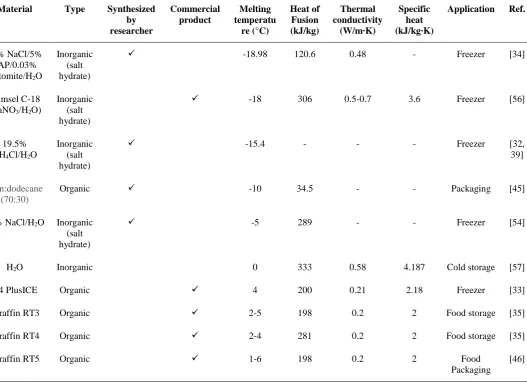
PCMs for reviewed researches in the low temperature range, as shown in Table 1. Several 9
studies on the phase changing process of salts hydrates were carried out. Cabeza et al. [49] 10
studied the thermal performance of sodium sulphite trihydrates mixed with cellulose, bentonite 11
and starch, and reported an thickening improvement of the mixed PCM thickness. Farid et al. 12
found that PCM directly contacting with the heat transfer methodology could completely 13
eliminate the need for extra heat transfer surface. Taylor et al. [50] found that the sub-cooling 14
of calcium hexahydrate was increased with a decrease in cooling rate and nucleation rate 15
similarly. Various salt hydrates have differing levels of toxicity which are generally non-toxic 16
in nature but can cause skin or eye irritation and respiratory problems [51]. 17
The phase change temperature of PCM used in this temperature range must fall in the operation 18
temperature range of refrigeration systems [21]. PCMs with higher phase change temperatures 19
can increase the COP of the refrigeration systems due to lower power consumptions during 20
phase change period but with poor quality of freezing food storage. On the contrary, PCMs 21
with lower phase change temperatures can maintain the relatively low temperature inside the 22
cabinet, while the fresh food storage quality is significantly affected in terms of taste and 23
flavour [38]. Therefore, a suitable PCM should have a phase change temperature that meets 24
both temperature requirements when integrated into refrigeration systems. Moreover, the 25
13
efficiency of refrigeration system [25, 52]. A supercooling temperature from 5°C to 10°C 1
completely prevents the proper heat extraction of the energy stored [53]. It is also demonstrated 2
that a refrigeration system with eutectic PCM achieves better COP than water, due to a low 3
melting temperature (-5°C) [54] and approximately 40% increase in the amount of PCM can 4
lead to almost 6% increase in the COP of the system [55]. An increase in the PCM thickness 5
can reduce the on-off time ratio and result in longer compressor-off time[38]. However, due to 6
high costs of materials and energy consumptions during the phase change period, PCM 7
thickness should be determined based on the specific load [21]. The main limitations for PCM 8
integrated into refrigeration systems are the material of the PCM container, the number of 9
cycles without any degradation, cycling stability and corrosion [20]. 10
[image:13.595.42.570.350.732.2]11
Table 1. Thermo-physical properties of key PCMs used for the applications within the low temperature range
(-12
20°C to 5°C)
13
Material Type Synthesized by researcher
Commercial product
Melting temperatu
re (°C)
Heat of Fusion (kJ/kg)
Thermal conductivity
(W/m∙K)
Specific heat (kJ/kg∙K)
Application Ref.
18% NaCl/5% SAP/0.03% diatomite/H2O
Inorganic (salt hydrate)
-18.98 120.6 0.48 - Freezer [34]
Climsel C-18 (NaNO3/H2O)
Inorganic (salt hydrate)
-18 306 0.5-0.7 3.6 Freezer [56]
19.5% NH4Cl/H2O
Inorganic (salt hydrate)
-15.4 - - - Freezer [32,
39]
Zein:dodecane (70:30)
Organic -10 34.5 - - Packaging [45]
90% NaCl/H2O Inorganic (salt hydrate)
-5 289 - - Freezer [54]
H2O Inorganic 0 333 0.58 4.187 Cold storage [57]
A4 PlusICE Organic 4 200 0.21 2.18 Freezer [33]
Paraffin RT3 Organic 2-5 198 0.2 2 Food storage [35]
Paraffin RT4 Organic 2-4 281 0.2 2 Food storage [35]
Paraffin RT5 Organic 1-6 198 0.2 2 Food
Packaging
[46]
14
PCMs used for Cold Thermal Energy Storage (CTES) in the low temperature range (-20 to 5ºC) 1
can help to reduce energy consumption of applications therefore providing financial savings 2
and reducing pollutant emissions (CO2, SO2, NOX and Chloro-Fluoro-Carbons (CFC) etc.)
3
when compared with traditional systems without PCM. Table 2 presents the primary features 4
of Cold Water Storage (CWS), Ice Thermal Storage (ITS) and PCM storage (eutectic salt 5
hydrates) investigated by previous research studies [57-59]. Compared to traditional CWS, the 6
space requirement of PCM storage is significantly reduced due to the higher thermal storage 7
capacity. However, the cost of PCM storage tank is relatively higher than CWS and ITS, and 8
this prevents its wide application. Cold thermal energy storage can potentially provide 9
significant contribution to energy savings, CO2 mitigation and economical savings mainly in
10
domestic and industrial sector in Europe [29], as shown in Table 3. 11
12
Table 2. Primary features of different type of CTES
13
CTES type Latent heat of fusion (kJ/kg)
Required tank volume
(m3/kW•h) COP [60]
Cost
Chiller
($/t)
Storage tank
($/t h)
CWS - 0.129 5.0 – 6.0 200 - 300 30-100
ITS 334 0.021 2.7 – 4.0 200 - 500 50-70
PCM 80-250 0.048 5.0 – 6.0 200 - 300 100-150
14
Table 3. Estimation of energy savings, environmental impacts and economic savings of CTES for different
15
sectors in Europe [29]
16
Sector
Energy Savings
(GWh per year)
CO2 mitigation
(1000 tCO2 per year)
Economical savings
(millions €per year)
Low-S High-S Low-S High-S Low-S High-S
Domestic sector 5941 25460 3434 14716 1082 4638
Commercial sector 1324 2283 765 1319 230 397
Cold in road transport 959 12788 293 3900 951 12675
Cold in industry 19182 95910 11087 55436 2167 10837
Total 27405 136440 15578 75371 4430 28547
*Low-S: Low scenario, lowest impact factors from case studies
17
*High-S: High scenario, highest impact factors from case studies
15
3.
Applications of PCMs in the medium-low temperature range from 5°C to
140°C
2This section reviews the applications of phase change materials in the medium-low temperature 3
range from 5°C to 40°C. PCMs have been integrated into free cooling, building passive heating 4
and cooling, and evaporative and radiative cooling systems to improve the indoor thermal 5
comfort and reduce energy consumption. Moreover, it has been used for solar absorption 6
chillers to improve the operation efficiency, and for air conditioning systems to shift the 7
daytime electricity load to night-time. Energy saving up to 42% could be achieved by 8
incorporating PCMs in latent thermal storage systems for heating and cooling applications in 9
this temperature range [61]. Cost saving on energy consumptions up to 50% could be achieved 10
for PCM-integrated systems in comparison to the traditional options and the fastest payback 11
period can be as short as about 6 years [62]. 12
13
3.1Free cooling 14
The working principle of a free cooling system with PCM is based on two operation modes as 15
shown in Fig. 12. One is direct cooling for indoor air, where the PCM is melted by absorbing 16
the heat from indoor air during day-time in order to reduce the room air temperature, when it 17
is above the comfort range. The other one is when the outdoor temperature is lower than indoor 18
temperature during night-time, the stored heat in the PCM is released to the warm the incoming 19
outdoor air. The effectiveness of a PCM-based free cooling application depends on the diurnal 20
temperature range (between 12°C and 15°C) [17], and the melting temperature of PCM 21
(between 19°C and 24°C) [63]. 22
16 1
Fig. 12. Two operation modes of a free cooling system with PCMs [64]
2 3
Weinläder et al. [65] experimentally investigated the performance of two types of cooling 4
ceiling with PCM (salt hydrate with a melting temperature ranging between 22 ºC and 24 ºC) 5
installed in two office rooms “R112” and “R113” in Germany, with an 45% area ratio of PCM 6
ceiling and floor. PCM in room R112 was installed on the top of the ceiling graphite layer and 7
PCM in room R113 was placed at the bottom of the ceiling graphite layer. It was found that 8
the measured passive cooling power could reach from 8 to 17W per PCM cooling ceiling area 9
for globe temperatures in the range of 24 ºC to 27 ºC, significantly lower than that of the active 10
cooling ceilings (80-100W/m2 at 26 ºC). Even with this low passive cooling power and high 11
internal heat gains of almost 50W/m2, it still took about 7-9 h for the highly insulated test rooms
12
to reach globe temperature of 27 ºC as a result of PCM integrated into cooling ceiling systems. 13
Sun et al. [66] evaluated the cooling energy reduction of a free air cooling system based on 14
organic PCM (melting temperature from 18 to 20 ºC) integrated into Telecommunications Base 15
Stations (TBS) as shown in Fig. 13a. The established indoor air temperature was between 18 16
and 28 ºC. The annual Energy Saving Ratio (ESR) was predicted using synthesized hour by 17
hour temperature for five selected cities with different climates, where the ESR was defined as 18
the ratio of energy savings attained by using PCM storage unit when compared to energy 19
consumption of convectional air conditioners. It was found that the largest annual ESR 20
achieved was 67% and the average value across the five cities was close to 50% as illustrated 21
in Fig. 13b. 22
17 1
Fig. 13. a) Schematic diagram of the TBSs; b) Variation of ESR for five locations as a function of monthly
2
mean temperature. [66]
3 4
Alam et al. [67] numerically investigated the free and passive cooling effectiveness of PCM 5
used in a residential building in Melbourne, where a salt hydrate with a melting temperature of 6
22 ºC was selected as the PCM. In the free cooling application, a PCM storage unit was utilised 7
to cool the outdoor air and in the passive applications, PCM was installed in the ceilings of the 8
building in this research. Based on the simulation under a typical summer weather condition of 9
Melbourne, it was found that the air temperature of the PCM based free cooling application 10
was reduced by up to 1.8 ºC and the air temperature of the PCM based passive cooling 11
application was reduced by up to 0.5 ºC. 12
13
3.2Passive heating and cooling by building elements 14
Phase change materials can be integrated into building envelopes i.e. walls, floors, roofs, 15
transparent elements and concretes as part of the building structure or as a building component, 16
to buffer the indoor temperature variation and enhance the thermal comfort. 17
PCM wallboard placed on the inner side of the building envelope is the most common 18
application of PCM in buildings, as a passive heating or cooling strategy. Wang et al. [68] 19
experimentally investigated the daily thermal behaviour of a microencapsulated Phase Change 20
Material (mPCM) incorporated into aluminium honeycomb board, using paraffin wax with a 21
melting temperature of 37ºC encapsulated by polymer shell as shown in Fig. 14a and Fig. 14b, 22
respectively. It was found that the mPCM wallboard could effectively release the stored heat 23
18
conditions of 24 h forced convection and 24 h natural convection, the effective thermal 1
protection periods were 4 h and 4.7 h, respectively, and the heat releasing periods were 2.8 h 2
and 3.8 h, respectively. Research investigations on shape-stabilized PCM with aluminium 3
honeycomb board were also conducted by Lai and Hokoi [69] and Xie et al. [70], reporting an 4
enhanced thermal conductivity of 2.08 W/m.K and stress tolerance limit promoted by 25.2%. 5
6
7
Fig. 14. a) aluminium honeycomb board; b) schematic diagram of the experimental setup [68]
8 9
Devaux and Farid [61] numerically investigated the performance of testing hut containing PCM 10
in its walls, ceiling and underfloor heating system. The interior wall was lined with PCM 11
Dupont Sheets with a melting temperature ranging between 27 and 29 ºC. It was found that 12
using PCM with lower melting temperature in walls was effective in building comfort 13
enhancement and a cost saving of 42% with a corresponding energy saving of 32% was 14
obtained. 15
Evola et al. [71] numerically investigated the effect of PCM wallboard on summer thermal 16
comfort in buildings. The installation of the PCM wallboards on the inner surface of the 17
partition walls could reduce the peak operative temperature by 1ºC. Furthermore, a significant 18
attenuation in the daily surface temperature swing of the partitions was observed, as shown in 19
Fig. 15, where the peak surface temperature of the east wall was decreased from 29.7 ºC to 28 20
ºC during the second day, and the daily temperature swing was reduced from 5.7 ºC to only 2.9 21
19 1
Fig.15. Effect of the PCM on the surface temperature for South and East wall [71]
2 3
Yao et al. [72] studied the performance of a novel SSPCM wallboard (a mixture of expanded 4
perlite and paraffin with a melting temperature range of 25-29 ºC) used in a typical office 5
building with an area of 4000 m2. It was found that an average temperature reduction of 9.22 6
ºC was achieved in the building operation time from 7:00 to 18:00 and all the incremental cost 7
can be recovered in 5.84 years. 8
Kong et al. [73] investigated the performance of a SSPCM wallboard for passive cooling in 9
building as shown in Fig. 16a. It was found that the peak temperature of the inside wall surface 10
was reduced by 7.03 ºC and the air temperature of room with PCM wallboard was reduced by 11
2.35 ºC on average as shown in Fig. 16b. 12
13
Fig. 16. a) Samples of prepared composite phase change material wallboard; b) Indoor temperature variation in
14
closed building experiment [73]
20
Lee et al. [74] investigated the thermal performance of PCM-enhanced walls on houses with a 1
typical residential frame wall construction, where PCM with a melting temperature of 28 ºC 2
was mixed with cellulose insulation and incorporated in the walls. It was found that the peak 3
heat flux was time delayed by 1.5 h on average and the daily average peak heat flux reduction 4
for the individual walls was 25.4%. 5
Biswas et al. [75] numerically investigated the energy saving potential of a prototype PCM 6
wallboard, consisting of a nano-PCM (n-heptadecane C17H36 with a melting temperature of
7
21.1 ºC) supported by expanded graphite nano-sheets for enhancements of thermal storage and 8
energy distribution. A 2D wall section model was created with gypsum wallboards and nano-9
PCM gypsum wallboards for an annual simulation with three room temperature set points of 10
19-21ºC, 20-22 ºC and 20-23.3 ºC, as shown in Fig. 17a. It was found that the annual heat gain 11
of the wall equipped with nano-PCM wallboards was reduced up to 24.65% in the room 12
temperature set points within 20-22 ºC, and the best energy saving effect (21.12%) was 13
achieved within 19-21 ºC. Moreover, the summer peak heat gains at 19-21 ºC set points were 14
reduced by using nano-PCM wallboards, as shown in Fig. 17b. 15
16
17
Fig. 17. a) Cross section of the numerical model of Nano-PCM gypsum (top) and commercial PCM in Gypsum
18
(bottom) wallboards; b) Calculated heat gains through the South wall during summer days with cooling set
19
points of 19-21 [75]
20 21
PCMs incorporated into floors and roofs, can also be suitable solutions for room thermal energy 22
storage. Xu et al [76] investigated the thermal performance of a PCM floor system in a passive 23
[image:20.595.69.524.420.625.2]21
which was verified by experimental results. By using the model, it was found that the suitable 1
melting temperature of PCM was roughly equal to the average indoor air temperature of sunny 2
winter days. Additionally, it was concluded that the thickness of PCM should not be larger than 3
20mm, and the heat of fusion and thermal conductivity of PCM should be greater than 120 4
kJ/kg and 0.5W/mK, respectively. Barzin et al. [77] investigated the application of PCM floor 5
heating in combination with PCM wallboards for energy saving as shown in Fig. 18, where a 6
paraffin based PCM was used with a melting temperature of 28 ºC. Experimental results 7
showed that the total energy saving and electrical cost saving over a period of 5 days were 18.8% 8
and 28.7%, respectively, and the highest energy saving was 35% with a corresponding cost 9
saving of 44.4% during the experimental period. 10
11
Fig. 18. The underfloor heating system used in the prototype. (a) Devi foil heaters, (b) underfloor heating system
12
layout [77]
13 14
The performance of a double layer of PCM incorporated into a roof was investigated by 15
Pasupathy and Velraj [78], using inorganic eutectic of hydrated salts with a melting 16
temperature from 26°C to 28°C. It was found that the PCM-roof could be efficient for all 17
seasons in Chennai, India, when the upper PCM layer had a melting temperature 6-7°C greater 18
than the ambient temperature in summer and the lower PCM layer with a melting temperature 19
close to the indoor temperature. Alawdhi and Alqallaf [79] studied the performance of a 20
concrete roof with cone frustum holes filled with PCM (melting temperature of 37 ºC) in a hot 21
climate. The results showed that the heat gain was significantly reduced with PCM 22
incorporated into the roof and the heat flux at the indoor space could be reduced by up to 39%. 23
Kośny et al. [80] developed a naturally ventilated roof/attic system with PV-PCM to reduce 24
22
granulate form organic PCM with a melting temperature of 32°C, the heating load and cooling 1
load (Fig. 19b) of the reference room were reduced by 30% and 55%, respectively. 2
3
4
Fig. 19. a) Construction details of the tested roof; b) Average weekly attic cooling loads measured during the
5
spring–summer–fall time period [80]
6 7
PCMs applied in transparent building elements can be effective solutions for reducing the 8
heating load in cold climates or reducing the cooling load by absorbing solar heat gain from 9
glazing in hot climates. Ismail et al. [81] numerically investigated the thermal performance of 10
two glass windows, one was filled with absorbing gases and the other with PCM exposed to 11
solar radiation in a hot climate, respectively. It was found that the window filled with an 12
absorbing gas had an F factor (the coefficient of total heat gain) in the range of 0.55-0.65, 13
indicating that the double glazing filled with absorbing gas had better performance than that of 14
double glass window filled with PCM (F factor in the range of 0.65-0.80). 15
Silva et al. [82] investigated the performance of a window shutter incorporated with PCM 16
(melting temperature of 28 ºC) during a summer period, compared to a traditional window 17
shutter without PCM. It was found that the maximum temperature peak in the PCM 18
compartment was reduced by up to 4 ºC and the minimum temperature was up to higher 3 ºC. 19
Gola et al. [83] investigated the performance of PCM incorporated into glazing in three 20
different seasons, using a simple glazing prototype with a commercial paraffin wax (melting 21
temperature of around 34°C). In contrast to a conventional double glazed unit, the thermal 22
comfort condition in the glazing prototype with PCM integration was significantly improved 23
23
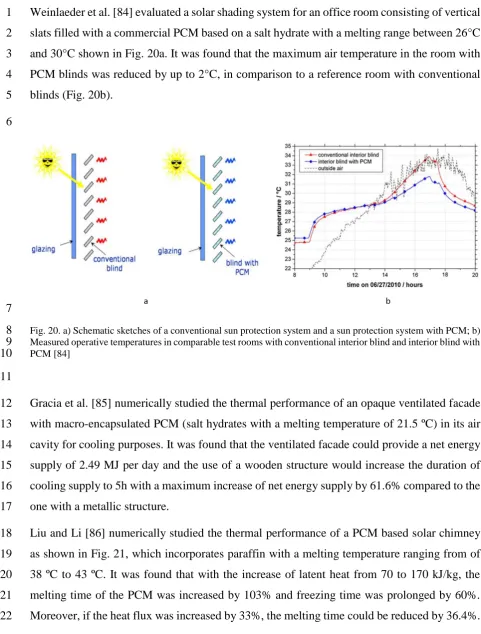
Weinlaeder et al. [84] evaluated a solar shading system for an office room consisting of vertical 1
slats filled with a commercial PCM based on a salt hydrate with a melting range between 26°C 2
and 30°C shown in Fig. 20a. It was found that the maximum air temperature in the room with 3
PCM blinds was reduced by up to 2°C, in comparison to a reference room with conventional 4
blinds (Fig. 20b). 5
6
7
Fig. 20. a) Schematic sketches of a conventional sun protection system and a sun protection system with PCM; b)
8
Measured operative temperatures in comparable test rooms with conventional interior blind and interior blind with
9
PCM [84]
10 11
Gracia et al. [85] numerically studied the thermal performance of an opaque ventilated facade 12
with macro-encapsulated PCM (salt hydrates with a melting temperature of 21.5 ºC) in its air 13
cavity for cooling purposes. It was found that the ventilated facade could provide a net energy 14
supply of 2.49 MJ per day and the use of a wooden structure would increase the duration of 15
cooling supply to 5h with a maximum increase of net energy supply by 61.6% compared to the 16
one with a metallic structure. 17
Liu and Li [86] numerically studied the thermal performance of a PCM based solar chimney 18
as shown in Fig. 21, which incorporates paraffin with a melting temperature ranging from of 19
38 ºC to 43 ºC. It was found that with the increase of latent heat from 70 to 170 kJ/kg, the 20
melting time of the PCM was increased by 103% and freezing time was prolonged by 60%. 21
[image:23.595.42.524.67.702.2]24 1
Fig. 21. Schematic diagram of the solar chimney combined with PCM: (a) closed mode; (b) open mode [86]
2 3
The benefit of incorporating PCMs into building construction materials or concrete is to 4
increase the heat storage leading to a lower indoor temperature in warm climates. Entrop et al. 5
[87] experimentally investigated the performance of a concrete floor with PCM (micro-6
encapsulated mixture of paraffin with a melting temperature of 23 °C) incorporated into two 7
rooms. It was found that after incorporating PCM into concrete floors, the temperature 8
difference in using light or heavy weight insulation was reduced from 2.8 - 4.2 ºC without PCM 9
compared to 0.1 – 1.5 ºC with PCM. Cabeza et al. [88] studied the thermal and energy saving 10
performance of an innovative concrete with microencapsulated PCM (melting point of 26°C). 11
It was found that a reduction in temperature fluctuation was achieved in the room with PCM-12
concrete floor as compared to a conventional concrete without PCM as shown in Fig. 22. 13
25 1
Fig. 22. Comparison between south wall temperature in both cubicles, outdoors ambient temperature, and heat
2
flux. [88]
3 4
3.3Solar absorption chillers 5
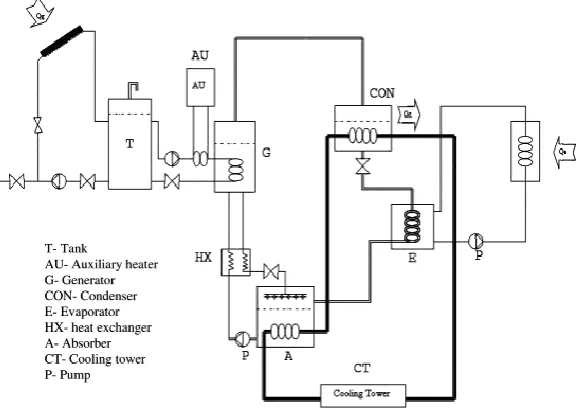
Wet cooling towers are normally applied in solar absorption cooling systems to provide the 6
heat rejection and fulfil the low returning temperature requirements, but simultaneously brings 7
space and maintenance limitations particularly for domestic applications as shown in Fig. 23. 8
PCM is presented as an alternative choice used in the thermal energy storage system to replace 9
the conventional wet cooling tower in the heat rejection loop of the chiller, for supplying a 10
stable re-cooling temperature during peak load period and storing latent thermal energy to be 11
discharged in the evening hours with lower space and maintenance limitations compared to a 12
traditional wet cooling tower [5]. 13
14
Fig. 23. Schematic diagram of a solar absorption system [89]
26
Helm et al. [90] investigated the performance of a solar driven absorption cooling system based 1
on a dry air cooler combined with PCM as shown in Fig. 24, using Calcium Chloride 2
Hexahydrate (CaCl2∙H2O) with a phase change temperature of 29°C. It was found that with
3
ambient temperature above 30°C, up to 50% of the daily reject heat load was absorbed by the 4
PCM and the latent heat storage could fully support the dry air cooler and ensure a 32°C 5
constant cooling water temperature to the chiller. In a similar research [91], it was predicted 6
that the daily Energy Efficiency Ratio of the solar cooling system was increased significantly 7
to 11.4 as compared with a traditional wet cooling tower and nearly 22% of the waste heat 8
produced by the absorption chiller could be dissipated to the ambient air at night. 9
Belmonte et al. [92] compared the performance of a conventional wet cooling tower and an 10
alternative PCM thermal storage coupled with a dry air cooler for an absorption solar cooling 11
system. Both the conventional and alternative configurations were simulated and compared 12
under 52 provinces’ climate conditions in Spain within 3 months. Greater system efficiency in 13
terms of cooling energy produced and chiller COP was achieved for the conventional 14
configuration at all locations. When the influence of the mean relative humidity and 15
temperature was included in the analysis, it was observed that the alternative configuration was 16
able to reach or surpass the energy performance of the conventional configuration but only in 17
few locations with a temperate and humid summer season. 18
19
20
Fig.24. Solar absorption chiller coupled with PCM: a) under cooling mode; b) under heating mode [90]
27 3.4Evaporative and radiative cooling systems 1
By using PCM as a storage media, a much higher working temperature can be achieved by the 2
heat transfer media in radiators, making it possible for summer cooling. 3
Zhang and Niu [93] developed and evaluated the performance of a novel hybrid cooling system 4
consisting of a microencapsulated PCM slurry storage tank and a nocturnal sky radiator as 5
shown in Fig. 25a and Fig. 25b. The numerical analysis was carried out based on an hour by 6
hour calculations in five typical cities with different climates in China. The micro-encapsulated 7
PCM slurry was based on hexadecane (C16H34) with a phase change temperature of 18°C. It
8
was found that for Chinese climates, the energy saving potential in Lanzhou and Urumqi were 9
up to 77% and 62% for low rise buildings, respectively. 10
11
Fig. 25. a) schematic diagram of the hybrid system; b) Construction of the nocturnal sky radiator [93]
12 13
Ansuini et al. [94] developed a lightweight piped radiant floor prototype with PCM (paraffin 14
based in granulate form) aimed to buffer internal gains at a constant temperature during 15
summer seasons without affecting its warming capacity in winter seasons. The internal 16
structure of the radiant floor was optimized by inserting a special steel matrix. The numerical 17
simulation results showed that the usage of cooling water was reduced approximately by 25% 18
in summer seasons and the floor peak temperature was reduced by 3.5°C. Wang et al. [95] 19
investigated the performance of a hybrid cooling system, which is a combination of cooled 20
ceiling, microencapsulated PCM slurry storage (hexadecane as core PCM with a melting point 21
of 18.1°C) and evaporative cooling technologies under five different Chinese climatic 22
conditions as shown in Fig. 26. It was indicated an energy saving for North-Western and South-23
Eastern Chinese climate was up to 80% and 10%, respectively. 24
28 1
Fig. 26. Schematic diagram of the hybrid system [95]
2 3
3.5Air conditioning (AC) systems 4
Integrating PCM into an air-conditioning system as a cool storage, is an effective approach of 5
shifting daytime peak electrical loads to night-time with a low cooling load, on which daytime 6
cooling can be supported by the cooling medium storing cool energy at night, resulting in a 7
reduction of building cooling energy consumption and size of the air conditioning system. 8
Fang et al. [96] carried out an experimental investigation of the performance of an air 9
conditioning (AC) system incorporated with spherical capsules packed bed which used a 25% 10
ethylene glycol solution as PCM as shown in Fig. 27. They investigated the evaporation 11
pressure and the condensation pressure of the refrigeration system, the refrigeration capacity 12
and the coefficient of performance (COP) of the system, and other performance parameters. It 13
was found that the operation performance of the AC system with the spherical capsules packed 14
bed was improved during the charging and discharging period of PCM capsules, where the 15
outlet air temperature stabilized between 20.7 °C and 24.4 °C and the inlet air temperature was 16
29 1
Fig. 27. Schematic diagram of the experimental AC system with PCM capsules [96]
2 3
Cheng et al. [97] developed a packed bed cold storage installation with a composite PCM 4
(melting temperature of 12.6°C) for an air conditioning system as shown in Fig. 28, composed 5
of carpic and lauric acid eutectic mixtures with 6% mole fraction of oleic. It was found that the 6
inlet heat transfer fluid (HTF) temperature had more influence on the charging rate and 7
maximal charging capacity and less effect on the exergetic efficiency, while the average 8
charging rate, maximal charging capacity and exergetic efficiency declined by 73.9%, 44.7% 9
and 10.4% respectively, when the inlet HTF temperature was elevated from 7 °C to 12 °C. 10
Chaiyat [98] presented a concept of PCM bed placed in the return duct of an AC system for 11
improving its cooling efficiency by reducing the air temperature entering the evaporating coil. 12
A paraffin wax with a melting point of 22°C was selected as PCM and the thermal performance 13
of the system was evaluated under Thailand climate. It was found the electrical power of the 14
modified system could be saved around 9% or 3.94 kW h/d compared to the normal system by 15
39.36 kW h/d. 16
17
Fig. 28. Schematic of the experimental setup of [97]
[image:29.595.195.404.580.701.2]30
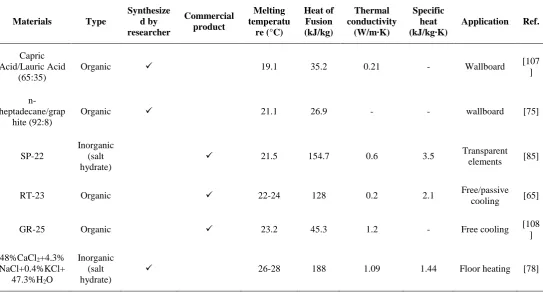
3.6Analysis of PCMs used in the medium-low temperature range 1
Based on the reviewed literature, typical PCMs such as paraffin, fatty acids and salt hydrate 2
compounds are typically used in the medium low temperature range as presented in Table 4. 3
Paraffin wax is the most typical commercial organic PCM. It is non-corrosive to most materials, 4
which doesn’t suffer from sub-cooling with over 1500 stable cycles [99, 100]. Commercial 5
paraffin waxes are found to be hazardous with long term exposure to their vapours due to the 6
benzene and toluene components [101]. Fatty acids are found to be corrosive [102], 7
inflammable and releasing undesirable odor [103]. 8
Although these PCMs have a high latent heat of fusion and good nucleation, paraffin waxes 9
and fatty acids are not suitable for direct use in practical application due to their low thermal 10
conductivity typically less than 0.2 W/m2/K [104], high volume variation and liquid seepage 11
during state changes [105], compared to inorganic materials. However, chemical instability is 12
the main limitation of salt hydrates for application, as they begin to degrade and lose water 13
content during every heating cycle. Chemically aggressive, low heat conductivity and relatively 14
high degree of super-cooling are both considerable issues when using salt hydrates as PCMs 15
[image:30.595.28.572.456.748.2][106]. 16
Table 4 Thermo-physical properties of key PCMs used for the applications within the medium-low temperature
17
range (5°C – 40°C)
18
Materials Type
Synthesize d by researcher
Commercial product
Melting temperatu
re (°C)
Heat of Fusion (kJ/kg)
Thermal conductivity
(W/m∙K)
Specific heat (kJ/kg∙K)
Application Ref.
Capric Acid/Lauric Acid
(65:35)
Organic 19.1 35.2 0.21 - Wallboard [107
]
n-heptadecane/grap
hite (92:8)
Organic 21.1 26.9 - - wallboard [75]
SP-22
Inorganic (salt hydrate)
21.5 154.7 0.6 3.5 Transparent
elements [85]
RT-23 Organic 22-24 128 0.2 2.1 Free/passive
cooling [65]
GR-25 Organic 23.2 45.3 1.2 - Free cooling [108
] 48%CaCl2+4.3%
NaCl+0.4%KCl+ 47.3%H2O
Inorganic (salt hydrate)
31
Delta®-Cool 28
Inorganic (salt hydrate)
26-30 188 - - Transparent
elements [84]
Paraffin 28 Organic 28 120 0.2 2 Wallboard [61]
PCMD-32SP Organic 32 140-160 - 1.6
Electronic device cooling
[109 ]
MPCM-37D Organic 37 166.5 0.13 3.21 Wallboard [68]
1
When comparing PCMs with the same latent heat storage, paraffin is better than fatty acid both 2
in volume and mass and glycerine has the largest heat storage capacity in same volume as 3
shown in Table 5. Compared to organic PCMs, salt hydrates are more attractive in thermal 4
energy storage due to high volumetric storage density (350 MJ/m3), relatively higher thermal 5
conductivity (0.5 W/m2/K) and moderate costs [110]. To overcome the disadvantages of PCMs 6
applied in this temperature range, encapsulation of PCM is widely used in practical applications 7
to enhance the heat transfer process and minimize the volume change and quality loss for better 8
performance, as reported by [93, 95-98, 111-113]. 9
[image:31.595.166.428.470.629.2]10
Table 5. Evaluation of the quantity of different types of PCM with the same heat storage capacity and volume
11
[114]
12
PCMs Fatty Acid Paraffin Glycerine
Latent heat storage (kJ) 200 200 200
Volume (dm3) 1.47 1.06 0.79
Mass (kg) 1.34 0.82 1.00
Latent heat storage (kJ) 136 189 253
Volume (dm3) 1.00 1.00 1.00
Mass (kg) 0.91 0.78 1.26
13
Life Cycle Assessment (LCA) is an effective approach for conducting environmental impact 14
analysis of any product or system’s total environmental performance during its life cycle, while 15
the energy and the materials consumed for the extraction of raw materials, transportation, 16
maintenance and disposal life-cycle stages are main indicative key factors for evaluation [115]. 17
32
It is a LCA weighting method that aggregated LCA results into clear and easily understanding 1
units as the Eco indicators [116]. It can convert the inventory emission data into intuitive 2
aggregated potential environmental impacts, where the environment impact is defined with 3
three types of damage: Human health, Ecosystem quality, and Resources. The Eco indicator 4
values are dimensionless figures, and higher value means greater environmental impact. 5
Several works on the LCA of PCMs in the medium to low temperature ranges were carried out. 6
De Gracia et al. [62] reported the use of PCM in ventilated facades with steel frames could 7
reduce the overall environmental impact by 7.5% with an environmental payback of 31 years, 8
considering a building lifetime of 50 years and a further study indicated that the environment 9
payback of the system with a wooden frame could be reduced to 6 years. Moreover, the addition 10
of PCMs did not produce a significant variation of the global impact results and the 11
manufacturing impact of salts hydrates was 75% lower than that of paraffin [117]. Table 6 12
presents the synoptic LCA studies on PCMs used in building applications. 13
[image:32.595.69.524.405.771.2]14
Table 6. Synoptic LCA on PCMs used in building applications
15
Research System
boundaries
Investigated constructions
Impact categories (Eco-indicator points)
Total Ecosystem
quality
Human
health Resources
De Gracia et
al. [117] M&O
REFbrick 220.77 2169.4 1459.93 3850.09
PU 138.08 1356.48 936.46 2431.11
PU+PCMparaffin 137.44 1347.93 950.41 2435.77
Castell et al.
[118] M&D
ALVbrick 141.14 1382.41 946.64 2470.01
ALVbrick+PCMsalt
hydrate 140.23 1369.32 941.82 2451.34
Menoufi et al.
[119] M&D
REFbrick 5.46 47.55 63.55 116.58
PU 6.02 55.17 80.01 141.22
PU+PCMparaffin 6.61 57.1 102 167.35
PU+PCMsalt hydrate 6.98 58.88 86.25 152.14
PU+PCMester 6.39 57.17 86.18 149.79
Rincón et al.
[120] M&D&O
REFbrick 117 8198 28 8343
PU 141 5028 26 5195
33
ALVbrick 130 5137 27 5294
ALVbrick+PCMsalt
hydrate 141 5072 27 5240
Abbreviations: ALVbrick – Alveolar brick; PU – Polyurethane; REFbrick – Reference conventional brick; M – Manufacture; O
1
– Operation; D – Disposal
2 3
Cost savings by using PCM were investigated and reported by many researchers. Cunha et al. 4
[121] reported that the heating and cooling energy consumption of mortars with PCM and 5
different blinders used in buildings was approximately 0.3 €/m3 during spring, and 0.7 €/m3 6
for autumn season. Moreover, the energy consumption showed a decrease of 11% by 7
incorporating PCM into mortars used in buildings during summer seasons. Saffari et al. [122] 8
reported short payback periods for residential buildings and official building with less than 3 9
years and 6 years to recover the investment of PCM storage, based on the numerical analysis 10
of incorporating PCM into buildings equipped with HVAC system. Mi et al. [123] numerically 11
investigated the Static Payback Period (SPP) and Dynamic Payback Period (DPP) with a 12
discount ratio (r) considering the time value of money for PCM applied in five cities in China. 13
It was found that PCMs applied in cities with cold winter (Shenyang, Zhengzhou, and 14
Changsha) were sufficient to recover the investment within 9 years, as shown in Table 7. 15
[image:33.595.110.483.499.638.2]16
Table 7. Economic analysis for PCM integrated into building in China [123]
17
Payback period (year)
Locations
Shenyang Zhengzhou Changsha Kunming Hong Kong
SPP (r=0) 5.91 5.99 7.07 19.91 30.09
DPP (r=5%) 7.18 7.29 8.94 NA NA
DPP (r=7%) 7.88 8.01 10.08 NA NA
DPP (r=9%) 8.82 8.98 11.74 NA NA
NA: payback period exceeds the lifespan of target building (35 years)
34
4.
Applications of PCMs in the medium temperature range from 40°C to
180°C
2This section reviews the applications of phase change materials in the medium range 3
temperature from 40°C to 80°C, where PCMs are used in solar air heaters, solar stills, and solar 4
domestic hot water systems for heating purpose and in electronic devices for cooling and 5
operational performance improvements. PCMs integrated into such solar based systems could 6
improve the operation efficiency by up to 26%, while electronic devices with a PCM heat sink 7
could extend the lifetime by up to 300% [124, 125]. The total lifespan cost of the PCM 8
applications could be reduced by using PCMs with higher melting temperatures in this 9
temperature range. 10
11
4.1 Solar air heaters 12
PCMs used in solar air heaters have the ability to store the excess thermal energy during the 13
daytime and recover it after sunset, effectively enhancing their thermal performances. 14
Kabeel et al. [126] experimentally investigated the performance of the flat and the v-corrugated 15
plate solar air heaters with built-in PCM (paraffin wax with a melting temperature of 54°C) as 16
shown in Fig. 29a. It was found that when the air mass flow rate was 0.062 kg/s with a PCM 17
storage unit, the outlet temperature of the v-corrugated plate solar air heater was higher than 18
the ambient temperature by 1.5-7.2°C in a period of 3.5 h after sunset, while the outlet 19
temperature of the flat plate solar air heater was 1-5.5 °C higher than the ambient air in a period 20
of 2.5 h after sunset. Moreover, it was concluded that the daily efficiencies of the v-corrugated 21
and flat plate solar air heaters with PCM were both higher than the corresponding ones without 22
35 1
Fig. 29 a) Schematic diagram of the experimental setup; b) a comparison of instantaneous thermal efficiency
2
between v-corrugated and flat plate solar air heater with and without PCM when mass flow rate = 0.062 kg/s.
3
[126]
4
Khadraoui et al. [127] developed an indirect forced convective solar dryer consisting of a solar 5
air panel for direct heating of the drying agent, a solar air collector with PCM (melting 6
temperature range of 56-60°C) and a drying chamber. It was found that the temperature of the 7
drying chamber was higher than the ambient temperature by 4-16°C. Additionally, the relative 8
humidity in the drying chamber was 17-34.5% lower than the ambient relative humidity. A 9
similar indirect solar dryer using PCM (paraffin wax with a melting temperature of 49°C) was 10
experimentally investigated by Shalaby and Bek [128] and it was found that the temperature 11
of the drying air was higher than ambient temperature by 2.5-7.5°C in a period of 5 hours after 12
sunset. 13
14
4.2 Solar stills 15
Desalination of the saline seawater is an efficient technique for fulfilling the demand for fresh 16
water. Solar stills incorporated with PCMs, are effective systems for improving the yield of 17
fresh water especially in remote areas. 18
Faegh et al. [129] numerically studied the performance of a solar still equipped with an external 19
heat storage system using PCM (paraffin wax) and solar tubes shown in Fig. 30. During the 20
daytime period, the wasted latent heat from the generated water vapour was absorbed and 21
stored in PCM. During the night-time period, the heat stored in PCM was transferred to saline 22
[image:35.595.94.525.70.259.2]36
continue the desalination process after the sunset without a yield reduction during the daytime 1
and the daily yield was increased by 86% to reach to 6.555 kg/m2 per day. 2
[image:36.595.105.481.120.283.2]3
Fig. 30. Schematic diagram of the system processes of solar still with external condenser containing PCM and
4
heat pipes: a) charging process b) discharging process [129]
5 6
Arunkumar et al. [130] investigated a modified parabolic concentrator coupled to a single slope 7
solar still with paraffin wax (melting temperature of 58-60°C) loaded with copper balls for heat 8
transfer enhancement placed in the still basin shown in Fig. 31 and evaluated its improvement 9
on the overnight productivity. It was found that adding PCM in the basin of the solar still was 10
more cost effective than increasing the flow rate of cooling water over the top cover. Kabeel et 11
al. [131] experimentally investigated the performance of a cylindrical parabolic concentrator 12
with a focal pipe coupled with a solar still with PCM (paraffin wax with a melting temperature 13
of 56°C) to improve the freshwater productivity. It was found that the freshwater productivity 14
of the solar still with PCM was 140.4% higher than that of a conventional one without PCM 15
on average 16
![Fig. 11. Packaging for blood thermal protections [47]](https://thumb-us.123doks.com/thumbv2/123dok_us/8555469.364047/12.595.204.392.145.286/fig-packaging-blood-thermal-protections.webp)
![Fig.15. Effect of the PCM on the surface temperature for South and East wall [71]](https://thumb-us.123doks.com/thumbv2/123dok_us/8555469.364047/19.595.112.479.68.280/fig-effect-pcm-surface-temperature-south-east-wall.webp)

![Fig. 21. Schematic diagram of the solar chimney combined with PCM: (a) closed mode; (b) open mode [86]](https://thumb-us.123doks.com/thumbv2/123dok_us/8555469.364047/24.595.200.409.68.287/fig-schematic-diagram-solar-chimney-combined-pcm-closed.webp)
![Fig. 28. Schematic of the experimental setup of [97]](https://thumb-us.123doks.com/thumbv2/123dok_us/8555469.364047/29.595.147.450.74.238/fig-schematic-experimental-setup.webp)
![Table 5. Evaluation of the quantity of different types of PCM with the same heat storage capacity and volume [114]](https://thumb-us.123doks.com/thumbv2/123dok_us/8555469.364047/31.595.166.428.470.629/table-evaluation-quantity-different-types-storage-capacity-volume.webp)
