A Framework for the Adoption of Wireless Technology in Healthcare: An Indian Study
Angela Howard Abdul Hafeez-Baig
Srecko Howard Raj Gururajan
Department of Information Systems Faculty of Business University of Southern Queensland Toowoomba, Queensland, 4350, Australia
Corresponding Author Email: [email protected]
Abstract
The factors that are identified as drivers of adoption of wireless technology in the Indian healthcare sector are reported here. The study using both qualitative and quantitative techniques, in which 30 physicians were interviewed and 300 health professionals were surveyed (using a questionnaire) established that in addition to technology factors, other factors such as clinical factors, administration factors and communication factors play key roles in the technology adoption in healthcare. The study also reports new factors of adoption that are particularly relevant to Indian healthcare.
Keywords
Indian Healthcare, Healthcare Technology, Technology Adoption, Wireless Technology
INTRODUCTION
In the last few years, high expectations, technological developments, and effective and efficient services have shown to be a prerequisite for the improvement in the healthcare domain. Latest trends in the healthcare sector include the design of more flexible and efficient service provider frameworks. In order to accomplish this framework, wireless technology is increasingly being utilised in healthcare specifically for data management. Decrease in cost of the wireless devices and improved awareness of wireless applications in the healthcare sector are some of the contributing factors towards the increased use of wireless technology. For example, wireless technology is increasingly used in emergency departments due to the critical operational issues in an emergency department and the necessity to access data at point of care. Even though the future of wireless devices and usability is promising, adoption of these devices is still in infant stages due to the complex and critical nature of the healthcare environment.
The information technology users are often attracted by the latest and newest concepts. This is evident by the increasing sales of the Information and Communication Technology (ICT) products such as the handheld devices. Therefore, in this competitive and complex business environment, technology developments have played a critical role in delivering high quality of care. However, there is limited knowledge and empirical research concerning the effectiveness and adoption of wireless technology in the Indian healthcare systems. A review of literature conducted by this team revealed that only limited scholarly publications are available on the relationship of wireless technology adoption, strategy, implementation, and environmental issues in pertaining to the Indian healthcare industry.
LITERATURE REVIEW
In healthcare literature, the application of wireless technology is discussed by many studies (Dyer, 2003; Hu, Chau, & Liu Sheng, 2002; Sausser, 2003; Simpson, 2003; Wisnicki, 2002). For example, Wisnicki (2002) provides details of how broadband technology, a component of wireless technology, can be used in healthcare. While prior studies agree that wireless applications have the potential to address the endemic problems of healthcare, very limited information can be found about the determinants of such applications (Raj Gururajan, Clint Moloney, & Don Kerr, 2005; Gururajan, Toleman, & Soar, 2004). Furthermore, five major studies reported by (Spil & Schuring, 2006) in the area of healthcare to test the Technology Acceptance Model (TAM) reported that 'Perceived Usefulness' is an important attribute for the adoption of technology in the healthcare environment and 'Ease of Use' did not have any effect on the adoption of technology. This is different to many other reported studies in the generic IS domain where both attributes were reported to be reliable predictors. This variation requires further empirical investigation in order to explain the reason behind this variation specific to healthcare. Therefore, there is a need to identify attributes that assist in the adoption of wireless applications in healthcare environment.
There are various adoption theories that are well researched and tested. In IS, the main adoption theories are Roger’s Innovation Diffusion Theory (IDT), Technology Acceptance Model (TAM), Theory of Planned Behaviour, and Theory of Reasoned Action. These theories have been tested and validated in scenarios very different to healthcare settings. For instance, IDT consists of five attributes of technology diffusion namely relative advantage, ease of use, result demonstrability, trialability and compatibility. TAM, a partial derivative of IDT was tested with students as surrogates in a generic software application domain. This environment is very different to the healthcare environment, where the professional skills are at different levels. Further, the healthcare environment is complex and time critical. These could be some of the reasons why TAM did not perform as expected in healthcare settings. As indicated earlier, 'Ease of Use' attribute of TAM has limited bearing on the adoption process in healthcare. This, when coupled with the fact that healthcare professionals are used to new technologies and practices, the levels of training and education, as well as exposure to technological developments, imply that there could be other factors beyond those studied so far that require identification. Furthermore, in a clinical setting, perhaps medical technologies may assume paramount importance and information communication technologies may be used as value added technologies.
Therefore, there appears to be a basis to identify factors that contribute to the adoption of technologies in healthcare settings. Given that wireless technologies have started making in-roads in healthcare, the overarching purpose of the research is to identify the factors that influence the adoption of wireless technology in Indian healthcare systems. The rationale of the purpose is justified by the fact that India is a leader in software technologies, especially medical applications. Further, India is emerging as ‘Health Tourism’ due to the advancement in medical technology and reduction in cost in offering high quality health services. However, our initial review of available literature indicated that this area is under-researched. Collectively, these aspects led to the following research question:
• What are the determinants for the adoption of wireless technology by physicians in the Indian healthcare systems?
The first stage of this study is focused on answering the research question qualitatively and the second stage on answering the research question quantitatively. Details are provided in the research methodology section below.
METHODOLOGY
1An examination of IS studies indicated that there is a necessity for a suitable research method, as most of the previous studies followed a quantitative approach, an instrument administered onto a domain with perhaps a lesser understanding of the domain issues. We felt that if technology issues were to be studied with respect to a specific domain, then user involvement with the technology issues forms a major part in establishing the adoption (or inhibiting) factors. This in turn necessitates the understanding of research philosophy, values of inquiry that would guide the study, and the choice of relevant research techniques required to conduct the investigation in order to answer the research questions.
Further, there appears to be limited information available in the Indian IS domain to guide the principles of this study as this study is relatively new and hence requires a rigorous justification as to the choice of research methods employed. Further, in many traditional studies in IS either quantitative or to some lesser extent qualitative methods are used but not both (see (Mingers, 2001) study for a detailed argument on this). However, this study investigated the suitability of both the approaches in order to answer the research questions.
This study recognizes that the foundation for any research will be grounded by the researcher’s fundamental philosophical view of the world (Myers, 1997). The choice of tools including research techniques, instruments, and methods such as qualitative and quantitative are not inherently linked to a particular philosophical position, as these positions are generic in nature. It is the contextual framework within which they are applied to in order to provide consistency to an inquiry. Our review of literature indicated that technology acceptance studies were predominantly looking at the technology and have ignored the context in which the technology was used.
The philosophical view of the world is evident to the individual researcher in the form of the knowledge he or she possesses. In health settings, many aspects of care are not documented and can only be extracted by talking to people in that domain. A simple example is the handover report where nursing staff brief another nurse in detail about a patients’ condition.
While the choice of tools and methods are not linked to the philosophical view, the articulation, which is commonly the process of explaining choices of research methods and its related choice of research instruments help to determine the philosophical disposition. This is usually achieved by asking questions on the beliefs, perceptions, experiences, advantages and disadvantages in order to determine this disposition. This may even include researcher’s personal experience within that domain or his or her expertise in explicating the information using any approach that may be suitable to that domain. This has prompted us to follow a qualitative approach as the first phase of the study. This approach facilitated direction to the main phase of the study.
The research question dictates the need to have quantitative research methods, while the behavioural component of the same investigation dictates qualitative research methods. The rational for this approach is based on the notion that behavioural components require a thorough understanding of how users apply wireless technology in a given setting in order to understand the behavioural issues. This is best extracted or accomplished by a qualitative approach, as we need to extract a number of ‘tacit’ aspects. A quantitative instrument then can be developed to extract the quantitative aspects such as the opinion scores.
Health professionals view the term ‘Wireless Technology’ in different ways. Wireless technology can be viewed as a product or a process. For example, the use of wireless devices is product oriented and the steps involved in their usage are process oriented. The combined domain of wireless technology and healthcare is relatively new in the Indian health care environment. While IS studies have discussed the impact of ICT tools on healthcare users, and associated behavioural intentions, limited information can be found as to how the combination of wireless technology and healthcare setting would influence users who are already conversant with medical technologies. The workplace or organizational factors that influence such combinations are yet to be explored in detail. Such an exploration has close association with the choice of research method as these methods pave the way for proper inquiry into the factors that determine these transfers. Considering the above, the suitability of one research method over the other had to be carefully weighed. Based on these, this study identified exploratory approach to be suitable as an initial investigation. This approach is particularly favourable in confirming the direction of the study, variables chosen for the study and help to refine the literature. The exploratory study could possibly eliminate some variables and could provide an opportunity to include other variables that are yet to emerge. Thus the principles of each method were applied to this study. Initially an exploratory phase was conducted using a qualitative approach to establish the direction for the study. This was then followed up with a main study using quantitative approach.
Qualitative Data Collection
As argued, for the first stage of this research a qualitative approach was used to collect initial sets of themes for the adoption of wireless technology by the physicians in the Indian healthcare systems. For this purpose, the first stage of the data collection concentrated on randomly identifying 30 physicians in Indian hospitals with some form of wireless technology already in use. The physicians were also selected based on their wireless technology awareness or working experience. They were drawn from both private and government hospitals. These physicians were interviewed by an independent member (external to the team) to identify the attributes for the adoption of wireless technology by physicians in the Indian healthcare systems. This approach was deliberately taken to avoid the criticism that there may be 'bias' in the interview process. Further, due to linguistic issues, we required a person with proficiency in Indian language as well as English. The interview questions were derived from existing literature and other studies conducted in Australia and Taiwan by one of the researchers of the team. The questions covered aspects such their the participants’ experience in using wireless technology, their perceived opinions on various benefits and problems, opinions on how this technology would fit-in their workplace functional requirements, and whether the technology would yield significant benefits.
Quantitative Data Collection
This study developed a survey instrument from the interview data. The main reason for this digressed attitude was that previously tested instruments were found to be inadequate in healthcare settings for India. The data from the interviews were used to develop a specific range of questions to gather more detailed view from the wider population. This survey instrument was pilot tested to capture the information reflecting the perceptions and practice of those adopting the wireless technology in the Indian healthcare system, particularly focussed on what internal and external environmental factors shape the adoption of wireless and the extent of influence.
This survey was then distributed to over 300 physicians (from the Southern Region) randomly chosen from the telephone book. A cover letter explained the objectives and goals of the research. In order to improve the response rate a telephone reminder occurred two weeks after the initial date of survey distribution. A total of 200 surveys were received. The survey responses were then transcribed into a spreadsheet file. A Visual Basic interface was written to generate numerical codes for various elements of the survey for data analysis using SPSS. The coded spreadsheet file was then copied into a SPSS file format.
DATA ANALYSIS
Qualitative data was analysed using the NVivo software to identify the initial themes from the interviews. Quantitative data was analysed through the SPSS software to identify the factors and their correlation for the adoption of wireless technology in the Indian healthcare systems.
Qualitative Data Analysis
The qualitative data was analysed using NVivo version 7. The data was manually coded to extract themes that had an impact on the wireless technology as stated by the physicians. In total, 63 themes were extracted from the interviews. These themes were then stored in 'free nodes' of NVivo, indicating that themes where in no particular order. Once this was accomplished, the data files were re-visited again to attach relevant text information to the themes.
The initial theme includes awareness, cost factors, advantages and disadvantages, medical errors, information sharing, current state of technology, usefulness and the role of wireless technology. On the basis of the interviews and the literature review, the themes were classified into drivers and inhibitors as shown in the Table 1 below. It is anticipated that these themes will assist in planning the adoption of wireless technology and identifying the issues to be resolved for the effective implementation of wireless technology into the Indian healthcare system. The themes may change after further investigation and analysis of the survey of a wider community.
Drivers
• Better awareness of wireless technology
• Reduction of medical errors using wireless technology
• Wireless technology can aid better information access
• Wireless technology is not matured • Usefulness of wireless technology • User-friendly features of wireless
technology to healthcare staff • Video conferencing facilitated by
wireless technology
• What are the purposes of using wireless technology
Inhibitors
• Cost as an impending factor do adopt wireless technology
• Disadvantages and limitations of using wireless technology
• What are the purposes of using wireless technology
[image:4.595.122.486.476.658.2]• Wireless technology is improved but not enough
Table 1: Themes of the drivers and inhibitors of wireless technology adoption in Indian healthcare from interview and literature review
contexts because of the influence of clinical knowledge required in conjunction with ICT. Wireless technology is not an exception.
A cursory glance at the above themes indicates that there are factors that enable as well as impede wireless technology adoption. For example, the factor 'disadvantages of using wireless technology' highlighted the problems of abuse in using technology, cost implications to a third world country, maintenance of wireless infrastructure, etc., as main barriers to using this technology.
Further analysis of the qualitative data and the literature review helped us to identify the drivers and inhibitors for the adoption of wireless technology in the Indian healthcare systems. This list of drivers and inhibitors was expected to provide a direction for the development of the survey instrument for the collection of quantitative data to capture the wider community views and to generalize the outcome of the research. This grouping is presented in the table 2.
Drivers
• Savings in time • Improved clinical flow • Efficiency in communication • Delivery of high quality
information
• Better quality of service • Saving effort
• Improved clinical performance • More contact time with patients • Improved delivery of information • Reduced overall cost
• Positive impact on patient safety • Reduced inaccuracies
• Improved public image • Reduced medical errors • Easy access to data • Attract more practitioners • Reduced workload
Inhibitors
• Legal barriers
• Administrative constraints • Communication with physicians • Patient education
• Communication with colleagues • Problems in obtaining lab results • Complications in note taking due
to difficult to read & write screens
• Electronic medical records • Device usage barrier • Benefit evaluation barrier • Resource barrier
[image:5.595.120.487.215.467.2]• Electronic prescribing
Table 2: The factors driving and inhibiting wireless technology adoption in healthcare
The contents of the table agree with previous studies conducted by Gururajan et al. (2004, 2005). While the mentioned studies are conducted for the Australian healthcare, we were able to find similar themes emerging from the Indian healthcare. This prompted us to conduct a quantitative study in order to establish generalisability.
Quantitative Data Analysis
As mentioned earlier, the data were initially coded into a spreadsheet file. Using a file comparator method, the data was reviewed and any transcription errors found were rectified. Once the data was made error free, an SPSS variable view was generated for quantitative analysis. The spreadsheet data was then copied into the SPSS file and initial normality tests were run to ensure that the data was normal.
In order to ensure statistical reliability, SPSS reliability tests were run on the total instrument as well as selected group of variables. For example, the reliability test returned Cronbach alpha value of 0.965 for the instrument indicating high reliability. The test was run because the instrument was generated from the interview data and was not adopted from literature. In addition to this, the reliability tests were also run for three factor groupings namely drivers of adoption, inhibitors of adoption, and other technology factors and the scores for these were found to be satisfactory.
Items Drivers Inhibitors
improve-clinical-workflow .798
tech-support .764
delivery-of-high-qual-info .760
save-time .757
better-quality-of-service .749
save-effort .743
improved-delivery-of-information .732
efficiency-in-communication .730
more-contact-time-with-patients .725
improve-clinical-performance .702
more-training .699
improve-public-image .695
easy-access-to-data .692
positive-impact-on-patient-safety .679
reduce-inaccuracies .659
reduce-workload .657
reduce-medical-errors .650
reduce-overall-cost .634
attract-more-practitioners .600
org-culture .464
poor technology barrier .605
time for training barrier .572
tech expertise barrier .554
benefit evaluation barrier .503
legal barriers .465
solutions barrier .444
system migration barrier .442
technical support barrier .436
lack of support barrier .352
device access barrier .316
device comfort barrier .248
funding barrier -.225
security as barrier .224
[image:6.595.85.510.84.481.2]device usage barrier .208
Table 3: The factors driving and inhibiting wireless technology adoption in healthcare from data analysis of survey result
The drivers were then tested for factor analysis. The analysis resulted in the following table 4:
Items Organizational Management Clinical
save-effort .716
reduce-overall-cost .708
reduce-inaccuracies .703
save-time .667
easy-access-to-data .659
attract-more-practitioners .769
improve-public-image .680
tech-support .680
reduce-workload .817
improve-clinical-performance
.797
[image:6.595.79.516.541.685.2]The next factor model was generated for the inhibitors. The model resulted in the following table 5:
Items Technology Resource Usage
poor technology barrier .625
time for training barrier .582
solutions barrier .575
benefit evaluation barrier .528
tech expertise barrier .527
system migration barrier .511
funding barrier -.749
resource barrier -.690
technical support barrier .542
device usage barrier .519
Table 5: The factors inhibiting wireless technology adoption in healthcare from data analysis of survey result Similar to the drivers, the inhibitors also resulted in three specific components. The first component ‘Technology’ identified factors of technology that inhibit wireless adoption in the Indian healthcare. The second component ‘Resource’ indicates the resource barriers the healthcare is encountering currently. The third component ‘Usage’ implies the inhibiting factors in terms of usage issues.
In addition to the two factor groups (drivers and inhibitors), we were able to identify another group. We named this as ‘clinical influence. This is shown in table 6 below:
Items
General Communication
Clinical Communication
Records Management
Obtain lab results .837
Administrative purpose .770
Electronic prescribing .670
Medical database referral .632
Patient education .727
Communication with colleagues .707
Communication with patients .676
Drug administration .596
Communication with physicians .548
Electronic Medical Records .764
Generating exception list .738
Note taking .617
Disease state management .563
Table 6: The factors ‘clinical influences’ of wireless technology adoption in healthcare from data analysis of survey result
This factor group yielded three components. The first component deals with the general communication aspects facilitated by the wireless technology in healthcare settings. The second component refers to clinical communication using wireless technology. The third component is specific to records management.
In summary the data analysis yielded three specific factors of adoption – drivers, inhibitors and clinical influences.
DISCUSSION
reducing the medication errors (Turisco, 2000), generating affordable applications that allow for greater mobility (Athey & Stern, 2002). In addition to these, wireless applications would also provide benefits to healthcare due to its flexibility and mobility in providing for better data management (Wisnicki, 2002), including complex patient data requirements (Davis, 2002), proper integration of data to existing systems (Craig & Julta, 2001), and improved access to data from anywhere at any time (Stuart & Bawany, 2001). This set of factors are grouped as drivers of adoption.
[image:8.595.69.507.215.469.2]While the studies stated here have indicated the benefits, perhaps, this is the first time that an empirical data were provided to justify claims made in prior studies. Some factors such as the ‘positive impact on patient safety’ highlight the perceived notion that digital health technologies would improve safety (and accuracy). Australian healthcare reports from 2004 onwards have cited this as a major reason for healthcare cost increase. This study conforms with this opinion in India.
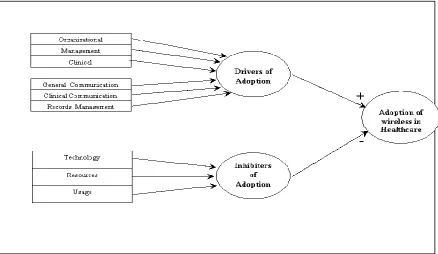
Figure 1: The initial framework for the adoption of wireless handheld devices in the healthcare
In terms of inhibiting factors (or barriers), this study found that technology is a barrier for wireless uptake in healthcare. This is evident by the factors such as the unreliability of current technology, system migration and solutions. The implication of this includes the lack of time available for training in order to use the new technologies. Studies in the information systems field argue that due to maturity of technology and familiarity of usage, training is not significant factor in technology adoption. However, in a complex healthcare setting, it appears that users are demanding training on how to use a new system. The second set of barriers include resources. Funding and availability of resources are cited as two major factors, negatively impacting the technology adoption. Media in Australia have already highlighted this aspect and India appears not to be different. The third set of factors impeding the adoption of technology includes device usage and security aspects. In a clinical domain, users demand that the device is usable. In this environment there is no provision for error. Similarly the security issues appear to include privacy of data and the provision available within the wireless system to cater to these privacy issues. It appears that the solutions emerging from vendors have yet to address this aspect. Due to this, the uptake appears to be slow. In addition, while the technology aspect is well developed, the inclusion of clinical issues within the technology is an under researched area. This has perhaps limited the use of wireless devices less in clinical/healthcare settings. Gururajan et al. (2005) have already highlighted these issues in a discussion paper and this study supports this empirically.
medical records and generating exception lists, when read in conjunction with information access, indicate the significant gains healthcare professionals can realise using wireless technology. While previous studies have indicated these, this is perhaps the first time that these are confirmed with empirical evidence. In summary, this study is able to identify three broad set of factor that can impact the adoption of wireless technoloy for the Indian healthcare. These are grouped in the following diagram in Figure 1.
FUTURE RESEARCH
This initial study established that in addition to the traditional factors identified in terms of technology adoption, new factors contribute to the adoption of technology in healthcare settings. For example, clinical factors appear to play a role in the adoption. While this can be expected due to the clinical focus of healthcare, what has emerged is the set of clinical factors that contribute to the technology adoption in healthcare. The next stage of the study involves hypothesising these aspects in order to generate an empirical model. The team is currently developing a research model to address this and it is expected that the data collection will begin by November 2007 in India.
REFERENCES
Dyer, O. (2003). Patient will be reminded of appointments by text messages. British Medical Journal, 326, 281. Gururajan, R., Kerr, D., Moloney, C., & Houghton, L. (2005). An investigation into the factors of adoption of
wireless applications for data management by nurses. Paper presented at the Asic-Pacific Decision Sciences Institute, Tiwan.
Gururajan, R., Moloney, C., & Kerr, D. (2005). Drivers for wireless handheld technology: views from Queensland nurses. Paper presented at the Australian Business & Behavioural Sciences Association (ABBSA) Conference, Cairns, Australia.
Gururajan, R., Toleman, M., & Soar, J. (2004, 25-27 July). Necessity for a new technology acceptance model to predict adoption of wireless technology in healthcare. Paper presented at the Let's Make a Difference with Health ICT, HIC Conference.
Hu, P. J., Chau, P. Y. K., & Liu Sheng, O. R. (2002). Adoption of telemedicine technology by health care organisations: An exploratory study. Journal of organisational computing and electronic commerce, 12(3), 197-222.
Mingers, J. (2001). Combining IS research methods: Towards a pluralist methodology. Information Systems Research, 12(3), 240-259.
Myers, M. D. (1997). Qualitative research in Information Systems. MIS Quarterly, 21(2), 241-242.
Sausser, G. D. (2003). Thin is in: Web-based systems enhance security, clinical quality,". Healthcare Financial Management, 57, 86-88.
Simpson, L. R. (2003). The patient point of view - IT matters. Nurse Admin Q, Lippincott Williams & Wilkins Inc, 27, 254-256.
Spil, T. A. M., & Schuring, R. W. (2006). E-Health system Diffusion and Use. Hershey: IDea Group Publishing. Wisnicki, J. H. (2002). Wireless networking transforms healthcare: physician's practices better able to handle
workflow, increase productivity (The human connection). Ophthalmology Times, 27, 38-41.
COPYRIGHT