SDR 164/2011 14 September 2011
Pupils Educated Other than at School, 2010/11 (Experimental Statistics)
This annual Statistical First Release reports on the number of pupils receiving education outside of school funded by Welsh local authorities and the number of pupils receiving home tuition in Wales. The information relates to the number of pupils receiving these forms of education during a census week in January for the academic years 2009/10 and 2010/11. During the 2010/11 academic year the census week was 17th to 21st January 2011.
Data relating to the 2009/10 academic year excludes 2 local authorities who were unable to supply the relevant information. All 22 local authorities provided data for the 2010/11 academic year.
Key results
Chart 1: Pupils educated other than at school, by enrolment status at maintained or
special schools, 2010/11
1,589 214 829
0 500 1,000 1,500 2,000 2,500 3,000
2011
N
u
m
ber
of
pupi
ls
Not on Roll
Subsidiary
Main or Current
Pupils educated other than at school (not including home tuition)
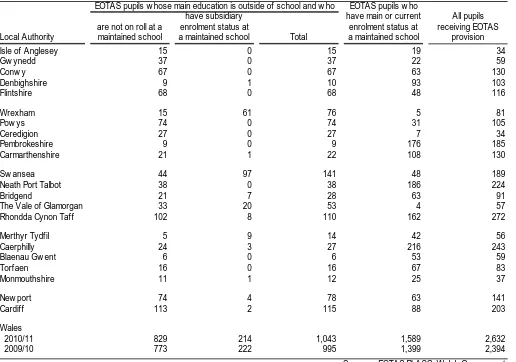
• 2,632 pupils were recorded as being educated other than at school, with 1,043 of these receiving their main education outside of school (Table 1);
• Almost three quarters of pupils whose main education is outside of school were boys (Table 2);
• 85 per cent of EOTAS pupils receiving their main education outside of school were recorded as having special educational needs (Table 3);
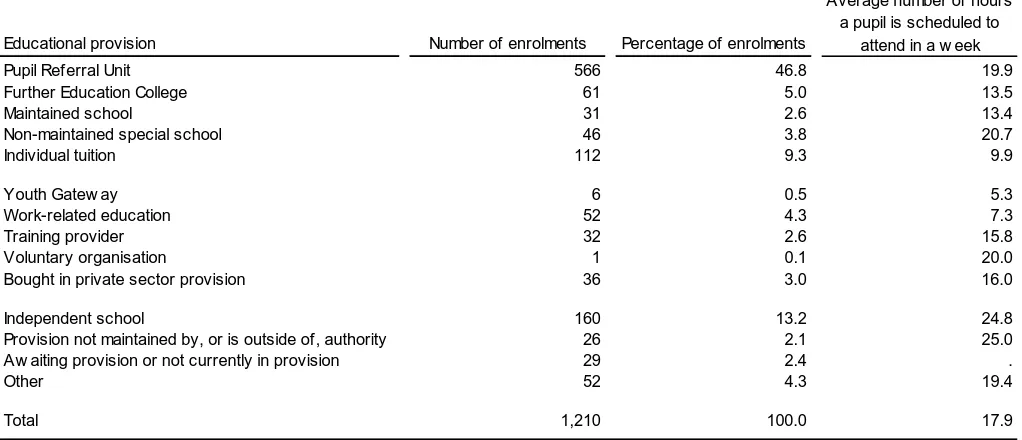
• The most frequently-used form of educational provision for EOTAS pupils whose main education is outside of school was being taught at a Pupil Referral Unit, accounting for almost half of all enrolments (Table 4);
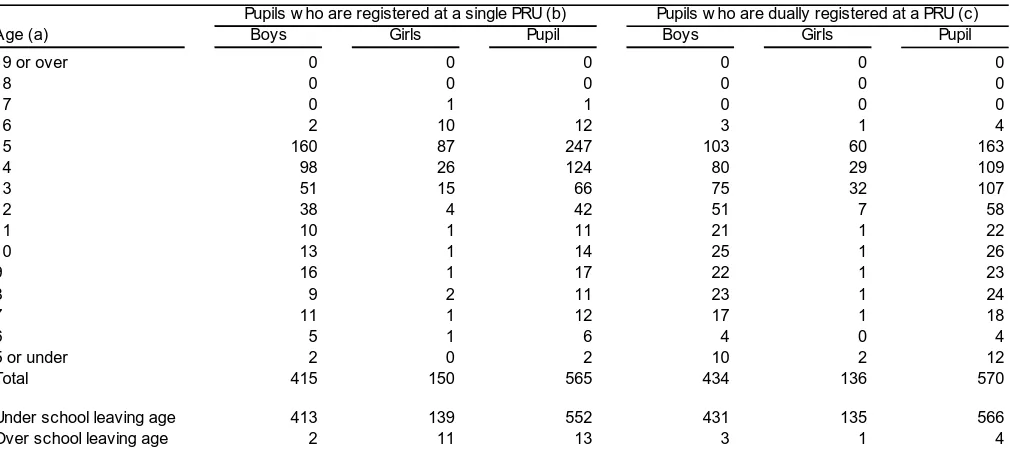
• 565 pupils were singly registered at a Pupil Referral Unit (Table 5).
Pupils educated at home
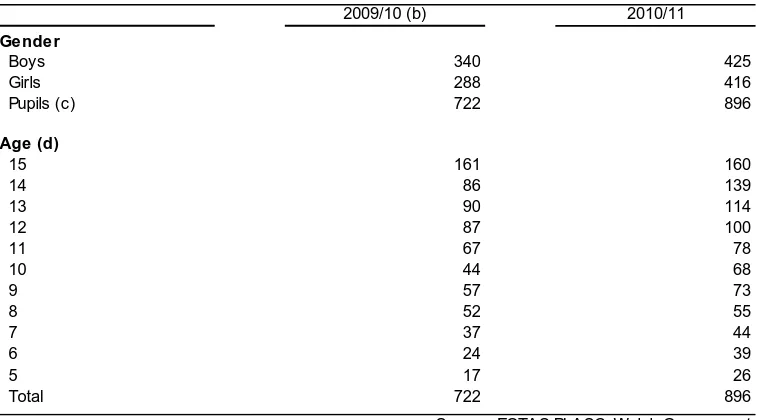
• 896 pupils of compulsory school age were reported to be educated at home during 2010/11 (Table 7);
• Of the pupils being educated at home, just under one fifth were 15-year-olds; there were more pupils in this age group than any other age group (Table 7).
Contents
page Chart 1 Pupils educated other than at school, by enrolment status at maintained or special
schools, 2010/11 1
Table 1 Number of pupils educated other than at school, by local authority, 2010/11 3
Table 2 Number of pupils whose main education is other than at school, by age and gender 4 Table 3 Pupils whose main education is other than at school, by Special Educational Need
(SEN) provision
4
Table 4 Pupils whose main education is other than at school, by educational provision, 2010/11
5
Chart 2 Pupils educated other than at school, by educational provision, 2010/11 5
Table 5 Number of pupils attending Pupil Referral Units in Wales, by age, 2010/11 6
Table 6 Number of pupils attending Pupil Referral Units in Wales, by local authority, 2010/11
7
Table 7 Number of pupils of compulsory school age electively educated at home, by gender
and age 8
Table 8 Number of pupils of compulsory school age electively educated at home, by local
Table 1: Number of pupils educated other than at school, by local authority, 2010/11 (a)
In the 2009/10 edition of this statistical release it was decided to exclude pupils whose main education was recorded as being in a maintained primary, secondary or special school in the January 2010 Pupil-Level Annual School Census since they had already been included in the statistical release entitled ‘School Census, 2010’. This year it was decided to include these pupils in this table and Chart 1 to give a complete picture of the number of pupils receiving education other than at school.
EOTAS pupils w hose main education is outside of school and w ho EOTAS pupils w ho
have subsidiary have main or current All pupils are not on roll at a enrolment status at enrolment status at receiving EOTAS Local Authority maintained school a maintained school Total a maintained school provision
Isle of Anglesey 15 0 15 19 34
Gw ynedd 37 0 37 22 59
Conw y 67 0 67 63 130
Denbighshire 9 1 10 93 103
Flintshire 68 0 68 48 116
Wrexham 15 61 76 5 81
Pow ys 74 0 74 31 105
Ceredigion 27 0 27 7 34
Pembrokeshire 9 0 9 176 185
Carmarthenshire 21 1 22 108 130
Sw ansea 44 97 141 48 189
Neath Port Talbot 38 0 38 186 224
Bridgend 21 7 28 63 91
The Vale of Glamorgan 33 20 53 4 57
Rhondda Cynon Taff 102 8 110 162 272
Merthyr Tydfil 5 9 14 42 56
Caerphilly 24 3 27 216 243
Blaenau Gw ent 6 0 6 53
Torfaen 16 0 16 67 83
Monmouthshire 11 1 12 25 37
New port 74 4 78 63 141
Cardiff 113 2 115 88 203
Wales
2010/11 829 214 1,043 1,589 2,632
2009/10 773 222 995 1,399 2,394
Sources: EOTAS PLASC, Welsh Government Pupil Level Annual School Census, Welsh Government
(a) 2 local authorities failed to provide useable data for the 2009/10 academic year. All 22 local authorities provided data in 2010/11. 59
• In 2010/11 2,632 pupils received local authority-funded education other than at school; of these:
• 829 pupils only received education other than at school;
• 214 pupils had ‘subsidiary’ enrolment status in maintained schools in PLASC, meaning that their main education was outside of school; and
Table 2: Number of pupils whose main education is other than at school, by age and
Gender (a)
2009/10 2010/11
Gender
Boys 730 760
Girls 265 283
Pupils 995 1,043
Age (b)
19 or over 0 1
18 6 11
17 17 28
16 32 43
15 419 427
14 216 209
13 117 111
12 58 79
11 46 34
10 26 29
9 19
8 14
7 10
6 10
5 or under 5 3
Total 995 1,043
Source: EOTAS PLASC, Welsh Government
(a) 2 local authorities failed to provide useable data for the 2009/10 academic year. All 22 local authorities provided data in 2010/11.
(b) Age as on 31 August at the start of the academic year.
27 17 16 8
• In 2010/11 almost three quarters of pupils who received their main education other than at school were boys;
• There were more pupils aged 15 receiving their main education other than at school than any other age group, with just over two fifths of pupils being of this age group;
[image:4.595.41.553.568.657.2]• As pupils of compulsory school age get older they are more likely to be in EOTAS provision.
Table 3: Pupils whose main education is other than at school, by Special Educational
Need (SEN) provision (a)
2009/10 2010/11
SEN provision Number Percentage Number Percentage
Statement of SEN 345 34.7 374 35.9
School Action Plus 412 41.4 456 43.7
School Action 51 5.1 58 5.6
No SEN 187 18.8 155 14.9
Total 995 100.0 1,043 100.0
Source: EOTAS PLASC, Welsh Government
(a) 2 local authorities failed to provide useable data for the 2009/10 academic year. All 22 local authorities provided data in 2010/11.
Table 4: Pupils whose main education is other than at school, by educational provision,
2010/11
Since pupils may attend more than one educational provision in a week, some pupils may be counted against more than one provision, which is why the number of enrolments is higher than the number of pupils whose main education is other than at school (1,043 pupils) in Table 1.
Educational provision Number of enrolments Percentage of enrolments
Pupil Referral Unit 566 46.8 19.9
Further Education College 61 5.0 13.5
Maintained school 31 2.6 13.4
Non-maintained special school 46 3.8 20.7
Individual tuition 112 9.3 9.9
Youth Gatew ay 6 0.5 5.3
Work-related education 52 4.3 7.3
Training provider 32 2.6 15.8
Voluntary organisation 1 0.1 20.0
Bought in private sector provision 36 3.0 16.0
Independent school 160 13.2 24.8
Provision not maintained by, or is outside of, authority 26 2.1 25.0
Aw aiting provision or not currently in provision 29 2.4 .
Other 52 4.3 19.4
Total 1,210 100.0 17.9
Source: EOTAS PLASC, Welsh Government
"." data item is not applicable.
Average number of hours a pupil is scheduled to
attend in a w eek
• In 2010/11 46.8 per cent of pupil enrolments were at Pupil Referral Units, the most popular educational provision; the next most popular educational provision was at independent schools;
• 31 pupil enrolments took place in a maintained school as part of the local authority-funded EOTAS provision;
• The average number of hours of education provided to pupils whose main education is outside of school was 17.9 hours.
Chart 2: Pupil enrolments, by educational provision, 2010/11
566 160 112 61 52 52 46 36 32 31 29 26 6 1
0 100 200 300 400 500 600
Table 5: Number of pupils attending Pupil Referral Units in Wales, by age, 2010/11
Pupils w ho are registered at a single PRU (b) Pupils w ho are dually registered at a PRU (c)
Age (a) Boys Girls Pupil Boys Girls Pupil
19 or over 0 0 0 0 0 0
18 0 0 0 0 0
17 0 1 1 0 0
16 2 10 12 3 1
15 160 87 247 103 60 163
14 98 26 124 80 29 109
13 51 15 66 75 32 107
12 38 4 42 51 7 58
11 10 1 11 21 1 22
10 13 1 14 25 1 26
9 16 1 17 22 1 23
8 9 2 11 23 1
7 11 1 12 17 1 18
6 5 1 6 4 0
5 or under 2 0 2 10 2 12
Total 415 150 565 434 136 570
Under school leaving age 413 139 552 431 135 566
Over school leaving age 2 11 13 3 1 4
Sources: EOTAS PLASC, Welsh Government Pupil Level Annual School Census, Welsh Government
(a) Age as on 31 August 2010.
(b) Figures relate to pupils educated at only one PRU and include pupils receiving other EOTAS provisions or being recorded as having ‘subsidiary’ enrolment status at a maintained or special school in the 2010/11 Pupil-Level Annual School Census (PLASC), but exclude those w ith ‘main’ or ‘current’ enrolment in a maintained or special school in PLASC.
(c) Figures relate to pupils educated at more than one PRU or educated at a PRU w hile having 'main' or 'current' enrolment status at a maintained or special school in the 2010/11 PLASC.
0 0 4
24
4
• In the 2010/11 academic year 565 pupils were singly registered at a Pupil Referral Unit, with almost three quarters of these pupils being boys;
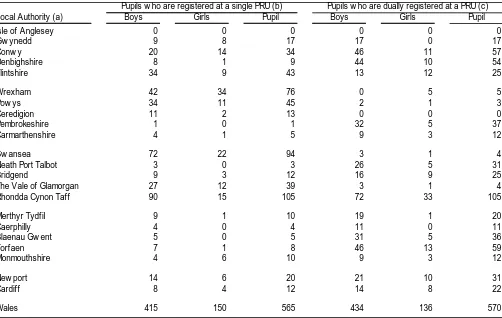
Table 6: Number of pupils attending Pupil Referral Units in Wales, by local authority,
2010/11
Pupils w ho are registered at a single PRU (b) Pupils w ho are dually registered at a PRU (c)
Local Authority (a) Boys Girls Pupil Boys Girls Pupil
Isle of Anglesey 0 0 0 0 0
Gw ynedd 9 8 17 17 0
Conw y 20 14 34 46 11
Denbighshire 8 1 9 44 10 54
Flintshire 34 9 43 13 12
Wrexham 42 34 76 0 5 5
Pow ys 34 11 45 2 1
Ceredigion 11 2 13 0 0 0
Pembrokeshire 1 0 1 32 5 37
Carmarthenshire 4 1 5 9 3 12
Sw ansea 72 22 94 3 1
Neath Port Talbot 3 0 3 26 5 31
Bridgend 9 3 12 16 9 25
The Vale of Glamorgan 27 12 39 3 1 4
Rhondda Cynon Taff 90 15 105 72 33 105
Merthyr Tydfil 9 1 10 19 1 20
Caerphilly 4 0 4 11 0 11
Blaenau Gw ent 5 0 5 31 5 36
Torfaen 7 1 8 46 13 59
Monmouthshire 4 6 10 9 3 12
New port 14 6 20 21 10 31
Cardiff 8 4 12 14 8
Wales 415 150 565 434 136 570
Sources: EOTAS PLASC, Welsh Government Pupil Level Annual School Census, Welsh Government
(a) Refers to the local authority in w hich pupils attended PRUs, not the local authority funding the provision.
(b) Figures relate to pupils educated at only one PRU and include pupils receiving other EOTAS provisions or being recorded as having ‘subsidiary’ enrolment status at a maintained or special school in the 2010/11 Pupil-Level Annual School Census (PLASC), but exclude those w ith ‘main’ or ‘current’ enrolment in a maintained or special school in PLASC.
(c) Figures relate to pupils educated at more than one PRU or educated at a PRU w hile having 'main' or 'current' enrolment status at a maintained or special school in the 2010/11 PLASC.
0 17 57
25
3
4
22
• Of the local authorities that had Pupil Referral Units in 2010/11 Ceredigion had the least number of pupils in attendance (13 pupils), while Rhondda Cynon Taff had the most number of pupils
attending Pupil Referral Units (210 pupils);
Table 7: Number of pupils of compulsory school age electively educated at home, by
gender and age (a)
2009/10 (b) 2010/11
Gender
Boys 340 425
Girls 288 416
Pupils (c) 722 896
Age (d)
15 161 160
14 86 139
13 90 114
12 87 100
11 67 78
10 44 68
9 57
8 52
7 37
6 24
5 17
Total 722 896
Source: EOTAS PLASC, Welsh Government
(a) 2 local authorities failed to provide useable data for the 2009/10 academic year. All 22 local authorities provided data in 2010/11.
(b) Figures published in 2009/10 included pupils educated at home of all age groups. This year they have been adjusted to include only pupils of compulsory school age.
(c) The total number of pupils does not equal the sum of boys and girls as one local authority did not supply gender information.
(d) Age as on 31 August at the start of the academic year. Where local authorities do not know a pupil's age they w ere asked to provide an estimate.
73 55 44 39 26
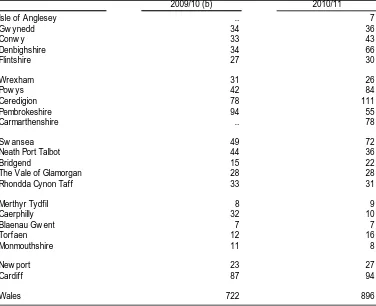
• In 2010/11 there were 896 pupils of compulsory school age recorded as being electively home educated;
Table 8: Number of pupils of compulsory school age electively educated at home, by
local authority (a)
2009/10 (b) 2010/11
Isle of Anglesey .. 7
Gw ynedd 34 36
Conw y 33 43
Denbighshire 34 66
Flintshire 27 30
Wrexham 31 26
Pow ys 42 84
Ceredigion 78 111
Pembrokeshire 94 55
Carmarthenshire .. 78
Sw ansea 49 72
Neath Port Talbot 44 36
Bridgend 15 22
The Vale of Glamorgan 28 28
Rhondda Cynon Taff 33 31
Merthyr Tydfil 8 9
Caerphilly 32 10
Blaenau Gw ent 7 7
Torfaen 12 16
Monmouthshire 11 8
New port 23 27
Cardiff 87 94
Wales 722 896
Source: EOTAS PLASC, Welsh Government
(a) 2 local authorities failed to provide useable data for the 2009/10 academic year. All 22 local authorities provided data in 2010/11.
(b) Figures published in 2009/10 included pupils educated at home of all age groups. This year they have been adjusted to include only pupils of compulsory school age.
".." means that the data item is not available.
Notes
1 Context
1.1 Policy/Operational
Local authorities are required to provide suitable education at school or otherwise than at school for those children of compulsory school age who, by reason of illness, exclusion from school or otherwise, may not for any period receive suitable education unless such arrangements are made for them. In practice, local authorities respond to that duty in widely varying ways, relating to their individual circumstances, such as their geography, socio-economic situation and educational policies. A key action within the Welsh Government ‘s Behaviour and Attendance Action Plan is to raise the standards of EOTAS provision across Wales, through the implementation of a specific action plan relating to EOTAS. This can be found at the following link:
http://wales.gov.uk/topics/educationandskills/schoolshome/pupilsupport/?lang=en
1.2 Related Publications
England publish the number of pupils on roll at Pupil Referral Units in the statistical release entitled ‘Schools, Pupils and their Characteristics, January 2011’. The latest available statistics can be found here: http://www.education.gov.uk/rsgateway/DB/SFR/s001012/index.shtml
2 Data Source
The EOTAS Pupil Census is carried out annually and collects data on pupils educated other than at school from local authorities electronically via a secure website. The collection is carried out by the Statistical Directorate within the Welsh Government.
3 Definitions
3.1 Coverage
The information in this Statistical First Release relates to pupils receiving local authority-funded education outside of the mainstream school environment during a census week each January and the number of pupils of compulsory school age (aged 5 to 15 on 31 August before the start of the academic year) known by local authorities to be electively home educated. For the 2010/11 academic year the census week was 17 to 21 January 2011.
Data for the 2009/10 academic year excluded 2 local authorities that were unable to supply useable data in time for publication and therefore gave an incomplete picture of the number of pupils educated other than at school in Wales. All 22 local authorities provided data for the 2010/11 academic year.
In 2010/11 data were received on 2,632 pupils receiving education other than at school from all 22 local authorities in Wales. Of the 2,632 pupils receiving EOTAS provision 1,589 were recorded in the January 2011 Pupil-Level Annual School Census as having ‘Main’ or ‘Current’ enrolment status in maintained primary, secondary or special schools and are therefore considered to be receiving their main education in a maintained school. The remaining 1,043 pupils are considered to be receiving their main education outside of school. The focus of this Statistical First Release is on pupils mainly educated other than at school, but to give a complete picture it was necessary to include all pupils receiving EOTAS provision in Chart 1 and Tables 1, 5 and 6.
3.2 Definitions of Pupils Educated Other than at School
In the context of this statistical release:• a pupil being educated other than at school (EOTAS) was recorded as receiving or awaiting education provision funded by the local authority otherwise than in a maintained school setting during the census week of the EOTAS Pupil Census. A pupil may also be included in this category if they:
• attend an independent or non-maintained special school for which the local authority is responsible for paying all or part of the tuition fees;
• are placed in a maintained school as part of their education funded by the local authority.
• the phrase EOTAS pupil is used to refer to a pupil educated other than at school as defined above.
• an EOTAS pupil whose main education is other than at school is a pupil being educated other than at school either not on roll at a maintained school or recorded as having a ‘subsidiary’ enrolment status at a maintained school in the January Pupil-Level Annual School Census.
• an EOTAS pupil whose main education is in a maintained school is a pupil being educated other than at school with a ‘main’ or ‘current’ enrolment status in the January Pupil-Level Annual School Census.
• pupils being electively home educated are children whose parents have decided to educate at home rather than at school and are not classed as EOTAS pupils. Although by definition they are educated other than at school, education for these pupils is not funded by the local authority and there is no legal basis under which the local authority can collect personal data about them. Data on electively home educated pupils are restricted to headcounts by local authority, gender and age and are provided voluntarily by the local authority. Figures related to pupils electively home educated have been reported in separate tables to those relating to EOTAS pupils.
4 Rounding and Symbols
In tables where figures have been rounded to the nearest final digit, there may be an apparent discrepancy between the sum of the constituent items and the total shown.
The following symbols have been used throughout this publication: . data item is not applicable;
.. data item is not available.
5 Key Quality Information
This section provides a summary of information on this output against five dimensions of quality: Relevance, Accuracy, Timeliness and Punctuality, Accessibility and Clarity, and Comparability.
5.1 Relevance
The statistics are used both within and outside the Welsh Government to monitor educational trends and as a baseline for further analysis of the underlying data. Some of the key users are:
• Ministers and the Members Research Service in the National Assembly for Wales;
• other government departments;
• local authorities and schools;
• ESTYN, Her Majesty’s Inspectorate of Education and Training in Wales;
• The Department for Education and Skills in the Welsh Government;
• other areas of the Welsh Government;
• the research community;
These statistics are used in a variety of ways. Some examples of these are:
• advice to Ministers;
• to inform the education policy decision-making process in Wales;
• to inform ESTYN during school inspections;
• to assist in research in educational attainment.
5.2 Accuracy
The Welsh Government works closely with local authorities in order to ensure all data are validated before tables are published. Data is collated into an electronic return and submitted to the Welsh
Government through DEWi, a secure online data transfer system developed by the Welsh Government. Various stages of automated validation and sense-checking are built into the process to ensure a high quality of data.
The first edition of this statistical first release was labelled as ‘experimental statistics’, which are new official statistics undergoing evaluation. Experimental statistics are published in order to involve users and stakeholders in their development and as a means to build in quality at an early stage. Issues raised regarding the coverage and quality of the data behind the statistical first release ‘Pupils Educated Other than at School, 2009/10’ and some of the tables within have been addressed in the latest edition,
improving the accuracy and usefulness of the statistics presented. Despite full coverage for the 2010/11 academic year, and the improvement in data quality through increased validation and verification checks, the only data available to compare the latest figures against are incomplete therefore it was decided to leave the ‘experimental statistics’ label on this release.
5.3 Timeliness and Punctuality
DEWi was available for uploading files on 18 January 2011, with local authorities asked to submit data for all pupils receiving or awaiting local authority-funded education outside of the maintained school environment during the census week of 17 to 21 January 2011. Local authorities were then asked to validate their data within the validation period, which closed on 11 March 2011.
Technical issues in several local authorities prolonged the validation period, but lessons learned during the 2009/10 data collection and improved validation checks, along with the help of colleagues in local authorities, have allowed us to bring forward the publication of this statistical first release by over four months.
5.4 Accessibility and Clarity
This Statistical First Release is pre-announced and then published on the Statistics section of the Welsh Government website. It will be accompanied by more detailed tables about the number of pupils at Pupil Referral Units on StatsWales, a free to use service that allows visitors to view, manipulate, create and download data.
5.5 Comparability
Two local authorities failed to provide useable data for the 2009/10 academic year and the data’s quality was questionable, so caution should be used when comparing data with this year.
Tables 5 and 6 contain the number of pupils only on roll at Pupil Referral Units (PRUs) in Wales by gender, age and local authority, which in previous years have been published in the Welsh
In the 2009/10 edition of this release Table 4 presented the number of pupils only registered at a PRU (which included pupils registered at more than one PRU) and the number of pupils registered at a PRU and other educational institutions. To meet with user demand this table (now Table 5) has been changed to present the number of pupils only registered at a single PRU and the number of pupils dual registered at more than one PRU or at a PRU and another maintained school. The new definitions have also been used in Table 6 and match the definitions previously used when presenting the number of pupils attending PRUs. Since Table 4 in the 2009/10 release and Table 5 in this release have different definitions for single and dual registered pupils it is not recommended that they be compared. Comparable data is available from the Statistical Directorate of the Welsh Government on request. Tables and charts in this statistical first release contain data about different groups of EOTAS pupils as defined in section 3.2. Whether the tables and charts are referring to EOTAS pupils whose main
education is other than at school, whose main education is at a maintained school or all EOTAS pupils is clearly indicated, so before comparing two tables or charts please check that they are referring to the same group of EOTAS pupils.
Pupils by age (Table 2) and by SEN (Table 3) can be set in context by comparing to the general school population. The relevant data can be found in the publication of final school census results here: