Application of Continuous-Wave Cavity
Ring-Down Spectroscopy to
Laminar Flames
Volume 8, Number 1, February 2016
Gordon S. Humphries
Iain S. Burns
Michael Lengden
Application of Continuous-Wave Cavity
Ring-Down Spectroscopy to
Laminar Flames
Gordon S. Humphries,1,2Iain S. Burns,2and Michael Lengden1
1
Center for Microsystems and Photonics, Department of Electronic and Electrical Engineering, University of Strathclyde, Glasgow G1 1XW, U.K.
2
Department of Chemical and Process Engineering, University of Strathclyde, Glasgow G1 1XW, U.K.
DOI: 10.1109/JPHOT.2016.2517575
1943-0655Ó2016 IEEE. Translations and content mining are permitted for academic research only. Personal use is also permitted, but republication/redistribution requires IEEE permission. See http://www.ieee.org/publications_standards/publications/rights/index.html for more information.
Manuscript received November 24, 2015; revised December 23, 2015; accepted December 23, 2015. Date of publication January 12, 2016; date of current version February 9, 2016. This work was supported by the UK Engineering and Physical Sciences Research Council Doctoral Training Grant Scheme. Corresponding author: G. S. Humphries (e-mail: [email protected]).
Abstract:In this paper, we describe the application of diode-laser continuous-wave cav-ity ring-down spectroscopy (cw-CRDS) to in-situ flame diagnostics. Spectra of the P17e acetylene feature at 1535.4 nm were recorded in a premixed laminar ethylene/air flame. The overall absorption of the feature was measured to be1:5104 cm1, which is a
short distance above the reaction zone for a flame fuel equivalence ratio of 1.66, and the minimum detection limitð3Þ of the system was calculated to be 1:2105 cm1. This
demonstrates the potential of the technique for the measurement of weakly absorbing species in flames. Finally, we discuss the advantages and limitations of the cw-CRDS technique for flame measurements.
Index Terms: Continuous-wave cavity ring-down spectroscopy (cw-CRDS), combustion, cavity ring-down, diode laser.
1. Introduction
In-situ optical sensing techniques are the preferred method for measuring species concentra-tion in high-temperature reacting flows, such as flames. This is because optical sensing tech-niques, such as tunable diode laser absorption spectroscopy, produce little to no perturbation in the combustion process as it is non-intrusive and measurements can be made in-situ. How-ever, standard single-pass absorption spectroscopy often lacks the required sensitivity for spe-cies concentration measurements in flames. This can be due to a combination of the low concentration or the low absorption cross-section of the target species, a short interaction length, and the intense background emission from the flame [1]. Even with specialized correc-tion techniques and extensive averaging, direct absorpcorrec-tion typically has a minimum detectable absorbance on the order of 104, and this performance is generally poorer under combustion conditions [2]. Recently, Wagner et al. [3] used direct diode laser absorption spectroscopy to probe the P17e transition of acetylene to measure acetylene concentration in methane/air flames, stabilized on a Wolfhard-Parker slot burner and in a Tsuji counter flow burner [4].
increasing the laser-gas interaction length [2] or reducing the noise by introducing modulation techniques such as wavelength modulation spectroscopy (WMS) [5]. Recently, calibration-free techniques for WMS have proven to be ideal for gas concentration and system temperature measurements in harsh environments [6], [7]. These applications of WMS have achieved ex-tremely high sensitivities in such environments and have been fully developed into commercially available measurement systems. However, technique can be limited by the complexity of the signal processing and by spectral broadening that results from the high modulation amplitude. In particular, the broadened derivative-like signals make it difficult to interpret spectra, especially in environments where a number of unidentified features are present. Thus this can limit its application in multi-species, high-temperature environments such as flames, particularly when targeting near-infrared ro-vibrational transitions.
In this paper we develop an alternative technique based on increasing the laser-gas interaction length using cavity ring-down spectroscopy (CRDS) [8]. Cavity ring-down spectroscopy has previ-ously been performed in flames using pulsed dye lasers for measurements of species such as OH, CH and 1CH2 [9]–[11]. The related technique of continuous-wave cavity ring-down spectroscopy
(cw-CRDS) [12] allows the use of compact, low-power diode lasers [13], [14] but has received little attention for in-situ flame measurements. Here, we report on the novel application of diode laser cw-CRDS to flames involving the development of an instrument for detection of acetylene.
The performance of the cw-CRDS system is demonstrated using a premixed laminar ethylene/air flame stabilized on a porous plug burner. We discuss how features of its performance compare with previous cavity ring-down studies performed in similar flames using pulsed laser sources.
2. Cavity Ring-Down Spectroscopy
CRDS is a cavity based spectroscopic technique which improves the sensitivity of absorption measurements by increasing the effective path-length of the laser light through the absorbing medium. This is achieved by coupling light into a high finesse optical cavity (typical mirror reflec-tivity is greater than 99.99%). When the input light into the cavity is terminated the intensity of light leaving the cavity through the output mirror decays exponentially. If no absorbing medium is present, the rate of decay should ideally only be due to mirror transmission/scattering losses. When an absorbing species is present this rate of decay is significantly increased due to the absorption losses in the optical cavity. Theoretically, following the termination of input light, the intensity of light IðtÞ remaining within the cavity at a time t is described according to the equation [15]
IðtÞ ¼I0exp t
(1)
where I0 is the intensity of the light at the moment the input light was terminated, and the decay constant is the cavity ring-down time described as
¼ Lc
c½ð1RÞ þðÞdþX (2)
where c is the speed of light, R is the mirror reflectivity, ðÞ is the absorption coefficient at a wavelength , d the path length through the absorbing medium, and Lc is the cavity
length. X describes the proportion of light lost per pass in the cavity from sources other than the narrow-band absorption, for example thermo-optic effects, and losses due to the presence of an particulates intra-cavity [16].
steering, can divert light into higher order transverse modes on each pass, reducing the inten-sity of light within the resonant, fundamental TEM00 mode and reducing the cavity ring-down
time. Miller et al. [17] encountered this difficulty, and only report data obtained by extractive sampling of gas from the flame. Lamoureux et al. [18] also preformed cw-CRDS on gas sam-ples extracted from flames.
The only cavity-based diode laser measurements that have been conducted in flames were based on the cavity enhanced absorption spectroscopy (CEAS) technique [19], where the aver-aged intensity of the light transmitted through the cavity over a scan of several periodically ex-cited modes is measured, instead of measuring the cavity ring-down time. Peeters et al. [19] used diode laser CEAS to make measurements of OH radicals in laminar flames. However, these were relative measurements since CEAS is a technique that requires calibration, unlike CRDS which provides an absolute measure of optical losses from the cavity.
Until now the application of cw-CRDS for species detection in flames has therefore been lim-ited to extractive sampling using a probe [20] with in-situ measurements being conducted using the pulsed CRDS technique [18]. In this paper we describe in-situ cw-CRDS measurements of optical absorption due to acetylene in a flame with a higher overall SNR than can be achieved using standard single-pass absorption or WMS.
3. Spectrometer Design
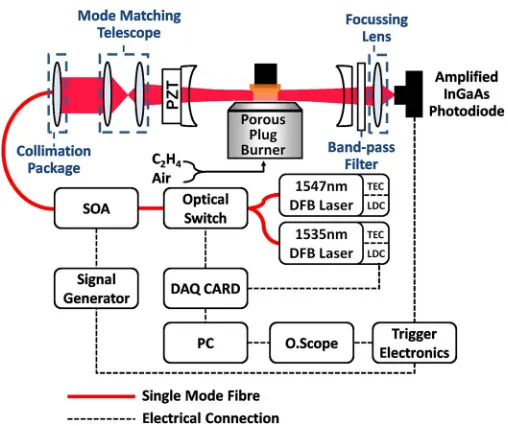
A detailed diagram of the spectrometer is shown in Fig. 1, presenting the key components in this new cw-CRDS approach to in-flame optical absorption measurements. Two diode sources are shown; the first is used to interrogate a targeted gas spectrum, in this case acetylene, and the second laser is used for signal normalization.
[image:4.594.171.425.56.269.2]The interrogation laser is a 15 mW, 1535 nm distributed feedback (DFB) diode laser, selected to probe the P17e transition of acetylene. The normalization laser is a 20 mW DFB at 1547 nm, and is used to quantify the optical losses caused by thermal gradients in the flame and align-ment drift over time. The final active optical source is a C-band semiconductor optical amplifier (SOA) (manufacturer: Kamelian), that has a maximum output power of 20 mW and is current controlled using an arbitrary function generator (manufacturer: Agilent Technologies). This SOA is used in place of the more common acousto-optic modulator (AOM) to interrupt the input laser light to the cavity and initiate ring-down. The SOA also has the further advantage of being able
to amplify the optical output of the laser. This increase in power can help to compensate for the loss in the on-resonance transmission encountered during combustion measurements (shown in Section 4), providing better signal to noise in the raw ring-down trace and was originally tested for cw-CRDS applications by Huanget al.[21].
The output from the SOA is collimated into the bulk optics section of the spectrometer using a fiber coupled aspheric lens collimation package, which produces a beam with a measured diam-eter of 2.7 mm. The optical cavity is constructed using two concave ultra-high reflectivity mirrors (ROC: 1 m, R¼0:9999 at 1550 nm, manufacturer: CRD Optics) which are spaced 500 mm apart, with the burner located in the centre of the cavity. The input mirror is mounted on a three actuator piezoelectric (PZT) mount (manufacturer: ThorLabs) that provides the fine variation of the cavity length, required to periodically bring a single longitudinal mode into resonance.
Mode-matching to theTEM00 mode is achieved using two biconvex positive spherical lenses
(focal lengths 60 mm and 30 mm, respectively) arranged in a basic Keplerian telescope format. The mode-matching optics reduce the beam diameter to 0.93 mm ð1=e2Þ at the center of the
cavity, matching both the diameter and waist position of theTEM00 transverse mode. The light
that exits the cavity, by transmission through the output mirror, is initially passed through an op-tical band pass filter (FWHM 40 nm, centre wavelength: 1550 nm), which reduces the intensity of the flame emission transmitted through the output mirror, before being focused onto an ampli-fied InGaAs photodiode. The photodiode output voltage is fed into a simple comparator circuit which outputs a TTL pulse when the cavity transmission exceeds a preset level. This TTL pulse triggers the signal generator to rapidly switch off the SOA drive current (edge time≈5 ns), allow-ing the cavity to rallow-ing-down. The total time delay from the cavity transmission exceedallow-ing the pre-set threshold until termination of input light to the cavity is ≈40 ns. Ring-down signals are recorded using a NI LabView controlled, 1 GS/s, digital oscilloscope (manufacturer: Tektronix).
A premixed flame of ethylene and air was stabilized on a 33 mm diameter porous-plug burner at atmospheric pressure [22]. This resulted in one-dimensional laminar flames, with conditions such as temperature, species concentration, and soot volume fraction varying only with height above the burner surface. The flame produced by the burner is stabilized using a 38 mm diame-ter steel cylinder mounted 21 mm above the burner surface. The flow-rates of air and ethylene (supplied at ambient temperature) are controlled using rotameters. The flame conditions have been described in detail previously [22]. The burner is mounted on an adjustable stage which al-lows it to be vertically translated with respect to the spectrometer. The zero-point for the transla-tion is taken to be the point at which the surface of the burner is at the same vertical positransla-tion as the center of theTEM00transverse mode.
The spatial resolution of the spectrometer in the flame can be determined from the diam-eter of the beam waist of the TEM00 mode, which varies very little through the flame
ðRayleigh distance¼434:5 mmÞ. There is potential for improving the spatial resolution of the system by using mirrors with a smaller radius of curvature.
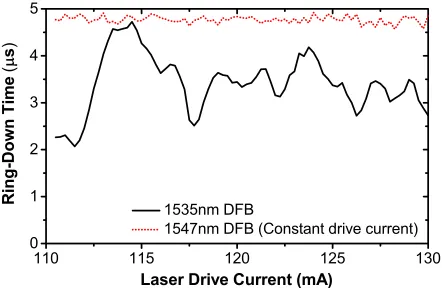
Initially, an in-flame CRD spectrum of the normalization DFB laser was obtained, to ensure that a suitable region free of significant absorption features was available, as shown in Fig. 2. In this case, the optical switch and the interrogation DFB laser were removed from the system. The 1547 nm laser was wavelength tuned by controlling the applied current using a laser diode controller (Manufacturer: ThorLabs Model: LDC 210C), whose output current can be varied via an applied input voltage, with a conversion rate of 100 mA/V. The control voltage was obtained from the analogue output (AO) of a 16 bit data acquisition (DAQ) board (manufacturer: National Instruments, Model: PCI 6120). The wavelength was varied through a 0.285 nm range around 1547.89 nm by tuning the drive current at 0.25 mA intervals. At each current increment, 32 ring-down signals were recorded and averaged on the oscilloscope and the data was recorded on the control PC.
To carry out normalized in-flame CRDS measurements of gas spectra, the optical switch and the interrogation DFB laser are re-introduced. In this case, the interrogation DFB laser is current tuned using the DAQ board. Between each wavelength increment of the interrogation DFB laser, a LabView program triggers the optical switch to shift to the normalization laser. Once a CRD sig-nal of the normalization laser is recorded the LabView program switches the optical switch back to the interrogation laser output and changes the drive current to tune the laser wavelength by one increment. The process is then repeated until a spectrum has been recorded over the de-sired wavelength range. The tuning characteristics of the interrogation laser are measured using a fiber ring resonator (FSR: 475 MHz) [23], which allows the relative wavelength scale of the scan to be determined. Although the wavelength relationship with laser drive current is not linear the average wavelength change achieved using this tuning method is≈0.0145 nm per mA.
4. Spectrometer Performance
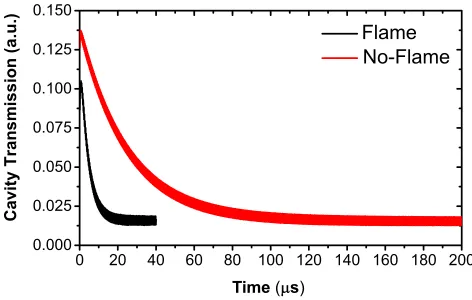
[image:6.594.186.408.60.202.2]The presence of a flame in the centre of an optical cavity significantly reduces its optical cou-pling efficiency, due to perturbation of the excited cavity mode. This results in a reduction in the cavity ring-down time and the resonant cavity transmission when the flame is ignited. Fig. 3 highlights this effect at the off-line wavelength of the 1547 nm normalization laser. This figure shows a comparison of a ring-down measurement in the absence of the flame and a ring-down
[image:6.594.178.414.272.422.2]Fig. 3. Average ring-down traces recorded 3 mm above the burner surface. In absence of the flame (red) and with an equivalence ratio flame of 1.54.
measurement for a 1.54 fuel equivalence ratio flame where the centre of theTEM00mode is po-sitioned 3 mm above the burner surface. The trigger voltage level has been reduced for the in-flame signal to achieve comparable measurement repetition rates.
The ring-down time for the optical cavity without the presence of the flame is 25.00
s. The increase in optical loss in the ignited flame leads to a ring-down time of 4.74s, implying an in-crease in the fractional cavity loss,X, of 2:85104, calculated using (2). This reduction in cou-pling efficiency is due to the thermal effects of the flame causing beam steering and thermal lensing of the light into transverse modes other than the TEM00 transverse cavity mode. Al-though the loss in overall cavity transmission indicates that light is being lost from the TEM00mode, it remains the primary excited mode and setting a sufficiently high trigger threshold en-sures that the ring-down events recorded are from theTEM00mode only.
Implementing the experimental measurement procedure described in Section 3, Fig. 4 shows a typical raw spectrum recovered at 3 mm above the burner surface in a 1.42 fuel equivalence ratio flame. In this case, the 1535 nm interrogation laser wavelength has been scanned from 1535.3 nm to 1535.55 nm in average increments of 3.6 pm. Averages of 32 ring-down events were taken for each wavelength increment of the 1535 nm laser and also for the 1547 nm mea-surements. The standard deviation of the 32 individual ring-down traces has been measured to be 0.132
s. For the 1547 nm laser, which is equivalent to 3% of its average ring-down time. As stated in Section 2, the drive current for the normalization laser was held constant at the point on the spectrum free of any strong absorption features, providing the dotted [red online] back-ground trace in Fig. 4. The recorded ring-down signals were fitted using a least squares expo-nential fit algorithm in Matlab. The overall data acquisition time for this spectrum was ≈470 s and, as can be seen from Fig. 4, the background ring-down measurement does drift a little over this timescale, meaning that the use of the normalization laser improves the quality of the result-ing measurements. The overall drift in rresult-ing-down time has been estimated to be1104s/sin this case. The source of this drift is thought to be due to a combination of optical alignment drift and fouling of the dielectric mirror coating.
The large number of interfering features presents some difficulty in assigning each one to a specific species. However, the assignment of the main P17e acetylene peak is clear, as shown in the higher resolution spectrum in Fig. 5, which provides a comparison of experimental data taken at wavelength increments of 1.45 pm, between 1535.36 nm and 1535.65 nm, and a mod-eled and scaled spectrum of acetylene, calculated for a temperature of 1600 K using the HITRAN 2008 database. The measurements were taken at a height of 3 mm above the surface of the burner in a 1.66 equivalence ratio flame. The overall acquisition time for this spectrum was ≈3700 s and the ring-down time of the 1547 nm laser was reduced by 0.154
s over this time-scale. [image:7.594.187.408.59.203.2]It is also possible to assign some of the stronger peaks as high temperature water vapor tran-sitions using the HITEMP 2010 database [25]. However, the majority of the weaker measured
absorption features remain un-assigned in this paper. The SNR for the P17e absorption peak has been calculated to be 32 for this spectrum, by measuring the standard deviation for the 1547 nm reference laser ring-down time and comparing it with the reduction in ring-down time due to the acetylene absorption. The measured absorbance of the P17e feature is 1:3 104 cm1 for the above flame conditions, leading to an overall minimum absorption measure-ment sensitivityð3Þof 1:2105 cm1.
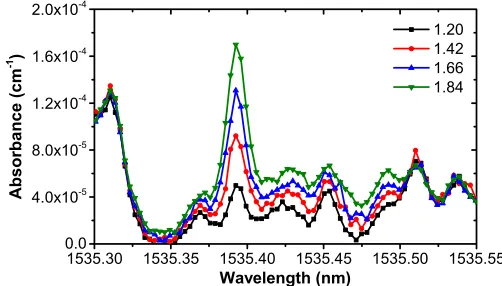
Finally, Fig. 6 highlights the variation in optical absorption from acetylene as a function of the fuel equivalence ratio, implying an increase in acetylene concentration. This is expected to in-crease due to the progressively more reducing conditions as the equivalence ratio is inin-creased. Interestingly, the variation in absorbance as a function of equivalence ratio is limited to the re-gion in which acetylene has a contribution, as shown in Fig. 5. It appears that the spectral fea-tures for which absorbance is roughly invariant with equivalence ratio may be associated with species, perhaps water vapor, whose concentration at this location in the flame is fairly constant over the range of conditions studied.
5. Discussion
[image:8.594.180.417.59.204.2]In introducing the application of cw-CRDS for in-situ flame diagnostics, it is worth considering how this method compares to the use of pulsed lasers (typically dye lasers) to perform CRDS in flames. CRDS using pulsed laser sources has been applied to the in-situ measurement of
Fig. 5. Higher resolution spectrum acquired 3 mm above the burner in the 1.66 equivalence ratio flame. Also shown is a model spectrum of C2H2from the Hitran 2008 Database [24]. The p17e
acetylene transition and H2O transition are identified.
[image:8.594.170.421.261.404.2]weakly absorbing species in flames [9]–[11], [26]–[28], achieving sensitivities as low as 106
fractional absorption. It is therefore necessary to discuss the advantages and disadvantages of both cw-CRDS and pulsed-CRDS in both a thermally homogenous cavity and with an intra-cavity flame.
Typically, in a homogenous environment cavity ring-down spectrometers can achieve sensitivi-ties on the order of 109cm1[2], and this sensitivity is directly related to the gas-laser interaction length. It is therefore essential to contain the light within the cavity for as long as possible, i.e., achieve the longest possible ring-down time.
In a cw-CRDS system light is coupled into a single transverse cavity mode, typically the
TEM00, thus requiring accurately designed mode matching optics. To initiate a ring-down the
light being coupled into the cavity is switched off, and during the ring-down process it is desir-able that all the coupled light not being transmitted through the output mirror continues to reso-nate in the TEM00 mode [29]. In some circumstances the sensitivity of cw-CRDS can be
enhanced by improving the mechanical stability of the cavity or by increasing the coupled opti-cal power into the cavity through locking the laser to a single longitudinal cavity mode [30].
Pulsed-CRD systems involve lasers that are much more bulky and expensive than the fiber-coupled diode lasers used for cw-CRDS. On the other hand, the high peak powers of pulsed dye lasers (≈MW) and the large line-widths (≈GHz), makes optical coupling into the cavity sim-pler. It is not necessary to temporarily attenuate the incoming light as the pulse duration of the coupled light is typically shorter than the cavity round-trip time. The implication of this is that there is very little overlap of the coherent field in the cavity, which results in no build up in inten-sity over time. Therefore, the maximum power that can be coupled into the cavity is just the pro-portion of light that is transmitted through the high reflectivity input mirror. As the peak pulse power is typically on the order of MW even this small fraction of transmitted light is enough to be detected. In contrast, due to the much lower output power of the laser sources used, cw-CRDS is entirely dependent on the coherent field replicating itself and building up over time to a much higher intra-cavity power.
A further contrast between the approaches becomes apparent when a flame is present within the optical cavity. As resonant effects are minimal in the pulsed regime it follows that any distur-bance to the transverse mode structure of the cavity, caused by thermal gradients of the flame, will produce a lesser reduction in the cavity ring-down time. This is not the case for a cw-CRD system, where all the light needs to remain within theTEM00 mode. We have previously used CRDS with a pulsed dye laser, with a pulse power of 6 mJ and a line-width of 0.1 cm−1, to under-take studies on singlet methylene and HCO in the same porous plug burner [31]. During these measurements a reduction of≈50% in the ring-down time was observed due to the thermal dis-turbance of the optical field, which is much less than the≈80% reduction seen in the cw-CRDS setup presented in Section 3. In the cw-CRDS system described in this work the most significant cause for de-coupling from the TEM00 mode is therefore the introduction of the flame into the cavity. Any improvements to the mechanical stability of the cavity would have a negligible effect on the overall sensitivity of the flame measurements since thermal losses are dominant.
vapor are present. Furthermore, by working in the near-infrared all vibrationally active species can be targeted. The use of a reference laser in the near-IR at a wavelength where no signifi-cant optical absorption occurs allows a very simple, real-time calibration technique that provides absolute measurements of absorbance, even when the cavity alignment may be drifting or the mirrors become fouled over time.
CRDS, whether pulsed or cw is inherently a path-integrated technique, as are all other optical absorption measurements. They are therefore most suited to relatively stable, laminar flames. If spatially resolved concentration measurements were required a tomographic approach would need to be developed. The use of laminar flames also improves the overall sensitivity of cw-CRD as the average of a number of ring-down measurements can be taken. Indeed, the in-homogeneous conditions and complex flame fronts produced by dynamic turbulent flames would cause a greater and more random disturbance to the transverse mode structure of the cavity. In the worst case this could potentially prevent resonance from occurring. The cw-CRDS approach we have taken does, however, show significant potential for the study of trace interme-diates in suitable flames, which can be used for the validation of flame chemistry models.
6. Conclusion
We have demonstrated what is, to the best of our knowledge, the first applications of cw-CRDS to conduct in-situ flame measurements. Although there is a significant loss in sensitivity due to thermo-optic effects we still achieved an absorption sensitivity limit ð3Þ of 1:2105 cm1 which is a significant improvement on single pass techniques. The spectrometer is immune to noise caused by flame emission and produces a direct measurement of absorption without the complex calibration required by some other cavity based techniques.
References
[1] J. J. Nikkari, J. M. Di Iorio, and M. J. Thomson,“In situ combustion measurements of CO, H2O, and temperature
with a 1.58-m Diode laser and two-tone frequency modulation,”Appl. Opt., vol. 41, no. 3, p. 446, Jan. 2002. [2] J. Hodgkinson and R. P. Tatam, “Optical gas sensing: A review,”Meas. Sci. Technol., vol. 24, no. 1, Jan. 2013,
Art. ID 012004.
[3] S. Wagner, B. T. Fisher, J. W. Fleming, and V. Ebert,“TDLAS-based in situ measurement of absolute acetylene concentrations in laminar 2D diffusion flames,”Proc. Combustion Inst., vol. 32, no. 1, pp. 839–846, Jan. 2009. [4] S. Wagneret al.,“In situ TDLAS measurement of absolute acetylene concentration profiles in a non-premixed
lami-nar counter-flow flame,”Appl. Phys. B, Photophys. Laser Chem., vol. 107, no. 3, pp. 585–589, Mar. 2012.
[5] F. S. Pavone and M. Inguscio,“Frequency- and wavelength-modulation spectroscopies: Comparison of experimen-tal methods using an AlGaAs diode laser,”Appl. Phys. B, Photophys. Laser Chem., vol. 56, no. 2, pp. 118–122, Feb. 1993.
[6] K. Sun et al., “TDL absorption sensors for gas temperature and concentrations in a high-pressure entrained-flow coal gasifier,”Proc. Combustion Inst., vol. 34, no. 2, pp. 3593–3601, 2013.
[7] P. Wrightet al.,“Progress towards non-intrusive optical measurement of gas turbine exhaust species distributions,” inProc. IEEE Aerosp. Conf., Mar. 2015, pp. 1–14.
[8] A. O’Keefe and D. A. G. Deacon,“Cavity ring-down optical spectrometer for absorption measurements using pulsed laser sources,”Rev. Sci. Instrum., vol. 59, no. 12, p. 2544, 1988.
[9] A. McIlroy,“Direct measurement of1CH2in flames by cavity ringdown laser absorption spectroscopy,”Chem. Phys.
Lett., vol. 296, no. 1/2, pp. 151–158, Oct. 1998.
[10] V. Lozovsky, I. Derzy, and S. Cheskis,“Nonequilibrium concentrations of the vibrationally excited OH radical in a methane flame measured by cavity ring-down spectroscopy,”Chem. Phys. Lett., vol. 284, no. 5/6, pp. 407–411, Mar. 1998.
[11] X. Mercier, P. Jamette, J. Pauwels, and P. Desgroux,“Absolute CH concentration measurements by cavity ring-down spectroscopy in an atmospheric diffusion flame,”Chem. Phys. Lett., vol. 305, no. 5/6, pp. 334–342, May 1999. [12] D. Romanini, A. Kachanov, N. Sadeghi, and F. Stoeckel,“CW cavity ring down spectroscopy,”Chem. Phys. Lett.,
vol. 264, no. 3/4, pp. 316–322, Jan. 1997.
[13] B. J. Orr and Y. He,“Rapidly swept continuous-wave cavity-ringdown spectroscopy,”Chem. Phys. Lett., vol. 512, no. 1–3, pp. 1–20, Aug. 2011.
[14] M. Mazurenka, A. J. Orr-Ewing, R. Peverall, and G. A. D. Ritchie,“Cavity ring-down and cavity enhanced spectros-copy using diode lasers,”inProc. Annu. Rep. Section“C”Phys. Chem., 2005, vol. 101, p. 100.
[16] C. Schoemaecker Moreau, E. Therssen, X. Mercier, J. Pauwels, and P. Desgroux,“Two-color laser-induced incan-descence and cavity ring-down spectroscopy for sensitive and quantitative imaging of soot and PAHs in flames,”
Appl. Phys. B, Lasers Opt., vol. 78, no. 3/4, pp. 485–492, Feb. 2004.
[17] J. H. Miller, A. R. Awtry, M. E. Moses, A. D. Jewell, and E. L. Wilson,“Measurements of hydrogen cyanide and its chemical production rate in a laminar methane/air, non-premixed flame using CW cavity ringdown spectroscopy,”
Proc. Combustion Inst., vol. 29, no. 2, pp. 2203–2209, 2002.
[18] N. Lamoureux, H. El Merhubi, L. Gasnot, C. Schoemaecker, and P. Desgroux,“Measurements and modelling of HCN and CN species profiles in laminar CH4/O2/N2low pressure flames using LIF/CRDS techniques,”Proc.
Com-bustion Inst., vol. 35, no. 1, pp. 745–752, 2015.
[19] R. Peeters, G. Berden, and G. Meijer,“Near-infrared cavity enhanced absorption spectroscopy of hot water and OH in an oven and in flames,”Appl. Phys. B, Photophys. Laser Chem., vol. 73, no. 1, pp. 65–70, Jul. 2001.
[20] X. Mercier and P. Desgroux, “Cavity ring-down spectroscopy for combustion studies,” in Cavity Ring-Down Spectroscopy: Techniques and Applications, G. Berden and R. Engeln, Eds. New York, NY, USA: Wiley, 2010, pp. 273–311.
[21] H. Huang and K. K. Lehmann,“CW cavity ring-down spectroscopy (CRDS) with a semiconductor optical amplifier as intensity modulator,”Chem. Phys. Lett., vol. 463, no. 1–3, pp. 246–250, Sep. 2008.
[22] G. S. Humphrieset al.,“A simple photoacoustic method for the in situ study of soot distribution in flames,”Appl. Phys. B, Photophys. Laser Chem., vol. 119, no. 4, pp. 709–715, May 2015.
[23] W. Johnstone, A. J. McGettrick, K. Duffin, A. Cheung, and G. Stewart,“Tunable diode laser spectroscopy for indus-trial process applications: System characterization in conventional and new approaches,”IEEE Sens. J., vol. 8, no. 7, pp. 1079–1088, Jul. 2008.
[24] L. Rothmanet al., “The HITRAN 2008 molecular spectroscopic database,”J. Quantitative Spectroscopy Radiative Transfer, vol. 110, no. 9/10, pp. 533–572, Jun. 2009.
[25] J. Tennysonet al.,“HITEMP, the high-temperature molecular spectroscopic database,”J. Quantitative Spectroscopy Radiative Transfer, vol. 111, no. 15, pp. 2139–2150, 2010.
[26] J. Scherer, D. Voelkel, and D. Rakestraw,“Infrared cavity ringdown laser absorption spectroscopy (IR-CRLAS) in low pressure flames,”Appl. Phys. B, Lasers Opt., vol. 64, no. 6, pp. 699–705, Jun. 1997.
[27] S. Cheskis and A. Goldman, “Laser diagnostics of trace species in low-pressure flat flame,” Progress Energy Combustion Sci., vol. 35, no. 4, pp. 365–382, Aug. 2009.
[28] I. Derzy, V. A. Lozovsky, and S. Cheskis,“Absolute CH concentration in flames measured by cavity ring-down spec-troscopy,”Chem. Phys. Lett., vol. 306, no. 5/6, pp. 319–324, Jun. 1999.
[29] H. Huang and K. Lehmann,“Noise in cavity ring-down spectroscopy caused by transverse mode coupling,”Opt. Exp., vol. 15, no. 14, p. 8745, Jul. 2007.
[30] S. G. Baran, G. Hancock, R. Peverall, G. A. D. Ritchie, and N. J. van Leeuwen,“Optical feedback cavity enhanced absorption spectroscopy with diode lasers,”Analyst, vol. 134, no. 2, pp. 243–9, Feb. 2009.