COMPARATIVE STUDY OF VERTICALLY REGULAR AND IRREGULAR
STEEL STRUCTURE
Shruti Bharvase
1, Priyanka Patil
21
P.G. Student, S.G.Balekundri Institute of Technology, Karnataka, India
2
Assistant Professor, Dept. of Civil Engineering, S.G.Balekundri Institute of Technology, Karnataka, India
---***---Abstract –The widely used material for construction in the world is steel. It is one of the fastest growing materials which are used now days.
When designing steel structures the effect of wind loads is important to be considered. The designing of the steel building is based on codes, IS 800, IS 875 PART 2, IS 875 –PART3.The aim of this thesis is to analyze the building for vertically irregularity and regular building. The frame consist of six storey and has 3 bays on both x and y direction. The selection of the frame sections are done, the column section selected is box ISMC 400, the beam sections selected are ISLB 325, ISLB 175 are secondary beams, the slab section considered is composite deck sheet. The irregular models of stiffness irregularity, mass irregularity, weak storey and set back irregular models are prepared using the same structural frame sections. The study of wind loads is focused in this paper. Comparative studies of the results tabulated are done for different parameters. The parameters which are studied are storey displacement, storey drift, storey stiffness and base shear.
The software used for the analysis is ETABS –v2016.
Key Words: Regular building, soft storey, mass, setback, weak storey.
1. INTRODUCTION
This thesis focuses on a comparative study and on the behavior of steel buildings. Particularly on vertically irregular steel structures. There is no such building in practice which can be termed as a perfect regular building.
Irregularities are in configuration of structures i.e. how the parts of structure are arranged and if the arrangement is irregular then there are consequences in the structure. The irregularities occur due to mass, geometry, stiffness and strength thus from the above information we can study that failure occurs at certain point of weakness, because of irregularity. When we take any urban infrastructure in to consideration we can observe that the irregular building covers a large number of infra-structure.
1.1 Irregularities
Classification of Irregularities:
The irregularities studied in this paper are only verticle irregularities
1.2 OBJECTIVES.
To carry out analysis of vertically regular steel structures and irregular steel structures having irregularities such as mass, stiffness and set back irregularity in ETABS- v2016 software.
To compare results of vertically irregular steel structures with regular steel structures subjected to wind loads
2. SCOPE OF STUDY.
Using ETABS-v2016 the steel structure analysis is studied.
Vertical irregularity was studied comparing to regular steel structures.
Column is considered to be fixed joints as restraints.
Studying of Storey Displacement, Storey Drift, Storey Stiffness
3. METHODOLOGY
The present literature by various authors was studied.
Different structures are selected with different irregularities.
Modeling is done for the structure’s which are selected
4. LITERATURE REVIEW
1) Avadhoot Bhosale, Robin Davis,Pradip Sarkar (2018) - “Seismic safety of vertically irregular buildings: performance of existing indicators.” This paper evaluates the seismic risk of vertically irregular buildings on the basis of fragility curves, annual collapse, drift hazard curves, and confidence levels and correlates seismic risk with the corresponding degree of irregularity using different existing irregularity indicators. This paper includes checking of adequacy of present irregularity indicators through probability-based seismic risk assessment. The results of this paper contradict some conventional beliefs on the vulnerability of vertically irregular buildings. The results presented in this paper show that the existing irregularity indicators do not correlate with the associated seismic risk of vertically irregular buildings.
2) George georgoussis achilleas Tsompanos & Triantafyllos Makarios (2015) –
“Approximate seismic analysis of multi-story buildings with mass and stiffness irregularities”. Setback buildings with mass and stiffness discontinuities are mainly observed in the growing infrastructure in the urban areas they are observed to be irregular in plans .for the equivalent single storey system the south wells formula is adopted. For the structural detailing by the pseudo static designing against equilateral lateral load there is no such provision to do so. Hence a basic dynamic data is collected from the approximate analysis i.e. the frequency and the base resultant force. The vertically irregular building are then overviewed for As-symmetric high rise structures including stiffness and mass irregularity the accuracy level is examined.
[image:2.595.370.441.98.220.2]5. MODELLING-
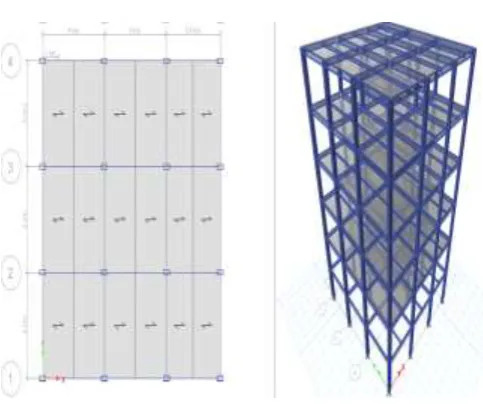
Fig.1: Plan & Rendered view of regular model.
Fig.2: Elevation view of regular steel structure
MODEL 2 - Stiffness Irregularity - soft storey model
[image:2.595.311.556.280.410.2]
Fig 3: stiffness irregularity
MODEL- 3: Mass Irregularity
[image:2.595.312.548.445.597.2]
Fig 4-Plan and 3D view of mass irregularity
[image:2.595.39.281.496.698.2]MODEL -5: Set Back Irregularity.
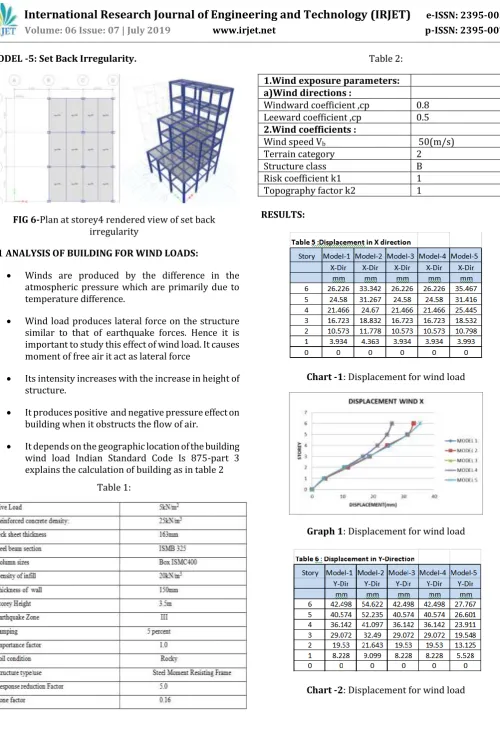
FIG 6-Plan at storey4 rendered view of set back irregularity
5.1 ANALYSIS OF BUILDING FOR WIND LOADS:
Winds are produced by the difference in the atmospheric pressure which are primarily due to temperature difference.
Wind load produces lateral force on the structure similar to that of earthquake forces. Hence it is important to study this effect of wind load. It causes moment of free air it act as lateral force
Its intensity increases with the increase in height of structure.
It produces positive and negative pressure effect on building when it obstructs the flow of air.
It depends on the geographic location of the building wind load Indian Standard Code Is 875-part 3 explains the calculation of building as in table 2
[image:3.595.47.548.41.775.2]Table 1:
Table 2:
1.Wind exposure parameters: a)Wind directions : 0deg, 90deg
Windward coefficient ,cp 0.8 Leeward coefficient ,cp 0.5 2.Wind coefficients :
Wind speed Vb 50(m/s)
Terrain category 2
Structure class B
Risk coefficient k1 1
Topography factor k2 1
RESULTS:
Chart -1: Displacement for wind load
Graph 1: Displacement for wind load
[image:3.595.37.287.113.246.2]Graph 2: Displacement for wind load
The displacement is observed to be maximum in y direction for model 2
The minimum displacement is observed in model-1, model-3, and model-4 in x direction.
The displacement is observed to be nearly 50% more for stiffness irregularity and 50% less for setback irregularity than regular structure.
Chart -3: Storey Drift for wind load
Graph 3: Storey Drift for wind load
Chart -4: Storey Drift for wind load
Graph 4: Storey Drift for wind load
The peak Storey Drift is observed in storey 2 of model 2 in Y direction.
The minimum storey drift is observed in model-4, storey-6 in X direction.
Chart -5: Storey Stiffness for wind load
Graph 6: Storey Stiffness for wind load
Maximum stiffness is observed in storey 1 of model-1 in x direction.
Minimum stiffness is observed in storey 6 of model 5 in X direction.
The stiffness shows sudden decrease at the soft storey level.
6. CONCLUSIONS
This project work studied the analysis of steel structure with 3 bays in both directions the different models with different vertical irregularities like stiffness irregularity, weak storey, mass irregularity, set back irregularity were studied in this project and a comparison of the results of different parameters was done i.e. the displacement, storey drift, stiffness of a structure, base shear for wind load cases.
The results when compared for different load condition the displacement due to soft storey increased by 50% than regular building.
Displacements are observed to be linearly increasing as the height of building affects the displacement.
This maximum displacement is observed at top storey for wind load case acting in y direction.
According to the analysis the storey stiffness is observed to reduce at storey 5 to about 50% of the storey 4 for the model 2 of stiffness irregularity
The results were observed nearly same for mass irregularity and weak storey.
The drifts are observed to get reduced by almost more than 50% for weak story comparing it to the drifts of the regular models.
It can be suggested that the weak storey effect and the mass irregularity effect can be efficient to some extent as the results obtained are similar to that of regular building.
The maximum destruction can be observed due to the soft storey effect.
The use of bracing system can be done to reduce such destructions.
REFERENCES:
[1] Chia-Hung Fang , Roberto T. Leon (2018) - “Seismic behavior of symmetric and asymmetric steel structures with rigid and semi rigid diaphragms.” Journal of Structural Engineering, ASCE, ISSN 0733-9445.
[2] George Georgoussis, Achilleas Tsompanos and Triantafyllos Makarios (2015) -“Approximate seismic analysis of multi-story buildings with mass and stiffnessirregularities.” Elsevier journal of ‘Procedia Engineering’ 125 (2015), pp. 959 – 966.
[4] IS 875 PART 2 -1987 code of practice for design loads (other than earthquake) for buildings and structures( imposed loads )
[5] IS 875 PART 3 code of practice for design loads (other than earthquake) for buildings and structures (wind loads)