JOURNAL OF VIROLOGY,JUlY1993,p. 4237-4245 0022-538X/93/074237-09$02.00/0
Copyright C1993, American Society for Microbiology
cis-Acting Elements in the
Lytic Origin of
DNA
Replication
of
Epstein-Barr Virus
ALOYS SCHEPERS, DAGMAR PICH, JOACHIM MANKERTZ, ANDWOLFGANG HAMMERSCHMIDT*
Institutfiur Klinische Molekularbiologie und
Tumorgenetik,
GSF-Forschungszentrumfiir Umwelt undGesundheit,
GmbH,
Marchioninistrasse
25,
D-8000Munchen
70,
Germany
Received 4 February 1993/Accepted 21 April 1993oriLyt,thecis-actingelementofEpstein-Barr virus, mediates viral DNA replication inthe lytic phaseofthe virus'slife cycle. Oligonucleotide-directed in vitro mutagenesis of oriLyt plasmids allowedtheidentification of
twononcontiguouscomponentswithin the complexstructureof oriLyt. Bothcomponentswere indispensable
for DNA replication of this origin. The upstream component colocalized with the promoter of the viral BHLFl-encoding gene, andmutants affecting DNA replication affected RNA transcription,too. The second componentcrucial fororiLyt functionwasdeterminedtobe40bp long and positionedapproximately530 bp downstream. It was dispensable for transcriptional transactivation but it was absolutely required for
replication. Thus, the overall design of oriLyt has striking similarity to multipartite regulatory elementsof transcription, consisting of proximal promoters and distal enhancers, but special elements are exclusively
dedicated toDNAreplication.
Epstein-Barrvirus (EBV) is a human gammaherpesvirus
which infects and immortalizes human primaryB lympho-cytesinvitro. The viralgenomeis maintainedas
extrachro-mosomal, multiple copiesinimmortalized cells. The plasmid origin of DNA replication, oriP, which is required for replication of the EBVgenomein dividing B cells, has been
identified together with the viral trans-acting element (43). Immortalized cellsarelatently infected with EBV; i.e., only averylimitednumber of viralgenesare expressed, andno
virus is produced. Within the population of latently infected cells,aminorproportionofcellscansupporttheproductive, lytic cycle of EBV. Duringthis phaseof EBV's life cycle, most or all of the approximately 100 viral genes are
ex-pressed, herpesviral DNA isamplified, and viral structural proteins are made. As a consequence, mature virions are
released and the cells die. The cis-acting element oriLyt, which is required for lytic-phase DNA amplification, has beenidentified (21). Thisorigin is functionally and structur-ally very different from oriP. Thus, EBV requires two
geneticelementstoreplicateits DNAgenomein itsbipartite lifecycle (see references 8 and 20 forreviews).
The structure of oriLyt differs from that of oriP. The plasmid origin of DNA replication consists oftwo compo-nents, a dyad symmetry element and a family of closely related30-bp repeatswhich areboth needed forreplication (37). The latter component scores as a transcriptional
en-hancer in conjunction with the only viral gene, EBNA1, which isrequired toactivate oriP intrans (36). Incontrast,
the lytic origin of DNA replication, oriLyt, has several regionswhicharerequiredfor itscompletefunction.oriLyt consists of two essential or core elements and several
nonessential or auxiliary elements. The core elements,
which have been defined operationally, comprise the mini-maloriLytsequence. oriLytconsists ofanupstreamregion which is 321bp long (nucleotides 52,623 to 52,944 of EBV
prototype strain B95-8) (3) and of a downstream region
which is 374bp long (nucleotides 53,207to53,581; Fig. 1A andB) (21).Thetworegionsof thecoreelementareflanked
* Correspondingauthor.
by poorly defined EBV sequences which are nonessential
but influence the efficiency with which oriLyt-containing plasmids replicate in transient experiments. Since removal of these sequence stretches decreased the efficiency of replication, theyscore asauxiliary regions (11, 21).
The functional association oforiLyt appearstobe
com-plex. It colocalizes withalocus of the EBVgenomewhich
has been identified as an efficient promoter and enhancer element that functions during the early events in the lytic phaseof EBV's lifecycle (27).Thislocus,which is called the duplicatesegment,ispresenttwice inmostEBVstrains and
encompasses a promoter which lies within the upstream
regionoforiLyt. Thispromoter, which drives the BHLF1-encoding gene, adjacent to the left duplicate segment, is transactivated directly by the viral BZLF1gene product, a
sequence-specific DNA-binding protein (Fig. 1A) (9). The BZLF1 transcription factor has similarities toc-Fos of the AP1 family (14)and bindsas ahomodimertospecificDNA motifs which have been identified within the duplicate
seg-ment. Four BZLFl-binding sites, which are also called ZREs, have beenmapped close to the TATA andCCAAT boxes of the BHLF1 promoter(14, 28, 31, 40).A fifth ZRE site with high affinity to BZLF1 resides within the
down-streamregionoforiLyt (Fig. 1B).
The BZLF1geneproduct,which also constitutes thekey switchtoactivate thelytic phaseof EBV's lifecycle (10, 39), is not the onlyviral transcriptional activator that interacts
with sequences essential for oriLyt function. The R
en-hancer factor binds specifically to two sequence motifs
located within the downstream region oforiLyt (Fig. 1B). Togetherwith R, theymakeupagenericenhancer element
(18).Thisarrangementofsequencesindicatesthat elements requiredfor RNA transcription mightbe intimatelylinked
with elementsrequiredfor DNAreplication. Moreover,it is possible that BZLF1, R, or other nonviral transcription
factors play a role in activating viral DNA replication directly.
With this possible association in mind, we set out to
dissect the core elementsoforiLyt. Owing to itscomplex structure, weconstructed mutantoriLyt plasmids in which
limited, systematic alterations within the upstream and 4237
Vol.67, No. 7
on November 9, 2019 by guest
http://jvi.asm.org/
4238 SCHEPERS ET AL.
0111.11
rIlamill(#40.849
I
i; 260s11 >(uyf2 52700 52750
I: X
5200(1 52(`[ '05 525)50 55232
PrrOi110lef, rx)IA siglx nal of1T3TRF I
i~~~~~
1s iR;
9-.* o t rSall #56,081)
_
.51 5550(1 :515 540 5450 53500
RNAwiti intron
cozintg region
*.--l. 001. palindrome
< aN5'nARNtart
TE -IAIA-BNox
0;/W COCAT-Box;RRE
0(D( 7RE
5355O 53
I-
].ooQ
0C
p988--- A
p989
A---P991- A
p992
---
p985--Pq0(I - A
-n li
D
A
upslrcam
C(Mfx)rlclltI
ClA
X I-_ - sr ON C, zX
C
5c
X ZNvN
ZNv aNv - aZN, I\ SI' ZN1 ZNN Z-:N C,N
A
A
A
A
'A
'A
A downstream
component
ErI
ON ZN
reS
t,
CNa l.11~
--v~
v .:_ CA
A
A
---60% 100%
40%
0% 10% 20% 90% 20% 30% 60% 0% 130% 90% 20% 0% 0% 10%
*~I~ ~ ~~~~~~ ~~~~~~=_ * _
test i;
cointrol
-
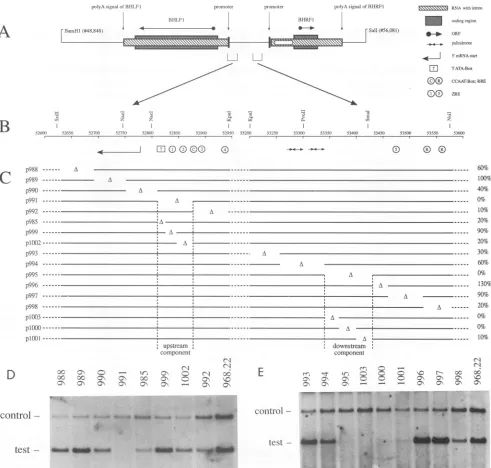
test-FIG. 1. Structure of thelytic originof DNAreplicationof EBV. (A)The BamHI-to-SalIfragment encompassing oriLytwithin the left duplicatedsegmentisschematicallyshown.The coordinates of thisfragmentarebasedonreference 3 andrepresent the situation of theB95-8
strain of EBV.Thisfragmentwascloned intoapUCvectorwhichwascalledp968.22. Itspansthewild-type lytic originofEBV,including
thecoreand auxiliary regions.Thedivergent genesfor BHLF1 and BHRF1areshowntogetherwith theirpromoterlocalizations, mRNA
structures, and open reading frames (ORFs). The horizontal brackets delineate the sequence elements described in reference 21 which encompasstheminimaloriLytelement. (B)Enlargedviewwhich shows the upstream(fromSstIItoKpnI)and downstream(fromKpnIto NsiI) regions of oriLyt togetherwith thenucleotidesequence mapof B95-8. Knownsequenceelementsareindicatedby symbols, including bindingsites for BZLF1(ZREs),the TATA andCCAATboxes,and obvioussecondarystructureswhich include directand invertedrepeats. (C) RelevantpartsoforiLytmutantplasmidsderivedfromp968.22areindicatedbyhorizontallines,and the localization of the deletionscan
beinferred from the nucleotidemap. Thereplication efficienciesof the different deletionmutantsin theoriLyt replicationassay,compared
withthereplication efficiency ofp968.22, whichwasset to 100%, aresummarized atthe right.The deletion inp991 andp995 abolished
replication completely and gives the boundaries of the essential upstream and downstream components, respectively. (D and E) Two
autoradiograms which present the original data of one set oftransient replication assays focusing on mutations of the upstream and downstreamregions, respectively. Theposition ofthecontrolsignals gives the position ofwild-type oriLyt plasmid p526 (21),which served
as aninternalstandardto correctfortransfectionefficiencyinthe individualsamples.Thepositionof thetestsignals givesthesignal strength,
which isarelativemeasurement of the efficiencywith which themutated oriLyt plasmid replicated.The deletions in the mutatedoriLyt plasmidsremoved thefollowing nucleotides: 52,630to52,692 in p988, 52,693to52,752inp989,52,753to52,810inp990, 52,811to52,877in
p991, 52,878to52,945inp992, 52,811to52,825 in p985, 52,826to52,846inp999, 52,847to52,877inp1002,53,202to53,256inp993, 53,257 to53,340inp994, 53,341 to53,428inp995, 53,429to53,459inp996, 53,460to53,526inp997,53,527to53,589inp998, 53,341to53,368in
plO03, 53,369to53,401inplO00, and 53,402to53,428 in p1001.
A
B
C
0D
(00
p993
P994 p995
p996
p997 P998
Cl Cl
'C r-> X OC
vN Z. ZN sO
c\ aN v Z
a
3
i
LI
J. VIROL.
s>5sN:sg1lialo.5it .1 :1
on November 9, 2019 by guest
http://jvi.asm.org/
[image:2.612.61.552.74.542.2]EBV cis-ACTING ELEMENT 4239
downstream regions of oriLyt could be tested in the context of core and auxiliary elements. By using this strategy, the overall structure of oriLyt was unchanged and preserved in allmutants. The function of the mutant oriLyt plasmids was tested in transient replication assays and quantitated to ensurereproducibility. In parallel, transcriptional activation of the flanking or integral promoter regions was measured in the mutated plasmids in two different EBV-positive cell lines. By analyzing more than 60 mutant oriLyt plasmids, two novel components within the lytic origin of DNA replication were identified. One component residing in the upstream region of oriLyt encompassed the BHLF1 pro-moterelement, and the second was found within the down-stream region. The updown-stream component seemed to consti-tute mainly transcription factor-binding sites, including binding sites for the BZLF1 gene product. The downstream component had no previously assigned function. The up-stream component of oriLyt was crucial for both DNA replication and RNAtranscription. The downstream compo-nent was absolutely required for replication but had no significant impact on transcription. Thus, at least two com-ponents with different yetinteracting functions are required for DNA replication of oriLyt.
MATERIALSANDMETHODS
Cell lines. D98 HR1 cells were derived from a somatic cell hybrid between EBVgenome-positive Burkitt's lymphoma cell line P3HR1 and human epithelial cell line D98 (17). This adherent cell line contains approximately 20 copies of the EBV genome (data not shown) and was maintained in Dulbecco's modified Eagle's medium containing 5% fetal and5%newborncalf sera. HH514 is ahet-free cell clone of the P3HR1 Burkitt's lymphoma cell line (23) which was growninRPM11640 medium supplemented with 5% fetal and 5% newborn calf sera.
Recombinant plasmids. Plasmid p968.22 was constructed byligating a 7.2-kbpBamHI-SaiI fragment from EBV strain B95-8(nucleotides 48,848 to 56,084) (3) into a BamHI-SalI-cut pUC8 vector plasmid. This plasmid clone was further modified to contain two linker insertions at positions 52,385 and 54,465 to carry additionalXhoI and SalI sites, respec-tively, for cloning. These alterations did not affect the oriLyt function of this plasmid (data not shown). Mutants of p968.22 were constructed in three steps. (i) A SacI-BglII fragment (EBV nucleotides 52,385 to 54,360) was inserted into appropriately cleaved M13mp18 or pBluescriptIlsk(-) plasmids. (ii) The single-stranded DNAs derived from these vectorplasmids were mutated in accordance with the oligo-nucleotide-directed in vitro mutagenesis protocol (26) with a commercially available kit (M13 in vitro mutagenesis kit; Bio-Rad) supplemented with T4 gene 32 and T4 DNA polymerase from Boehringer Mannheim. (iii) The mutated fragment was reinserted into the p968.22 plasmid to provide theoriLyt flanking sequences. All mutations were confirmed by DNA sequencing with the chain termination method (38).Thesynthetic oligonucleotides needed for mutagenesis and the sequencing primers were purchased (University of Wisconsin Biotechnology Center) or synthesized on an oligonucleotide synthesizer (Pharmacia) and purified on re-verse-phase columns through high-pressure liquid chroma-tography. All deletion, randomization, and substitution mu-tants of oriLyt relevant to this study are graphically presented in the Fig. 1 to 5, which include sequence infor-mation onspecific mutations.
Toperform the transient transcription assays, the 3.8-kbp
SacII-EcoRI fragment of p968.22 (from position 52,623 of EBV to the multiple cloning site in p968.22) carrying the BHLF1 open reading frame was replaced by the luciferase gene, which was used as a reporter gene. Similarly, the 1.7-kbpBgiII-SalI fragment (from position 54,360 of EBV to the multiple cloning site in p968.22) carrying the BHRF1 open reading frame was replaced by the luciferase gene.
Plasmid pCMV-BZLF1 is an expression vector which efficiently induces the lytic phase of EBV's life cycle. The BZLF1-encoding gene is driven in this retroviral vector construct by the promoter of the immediate-early genes of the humancytomegalovirus as previously described (21).
Transfection of plasmid DNA. Transfections of plasmid DNA wereperformed with an electroporator (Bio-Rad). We used cuvettes (0.4-cm gap) containing 5 x 10⁶ cells in a volume of 250
RI
of cellculture medium supplemented with serum. The cells were electroporated with 180 (D98HR1 cells) or 220 (HH514cells) V.Transient replication assays. Ten micrograms of oriLyt plasmid DNA wascotransfected with 1
jig
ofp526and 10jig
ofpCMV-BZLF1 into D98HR1 cells as described previously (21). Plasmid p526 has been described (21) and contains a wild-type oriLyt fragment. It was used as aninternal control for standardization for each mutant plasmid to be tested. Concomitant introduction of plasmid pCMV-BZLF1 effi-ciently induces the lytic cycle of EBV. Two days after cotransfection, DNA was prepared, input plasmid DNA was digested with DpnI and BamHI, and the efficiency with which the oriLyt plasmids replicated was quantitated by scanning the specific fragment signals detected after South-ern blot hybridization and autoradiography as described previously (21).Transient transcription assays. To measure relative tran-scriptional activation from the divergent promoter elements of the BHLF1- and BHRF1-encoding genes in different mutant oriLyt plasmids (Fig. 1A), 10 ,ug of plasmid DNA containing the luciferase reporter gene at the appropriate position was cotransfected together with 10
jig
of pCMV-BZLF1 and 0.5jig
ofpCMV-13-galintoD98HR1 andHH514 cells as described above. Plasmid pCMV-,-gal was used as aninternal standard to normalize for transfection efficiency. Luciferase activity was measured as previously described (12), with minormodifications. Transfected cells were har-vested 2 days aftertransfection, washed once in phosphate-buffered saline, and lysed in 100,ul of 100 mM K2HPO4 (pH7.8)-i
mM dithiothreitol-1% Triton X100. The lysate was transferred into an Eppendorf tube, vortexed for 1 min, and centrifuged for 15 min at 15,300 x g at 4°C. Ten microliters of the supernatant was added to 350RI
of ice-cold 25 mM glycyl-glycine-5 mM rATP-15 mM MgSO4. An LB9501 luminometer (Berthold) was programmed to inject 100 ,ul of luciferin (0.3 mg/ml in 0.5 MK2HPO4, pH 7.8). Relative light units were determined during a 10-s period. Each sample was analyzed in duplicate. To normalize for efficiency of transfection, the ,-galactosidase activity expressed from cotransfected plasmid pCMV-I-gal (32) was measured as described in reference 24, with slight modifications. The chemiluminescent substrate for ,B-galactosidase was 3-(4-methoxyspiro[1,2-dioxetane-3,2'-tricyclo[3.3.1.13'7]decan]-4-yl)phenyl-j-D-galactopyranoside
(AMPGD; Serva) at 10 ,ug/ml, and 5RI
of the supernatant of each sample was measured in 150,ulof 100 mMNa2HPO4 and 0.1 mM MgCl2. After 15 to 30 min at room temperature, the reaction was stopped with the injection of 100,u1 of 0.2 MNaOH and10% Emerald Enhancer (Serva). Two seconds after injection of VOL.67, 1993on November 9, 2019 by guest
http://jvi.asm.org/
MUTANT
PLASMID REPLICATIONEFFICIENCY
52780 +1
I . 52880
100%
p91 GCTGCGACCGCTCGGCCCGGCCGAGCGGAAG A GGTTA
CCAAT
p9OC
CGACGCTGGCGAGCCGGGCCGGCTCGCCTTC GGGGTCTCTGTGTAATACTTTAAGGTTTGCTCAGGAGTGGGGGCTTCTTATTGGTTAP985 GCTGCGACCGCTCGGCCCGGCCGAGCGGAAG CCCCAGAGACACATTATGAAATTCCAAACGAGTCCTCACCCCCGAAGAATAACCAAT
p980
CGACGCTGGCGAGCCGGGCCGGCTCGCCTTCTTCTTTTCTTAGGGGTCTCTGTGTAATACTTTAAGGTTTGCTCAGGAGTGGGGGCTTCTTATTGGTTA
GCTGCGACCGCTCGGCCCGGCCGAGCGGAAGAAATAAAAAATCCCCAGAGACACATTATGAAATTCCAAACGAGTCCTCACCCCCGAAGAATAACCAAT
P981 CGACGCTGGCGAGCCGGGCCGGCTCGCCTTCATTTCTTTCCTTTTTGGGGTCTCTGTGTAATACTTTAAGGTTTGCTCAGGAGTGGGGGCITCTTATTGGTTA
P983 GCTGCGACCGCTCGGCCCGGCCGAGCGGAAGTAAGAAGQAAAAACCCCAGAGACACATTATGAAATTCCAAACGAGTCCTCACCCCCGAAGAATAACCAAT p982PGCTGCGACCGCTCGGCCCGGCCGAGCGGAAG532&T
CGACGCTGGCGAGCCGGGCCGGCTCGCCTTCATAA5TAAAAATAGGGGTCTCTGTGTAATACTTTAAGGTTTGCTCAGGAGTGGGGGCITCTTATTGGTI
STTTTTTTAATCCCCAGAGACACATITATGAAATTCCAAACGAGTCCTCACCCCCGAAGAATAACCASp983
CGACGCTGGCGAGCCGGGCCGGCTCGCCTTCTAATTTTTTT25T=&TGGGGTCTCTGTGTAATACTTTAAGGTTTGCTCAGGAGTGGGGGCTTCTTATTGGTI
GCTGCGACCGCTCGGCCCGGCCGAGCGGAAGATTAAAAAAAATAAATACCCCAGAGACACATTATGAAATITCCAAACGAGTCCTCACCCCCGAAGAATAACCAPp984
CGACGCTGGCGAGCCGGGCCGGCTCGCCTTCAAAAAGAG9ITaAhAGGGGTCTCTGTGTAATACTTTAAGGTTTGCTCAGGAGTGGGGGCTTCTTATTGGTTA
P GCTGCGACCGCTCGGCCCGGCCGAGCGGAAGTTTTTCTATTTTCCCCAGAGACACATTATGAAATTCCAAACGAGTCCTCACCCCCGAAGAATAACCAAT
p979 #52630 A 1TT1 TTATCCTCTT11GGTCTCTGTGTAATA1AGGTTTGCTCAGAGTGGGGGCTTCTTATTGGl A
AAAATAGGAGAAAAACCCCAGAGACACATTATGAAATTCCAAACGAGTCCTCACCCCCGAAGAATAACCAAT
p1055 CGACGCTGGCGAGCCGGGCCGGCTCGCCTTC GGGGTCTCTGTGTAATACTTT a GGTTA
P GCTGCGACCGCTCGGCCCGGCCGAGCGGAAG CCCCAGAGACACATTATGAAA CCAAT
90%
0%
upstream component
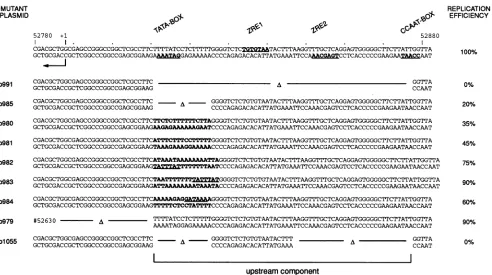
FIG. 2. Mutations in the TATA box of the BHLF1promotermodulate theefficiencyoforiLyt replication.The top linegivesthe structure oftheBHLF1promoterwith known hallmarks of thiselement,includingthe 5' end of themRNA;the TATA box motif(27);BZLF1-binding sitesZRE1 and ZRE2(28),towhichBZLF1 binds(4, 25); and the CCAATbox motif. Thesesequenceelementsareunderlined andindicated
inboldtogetherwith the strand specificity. Themutantsarebasedonwild-type plasmid p968.22, andthe deletionsandsubstitutionsaregiven
in detail inthe lowersectiontogetherwith themutatedoriLyt plasmids (leftcolumn)and their relativereplicationefficiencies(right column). Inp980 and p981, the originalsequence wasrandomizedarbitrarily, p982 and p983carrythe simian virus 40earlypromoterTATA box(5),
andp984 carries aninversion ofthe BHLF1TATAbox shown in thetop line. TheconsensusTATA box isunderlined, and the mutated
nucleotidesareinbold.
thestopmixture, the emitted photonsweremeasured for5s.
Allreactions wereperformedin duplicate. RESULTS
Fine mapping of sequence elements required for oriLyt function. Replication of oriLyt plasmids was measured in D98HR1 cells, which are latently infected with EBV and
supportthe lytic phase of EBV's lifecycle. Thecellswere
cotransfected with three different plasmids. (i) pCMV-BZLF1inducedthelytic cyclein thesecellstoprovideEBV functions intrans, (ii) p526carriesafullyfunctional oriLyt
sequence and served as aninternal controlfor
standardiza-tion, and (iii) p968.22 or a mutant oriLyt plasmid to be tested. Twodaysafterelectroporation, DNAwasprepared
anddigestedwith BamHItocleave theoriLyt plasmidsonce ortwice. The cell DNAwasdigested inparallel withDpnI,
which cleaves input DNA that had been methylated in a
dam+Escherichia coli host into smallfragmentsbut leaves DNAintact that hasgonethroughatleastoneroundofDNA
replication in eukaryotic cells. The cleaved DNAs were
separated on gels, and the oriLyt plasmid DNAs were
detected with radioactively labeled prokaryotic sequences
afterSouthernblotting aspreviously described (21).
Previously, two minimal regions within oriLyt had been identified by using progressive deletion mutants of oriLyt plasmids (Fig. 1B) (21). This information wasthe basis for
dissection of these minimal regions in more detail. Small
deletions(from 25to90 bp long)wereintroducedintooriLyt
anddesigned as scanning mutations, as shown inFig. 1C.
The mutations were generatedby oligonucleotide-directed
mutagenesis on single-stranded DNAtemplates. All oriLyt mutantplasmids encompassedEBVsequencesfrom
coordi-nates 48,848 to 56,081 (3) (Fig. 1A), and they all were
partially sequencedtoconfirm theintended mutations andto
ensure the integrity offlanking regions. The results ofthe
transientreplication assaysaresummarized in Fig. 1C, and examplesareshown inFig. 1D and E. The relative replica-tion efficiencies, compared with that of wild-type oriLyt, given in Fig. 1C and elsewhere in this report, are mean
values ofat least threeindependent experiments.
Within theupstreamregion of the minimaloriLyt,mutant plasmid p991 identified a 67-bp sequencewhich was
abso-lutely required for DNA replication (Fig. 1C). Likewise, mutant plasmid p995 allowed identification of an 88-bp sequencein the downstreamregionwhichwasessential for replication. For clarity, these sequences were termed up-stream and downstream components of oriLyt (Fig. 1C). Othermutations merelyaffected the efficiency with which oriLytmutantplasmids replicated. Some deletions reduced theefficiencyoforiLyt replicationbya factor of 10(p992);
others hadnomeasurableeffect(p989).In thisstudy,thetwo components identified by oriLyt plasmids p991 and p995
wereinvestigated in detail.
The67-bpupstreamcomponentwasfurtheranalyzed for
sequence elements required for oriLyt replication in cis.
0%
20%
35%
45%
75%
90%
60%
CGACGCTGGCGAGCCGGGCCGGCTCGCCTTCTTTTATCCTCTTTTTGGGGTCT'CTG TACTTTAAGGTTTGCTCAGGAGTGrGGGCTTCTTATTGGTTA
AT TA AT
on November 9, 2019 by guest
http://jvi.asm.org/
[image:4.612.62.554.70.345.2]EBV cis-ACTING ELEMENT 4241
52780 +1 52880
CGIACGCTGGCGAGCCGGGCCGGCTCGCCTTCTTTTATCCTCTTTTTGGGGTCTCTGTGTAATACTTTAAGGTTTGCTCAGGAGTGGGGGCTTCTTATTGGT,TA
GCTGCGACCGCTCC-GCCCGGCCGAGCGGAAGAAAATAGGAGAAAAACCCCAGAGACACATTATGAAATTCCAAACGAGTCCTCACCCCCGAAGAAZ&AAT
p990 #52753 A TTTTATCCTCTTTTTGGGGTCTCTGT TACTTTAAGGTTTGCTCAGGAGTGGGGGCTTCTTATTGGTTA AAAp90GAGAAAAACCCCAGAGACACATTATGAAATTCCAAACGAGCCTCACCCCCGAAGAATAACCAAT 1 057 CGACGCTGGCGAGCCGC-GCCGGCTCGCCTTC
GCTGCGACCGCTCGGCCCGGCCGAGCGGAAG A
40% n.d.
.#52899 2% n.d.
p1058 CGACGCT A GGGGTCTCTGTG TACTTTAAGGTTTGCTCAGGAGTGGGGGCTTCTTATTGGTTA GCTGCGA CCCCAGAGACACATTATGAAATTCCAAACGAGTCCTCACCCCCGAAGAATAACCAAT P991 (:1ACGC'1CCL1'CTGTT
GCTGCGACCGCTCGGCCCGGCCGAGCGGAAG A
GGTTA CCAAT
p992 CGACGCTGGCGAGCCGGGCCGGCTCGCCTTCTTTTATCCTCTTTTTGGGGTCTCTGTGTAATACTTTAAGGTTTGCTCAGGAGTGGGGGCTTCTTATT 1
p2 GCTGCGACCGCTCGGCCCGGCCGAGCGGAAGApc TAGAGAAAAACCCCAGAGACACATTATGAAATTCCA ACTCACCCCCGAAGAkATAA
p1054 CGACGCTGGCGAGCCGGGCCGGCTCGCCTTCTTTTATCCTCTTTTT
GCTC-CGACCGCTCGGCCCGGCCGAGCGGAAGAAAATAGGAGAAAAA CCAATGGTTA p1056 CGACGCTGGCGAGCCGGGCCGGCTCGCCTTC A TTTAAGGTTTGCTCAGGAGTGGGGGCTTCTTATTGGTTA p06 GCTGCGACCGCTCGGCCCGGCCGAGCGGAAG AAATTCCAAACGAGTCCTCACCCCCGAAGAATAACCAAT
CGACGCTGGCGAGCCGGGCCGGCTCGCCTTC A GGGGTCTCTGTG TACTTTT GGTTA
GCTGCGACCGCTCGGCCCGGCCGAGCGGAAG CCCCAGAGACACATTATGAAA CCAAT p1059 CGACGCTGGCGAGCCGGGCCGGCTCGCCTTC=TATCCTC=TTGGGGTC A _ GAGTGGGGGCTTCTTATTGGTTA
GCTGCGACCGCT'CGGCCCGGCCGAGCGGAAGAAATGAGAAAAACCCCAG CTCACCCCCGAAGAA ~AAT
p985 CGACGCTGGCGAGCCGGGCCGGCTCGCCTTC A GGGGTCTCTGTGTAATACTFTTAAGGTTTGCTCAGGAGTGGGGGCTTCTTATTGGTTA
p985 GCTGCGACCGCTCGGCCCGCCCGAGCGGAAG CCCCAGAGACACATATGAAATTCCAACGAGTCCTCACC CCCGAAGAATAACAAT
10% n.d.
0% 7%
10% n.d.
6% 60%
11% 8%
0% 4%
50% 60%
20% 30%
GCTGCGACCGCTCGGCCCGGCCGAGCGGAAGAAAATAGAGAAAAA
A AAGGTTTGCTCAGGAGTGGGGGCTTCTTATTGGTTA
TTCCAAg ACCCCCGAAGAATAACAAT pl002 CGACGCTGGCGAGCCGGGCCGGCTCGCCTTCTTTTATCCTCTTTTTGGGGTCTCTGTGTAATAC.-TT AGGT-A GCTGCGACCGCTCGGCCCGGCCGAGCGGAAGAAAATAGGAGAAAAACCCCAGAGACACATTATGAAA A CCAAT
upstream component
[image:5.612.64.558.76.369.2]20% 100%
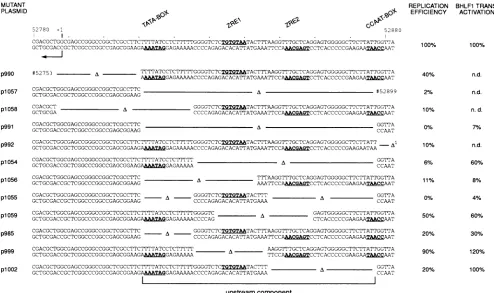
FIG. 3. Cooperativeelements mediate oriLyt replication in theupstreamcomponent.Thetopline is identicaltoFig. 2,which gives the
structureof the BHLF1promoterwith important elements, including theTATA boxmotif(27),BZLF1-binding sitesZRE1and ZRE2 (28),
and theCCAAT box motif.Singleanddouble deletionmutantsin thebackground of wild-type oriLyt plasmid p968.22areindicated together
with thesequence elements thatwere removed in the single constructs. Relative efficiencyin termsof DNA replicationis indicated (first
columnontheright side), togetherwith theeffectsontranscriptional transactivationof the BHLF1promoterin luciferasereporter constructs (secondcolumnontheright side). The boundariesof theupstream componentaregivenatthe bottom.
Surprisingly,all threedeletionmutantsthat removedpartsof the upstream component reduced the efficiency of DNA replication but didnotabolish itcompletely (Fig. 1C and E, p985, p999, p1002). This initial finding indicated that
ele-ments affected by smaller deletions might cooperate with other sequence elements that reside within the upstream component. In contrast, the refinement of the downstream
componentidentified acontiguous sequence element which
was nonfunctional likep995 (Fig. 1C toE).
TATA box mutations alone have a minor effect on DNA replication. First, we wanted to dissect the upstream
com-ponent even further. We speculated that the TATA box
might beagood candidate to startwith, since its deletion in
the BHLF1promoterdecreased theefficiency of p985 repli-cationby 80% (Fig. 1). Wewondered whether this effectwas
caused by removal ofa generic TATA box-binding factor
motifor by a spacing problem. Two substitution mutants
which had thesameA Tcontentbutarandomizedsequence
composition (p980andp981) partiallyrestored activityto35 and 45% of thewild-type level, respectively, comparedwith
deletionmutantp985 (Fig. 2). Introduction of the TATA box motif from the simian virus 40 early promoter (5) in either
orientation (p982 and p983) improved replication almost to
thewild-type level, whereas inversion of the BHLF1 TATA
box and itsflanking regionhadanintermediate effect(p984; Fig. 2). In all, a functional TATA box motif seemed to
improve the efficiency of oriLyt replicationbut was not an
absolute requirement.
Atleasttwo promoterelements cooperatefororiLyt func-tion. The modulation of DNAreplication seen with TATA
boxmutantsoforiLyt ledustolook forsynergisticoratleast cooperative effects with other elements. Known transcrip-tion factors that bind within the BHLF1 promoter might
represent such candidates which cooperate with TATA box-binding proteins (29) and could play a role in DNA
replication, too.Binding motifs for the BZLF1geneproduct
(ZRE1 and ZRE2) are located between the TATAbox and
the CCAAT boxconsensussequence, andeachof themwas
inactivated in oriLyt null mutant p991 (Fig. 1 and 3). Consequently, we analyzed oriLyt mutants in which these
individual sequence elementswere deleted in various
com-binations (Fig. 3). Deletion ofsequencesdownstream of the
TATAbox that removed ZRE1,ZRE2, and theCCAAT box
hadapronouncedeffect (6%; p1054),verysimilartothat of
combinatorial deletions of the TATA boxtogetherwithone
ZRE element (11%; p1056) or one ZRE element plus the
CCAATbox motif(0%; plO55). Removal of the two
ZRE-bindingmotifs alone hadanintermediate effect(50%; p1059) which is partly due to a spacing problem which brings downstream sequences closer to the TATA box sequence
motif(data not shown).
RNAtranscription and DNAreplication are dependenton
shared sequence elements. Since the upstream component
encompassesthe well-defined BHLF1promoter(27, 30, 31),
it was tempting to speculate that the elements required for
DNAreplication are identicaltoelementsrequiredfor RNA MUTANT
PLASMID REPLICATIONEFFICIENCY BHLF1 TRANS-ACTIVATION
100% 100%
p999 90% 120%
VOL. 67,1993
on November 9, 2019 by guest
http://jvi.asm.org/
52700 52750 52800 52850 52900
2
cn z52950 53200 53250 53300 53350 53400 53450 53500 53550 53600
I ~ ~~~I
4
I
r
ED (D
D®
A
A
A
0)
0D
00(9
A
A
A
A
A
A
A
A
---290% lucm -- Aii
upstream downstream
component component
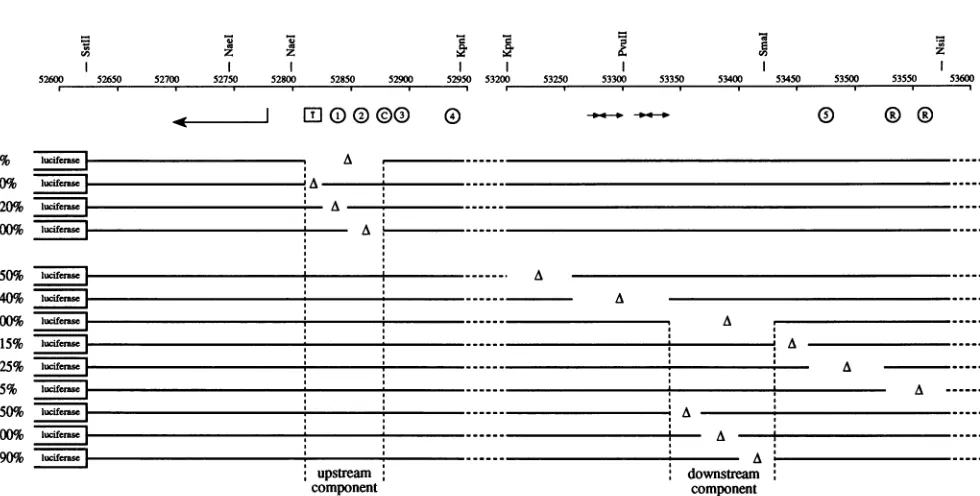
FIG. 4. Some, butnotall,of the elements involved intranscriptionandreplicationcolocalize inoriLyt. oriLytmutantswereanalyzedfor
transcriptionaltransactivation of the BHLF1 promoter in luciferase reporterconstructs.The deletionmutantsusedwereidenticaltotheones
showninFig.1C,includingthe features and annotations of the minimaloriLyt regionsin thetop line. Removal of thecomplete upstream
componentreduced thelevelof the promoteractivityto7% of thewild-type configuration (left column)but didnotabolish itcompletely.In
contrast,smaller deletionmutantsof the upstream componentpartlyrelieved this effect.Scanningdeletionmutantsof the downstreamregion,
including the downstreamcomponent,hadonlymarginaleffectsonBHLF1 promoteractivity,withoneexception (bottom line)whichcaused
threefoldactivation of the BHLF1promoter.
transcription. To concentrate on this possibility, we
con-structed a number of reporter plasmids based on oriLyt
deletion mutants. Theluciferasereportergenereplacedthe
BHLF1 coding sequences, which allowed quantitation of BHLF1 promoter activity in the different mutants. The plasmidsareschematically depictedinFig.3and 4together with their relativelevels of BHLF1promoteractivity. From thisanalysis, itappearedthatmostmutationshad
compara-ble effects on transcription andreplication. Deletion of the
TATAbox, aloneorinconjunctionwith otherbinding sites
forpromoterfactors, paralleledthe effects seenwithsingle
and combinatorial oriLyt mutants in general. However, thereweretworemarkableexceptionsto thisrule: mutants p1002 and p1054 (Fig. 3), which had very much reduced
levels of DNA replication and nearly wild-type levels of RNA transcription. Although we do not know the molec-ular basis for this finding, it indicates that transcription and replication are not necessarily intimately linked (see below).
The downstream component is a novel motif in complex herpesviral origins. The downstream component of oriLyt
was defined by oriLyt mutant p995 (Fig. 1). Attempts to
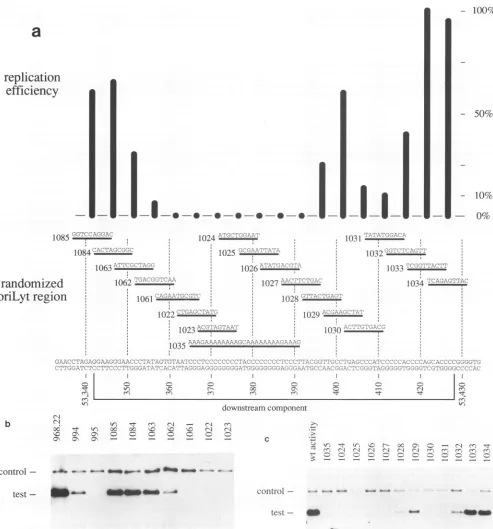
delineate further thesequences crucial forDNAreplication were undertaken with 3 deletion mutants (Fig. 1C, p1001, p1002,andp1003) and 19 substitutionmutants(Fig. 5a). The latterwere arranged in partlyoverlapping fashion and
con-tainedrandomizedstretches(usually 10 bp)within the down-stream component. Again, the mutations were embedded
into theBamHI-SalIfragment of EBV depicted in Fig. 1A. In transient replication assays, the oriLyt mutant plasmids identifiedauniquesequence element spanning EBV
coordi-nates53,355to53,395whichwasextremely sensitive toany
mutationintroduced(Fig. 5).Furtherdownstream,asecond site was identified with oriLyt mutants p1030 and p1031. Randomized substitution of 10 to 20 bp was sufficient to
reduce the efficiency of oriLyt DNA replication substan-tially. Anucleotide sequence comparisonwith the regions from coordinates 53,350 to 53,430 revealed similarly
con-servedregionswhichwerereiterated in the simian cytomeg-alovirus lytic origin of replication (data not shown; 2). Whether this homology merely reflects the very high GC
contentof thisarea orisfunctionally importantremainstobe demonstrated.
RNA transcription and DNA replication are not always linked in oriLyt. Since the upstream component of oriLyt showed an impressive interaction with known sequence
elementsinvolved in RNAtranscription,wewantedtoknow whether this finding might hold true for the downstream element. Others identified enhancer-like structures in this region which includedtwobinding sites for viral transcrip-tion factor R (18, 30). oriLyt mutants spanning the
down-stream region of the minimal origin were constructed to
measure transcriptional transactivation from the BHLF1
(Fig. 4) or BHRF1 promoter in two different cell lines (D89HR1 and HH514; datanot shown). The mutantswere
found to be only marginally affected with respect to tran-scription. Whereastranscriptionfromthe BHRF1promoter
wasgenerallyreduced to about30 to 50% of thewild-type
levelirrespectiveof themutation,BHLF1promoteractivity
waspartlydiminishedbyonemutant but stimulated almost threefoldby another(Fig. 4). Theformer removed thetwo
bindingsites fortranscriptionfactorR, and the latter had a
sequence removed which was found to be part of the
downstreamcomponent.Neitherdeletion ofafifth
BZLF1-52600 52650
7%
30% 120%
100%
150%
140% 100%
115%
125%
65%
150% 100%
lucifemse lucifemse lucifemsp-lucifemse
lwffcmsc lwffcmsc lwffemsc lucifemse lucifemse lucifemse lucifemse lucifemse
on November 9, 2019 by guest
http://jvi.asm.org/
[image:6.612.64.554.57.305.2]EBV cis-ACTING ELEMENT 4243
a -
100(%
replication
efficiency
-S
-S-S-@-0-S-I-1085
1084
-1063A:ed
1062 -.1061 1022d)
I1023
1025 1026
1027
Io:.
1031----1032
- ~~~~~1033
1034
1030 -" '-7-..
10359
I ~~~INJII~ ~ ~ ~ ~ ~ ~ ~II~
CS I~~~~~~~~~~~~~~~~~~~~~~~~~~~~~~t
to~ -t C5~ (Cl ell
r5-VI X ZC IC Cli (-,
CZN
C-Lit Lfl C:- >- C- I
Cs,-(NI r,I ((ClI CI- CI CS- CS.
control %"- O*'tw . edoOM om
test mSIa--e ofs A conitrol
lest to
FIG. 5. Finemappingof the downstreamcomponentrevealsanovelelement involved inoriLyt replication.Deletionscanningmutantsof thedownstreamregionweretestedfor DNAreplication in the transientoriLyt replicationassay. Inparta,thereplicationefficiencies of the
singlemutantsaregiveninahistogramin whichthat ofwild-type oriLyt plasmid p968.22wasset to100%. The sequence stretches mutated
by randomsubstitutions are given in the lower section together with the context of oriLyt spanning the downstream component from nucleotides52,342to53,428of EBV(3). Again, themutantplasmidsarebasedonp968.22toprovideall of the otherflanking regionsshown inFig.1A.Panels b andcpresenttheoriginaldataonthesemutantsintwoautoradiograms.The mutatedplasmidsarearrangedinidentical
order, andplasmids p994andp995,whicharealso shown in Fig.1, areincluded.
VOL. 67, 1993
a
- 50%
- 10(%
randomiz
oriLyt
reg--ion
b
CA
Cl4
:c
-t-'C ZIN
ZN ZN
1024-7,-.
(iownstream
coniponent
,
r.1:.,c, ;.-, -,
--7t..1-7 t-1.11.
I
on November 9, 2019 by guest
http://jvi.asm.org/
[image:7.612.67.560.94.623.2]binding site (ZRE5 in Fig. 4) nor removal of obvious sec-ondary structure sequences had any significant impact on RNA transcription or DNA replication. Thus, sequence elements required for DNA replication are not necessarily required for RNAtranscription and vice versa.
DISCUSSION
Definition of oriLyt core elements. Wehave identified two componentswhich, when embedded in the otherwise intact lytic origin of DNA replication of EBV, are both absolutely required for any DNA replication of oriLyt. In contrast to these upstream and downstream components, which com-prise the core of oriLyt, flanking sequences determine the relative efficiency of oriLytfunctions. Deletion of a number of sequences whicharedistributed between thetwo compo-nentsof the core origin, as well as in distal flanking regions, decreased the level oforiLyt replication to various extents (21; Fig. 1). However, the nature of small scanning deletion mutantsmakes it verydifficult to identify the molecular basis for this finding. Small deletions which arbitrarily affect only parts ofredundant replication elements might have effects comparable to those of deletions which disturb spacing requirements. For example, we have previously identified a region within oriLyt which rescued oriLyt replication from a null mutant by functional substitution (21). The identified region, represented by oriLyt mutants p996 through p998 (Fig. 1C), was found to have only auxiliary functions here, since mutations did not abolishDNAreplication completely (Fig. 1). In the former study, the same region appeared to be conditionallyrequired for oriLyt function. Thus, it is likely that a more extended deletion in thisregion might dramati-cally affect oriLyt replication, too.
Likewise, redundant and multiple sites for replication factors with certain requirements for specific binding motifs might be scattered throughout oriLyt and therefore be missed by this strategy. Agood example of such sequence elements are the binding sites for the viral transcription factor BZLF1. Six, or perhaps seven, BZLF1-binding sites were found in the oriLyt fragment used here (28). Two pairs of such sitesareclustered; one pair(ZRE1 and ZRE2) is part of the upstreamcomponent, and theother (ZRE3 and ZRE4) is found in its close vicinity (Fig. 1B). The remaining ZREs are dispersed and located downstream of this cluster (19, 31). Removal of the ZRE5 site to which BZLF1 has the highest affinity in vitro had no effect on replication. In contrast, reciprocal deletions of the ZRE1-ZRE2 and ZRE3-ZRE4 pairs argued for a distinct role of BZLF1 in oriLyt replication (Fig. 1C to E). Specific deletion of ZRE1 alone hadamarginal effect, while deletion of ZRE1-ZRE2 had an intermediate effect(Fig. 3). Thus, we may have missed other essentialbut redundant elements which were scored neither indeletion scanning mutations nor by conventional comput-er-assisted homology search criteria (data not shown). Therefore, our definition of two core components of oriLyt is limitedby our analysis.
oriLytis distinctfrom thelytic origins of the alphaherpes-virus andbetaherpesvirus subgroups. The overall structure of oriLyt, its multipartite organization, and its colocalization with elements of transcription make itvery different from otherherpesviralorigins. Although the structure of two lytic origins ofreplication from members of the betaherpesvirus subgroup is similarly complex (1, 2, 22, 33), it does not share anyobvious extended homology with oriLyt of EBV. Her-pessimplexvirus and other members of the alphaherpesvi-rus subgroup, on the other hand, appear to be simple with
respect to their lytic-phase origins of DNA replication. These generally consist of oneelement of less than 150 bp which ishighlyconserved in structure and nucleotide com-position(see reference 20 for a review). The origins have a mirror imageof symmetry with anA. T-rich center flanked by one or two binding sites for a virally encoded DNA-binding protein (13, 34). This protein is an ATP-dependent helicase (6, 15) which may provide a link to other viral proteins that act in trans (7, 35, 42). The efficiency of lytic-cycle DNA replication is influenced by sequence ele-ments flanking the coreof thelytic origin in herpes simplex virus (41). Like oriLyt of EBV, these flanking sequences consist of promoters and DNA-binding motifs for viral or cellular transcription factors. In herpes simplex virus, the flanking sequences score as auxiliary components, which might allow for redundant and cooperative DNA-protein interactions, thereby stimulating DNA replication. Again, themolecular basis for this effect is unclear.
Genetic data support the idea that many, if not most, of the proteins involved in lytic-phase DNA replication of herpesviruses are virally encoded. A complementation assay (7) was crucial in identifying the trans-acting genes essential for lytic DNA replication of herpes simplex virus (see reference 7for areview). A similar approach has led to the identification of viral genes ofEBVthat interact with oriLyt in thelyticphaseof the virus's life cycle (16). Although the trans-actingreplication factors are expected to exert similar functions, there is a striking difference between EBV and herpes simplex virus. It appears that EBV lacks a homolog of theorigin-specific DNA-binding protein found in herpes simplex virus and otheralphaherpesviruses (16). By analogy to herpes simplex virus, oriLyt of EBV requires a similar function whichmight be provided by a viral or cellular factor in trans. Such a protein is expected to have specific func-tions dedicatedtolytic-cycle replication. Given our findings of twoessential components of oriLyt, it is very likely that one(or both) could encompass DNA-binding sites required forayet tobe definedreplicationfactor(s). BZLF1 is a likely candidate for this virus-specific replication factor.
ACKNOWLEDGMENTS
We aregratefultoNoreen Warren, whohelped to make the initial
oriLyt mutants. We thank Bill Sugden and Georg Bornkamm for
continuoussupport, manyhelpfuldiscussions, and comments on the manuscript.
We were supported by grants AI-29988, CA-22443, and CA-07175 from the National Institute of Allergy and Infectious Diseases, by grant Fa 138/3-7 from the Deutsche Forschungsgemeinschaft to W.H., andbyagrantfrom the Fond der Chemischen Industrie to G.
Bornkamm.
REFERENCES
1. Anders, D. G., M. A. Kacica, G. Pari, and S. M. Punturieri. 1992.Boundaries and structure of human cytomegalovirus ori-Lyt, acomplex origin for lytic-phase DNA replication. J. Virol. 66:3373-3384.
2. Anders, D. G., and S. M. Punturieri. 1991. Amulti-component origin of cytomegalovirus lytic-phase DNA replication. J. Virol. 65:931-937.
3. Baer, R., A. T. Bankier, M. D. Biggin, P. L. Deininger, P. J. Farrell, T. J. Gibson, G.Hatfull, G. S. Hudson, S. C. Satchwell, C.Seguin, P. S.Tufnell,and B. G.Barmll.1984. DNAsequence andexpression of the B95-8Epstein-Barrvirus genome. Nature
(London)310:207-211.
4. Bannister, A. J., A. Cook, and T. Kouzarides. 1991. In vitro DNAbinding activity of Fos/Jun and BZLF1 but notC/EBPis affectedbyredoxchanges. Oncogene6:1243-1250.
5. Benoist,C., and P. Chambon. 1981. Invivo sequence
on November 9, 2019 by guest
http://jvi.asm.org/
EBV cis-ACTING ELEMENT 4245
ments of the SV40 early promotor region. Nature (London) 290:304-310.
6. Bruckner,R.C., J.J. Crute, M. S. Dodson, and I. R. Lehman. 1991. Theherpes simplexvirus 1origin binding protein:aDNA
helicase. J. Biol. Chem.266:2669-2674.
7. Challberg,M. D.1986. A method for identifying theviral genes required for herpesvirus DNA replication. Proc. Natl. Acad. Sci. USA 83:9094-9098.
8. Challberg, M. D., and T. J. Kelly. 1989. Animal virus DNA replication.Annu. Rev. Biochem. 58:671-717.
9. Chevallier-Greco, A., E. Manet, P. Chavrier, C. Mosnier, J.
Daillie,and A. Sergeant. 1986. BothEpstein-Barr virus (EBV)-encoded trans-acting factors, EB1 and EB2, are required to activate transcription from an EBVearlypromoter. EMBO J.
5:3243-3249.
10. Countryman, J., and G. Miller. 1985. Activation ofexpression
of latent Epstein-Barr herpesvirus after gene transfer with a small cloned subfragment of heterogeneous viral DNA. Proc.
Natl. Acad. Sci. USA82:4085-4089.
11. DePamphilis, M. L. 1988. Transcriptional elements as
compo-nentsofeukaryotic originsof DNA replication. Cell 52:635-638. 12. deWet, J. R.,K. V.Wood, M. DeLuca, D. R. Helinski, andS.
Subramani. 1987. Firefly luciferase gene: structure and expres-sioninmammalian cells. Mol. Cell. Biol. 7:725-737.
13. Elias, P.,andI.R.Lehman. 1988. Interaction of originbinding proteinwith anoriginofreplication of herpes simplex virus 1. Proc.Natl.Acad. Sci. USA85:2959-2963.
14. Farrell, P.J., D. T. Rowe, C. M. Rooney, and T. Kouzarides. 1989. Epstein-Barr virus BZLF1 trans-activator specifically
binds toaconsensusAP-1site and is related to c-fos. EMBO J. 8:127-132.
15. Fierer, D. S., and M. D. Challberg. 1992. Purification and
characterization ofUL9,theherpes simplex virus type 1
origin-binding protein.J. Virol.66:3986-3995.
16. Fixman, E. D., G. S. Hayward, and S. D. Hayward. 1992. trans-acting requirements for replication ofEpstein-Barr virus ori-Lyt. J. Virol.66:5030-5039.
17. Glaser, R., and M. Nonoyama. 1974. Host cell regulation of
induction ofEpstein-Barrvirus. J. Virol. 14:174-176.
18. Gruffat, H., E.Manet, A. Rigolet, and A. Sergeant. 1990. The
enhancer factor R ofEpstein-Barr virus (EBV) is a sequence-specific DNA binding protein. Nucleic Acids Res. 18:6835-6843.
19. Gruffat, H., N. Moreno, and A. Sergeant. 1990. The Epstein-Barrvirus(EBV)
ORII,
enhanceris not B-cell specific and does notrespond synergistically totheEBVtranscription factors R and Z. J. Virol. 64:2810-2818.20. Hammerschmidt,W., and J. Mankertz. 1991. Herpesviral DNA replication:between the known and the unknown. Semin. Virol. 2:257-269.
21. Hammerschmidt, W., and B. Sugden. 1988. Identification and characterizationoforiLyt,a lyticorigin of DNA replication of Epstein-Barrvirus. Cell55:427-433.
22. Hamzeh,F.M.,P. S.Lietman, W. Gibson, and G. S. Hayward. 1990. Identification of the lyticorigin of DNA replication in humancytomegalovirusby a novel approach utilizing ganciclo-vir-induced chain termination. J. Virol. 64:6184-6195.
23. Heston, L.,M. Rabson, N. Brown, and G. Miller. 1982. New Epstein-Barrvirus variants from cellular subclones of P3J-HR-1 Burkittlymphoma. Nature(London) 295:160-163.
24. Jain,V.K.,andI.T.Magrath. 1991. Achemiluminescentassay
forquantitation ofbeta-galactosidase inthe femtogram range: application toquantitation ofbeta-galactosidase in lacZ-trans-fected cells. Anal. Biochem. 199:119-124.
25. Kouzarides,T., G. Packham, A. Cook, and P. J. Farrell. 1991. The BZLF1 protein of EBV has a coiled coil dimerisation
domain without a heptad leucine repeat but with homology to theC/EBP leucine zipper. Oncogene 6:195-204.
26. Kunkel,T.A., J.D.Roberts,and R. A. Zabour. 1987.Rapidand efficient site-directedmutagenesiswithoutphenotypicselection, p. 367-382. In R. Wu and L. Grossman (ed.), Recombinant
DNA, partE.Academic Press, Inc., SanDiego, Calif. 27. Laux,G., U. K. Freese,and G. W.Bornkamm. 1985. Structure
andevolutionof two relatedtranscription units ofEpstein-Barr
viruscarrying smalltandem repeats. J. Virol. 56:987-995.
28. Lieberman, P. M., and A. J.Berk. 1990. Invitrotranscriptional activation, dimerization, and DNA-binding specificity of the Epstein-Barr virus Zta protein. J. Virol. 64:2560-2568.
29. Lieberman,P.M.,and A.J.Berk.1991. TheZtatrans-activator protein stabilizes TFIID association with promoter DNA by directprotein-protein interaction. GenesDev. 5:2441-2454. 30. Lieberman, P. M., J. M. Hardwick, and S. D. Hayward. 1989.
Responsivenessof the Epstein-Barr virusNotI repeat promoter totheZtransactivator is mediatedinacell-type-specificmanner
bytwoindependent signalregions. J. Virol. 63:3040-3050. 31. Lieberman, P. M., J. M. Hardwick, J. Sample, G. S.Hayward,
and S. D. Hayward. 1990. The Zta transactivator involved in
induction oflytic cycle geneexpression inEpstein-Barr
virus-infected lymphocytes binds to both AP-1and ZRE sites intarget promoter and enhancer regions. J.Virol. 64:1143-1155.
32. MacGregor, G. R., and C. T. Caskey. 1989. Construction of plasmids that express E. coli beta-galactosidase in mammalian cells. Nucleic Acids Res. 17:2365.
33. Masse, M. J., S. Karlin, G. A. Schachtel, and E. S. Mocarski. 1992. Human cytomegalovirus origin of DNA replication (ori-Lyt) resides within a highly complex repetitive region. Proc.
Natl. Acad. Sci. USA 89:5246-5250.
34. Olivo, P. D., N. J. Nelson, and M. D. Challberg. 1988. Herpes simplex virus DNA replication: the UL9 gene encodes an
origin-binding protein. Proc. Natl. Acad. Sci. USA
85:5414-5418.
35. Olivo, P. D., N. J. Nelson, and M. D.Challberg. 1989. Herpes simplex virus type 1 gene products required for DNA replica-tion: identification and overexpression. J. Virol. 63:196-204. 36. Reisman, D., and B. Sugden. 1986. trans activation of an
Epstein-Barr viral transcriptional enhancer by the Epstein-Barr viral nuclear antigen 1. Mol. Cell. Biol.6:3838-3846.
37. Reisman, D., J. Yates, and B. Sugden. 1985. A putative origin of replication of plasmids derived from Epstein-Barr virus is composed of two cis-acting components. Mol. Cell. Biol. 5:1822-1832.
38. Sanger, F., S. Nicklen, andA. R.Coulson. 1977.DNA
sequenc-ing with chain-terminatsequenc-ing inhibitors. Proc. Natl. Acad. Sci. USA 74:5463-5467.
39. Takada, K., N. Shimizu, S. Sakuma, and Y. Ono. 1986. trans activation of the latent Epstein-Barr virus (EBV) genome after transfection of the EBV DNA fragment. J. Virol. 57:1016-1022. 40. Urier, G., M. Buisson, P. Chambard, and A. Sergeant. 1989. The Epstein-Barr virus early protein EB1 activates transcription from different responsive elements including AP-1 bindingsites. EMBO J. 8:1447-1453.
41. Wong, S. W., and P. A. Schaffer. 1991. Elements in the transcriptional regulatory region flanking herpes simplexvirus type 1oriS stimulate origin function. J. Virol. 65:2601-2611. 42. Wu, C. A., N. J. Nelson, D. J. McGeoch, and M. D.Challberg.
1988. Identification of herpes simplex virus type 1 genes re-quired for origin-dependent DNA synthesis. J. Virol. 62:435-443.
43. Yates, J. L., N. Warren, and B. Sugden. 1985. Stable replication of plasmids derived from Epstein-Barr virus in various mamma-lian cells. Nature (London) 313:812-815.
VOL. 67,1993