White Rose Research Online URL for this paper: http://eprints.whiterose.ac.uk/86076/
Version: Accepted Version
Article:
Delaney, R, Strough, J, Parker, AM et al. (1 more author) (2015) Variations in
decision-making profiles by age and gender: A cluster-analytic approach. Personality and Individual Differences, 85. 19 - 24. ISSN 0191-8869
https://doi.org/10.1016/j.paid.2015.04.034
© 2015, Elsevier. Licensed under the Creative Commons Attribution-NonCommercial-NoDerivatives 4.0 International http://creativecommons.org/licenses/by-nc-nd/4.0/
[email protected] https://eprints.whiterose.ac.uk/
Reuse
This article is distributed under the terms of the Creative Commons Attribution-NonCommercial-NoDerivs (CC BY-NC-ND) licence. This licence only allows you to download this work and share it with others as long as you credit the authors, but you can’t change the article in any way or use it commercially. More
information and the full terms of the licence here: https://creativecommons.org/licenses/
Takedown
If you consider content in White Rose Research Online to be in breach of UK law, please notify us by
Variations in Decision-Making Profiles by Age and Gender:
A Cluster-Analytic Approach
Abstract
Using cluster-analysis, we investigated whether rational, intuitive, spontaneous, dependent, and
avoidant styles of decision making (Scott & Bruce, 1995) combined to form distinct
decision-making profiles that differed by age and gender. Self-report survey data were collected from
1,075 members of RAND’s American Life Panel (56.2% female, 18-93 years, Mage = 53.49).
Three decision-making profiles were identified: affective/experiential,
independent/self-controlled, and an interpersonally-oriented dependent profile. Older people were less likely to be
in the affective/experiential profile and more likely to be in the independent/self-controlled
profile. Women were less likely to be in the affective/experiential profile and more likely to be in
the interpersonally-oriented dependent profile. Interpersonally-oriented profiles are discussed as
an overlooked but important dimension of how people make important decisions.
Keywords: decision making; decision-making styles; gender; age differences; cluster
Variations in Decision-Making Profiles by Age and Gender: A Cluster-Analytic Approach
1. Introduction
Individual differences in decision-making styles, such as the tendency to use reason or
intuition, are of long-standing interest to psychologists (see Appelt, Milch, Handgraaf, & Weber,
2011 for review). Decision-making styles are associated with job performance (Russ, McNeilly,
& Comer, 1996), self-esteem (Thunholm, 2004), planning behaviors (Galotti et al., 2006), and
decision-making competence (Bruine de Bruin, Parker, & Fischhoff, 2007; Parker, Bruine de
Bruin, & Fischhoff, 2007). Whereas some style measures are context-specific (e.g., career
decision making, Harren, 1979), others assess styles across contexts (e.g., Epstein, Pacini,
Denes-Raj, & Heier, 1996; Nygren, 2000). The General Decision-Making Styles Inventory
(GDMS; Scott & Bruce, 1995) assesses five decision styles of making important decisions—
rational, intuitive, spontaneous, avoidant and dependent. Past GDMS research has used a
“variable-centered” approach to investigate intercorrelations among items to compute subscales
for specific styles, and analyze individual differences in those styles. Here, we use a “person
-centered” approach to examine whether certain styles cluster together to form distinct profiles
among subgroups of people, by looking at intercorrelations among subscales rather than items
(Henry, Tolan, & Gorman-Smith, 2005).
1.1. Decision making
Many theories of decision making distinguish two ways of making decisions (Epstein,
1994; Evans, 2008; Sloman, 1996; Osman, 2004). First, the “affective/experiential” mode is fast
and uses gut feelings and experience. Second, the “rational” mode is slower and uses reason and
deliberation. Variability in these modes is seen between individuals, depending, for example, on
rational mode alters initial intuitions (Kahneman, 2003). Critics of dual-process approaches,
however, note that focusing on two modes obscures the complexity of decisional processes
(Keren, 2013; Keren & Schul, 2009). Some suggest there is one integrative decision-making
process (e.g., Kruglanski & Gigerenzer, 2011), while others argue that decision making involves
multiple processes (e.g., Frank, Cohen, & Sanfey, 2009) and is affected by social context
(Strough, Karns, & Schlosnagle, 2011).
Drawing from previous decision measures (e.g., career decision-making, Harren, 1979)
Scott and Bruce (1995) proposed four decision styles (i.e., rational, intuitive, dependent, and
avoidant) which were confirmed, in addition to a fifth style, spontaneous. The rational style
involves logical deliberation, matching the “rational” mode of dual-process models. The intuitive
style reflects relying on feelings whereas the spontaneous style captures making decisions
quickly; both of which match aspects of the affective/experiential mode of dual-process models.
Prior work shows that spontaneous and intuitive styles are positively correlated (Baiocco, Laghi,
& D’Alessio, 2009; Loo, 2000; Thunholm, 2004), suggesting these two styles may cluster
together to form a profile.
The other two styles in Scott and Bruce’s (1995) measure, the dependent (seeking
assistance from others) and avoidant styles (postponing decisions) do not conform to a
dual-process model. These styles may stand alone in differentiating between people, or they may
co-occur with other styles as part of a profile. One study showed a positive association between
rational and dependent styles (Loo, 2000), suggesting that people with rational styles may
deliberate with others. However, individuals may involve others in the decision-making process
for different reasons (see Meegan & Berg, 2002; Strough, Cheng, & Swenson, 2002).
Dual-process models of aging and decision making posit that older people rely more on
emotions and experience and less on reason than do younger people (Peters, Hess, Västfjäll, &
Auman, 2007). Fluid cognitive abilities and working memory that support rational decision
making decline in older age (see Babcock & Salthouse, 1990; Verhaeghen, Marcoen, &
Goossens, 1993). Emotional and affective skills that support intuition may remain stable or even
improve with age (Blanchard-Fields, 2007; Charles & Carstensen, 2010; Kennedy & Mather,
2007). Research investigating age differences in the role of emotions and cognitive ability in
decision making yields inconsistencies (see Strough, Parker, & Bruine de Bruine 2015, Mikels,
Shuster, & Thai, 2015 for reviews). If older people compensate for age-related cognitive declines
by relying more on quick gut reactions, then older age may be associated with a decision-making
profile focused on intuition and spontaneity rather than rationality.
However, two studies on age differences in decision styles yield inconsistent findings.
Older age in community-dwelling adults was associated with a greater likelihood of reporting
both rational and intuitive styles (Bruine de Bruin et al., 2007). For the intuitive style, a study of
undergraduates (19-50 years) showed the opposite—older age was associated with reporting a
less intuitive style (Loo, 2000). Discrepant findings could reflect differences in samples, with
college education affecting the degree to which people rely on rationality and intuition. The
current study therefore uses a large, life-span adult sample, in which participants of all ages are
recruited in the same way (see Method).
Additionally, research on aging and decision making suggests that age differences in
dependent styles are in need of investigation. Older adults (65-94 years) are more likely than
younger adults (18-64 years) to report delegating decisions to others (Finucane et al., 2002).
members to make decisions about financial and health plans for them, others want to avoid
burdening family (Samsi & Manthorpe, 2011). The personal relevance of decisions may also
influence how older adults approach decisions (Hess, 2014).
Dependence on others may increase with age (Strough et al., 2002), as older adults
experience a decline in fluid abilities (Salthouse, 2012). If so, depending on others might allow
older adults to rely on deliberation, with dependent and rational styles co-occurring in profiles
characteristic of older adults. Alternatively, people may depend on others to avoid making
decisions themselves. Dependent and avoidant styles are positively correlated in adolescence
(Baiocco et al., 2009), but little is known about these styles in older adults because prior research
focuses on intuition and reason.
1.3. Gender differences
Gender stereotypes characterize men and women as fundamentally different, even from
different “planets” (Gray, 1992). Women are stereotyped as “intuitive” and men as “rational”.
However, research investigating gender differences in reports of intuitive and rational
decision-making styles yields mixed results. Undergraduate women are more likely than men to report
intuitive styles (Sadler-Smith, 2011). Using a mood induction that asked people to describe
feelings about winning or losing a competition, women reported using more intuition, and men
reported using more reason (Sinclair, Ashkanasy & Chattopadhyay, 2010). However, studies
assessing general decision-making styles in age diverse samples do not find significant gender
differences (Baiocco et al., 2009; Loo, 2000; Spicer & Sadler-Smith, 2005).
Gender stereotypes characterizing women as interpersonally oriented and men as
self-reliant and individualistic (Gilligan, 1982; Tannen, 1991) suggest that men and women differ
decisions, women are more likely than men to endorse relying upon others (Phillips, Pazienza, &
Ferrin, 1984). In addition, women are more willing to seek support compared to men (Tamres,
Janicki, & Helgeson, 2002; Thoits, 1991). Together, this research suggests that women may be
more likely than men to report using an interpersonally-oriented decision-making style.
1.4. Current study
Research Aim 1 is to examine whether decision-making styles form distinct clusters or
profiles. Specifically, we examine whether decision-making profiles correspond to using reason
versus affect and experience (asdual-process theories posit), as well as advice seeking, or using
the dependent style. Research Aim 2 is to investigate age and gender differences in decision
profiles.
2. Method
2.1. Participants
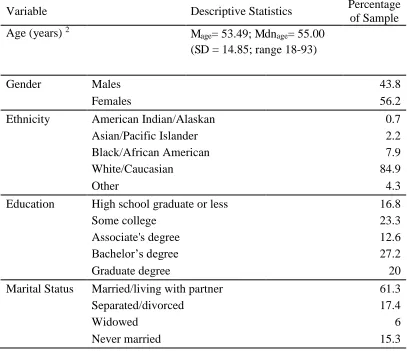
Participants were 1,075 members of RAND’s American Life Panel
(https://mmicdata.rand.org/alp/) who completed an internet survey (see Table 1 for demographic
information). Panelists receive approximately $20 per 30 minutes of survey completion time.
Panel members were recruited through random digit dialing for national surveys, including the
monthly University of Michigan Consumer Survey. Additional members were recruited via
snowball sampling. Panelists without internet access (3.7 %) were provided with access.
2.2. Procedure
Our survey invitation was sent to 1,353 panelists, 1,075 who responded1 (for a 79.5%
response rate).
2.3. Measures
1 Respondents were more likely than nonrespondents to be male, older, and White (see Bruine de Bruin, Strough, &
2.3.1. Demographics. Participants reported their age (which was entered into the
analyses as a continuous variable), as well as their gender, marital status, family income,
ethnicity, and highest education attained (see Table 1).
2.3.2. Decision-Making Styles. The 25-item GDMS Inventory (Scott & Bruce, 1995)
measured the following styles: rational (e.g. "My decision making requires careful thought"),
intuitive (e.g. "When making decisions, I rely upon my instincts"), dependent (e.g. "I rarely make
important decisions without consulting other people"), avoidant (e.g. "I postpone decision
making whenever possible"), and spontaneous (e.g. "I make quick decisions"). Scott and Bruce
(1995) established validity, through factor-analytic procedures, and reliability among four
samples (military, young adults, undergraduates, and engineers/technicians; s = .68-.87).
Participants used a 5-point Likert scale (1=strongly disagree to 5=strongly agree) to rate how
well statements described how they make “important” decisions ( > .81; see Table 2).
2.4. Data Analysis
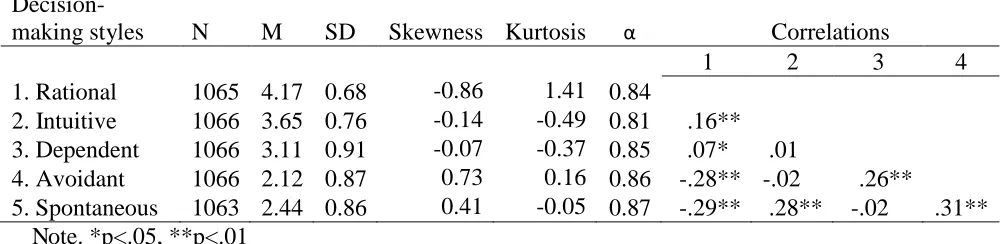
Analyses were conducted using SPSS 18.0. Table 2 shows descriptive statistics and
correlations for the measures of decision styles. We examined skewness and kurtosis and
applied transformations as needed. Following Henry et al. (2005), we used a two-step cluster
analytic approach. The first step was Ward’s hierarchical cluster analysis which formed clusters
by maximizing within-group similarities and between-group differences. Second, a
non-hierarchical (K-means) cluster analysis confirmed the non-hierarchical cluster solution. Cluster
solutions were validated by conducting a MANOVA that used the cluster profiles as independent
variables, and the five decision-making styles as dependent variables to ensure distinctions
gender as predictors of profile memberships, controlling for marital status, family income,
education, and ethnicity.
3. Results and Discussion
3.1. Preliminary Analyses
We used logarithmic transformations to correct for skewness and kurtosis of rational and
avoidant styles. Correlations among variables were small to moderate (see Table 2); there were
no multivariate outliers or multicollinearity issues.
3.2. Decision-Making Style Profiles
The two-step cluster analysis (Henry et al., 2005) identified a 3-cluster solution. A
MANOVA found a significant 3-cluster differentiation in the five decision styles, F(5, 1055) =
13,285.54, Wilk's = 0.450, p <.001. As shown in Table 3, the spontaneous and dependent
decision styles were the most distinguished between the clusters.
Figure 1 presents the three clusters, in terms of their mean standardized scores on each
decision-making style. Cluster 1 corresponded to high use of a spontaneous style and moderately
high use of an intuitive style (N= 315, 29.7%). Cluster 2 captured high use of a dependent style
and low use of all other styles (N= 281, 26.5%). Cluster 3 (N= 288, 27.1%) represented low
endorsement of all styles with the dependent and spontaneous styles the lowest.
3.2.1. Decision Profiles Discussion. The first profile matches the idea of the intuitive,
fast mode of decision making posited in dual-process models (Epstein, 1994; Evans, 2008;
Osman, 2004; Reyna, 2004), and hence we labeled it “affective/experiential.” This profile also
shows below-average use of advice or support from others. In contrast, the second profile is
defined as using or needing advice and assistance from other people. This profile captures the
(Finucane et al., 2002; Samsi & Manthrope, 2011), seek advice, and make decisions with others.
We labeled this profile “dependent”to match Scott and Bruce’s term for the subscale.
Importantly, however, items from the dependent subscale do not distinguish how or why people
involve others. For example, using “advice of other people in making important decisions” and
“rarely making important decisions without consulting other people” could indicate seeking
information from experts to make the “best” decision, or delegating decisions to others due to
lack of interest or ability. Hence, the term “interpersonal” might better represent this profile.
Distinguishing characteristics of the third profile are independence from others and a lack
of spontaneity—that is, not making decisions driven by quick, affective reactions or consulting
others. Hence, we labeled it “independent/self-controlled.” This profile suggests a slow,
controlled approach to decision making which is consistent with the deliberative system in
dual-process models (Kahneman, 2003; Stanovich & West, 2000). Notably, however, the rational
style was not a defining feature of this profile, nor was it well-distinguished across any profile.
Hence, this style seems to be less central for differentiating decision-making profiles.
3.3. Aim 2: Age and Gender Differences in Profiles
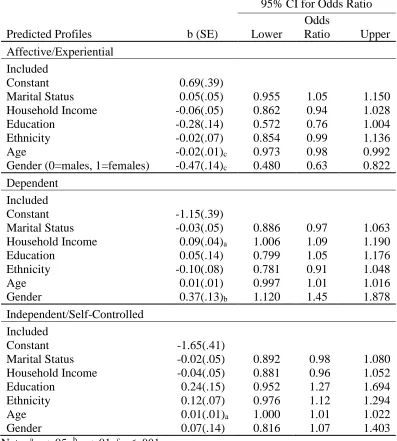
Three binary logistic regressions were conducted with membership in each
decision-making style profile as a discrete outcome variable (0= not in profile, 1= in profile) to assess
potential age and gender differences. When entering indicators simultaneously, significant
models were found when predicting the affective/experiential, ²(6)= 31.66, p<.001, R2= .04
(Nagelkerke) and dependent profiles, ²(6)= 19.10, p= .004 R2= .02, but not the
independent/self-controlled profile, ²(6)= 9.78, p=.13, R2= .01.
3.3.1. Age Differences: Results and Discussion. For the affective/experiential profile,
2% decreased odds of being in the affective/experiential profile. Although the overall model was
not significant, age was a significant predictor of the independent/self-controlled profile.
Growing older by one year was associated with 1% increased odds of being in the
independent/self-controlled profile (see Table 4).
Theorists suggest that as people grow older, they shift towards relying more on affect and
experience and less on deliberation to make decisions, reflecting age-related declines in fluid
cognitive abilities and maintenance or improvement in emotion regulation (e.g., Peters et al.,
2007). However, belonging to the affective/experiential profile was less likely with older age.
Rather, older age was associated with an increased likelihood of being in the
independent/self-controlled profile. Notably, Scott and Bruce’s (1995) inventory asks about “important” decisions.
Hess (2014) suggests that older adults apply cognitive resources to personally important
decisions. Hence, our findings may reflect that with age, people may be less inclined to make
what they see as important decisions quickly and intuitively perhaps due to less time left in life
to recover from, say, a bad financial decision.
We did not find a significant association between the dependent profile and age. Previous
studies show older adults are more likely to delegate or defer decisions to others (Chen, Ma &
Pethtel, 2011; Finucane et al., 2002). Although depending on others and delegating decisions
both involve other people, dependence (as measured by GDMS inventory) reflects utilizing
others’ advice or obtaining support to make decisions, whereas delegation and deferring reflect
not wanting to take responsibility for or postponing decisions. Age may not relate uniformly to
various ways people involve others when making decisions. Our findings suggest that obtaining
3.3.2. Gender Differences: Results and Discussion. Significant gender differences were
found in two of the three profiles (see Table 4). Females have 37% decreased odds of being in
the affective/experiential profile than males, but have 45% increased odds of being in the
dependent profile.
Stereotypical views of men and women suggest women use intuition and are
interpersonally-oriented whereas men are logical and independent (Gilligan, 1982; Gray, 1992).
In contrast to these stereotypes, men were more likely than women to be in the
affective/experiential profile. The spontaneous items on Scott and Bruce’s subscale are
conceptually similar to items used to measure impulsivity (Parker et al., 2007). Other work
suggests that, on average, men tend to engage in more impulsive and risky behaviors than
women do (Byrnes, Miller, & Schafer, 1999; Cross, Copping, & Campbell, 2011). Hence, men’s
relatively greater likelihood of belonging to the affective/experiential profile may represent a
tendency toward greater impulsiveness.
In accord with gender stereotypes, women were more likely than men to belong to the
dependent decision-making profile. Women may utilize other people for support and advice
when making decisions, similar to how women are more likely than men to use social support as
a coping strategy (e.g. Thoits, 1991). However, as discussed earlier, our findings do not address
the function of involving others in decision making (getting advice to make the best decision,
relying on others to make decisions, delegating decisions to others).
4.1. Limitations and Future Directions
Notable strengths of the current study include a large, national adult life span sample,
which addresses limitations from prior research using convenience samples. There are some
by our sample, which included relatively few non-white participants. Second, self-report
measures of decision styles may potentially be affected by participants’ concerns about social
desirability, and not reflect their actual decision-making performance (see Applet et al., 2011).
Men, for instance, may have rated “interpersonal” items lower because relying on others is
inconsistent with masculine gender roles in contemporary US culture. In addition, decision styles
assess participants’ perceptions of how they approach decisions, which may not reflect cognitive
decision processes. Lastly, our cross-sectional design does not address age changes or cohort
differences (Miller, 2007). Cross-sequential designs are necessary to understand within-person
changes and historical influences.
Despite these limitations, our findings can inform future research. In terms of individual
differences in decision-making profiles, the “fast” versus “slow” distinction (Kahneman, 2011) is
not the only important dimension. Although limited by the number of styles measured in the
GDMS, our study shows that profiles also vary on the dimension of interpersonal versus
individualistic. Future research should focus on disaggregating aspects of the “dependent”
profile. A first step would be to distinguish different functions of including others, such as
information or advice seeking, compensating for one’s own perceived or actual deficits, or
collaborating to make joint decisions (see Meegan & Berg, 2002; Strough et al., 2002).
Additional research is necessary to investigate whether focusing on multidimensional profiles (as
opposed to styles in isolation) distinguish negative and positive real-world decision outcomes
(Bruine de Bruin et al., 2007).
4.2. Conclusions
Individuals’ decision-making approaches are multidimensional. Individuals appear to
important decisions. Older adults and women were less likely to be in the affective/experiential
decision profile, however, women were also more likely to have an interpersonally-oriented,
“dependent” profile. Given the age and gender differences found, researchers should
acknowledge how age and gender may influence decision-making processes. Examining how the
styles cluster among diverse samples and in relation to real-world outcomes will also enhance
References
Appelt, K. C., Milch, K. F., Handgraaf, M. J., & Weber, E. U. (2011). The Decision Making
Individual Differences Inventory and guidelines for the study of individual differences in
judgment and decision-making research. Judgment and Decision Making, 6(3), 252-262.
doi: 1011293549
Aldenderfer, M. S. & Blashfield, R. K. (1984) Cluster Analysis. Beverly Hills, CA: Sage Press.
Babcock, R. L., & Salthouse, T. A. (1990). Effects of increased processing demands on age
differences in working memory. Psychology and Aging, 5(3), 421 -428.
doi:10.1037/0882-7974.5.3.421
Baiocco, R., Laghi, F., & D'Alessio, M. (2009). Decision-making style among adolescents:
Relationship with sensation seeking and locus of control. Journal of Adolescence, 32(4),
963-976. doi:10.1016/j.adolescence.2008.08.003
Blanchard-Fields, F. (2007). Everyday problem solving and emotion. An adult developmental
perspective. Current Directions in Psychological Science, 16, 26–31.
doi:10.1111/j.1467-8721.2007.00469.x
Bruine de Bruin, W., Parker, A. M., & Fischhoff, B. (2007). Individual differences in adult
decision-making competence. Journal of Personality and Social Psychology, 92(5),
938-956. doi:10.1037/0022-3514.92.5.938
Bruine de Bruin, W., Strough, J., & Parker, A. M. (2014). Getting older isn’t all that bad: Better
decisions and coping when facing ‘sunk costs.’ Psychology and Aging, 29, 642-647.
doi:10.1037/a0036308
Byrnes, J. P., Miller, D. C., & Schafer, W. D. (1999). Gender differences in risk taking: A
Charles, S., & Carstensen, L. (2010). Social and emotional aging. Annual Review of Psychology,
61, 383-409. doi: 10.1146/annurev.psych.093008.100448
Chen, Y., Ma, X., & Pethtel, O. (2011). Age differences in trade-off decisions: Older adults
prefer choice deferral. Psychology and Aging, 26(2), 269-273. doi:10.1037/a0021582
Cross, C. P., Copping, L. T., & Campbell, A. (2011). Sex differences in impulsivity: A
meta-analysis. Psychological Bulletin, 137(1), 97-130. doi:10.1037/a0021591
Epstein, S. (1994). Integration of the cognitive and the psychodynamic unconscious. American
Psychologist, 49(8), 709-724. doi:10.1037/0003-066X.49.8.709
Epstein, S., Pacini, R., Denes-Raj, V., & Heier, H. (1996). Individual differences in intuitive–
experiential and analytical–rational thinking styles. Journal of Personality and Social
Psychology, 71(2), 390-405. doi: 10.1037/0022-3514.71.2.390
Evans, J. S. B. (2008). Dual-processing accounts of reasoning, judgment, and social cognition.
Annual Review of Psychology, 59, 255-278. doi:
10.1146/annurev.psych.59.103006.093629
Finucane, M. L., Slovic, P., Hibbard, J. H., Peters, E., Mertz, C. K., & MacGregor, D. G. (2002).
Aging and decision-making competence: An analysis of comprehension and consistency
skills in older versus younger adults considering health-plan options. Journal of
Behavioral Decision Making, 15(2), 141-164. doi:10.1002/bdm.40
Frank, M. J., Cohen, M. X., & Sanfey, A. G. (2009). Multiple systems in decision making: A
neurocomputational perspective. Current Directions in Psychological Science, 18(2),
Galotti, K. M., Ciner, E., Altenbaumer, H. E., Geerts, H. J., Rupp, A., & Woulfe, J. (2006).
Decision-making styles in a real-life decision: Choosing a college major. Personality and
Individual Differences, 41(4), 629-639. doi:10.1016/j.paid.2006.03.003
Gilligan, C. (1982). In a different voice: Psychological theory and women's development.
Cambridge, MA: Harvard University Press.
Gray, J. (1992). Men are from Mars, women are from Venus: A practical guide for improving
communication and getting what you want in your relationships. New York, NY: Harper
Collins.
Harren, V. A. (1979). A model of career decision making for college students. Journal of
Vocational Behavior, 14(2), 119-133. doi:10.1016/0001-8791(79)90065-4
Henry, D. B., Tolan, P. H., & Gorman-Smith, D. (2005). Cluster analysis in family psychology
research. Journal of Family Psychology, 19(1), 121-132.
doi:10.1037/0893-3200.19.1.121
Hess, T. M. (2014). Selective engagement of cognitive resources: Motivational influences on
older adults’ cognitive functioning. Perspectives on Psychological Science, 9(4),
388-407. doi: 10.1177/1745691614527465
Kahneman, D. (2003). A perspective on judgment and choice: Mapping bounded rationality.
American Psychologist, 58(9), 697-720. doi: 10.1037/0003-066X.58.9.697
Kahneman, D. (2011). Thinking, fast and slow. New York, NY: Macmillan.
Keren, G. (2013). A tale of two systems a scientific advance or a theoretical stone soup?
Commentary on Evans & Stanovich (2013). Perspectives on Psychological Science, 8(3),
Keren, G., & Schul, Y. (2009). Two is not always better than one a critical evaluation of
two-system theories. Perspectives on Psychological Science, 4(6), 533-550. doi:
10.1111/j.1745-6924.2009.01164.x
Kennedy, Q., & Mather, M. (2007). Aging, affect and decision making. In K.D. Vohs, R.F
Baumeister, & G. Loewenstein (Eds.), Do emotions help or hurt decision making? A
hedgefoxian perspective (pp. 245-265). New York, NY: Russel Sage Foundation.
Kruglanski, A. W., & Gigerenzer, G. (2011). Intuitive and deliberate judgments are based on
common principles. Psychological Review, 118(1), 97. doi: 10.1037/a0020762
Loo, R. (2000). A psychometric evaluation of the General Decision-Making Style Inventory.
Personality and Individual Differences, 29(5), 895-905.
doi:10.1016/S0191-8869(99)00241-X
Meegan, S. P., & Berg, C. A. (2002). Contexts, functions, forms, and processes of collaborative
everyday problem solving in older adulthood. International Journal of Behavioral
Development, 26, 6-15. doi:10.1080/01650250143000283
Mikels, J. A., Shuster, M. M., & Thai, S. T. (2015). Aging, emotion, and decision making. In
T.M. Hess, J. Strough, & C. Löckenhoff (Eds.), Aging and decision making: Empirical
and applied perspectives, (pp. 170-184). New York, NY: Elsevier Inc.
Miller, S. A. (2007). Design. In S. A. Miller (Ed.), Developmental research method (pp. 30-58).
Thousand Oaks, California: Sage Publications.
Nygren, T. E. (2000, May). Development of a measure of decision making styles. Paper
presented at the 72nd annual meeting of the Midwestern Psychological Association,
Osman, M. (2004). An evaluation of dual-process theories of reasoning. Psychonomic Bulletin &
Review, 11(6), 988-1010. doi: 10.3758/BF03196730
Parker, A. M., Bruine de Bruin, W., & Fischhoff, B. (2007). Maximizers versus satisficers:
Decision-making styles, competence, and outcomes. Judgment and Decision Making, 2,
342-350. doi: 1010989404
Peters, E., Hess, T. M., Västfjäll, D., & Auman, C. (2007). Adult age differences in dual
information processes: Implications for the role of affective and deliberative processes in
older adults' decision making. Perspectives on Psychological Science, 2(1), 1-23.
doi:10.1111/j.1745-6916.2007.00025.x
Phillips, S. D., Pazienza, N. J., & Ferrin, H. H. (1984). Decision-making styles and
problem-solving appraisal. Journal of Counseling Psychology, 31(4), 497-502. doi:
10.1037/0022-0167.31.4.497
Reyna, V. F. (2004). How people make decisions that involve risk: A dual-process approach.
Current Directions in Psychological Science, 13(2), 60-66. doi:
10.1111/j.0963-7214.2004.00275.x.
Russ, F. A., McNeilly, K. M., & Comer, J. M. (1996). Leadership, decision making and
performance of sales managers: A multi-level approach. The Journal of Personal Selling
and Sales Management, 1-15. Retrieved from http://www.jstor.org/stable/40471636
Sadler-Smith, E. (2011). The intuitive style: Relationships with local/global and verbal/visual
styles, gender, and superstitious reasoning. Learning and Individual Differences, 21(3),
263-270. doi:10.1016/j.lindif.2010.11.013
Salthouse, T. (2012). Consequences of age-related cognitive declines. Annual Review of
Samsi, K., & Manthorpe, J. (2011). 'I live for today': a qualitative study investigating older
people's attitudes to advance planning. Health and Social Care in the Community, 19(1),
52-59. doi:10.1111/j.1365-2524.2010.00948.x
Scott, S. G., & Bruce, R. A. (1995). Decision-making style: The development and assessment of
a new measure. Educational and Psychological Measurement, 55(5), 818-831. doi:
10.1177/0013164495055005017
Sinclair, M., Ashkanasy, N. M., & Chattopadhyay, P. (2010). Affective antecedents of intuitive
decision making. Journal of Management & Organization, 16(3), 382-398.
doi:10.5172/jmo.16.3.382
Sloman, S. A. (1996). The empirical case for two systems of reasoning. Psychological Bulletin,
119(1), 3-22. doi: 10.1037/0033-2909.119.1.3
Spicer, D. P., & Sadler-Smith, E. (2005). An examination of the general decision-making style
questionnaire in two UK samples. Journal of Managerial Psychology, 20(2), 137-149.
doi: 10.1108/02683940510579777
Stanovich, K. E., & West, R. F. (2000). Individual differences in reasoning: Implications for the
rationality debate? Behavioral and Brain Sciences, 23(5), 645-665.
Strough, J., Cheng, S., & Swenson, L. M. (2002). Preferences for collaborative and individual
everyday problem solving in later adulthood. International Journal of Behavioral
Development, 26(1), 26-35. doi:10.1080/01650250143000337
Strough, J., Karns, T. E., & Schlosnagle, L. (2011). Decision-making heuristics and biases across
the life span. Annals of the New York Academy of Sciences, 1235(1), 57-74.
Strough, J., Parker, A., & Bruine de Bruin, W. (2015). Understanding life-span developmental
changes in decision-making competence. In T. Hess, J. Strough, & C. Löckenhoff (Eds).
Aging and decision making: Empirical and applied perspectives. San Diego: Elsevier
Academic Press.
Tamres, L. K., Janicki, D., & Helgeson, V. S. (2002). Sex differences in coping behavior: A
meta-analytic review and an examination of relative coping. Personality and Social
Psychology Review, 6(1), 2-30.
Tannen, D. (1991). You just don't understand: Women and men in conversation. New York:
Ballantine Books.
Thoits, P. A. (1991). Gender differences in coping with emotional distress. In J. Eckenrode
(Eds.), The social context of coping (pp. 107–138). New York: Plenum.
Thunholm, P. (2004). Decision-making style: Habit, style or both? Personality and Individual
Differences, 36(4), 931-944. doi: 10.1016/S0191-8869(03)00162-4
Verhaeghen, P., Marcoen, A., & Goossens, L. (1993). Facts and fiction about memory aging: A
quantitative integration of research findings. Journals of Gerontology: Psychological
Table 1
Demographic Characteristics
Variable Descriptive Statistics Percentage
of Sample
Age (years) 2 Mage= 53.49; Mdnage= 55.00
(SD = 14.85; range 18-93)
Gender Males 43.8
Females 56.2
Ethnicity American Indian/Alaskan 0.7
Asian/Pacific Islander 2.2
Black/African American 7.9
White/Caucasian 84.9
Other 4.3
Education High school graduate or less 16.8
Some college 23.3
Associate's degree 12.6
Bachelor’s degree 27.2
Graduate degree 20
Marital Status Married/living with partner 61.3
Separated/divorced 17.4
Widowed 6
Never married 15.3
2Percentage of adults in each age group: 18-39 yrs (17.9%), 40-59 yrs (47%), 60-69 yrs (23.4%),70+ yrs (11.7%).
Table 2
Descriptive Statistics, Correlations, and Coefficient Alpha, for Decision-Making Styles
Decision-making styles N M SD Skewness Kurtosis Correlations
1 2 3 4
1. Rational 1065 4.17 0.68 -0.86 1.41 0.84
2. Intuitive 1066 3.65 0.76 -0.14 -0.49 0.81 .16**
3. Dependent 1066 3.11 0.91 -0.07 -0.37 0.85 .07* .01
4. Avoidant 1066 2.12 0.87 0.73 0.16 0.86 -.28** -.02 .26**
5. Spontaneous 1063 2.44 0.86 0.41 -0.05 0.87 -.29** .28** -.02 .31**
Table 3
MANOVA Main Effects with Decision-Making Styles and Profiles
Decision-Making Styles F p2
Rational 29.95 0.05
Intuitive 67.69 0.11
Dependent 461.78 0.47
Avoidant 26.83 0.05
Spontaneous 629.55 0.54
Table 4
Binary Logistic Regressions Predicting Profile Membership from Age and Gender
95% CI for Odds Ratio
Predicted Profiles b (SE) Lower
Odds
Ratio Upper
Affective/Experiential
Included
Constant 0.69(.39)
Marital Status 0.05(.05) 0.955 1.05 1.150
Household Income -0.06(.05) 0.862 0.94 1.028
Education -0.28(.14) 0.572 0.76 1.004
Ethnicity -0.02(.07) 0.854 0.99 1.136
Age -0.02(.01)c 0.973 0.98 0.992
Gender (0=males, 1=females) -0.47(.14)c 0.480 0.63 0.822
Dependent
Included
Constant -1.15(.39)
Marital Status -0.03(.05) 0.886 0.97 1.063
Household Income 0.09(.04)a 1.006 1.09 1.190
Education 0.05(.14) 0.799 1.05 1.176
Ethnicity -0.10(.08) 0.781 0.91 1.048
Age 0.01(.01) 0.997 1.01 1.016
Gender 0.37(.13)b 1.120 1.45 1.878
Independent/Self-Controlled
Included
Constant -1.65(.41)
Marital Status -0.02(.05) 0.892 0.98 1.080
Household Income -0.04(.05) 0.881 0.96 1.052
Education 0.24(.15) 0.952 1.27 1.694
Ethnicity 0.12(.07) 0.976 1.12 1.294
Age 0.01(.01)a 1.000 1.01 1.022
Gender 0.07(.14) 0.816 1.07 1.403
Figure 1. Decision-making style profiles displaying the three different endorsement patterns.
Numbers in parentheses indicate the percentage of the sample belonging to each profile. Clusters
Dependent
(26.5%) Affective/
Experiential (27.9%)
Independent/ Self-Controlled
(27.1%)
Me
an (z
-sc
or