Int. J. Electrochem. Sci., 5 (2010) 501 - 508
International Journal of
ELECTROCHEMICAL
SCIENCE
www.electrochemsci.org
Electrocatalytic Oxidation of Ascorbic Acid Mediated by
Lithium doped Microparticles Bi
2O
3/MWCNT Modified Glassy
Carbon Electrode
Mohammed Zidan1,*, WeeTee TAN1, Zulkarnain Zainal1 , Abdul Halim Abdullah1 and Joo Kheng Goh2
1
Department of Chemistry, Faculty of Science, Universiti Putra Malaysia, 43400 UPM, Serdang, Selangor D.E., Malaysia
2
School of Sciences, Monash University Sunway Campus, 46150 Bandar Sunway, Petaling Jaya.
*
E-mail: [email protected]
Received: 25 February 2010 / Accepted: 28 April 2010 / Published: 30 April 2010
Use of a lithium doped Bismuth oxide and MWCNT modified glassy carbon electrode (Bi2O3/Li+/CNT/GC) enhance the oxidation current of ascorbic acid during cyclic voltammetry
compared to bare GC and (Bi2O3 /Li+/ CNT) modified electrode. Peak potential was observed to shift
slightly to less positive value by about 220 mV and current was significantly enhanced by about two folds. The sensitivity under conditions of cyclic voltammetry is significantly dependent on pH, temperature, electrolyte and scan rate. The result of scanning electron micrograph shows that the size increased slightly by < 1 µ m after electrolysis using Bi2O3 /Li+/ CNT modified electrode. The detection
limit of this modified electrode was found to be 50µM. The oxidation current of ascorbic acid decreased slightly after the first cycle and became stable with minor decreases after second cycle. It is therefore evident that the Bi2O3/CNT modified GC electrode possesses some degree of stability.
Potential use of Bi2O3/CNT as a useful electrode material is therefore clearly evident.
Keywords: Electrocataysis, Bi2O3 /MWCNT composite; Modified GCE; Ascorbic Acid; Cyclic
Voltammetry
1. INTRODUCTION
have been reported, such as CNT paste electrode [4-5]. These properties suggest that carbon nanotubes have fast electron transfer reaction when use as an electrode modifying material [6]. In recent years, the fabrication of chemically modified electrode (CME) is widely reported to improve sensitivity and selectivity of DNA, amino acid, vitamin, etc. [7-11]. On the other hand, Bismuth oxide is known to be an important transition metal oxide due to its characteristic parameters such as energy band gap, and photoconductivity that are suitable for large range applications [12-14]. Ascorbic acid also known as vitamin C is an organic acid soluble in water. It is responsible for building and maintaining our tissues and strengthening our immune system. It also takes part in metabolisms including the synthesis of adrenalin, inflammatory steroids, collagen, and neurotransmitters [15-19]. To our knowledge, there is no report in the literature on the enhancement of electrocatalytic oxidation of Ascorbic acid using bismuth oxide with CNT modified GC electrode. The characterization of known amount of Bi2O3/CNT
that could catalyze the oxidation process of ascorbic acid in 0.1 M KH2P04 electrolyte solution is
investigated.
2. EXPERIMENTAL PART
2.1. Instrumentation and electroanalytical analysis methods
Electrochemical workstations of Bioanalytical System Inc. USA: Model BAS 50W with potentiostat driven by electroanalytical measuring softwares were connected to computer to perform cyclic voltammetry (CV), chronoamperometry (CC) and chronoamperometry (CA). An Ag/AgCl (3M NaCl) and platinum wire were used as a reference and counter electrodes respectively. The working electrode used in this study was 3 mm diameter glassy carbon (GC). Unless otherwise stated, the voltammetric experiments were carried out at 25 ± 2oC using 0.1 M KH2P04 as supporting electrolyte.
Solutions were degassed with nitrogen for ten minutes prior to recording the voltammogram. Scanning electrode microscopy (SEM) was used to characterize the surface of the Bi2O3/MWCNT composites at
5 mm diameter basal plane paralytic graphite electrode (BPPGE) (Model JOEL,JSM-64000 machine).
2.2. Reagents
A multi-walled carbon nanotubes (MWCNT) with purity of ≥95%, diameter 20–40 nm, and length of 5-15 µm was purchased from Shenzhen Nanotech and used without any further purification. Bismuth oxide (Bi2O3) was obtained from A Johnson Mattney Company, with 99.9% purity .
Deionized water by reverse osmosis (RO) via Elken’s water filteration system (BIO PURE) was used in the preparation of solutions. Unless otherwise specified, the supporting electrolyte was 0.1 M KH2P04 in aqueous media at room temperature. All solutions were deaerated with oxygen-free
2.3. Procedures
MWCNTs powder and Bismuth oxide (Bi2O3 ) were transferred to the surface of glassy carbon
(GC) as follows: ratio amounts of 1:3 mg of Bi2O3 and MWCNTs respectively. Mixture (composites)
of Bi2O3/MWCNTs was mechanically transferred to the surface of a 3 mm diameter GCE.
Bi2O3/MWCNTs modified glassy carbon surface was cleaned after the measurement by physical
removal of the coat/film, followed by polishing with 0.5µm alumina slurry, and ultrasonic cleaning for 1 minute.
3. RESULTS AND DISCUSSION
3.1. Enhancement Study
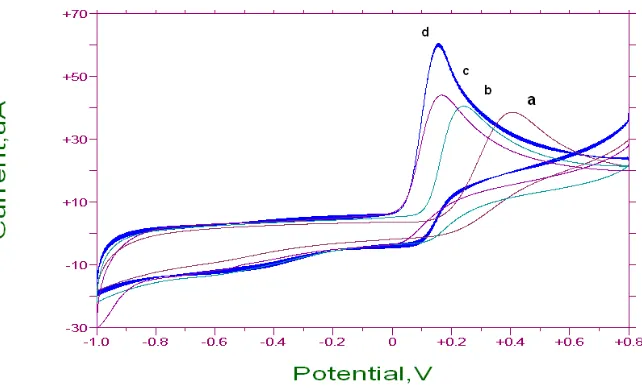
Figure 1 shows the cyclic voltammograms obtained for the oxidation of ascorbic acid in 0.1 M KH2P04 supporting electrolyte at pH 6.0 at bare (unmodified) GC electrode (a), Bi2O3 /GC modified
electrode (b), Bi2O3/Li+/GC modified electrode (c)and Bi2O3/Li+/CNT/GC modified electrode (d). The
voltammogram showed that the oxidation potential of ascorbic acid appears at 420 mV vs Ag/AgCl and there is an absence of electroactivity on the reverse scan or rereduction indicating the oxidation process is irreversible. While at the modified GC electrode, peak shift of 180 mV and 220 mV towards less positive region was observed for Bi2O3/Li+/CNT/GC and Bi2O3/Li+/GC respectively with a slight
current increase as compared to those of an unmodified electrode. However, at Bi2O3/Li+/CNT/GCE
current increases by 2.1 times with a similar peak shift as those of Bi2O3/Li+/GCE, indicating presence
of a electrocatalysis process effected by the Bi2O3/Li+, and Bi2O3/Li+/CNT coating. In subsequent
studies, various chemical and physical effects were assessed in order to determine the optimum conditions under which maximum current response at the Bi2O3/Li+/CNT/GC electrode can be
obtained.
Figure 1. Cyclic voltammetry of 0.5mM ascorbic acid in 0.1 M KH2P04 , at pH4.6 for the (a) GC
working electrode, (b) Bi2O3/GC modified electrode (c) Bi2O3/Li+/GC modified electrode (d)
[image:3.612.149.470.488.682.2]
3.2. Effect of varying pH
The solution was varied from pH 2.0 to 11 in order to determine its effect on the catalytic oxidation of ascorbic acid at the lithium doped Bi2O3/Li+/CNT/GC modified electrode. Figure 2 shows
that the oxidation current of 0.5 mM ascorbic acid increases with an increase in pH between 2.7 to 4.5 with a maximum current response at pH6. However, the pH range for current decreased gradually from pH 6 onward until pH 11.
0 1 2 3 4 5 6 7 8
0 2 4 6 8 10 12
pH
c
u
rr
e
n
t,
m
[image:4.612.184.429.188.347.2]A
Figure 2. Graph of current versus pH for 0.5 mM ascorbic acid in 0.1 M KH2P04 in different pH, for
The Bi2O3/Li+/CNT/GC modified electrode.
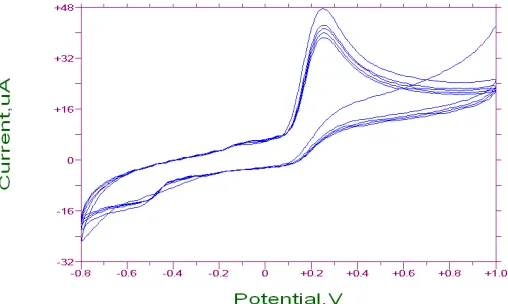
Figure 3. Multiple Cycle voltammetry of 0.5 mM ascorbic acid in 0.1 M KH2P04 at pH 6, for the
Bi2O3/Li+/CNT/GC modified electrode.
3.3. Effect of potential cycling
The stability of the lithium doped Bi2O3/CNT modified electrode and its effect on the ascorbic
[image:4.612.180.434.419.571.2]
after 20th potential cycle, the oxidation peak of ascorbic acid remains high; reflecting the stability of
Bi2O3/Li+/CNT coating.
3.4. Effect of varying scan rate
The effect of varying scan rates on the cyclic voltammograms of 0.5 mM ascorbic acid using lithium doped Bi2O3/CNT modified working electrode in 0.1 M KH2P04 supporting electrolyte was
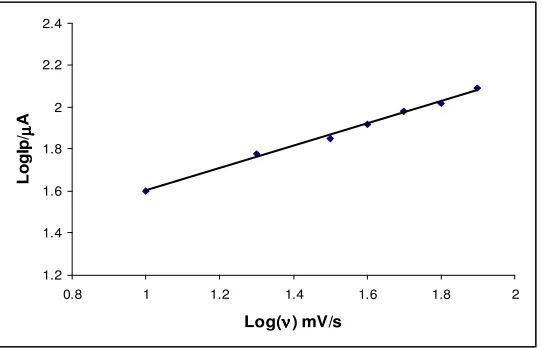
studied over 5 – 1000 mV/s. Oxidation currents of ascorbic acid was observed to increase with scan rate due to heterogeneous kinetics. Based on a plot of log peak current versus log scan rate (Figure 4), v for oxidation current of ascorbic acid, a straight line was obtained fulfilling the equation y = 0.47x + 0.67 with R2=0.9953. A slope of 0.47 which is quite comparable with theoretical slope of 0.5 for diffusion controlled process.
1.2 1.4 1.6 1.8 2 2.2 2.4
0.8 1 1.2 1.4 1.6 1.8 2
Log(νννν) mV/s
L
o
g
Ip
/µµµµ
[image:5.612.172.443.279.453.2]A
Figure 4. Graph of log peak current versus log scan rate for 0.5mM ascorbic acid in 0.1 M KH2P04 in
different scan rate, for the Bi2O3/Li+/CNT/GC modified electrode.
3.5. Effect of Temperature
Effect of temperature on the oxidation process of ascorbic acid was studied. The current increases gradually at the temperature of 20oC to 80oC . (Voltammogram is not shown) The plot of log oxidation current of ascorbic acid versus reciprocal of temperature was found to be fairly linear in agreement with thermodynamic expectation of Equations 1 and 2. The increase in oxidation current of ascorbic acid may be due to the conductivity of the Bi2O3/CNT particles with the increase in
temperature, as can be described by the Arrhenius equations (Eq.1 and 2) given below.
σ = σo exp (-Ea/RT) (1)
y = 23.842x + 0.207 R2
= 0.9958
0 5 10 15 20 25 30 35 40 45 50 55 60 65 70
0 1 2 3 4 5 6
concentration of Ascorbic acid [mM]
c
u
rr
e
n
t (
u
A
)
Where σ/D are conductivity/diffusibility and σo/Do are standard conductivity/the initial diffusibility. However while use at elevated temperature can give an increase in current, in a practical sense application need to be continued close to ambient temperature, 25oC [20-22].
3.6. Effect of varying ascorbic acid concentrations
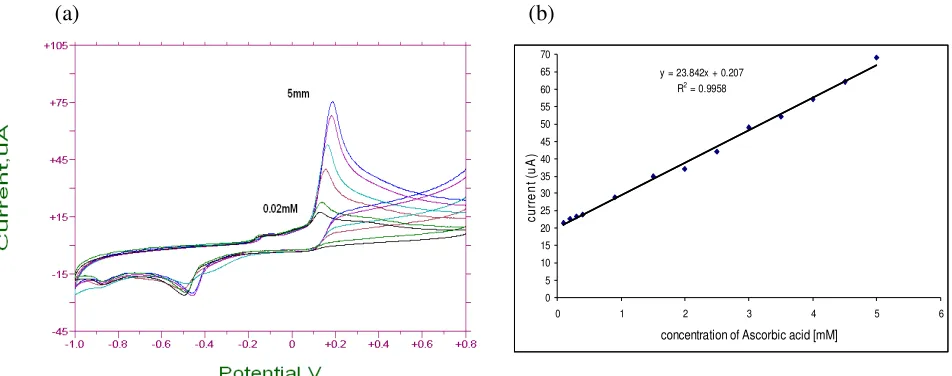
Figure 5 shows the calibration graph of ascorbic acid in 0.1M KH2P04. Linear response was
achieved over the concentration range from 0.02 to 5 mM, which showed correlation of 0.995 R2 value. The sensitivity of the modified electrode obtained from the linear equation slope was close to 24 mA L M-1.
(a) (b)
Figure 5. (a) Typical cyclic voltammograms of various ascorbic acid concentrations at
Bi2O3/Li+/CNT/GC electrode immersed in 0.1 M KH2P04, pH 6.0, at scan rate of 100 mV/s
(b) Calibration graph of ascorbic acid (Similar conditions as above).
Figure 6. Scanning electron micrographs of Bi2O3/Li+/CNT modified GC electrode to a basal plane
[image:6.612.79.555.246.434.2] [image:6.612.95.517.504.655.2]
3.7. Scanning Electron Microscopy
As is shown in figure 2, prior to the application of a reducing potential, Bismuth oxide had a size range of the order of 0.4 - 3 µm in diammeter. After the controlled-potential electrolysis in the presence of ascorbic acid using Bi2O3/ CNT modified electrode, the size increased slightly to 1 – 4 µm
with improved crystaline structure under the magnification of 4000-5000 times.
4. CONCLUSIONS
The result presented here demonstrates the use of MWCNT/ Li+/Bi2O3 composites modified
glassy carbon electrode is highly sensitive and stable in electrochemical measurement. Electrocatalytic response and stability were improved when MWCNT/ Li+/Bi2O3 were used as compared to when only
Bi2O3/GCE modified and unmodified GCE were used. Peak potential was observed to shift slightly to
less positive value by about 220 mV and current was significantly enhanced by about two folds indicating an electrocatalysis process due to the presence of Bi2O3/Li+/CNT microparticles. The
oxidation current of ascorbic acid decreases slightly after the first cycle and remains stable after the fourth cycle. It is therefore evident that the Bi2O3 modified GC electrode possess some degree of
stability. Potential use of Bi2O3/CNT as a useful electrode material is therefore clearly evident.
ACKNOWLEDGEMENT
The authors wish to thank Universiti Putra Malaysia for providing research facility and financial support for the accomplishment of this work.
References
1. S. Iijima, iNature 354 (1991) 56
2. Cattien V Nguyen, Kuo-Jen Chao, Ramsey M. D. Stevens, Nanotechnology 12 (2001) 363 3. Stephen Roche, Carbon Nanotube: Exceptional Mechanical and Electronic (1999)
4. J. Justin Gooding, Nanostructuring electrodes with carbon nanotubes: A rev. on electrochem. and applications for sensing (2005)
5. Hamid R. Zare, Reza Samimi, M. Mazloum Ardakani . Int. J. Electrochem. Sci., 4 (2009) 730. 6. M. Muzibur Rahman, I. Cheol Jeon, J. Braz. Chem. Soc. 18 (2007) 6
7. R.A. Durst et al, Andrienx, Pure and Applied Chemistry 69:6 (1997) 1317.
8. M.K. Walingo, African Journal of Food Agriculture and Nutritional Development, 5:1(2005) 1 9. J. Wang, Analytical Electrochemistry. 2nd Edition. John Wiley & Sons, Inc., Publication, 2000. 10. K. Wu, S. Hu, Microchimica Acta, 144 (2004) 131.
11. M. M. Radhi, W. T. Tan, M. Z. B Ab Rahman, and A. B. Kassim . Int. J. Electrochem. Sci., 5 (2010) 254.
12. Lingzhi Li, Bing Yan Journal of Alloys and Compounds 476 (2009) 624.
13. P.R. Roy, M.S. Saha, T. Okajima, S.-G. Park, A. Fujishima, T. Ohsaka, Electroanalysis 51 (2006) 4447.
16. W.T Tan et al, Sensors & Transducers Journal, Vol. 104, ( 2009) 119. 17. J.K. Goh et al, The Malaysian Journal of Analytical Sciences, 12(2008) 480.
18. W. Okiei, M. Ogunlesi, L. Azeez, V. Obakachi, M. Osunsanmi, G. Nkenchor . Int. J. Electrochem. Sci., 4 (2009) 276.
19. Ongera Gilbert, B.E.Kumara Swamy, Umesh Chandra, B.S.Sherigara . Int. J. Electrochem. Sci.,4 (2009) 582.
20. Instruction manual, CV 50W, version 2. Bioanalytical System, Inc. USA, Feb (1996) 21. P. G. Bruce, Solid State Electrochemistry, Cambridge University Press, Cambridge (1955). 22. S. R. Jacob et al,, J. Phys. Chem. B 103 (1999) 2963