A Robust and Scalable Solution for Interpolative
Multidimensional Scaling with Weighting
Yang Ruan, Geoffrey Fox
School of Informatics and ComputingIndiana University Bloomington, Indiana, USA {yangruan, gcf}@indiana.edu
Abstract— Advances in modern bio-sequencing techniques have led to a proliferation of raw genomic data that enables an unprecedented opportunity for data mining. To analyze such large volume and high-dimensional scientific data, many high performance dimension reduction and clustering algorithms have been developed. Among the known algorithms, we use Multidimensional Scaling (MDS) to reduce the dimension of original data and Pairwise Clustering, and to classify the data. We have shown that interpolative MDS, which is an online technique for real-time streaming in Big Data, can be applied to get better performance on massive data. However, SMACOF MDS approach is only directly applicable to cases where all pairwise distances are used and where weight is one for each term. In this paper, we proposed a robust and scalable MDS and interpolation algorithm using Deterministic Annealing technique, to solve problems with either missing distances or a non-trivial weight function. We compared our method to three state-of-art techniques. By experimenting on three common types of bioinformatics dataset, the results illustrate that the precision of our algorithms are better than other algorithms, and the weighted solutions has a lower computational time cost as well.
Keywords—Deterministic Annealing; Multidimensional Scaling I. INTRODUCTION
The speed of data collections by modern instruments in every scientific and technical field is accelerating rapidly with the advancement of science technologies. As this massive amount of data can easily overwhelm a single computer, traditional data analysis technologies needs to be modified and upgraded to adapt to high performance computational environment for acceptable performance. Many data mining and machine learning algorithms have been developed to solve these big data problems. Among those algorithms, dimension reduction has been proved to be useful in data clustering and visualization field [1] [2]. This technique enables the investigation of unknown structures from high dimensional space into visualization in 2D or 3D space.
Multidimensional Scaling (MDS) is one set of techniques among many existing dimension reduction methods, such as Principal Component Analysis (PCA) [3], Generative Topographic Mapping (GTM) [4], and Self-Organizing Maps (SOM) [5]. Different from them, which focus on using the feature vector information in original dimension to construct a configuration in low dimension space, MDS focuses on using the proximity data, which is represented as pairwise
dissimilarity values generated from high dimensional space. As in bioinformatics data, one needs to deal with sequences generated from sequencing technology, where the feature vectors are very difficult to be retrieved because of various sequence lengths. It is not suitable to use technologies other than MDS for their dimension reduction.
DACIDR [6] is an application that can generate robust clustering and visualization results on millions of sequences by using MDS technique. In DACIDR, the pairwise dissimilarities can be calculated by pairwise sequence alignment. Then MDS uses the result from it as input. Furthermore, to deal with large-scale data, DACIDR uses an interpolation algorithm called Majorizing Iterative MDS (MI-MDS) [7] to reduce the memory usage. It has been proven that DACIDR could visualize and cluster over millions of sequences with limited computing power. But in our recent study, we found out that pairwise sequence alignment could generate very low quality dissimilarity values in some cases, where these values could cause inaccuracy in clustering and visualization. So in MDS or interpolation, these values should be considered missing. Therefore, in this paper, we propose a robust solution for input data with missing values by adding a weight function to both MDS and interpolation. And we have reduced the time complexity of weighted MDS from cubic to quadratic so that its processing capability could be scaled up. Furthermore, as the MI-MDS uses iterative majorization to solve the non-linear problem of interpolation, it could suffer from local optima problem [8]. So we apply a robust optimization method called Deterministic Annealing [9] [10] (DA) in order to find the global optima for interpolation problem.
The structure of the paper is organized as following: Section II discusses existing methods for MDS and interpolation problems; Section III introduces and explains the weighted solution for MDS; The proposed weighted and DA solution for interpolation is introduced in Section IV; In Section V, we present our experiment results on 3 types of sequence dataset and compare our proposed solutions to other existing methods; Followed by our conclusion and future work in Section VI.
II. RELATED WORK
method used the Hessian to form a basic Newton iteration, and then iterated through it until convergence. Although the time complexity of its conversion is quadratic, both Hessian construction and inversion require cubic time complexity. Quasi-Newton [12] method is proposed to solve this problem by using an approximation of inverse Hessian at each iteration. This significantly reduced the time complexity of Newton method to sub-cubic. [13] has proposed an Multi-Grid MDS (MG-MDS) to solve the isometric embedding problems. As a parallel solution, it shows the dramatic increase in performance compared to other existing methods. Scaling by Majorizing a Complicated Object Function (SMACOF) [14] is a gradient-decent-type of algorithm which is widely used for large-scale MDS problems. However, it involves full matrix inversion before the calculation with weighting, which always has cubic time complexity. Additionally, as this method is an Expectation Maximization (EM) like problem, it is suffered from local optima problem. [15] has added a DA solution to SMACOF, so called DA-SMACOF, where it increased mapping quality and decreased the sensitivity with respect to initial configuration. Simulated Annealing and Genetic Algorithm have also been used to avoid the local optima in MDS [16] [17]. However, they suffered from long running time due to their Monte Carlo approach.
As MDS requires quadratic memory to compute, it becomes a limitation for large-scale data, e.g. millions of sequences while the computing power is limited. To address this issue, many algorithms have been developed to extend the capability of various dimension reduction algorithms by embedding new points with respect to previously configured points, or known as of-sample problem. A generalized out-of-sample solution has been provided by [18] that uses coordinate propagation for non-linear dimension reduction, such as MDS. [19] has proposed a solution as an out-of-sample extension for the algorithms based on the latent variable model. In MDS, the out-of-sample problem could also be considered as unfolding problem since only pairwise dissimilarities between in-sample sequences and out-of-sample sequences are observed [20]. An out-of-sample extension for the Classical Multidimensional Scaling (CMDS) has been proposed in [21]. It has applied linear discriminant analysis to the labeled objects in the representation space. In contrast to them, [7] has proposed an EM-like optimization solution, called MI-MDS to solve the problem with STRESS criteria in (26), which found embedding of approximating to the distance rather than the inner product as in CMDS. In addition to that, [6] has proposed a heuristic method, called HE-MI, to lower the time cost of MI-MDS. An Oct-Tree structure called Sample Sequence Partition Tree is used in HE-MI to partition the in-sample 3D space, and then interpolated the out-of-sample data hierarchically to avoid additional time cost. However, both of the methods suffer from local optima problem as same as in SMACOF, and could only process non-weighted data.
III. WEIGHTED SOLUTION FOR DA-SMACOF In this section, we propose a weighted solution for DA-SMACOF, a DA and weighted solution for MI-MDS. MDS and DA will be briefly discussed first, followed by introduction of WDA-SMACOF and WDA-MI-MDS.
A. Multidimensional Scaling
MDS is a set of statistic techniques used in dimension reduction. It is a general term for these techniques to apply on original high dimensional data and reduce their dimensions to target dimension space while preserving the correlations, which is usually Euclidean distance calculated from the original dimension space from the dataset, between each pair of data points as much as possible. It is a non-linear optimization problem in terms of reducing the difference between the mapping of original dimension space and target dimension space. In bioinformatics data visualization, each sequence in the original dataset is considered as a point in both original and target dimension space. The dissimilarity between each pair of sequences is considered as Euclidean distance used in MDS.
Given a data set of points in original space, a pairwise distance matrix can be given from these data points (
) where is the dissimilarity between point and point in original dimension space which follows the rules: (1) Symmetric: . (2) Positivity: . (3) Zero Diagnosal: . Given a target dimension , the mapping of points in target dimension can be given by an matrix , where each point is denoted as from original space is represented as th row in .
The object function represents the proximity data for MDS to construct lower dimension space is called STRESS or SSTRESS, which are given in (1) and (2):
(1)
(2) where denotes the possible weight from each pair of points that , denotes the Euclidean distance between point and in target dimension. Due to the non-linear property of MDS problem, an EM-like optimization method called SMACOF is proposed to minimize the STRESS value in (1). And to overcome the local optima problem mentioned previously, [15] added a computational temperature to the SMACOF function, called DA-SMACOF. It has been proved to be reliable, fast, and robust without weighting. B. Deterministic Annealing
DA is an annealing process that finds global optima of an optimization process instead of local optima by adding a computational temperature to the target object function. By lowering the temperature during the annealing process, the problem space gradually reveals to the original object function. Different from Simulated Annealing, which is based on Metropolis algorithm for atomic simulations, it neither rely on the random sampling process nor random decisions based on current state. DA uses an effective energy function, which is derived through expectation and is deterministically optimized at successively reduced temperatures.
In DA-SMACOF, the STRESS function in (1) is used as object function. We denote the as the cost function for SMACOF, and as a simple Gaussian distribution:
Algorithm 1 WDA-SMACOF algorithm Input: , , and
Generate random initial mapping . ;
while do
Compute and using (12). ;
while
Use CG defined from (26) to (30) to solve (23).
;
end while
Cool down computational temperature ;
end while
output of SMACOF based on return
(4)
where is the average of simple Gaussian distribution of th point in target dimension . Also, the probability distribution
and free energy are defined as following:
(5)
(6)
(7)
where T is the computational temperature used in DA. C. Weighted DA-SMACOF
The goal of DA in SMACOF is to minimize
with respect to parameters is independent of so the problem can be simplified to minimize if we ignore the terms independent of . By differentiating (7), we can get
(8)
where is the th point in the target dimension , as same as th line in matrix .
Take (8) into (3), finally the became
(9)
(10)
As the original cost function and target dimension configuration gradually changes when the computational temperature changes, we denote as the target dimensional configuration and as the dissimilarities of each pair of sequences under temperature T. So the updated STRESS function of DA-SMACOF becomes
(11)
where is defined as
(12)
Note that if the distance between point and point is missing from , then . There is no difference between and since both of the distances are considered missing values. This is not proposed in the original DA-SMACOF where all weights for all distances in are set to 1.
By expanding (11), updated STRESS value can be defined as
(13)
(14)
Equation (14) has three terms, the first term is a constant because it only depends on fixed weights and temperature, so it is a constant. Then to obtain the majorization algorithm for
and , they are defined as following:
(15)
= (16)
where and is defined as following:
(17)
(18)
Finally, to find the majorizing function for (11), we apply (15) and (16) to (14). By using Cauchy-Schwarz inequality, the majorization inequality for the STRESS function is obtained as following
(19)
(20) By setting the derivatives of to zero, we finally get the formula of the WDA-SMAOCF,
Instead of using pseudo-inverse of V, we d and if N is large, , where is an matrix, so by replacing V by in (21), we hav function of WDA-SMACOF as
Theorem 1. is a symmetric positive definite Proof. Since , so , and
can be represented as
Because , so . And
. So according to [24], Theorem 1 is Since is an SPD matrix, we could solv (22) without doing the pseudo-inverse of . issue, a well-known iterative approximation the form equation, so called Conjugat [25] could be used here. Traditionally, it i quadratic form while and are both vecto
and are both matrices. So could be directly used when . Neverth situations, the CG method needs to be updated equations. In th iteration of CG, the residual the search direction is denoted as , and
and are given as
where is the produce of . Let’s denote
and is matrix and is the th element in and is the th row, th column another word, is calculating the sum over rows of and their corresponding colum complete equations for CG are updated to
It is a recognized fact that original CG algorithm, that and the other parameters are iteration. And the error, which is denoted as is a non-increasing value until converge complexity of CG is as the matrix mult and (28) are where .
WDA-SMACOF algorithm is illustrated The initial temperature is critical in
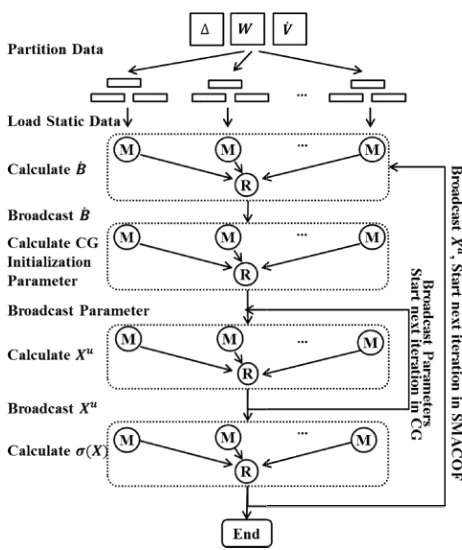
WDA-Fig. 1. The flowchart of parallel WDA MapReduce runtime. M denotes ma denote as
n identity ve the majorizing
(23) e (SPD) matrix.
. From (17),
(24)
proved.
e (23) instead of To address this method to solve te Gradient (CG) is used to solve ors. In our case, the original CG heless, for d using following l is denoted as , are scalars. So
(25)
where is h row, th column n element in . In m of dot product mns in . So the
(26)
(27) (28)
(29)
(30) G is an iterative e updated in each , e. So the time tiplication in (26)
in Algorithm 1. -SMACOF that a
flat initial configuration (all dista needs to be avoided. So the is cal value of weight times distance.
The original SMACOF uses a first, then do an matrix mult WDA-SMACOF does the same and one CG approximation in each Therefore, WDA-SMACOF has a m original SMACOF proposed as Gutt
D. Parallezation of WDA-SMACOF
As WDA-SMAOCF is an iterat we use an iterative MapReduce runt parallelize it for maximum performa overall performance of DACID MapReduce workflow system [27] DA-SMACOF, the weight matrix during the computation, so the m SMAOCF is higher compared to since both and are matr has memory (space) complexity of
The parallelized WDA-SMA MapReduce computations and one n computation in one iteration as oute MapReduce computation has computation in one iteration as inner outer loop contain two matrix multi calculation. The computation i approximation in CG, as illustrated parameter broadcasted in each ite where is often set to 2 or 3 for visu is not much communication overhea
A-SMACOF on an iterative apper, R denotes reducer.
nce in equals to zero) lculated based on maximum
an matrix inversion tiplication in each iteration. matrix multiplication, SMACOF iteration as well. much higher scalability than
tman transform.
F
tive optimization algorithm, time, called Twister [26], to ance. We also improved the DR by using a hybrid ]. Note that different from x , and are included memory usage of
WDA-DA-SMAOCF. However, rices, WDA-SMACOF still
.
[image:4.612.324.555.48.323.2]Algorithm 2 WDA-MI-MDS algorithm Input: , , , and
for each in do Compute and Compute ;
while do Update to using (12)
Initialize random mapping for , called
while
Update using (45)
end while
Cool down computational temperature
end while end for return
IV. WEIGHTED DA SOLUTION FOR MI-MDS In this section, we propose a weighted deterministic annealing solution for MI-MDS. First, we briefly discuss out-of-sample problem and MI-MDS, and then we describe weighted DA-MI-MDS (WDA-MI-MDS) in detail.
A. Out-of-Sample Problem and MI-MDS
The in-sample and out-of-sample problem has been brought up in data clustering and visualization to solve the large-scale data problem. In DACIDR, MDS is used to solve the in-sample problem, where a relatively smaller size of data is selected to construct a low dimension configuration space. And remaining out-of-sample data can be interpolated to this space without the usage of extra memory.
In formal definition, suppose we have a dataset contains size of in-sample data, denoted as , and size of out-of-sample points, denoted as , where in-sample points were already mapped into an L-dimension space, and the out-of-sample data needs to be interpolated to an L-dimension space,
defined as , where and
. Note that only one point at a time is interpolated to the in-sample space. So the problem can be simplified to interpolate a point to L-dimension with the distance observed to in-sample points. The STRESS function for is given by
(31)
where is the distance from to in-sample point in target dimension, and is the original dissimilarity between
and point . If all weights equals to 1, equation (31) is transformed to
(32)
MI-MDS is an iterative majorization algorithm proposed by [7] to minimize the STRESS value in (32), where all weights are assumed to be 1. It will find nearest neighbors from in-sample points of a given out-of-sample point at first, denoted
as . Then by finding a majorizing function, its minimum STRESS can be obtained analytically. B. Weighted DA solution for Majorizing Interpolation MDS
MI-MDS has been proved to be efficient when deal with large-scale data. However, there are two disadvantages with this method. First, it assumed that all weights equal to one, where it couldn't deal with missing values and different weights. Secondly, this method is an EM-like optimization algorithm, which could be trapped in local optima as the EM-SMACOF.
Therefore, we propose WDA-MI-MDS to solve these issues. To solve the weighted out-of-sample problem, we need to find an optimization function for (31). By expanding (31), we have
(33)
(34) where is a constant irrelevant to . So similar to SMACOF, only and need to be considered to obtain the majorization function. can be deployed to
(35) (36)
where where is the target
dimension. The Cauchy-Schwarz inequality can be applied on in to establish the majorization function, which is given as
(37)
(38)
(39)
where is a vector of length which contains , and . By applying (37) to , we will have
(40)
(41)
where is a constant irrelevant from . After applying (36) and (41) to (34), we will have
(42)
The minimum of this function can be obtain derivatives of to zero, that is
where is the previous estimated . Although far can guarantee to generate a series o STRESS value for from original distance weights, it still could be trapped into local op to add a deterministic annealing solution int (12) to (44), and finally we have the iterat equation for WDA-MI-MDS in (45), and illustrated in algorithm 2.
where can be obtained using (12).
C. Parallelization of WDA-MI-MDS
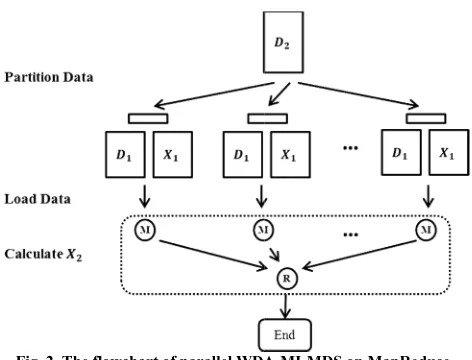
Different from WDA-SMACOF, the out-dimension reduction result only depends o points. So and are copied and loaded every mapper. Since every out-of-sample poin from any other out-of-sample points, WDA-pleasingly paralleled. Therefore is distributed across the mappers. And the result could be simply merged into , as illustrated
V. EXPERIMENTS
The experiments were carried out on F Cluster, which has 168 AMD Opteron 2378 cores. We tested the accuracy of the re normalized STRESS value, which can be calcu
[image:6.612.325.561.52.232.2]where is given by PID distance calculate sequence alignment. Equation (46) is least difference between the mapped distance reduction and original distance and naturally l STRESS means better performance [7] [14].
TABLE 1 ALGORITHM COMPARISO
Full MDS Int
DA EM DA
Weight WDA-SMACOF WEM-SMACOF WDA-MIMDS
Non-Weight
NDA-SMACOF
NEM-SMACOF
NDA-MI-MDS
In our experiments, we denote Full MDS performed on in-sample data, which runs SM given pairwise dissimilarities; and Interp algorithms experimented on out-of-sample sample data get continued updates to in-sam
Fig. 2. The flowchart of parallel WDA runtime. M denotes mapper, ed by setting the
(43)
(44)
this algorithm so f non-increasing es with various ptima. Therefore, to that, we apply tive majorization the algorithm is
(45)
of-sample point's on the in-sample
into memory on nt is independent MI-MDS can be partitioned and t of each mapper in Figure 2.
FutureGrid XRay CPUs and 1324 esults based on ulated by
(46)
ed from pairwise squares sum of after dimension lower normalized
ON
terpolation EM
I-
WEM-MI-MDS
-
NEM-MI-MDS
as the algorithms MACOF based on polation as the data. As out-of-mple data during
interpolation, it’s similar to real-tim These out-of-sample data were inter
of in-sample data using MI-MDS w
listed in Table 1, Full MDS includ Annealing (WDA), non-weighted (NDA), weighted Expectation Maxi weighted Expectation Maximizati Among them, WEM- and NEM-SM NDA-SMACOF is proposed in [ WDA, WEM, NDA, and NEM of M proposed in [14], WEM-MI-MDS i function, and NDA-MI-MDS is im function. Additionally, equation (1 cases could be considered as a spec that initial temperatures were set to 0
A. Nomalized Stress Comparison
In this experiment, we used thr dataset, include Metagenomics DNA proteins. We compared the normal Full MDS and Interpolation of all a is set to 10-6, and the experiments w
for each algorithm. The results wer these runs. The error bars in Figure Figure10 were the maximum and mi
1) Metagenomics DNA: This da
DNA sequences. 2000 of these sequ
sample data, and rest 2640 sequenc
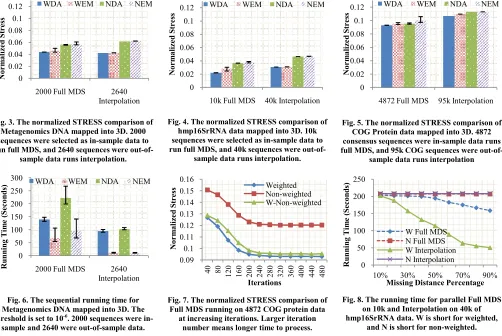
of-sample data. As this dataset is rel sequential version of both Full MD sequences were aligned using loc calculate the original dissimila calculation, 10.775% of the origin found as missing because of the lo the result shown in Figure 3, we weighted solutions outperforms th DA solutions showed much less di solutions. The average normalized MDS was 0.0439, which outperfor 23%.
A-MI-MDS on MapReduce R denotes reducer.
me streaming in Big Data. rpolated to Full MDS result within the same dataset. As des weighted Deterministic d Deterministic Annealing imization (WEM), and
non-on (NEM) of SMACOF. MACOF are proposed in [6], 15]. Interpolation includes MI-MDS. NEM-MI-MDS is s implemented without DA mplemented without Weight 12) shows that all the EM cial case of DA algorithms 0.
ree different bioinformatics A, hmp16SrRNA and COG lized STRESS values from algorithms. The threshold were carried out by 20 runs re based on the average of e 3, Figure 4, Figure 5 and inimum value in the runs. ataset includes 4640 unique
[image:6.612.50.295.591.655.2]2) hmp16SrRNA: The original hmp16SrRNA dataset has 1.1 million sequences, which was clustered and visualized by DACIDR in our previous research [5]. In this experiments, we
selected 10k of it as in-sample data and 40k as out-of sample
data. Due to the larger size, it can not be done on a single core, so we used the parallel version of Full MDS and Interpolation to run the experiments on 80 cores. The distance was calculated using local alignments and 9.98% of distances were randomly missing and set to an arbitrary number. The normalized STRESS were shown in Figure 4. In this case, the weighted solutions has a normalized STRESS value lower than non-weighted solutions by 40%.
3) COG Protein: Differently from DNA and RNA data, the Protein data doesn't have nicely clustered structure after dimension reduction, and its distance calculation was based on global alignment other than local alignment. In our experiments, we used 4872 consensus sequences to run full MDS, and interpolated rest 95672 sequences to these consensus sequences. Among these distances from Full MDS and Interpolation, 10% of them were randomly chosen to be
missing distances. The runs for 4872 in-sample sequences
were carried out on a single core, while the Interpolation for
95672 out-of-sample sequences used 40 cores. The results for
COG Protein data were shown in Figure 5. Non-weighted and weighted cases show insignificant difference that WDA performs only 7.2% better than non-weighted cases.
In these experiments, different dataset shows different features after dimension reduction. Figure 11, Figure 12, and Figure 13 are the clustering and visualization results for these three dataset shown in software called PlotViz [28]. It is clear that the Metagenomics DNA data has well-defined boundaries between clusters; the sequences in hmp16SrRNA dataset are not as clearly separated but we could still observe some clusters; COG data points were evenly distributed in the 3D space, and the different colors are indication of existence of clusters identified by [2]. Although these three dataset had diverted visualization results, WDA solution always shows lowest normalized STRESS value and smallest divergence in all experiments.
B. Comparison of Computational Complexities
In these results, we assume that distances are calculated
beforehand, and the time of CG is compared separately with full matrix inversion in subsection C. So in this section, only performance differences of computing majorizing functions in different algorithms are shown. Therefore, for all of the algorithms, the time costs reflect the number of SMACOF iterations.
[image:7.612.54.556.58.394.2]1) Fixed threshold runs: For the runs in Section A where the ending condition for the algorithms wass threshold, the iteration number could be various due to the configuration/feature space of different dataset. As shown in Figure 6, for 4640 DNA data, DA solutions took longer to process because it converged multiple times as the
Fig. 3. The normalized STRESS comparison of Metagenomics DNA mapped into 3D. 2000 sequences were selected as in-sample data to run full MDS, and 2640 sequences were
[image:7.612.396.554.59.160.2]out-of-sample data runs interpolation.
Fig. 4. The normalized STRESS comparison of hmp16SrRNA data mapped into 3D. 10k sequences were selected as in-sample data to run full MDS, and 40k sequences were
out-of-sample data runs interpolation.
Fig. 5. The normalized STRESS comparison of COG Protein data mapped into 3D. 4872 consensus sequences were in-sample data runs full MDS, and 95k COG sequences were
out-of-sample data runs interpolation
Fig. 6. The sequential running time for Metagenomics DNA mapped into 3D. The
threshold is set to 10-6. 2000 sequences were
in-sample and 2640 were out-of-in-sample data.
Fig. 7. The normalized STRESS comparison of Full MDS running on 4872 COG protein data
at increasing iterations. Larger iteration number means longer time to process.
Fig. 8. The running time for parallel Full MDS on 10k and Interpolation on 40k of hmp16SrRNA data. W is short for weighted,
and N is short for non-weighted. 0 0.02 0.04 0.06 0.08 0.1 0.12
2000 Full MDS 2640
Interpolation No rm al iz ed S tr es s
WDA WEM NDA NEM
0 0.02 0.04 0.06 0.08 0.1 0.12
10k Full MDS 40k Interpolation
No rm al iz ed S tr es
s WDA WEM NDA NEM
0 0.02 0.04 0.06 0.08 0.1 0.12
4872 Full MDS 95k Interpolation
No rm al iz ed S tr es s
WDA WEM NDA NEM
0 50 100 150 200 250 300
2000 Full MDS 2640
Interpolation Runni ng T im e (Se co nds)
WDA WEM NDA NEM
0.09 0.1 0.11 0.12 0.13 0.14 0.15 0.16
40 80 120 160 200 240 280 320 360 400 440 480
No rm al iz ed S tr es s Iterations Weighted Non-weighted W-Non-weighted 0 50 100 150 200 250
10% 30% 50% 70% 90%
Runni ng T im e (Se co nds)
Missing Distance Percentage W Full MDS
temperature cools down. weighted solutions had less iterations because the configuration space with weight enabled faster convergence, so the total time cost of weighted solutions were smaller than non-weighted solutions. However, this effect was not permanent on different dataset. When SMACOF ran on COG data, non-weighted solutions had less iterations to converge than weighted solutions as shown in Figure 7. This feature shows that if the points in the target dimension space are almost evenly spreaded out, the iterations converge quicker. Figure 7 shows the normalized STRESS value for Full MDS of COG data as the iteration number increases. Both algorithms were set to run 480 iterations. It shows that for weighted case, the normalized STRESS kept decreasing and it finally converges after 480 iterations with a threshold of
10-6. And for non-weighted case, the algorithm treats the input
data as if there is no value missing. So when we calculated STRESS with non-weighted solution, it was always much higher than weighted case. It converges at about 280 iterations, but its weighted STRESS (W-non-weighted) value was still higher than WEM cases at that point.
2) Fixed iterations: If the iteration number of each run was fixed, we could simply compare the efficiency of different algorithms. Figure 8 shows how the time cost varied for weighted and non-weighted solutions of Full MDS and Interpolation when percentage of missing distance values from input increases. Full MDS ran a fixed number of iterations at
480 and Interpolation runs 50 iterations for every
out-of-sample point. Because in non-weighted solutions, all weights were uniformly set to 1, there was no time difference for
non-weighted solutions when percentage of missing distance values increased. However, for weighted solutions, if an input distance was missing, the correspond weight equaled zero. According to (18), part of calculations in Full MDS were eliminated, and as in (45), a large percentage of calculations in Interpolation weren’t needed because the product of zero was still zero. The results showed that non-weighted Full MDS took an average of 206 seconds and non-weighted Interpolation took 207 seconds to finish for all cases. And weighted Full MDS only decreases 23% compared to non-weighted solution, even in case where 90% values of input distance matrix were missing. But for Interpolation, as main part of the computation were spared due to the missing values, the time cost decreases almost linearly when the percentage of missing distances increases. It is clear that weighted solution has a higher efficiency on Full MDS and Interpolation than non-weighted solutions with fixed iterations.
In conclusion, the weighted solution is not always faster than non-weighted solution when the threshold is fixed. But if the number of iterations is fixed, the weighted problem solution has a lower time cost compared to the non-weighted case. Within a given time, weighted solution can finish more iterations than non-weighted solution.
C. Scalability Comparison
[image:8.612.82.275.35.155.2]In this section, we did a scale up test on a single core with matrix inversion and CG to show their different time complexity. A large-scale experiment using 50k hmp16SrRNA data with Full MDS was carried out on 600 cores, where 20% of original distances are missing. Some preliminary analysis of Fig. 9. The running time of CG compared to matrix inverse in SMACOF.
Total iteration number of SMACOF is 480, and data is selected from hmp16SrRNA. CG has an average of 30 iterations.
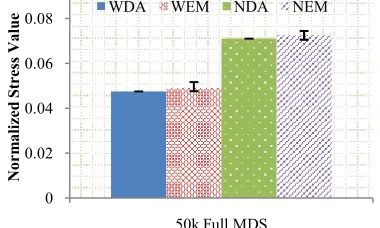
Fig. 10. The normalized STRESS comparison of hmp16SrRNA data mapped into 3D. 50k sequences were selected as in-sample data to run full
MDS with Conjugate Gradient method.
Fig. 11. Clustering and visualization result of
Metagenomics DNA dataset with 15 clusters. Fig. 12. Clustering and visualization result of hmp16SrRNA dataset with 12 clusters. Fig. 13. Visualization result of COG protein dataset, with 11 clusters identified. 0
10000 20000 30000 40000 50000 60000
1k 2k 3k 4k 5k 6k 7k 8k
Se
co
nds
DataSize
CG Inverse
0 0.02 0.04 0.06 0.08
50k Full MDS
No
rm
al
iz
ed
S
tr
es
s
Va
lu
[image:8.612.340.530.39.153.2] [image:8.612.54.566.195.363.2]using CG instead of matrix inversion were done. We found 30 iterations within CG sufficed for up to 50K points, so 30 CG iterations per SMACOF step was used in these experiments.
Figure 9 illustrates the difference between matrix inversion and SMACOF iteration time cost when data size goes up on a single machine. The original SMACOF performed better when data size was small, since matrix inversion ran only once before SMACOF iteration started. Additionally, we ran 480 iterations for SMACOF, and CG is processed in every SMACOF iteration, so it has a higher time cost when there were less than 4k sequences. But when data size increased to 8k, matrix inversion had significantly higher time cost than to CG. This suggests CG and its extensions gives an effectively
approach when , while
the time complexity of matrix inverse was always O(N3). Figure 10 shows the result of Full MDS on 50k in-sample hmp16SrRNA data using CG method where CG only needed 4000 seconds in average to finish one run. The results shows that even at large scale, WDA-SMACOF still performed the best compared to other three methods.
VI. CONCLUSIONS AND FUTURE WORK
In this paper, we proposed WDA-SMACOF and WDA-MI-MDS, as two algorithms for full MDS and interpolation problems with DA techniques and weighted problems. Our results showed that the WDA solution always performs best for weighted data. Additionally, we effectively reduced the time complexity of SMACOF from O(N3) to O(N2) by using
Conjugate Gradient instead of full Matrix Inversion and showing that a few iterations were sufficient. Future work will include larger scale test, adding weight function to HE-MI [6].
ACKNOWLEDGMENT
This material is based upon work supported in part by the National Science Foundation under FutureGrid Grant No. 0910812. Our thanks to Mina Rho and Haixu Tang from Center for Genomics and Bioinformatics for providing the DNA and RNA data, and Larissa Stanberry from Seattle Children’s Research Institute for providing the protein data.
REFERENCES
[1] A. Hughes, Y. Ruan, S. Ekanayake, S.-H. Bae, Q. Dong, et al. (2012). "Interpolative multidimensional scaling techniques for the identification of clusters in very large sequence sets." BMC Bioinformatics 13(Suppl 2): S9.
[2] L. Stanberry, R. Higdon, W. Haynes, N. Kolker, W. Broomall, et al. "Visualizing the Protein Sequence Universe." Proceedings of ECMLS’12 of ACM HPDC 2012, Delft, Netherlands, ACM, 2012. [3] Ian T. Jolliffe. Principal component analysis. Vol. 487. New York:
Springer-Verlag, 1986.
[4] Christopher M. Bishop, M. Svensén, and C. KI Williams. "GTM: The generative topographic mapping." Neural computation 10, no. 1 (1998): 215-234.
[5] P. Tamayo, D. Slonim, J. Mesirov, Q. Zhu, et al. "Interpreting patterns of gene expression with self-organizing maps: methods and application to hematopoietic differentiation." Proceedings of the National Academy of Sciences 96, no. 6 (1999): 2907-2912.
[6] Y. Ruan, S. Ekanayake, M. Rho, H. Tang, S.-H. Bae, et al. "DACIDR: deterministic annealed clustering with interpolative dimension reduction using a large collection of 16S rRNA sequences." In Proceedings of the
ACM Conference on Bioinformatics, Computational Biology and Biomedicine, pp. 329-336. ACM, 2012.
[7] S.-H. Bae, J. Y. Choi, J. Qiu, and G. C. Fox. "Dimension reduction and visualization of large high-dimensional data via interpolation." InProceedings of the 19th ACM International Symposium on High Performance Distributed Computing, pp. 203-214. ACM, 2010. [8] N. L. Dempster, and D. Rubin, “Maximum likelihood from incomplete
data via the em algorithm,” Journal of the Royal Statistical Society. Series B, pp. 1–38, 1977.
[9] K. Rose, E. Gurewitz, and G. C. Fox, “A deterministic annealing approach to clustering,” Pattern Recognition Letters, vol. 11, no. 9, pp. 589–594, 1990.
[10] H. Klock, and J. M. Buhmann. "Multidimensional scaling by deterministic annealing." In Energy Minimization Methods in Computer Vision and Pattern Recognition, pp. 245-260. Springer Berlin Heidelberg, 1997.
[11] Kearsley A, Tapia R, Trosset M. "The solution of the metric STRESS and SSTRESS problems in multidimensional scaling using Newton’s method." Computational Statistics, 13(3):369–396, 1998.
[12] Kelley CT. "Iterative Methods for Optimization. Frontiers in Applied Mathematics." SIAM: Philadelphia, 1999.
[13] M. M. Bronstein, A. M. Bronstein, R. Kimmel, and I. Yavneh. "Multigrid multidimensional scaling." Numerical linear algebra with applications13, no. 2 3 (2006): 149-171.
[14] I. Borg and P. J. Groenen, Modern Multidimensional Scaling: Theory and Applications. New York, NY, U.S.A.: Springer, 2005.
[15] Bae, Seung-Hee, Judy Qiu, and Geoffrey C. Fox. "Multidimensional Scaling by Deterministic Annealing with Iterative Majorization algorithm." In e-Science (e-Science), 2010 IEEE Sixth International Conference on, pp. 222-229. IEEE, 2010.
[16] M. Brusco, “A simulated annealing heuristic for unidimensional and multidimensional (city-block) scaling of symmetric proximity matrices,” Journal of Classification, vol. 18, no. 1, pp. 3–33, 2001.
[17] R. Mathar and A. ˇZilinskas, “On global optimization in two-dimensional scaling,” Acta Applicandae Mathematicae: An International Survey Journal on Applying Mathematics and Mathematical Applications, vol. 33, no. 1, pp. 109–118, 1993.
[18] S. Xiang, F. Nie, Y. Song, C. Zhang, and C. Zhang. Embedding new data points for manifold learning via coordinate propagation. Knowledge and Information Systems, 19(2):159–184, 2009.
[19] M. Carreira-Perpin´an and Z. Lu. The laplacian eigenmaps latent variable model. In Proc. of the 11th Int. Workshop on Artificial
Intelligence and Statistics (AISTATS 2007). Citeseer, 2007. [20] C. H. Coombs. "A theory of data". (1950) New York: Wiley.
[21] M. W. Trosset and C. E. Priebe. "The out-of-sample problem for classical multidimensional scaling." Computational Statistics and Data Analysis, 52(10):4635 4642, 2008.
[22] P. F. Dubois, A. Greenbaum, and Garry H. Rodrigue. "Approximating the inverse of a matrix for use in iterative algorithms on vector processors."Computing 22, no. 3 (1979): 257-268.
[23] Peter D. Robinson, and Andrew J. Wathen. "Variational bounds on the entries of the inverse of a matrix." IMA journal of numerical analysis 12, no. 4 (1992): 463-486.
[24] Curtis F. Gerald, and Patrick O. Wheatley. Numerical analysis. Addison-Wesley, 2003.
[25] Van der Vorst, Henk A. "An iterative solution method for solving f(A)x= b, using Krylov subspace information obtained for the symmetric positive definite matrix A." Journal of Computational and Applied Mathematics 18, no. 2 (1987): 249-263.
[26] J.Ekanayake, H. Li, B. Zhang, T. Gunarathne, et al. "Twister: A Runtime for iterative MapReduce." Proceedings of MapReduce’10 of ACM HPDC 2010, pp. 810-818. ACM, 2010.
[27] Y. Ruan, Z. Guo, Y. Zhou, J. Qiu, and G.C. Fox. "HyMR: a Hybrid MapReduce Workflow System." Proceedings of ECMLS’12 of ACM HPDC 2012, Delft, Netherlands, ACM, 2012.