Abstract: In recent times, Direction of Arrival (DOA) Estimation study earns attention in array signal processing and it develops rapidly in several application such as sonar, radar, communication, biomedicine and seismology measurements. The self adaption and spatial spectrum are the broad research area in array processing. The spatial spectrum estimation focused on the signal distribution in the space is received from all direction to receiver. To maintain accuracy in DOA estimation for the antenna array the basic knowledge is required for main beam, and side lobes pattern must be small to suppress signal from other direction. This paper discussed the overview of the Direction of Arrival (DOA) estimation based on classical Sum and delay beamformer, Minimum Variance Distortionless Response (MVDR) technique, Min Norm technique and Multiple Signal Classification(MUSIC) by using the spatial spectrum parameters.
Keywords: MUSIC, DOA, MVDR, Min-Norm, Beamforming
I.INTRODUCTION
In recent years the application such communication system ,bio medical systems , satellite, and radar systems using array signal processing. It arise as a important and thought-provoking area in the signal processing field. The signal processing in arrays plays a vital role in extracting signal parameter of received signal by limiting the noise and interference, while at a same time it strengthening the useful signals. As the sensor array provide enhanced gain and durable immunity for interference by control the beam flexibly. The above features made array signal processing theory to successful in modern period.
The self adaption and spatial spectrum are the broad research area in array signal processing. The self-adaption is traditional methods used in many practical engineering application. Though spatial spectrum estimation has developed rapidly, it is rarely found in practical systems. Nowadays for enhance the resolution of Direction of arrival (DOA), the antenna array system with advanced signal processing can be used rather than single antenna. The spatial samples of received signal is provided by antenna array system. As compare to single sensor, the sensor array plays a enhanced role in signal analysis as well as in parameter valuation. The mostly used super resolution algorithms are
Revised Manuscript Received on July 05, 2019.
R.Agilesh Saravanan, Electronics and Communication Engineering, Koneru Lakshmaiah Educational Foundation, Guntur District, A.P., India.
Dr.Deepak Kumar Naik , Electronics and Communication Engineering , Koneru Lakshmaiah Educational Foundation, Guntur District, A.P., India. J.Bennilo Fernandes , Electronics and Communication Engineering , Koneru Lakshmaiah Educational Foundation, Guntur District, A.P., India.
S.A.Sivasankari , Electronics and Communication Engineering , Koneru Lakshmaiah Educational Foundation, Guntur District, A.P., India.
MVDR, Min-norm and MUSIC. In subspace-based technique most widely used algorithm is MUSIC algorithm. The MUSIC algorithm needed large computations to search for the spectral angle, so its implementation can be difficult in real time applications. The Root MUSIC method yield better performance than conventional MUSIC algorithm. It reduces the computation complexity . Its major drawback is if the antenna arrays are not equally spaced the outcomes are highly affected by noise.
The work is described as follows. Part II it concentrated on the collected works and assessment of DOA estimation. Part III focused on the elementary scientific models of classical estimation methods and subspace algorithm. Part IV deals with the performance valuation and simulation results of DOA estimation methods. Part V reviews the paper with conclusion followed by references used.
II.LITERATURE SURVEY
In early days the Fourier transform is used for DOA Estimation. The Rayleigh limit is highly disturbing the Fourier transform in estimating DOA, due to that its not possible for the Fourier transform to produce high-resolution outcomes, or to counterattack the noise, so it unable to fulfilled performance so it included the periodogram method. The researcher has the great courtesy towards the maximum likelihood estimation (ML) because of its unique feature such as high resolution and robust personality. The high dimensional parameter space is used in search for the ML spectrum estimation[1], so computation complexity is increased. Thus, it is inflexible to be set into practice . The Burg in 1967 recommended the maximum entropy estimation method in spectrum estimation. The other methods such as
Moving Average Mode, Autoregressive model,
Auto-Regressive and Moving Average Mode, parameter method and maximum entropy [2],[3] are includes in spectrum estimation. All the above mentioned methods are excellent in providing good resolution outcomes but they all failed because of computation complexity, they required enormous amount of calculation. The spectrum estimations based on eigenvalues decomposition are put forward by researchers. MUSIC Algorithm and ESPRIT(Estimation Signal Parameters via Rotational Invariance) Technique [4],[5] are the methods in which the spectrum estimation is done by eigenvalues decomposition. In general circumstances the MUSIC algorithm is the single dimension execution of maximum entropy so it has the same characteristics of ML estimation [6],[7]. In certain cases , MUSIC performed better than any other traditional methods, on the other hand it increase the computation
complexity. Progressive methods such as ESPRIT using its enhanced arithmetic
Direction of Arrival Estimation using
Conventional Subspace Algorithms
and produced high resolution and also it evades more computation, thus it can speed up the Direction of arrival estimation. But some special array structure is needed to accelerate speed of computation this is not feasible in all cases, so its application is relatively limited [8].
Currently, For DOA estimation the above methods neglects the time characteristics of the signal in evaluation. In array signal processing, due to the multipath propagation one signal may interfere with other signal and create spatial spectrum problem to overcome the above problem the time domain problem should be studied. For analyzing and extract suitable data from the signal the researchers at the same time sampled the signal in both time domain and spatial domain. The two dimension processing overcomes the deficient of spatial information, it decreases the limitation of array structure and increase the arithmetic competence to restrict noise [9],[10]. The signals which includes voice, radar, sonar signals and biomedical signals are non stationary signals and there individualities are restricted by the time period and spatial variation. Lately, in DOA estimation Artificial neural networks (ANN) [11] is the emerging research area.It is mainly focused on nonlinear and non Stationary characteristic of signal in real time system .
III.VARIOUS DOA ESTIMATION METHODS
In order to provide a high resolution outcomes DOA estimators that make use of the signal subspace methods and classical techniques. In spectral estimation research, Signal subspace is a method in which for the signal added noise model the auto covariance or auto correlation is calculated and it is used to create matrix then the created matrix is used to generate a signal and noise subspace by using eigen structure of it. The DOA estimation by antenna array using the same technique of generating the spatial covariance matrix. A. Delay and Sum Method
The delay and sum method computes the signal strength at each promising angle of arrival(AOA) and choosing AOA estimates in which direction the maximum strength is concentrated [12]. The beam is formed towards particular direction and the power is calculated and depends on that the weights of beamformer are adjusted and make it equal to steering vector which is corresponding to specific direction.In this method the power is calculated by using (3.1)
(3.1) The P(θ) is signal peaks corresponding to steering vectors and w is equal to the vectors formed by beam steering corresponding to the incoming signals. In this method the sensor elements in the antenna array to be increased, for increasing the DOA resolution, it creates a major drawback. B. The Minimum Variance Distortionless Response (MVDR) Beamformer
These beamformer[13] is mainly focused on reducing the output power of the beamformer however limiting the gain to unity in the specific direction. This can be defined as follows:
(3.2) In MVDR [13] the weights are given by (3.3)
(3.3) The a(θ) is a steering vector matching to the preferred signal and w is complex weights. As compared to conventional beamforming methods the MVDR beamforming method is more significant , for the given DOA it diminishes the power from undesirable direction.
C. The Minimum-Norm Method
Kumaresan et al., proposed the Minimum Norm method [15] for estimating the direction of arrival which is alike as MUSIC algorithm. According to the minimum norm method[14], the first element in vector which is present in the noise subspace is used to have minimum norm. The vector is defined as follows
(3.4)
The angle of arrival are identified by the maximum peaks of the subsequent function when the minimum norm vector has been known[14]
(3.5) The next aim is to decide the minimum norm vector(g). Qs is a matrix in which the columns are made up of basis of signal subspace and it can be subdivided as [14]
(3.6)
g is the vector whichfalls in the noise subspace, and g and Qs both subspace are orthogonal to each other , the following equation [14]
(3.7)
The equations (3.7) will be underdetermined, thus minimum Frobenius norm solution[14] is used and given the following equation,
(3.8)
(3.9)
From this equation, we can write:
(3.10) Using (3.10), the calculation of the matrix inverse is eliminated in (3.8). g is evaluated on orthonormal basis of signal subspace as follows:
After computing the g ,the Min Norm function is calculated and DOA is given by the r peaks (see Fig. 3). The Min Norm method is one of the high resolution method even though it is still lower outcomes than MUSIC.
D.Multiple Signal Classification Algorithm (MUSIC)
In General, the signal and noise subspace both are acting orthogonal to each other, the received signal always present in signal subspace. The steering vectors is corresponds to received signal. In this technique the search is made through all possible sets of steering vector and identified the vector which is orthogonal to noise subspace. For the incoming signal the the corresponding steering vector a(θ) is given by:
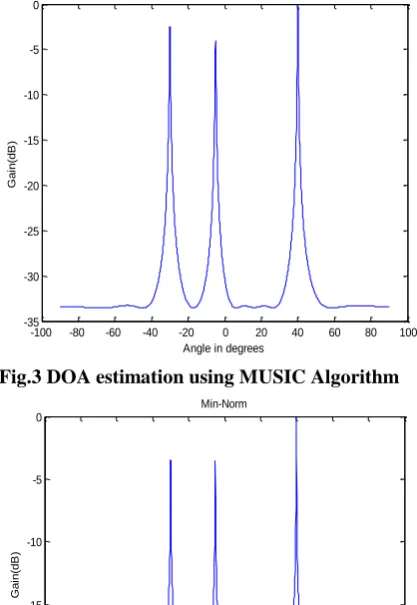
(3.12) After the computation for all steering vector the larger values of θ will consider as DOA of the incoming signals. The equation (3.12) which is used for estimating the the multiple signal classification (MUSIC) “spectrum”. Schmidt et al. [16], proposed the MUSIC algorithm which used to evaluate a basis for noise subspace (Qn), and then defines the r peaks in (3.12) that corresponding angles defines the Direction of arrival (DOA) estimates.
As compared to other algorithm the MUSIC algorithm has high performance so it is mostly used in various array processing system, the major drawback of the algorithm is it is fails to estimate the DOAs of correlated signals and also the computation complexity is increased because of its search for the peaks.
IV. SIMULATION RESULTS AND DISCUSSION
The simulation is performed by a linear array having antenna ten elements and each element is spaced by λ/2 spacing. Three signals with equal power are present. In this simulation, the data vectors were generated and spatial covariance matrix Rxx was computed. The beampattern of a 10-element array where all the weights are equal to 1, for angles of arrival ranging from −90° to +90°.
The simulation of Sum and Delay method shoe in fig.1. In a linear array, the elements of the steering vectors have gains of equal magnitude, the weight vector w produces a sinc beampattern that has large sidelobes.The largest sidelobe has a magnitude that is only 10 dB below that of the mainlobe. Despite the narrow mainlobe width, the large sidelobes allow unwanted power to enter into the computation of P(θ) for different angles of arrival and hence DOA resolution deteriorates.
-100 -80 -60 -40 -20 0 20 40 60 80 100
-12 -10 -8 -6 -4 -2 0
G
a
in
(d
B
)
Angle in degrees Delay and sum
Fig.1 DOA estimation using Delay and Sum Method
This method allows the system to vary for all possible set of values and to select the weight vector with the finest possible beam in the direction from which power is measured. By increasing the number of element in antenna array the resolution of DOA estimation is increased.
A simulation of the MVDR is shown is fig.2 The simulation is performed by linear array with ten elements and elements in antenna array are spaced by λ/2 spacing. The results of MVDR has high resolution as compared to Conventional delay sum method but the failure of the method is that during the processing of highly correlated signal the inverse matrix computation is requires which creates a troublesome situation in calculation.
-100 -80 -60 -40 -20 0 20 40 60 80 100
-12 -10 -8 -6 -4 -2 0
Angle in degrees
G
a
in
(d
B
)
MVDR
Fig.2 DOA estimation using MVDR Method
-100 -80 -60 -40 -20 0 20 40 60 80 100 -35
-30 -25 -20 -15 -10 -5 0
MUSIC Spectrum
Angle in degrees
G
a
in
(d
B
)
Fig.3 DOA estimation using MUSIC Algorithm
-100 -80 -60 -40 -20 0 20 40 60 80 100
-25 -20 -15 -10 -5 0
Angle in degrees
G
a
in
(d
B
)
[image:4.595.60.269.63.366.2]Min-Norm
Fig.4 DOA estimation using Min-Norm Method
[image:4.595.55.280.625.684.2]By comparing the results of other algorithm the MUSIC algorithm has high performance so it is mostly used in various array processing system, the major drawback of the algorithm is it is fails to estimate the DOAs of correlated signals and also the computation complexity is increased because of its search for the peaks of the incoming signals .The Min-Norm technique results shown in Fig.4 .It is one of the high-resolution method but it unsuccessful to suppress the incorrect peaks so it is inferior as compared to MUSIC algorithm.
Table I
Performance analysis and comparison of various Algorithms
s.no Methods/Algorithm Gain(dB)
1 Delay and Sum -10.20
2 MVDR -10.66
3 Min-Norm -22.23
4 MUSIC -33.54
In this paper the simulation is performed with 10 sensors in a linear array tracking three signals, each with an SNR of 0 dB. The sensors are placed half a wavelength apart. The various algorithm such as the MUSIC algorithm, the MVDR algorithm, the Min-Norm algorithm, and the classical beamformer performance results are plot in figures and result is tabulated in Table I. . It can be observed that the MUSIC algorithm and the MVDR method identify the three signals
and have no other fake components. But in analysis the MUSIC algorithm is superior as compared to MVDR because it able to show the location with more sharp peaks. The Min-Norm algorithm produces the false peaks at other location this create a major drawback in system which is using low sample rate.The classical beamformer classifies the incomming signals, however the positions are not denoted by piercing peaks. The classical beamformer also produces several false peaks. Therefore as compared to other DOA algorithms, multiple signals are exactly identified by the MUSIC algorithm.
V.CONCLUSION
In this paper, the classical beamforming technique (Sum and Delay, MVDR) and Subspace methods (MUSIC and Min-Norm) are used for DOA estimation. Further algorithms is simulated using MATLAB. Based on above simulation the MUSIC algorithm provides a higher resolution for spatial spectrum estimation by suppressing the sidelobes It affords sufficient computation and increased the robustness of array structure as compared to other subspace techniques.The various classical subspace algorithms is analyzed and performance assessment for all the algorithms is studied. From the results its clearly evident that subspace based MUSIC algorithm is highly capable and efficient method to used in real time military direction finding application such as radar, sonar etc.
REFERENCE
1. Perte Stoica et al., “Maximum Likelihood Method for Direction of Arrival Estimation”, IEEE Transaction on ASSP. Volume. 38 (7),pp. 1132-1143,1990.
2. Michael L. Miller et al.,“Maximum Likelihood Narrow-band Direction Finding and EM Algorithms”, IEEE Transaction on ASSP. Vol. 36 (10), pp.1560 - 1577. 1990
3. Ziskind I. et al.,“Maximum Likelihood Localization of Multiple Sources by Alternating Projection”, IEEE Transaction on ASSP. 1988. Vol. 36 (10) . Page no 1553-1560.
4. Ronald D, Degrot,” The Constrained MUSIC Problem”, IEEE Transaction on SP, 1993. Volume. 41(3), pp.1445-1449.
5. Fuli Richard,” Analysis of Min-norm and MUSIC with Arbitrary Array Geometry”, IEEE Transaction on AES.1990. Vol. 26(6). P976~985. 6. Peter Stonica et al.,”MUSIC Maximum Likelihood and Cramer-Rao
Bond”, IEEE Transaction on ASSP. 1989. Vol. 37(5). P720~741. 7. Harry B. Lee ,”Resolution Threshold Beamspace MUSIC for Two
Closely Spaced Emitters”, IEEE Transaction on ASSP.Volume. 38(9). pp.723-738.1990
8. M.Gavish et al.,” Performance Analysis of the VIA ESPRIT Algorithm”,IEEE-Proceeding-F. 1993. Volume. 140(2). pp.123-128. 9. T J Shan, Wax M,” Adaptive beamforming for Coherent Signals and Inference”, IEEE Transaction on ASSP. 1985. Vol. 33(4). pp.527-536. 10. Zhang XF et al.,”Blind DOA and Polarization Estimation for
Polarization-sensitive Array using Dimension Reduction MUSIC”,
Multi dimensional Systems and Signal Processing. Jan, 2014, 25-1. Pp.67-82.
11. Kim. Y, Ling. H., “Direction of Arrival Estimation of Humans with a Small Sensor Array using an Artificial Neural Network.” TX, USA.
EMW Publishing. Progress in Electromagnetics Research B 2011. Vol. 27. pp. 127-49.
13. A. Alexiou and M. Haardt, “Smart antenna technologies for future wireless systems: trends and challenges,” IEEE Communications Magazine, vol. 42, pp. 90–97, Sept. 2004. doi:10v.1109/MCOM.2004.1336725
14. P. Stoica and R. Moses, “Introduction to Spectral Analysis”. Upper Saddle River, NJ: Prentice Hall, 1997.
15. R. Kumaresan and D. W. Tufts, “Estimating the angles of arrival of multiple plane waves,” IEEE Transactions on Aerospace and Electronic Systems, vol. AES-19, pp. 134–138, Jan.1983.
16. R. O. Schmidt, “Multiple emitter location and signal parameter estimation,” IEEE Transactions on Antennas and Propagation, vol. AP-34, pp. 276–280, Mar. 1986.
AUTHORSPROFILE
R. Agilesh Saravanan is pursuing Ph.D., degree in K L University, Vijayawada in the faculty of Electronics and Communication Engineering since 2017, Specialized in Signal Processing. He received his Master of Engineering Degree in Applied Electronics from
Velammal Engineering College, Anna
University,Chennai in 2014. He received his B.E. Degree in Electronics and Communication Engineering from Chettinad College of Engineering and Technology, Anna University, Chennai in 2012. He has been employed as Assistant Professor in various Engineering College from 2014 till date. His present affiliation is with Koneru Lakshmaiah Education Foundation, Guntur, Andhra Pradesh designated as Assistant professor in ECE. His research interest are Ultrasound imaging, Sensor Array Processing and Compressed Sensing.
Deepak Kumar Nayak has obtained his degree A.M.I.E in Electronics and
communication Engineering from
Institution of Engineers (India) in the year 2002, theM.E degree in applied electronics from Anna University in the year 2005, and the PH.D degree in power electronics from Anna University in the year 2012. He worked as a lecturer in Electronics and
communication Engineering , Aalim
Muhammed Salegh college of Engineering, Chennai from August 2005 to May 2016. He has also worked as an Associate professor, Electronics and communication Engineering, Dhanalakshmi college of Engineering, chennai from July 2016 to July 2017. Presently he is an Associate professor in Electronics and communication Engineering, Koneru Lakshmaiah Education Foundation, formerly K L University, Guntur. His research interests include DC/DC converter, wireless 4G/5G cellular standards and CDMA/OFDM/MIMO wireless technologies.
J.Bennilo Fernandes pursuing Ph.D., in KL University under the faculty of Electronics and Communication Engineering, Guntur. He is working as Asst.Professor, Department of Electronics and Communication Engineering, Koneru Lakshmaiah Education Foundation, Guntur, Andhra Pradesh. His research interest includes Speech Processing, Image Processing, Embedded Systems and Wireless Sensor Networks. He has published 5 papers in International Journals and 3 Papers in International / National Conferences. He has 3 years of teaching experience.