International Journal of Innovative Technology and Exploring Engineering (IJITEE) ISSN: 2278-3075, Volume-8 Issue-12, October 2019
Abstract: In the era of digital world, technological convergence through ICT has been receiving a significant attention. The ubiquitous connectivity provided through convergence has the potential to transform the society and establish an ecosystem to serve new dimensions to the economy of the country. Thereby, this study has attempted to identify the phenomenon of convergence on three level – upstream, midstream and downstream. Upstream level focuses on issues dealing with the synthesis of technology including R&D, FDI and Standards. Midstream level focuses on the growth of various sectors with the help of convergence including education, health, governance and employment. The downstream level focuses on the diffusion of technology in the society and includes factors like – diffusion, penetration and user friendly. The framework of Vision 2020 laid down by Planning Commission (Niti Aayog) has been adopted to choose the parameters and foresight exercise has been conducted. The opinions of experts have been taken to conduct the foresight analysis. With the help of LIPSOR scenario planning tools – Micmac, Mactor, Multipol and Smic-Prob, this paper has attempted to forecast the scenarios for the adoption of ICT in India. Following the variable analysis through Micmac and actor analysis through Mactor, this paper has attempted to generate the entire field of possibilities in terms of hypothesis and construct various scenarios through Multipol. And lastly, final scenarios were selected using the Smic-Prob by assigning the probability to all the scenarios (including the conditional probability).
Keywords: Convergence, Foresight Analysis, Policymaking, Scenario Planning
I. INTRODUCTION
The phenomenon of convergence has led to integration of technologies facilitating different services on single platform. The ubiquitous connectivity provided by the ICT has the potential to transform the society and establish an ecosystem to serve new dimensions to the economy of a country. Convergence can be referred to a trend where some technologies with distinct functionalities evolve over the technologies that overlap; that is, the integration of multiple products to form a single product with the advantage of each initial components (Hukill, Ono, Vallath, 2000). The World Bank has considered the technological progress as a considerable driving force behind the economic growth, citizen engagement and job creation. With the growing phase of technology, the vision 2020 was drafted by the Planning Commission of India in 2002 (India Vision 2020, Report: 2002). The report focuses on developments that may take place with the creation and dissemination of knowledge and
Revised Manuscript Received on October 05, 2019
* Correspondence Author
Shruti Chopra*, Centre for Studies in Science and Policy, School of Social Sciences, Jawaharlal Nehru University, New Delhi, India.
Pranav N. Desai, Centre for Studies in Science Policy, School of Social Sciences, Jawaharlal Nehru University, New Delhi, India.
IT in various sectors including health, employment, agriculture and governance. The framework of Vision 2020 has been discussed in detail in the later sections of this study. The present study aims to investigate the phenomenon of convergence at three levels – upstream, midstream, and downstream. Upstream addresses to issues that may result to convergence at the policy level – R&D, FDI and Standards; the midstream level addresses convergence at the application level to different sectors as mentioned earlier and the downstream level addresses the concerns related to the diffusion of these technologies at the societal level.
II. UTILITYOFTECHNOLOGYFORECASTING Technological forecasting is an attempt to identify the appropriate and relevant technologies. Bowonder (1979) has talked about the seven major limitations of „futures research‟ which do not allow the appropriate technology to penetrate in. These limitations include factors like (a) absence of formalized criteria, which means that planner, decision maker and the politicians have different vision; thus, an additional integrator is required to conceptualize the whole view and this type of multidimensionality or polycular perception is usually absent while visualizing the need for the technological design; (b) exogenous planning, that is, the planners and forecasters are exogenous to the system planned and thus it inhibits to extend the field of horizon; (c) existence of multiple needs, that refers to the needs which are subjective and are determined by socio, political, economical, cultural, environmental and psychological interactions; (d) complexities of the future, future can be referred to as the projection of aspirations and so the planning gets disrupted in case of developing countries where the resources are limited; (e) value dependence of technology, that is, technological developments are determined by political values and are thus, appropriate mainly because of sociopolitical paradigms; (f) information lacunae, that is, lack of information or data becomes the major road blocks for rational policy making and planning; and (g) poor policy making capabilities1.Schumacher (1973) has pointed out that the problems of developing countries cannot be solved without the reorientation of technology to make possible the development of new lifestyle and this might require the appropriate technological adaptation. In this context, there is need to overcome with these seven limitations in order to plan the appropriate technology considering the present and the possibilities of future socio-economic scenario. Here, our attempt is to see the possibilities of socio-economic
1 B. Bowonder Appropriate Technologies for Developing Countries: Some Issues, Technological Forecasting and Social Change, Vol. 15, 1979, pp.55-67
Foresight Analysis of ICT Adoption in India: A
Framework on Vision 2020
perspectives that we may come across the foresight of Information Communication Technologies 2020. This has been accomplished by using Scenario planning.
III. FRAMEWORKOFVISION2020
As mentioned earlier, this study has taken the report „India Vision 2020‟ as basis for overall growth that is aimed by Planning Commission. The report has visualized 2020 in two respects – First, it considers the growth of ICT and secondly, it considers the growth through the use of ICT. The indicators for the growth of ICT necessitate that there should be more penetration of Internet/broadband services, there shall be efficient usage of 3G services and by 2020, there shall be emergence of 4G mobile communications, there shall be increase in tele-density in rural areas, there shall be more usage of internet telephony using services like VoIP. The other aspect is that this report has viewed the use of IT in various branches like biotechnology, nanotechnology, medical sciences and other emerging fields of technology. The use of IT and ITES might help in different ways like:
a) This will help in generating large number of employment opportunities; according to the report, IT can generate job opportunities ten times greater in number than those involved in the core industries. The growth of ITES in India includes the setting up of call centers, medical transcriptions, technical support, pay back office processing, engineering and design, geographic information services, payroll and other human resource services, legal databases etc. This is also a stimulant of growth of home based employment opportunities, especially suitable for women.
b) It can help in increasing S&T activities and R&D to a great extent. It has been estimated that India‟s R&D expenditure is 1/60th of Korea, 1/250th of USA and 1/340th of Japan. R&D expenditure in India‟s IT sector is averaging 3 percent of sales turnover which is lower as compared to 14-18 percent expended by internationally reputed software firms. It can be noticed that much of the work done by Indian software companies for overseas clients and parent companies rightly fall under the category of new product development; thus R&D is not only essential for propelling growth in industrial fields but it can also become a growth industry on its own.
c) The use of computerization in education will dramatically improve the quality of instruction and the pace of learning.
d) Computerization in government offices will streamline procedures and response time to a great extent.
Thus, considering this report as a background, we will try to foresee it more efficiently using scenario.
IV. SCENARIOPLANNING
Michael Godet has defined Scenario as “a set of hypothetical events set in the future constructed to clarify a possible chain of casual events as well as their decision points” or in other words, it is a “description which assumes the intervention of several key events or conditions which will have taken place between the time of the original situation and the time in which the scenario is set”. There can be two major types of scenarios – exploratory and normative; exploratory scenarios are concerned with past and present trends and lead to likely futures whereas normative scenarios
are constructed from alternative images of the future which may be perhaps desirable and feared. At present we are trying to project the normative scenarios.
A. Methodology
The scenario planning has been done considering the views of experts in the core field. There were seven experts; out of which three were academicians and four were engineers and administrative officers from field of communication. After the discussions, variables were set and then hypothesis were made.
B. Variable Analysis
The variables include - Research and Development (R&D), Foreign Direct Investment (FDI), Standards (Stnds), Convergence (Conv.), Diffusion of technology (Diff.), Employment (Emp.), Education (Edu.), Governance (Gov.), Health (Hlth), Penetration (Pentrn), User friendly (Uf).Using Micmac software, direct influence between the variables has been found. The matrix below shows the direct influence between the variables.
Table- I: Direct influence matrix between variables
Table- I depicts the direct influence between variables; where, 0 is no influence, 1 is weak, 2 is moderate influence, 3 is strong influence and P is potential influences
The analysis of the given table is as follows:
Fig. 1. Direct Influence/Dependence Map
1
:
R
&
D
2
:
F
D
I
3
:
S
tn
d
s
4
:
C
o
n
v
.
5
:
D
iff
.
6
:
E
m
p
.
7
:
E
d
u
.
8
:
G
o
v
.
9
:
H
lth
1
0
:
P
e
n
tr
n
1
1
:
U
f
1 : Research and Development 2 : Foreign Direct Investment 3 : Standards
4 : Convergence 5 : Diffusion of technology 6 : Employment
7 : Education 8 : Governance 9 : Health 10 : Penetration 11 : User friendly
0 P 3 3 3 2 P P 3 P 3
3 0 3 3 P 0 0 P 3 P 0
P 0 0 3 3 0 P P P 3 3
P P 3 0 3 3 3 3 3 3 3
P P P 3 0 2 3 3 3 3 3
P 0 0 0 0 0 P P 0 P P
3 1 2 2 3 3 0 3 3 3 3
3 3 3 3 3 3 3 0 3 3 P
P 0 0 2 P P P 0 0 P 0
P 1 3 3 3 3 3 3 2 0 3
P 0 3 3 3 2 3 3 2 3 0
©
L
IP
S
O
R
-E
P
IT
A
-M
IC
M
A
International Journal of Innovative Technology and Exploring Engineering (IJITEE) ISSN: 2278-3075, Volume-8 Issue-12, October 2019
Fig.1 shows that the variables like Governance, Education, Penetration, User friendliness, Diffusion of Technology and Convergence are most influenced and dependent variables whereas employment, standards and health are less influenced but more dependent variables. On the other hand variables such as R&D and FDI are more influenced but less/not dependent variables.
C. Actor Analysis
The actors or the stakeholders taken into consideration were as follows: Telecom Regulatory Authority of India (TRAI), Department of Telecommunication (DoT), Telecom
Engineering Centre (TEC), International
Telecommunication Union (ITU), International Standard Developing Organisations (ISDO), Consumers (Cons.), Service Providers (SPs), Civil Soc. (Civ.S), and Centre for Development of Telematics (CDOT).
Using Mactor, the matrix consisting the direct influence between actors was calculated and is given as :
Table- II : Direct influence matrix between the actors
Table- II depicts direct influence matrix between the actors ; where 0 is no influence, 1 is operating procedures, 2 is projects, 3 is missions and 4 is existence
Their stake with the objectives is given below:
[image:3.595.309.557.176.393.2]Table- III : Actor’s stance on each objective
Table- III shows the actor‟s stance on each objective ; where, 0 is objective with a bleak outcome, 1 is objective jeopardises the actor's operating procedures (management, etc...) / is vital for its operating procedures, 2 is objective jeopardises the success of the actor's projects / is vital for the success of its projects, 3 is objective jeopardises the accomplishment of the actor's mission / is indispensible for its missions and 4 is objective jeopardises the actor's existence / is indispensible for its existence.
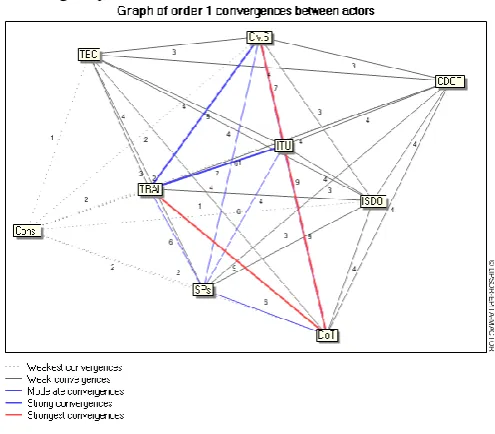
The influence between the actors can be interpreted in a following way :
Fig. 2. shows the convergence between the actors It can be noted in fig. 2., that consumer as an actor has the least influence on all the actors and thus, shares the weakest convergence bond with them; this perhaps shows that technologies and services follow the top-down approach. D. Morphological Analysis
Later, at the third stage, morphological analysis was carried out to consider the entire field of possibilities and construct scenarios. There were 27 hypotheses taken under 4 domains. This makes the probability of generating around
11,000 scenarios; or scenarios equal to
2X1X2X3X3X3X3X2X3X3X2. The following table shows the hypotheses:
E. Smic-ProbAnalysis
Out of the total scenarios, five scenarios were selected. Later, using Smic prob, the probability was assigned to all the scenarios (including the conditional probabilities).
Table- IV : Table of Hypotheses Table of Hypotheses
Domains Variables H1 H2 H3
Convergence of Technology
R&D R&D has greater degree of impact on
convergence of
technology
Institutions may play an important role to determine R&D expenditure
FDI FDI can lead to
more R&D and convergence
T
R
A
I
D
oT
T
E
C
IT
U
IS
D
O
C
on
s.
S
P
s
C
iv
.S
C
D
O
T
TRAI DoT TEC ITU ISDO Cons. SPs Civ.S CDOT
0 3 2 0 0 3 4 0 0
4 0 3 0 1 3 4 0 2
0 2 0 0 1 0 4 0 2
3 3 3 0 3 1 3 1 1
2 3 3 2 0 1 2 1 2
1 0 0 0 0 0 0 2 0
0 0 0 0 0 3 0 1 0
2 2 0 2 1 0 1 0 0
0 0 0 0 0 1 0 1 0
©
L
IP
S
O
R
-E
P
IT
A
-M
A
C
T
O
R
MDI
R
&D FDI
S
tn
ds
C
on
v.
D
iff. Em
p.
E
du
.
G
ov
.
H
lth Pen
trn
U
f
TRAI DoT TEC ITU ISDO Cons. SPs Civ.S CDOT
3 3 1 3 3 0 0 2 2 3 3 3 3 2 3 3 0 2 1 2 3 3 3 2 4 3 0 0 0 0 0 0 0 3 1 3 3 2 0 2 0 0 3 3 4 2 4 2 0 0 0 0 0 0 0 0 0 0 3 3 0 0 0 0 0 0 2 0 4 4 4 0 0 0 0 3 3 3 0 2 3 4 0 3 3 2 3 3 4 2 4 3 0 0 0 0 0 0 0
©
L
IP
S
O
R
-E
P
IT
A
-M
A
C
T
O
R
Standards Standards can lead
to less
interoperability and less convergence
ISDOs may
determine the choice of standards
Role of ICT in the growth of various sectors
Employment ICT in different sectors can increase employment
opportunities
Opportunities might be generated in R&D
There will be need
for computer
literates only
Education ICT can help in educating masses
For education, computer literacy will be required at various levels
To educate
masses, employment will be generated
Governance Governance can
be improved with the help of ICT
ICT can keep a track on institutions for various activities
ICT can involve participation of civil
societies and
consumers
Health ICT can help in
improving health related infrastructure
ICT can contribute in bringing new
techniques of
treatment, thus
leading to
convergence in
sectors also
ICT can also help
in generating
medical reports and disseminating information faster
Convergence of Services and sectors
Convergence Convergence of technology can lead to convergence of different services in different sectors
Use of ICT in different sectors demonstrates converging services in different sectors
Diffusion of
Converging technologies
Diffusion Diffusion requires awareness
Consumers look
for dominant
designs, a new
technology has to go through era of ferment
There are market risks involved for a
new technology/
service when
initially emerges
Penetration More penetration can lead to diffusion of technology
More penetration can make technology easy to use
More penetration can also turn to people‟s choices, making it into a dominant design User friendly Easy interface of
technology can lead to its diffusion
It makes
penetration easy and reduces the market risks
The opinions of experts were put into the format in such a way that it may fulfill the necessary conditions:
a) O < P(i) < 1
b) P(i/j).P(j) = P(j/i).P(i) = P(i.j) c) P(i/j).P(j) + P(i/ nonj).P(nonj) = P(i)
Thus, based on the analysis, two similar scenarios had the maximum probability to occur:
First scenario (in Table- V), i.e., scenario 11111111211 showed the opinions of academicians and second scenario (in Table- VI), i.e., scenario 11111111321 showed the opinions belonging to the core industry.
Table- V: Probable Scenario 11111111211 Scenario: 11111111211
R&D has greater degree of impact on convergence of technology
FDI can lead to more R&D and convergence
Standards can lead to less interoperability and less convergence
ICT in different sectors can increase employment opportunities
ICT can help in educating masses
Governance can be improved with the help of ICT
ICT can help in improving health related infrastructure
Convergence of technology can lead to convergence of
Consumers look for dominant designs, a new
More
penetration can lead to
diffusion of
International Journal of Innovative Technology and Exploring Engineering (IJITEE) ISSN: 2278-3075, Volume-8 Issue-12, October 2019
different services in different sectors
technology has to go through era of ferment
technology
Table- VI: Probable Scenario 11111111321 Scenario: 11111111321
R&D has greater degree of impact on convergence of technology
FDI can lead to more R&D and convergence
Standards can lead to less interoperability and less convergence
ICT in different sectors can increase employment opportunities
ICT can help in educating masses
Governance can be improved with the help of ICT
ICT can help in improving health related infrastructure
Convergence of technology can lead to convergence of different services in different sectors
There are market risks involved when new
technology/ service initially emerges
More
penetration can make
technology easy to use
Easy interface of technology can lead to its diffusion
But, out of these two scenarios the probability of second scenario to occur is more, this is equal to P(0.4) which is equivalent to 40 percent as compared to P(0.35) which is 35 percent of first scenario. Therefore, the most probable scenario is 11111111321.
V. CONCLUSION
The present study has attempted to contextualize the parameters of India Vision 2020 as set by the Planning Commission of India (2002) and foresight exercise has been conducted considering those parameters as the framework. It has been found that converging technologies leading to the enhanced applications of Information Technology enabled services which have the potential to transform the society and establish an ecosystem to serve new dimensions of the economy of the country. Thereby, adopting the LIPSOR foresight tools following scenarios have been developed. Total of 27 hypotheses were formulated under 4 domains. This led to the probability of generating around 11,000 scenarios. Out of these scenarios, two most probable similar scenarios were selected – one by academicians and the other by industry experts. And out of these two, the scenario fostered by the opinions of industry experts has drawn the probability of 40% as compared to the 35% of the first one. The most probable scenario states that convergence of technology will lead to the convergence of services and the variables R&D, FDI and Standards have significant impact on the convergence of technology. Thus, there is significant contribution of Information Communication Technologies in generating employment opportunities, educating masses, governance and improving health facilities in the country. The user – friendly interface of the ICT applications can lead to better penetration and diffusion of the technology.
REFERENCES
1. B. Bowonder, “Appropriate Technologies for Developing Countries: Some Issues”, Technological Forecasting and Social Change, Vol. 15, Issue 1, September 1979, pp.55-67
2. E.F. Schumacher, Small is Beautiful: Economics as if People Mattered, Blond and Briggs Publishers
3. C. Hipp and H. Grupp, “Innovation in the Service Sector: The demand for service-specific innovation measurement concepts and typologies”, Research Policy, Elsevier, Vol. 34, 2005, pp. 517-535
4. M. Godet and P. Durance, Strategic Foresight: For Corporate and Regional Development, United Nations Educational, Scientific and Cultural Organization, 2011
5. M.Godet, From Aniticipation to Action. A Handbook of Strategic Prospective, UNESCO Publishing, 1994
6. S.D. Andreson, Technological Challenges: Exploring Electronic Media: Chronicles and Challenges, New York: Wiley, 2007
7. M. Latzer, “Convergence Revisited: Towards a Modified Patterns of Communications Governance”, Convergence: The International Journal of Research into New Media Technologies, Sage Publication Vol. 15, No.4, 2009, pp. 411 – 426
8. P. Malik, and V.P. Llavarasan, Trends in Public and Private Investments in ICT R&D in India, European Union: Luxembourg, 2011
9. S.P. Gupta, Report of the Committee on India Vision 2020, Planning Commission, 2002
10. M. Hukill, R. Ono and C. Vallath, Electronic Communication Convergence: Policy Challenges in Asia, New Delhi: Sage Publication, 2000
11. World Bank, “World Development Indicators”, Washington, DC
AUTHORSPROFILE
Shruti Chopra is Research Scholar at Centre for Studies in Science Policy, School of Social Sciences, Jawaharlal Nehru University. Her research areas include ICT, telecommunications, digital media and media policies.