1 INTRODUCTION
In the day-to-day ship operations, structural and ma-chinery failures may lead to major accidents, endan-gering crew and passengers lives onboard, posing a threat to the environment, damaging the ship itself and having a great impact in terms of business losses. Moreover, with the introduction and building of a big number of new ships, their monitoring and inspection from both regulatory bodies and Classification Soci-eties has become more difficult in order to obtain the optimum inspection results and eliminating the haz-ards posed by high-risk and sub-standard ships.
In this respect, the INCASS (Inspection Capabili-ties for Enhanced Ship Safety) project brings together a range of experienced and dedicated partners in order to tackle the issue of ship inspection by providing ac-cess to information related to ship surveys independ-ent of the ship’s flag and inspection regime and incor-porate enhanced and harmonized cooperation of maritime stakeholders aiming to avoid ship accidents, promote maritime safety and protect the environment (EC, 2009). The INCASS partners include universi-ties such as the University of Strathclyde Glasgow (USG), Universitat De Les Illes Balears (UIB), Clas-sification Societies such as Lloyd’s Register EMEA (LR), RINA Services SPA, Bureau Veritas (BV), ship owners /managers (Danaos Shipping Company and AP&A) service providers (Glafcos Marine, Atlantec Enterprise Solutions GMBH (AES), Technicas Y Ser-vicios De Ingenieria S.L. (TSI), Shipcon) and re-search institutes such as Deutsches For-schungszentrum Fuer Kuenstliche Intelligenz GMBH (DFKI). The INCASS consortium brings an innova-tive solution to the ship inspection regime through the introduction of enhanced inspection of ship structures
based on robotic platforms, providing ship structures and machinery monitoring with real time information using ‘intelligent’ sensors and incorporate Structural and Machinery Risk Analysis.
Moreover, INCASS introduces Condition Based inspection tools and methodologies, reliability and criticality based maintenance, providing an enhanced Central Database including ship structures and ma-chinery by developing a Decision Support System (DSS) for ship structures and machinery for continu-ous monitoring and risk analysis and management of ship operations.
The INCASS concept, through the utilization of some of Europe’s leading companies and institutions, both in the consortium and advisory board, in various fields including ship inspection, ship operations, con-dition monitoring, development of advanced tools and methodologies, makes a significant contribution at European and international level in terms of en-hancing ship inspections, and thus achieving the iden-tification of high risk or sub-standard shipping oper-ations.
Hence, this paper is structured among various sec-tions. The first section provides the fundamental as-pects of INCASS project, followed by the literature review on Condition Based Maintenance (CBM) and well known condition monitoring assessment tools. Afterwards, the INCASS methodology is demon-strated as well as the employed tools that the method-ology consists. Lastly, the project’s impact in marine industry is presented as well as considerations for the progress work.
Inspection Capabilities for Enhanced Ship Safety
I. Lazakis, G. Theotokatos, N. Barltrop
Dpt. of Naval Architecture, Ocean and Marine Engineering, University of Strathclyde, Glasgow, UK
2 RESEARCH BACKGROUND
Ship accidents and near misses can be frequently at-tributed to the failure of structures and machinery. Accordingly, the latter increases the risk for crew and passengers’ injuries and fatalities, environmental damage and pollution, damage or total loss of the ship and its equipment as well as disruption of the ship’s operations which consequently lead to operational losses. Additionally, the maritime regulatory and ad-ministration authorities such as Flag states, Port State Control authorities and Classification Societies have increased their cooperative efforts towards the pro-motion of safe, secure and environmental friendly ship operations over the last years.
On top of the above, ship managers/operators still try to find a way to combine the rich practical knowledge acquired in the actual marine field with the technological advances stemming from the rele-vant information technology sector in an effective way. The latter comes in addition to the effects of not applying the appropriate maintenance sequence onboard a ship. Moreover, when repair works and/or spare parts are needed onboard the vessel, they have to be planned well in advance as the ship sails in dif-ferent geographical locations, thus with significant functional/access restrictions.
Besides the above, the overall risk analysis, risk management and maintenance process in the mari-time sector still lacks the element of applying and im-plementing technologically advanced tools in con-trast to applications in other industrial sectors such as the nuclear and aerospace industry which provide real-time monitoring (e.g. condition monitoring tools and techniques). In this case, condition based proce-dures in the maritime industry are not well established yet (Imarest, 2011).
However, various developed methodologies can be found in literature. For instance, Lazakis et al. (2010) introduce a new maintenance management ap-proach, particularly referring in the appraisal of the reliability and criticality characteristics of a vessel, thus increasing the vessel’s operational efficiency. In Straub et al. (2006) the Risk Based Inspection (RBI) application is presented regarding fatigue deteriora-tion for offshore fixed steel structures and floating, production, storage and offloading vessels (FPSO’s). Ku et al. (2004) discussed the implementation of risk-based inspection plans regarding the strength and fa-tigue assessment of a floating production unit (FPU) located in offshore West Africa while Turan et al. (2009) also presented a methodology for examining the effects of hull structure repairs on the life cycle cost of ships.
2.1 Hull Condition Assessment (HCA)
HCA is a critical activity in the maritime industry as it is straightforwardly linked to the ship’s functional
condition and the safety preconditions mandated for the ship herself and the onboard personnel. On time identifications of defects has also a significant mone-tary value for the ship operators as it allows better scheduling of maintenance activities and prohibits failure propagation effects, thus minimizing the risks. HCA is currently performed under two directions. Firstly, the periodic Classification surveys, during which the hull status is compared to some predefined nominal values (with metrics like hull and structural members’ thicknesses or extent of rust or pitting). Whereas, Condition surveys are performed under the ship owner’s/operator’s responsibility and usually have as objective the scheduling of the repair activi-ties.
This need has been identified in the maritime transport sector and has introduced two EC funded re-search paradigms, namely the HCA-Flagship (Emmett et al., 2011) effort and RISPECT (Risk-Based Expert System for Through-Life Ship Struc-tural Inspection and Maintenance and New-Build Ship Structural Design) project (Barltrop et al., 2010), which offer decision support tools to assist in the de-cision making process, prediction for possible areas of defect depending on parameters like the ship’s type, age and size, with knowledge and information collected from past experiences (databases) and up-dated with current survey data.
RISPECT project combined the traditional experi-ence based inspection method with the first-princi-ples, statistical analysis, for safe, cost-effectiveness structural inspection, repair and design rule improve-ment of existing ships (RISPECT, 2012). It provided aids to the structural integrity management of ships that can be succeeded by optimizing the overall man-agement of shipping operations. More specifically, the project developed tools for assessing structural loads, stresses and strength. Additionally, a standard database structure was also created in order to be ac-cessed by Classification Societies and ship operators. This was populated with sanitized data from survey results in order to avoid duplications and sensitive in-formation being released, while at the same time maintaining the significance of the collected infor-mation. However, no real-time information was col-lected. Moreover, the analysis performed was not centered on risk-based approaches, thus identifying the critical ship structural areas and consequently ships. This is an area at which the INCASS project aims for.
rObotic Assistant System) project comprised the in-spection of both dry and wet areas of the vessel (e.g. flooded ballast tanks or external hull) (Biduli et al., 2011). Moreover, the project was not limited to tele-operated floating tethered vehicles and considered a varied set of robotic technologies with different loco-motion capabilities and different degrees of auton-omy. In more detail, the MINOAS concept comprised aerial vehicles, magnetic crawlers, and ROVs. The aerial vehicle, due to its mobility, was intended to provide a fast overview of the state of the structure under inspection, e.g. a cargo hold of a ship.
2.2 Condition Based Maintenance (CBM)
CBM tries to avoid unnecessary inspections for ma-chinery and structure which are in technically perfect condition and to minimize the amount of unexpected machinery breakdowns and structure failures. This methodology seeks to know the actual state of the ma-chinery by means of the measurement and suitable analysis of a list of specific variables and parameters without interfering in the normal operation of the sys-tem. This leads to know if the system is working properly, estimate when the failure is likely to happen and what the cause has been or will be, allowing to programme the maintenance tasks, thus to reduce the cost associated to them, and to minimize the inherent risks and not expected costs of an unforeseen machin-ery failure.
More specifically, the key concept of the machin-ery CBM methodology rests on that evmachin-ery machine, when it works properly, has a determined level of vi-bration, noise or whatever parameter, considered as “base state” and when a defect appears, even in early stages, leads to a characteristic increment of the level which permits to identify it and evaluate its severity. The experience has revealed that vibration monitor-ing is one of the most powerful tools to control properly the condition of the rotating and oscillating machinery. However other techniques have been de-veloped, in some cases, to provide support to the first one, in other cases to get new and necessary infor-mation, which allows the identification of defects mainly in static equipment, electrical and internal combustion engines. Some of the tools necessary to develop a successful Condition Based Maintenance programme are mentioned next.
2.2.1 Vibration Monitoring
The various vibration frequencies in a rotating ma-chine are directly related to its geometry and operat-ing speed (Al-Najjar, 1996). By knowoperat-ing the relation-ship between the frequencies during optimal operation of machinery, it is easy to identify at an early stage any types of defects and take remedial ac-tion well before the equipment is damaged or has to be taken out of operation. Among others, vibration
monitoring can detect unbalanced rotating machinery parts, excess sleeve or bearing wear, misalignments, damaged gear teeth, and damaged bearings. This technique applies also to Propulsion Diesel engines, Electrical Generator engines, Gear boxes, Main steam turbines, Pumps and Motors Compressors, Turbo-chargers, Generators, Propellers and Shafting & wa-ter jets, covering most equipment onboard a ship. It has to be noted that a number of structural defects have their origin in excessive vibration from machin-ery, as mentioned above, so its early identification and rectification ensures the good condition and lon-gevity of associated structures. All the sensors used to measure vibration, convert the physical magnitude (in terms of displacement, velocity or acceleration de-pending on the kind of sensor) into a proportional electrical signal that can be split into its fundamental frequencies.
2.2.2 Thermography
This technique measures absolute or relative temper-atures of the different parts of the machine (Bagavathiappan et al., 2013). Abnormal tempera-tures indicate developing problems. Any friction or coupling problem generates overheating and any in-crement in the electric resistivity results in “hot spots”. The most common contact methods use ther-mocouples and thermometers. However non-contact methods using infrared sensors have become a desir-ably alternative over the conventional ones (Budweg, 2012). This technique can be applied to Steam tur-bines, Turbochargers, Diesel engines, Electrical en-gines, Generators.
2.2.3 Lubricating oil analysis
This tool is aimed at controlling the state of the lubri-cant, the level of degradation of the different compo-nents of the machine and the presence of moisture and water by analyzing the lubricating oil (Jiang and Yan, 2008). Its specific application to diesel engines, com-pressors and gear boxes, besides to the advantages re-lated to the optimization of the lubricant oil changes, can confirm the diagnostic made with others tools, in particular with vibration monitoring. This technique monitors the following parameters: kinematic viscos-ity, humidity/water content, particles content, etc. giving an early indication of potential damages and malfunctions. Lubricating oil analysis can be applied to Diesel engines, Gear boxes, Steering Gears, Com-pressors and Steam turbines among others.
3 INCASS METHODOLOGY
ship owners/ operators/ managers and service provid-ers which are at the forefront of research and devel-opment with long experience and high expertise re-lated to ship inspections, surveying and monitoring, data gathering and assessment as well as the develop-ment and impledevelop-mentation of databases and DSS. In this respect, INCASS project takes into account the achievements of both RISPECT and MINOAS pro-jects and furthermore expand on them through the in-clusion of machinery related data gathering, assess-ment and risk and reliability appraisal. Moreover, INCASS enhances the previous projects’ framework by developing a Central Database for both structures and machinery and additionally incorporating a DSS in order to address emergency (short term) decision making in case of accidents occurring as well as sup-porting long term decisions.
3.1 INCASS Project Innovations
Overall, through the implementation of the INCASS platform, the improvements aim to develop new pat-tern recognition and image processing methods. IN-CASS employs robotic platforms and state-of-the-art technologies for vessel status data collection. Moreo-ver, the project collects and analyses structural failure consequence data and machinery and equipment data by employing historical expert and real time monitor-ing data. It applies a CBM approach with respect to detection of required maintenance activities, spares logistics and approval of maintenance and repair jobs. In additional, INCASS develops Structural and Ma-chinery Risk Analysis (SRA and MRA respectively) tools to monitor high risk ships, combined with a Central Database which will include information for structures and machinery to be available to the mari-time industry for access.
3.2 INCASS Framework
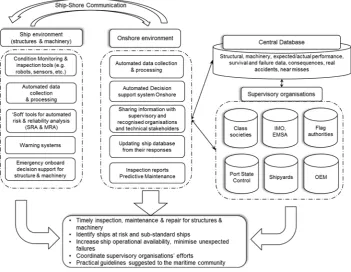
This section demonstrates the INCASS framework as shown in Figure 1. INCASS is developed by as-sessing structural loads, developing a Central Data-base, methodology update through the use of crawl-ing and flycrawl-ing robots for structural close-up inspection, transfer of visual information and data to a centralized display and expands on including a real-time condition monitoring framework onboard the ship in the first place. This occurs with the use of in-spection tools for structures such as continuous itoring with strain sensors for structures, ship’s mon-itoring of hydrodynamic influence from the actual ship operation, enhanced robots image and data ac-quisition, engulfing the different operational profiles of the ship as it sails worldwide.
[image:4.595.122.474.517.789.2]Accordingly, real-time monitoring is described for the ship machinery and equipment with sensors used for machinery vibration monitoring, performance monitoring of ship engines, thermal imaging for elec-trical panels and switchboard and other condition monitoring applications. At this point, it must be mentioned that although some of these tools and tech-niques are applied in the maritime industry to some extent (mostly in the offshore oil and gas industry); they are not exploited to their full capabilities. In IN-CASS, these are operating in a collaborative way, feeding into the main procedure for automated data collection and processing while also considering the practices that will be conveyed in the project by part-ners with experience and expertise in other critical safety industries (aerospace and nuclear ones).
Moreover, soft tools for automated risk & reliability analysis are developed for structures (Structural Risk Analysis-SRA) and machinery (Machinery Risk Analysis-MRA) using the data that are collected in the previous steps. At this stage, the assessment of the ship’s structures and machinery condition is per-formed leading to warning systems in case of an emergency. Eventually, this leads to an onboard De-cision Support tool for both structures and machinery, enabling the short-term quick decision making that the crew of the ship can face with in emergency situ-ations. The Decision Support process is developed to utilize inspection and real-time monitoring data in-cluding a number of linguistic (experts judgement, se-mantic values) and numerical attributes (MTBF, fail-ure rates, mean time to repair, etc.) supported by automatic analytical methods; such as historic and real-time monitoring and ship performance data. Moreover predictive methods are also introduced aiming at forecasting future ship performance.
On the other hand, the onshore environment con-sists of an automated data collection and processing tool that is fed in with real-time information based on the ship’s condition of structures and machin-ery/equipment. It is important to note that an auto-mated Decision Support (DS) tool will be also avail-able so as to support the decision making on shore in need of a longer-term decision making involving and sharing information among the ship operators and technical stakeholders. The latter leads to inspection reports being produced for longer-term scheduling, including actions for maintenance and repairs of structural parts and machinery.
The results of the Decision Support tool including inspection reports and predictive maintenance tasks are eventually fed into the Central Database which are in place onshore and used for data and information storage being updated with maritime stakeholders’ re-sponses as well. In this case, the Central Database in-cludes information for ships’ structures and machin-ery, their expected and actual performance, survival and failure data as well as potential failure conse-quences and information from real accidents and near misses. This in turn enables the Central Database be-ing continuously updated so as to include the latest information for a particular ship and fleet size.
4 INCASS TOOLS
This section layouts the INCASS project tools, their functionalities and innovations applied. In more de-tail, the data collection, Structural and Machinery Risk Analysis and decision making process are de-scribed.
4.1 Structural and Machinery Risk Analysis
Initially, data is gathered from a number of differ-ent sources. These refer to original inspection data, historical data from previous ship inspections and da-tabases, previous efforts using numerical models to estimate the inspection planning as well as infor-mation from actual ship accidents and near misses. Also data is collected from external databases (e.g. UK MAIB, OREDA database), historical data includ-ing failure consequences, Mean Time Between Fail-ures (MTBF), failure rates for individual components, inspection and maintenance intervals performed onboard, experts’ data from condition monitoring campaigns onboard ships, real time monitoring through the use of intelligent sensors.
The data from the above sources will be combined in order to feed into the SRA and MRA soft tools. The SRA includes elements of the Risk Based Inspection (RBI) coupled with risk management leading to the structural inspections based on the risk analysis re-sults. For the MRA, the RCBM (Reliability and Crit-icality based Maintenance) process takes place for specific machinery systems (e.g. Main Engine, Tur-bocharger, selected pumps and the steering gear). In this case, the less reliable and high or medium level criticality machinery systems and components are identified in a specific and measurable way so as to enable not only the ship risk management but also en-able the comparison of the in-service reliability of ships overall through a common metric such as the Overall Equipment Effectiveness so that different ships can be easily comparable and high risk ships identified. The above is also provided in the form of guideline suggestions to the maritime authorities for further application throughout the fleet numbers.
re-quirements of Class and regulatory authorities fol-lowing the initial appraisal of the condition of the ship’s structure and machinery.
4.2 Central Database
Regarding the Central Database, the collection of structural & machinery data and risk analysis takes place through the use of a series of new developed tools. The system is initialized by importing design information. Possible data sources are listed as exist-ing design information from Class, CAD design in-formation (3D models or drawing based), specifica-tions, and tabular information like inventories or part lists. The HCM adapter will allow import of detailed structural design and life-cycle information (Jaramillo, 2007).
Once a minimum set of mandatory information is available, initial risk analysis and assessment calcula-tions can be carried out. This enables the system to be operated in decision support mode. During ship oper-ation, new information can be added on-board as measurement and recorded sensor data becomes available. Due to the volume and nature measure real-time data, pre-processing and filtering will occur be-fore the data is persistently stored in the system. Sim-ilarly, results from inspections (e.g. as provided by in-spection companies) can be added, e.g. by importing results using HCM data Whenever new data is avail-able, the risk analysis and assessment can be repeated, resulting in new risk analysis results. Alternatively, in an emergency situation or in case of a spontaneous failure of some component(s), a faster emergency risk assessment is possible. Such failure information can also be entered interactively, which would all support what-if types of analysis.
4.3 Structural modelling and analysis
In addition to the existing inspection data within the database, the inspection data obtained from robots will also be included to support the calibration pro-cess. Furthermore, the real-time information obtained from robots will be used to check the current-status of the ship structure for the emergency DSS.
In this case, the INCASS structural platform of tools enhances the existing tools and methodology with new ones. First of all, the creation of interface and analysis for the data is introduced that will be col-lected through the robotic applications during the ship inspection. Furthermore, a tool for ship hydrody-namic and structural analysis is developed. Addition-ally, analysis and consolidation of the structural data is established through the various data acquisition methods.
4.4 Machinery tools and methodology
In a similar manner, tools are developed as part of the machinery and equipment set of tools and methodol-ogies and they feed in their results and data in the ma-chinery and equipment database. These include sys-tems according to the ship types that are investigated through the INCASS project (i.e. tankers, bulk carri-ers and container ships) and include the Main Engine, Turbocharger, selected pumps and the steering gear.
Accordingly, the results from the integration of the numerical models and the failures identification based on reliability and criticality calculations are in-tegrated in the machinery and equipment assessment framework. The ship systems examined above feed in with data to the machinery and equipment database toolbox. This in turn includes the calculations and risk and reliability analysis performed so as to identify the components and systems prone to failure as well as assess their criticality level. In this case, the decision support process is also activated in order to inform the onboard and onshore personnel of the available opti-mum suggestions.
As an addition to the above, one of the outcomes of the INCASS framework is the development of practical guidelines regarding ship inspection in terms of structures and machinery so as to focus the inspection effort at the critical and most sensitive ar-eas of the ship. The guidelines will be addressed to both European (e.g. EMSA) and international author-ities (e.g. IMO). Concurrently, the high risk ships will be easier monitored and their operations controlled, contributing to the European and international efforts for minimization and avoidance of ship accidents with important results on safety and the environment. 4.5 Preliminary results
INCASS project consortium includes a number of partners such as universities, Classification Societies as well as ship operators, managers, owners and ser-vice providers. Thus, CM requirements vary among the project stakeholders. Due to different CM neces-sities, the project members’ requirements are assessed leading to the final machinery and equipment selec-tion (INCASS, 2014).
As it can be summarized from the INCASS stake-holders requirements, Classification Societies are mostly focused on the ship’s functionality ensuring safety and environmental protection among others. Whereas, ship operators, managers, owners and ser-vice providers are focused on ship’s operation and availability ensuring business efficiency and safety. 4.5.1 Classification Societies requirements
The role of Classes is to check that safety standards of ships are met throughout surveys, inspections, tests and controls. As long as ship machinery and equip-ment monitoring technologies provide relevant infor-mation that can demonstrate that condition of equip-ment is acceptable to ensure ship safety, they can be used as a complementary means for Classes to con-firm that machinery, equipment and appliances com-ply with the applicable rules and remain in satisfac-tory condition. Moreover, when CM techniques are properly applied, they can enhance decision support and facilitate the work of Class surveyors, thus they can get an objective opinion on the condition of a sur-veyed item/system of machinery and equipment with-out dismantling it. A Classification survey is a visual examination that normally consists of an overall ex-amination of the items for survey, detailed checks of selected parts and witnessing tests, measurements and trials where applicable. According to Classification Societies’ input, the most critical failure records are distributed among Oil Tanker, Bulk Carrier and Con-tainer ship categories respectively. Moreover, failure records by ship and machinery type indicate the Main Engine (M/E), propeller unit, and the steering gear as the most critical due to higher failure occurrence. 4.5.2 Ship operators/managers/owners/service
pro-viders requirements
All ship related stakeholders have the greatest interest in collecting ship machinery and equipment data for a number of reasons. First and foremost a major ma-chinery breakdown leads not only to major/minor re-pair cost, but also and probably most importantly in-creases ship systems downtime through which valuable ship earning may be lost and/or could lead to environmental cost. From ship operators/ manag-ers/ ownmanag-ers/ service providers’ perspective, the rea-sons for monitoring and collecting information on ships are related to environmental protection, safety of personnel onboard, compliance, Class Statutory re-quirements, minimizing business risk, and minimiz-ing costs.
In INCASS stakeholders’ requirements specifica-tion, a comparative research study takes place. The systems that project members agreed on their opera-tional importance ensuring all considered require-ments are summarized as the Main Engine (M/E),
Turbo-chargers (T/C), critical selected pumps (in-cluding steam powered tanker ship cargo pumps) and steering gear system.
5 DISCUSSION AND CONCLUSIONS
INCASS project contributes towards the develop-ment of methodologies and tools which can enable recognized organizations and regulatory authorities to assess and upgrade their risk management pro-cesses. The project targets to enable more efficient coordination of inspection scheduling, and monitor-ing practices particularly by sharmonitor-ing information on incidents and near loss cases. Moreover, it contributes towards the classification and identification of pre-ventive actions over time, by performing risk sis, involving risk control options, cost benefit analy-sis and decision making recommendations. Furthermore, INCASS aims to improve technologies in inspection, repair and verification of ship struc-tures, by considering vessel condition information through real time information from ‘intelligent’ sen-sors, enabling the awareness of more targeted and time efficient inspection processes.
The Structural Risk Analysis (SRA) and Machin-ery Risk Analysis (MRA) tools improve and upgrade the existing regulatory risk management processes as they provide an easily accessible way to determine the vulnerability of ships at any time in a quick and efficient way. In this case, the quality of the services that recognized inspection organizations offer are ma-jorly improved, allowing for comprehensive horizon-tal access to ship inspections, data gathering and def-inition of the risk profile of ships.
Moreover, with the development of the Central Database, the overall screening of information re-garding different ships types is available in a direct and continuous way. This is available at both a single ship and entire fleet level so as to enable the through life ship monitoring regardless of the ship ownership and Flag regime. The latter eventually decreases the cost for costly and time-consuming ship inspections for both the ship operators’ side and the Classification Societies and other inspection organizations in-volved. Additionally, the Central Database is also continuously upgraded regarding the most recent in-formation and knowledge from existing databases of Port State Control authorities and their inspection re-sults in a seamless way.
avoids, mitigates and reduces the unexpected, costly, unsafe and environmentally unfriendly ship opera-tions especially following a ship incident or near miss, either including structural damage (e.g. flood-ing of ship compartments, losflood-ing structural integrity) or machinery failure (e.g. leaking of fuel/hydraulic pipes, explosions and fire due to unexpected machin-ery breakdown).
In conclusion, INCASS provides a development platform for combining a range of several advanced information technology features, ranging from data management and analysis, image processing to effi-cient long-range communication. The management of data large volume as generated by sensors and inspec-tion methods combines with a large scale analysis system, which also needs to maintain even larger data repositories. INCASS contributes substantially to the realization of a full scope life-cycle data representa-tion for maritime vessels. This in turn will facilitate data analysis and data mining capabilities to be ap-plied in ways that are not possible today. As the over-all system requires an optimized combination of state-of-the-art computational equipment with advanced software solution approaches, it will lead to new find-ings and insights on how to implement such an envi-ronment. The project will also provide a test bed for investigating ship-to-shore communication for data-intensive applications.
6 ACKNOWLEDGEMENTS
INCASS project has received research funding from the European Union’s Seventh Framework Pro-gramme under grant agreement no 605200. This pub-lication reflects only the author’s views and European Union is not liable for any use that may be made of the information contained herein.
7 REFERENCES
AL-NAJJAR, B. (1996) Total quality maintenance: An approach for continuous reduction in costs of quality products. Journal of Quality in Maintenance Engineering, 2, 4-20.
BAGAVATHIAPPAN, S., LAHIRI, B. B., SARAVANAN, T., PHILIP, J. & JAYAKUMAR, T. (2013) Infrared thermography for condition monitoring – A review. Infrared Physics & Technology, 60, 35-55.
BARLTROP, N., HU, L. & HIFI, N. (2010) Risk-Based Expert System for Through - Life Ship Structural Inspection. Maintenance and New-Build Ship Structural Design. University of Strathclyde.
BIDULI, M., BRUZZONE, G., CACCIA, M., ORTIZ, A., VOEGELE, T., EICH, M., DRIKOS, L., KOVEOS, Y., KOLIVAS, E.,
SPADONI, F., VERGINE, A., TANNEBERGER, K., TODOROVA, A., GAVIOTIS, I. & APOSTOLOPOULOU, V. (2011) The MINOAS project: Marine INspection rObotic Assistant System.
Proceedings of the IEEE Mediterranean Conference on Control.
BUDWEG, M. (2012) Temperature Monitoring, Switchgear busbars, Hot Topic. Marine Maintenance Technology International, The Official Publication of Marine Maintenance World EXPO. Brussels, Belgium, Raytek Corporation.
EC (2009) Regulation (EC) No 391/2009 of the European Parliament and of the Council of 23 April 2009 – (Common Rules and Standards for Ship Inspection and Survey Organisations),. Official Journal of the European Union.
EMMETT, L., CHURCHMAN, L. & HOOLEY, S. (2011) FLAGSHIP-HCA enables accurate hull condition forecasting for improved maintenance and investment.
IMAREST (2011) The philosophy behind condition monitoring. Marine engineers review (MER).
INCASS (2014) Deliverable D4.2 Stakeholders’ data requirements. INCASS - Inspection Capabilities for Enhanced Ship Safety. EC FP7 Project.
JARAMILLO, D. (2007) Specification of HCM (Hull Condition Data Model). FP6-516561 , CAS Project.
JIANG, R. & YAN, X. (2008) Condition Monitoring of Diesel Engines. Complex System Maintenance Handbook. Springer London. KU, A., SERRATELLA, C., SPONG, R., BASU, R.,
WANG, G. & ANGEVINE, D. (2004) Structural reliability applications in developing risk-based inspection plans for a floating production installation. 23rd International Conference of Offshore Mechanics and Arctic Engineering (OMAE).
Vancouver, Canada.
LAZAKIS, I., TURAN, O. & AKSU, S. (2010) Increasing ship operational reliability through the implementation of a holistic maintenance management strategy. Ships and Offshore Structures, 5, 337-357.
STRAUB, D., GOYET, J., SORENSEN, J. & FABER, M. H. (2006) Benefits of risk based inspection planning for offshore structures.
Proceedings of the 25th International Conference of Offshore Mechanics and Arctic Engineering (OMAE). Hamburg, Germany. TURAN, O., OLCER, A. I., LAZAKIS, I., RIGO, P.
& CAPRACE, J. D. (2009) Maintenance/repair and production-oriented life cycle cost/earning model for ship structural optimisation during conceptual design stage. Ships and Offshore Structures,