R E S E A R C H
Open Access
Comparative quantitative proteomics of
prochlorococcus
ecotypes to a decrease in
environmental phosphate concentrations
Matthew A Fuszard, Phillip C Wright and Catherine A Biggs
*Abstract
Background:The well-lit surface waters of oligotrophic gyres significantly contribute to global primary production. Marine cyanobacteria of the genusProchlorococcusare a major fraction of photosynthetic organisms within these areas. Labile phosphate is considered a limiting nutrient in some oligotrophic regions such as the Caribbean Sea, and as such it is crucial to understand the physiological response of primary producers such asProchlorococcusto fluctuations in the availability of this critical nutrient.
Results:Prochlorococcusstrains representing both high light (HL) (MIT9312) and low light (LL) (NATL2A and SS120) ecotypes were grown identically in phosphate depleted media (10μM Pi). The three strains displayed marked
differences in cellular protein expression, as determined by high throughput large scale quantitative proteomic analysis. The only strain to demonstrate a significantly different growth rate under reduced phosphate conditions was MIT9312. Additionally, there was a significant increase in phosphate-related proteins such as PhoE (> 15 fold increase) and a depression of the Rubisco protein RbcL abundance in this strain, whereas there appeared to be no significant change within the LL strain SS120.
Conclusions:This differential response between ecotypes highlights the relative importance of phosphate availability to each strain and from these results we draw the conclusion that the expression of phosphate acquisition mechanisms are activated at strain specific phosphate concentrations.
Keywords:Prochlorococcus, PstS, PhoA, PhoE, Growth, Phosphate
Background
Within marine oligotrophic systems, such as central subtropical gyres, orthophosphate (Pi) is a crucial
macronutrient governing microbial population densities, particularly within the well-lit surface waters of the euphotic zone [1-3]. The principal photosynthetic organism numerically dominating these areas is
Pro-chlorococcus, which is estimated to represent about 50% of all photosynthetic activity within them [4,5].
Prochlor-ococcushas been broadly delineated into two clades, or ecotypes, high light (HL) and low light (LL) based upon the ratios of divinylchlorophylla and b within their light harvesting apparatuses and as such their assumed depth within the water column [6,7]. Further clade
subdivisions have been implemented through phyloge-netic analyses of 16S rRNA sequences [8]. As a taxon,
Prochlorococcus is characterised by its small size (~ 1
μm3), and significantly reduced genomes which ranges from 1.64 Mbps (the HL strain MIT9301) to 2.68 Mbps (the LL strain MIT9303) [9]. This diminished volume and genome is hypothesised to be the result of an accel-erated evolutionary process adapting to reduced phosphorus in its environment [10,11]. Indeed,
Prochlor-ococcus is known to replace phospholipids in its mem-branes with sulpholipids, which dramatically reduce its Pirequirements [12].
Given the importance of Pito Prochlorococcus,
per-haps it is surprising to find no significant correlation between ecotype distribution and Piconcentration [13].
However, fluxes in Pitransport within these regions are
important considerations, which could help to explain
* Correspondence: [email protected]
ChELSI Institute, Department of Chemical and Biological Engineering, University of Sheffield, Mappin Street, Sheffield S1 3JD, UK
the discrepancy. Nevertheless the observation of a large number of known Piacquisition genes in some LL
eco-types (i.e. MIT9313 and NATL2A), and not others (i.e. SS120) [14,15] is confusing. Indeed, Piacquisition genes
are present in some HL strains (i.e. MED4) and not others (i.e. MIT9515) [14]. However it was recently observed that the prevalence ofProchlorococcus genes involved in acquisition of phosphate substrates were correlated with areas of low Pisuch as the Caribbean
Sea and NW Mediterranean [16]. This conflict is likely resolved due to the presence of hypervariable genomic islands within Prochlorococcus, allowing for evolutiona-rily rapid niche adaptation [17]. Given this, it was hypothesised that the presence or absence of these genes could directly affect the protein content of cells when Pi stressed, and as such directly affect the ability
of a strain to acclimate to environmental Pifluctuations
[16]. So the question arises, how effective are cells with and without these genes at acclimating to a shift in environmental Pi? Indeed, the levels of mRNA
tran-scripts of two strains, MED4 and MIT9313, which both contain the two component response regulation system
phoBR, behaved quite differently to Pistarvation [14].
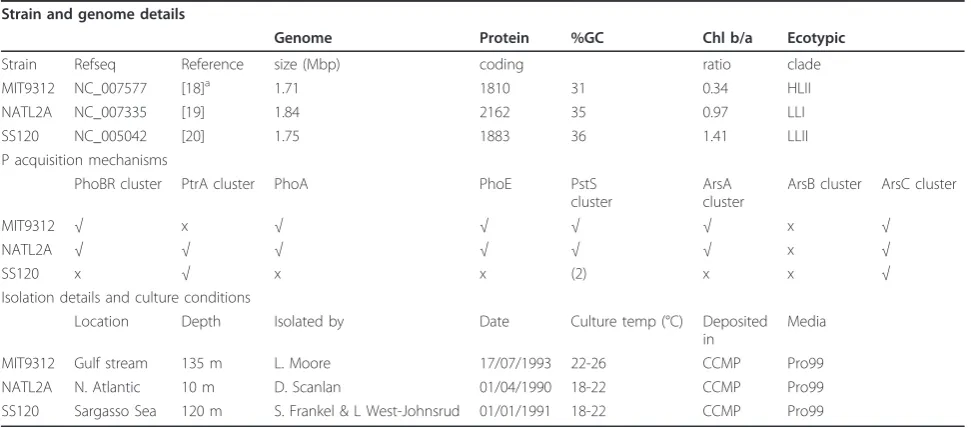
To address this we selected three strains, MIT9312, NATL2A and SS120, each representative of an ecotype and a position within the water column (Table 1). MIT9312 is a HLII strain isolated at depth from the Gulf Stream. NATL2A is a LLI strain isolated from the North Atlantic which contains most of the Piacquisition
genes found in MED4 and MIT9312, and yet is thought to experience both high and low light environments due to storm mixing events. SS120, originally isolated in the
Sargasso Sea, does not possess phoBR, yet has two copies of the periplasmic phosphate binding protein, PstS. We took these three strains and allowed cells to acclimate to a significant reduction in environmental Pi
and investigated their respective protein contents.
Results and discussion
Overview
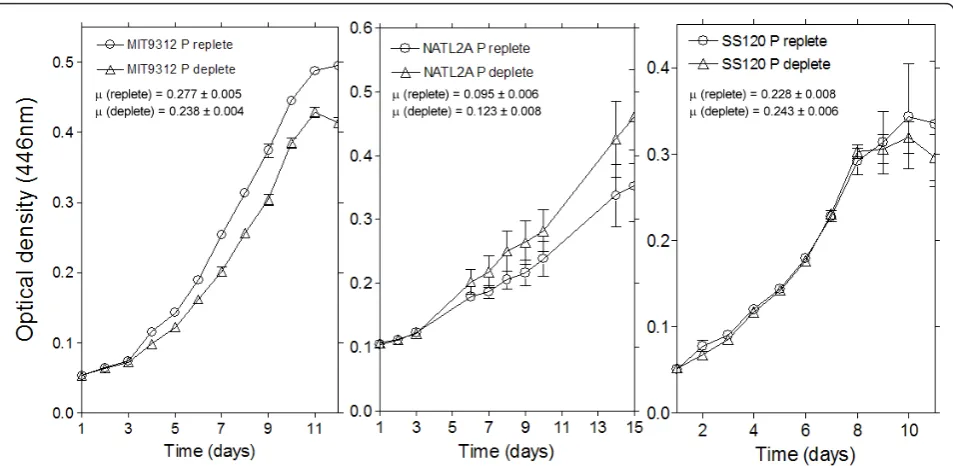
The experimental growth data for each strain under Pi
replete and Pi deplete cultures is shown in Figure 1.
Logistic curve fitting and statistical analysis of the experimental growth data reveals no significant differ-ences between the growth rates between Pireplete and
Pi deplete cultures, with the exception of MIT9312
growth rates whereby Pireplete growth was significantly
greater than Pideplete growth (p < 0.05), as can be seen
in Figure 1. It is important to consider the physiological status of the cells at the harvest point when considering protein relative abundances. Importantly, growth analy-sis shows that both MIT9312 and SS120 were in late exponential/early stationary phase at harvest, whilst NATL2A was in mid exponential phase. As the point of harvest differs for NATL2A, it would be difficult to directly compare the protein complement of NATL2A cells to either MIT9312 or SS120. Given this, the results for NATL2A will be discussed separately.
[image:2.595.56.542.500.714.2]Thirty eight, 63 and 34 proteins were identified with 2 or more peptides for strains MIT9312, NATL2A and SS120 respectively (Additional file 1: Table S1) with no false positives. An overview of the respective proteomes, through plotting theoretical values of isoelectric points (pI) against molecular weights (MW) reveal significant
Table 1 Details of the strains used in this study, as obtained from NCBI and CCMP.
Strain and genome details
Genome Protein %GC Chl b/a Ecotypic
Strain Refseq Reference size (Mbp) coding ratio clade
MIT9312 NC_007577 [18]a 1.71 1810 31 0.34 HLII
NATL2A NC_007335 [19] 1.84 2162 35 0.97 LLI
SS120 NC_005042 [20] 1.75 1883 36 1.41 LLII
P acquisition mechanisms
PhoBR cluster PtrA cluster PhoA PhoE PstS cluster
ArsA cluster
ArsB cluster ArsC cluster
MIT9312 √ x √ √ √ √ x √
NATL2A √ √ √ √ √ √ x √
SS120 x √ x x (2) x x √
Isolation details and culture conditions
Location Depth Isolated by Date Culture temp (°C) Deposited in
Media
MIT9312 Gulf stream 135 m L. Moore 17/07/1993 22-26 CCMP Pro99 NATL2A N. Atlantic 10 m D. Scanlan 01/04/1990 18-22 CCMP Pro99 SS120 Sargasso Sea 120 m S. Frankel & L West-Johnsrud 01/01/1991 18-22 CCMP Pro99
a
indicates that the genome sequence has been submitted, yet not cleared. Ticks in‘P acquisition mechanisms’indicates presence of gene/cluster, and copies are in parentheses
Fuszardet al.Aquatic Biosystems2012,8:7 http://www.aquaticbiosystems.org/content/8/1/7
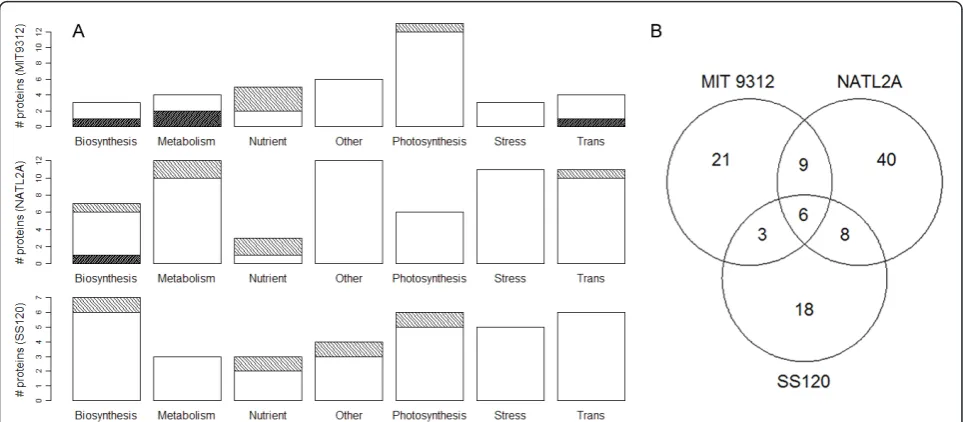
bias towards lowpI values (Additional file 2: Figure S1), with no further correlation to MW, relative protein abundance, nor total peptide hits per protein (data not shown). This bias may be an artefact of the mass spec-trometric analysis, where peptides are protonated directly before entry into the MS in order to assist flight and detection. As a consequence, naturally occurring proton-donor peptides may be preferentially selected. However, as there are no observable correlations betweenpIand peptide hits per protein, we can be con-fident that the intracellular protein abundances reported are directly reflective of the physiological status of the cells. Indeed, when interrogating the proportion of pro-teins with ≥ 50% of peptide hits, we see similarities between strains, such as the presence of RplL, RbcL and CsoS1 (Additional file 1: Table S1), however all three proteins havepI values < 7. Nevertheless, a highpI pro-tein, PetH, is present in both MIT 9312 and SS120 sam-ples. Also, identified proteins from all three strains are located evenly across the genomes, and are representa-tive of most major functional groups such as central metabolism, photosynthesis, transcription and transla-tion, biosynthesis and nutrient acquisition (Figure 2A). Of the 105 unique proteins identified, 6 were found in all three strains (Figure 2B). They are the ATP synthase subunits AtpA and AtpD, the PSII protein PsbO, the nitrogen regulatory protein GlnK, rubisco subunit RbcL, and the carboxysome shell protein CsoS1.
Using relative abundance cut-offs of 1.6 and 0.6 fold dif-ferences to represent increased or decreased relative
abundances [21,22], 4 proteins were more abundant in MIT9312 and 4 were less abundant than the replete cul-tures. Within NATL2A, 6 proteins were more abundant and 1 was less abundant than the replete cultures. In SS120, 4 were more abundant and none were lower than the replete cultures (Figure 2A).
Nutrient acquisition
What is immediately apparent from our results is the differential abundance of Pi acquisition proteins
exhib-ited by all three strains to being grown in 10 μM Pi.
MIT 9312 demonstrates the greatest sensitivity to Pi
-deplete media, whereby the Pistress related porinPhoE
is > 15-fold more abundant (Figure 3), the putative alka-line phosphatase PhoA appears to be > 9-fold greater, and the periplasmic Pi binding protein PstS > 3 times
more than the replete cultures. This result is directly in line with an earlier proteomic assay of P stress in a HL ecotype, MED4 [21], and closely reflective of microarray analyses of both MED4 and MIT9313 [14],
Synechococ-cucsWH8102 [23], measured alkaline phosphatase activ-ity of MIT9312 [15] and in line with observed responses within earlier Pidepletion studies of other cyanobacteria
[15,24-26].
Within NATL2A, PstS abundance is significantly greater within Pi-deplete conditions, though with greater
[image:3.595.61.538.88.321.2]uncertainty (Additional file 1: Table S1). However neither PhoA nor PhoE was observed with mass spec-trometry here, which is surprising as we showed pre-viously that both PhoA and PhoE are greater in
abundance alongside PstS in the high light ecotype MED4 [21], as is true with MIT9312 in this study. However, considering that NATL2A cells are in mid-exponential phase as opposed to early stationary phase this may indicate a progressive strategy of protein expression within the cells, however more work is needed to clarify this.
What was also unexpected, was the absence of any Pi
acquisition mechanisms (as reflected in observed peptide identifications) within SS120 cells (Additional file 1: Table S1), allied with no significant difference in growth rates between Pi-replete and Pi-deplete cultures (p >
0.05). SS120 is deficient in most Pi acquisition genes
[14,15], however it does have two copies of PstS, neither of which were present in our assay. At first glance, this
result appears counter-intuitive, as a ‘very’ LL strain typically presentin vivo within Pi-replete environments
would be expected to be adversely affected by a substan-tial decrease in Pi. However, the absence of aphoBR
re-gulon suggests that the strain is incapable of regulating a response to shifts in environmental concentrations of Pi that are not immediately starvation inducing [27].
Curiously, this also infers that activation of the phoBR response mechanisms within MIT9312 and NATL2A were directly due to the mechanism’s innate sensitivity to changing external Pi concentrations. This suggests
that the intensity of response is directly proportional to external Piconcentration, coincidentally specific to each
strain, and may be reflective of each strain’s environ-mental niche and/or obligate cellular requirements.
Photosynthesis, biosynthesis and central metabolism
The exposure of all three strains to lower Pi
concentra-tions appears to have had little effect upon the photo-synthetic machinery (Figure 4A and Additional file 1: Table S1). This is unusual, as Pi depleted conditions
have been previously noted to directly affect both photo-systems in cyanobacteria [21,23,28]. In contrast, it is interesting to note that, for MIT9312, both Rubisco sub-units (RbcL and RbcS) are noticeably lower in abun-dance (Figure 3B). This suggests that there is a progressive strategy within the cell when acclimating to lowered Pi, whereby photosynthesis is initially
[image:4.595.57.539.89.300.2]disso-ciated from glycolysis, to then strategically break down the photosynthetic apparatus. This is a reasonable con-clusion, considering a Pi-induced organised break down
[image:4.595.57.292.559.663.2]Figure 2 (A) Distribution of proteins identified in all three strains within functional categories (’Trans’stands for‘Transcription, translation and stress’). Light hatching represents proteins significantly more abundant than the control, and dark hatching represents proteins significantly less abundant than the control. (B) Venn diagram of all unique proteins specific to, or shared between, the strains.
Figure 3Relative abundances of proteins associated with (A) nutrient acquisition and (B) central metabolism from MIT9312 (blue circles) and SS120 (black crosses). Dotted lines represent the abundance limits of 1.6 and 0.6. Error bars represent one standard error.
Fuszardet al.Aquatic Biosystems2012,8:7 http://www.aquaticbiosystems.org/content/8/1/7
of phycobilisomes has been previously observed in
Syne-chococcus sp. PCC 7942 [29], chlorosis has been observed in thermophillicSynechococcusunder Pi-stress
[28], and a strategic approach to a reduction in photo-synthetic function has been hypothesised in MED4 [21]. Indeed, within WH8102 it appears that PSII was degraded before PSI, allowing continued cyclic photo-phosphorylation-based ATP generation to continue [23]. In this context, this could explain why an essential chlorophyll biosynthetic protein (ChlP) appears to be less abundant within Pi-deplete MIT9312 cells (Figure
4B). However, it would be parsimonious to also expect a concurrent reduction in the light harvesting protein (Pcb) within Pi-deplete MIT9312, which was noticed in
MED4 [21], but there is no change. The reason for this is not clear.
[image:5.595.58.540.92.539.2]When considering NATL2A solely, there appear to be a few subtle discrepancies in protein abundances between stressed and non-stressed cultures. Fumerase (FumC) is an enzyme associated with both the tricar-boxylic acid (TCA) cycle and arginine/proline biosynth-esis, and appears to be more abundant within NATL2A
cells when Pi-deplete (Additional file 1: Table S1). As
NATL2A has an incomplete TCA cycle, it is safe to assume that its function within the cell is within argi-nine and proline metabolism. Also, the acyl carrier pro-tein (AcpP) is an essential component of fatty acid biosynthesis, and is more abundant in Pi-deplete
NATL2A cells (Additional file 1: Table S1). Fatty acids are for the most part used within either fuel storage or membrane manufacture. However it may be misleading to arrive at the conclusion that this is a specific cellular response to lower Pi concentrations. It is possibly a
function of apparently slightly elevated (albeit not signif-icant) growth within NATL2A Pi-deplete cultures, and
as such could reflect comparatively greater metabolic activity. Nevertheless, this explanation cannot immedi-ately address the lower abundance of CobJ, a Precorrin-3B C17-methyltransferase region-containing protein (Additional file 1: Table S1), part of the aerobic vitamin B12 biosynthesis pathway within Pi-stressed cells.
How-ever, B12 synthesis is a sub pathway offshoot from the main chlorophyll biosynthetic pathway, and as such may reflect a metabolic preference for chlorophyll production that, again, may be representative of faster growing populations.
An interesting observation is the abundance of CitT within Pi-stressed SS120 cells (Figure 3A). This protein
functions as a di/tricarboxylate transporter, which implies that the cells are scavenging lysed cellular mate-rial from the environment. That stressed SS120 cells appear to be preferentially acquiring tricarboxylic acid intermediates when growing in Pi-deplete conditions,
and not upregulatingPstS, is puzzling. However, it may indicate that this strain may be supplementing an affected glycolysis pathway through acquiring external carbon sources, and that this is more evidence that the cells response to an environmental stress is an iterative, evolving process. SS120 may simply have not initiated transcription of PstS in sufficiently detectable quantities. Indeed, even in starvation experimentspstSexperession is far from an immediate response [14,23].
Other proteins
An interesting observation is the presence of LuxR, the response regulatory family protein involved in quorum sensing within bacteria, in NATL2A cells (Additional file 1: Table S1). To our knowledge, this is the first instance of observing proteins putatively indicated in quorum sensing capability in any marine cyanobacteria. However, we were unable to locate any LuxI homolo-gues, an essential protein required for effective quorum sensing, within NATL2A (data not shown). However LuxR is known to be a transcriptional regulator acti-vated when cell concentrations of a particular trigger compound (usually N-(3-oxohexanoyl)-L-homoserine
lactone, which is generated through the enzymatic func-tioning of LuxI) reach particular levels. As such, we speculate that the protein acts as a density-dependant transcriptional regulator, but for an unknown function, and through another trigger compound.
Conclusions
Prochlorococcus are now widely considered to be evolu-tionarily adept at environmental niche domination, par-ticularly within nutrient poor oligotrophic waters. The genus is typified by genomes characterised by hypervari-able genomic islands [17], which are thought to contain genes obtained through phage-mediated horizontal gene transfer, and infer niche-specific advantages such as nutrient acquisition and phage resistance. Our results reinforce previous results concerning the importance of phosphate concentrations to specific strains, but also highlight the possibility of the cells employing a progres-sive acclimation strategy. It appears thatProchlorococcus strains evolutionarily adapted to life in a Pi-deplete
environment respond to phosphate fluctuations through a succession of cellular processes, such as the upregula-tion of Pi acquisition mechanisms, a dissociation of
photosynthesis from central metabolic pathways, and a staggered breakdown of the photosystems allowing longed photophosphorylated ATP generation. This pro-gressive response allows the cell to react quickly to any subsequent increases in ambient Piconcentrations. It is
our hypothesis that HL strains are also particularly sen-sitive to changes in Pi, and that ambient phosphate
con-centrations initiate a strong response regardless of being predominantly growth limited elsewhere.
We also note that our results strongly infer that the induction of Pi acquisition mechanisms are
concentra-tion specific between strains, particularly considering the absence of any stress response of the LL strain SS120 compared to MIT9312 when grown from identi-cal initial concentration levels.
Methods
For a complete description of the Materials and Meth-ods used please refer to the (Additional file 3: Material and Methods). In brief, however, biological triplicates of all three strains (MIT9312, NATL2A and SS120 (CCMP, Maine)) were grown under 2 separate condi-tions: Pireplete (Pro99 media with 50 μM NaH2PO4
[30]) and Pi deplete (Pro99 media with 10 μM
NaH2PO4), and moderate white light intensities (30, 10
and 20 μE m-2s-1respectively), in a 13:11 h light:dark regime at 23°C.
For the proteomic analysis, the cells were harvested once measured optical densities reached 0.4 (after which populations had been observed to crash), and proteins were extracted from the three biological replicates for
Fuszardet al.Aquatic Biosystems2012,8:7 http://www.aquaticbiosystems.org/content/8/1/7
each phenotype [31]. 100 μg of protein from each repli-cate was then reduced, alkylated, digested and labelled with 8-plex iTRAQ reagents according to the manufac-turer’s (ABSciex, Framingham, MA) protocol. The labelled replicates were then pooled before primary strong cation exchange (SCX) fractionation [21]. Mass spectrometric analysis of the SCX fractions was per-formed with a QStar XL Hybrid ESI Quadrupole time-of-flight tandem mass spectrometer, ESI-qQ-TOF-MS/ MS (Applied Biosystems; MDS Sciex, Concord, Ontario, Canada), coupled with an online capillary liquid chro-matography system (Ultimate 3000, Dionex/LC Pack-ings, The Netherlands) [21,22]. Preliminary data analysis, protein identification and quantitation were carried out using the PHENYX [Geneva Bioinformatics (GeneBio), Geneva, Switzerland] software platform.
Additional material
Additional file 1: Table S1. Full list of identified proteins and peptides for all 3 strains used in this study.
Additional file 2: Figure S1. Virtual 2D gel representations of proteins identified from MIT9312 (top left), NATL2A (top right), and SS120 (bottom left).
Additional file 3: Materials and methods[32-34].
Acknowledgements
The authors wish to acknowledge the provision of an EPSRC studentship, Advanced Research Fellowship for CAB (EP/E053556/01) and further EPSRC funding (GR/S84347/01 and EP/E036252/1). We also acknowledge the Provasoli-Guillard National Center for Culture of Marine Phytoplankton for the kind provision of cells. Thanks also to Adam Martiny for additional input.
Authors’contributions
MAF designed the study, carried out the proteomics, analysed the data and drafted the manuscript. PCW and CAB conceived of the study and participated in its design. All authors read and approved the final manuscript.
Competing interests
The authors declare that they have no competing interests.
Received: 8 November 2011 Accepted: 19 March 2012 Published: 19 March 2012
References
1. Ammerman JW, Hood RR, Case DA, Cotner JB:Phosphorus deficiency in the Atlantic: An emerging paradigm in oceanography.Eos Trans Am
Geophys Union2003,84:165-170.
2. Thingstad TF, Krom MD, Mantoura RF,et al:Nature of phosphorus limitation in the ultraoligotrophic eastern Mediterranean.Science2005,
309:1068-1071.
3. Thingstad TF, Zweifel UL, Rassoulzadegan F:P limitation of heterotrophic bacteria and phytoplankton in the northwest Mediterranean.Limnol
Oceanogr1998,43:88-94.
4. Chisholm SW, Olson RJ, Zettler ER, Goericke R, Waterbury JB, Welschmeyer NA:A novel free-living prochlorophyte abundant in the oceanic euphotic zone.Nature1988,334:340-343.
5. Partensky F, Hess WR, Vaulot D:Prochlorococcus, a marine photosynthetic prokaryote of global significance.Microbiol Mol Biol Rev1999,63:106-127.
6. Moore LR, Chisholm SW:Photophysiology of the marine cyanobacterium
Prochlorococcus: ecotypic differences among cultured isolates.Limnol
Oceanogr1999,44:628-638.
7. Moore LR, Rocap G, Chisholm SW:Physiology and molecular phylogeny of coexistingProchlorococcusecotypes.Nature1998,393:464-467. 8. Rocap G, Distel DL, Waterbury JB, Chisholm SW:Resolution of
ProchlorococcusandSynechococcusecotypes by using 16S-23S ribosomal DNA internal transcribed spacer sequences.Appl Environ
Microbiol2002,68:1180-1191.
9. Partensky F, Garczarek L:Prochlorococcus: Advantages and Limits of Minimalism.Ann Rev Marine Sci2009,2:305-331.
10. Coleman ML, Chisholm SW:Ecosystem-specific selection pressures revealed through comparative population genomics.ProcNatlAcadSci
2010,107:18634-18639.
11. Dufresne A, Garczarek L, Partensky F:Accelerated evolution associated with genome reduction in a free-living prokaryote.Genome Biol2005,6: R14.
12. Van Mooy BA, Rocap G, Fredricks HF, Evans CT, Devol AH:Sulfolipids dramatically decrease phosphorus demand by picocyanobacteria in oligotrophic marine environments.Proc Natl Acad Sci USA2006,
103:8607-8612.
13. Johnson ZI, Zinser ER, Coe A, McNulty NP, Woodward EM, Chisholm SW:
Niche partitioning amongProchlorococcusecotypes along ocean-scale environmental gradients.Science2006,311:1737-1740.
14. Martiny AC, Coleman ML, Chisholm SW:Phosphate acquisition genes in
Prochlorococcusecotypes: evidence for genome-wide adaptation.Proc
Natl Acad Sci USA2006,103:12552-12557.
15. Moore LR, Ostrowski M, Scanlan DJ, Feren K, Sweetsir T:Ecotypic variation in phosphorus-acquisition mechanisms within marine picocyanobacteria.
AquatMicrobEcol2005,39:257-269.
16. Martiny AC, Huang Y, Li W:Occurrence of phosphate acquisition genes in
Prochlorococcuscells from different ocean regions.Environ Microbiol2009,
11:1340-1347.
17. Coleman ML, Sullivan MB, Martiny AC, Steglich C, Barry K, Delong EF, Chisholm SW:Genomic islands and the ecology and evolution of
Prochlorococcus.Science2006,311:1768-1770.
18. Copeland A, Lucas S, Lapidus A, Barry K, Detter JC, Hammon N, Israni S, Pitluck S, Thiel J, Schmutz J, Larimer F, Land M, Kyrpides N, Lykidis A, Richardson P:Complete sequence ofProchlorococcus marinusstr.MIT
2005, 9312, Unpublished.
19. Kettler GC, Martiny AC, Huang K, Zucker J, Coleman ML, Rodrigue S, Chen F, Lapidus A, Ferriera S, Johnson J,et al:Patterns and implications of gene gain and loss in the evolution ofProchlorococcus.PLoS Genet2007,3: e231.
20. Dufresne A, Salanoubat M, Partensky F, Artiguenave F, Axmann IM, Barbe V, Duprat S, Galperin MY, Koonin EV, Le Gall F, Makarova KS, Ostrowski M, Oztas S, Robert C, Rogozin IB, Scanlan DJ, Tandeau de Marsac N, Weissenbach J, Wincker P, Wolf YI, Hess WR:Genome sequence of the cyanobacteriumProchlorococcus marinusSS120, a nearly minimal oxyphototrophic genome.Proc Natl Acad Sci USA2003,
100(17):10020-10025.
21. Fuszard MA, Wright PC, Biggs CA:Cellular acclimation strategies of a minimal picocyanobacterium to phosphate stress.FEMS MicrobiolLett
2010,306:127-134.
22. Pandhal J, Wright PC, Biggs CA:A quantitative proteomic analysis of light adaptation in a globally significant marine cyanobacterium
Prochlorococcus marinusMED4.J Proteome Res2007,6:996-1005. 23. Tetu SG, Brahamsha B, Johnson DA, Tai V, Phillippy K, Palenik B, Paulsen IT:
Microarray analysis of phosphate regulation in the marine cyanobacteriumSynechococcussp. WH8102.ISME J2009,3:835-849. 24. Huber AL, Hamel KS:Phosphatase activities in relation to phosphorus
nutrition inNodularia spumigen(Cyanobacteriaceae).Hydrobiologia1985,
123:81-88.
25. Natesan R, Shanmugasundaram S:Extracellular phosphate solubilization by the cyanobacteriumAnabaenaARM310.J Biosci1989,14:203-208. 26. Scanlan DJ, Mann NH, Carr NG:The response of the picoplanktonic
marine cyanobacteriumSynechococcusspecies WH7803 to phosphate starvation involves a protein homologous to the periplasmic phosphate-binding protein ofEscherichia coli.Mol Microbiol1993,
27. Scanlan DJ, West NJ:Molecular ecology of the marine cyanobacterial generaProchlorococcusandSynechococcus.FEMS Microbiol Ecol2002,
40:1-12.
28. Adams MM, Gomez-Garcia MR, Grossman AR, Bhaya D:Phosphorus Deprivation Responses and Phosphonate Utilization in a Thermophilic
Synechococcussp. from Microbial Mats.J Bacteriol2008,190:8171-8184. 29. Collier JL, Grossman AR:Chlorosis induced by nutrient deprivation in
Synechococcussp. strain PCC 7942: not all bleaching is the same.J
Bacteriol1992,174:4718-4726.
30. Moore LR, Post AF, Rocap G, Chisholm SW:Utilization of Different Nitrogen Sources by the Marine CyanobacteriaProchlorococcusand
Synechococcus.LimnolOceanogr2002,47:989-996.
31. Meijer EA, Wijffels RH:Development of a Fast, Reproducible and Effective Method for the Extraction and Quantification of Proteins of Micro-algae.
Biotechnol Tech1998,12:353-358.
32. Moore LR, Goericke R, Chisholm SW:Comparative physiology of
SynechococcusandProchlorococcus: Influence of light and temperature on growth, pigments, fluorescence and absorptive properties.Mar Ecol
Prog Ser1995,116:259-276.
33. Ow SY, Noirel J, Cardona T, Taton A, Lindblad P, Stensjo K, Wright PC:
Quantitative Overview of N2 Fixation inNostoc punctiformeATCC 29133 through Cellular Enrichments and iTRAQ Shotgun Proteomics.Journal
Proteome Research2009,8:187-198.
34. Team RDC:R: A Language and Environment for Statistical ComputingR Foundation for Statistical Computing: Vienna, Austria; 2011.
doi:10.1186/2046-9063-8-7
Cite this article as:Fuszardet al.:Comparative quantitative proteomics
ofprochlorococcusecotypes to a decrease in environmental phosphate concentrations.Aquatic Biosystems20128:7.
Submit your next manuscript to BioMed Central and take full advantage of:
• Convenient online submission
• Thorough peer review
• No space constraints or color figure charges
• Immediate publication on acceptance
• Inclusion in PubMed, CAS, Scopus and Google Scholar
• Research which is freely available for redistribution
Submit your manuscript at www.biomedcentral.com/submit Fuszardet al.Aquatic Biosystems2012,8:7
http://www.aquaticbiosystems.org/content/8/1/7