White Rose Research Online URL for this paper: http://eprints.whiterose.ac.uk/125354/
Version: Accepted Version
Article:
Kramer, Robin Stewart Samuel, Young, Andrew William orcid.org/0000-0002-1202-6297 and Burton, Anthony Michael orcid.org/0000-0002-2035-2084 (2018) Understanding face familiarity. Cognition. pp. 46-58. ISSN 0010-0277
https://doi.org/10.1016/j.cognition.2017.12.005
[email protected] https://eprints.whiterose.ac.uk/ Reuse
This article is distributed under the terms of the Creative Commons Attribution-NonCommercial-NoDerivs (CC BY-NC-ND) licence. This licence only allows you to download this work and share it with others as long as you credit the authors, but you can’t change the article in any way or use it commercially. More
information and the full terms of the licence here: https://creativecommons.org/licenses/
Takedown
If you consider content in White Rose Research Online to be in breach of UK law, please notify us by
Understanding face familiarity
Robin S. S. Kramer1,2, Andrew W. Young1, A. Mike Burton1
1
Department of Psychology, University of York, UK
2
School of Psychology, University of Lincoln, UK
Correspondence to:
A. Mike Burton,
Department of Psychology,
University of York,
York,
YO10 5DD, United Kingdom.
Abstract
It has been known for many years that identifying familiar faces is much easier than
identifying unfamiliar faces, and that this familiar face advantage persists across a range
of tasks. However, attempts to understand face familiarity have mostly used a binary
contrast between ÔfamiliarÕ and ÔunfamiliarÕ faces, with no attempt to incorporate the vast
range of familiarity we all experience. From family members to casual acquaintances
and from personal to media exposure, familiarity is a more complex categorisation than is
usually acknowledged. Here we model levels of familiarity using a generic statistical
analysis (PCA combined with LDA) computed over some four thousand naturally
occurring images that include a large variation in the numbers of images for each known
person. Using a strong test of performance with entirely novel, untrained everyday
images, we show that such a model can simulate widely documented effects of familiarity
in face recognition and face matching, and offers a natural account of the internal feature
advantage for familiar faces. Furthermore, as with human viewers, the benefits of
familiarity seem to accrue from being able to extract consistent information across
different photos of the same face. We argue that face familiarity is best understood as
reflecting increasingly robust statistical descriptions of idiosyncratic within-person
variability. Understanding how faces become familiar appears to rely on both bottom-up
statistical image descriptions (modelled here with PCA), and top-down processes that
cohere superficially different images of the same person (modelled here with LDA).
1. Introduction
The concept of familiarity is central to our understanding of face recognition. It has
been known for many years that perception of familiar and unfamiliar faces differs in a
number of ways (for reviews see Johnston & Edmonds, 2009; Young & Burton, 2017),
and this point is emphasised in theoretical models (Bruce & Young, 1986; Burton, Bruce
& Hancock, 1999). For example, in studies of recognition memory, familiar faces are
recognised faster and more accurately than unfamiliar faces (Ellis, Shepherd & Davies,
1979; Klatzky & Forrest, 1984; Yarmey, 1971). This difference is not in any
straightforward sense purely a memory effect, because in more recent studies of
perceptual face matching, participants are again more accurate with familiar (compared to
unfamiliar) faces, when judging whether two images depict the same person (e.g. Bruce
et al., 1999, 2001; Burton, Wilson, Cowan & Bruce, 1999; Megreya & Burton, 2006,
2008).
Despite these differences, our working definition of familiarity has been
unsophisticated and our understanding of what happens when a face becomes
increasingly familiar has been limited at best. Almost all studies compare unfamiliar,
never previously seen, faces to highly familiar people, often well-known celebrities.
However, our daily experience tells us that familiarity is not simply a dichotomy. We all
know many people with varying levels of familiarity, from members of our family
encountered every day over long periods, to casual acquaintances perhaps seen
occasionally on our route to work, or serving us in an infrequently-visited cafŽ. In this
paper, we aim to capture familiarity in all its diversity. We present a model of face
recognition which incorporates a large range of familiarity, and explore the consequences
of increasing familiarity.
One key effect of familiarity is that it leads to generalisable representations for
recognition. Early memory studies consistently showed that superficial image changes in
pose, expression or lighting were detrimental to memory for unfamiliar faces, but had
OÕToole, Edelman & BŸlthoff, 1998; Patterson & Baddeley, 1977). This has led to the
idea that unfamiliar face processing is highly image-bound (Hancock, Bruce & Burton,
2000; Megreya & Burton, 2006). In consequence, recognition declines as a function of
differences between study and test photos (Beveridge et al., 2011; Estudillo &
Bindemann, 2014), since representations of unfamiliar faces are tied to the specific
images that were encountered. This image-dependence for unfamiliar faces seems to hold
even after extensive training involving repeated exposure to a small number of different
views of the same face (Liu, Bhuiyan, Ward & Siu, 2009; Longmore, Liu & Young,
2008). In such circumstances, particular training examples themselves become
well-recognised, but show little generalisation to novel examples of the learned faces.
In marked contrast to unfamiliar face recognition, recognition of highly familiar
faces is very robust. We can tolerate severe image degradation (Burton et al, 1999; Bruce
et al, 2001) and considerable image distortion (Hole, George, Eaves & Rasek, 2002) with
very little effect on our ability to recognise the people we know. Why might this be?
One proposal that lies at the heart of the approach we develop here is that our exposure to
familiar faces has itself been highly diverse, including the very wide variability in the
appearance of any particular individual that arises under everyday conditions (Jenkins,
White, van Montfort & Burton, 2001; Burton 2013; Jenkins & Burton, 2011). To
illustrate this point, consider Figure 1, comprising five photos of the actor Hugh Jackman.
These pictures vary due to characteristics of the person (e.g. age, hairstyle, weight), the
pose and facial expression, the image capture conditions (e.g. lighting, viewpoint) and the
capture device (e.g. perspective settings, exposure levels). The images are therefore
superficially very different in a way that is typical of everyday, ambient images (Burton,
Jenkins & Schweinberger, 2011). However, despite this diversity, a viewer familiar with
the actor can recognise Hugh Jackman easily in all the photos. Our proposal in earlier
work has been that this is because we have already encountered his face in a wide range
of conditions, allowing us to have built up a representation of him which includes
Figure 1. Unconstrained ambient images of the same person. Depicted variation is due to
changes in pose, lighting, expression, age, camera settings, and so on. Image attributions
from left to right: Eva Rinaldi (Own work) [CC BY-SA 2.0], Grant Brummett (Own
work) [CC BY-SA 3.0], Gage Skidmore (Own work) [CC BY-SA 3.0], Eva Rinaldi
(Own work) [CC BY-SA 2.0], Eva Rinaldi (Own work) [CC BY-SA 2.0].
The nature of face representations has, of course, been a long-standing concern. In
particular, many researchers have asked how it might be possible to build a representation
that can be accessed when presented with any recognisable instance of a particular face
(Bruce & Young, 1986; Eger, Schweinberger, Dolan & Henderson, 2005). Most
conceptions, until recently, have emphasised what might potentially be common to all
images of a person. For example, the most widely used idea involves the second-order
configuration of distances between facial features (Carey & Diamond, 1977), though this
is now known to run into both empirical and conceptual difficulties (Burton,
Schweinberger, Jenkins & Kaufmann, 2015; Maurer, Le Grand & Mondloch, 2002).
Alternatively, it has been pointed out that there might be common texture patterns across
the face that can be captured through image averaging (Burton, Jenkins, Hancock &
White, 2005). Such approaches imply, at least implicitly, that familiarisation results in
higher fidelity representations which can become sufficiently refined to be recruited
when recognising a novel image of a known person. By focusing on what might be
common to all views of the same face, research in this tradition thus often treats
within-person variability Ð the extent to which the same face can look different Ð as noise.
Typical experimental approaches in consequence tend to use highly controlled stimuli in
which images of different people are taken under very similar conditions (lighting, pose,
The approach used here represents a break from this tradition. We have recently
followed an important insight of Bruce (1994) and suggested that, rather than being
irrelevant noise, within-person variability can actually assist in finding information that is
diagnostic of individual identity (Burton, Kramer, Ritchie & Jenkins, 2016). This is
because statistical analysis of multiple images of the same person shows that
within-person variability is, to some extent, idiosyncratic. So, the ways in which one face varies
are different from the ways in which another varies. Under this proposal, it is important
to sample widely over different, naturally occurring images of someone in order to
become familiar with that person - because part of familiarisation is learning that
personÕs unique variability.
This proposal that variability is central to creating effective representations of face
identities is gaining experimental support. For example, participants learn a face more
effectively when exposed to greater variation in the images they see (Menon, White &
Kemp, 2015a; Murphy, Ipser, Gaigg & Cook, 2015; Ritchie & Burton, 2017). So, while
traditional approaches to face learning emphasise image-independent factors such as
duration of exposure (Read, Vokey & Hammersley, 1990; Reynolds & Pezdek, 1992),
this may not be so critical as the image-dependent type of exposure, and especially the
range of exposure. Likewise, if people have idiosyncratic facial variability, then we
would expect any training on a particular face to have rather limited generalisability to
other faces. Once again, this is borne out by experiments studying training in face
recognition. Facial learning can be enhanced by various training regimes, but the benefits
accrue only to those faces encountered, and do not generalise to others (Dowsett
Sandford & Burton, 2016; Hussain, Sekuler & Bennett, 2009).
Renewed interest in face learning, as described above, highlights the fact that we
need a better understanding of familiarity. Studies manipulating levels of familiarity do
so, almost exclusively, through a binary categorisation of faces as ÔfamiliarÕ or
ÔunfamiliarÕ, and tests of learning tend to dichotomise responses as ÔseenÕ or ÔunseenÕ.
who show that pairwise matching Ð i.e. the ability to match two different images of a face
Ð varies relatively smoothly with levels of familiarity. Nevertheless, for the most part,
familiarity is treated in the research literature as a discontinuous variable with only two
states.
In this paper, we take the important step of examining familiarity as a multi-valued
function. We present a development of a previously implemented computational model
(Kramer, Young, Day & Burton, 2017a) using minimal assumptions and standard image
analysis techniques involving a combination of Principal Components Analysis (PCA)
and Linear Discriminant Analysis (LDA). Whilst this approach has already been shown
to simulate the specific property of image invariant familiar face recognition (Kramer et
al., 2017a), these methods potentially offer a generic approach to exploiting statistical
regularities in the images. Here, we show that the same approach can be used to simulate
a range of key properties of face recognition across different levels of familiarity.
Building on earlier research, Kramer et al. (2017a) demonstrated that combining
PCA with LDA is effective at capturing the human-like property of good recognition of
novel views of familiar faces when the training involves a substantial number of images
of each face. To achieve this result, however, Kramer et al. (2017a) used an
implementation that involved training their model on a fixed number of instances of each
face. In this sense, their approach was based on a specific combination of circumstances
in which some faces were uniformly familiar (trained across the same number of images)
and other faces were completely unfamiliar (untrained). This of course approximates the
binary way in which familiarity has often been conceptualised in the research literature.
Here we take the further critical steps necessary to arrive at a more general understanding
of familiarity, building a model in which some identities are represented by only a single
photo, whereas others are represented by varying numbers of different photos, creating a
parallel with the different degrees of familiarity encountered in everyday life. Unlike
many traditional models based on a single standardised view of each face, we train the
model to recognise people based on prior exposure to widely varying images of each face
highly varied ambient images. The basics of the approach we use are exactly the same as
those used by Kramer et al. (2017a); only the composition of the training or test image
sets is changed.
Computer simulation offers the considerable advantage of forcing the theorist to
make every aspect of a model fully explicit, but it also carries the attendant risk of
crafting a model that 'works' only under the specific set of circumstances for which it was
created. The best way to mitigate this risk is to demonstrate that the model can
encompass phenomena that extend well beyond those from which it was derived (Young
& Burton, 1999). To show that our extension of Kramer et al.'s (2017a) approach does
indeed offer general insights into face familiarity we used it to simulate a range of key
findings from the face recognition literature. We demonstrate not only that our model
benefits from being trained across more exemplars but also that this increases resistance
to the effects of image degradation and can account for the finding that increasing
familiarity particularly enhances recognition based on the face's internal rather than
external features (Ellis, Shepherd & Davies, 1979; Young, Hay, McWeeny, Flude, &
Ellis, 1985). As a further demonstration of the model's applicability, we show that it can
encompass findings from widely used face matching tasks.
Having demonstrated the model's wide applicability, we finish by investigating in
more detail what lies behind these findings and their implications for understanding the
nature of face familiarity. We show how LDA reshapes the perceptual space created by
PCA, and that the benefits of familiarity are largely but not entirely specific to each
familiar face. Moreover, we examine the importance of supervised learning to this
process. Our approach involves a combination of an unsupervised 'bottom-up' analysis
(PCA of the image training set) with supervised 'top-down' learning (via LDA) of the
characteristics of a set of trained identities. Supervised learning approximates what
happens in everyday life in that we will usually know who someone is during a social
encounter. By comparing the resulting PCA and PCA+LDA spaces we investigate how
far face recognition can be based on the unsupervised image statistics of the perceptual
bottom-up influences (PCA+LDA). These observations have broad implications for
understanding the nature of perceptual expertise with faces.
2. The model
We begin by implementing a basic model to demonstrate that increasing familiarity
with a face (as indexed by the number of different photos of the face on which the model
is trained) differentially enhances the recognition of new (untrained) images of that face.
Having established this parallel with behavioural demonstrations of image invariance for
recognition of familiar faces, we turn to investigating whether the same model can
account for resistance to image degradation in recognising familiar faces, for the internal
feature advantage for familiar face recognition, and for performance in face matching
tasks. Finally, we explore in more detail what happens in the model as a face becomes
increasingly familiar.
2.1. Image sets
In order to model real-world exposure to faces, we collected ambient, everyday
images. These were similar in nature to the ÔLabeled Faces in the WildÕ database (Huang,
Ramesh, Berg, & Learned-Miller, 2007), which attempts to incorporate natural variability
across numerous dimensions, including pose, lighting, expression, age, and camera
conditions. We used images in which no part of the face was obscured (by clothing,
glasses, hands, etc.). To facilitate the placement of landmark fiducial points on each
image, we also limited our image poses to within approximately ±30¡ from full face.
Beyond these limits some fiducials would be obscured; for example when one edge of the
face is no longer seen as the view moves toward profile. Apart from these minimal
technical requirements, the face images were entirely unconstrained.
Based on these criteria, we collected a large set of 4,154 colour images using
were White but other ethnicities featured, and approximately half were women. Many
were Hollywood actors, although people from other professions (athletes, politicians,
etc.) were also represented. The Ôlevel of familiarityÕ was represented by varying the
number of images of different faces in the set, ranging from a single image (for 161
identities) up to 159 images for the most Ôhighly familiarÕ individual. For the remaining
identities, the number of images per face varied widely: M = 22.16 images, SD = 26.20.
In all cases, we simply took the first n images (where n was the number of images
required) returned by Google Image search that met the pose criteria given above. In this
way we sought to ensure that as far as possible the images would reflect the variability
that might be encountered for each face.
Images were cropped to include only the head, rescaled to 190 pixels wide x 285
pixels high, and represented in RGB colour space using a lossless image format (bitmap).
2.2. General procedure
We used LDA to train our model to group different images of the same person
together. This technique fits exemplars (here faces) to a space in which intra-class
differences are minimised, while inter-class differences are maximised, i.e. faces of the
same person are clustered together. This is a technique which has been used in many
previous models of face recognition (e.g. Belhumeur, Hespanha & Kriegman, 1997; Jing,
Wong & Zhang, 2006; Kramer et al., 2017a) and is sometimes referred to as the
Fisherface approach because the discriminant function used is due to R.A. Fisher (1936).
When classifying images, it is common to have fewer sample vectors (images) than
features (pixels). In such cases, LDA cannot be carried out without first reducing the
number of feature dimensions. This can be done in a number of ways, including
morphological analysis of faces to create a reduced-dimensional description (e.g., Chen et
al., 2000). A more popular approach is first to subject the faces to Principal Components
Analysis (PCA), resulting in a low-dimensional description of ÔeigenfacesÕ representing
the variability in the image set (e.g., Bekios-Calfa, Buenaposada & Bamela, 2011). In our
All images were shape-standardised by morphing them to a template derived from
the average shape of the entire set (Burton, Miller, Bruce, Hancock & Henderson, 2001;
Craw, 1995). This standardisation was based on the alignment of 82 fiducial points for
each image (e.g., corners of eyes, corners of mouth etc.; for technical details, see Burton
et al., 2016, and for downloadable face processing software, see Kramer, Jenkins, &
Burton, 2017b). Assignment of these fiducial points was carried out using a standard
semi-automatic process requiring just five manually-entered landmarks (see Kramer et
al., 2017b, for details). PCA was then computed on these normalised images. In order to
reduce the number of dimensions describing the resulting space without significant loss
of variability, we retained the highest 335 components only. This corresponds to the
number of identities and is therefore the minimum number of PCs required for the
subsequent LDA. These principal components explained 95.6% of the variance in the
image RGB information. The imagesÕ projections on these principal components were
then entered into an LDA, where each class represented an identity. The result is a
reshaped space comprising 334 dimensions (the number of identities minus 1). Again, to
reduce the number of dimensions describing the PCA+LDA space without significant
loss in performance, we retained the first 143 components, which accounted for 95.0% of
the ÔdiscriminabilityÕ from the overall LDA space.
Our face identity training involved applying this PCA+LDA procedure to a large
set of training images in order to produce a space that could best distinguish the 335
identities.The actual size of the training set was subject to minor variations when
essential to address specific questions, as noted below. For example, a small proportion
of the 4,154 available images was left untrained when these were needed to serve as
novel test items for familiar face recognition (e.g. in Section 3.1, below).
Although our analysis was based primarily on shape-normalised images, we do not
wish to imply that face shapes are unimportant in recognition or familiarization.
Normalised faces still carry considerable information about the shape of the original Ð for
While some previous work has attempted to separate shape from texture (e.g. Andrews et
al, 2016; Itz et al., 2017), we remain neutral here about their relative influence, and about
their relative contribution to the normalized representations we employ. In order to
establish whether the normalization process removes useful information, however, we
also ran the PCA+LDA procedure described above on the shape vectors comprising raw
fiducial points of the original images and on the shape vectors calculated in terms of
differences from the average fiducial position. We describe these simulations below.
3. Simulations
3.1. Familiarity improves recognition
A basic requirement for a model of familiarity is that recognition is more accurate
for more familiar faces. Novel, previously unseen (i.e. untrained) images of well-known
faces should be better recognised than novel images of less well-known people. To
examine this, we first sampled one image of each to-be-trained person to act as untrained
ÔtestÕ images. This was possible for all the identities represented by at least two images
(i.e. 174 identities). We then ran the PCA+LDA procedure, as described above, without
these test photos (i.e. with 3,980 training images). Next, we projected each untrained test
image into the resulting space, and computed its distance from representations of the
known faces. This procedure was repeated for 100 iterations, each time randomly
selecting the image of each identity to be used as the test image. Model accuracy was
then calculated by averaging responses across all iterations, producing a proportion of
iterations in which the model was correct.
There are two common ways to judge successful recognition in this type of model.
One is to measure the distance between the test item and all other images, counting the
Ônearest neighbourÕ image as the model's ÔdecisionÕ, with this being correct or incorrect if
the nearest neighbour is a photo of the same (correct) or a different (incorrect) identity.
of all its exemplars in the PCA+LDA space Ð and represent the modelÕs decision as the
nearest centroid.
We examined both of these metrics because they can be seen as approximating
instance-based approaches to face recognition in which recognition will be in terms of the
most similar variant encountered before (the nearest neighbour measure), such as Hay
(2000), or the more abstractive type of model in which recognition is based on a
representation that can generalise across many instances (the nearest centroid measure),
such as Bruce and Young's (1986) concept of 'face recognition units' or Burton et al.'s
(2005) image averaging approach. Distinguishing between instance-based and abstractive
accounts has not been easy in terms of behavioural data (e.g. Ellis, Young, Flude & Hay,
1987; Hay, 2000; Young & Bruce, 2011), and we also found that the nearest neighbour
and nearest centroid measures generated highly comparable patterns. We therefore chose
to focus on the nearest centroid measure here for two reasons. First, the nearest centroid
approach approximates what remains the dominant theoretical perspective (e.g. Bruce &
Young, 1986). Second, creating a single centroid for each known face avoids the danger
of inflating the recognition rate at low levels of performance through the possibility of
random 'hits' resulting from the presence of multiple instances for the more familiar
faces. While we have chosen a centroid approach to decisions in the model, we do not
wish to exclude other possibilities, and so in the simulations below we also report
summary statistics for the nearest neighbour measure when it can be used, to illustrate
that the pattern is always the same.
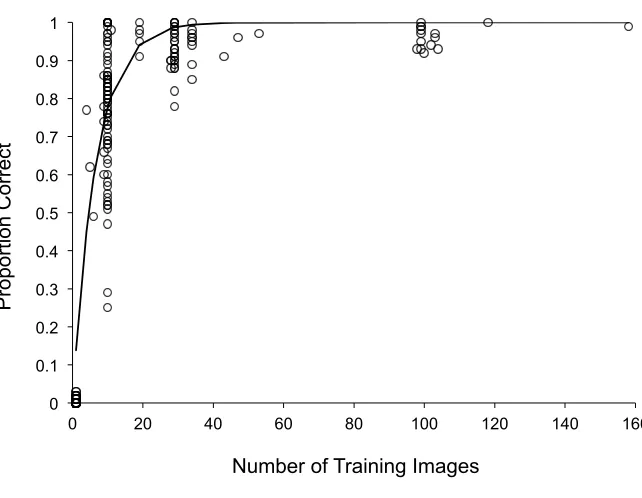
Figure 2 shows the relationship between familiarity (i.e. number of training images)
and the proportion of ÔcorrectÕ identifications of untrained test images, based on the
nearest centroid measure. Each data point in Figure 2 represents the average proportion
of correct decisions across test images for a specific identity. As can be seen, some faces
are easier to recognise than others, even at low levels of familiarity (i.e. with few training
images); this corresponds to the well-known phenomenon of facial distinctiveness
(Valentine, 1991, Valentine & Bruce, 1986). More importantly there is a clear, highly
increasingly familiar people are correctly recognised more often than novel photos of less
familiar people, rs(172) = .74, p < .0001. For the nearest neighbour measure, rank
[image:15.612.173.494.164.413.2]correlation gave a closely comparable value of rs(172) = .72, p < .0001.
Figure 2. The proportion of correct recognitions of untrained novel face images using the
Ônearest centroidÕ measure increases for more familiar faces (where familiarity is
represented by the number of training images). Each point represents the average across
test images for a specific identity (but note that several of these data points are
overlapping). The fitted curve represents an exponential function. Although some faces
are easier to recognise than others, even at low levels of familiarity, there is a substantial
correlation between familiarity and recognition rate (rs = 0.74), such that novel photos of
increasingly familiar people are correctly recognised more often than novel photos of less
familiar people.
A pitfall that needs to be avoided in statistical learning studies is that of overfitting, 0
0.1 0.2 0.3 0.4 0.5 0.6 0.7 0.8 0.9 1
0 20 40 60 80 100 120 140 160
Pro
p
o
rt
io
n
C
o
rre
ct
in which the model finds essentially spurious random patterns in the data. To guard
against overfitting, the data presented in Figure 2 used a strong test of recognition based
on correct classification of novel (untrained) images of the target faces. As an additional
precaution, however, we ran simulations in which PCA was carried out as usual but the
image identities were randomly scrambled at the LDA stage. This gives data of the same
order, but with no top-down structure, i.e. it attempts to use LDA to cluster together
random sets of images of different people. If such a model were nevertheless able to learn
an effective categorization, this would provide evidence against the utility of our
approach and instead imply that overfitting remains possible despite the precaution of
using novel test images. In fact, and reassuringly, this procedure caused performance to
collapse completely, resulting in mean recognition rates of 0.01 for both centroid and
nearest neighbour measures. This collapse in performance shows that random patterns in
the data are of little use in classifying the identities of these highly variable face images.
As noted above, we also evaluated whether familiarity can improve recognition
based only on the 2D shape information given by the raw positions of the fiducials in
each image, or by their differences from the average locations. A combined PCA+LDA
of the locations of the 82 fiducial points in the unstandardised images showed that
performance was very poor (mean recognition rates of 0.03 for both centroid and nearest
neighbour measures), and it remained poor when we applied the same technique to shape
vectors calculated in terms of differences from the average fiducial position (mean
recognition rates still 0.03 for both centroid and nearest neighbour measures). These poor
levels of performance do not of course show that 2D shape information is irrelevant, but
they do show that the information about fiducial locations in each image removed by our
normalization procedure is of no value over and above the normalized information itself.
3.2. Familiarity confers resistance to image degradation
As well as being recognisable across many different views in normal conditions,
by low resolution video surveillance cameras (Burton et al, 1999; Bruce et al, 2001). To
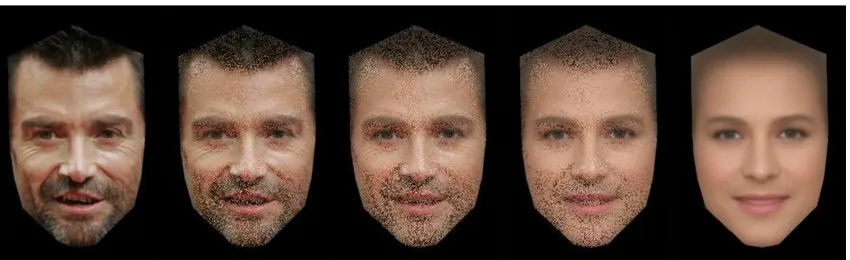
operationalise image degradation in our model, we constructed images where a
proportion of the pixels were replaced by the average RGB pixel values of the entire set,
as illustrated in Figure 3. This manipulation results in images with the same dimensions
as the whole set, which can therefore be used to test recognition in exactly the same way.
However, those pixels that were replaced by the average values become completely
[image:17.612.94.519.235.365.2]uninformative for face identity.
Figure 3. An illustration of the image degradation manipulation. A shape-standardised
full-face image is shown at the far left, and the average of all images from the training set
at the far right. Intermediate images have 25%, 50%, and 75% of their pixels (selected at
random) replaced with those of the training set average image. Original image attribution:
Eva Rinaldi (Own work) [CC BY-SA 2.0].
We tested the model's performance with images degraded by 25%, 50%, and 75%,
by projecting each test image into the PCA+LDA space in its degraded form and
measuring recognition based on the nearest centroid and the nearest neighbour. We
repeated this procedure across 100 iterations, each time randomly selecting the test image
for each identity. Model accuracy was calculated by averaging responses across all 100
iterations, producing a proportion of iterations in which the model correctly identified the
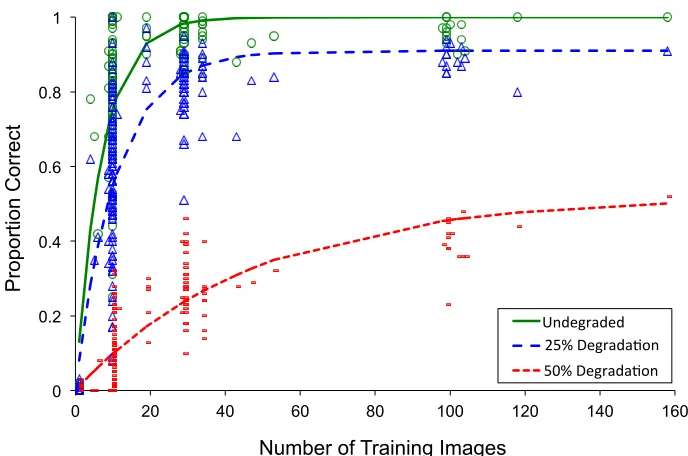
Figure 4. Effect of image degradation on recognition of untrained novel images, using
the nearest centroid measure. Fitted curves represent exponential functions. Performance
with the undegraded images is included for comparison. Performance following 25% and
50% degradation remains strongly influenced by the number of training images (our
proxy for familiarity). At 75% degradation the model's performance is at floor, and
therefore not visible.
Figure 4 shows the model's performance. To create a measure of variability in
performance, data are separated into frequency bins reflecting increasing numbers of
training images (1, 10, 11-20, 21-31, 31-40, 41-50 98-100, 101-110, plus two single
identities with 115 and 158 images). With 25% image degradation, we found a significant
relationship between face recognition accuracy and familiarity (nearest centroid, rs = .83;
nearest neighbour, rs = .77), with well-preserved performance on the more familiar faces
(i.e. those with the largest number of training images). With 50% degradation, there was
a clear overall detriment, but still a significant relationship between face recognition
accuracy and familiarity (nearest centroid, rs = .83; nearest neighbour, rs = .72). At 75%
0 0.2 0.4 0.6 0.8 1
0 20 40 60 80 100 120 140 160
Pro
p
o
rt
io
n
C
o
rre
ct
Number of Training Images
Undegraded
25% Degreda-on 50% Degreda-on 25% Degrada-on
degradation, in which the large majority of pixels carry no identity information,
performance was at floor.
3.3. Recognition from internal and external features
Increasing familiarity with a face differentially enhances recognition based on its
internal features such as eyes, nose and mouth, compared with external features such as
hair and face shape. Although well-replicated in behavioural studies (Clutterbuck &
Johnston, 2002; Ellis et al., 1979; Young et al., 1985), we are not aware of any previous
attempts to simulate this pattern of increasing reliance on internal features of familiar
faces.
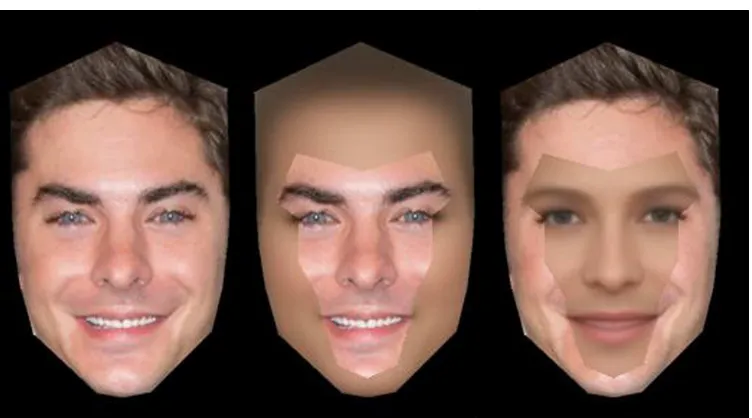
To operationalise comparison of internal and external features in our model, we
constructed images preserving only these aspects, as illustrated in Figure 5. A template
for the internal feature region of the face was defined using 16 fiducial points to create a
boundary around the largest area that included the eyes, nose, and mouth, whilst
remaining within the overall envelope of the face outline.As all the images had been
shape-normalised, the same template could always be used. This template was then used
to create images in which either the external or the internal parts were replaced by the
average RGB pixel values of the entire set. This manipulation results in images with the
same dimensions as the whole set, which can therefore be used to test recognition in
exactly the same way. However, when the internal features are replaced by the average
values they become completely uninformative for face identity, and when the external
Figure 5. An illustration of the internal and external feature manipulation. A
shape-standardised full-face image (left), its internal features (middle), and its external features
(right). To create images with the same dimensions as the original shape-standardised
image, missing regions are completed with uninformative RGB values using the average
of the entire set of images. Original image attribution: Liam Mendes (Own work) [CC
BY-SA 2.0].
Next, we projected each test image into the PCA+LDA space in its internal features
or external features form and measured recognition. We repeated this procedure across
100 iterations, each time randomly selecting the test image for each identity. Model
accuracy was calculated by averaging responses across all 100 iterations, producing a
proportion of iterations in which the model correctly identified the novel image for each
face based on its internal or external features. These proportions were then correlated
with the familiarity of the identities (i.e., the number of images of each identity that went
Figure 6. The proportion of correct recognitions of untrained novel face images from
internal and external features using the nearest centroid measure. Each point represents
the average across test images for a specific identity. Familiarity (represented by the
number of training images) has more effect on recognition from internal than external
features. Exponential trendlines are displayed for performance based on the internal
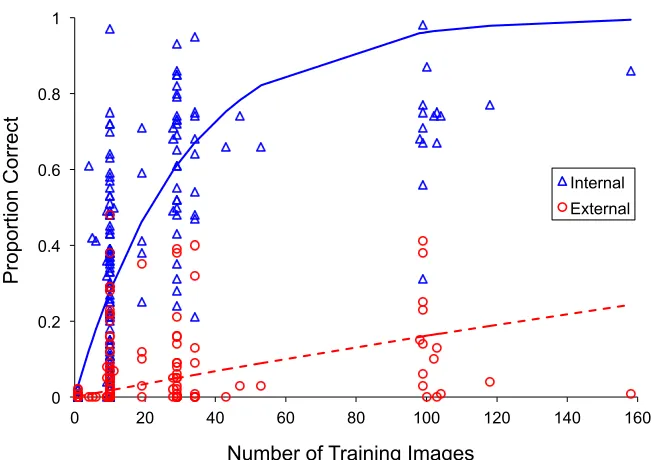
features (solid) and the external features (dashed).
We found significant relationships between face recognition accuracy and
familiarity for both internal and external features (Figure 6). However, recognition of
internal features showed a stronger association with familiarity (nearest centroid, rs = .76;
nearest neighbour, rs = .77) in comparison with recognition of external features (nearest
centroid, rs = .30; nearest neighbour, rs = .59). So, while increased familiarity supports
better recognition in general, this effect is more pronounced for the internal features, and
seems to account for more of the effect of familiarity on full (unedited) face recognition
shown in Figure 2. 0 0.2 0.4 0.6 0.8 1
0 20 40 60 80 100 120 140 160
Pro
p
o
rt
io
n
C
o
rre
ct
Number of Training Images
Interestingly, these results are not simply due to the amount of pictorial information
available from internal versus external features. In fact, in our cropped images, the
internal features occupy 11,952 pixels, whereas the external features occupy 18,537
pixels. If all other things were equal, then, internal features could provide less RGB
information regarding the individual faces than could external features, yet it was the
internal features that proved most recognisable, especially for the more familiar faces.
This implies both that the internal features are themselves more informative and that the
PCA+LDA space has become somewhat tuned towards the use of internal features,
beyond the raw amount of information available.
3.4. Face matching
3.4.1 Unfamiliar face matching
So far, we have shown that our basic model, derived from a substantial training set
of highly varied naturalistic ambient images, demonstrates a graded familiarity effect in
its ability to correctly 'recognise' (i.e. classify) untrained novel exemplars, and that this
applies particularly to classification based on internal facial features. To test the model's
applicability further, we sought to determine whether it could also fit known findings
from perceptual matching tasks, where familiarity is known to exert a strong influence,
with relatively poor performance in unfamiliar face matching and excellent performance
with familiar faces (Bruce et al., 1999, 2001; Burton et al., 1999; Megreya & Burton,
2006, 2008).
Before turning to the role of familiarity in face matching, though, we sought first to
check that the model was able to simulate performance for unfamiliar face matching. To
achieve this, we used stimuli from a widely adopted standard human test of unfamiliar
face matching; the Glasgow Face Matching Test (GFMT; Burton, White, & McNeill,
2010). Ability to simulate this test of unfamiliar face matching forms a starting point
from which any enhancement of performance with more familiar faces can be evaluated.
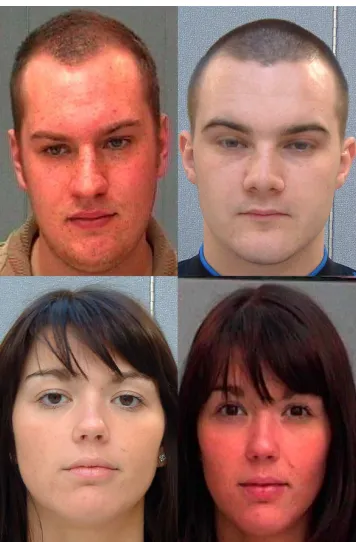
faces, half of which match and half of which do not. Examples of images used to create
the GFMT are shown in Figure 7. Participants simply indicate whether the face identities
match or mismatch on each trial. The difficulty of the task stems from the fact that many
image properties are unconstrained, making it hard for participants to know which image
differences are relevant and which are irrelevant to the unfamiliar face identities. In the
standardised version of the GFMT the images are presented in greyscale, but because of
the way we implemented the current PCA+LDA model we used the original colour
images for our simulation here. While using colour vs. greyscale images will undoubtedly
have some effect, the role of colour in human perception of identity is limited (Kemp,
[image:23.612.91.269.297.568.2]Pike, White & Musselman, 1996).
Figure 7. Two example pairs of images used to create trials in the Glasgow Face
Matching Test (Burton et al., 2010). The top row shows two images of different
identities, while the bottom row illustrates a Ôsame identityÕ image pair. Note that all
faces in the GFMT are unfamiliar and that all test items involve pairs of photographs with
substantial superficial differences.
PCA+LDA space through training all 4,154 images in our stimulus set and then projected
the pairs of images from each GFMT trial into this PCA+LDA space. Note that all faces
[image:24.612.220.374.179.436.2]from the GFMT are unfamiliar here Ð none have been used in the training set.
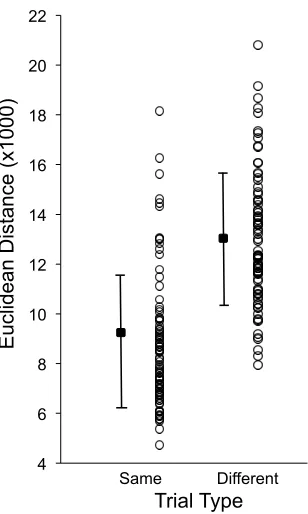
Figure 8. Performance for same identity trials and different identity trials from the
Glasgow Face Matching Test (Burton et al., 2010). Each data point represents the
Euclidean distance in PCA+LDA space between the pair of images forming each trial.
Summary statistics (M and SD) are also displayed for each trial type.
The simplest way to represent the model's performance is in terms of the Euclidean
separation between pairs of images in PCA+LDA space. This is shown in Figure 8,
where the between-image distances are lower on average for same identity than for
different identity pairs of unfamiliar face images, t(166) = 10.05, p < .001, CohenÕs d =
1.55. So the model is capable of separating 'same' from 'different' identity pairs to some
degree, though there is clear overlap in the distributions. 4
6 8 10 12 14 16 18 20 22
Eu
cl
id
e
a
n
D
ist
a
n
ce
(x1
0
0
0
)
The overlapping distributions mimic what is seen in human performance on the
GFMT, which is often far from perfect. With a behavioural measure of this type, in which
every pair of images is physically different to some degree, human participants have to
adopt their own criterion for how different the images of each face must be in order to
assign them to 'same' or 'different' response categories. As Figure 8 shows, overall
performance will vary according to how this criterion is set, and of course one of the key
purposes of the GFMT is to measure individual differences that will in part reflect this
criterion setting. In this respect, we note that calculating the distance between pairs of
GFMT images and setting the Ômatch decisionÕ threshold value to give comparable levels
of performance across match and mismatch trials (as is observed on average with human
viewers) produced performance levels of 82% and 77% accuracy for ÔsameÕ and
ÔdifferentÕ face pairs by the model, compared to mean human performance of 92% and
88%, respectively (Burton et al., 2010). Although our computer model was trained on
ambient images of many international celebrities, and has never been exposed to images
of the type shown in Figure 7, it can achieve levels of matching performance within the
range of human participants on these images.
As human participants show substantial individual differences on the GFMT,
however, a better way to evaluate the model's performance may be in terms of whether it
tends to make mistakes on the same item pairs that human observers find difficult. We
found significant correlations in the expected directions involving the model distance
between the image pairs and overall human performance for same trials, rs(82) = -0.23, p
= .039, and for different trials, rs(82) = 0.28, p = .009.
3.4.2 Face matching as a function of familiarity
Having established how to apply our model to unfamiliar face matching, we
investigated how an increase in familiarity affects face matching Ð that is, correctly
perceiving that two novel instances of a face are the same person. It is well-established
that face matching is easier for familiar than unfamiliar faces (Bruce et al, 2001; Johnston
& Edmonds, 2009; Megreya & Burton, 2006) and so this is a key requirement for a
there is already evidence that matching performance is predicted by degree of familiarity
(Clutterbuck & Johnston, 2002, 2004, 2005). This makes matching a good candidate for
simulation in our model.
To simulate unfamiliar face matching, we had measured the distances between
pairs of images of faces that had not been explicitly represented in our model's
PCA+LDA space. This is in line with the idea that unfamiliar face matching will rely
heavily on image similarity (Hancock et al, 2000; Megreya & Burton, 2006). In contrast,
familiar face matching need not rely much on image similarity Ð if two images are both
recognised as Jennifer Lawrence, then they can be matched easily, regardless of their
image similarity, on the basis of a more conceptual match. To simulate the impact of this
conceptual matching, we investigated how the model dealt with pairs of novel images of
a trained identity at different levels of familiarity.
In this simulation, we manipulated the level of familiarity of a specific face in the
context of the larger model, with all its complexity and variability. To do this, we
constructed variants of the model which differed only in terms of the number of items
ÔknownÕ (i.e. the number of training images) for one particular individual Ð all the
training images for the remaining 334 people remained the same in each model variant.
We took the identity for whom we had the largest number of images (159 for Jennifer
Lawrence) in our initial set and then varied the number of images of the actress included
in the model's training set (from 0 to 151), measuring how this affected matching
performance across pairs of novel images of Jennifer Lawrence's face.
For a single model iteration, we chose a random set of 151 training images plus two
test images, from the 159 available for this identity. We constructed models containing
the 334 other identities and incremental steps of ten training set images of Jennifer
Lawrence by using 0 images or 1 image to create a baseline, and then images 1-11, 1-21,
1-31 etc. To test how familiarity (as represented by increasing the number of training
images) affected face matching performance, we projected two novel test images of
these two novel images, we then calculated three principalmeasures: 1) the distance from
each image to LawrenceÕs centroid (the distance to JL centroid measure), 2) the distance
from each image to the nearest non-Lawrence centroid (the distance to nearest non-JL
centroid measure), and 3) the distance between the pair of test images themselves
(distance between novel images measure).
This process was repeated for 20 iterations, each time randomly selecting which
images of Lawrence to use as training and novel images. We averaged across iterations
and present the data in Figure 9. A comparable procedure using the nearest neighbour
Figure 9. Performance with two novel images of Jennifer Lawrence's face as familiarity
with Jennifer Lawrence (represented by the number of training images) increases. The
mean Euclidean distance in PCA+LDA space (across 20 iterations) between the novel
images and LawrenceÕs centroid, between the novel images and the nearest
non-Lawrence centroid, and the distance between the two novel images themselves.
Figure 9 makes clear that the possibility of conceptual matching increases as
familiarity increases, as evidenced by the increasing separation between the distance to
JL centroid and distance to nearest non-JL centroid measures. Interestingly, it also shows
that the centroids for faces other than JL's become more distant from the JL centroid as
familiarity increases, reflecting the reshaping of the overall space produced by LDA. The
Spearman correlation between familiarity (number of training images) and distance to the
nearest non-JL centroid (averaged over the 20 iterations) is rs(14) = .95, p < .001.
8 9 10 11 12 13 14 15 16 17 18
0 20 40 60 80 100 120 140 160
Me a n Eu cl id e a n D ist a n ce (x1 0 0 0 )
Number of Training Images
Distance between Novel Images
Distance to Nearest non-JL Centroid
Less obviously, the distance between the pairs of novel images of Jennifer
Lawrence also reduces slightly as familiarity increases (i.e. there is a small downward
slope to the 'distance between novel images'). The Spearman correlation between
familiarity (number of training images) and distance between the two novel images
(averaged over the 20 iterations) is rs(15) = -.96, p < .001.This seems to reflect a more
local reshaping of the region of PCA+LDA space that represents JL's face as familiarity
with her increases. This observation led us to look further at the underlying mechanisms
and the extent to which they might operate in an identity-specific manner.
3.5. Underlying mechanisms
Our simulations have shown a clear advantage for increasingly familiar faces when
tested using face recognition and face matching. This is consistent with key findings
across decades of face research and offers insights into the nature of face familiarity. In
this final empirical section, we examine underlying mechanisms in more detail.
In a previous study, we established that the combined use of LDA with PCA offers
much better performance for recognising novel images of familiar identities than a
PCA-based system alone (Kramer et al., 2017a). We suggested that a combination of LDA
with PCA is particularly useful because each face has its own idiosyncratic forms of
variability that need to be learnt as it becomes familiar (cf. Burton et al., 2016). This
idiosyncratic variability limits the usefulness of generic methods such as PCA that
represent only the variability of the entire set of training images without taking the
idiosyncrasies of particular faces into account. Here, we put this suggestion to a formal
test.
As already noted, Figure 9 shows that the between-pair distances of novel images
of Jennifer Lawrence decreases slightly as the number of training images increases. That
is, as the model becomes more familiar with Jennifer Lawrence's face, novel instances of
her become closer together in PCA+LDA space. Although a far more gradual process
recognition accuracy as familiarity increases), this clustering of novel images illustrates
how the underlying space in the model changes across familiarity. It is noteworthy that
we should observe such a clear relationship, because the relative contribution of the
Jennifer Lawrence images to the whole model is very small as training images are added;
all the other 334 known people and 3,995 images remain unchanged as novel images of
Jennifer Lawrence are added. The fact that the region of the PCA+LDA space that
represents Jennifer Lawrence's face should change in this way underscores the key point
that the variability in images of her face must be to some extent idiosyncratic and
therefore needs to be represented separately from the other 3,995 images in the set
(Burton et al., 2016).
To demonstrate more formally how the combination of PCA with LDA reshapes
the space corresponding to each familiar identity, we used the face of Ryan Reynolds, for
whom there are 104 images in our initial database. We removed 4 randomly selected
images and then randomly split the remaining images into sets of 80 training images and
20 test images. The 80 training images of Ryan Reynolds were then included alongside
all of the remaining 4,050 images of all other identities at the PCA stage. At the
subsequent LDA stage, however, the 80 images of Ryan Reynolds were either left in (the
trained identity condition) or left out (the untrained identity condition). We then
calculated all pairwise distances between the 20 novel images of Reynolds after
projecting these into the PCA+LDA space, and compared the mean of those distances
across the trained identity and untrained identity conditions. This procedure was repeated
across 20 iterations involving different random samples of 80 and 20 images from the
Figure 10. The mean pairwise Euclidean distances between 20 novel images of Ryan
Reynolds, averaged across 20 iterations. In the trained identity condition, 80 training
images of Reynolds were included in the full PCA+LDA process. In contrast, in the
untrained identity condition, the 80 training images were included at the PCA stage but
then removed before LDA was carried out. Error bars depict the standard error of the
mean.
Results are presented in Figure 10, which shows that the distance between novel
images of Ryan Reynolds is reduced by training with other images of him using the
PCA+LDA procedure (the trained identity condition), in comparison to when images of
Reynolds were included only in the PCA stage (the untrained identity condition). Note
that the data in Figure 10 involve entirely novel images that were not used in the PCA or
LDA stages, but that exactly the same sets of novel images are tested across the trained
identity and untrained identity conditions. The difference between these conditions is
therefore entirely attributable to the consequences of training (or not training) the identity
using a different set of images at the LDA stage. Clearly, then, identity training with 132 134 136 138 140 142 144 146 148 Me a n Eu cl id e a n D ist a n ce (x1 0 0 )
LDA has the effect of reshaping the underlying PCA-based space in a way that brings
any instances of the trained face into closer proximity to each other.
The benefit accruing to familiar face recognition from LDA, as an example
clustering algorithm, is therefore clearly established relative to the unsupervised
statistical analysis offered by PCA alone. However, our approach also allows us to go
further and ask whether the representations of previously unseen faces derive any benefit
from being projected into a space based on familiarity with known faces. The issue is
important because many researchers claim that we are generic experts at perceiving face
identity (Carey, 1992), whereas the view put forward here is that this characterisation in
terms of face identity expertise is correct only for familiar faces (cf. Young & Burton,
2017). In effect, we have been demonstrating through our simulations based on image
statistics that someone can become a Jennifer Lawrence face expert or a Ryan Reynolds
face expert without actually testing whether these forms of expertise might also to some
extent enhance the perception and recognition of other, unfamiliar faces.
We therefore sought to address the issue of whether the reshaping of PCA space
that results from applying LDA is entirely person-specific? If the reshaping is completely
idiosyncratic to each known face, there will be no accrued benefit from learning several
different face identities through LDA on ability to represent the identities of unfamiliar
faces in PCA+LDA space, whereas if the reshaping is only partly idiosyncratic then we
might expect some improvement in the ability to represent unfamiliar face identities as
more familiar faces are known.
To test whether learning familiar face identities can enhance representations of
unfamiliar face identities, we examined the similarity between pairs of images of the
same unfamiliar face when measured within a purely PCA-based space, or when
measured within a PCA+LDA space built to recognise other faces. Do we gain something
from tackling unfamiliar face matching within a reshaped space derived through
To answer this question, we collected two images for each of 40 new identities
using Google Image search, following the same guidelines described earlier. Half of these
celebrities were women, and all were White. None of these identities appeared in our
training set. In order to determine whether our identity-derived space produced benefits
for unfamiliar face matching, we projected the 80 new images into our modelÕs
PCA+LDA-trained space. For comparison, we also projected these images into the space
derived from carrying out only the PCA stage of our model. In both cases, the training set
was identical, but for the PCA-alone model, identity information was not used in order to
derive dimensions that best discriminated between face images.
Using the 80 novel images, we simulated 40 ÔsameÕ trials with the two images of
each identity. As a measure of the modelÕs performance, we calculated the Euclidean
distances in PCA space and in PCA+LDA space between these pairs of images. In order
to generate 40 ÔdifferentÕ trials, we paired one image for each identity with a foil chosen
from the other images in this set. We took care to match the two faces on basic
descriptors like sex, hair colour, the presence of stubble, and age, acknowledging the
limitations inherent in such a small sample of faces. For each of these trials, we again
calculated the Euclidean distances in PCA space and in PCA+LDA space between the
Figure 11. Mean Euclidean distances between ÔsameÕ and ÔdifferentÕ identity pairs of
novel images of unfamiliar faces in PCA-space (image similarity only) and
PCA+LDA-spaces (image similarity plus identity training for familiar faces). Error bars show 95%
confidence intervals. There is a clear benefit to determining that different images of
unfamiliar faces represent the same identity in the PCA+LDA space, despite it having
been trained on other faces.
Figure 11 illustrates these ÔsameÕ and ÔdifferentÕ identity distances when the images
are projected into PCA-based and PCA+LDA spaces. We find that there is no statistically
significant difference between the two types of trial for the PCA-alone model, t(78) =
1.02, p = .313, CohenÕs d = 0.23. In contrast, the PCA+LDA model successfully
discriminates between ÔsameÕ and ÔdifferentÕ identity image pairs, t(78) = 4.90, p < .001,
CohenÕs d = 1.10.
This result is an important one. Using the same training image set, we can derive
dimensions that best capture the variance in the imagesÕ pixel values (PCA) or we can 95 100 105 110 115 120 125 130 135 140 145 Me a n Eu cl id e a n D ist a n ce (x1 0 0 )
Same Trials Different Trials Same Trials Different Trials
calculate dimensions that are optimal for identity discrimination (PCA+LDA). This latter
case appears to result in a reshaped space well suited to discriminating the identities of
novel images of both familiar (trained) faces and, to some extent, of unfamiliar
(untrained) faces. Even though the faces used here never appeared in the training set, we
find that the PCA+LDA space provides some support for establishing similarity in
identity beyond superficial image similarity that extends to completely new faces.
4. Discussion
We set out to test the idea that familiarity can be thought of as involving bottom-up
low level image descriptions, together with a top-down mechanism for cohering
superficially variable images of the same person. Using a combination of PCA and LDA,
we successfully reproduced key findings in the literature regarding how people perform
in face recognition and face matching tasks. Crucially, we were able to show familiarity
advantages for entirely untrained images with a model based only on the optimal
separation of identities in PCA+LDA space. The benefits of increasing familiarity - as
defined by the number of different training images used for a given face - accrued in
terms of better recognition of novel exemplars of the trained faces, better face matching,
better resistance to the effects of image degradation, and better recognition from internal
than external features.
The combination of bottom-up image description, with top-down clustering, has been
used in previous models (e.g. Bekios-Calfa et al, 2011). In our own previous work
(Kramer et al, 2017a) we have used this approach to classify sex and race from familiar
and unfamiliar faces. However, previous models, including our own, treated familiarity
as a bivalent variable, in which ÔfamiliarÕ faces were uniformly familiar. For the reasons
described above, that is an incomplete approach to understanding familiarity which is
self-evidently graded, i.e. we know some faces better than others. Here we show that the
same general approach used in understanding other aspects of face perception, can also
The contrast between familiar and unfamiliar faces is often linked, either explicitly
or by implication, to the idea of qualitative differences between the processing of familiar
and unfamiliar faces (Bruce & Young, 1986; Burton, Bruce & Hancock, 1999; Hancock
et al., 2000; Megreya & Burton, 2006). For example, the perception of faces that have
never been encountered before is so image-dependent that participants experience little
difficulty in being taught the incorrect information that two different images of the same
face belong to different people (Longmore et al., 2008). Yet at the other extreme, the
recognition of highly familiar faces is so fluent that we can find it hard to see how
different two images of a familiar person actually are (Jenkins et al., 2011) and relatively
difficult to remember the details of specific images that have been seen (Armann, Jenkins
& Burton, 2016). Our results show how despite familiarity lying along a graded
continuum it remains reasonable to look upon the extremes of familiarity as involving
differences that are to all intents and purposes so large as to appear qualitative in nature,
but they also show how there can be gradations in performance between these extremes.
Given the highly unconstrained nature of the images used in the simulations above,
sampled from internet search and with no control of low-level image properties, the
performance we report is surprisingly good, as well as having human-like properties. Of
course, we do not wish to claim that the human brain explicitly uses PCA or LDA.
Instead, the model presented here demonstrates that a clustering algorithm, cohering
together multiple instances of the same person, can use simple intensity (pixel) level
statistical structure to deliver apparently high-level information in the form of face
recognition. The model provides an existence proof of this, without commitment to
specific implementation.
None the less, one might ask how far learning faces from photographs is truly
representative of natural face learning? At the present state of knowledge we cannot be
completely certain, but some points stand out. First, although photographs are entirely
static, recognition of static images is so good that any idiosyncratic patterns of facial
degradation is needed before any effects of facial movement become apparent (Lander,
Christie & Bruce, 1999; O'Toole, Roark & Abdi, 2002). Second, while faces learnt from
single photographs show remarkably poor generalisation (Bruce, 1982; Longmore et al.,
2008), it is none the less clear that faces can be learnt from multiple variable photographs
of the same face in ways that show properties comparable to natural recognition (S.
Andrews et al., 2015; Dowsett et al., 2016). Moreover, the degree of variability in
exposure to such multiple images is predictive of how well this learning can generalise to
new exemplars (Ritchie & Burton, 2017). Both phenomena fit with the observation that
variability in the views of faces to which we are exposed is typical of our everyday lives.
On balance, then, the available evidence suggests that there is nothing special (or
unrepresentative) about learning faces from photos.
In common with other graphical approaches, we began by standardising the
positions of key fiducial positions in each image (Beymer, 1995 Craw, 1995; Vetter &
Troje, 1995). Behavioural studies show that such stimuli remain easily recognisable to
human observers (Burton et al., 2005; T. Andrews et al., 2016). The analyses were then
conducted entirely on pixel-based surface colour and brightness values. These surface
properties involve a combination of the surface reflectances of different parts of the face
(known as its albedo map in the computer science literature), prevailing illumination
conditions (such as direction of lighting) and camera characteristics. In any given image,
there will be an unspecified mix of these different factors. Importantly, our model did not
make any attempt explicitly to represent shape information concerning the second-order
configuration of features, three-dimensional information about head shape, knowledge of
how expressions can alter the face, and other visual properties often thought to be
involved in face recognition. Indeed, with these highly variable everyday images we
found that 2D shape information from the fiducial locations alone was of limited value in
comparison to the surface properties of the shape-normalised images. This does not mean
that shape is irrelevant; there is evidence that human observers can be sensitive to shape
properties (O'Toole, Vetter & Blanz, 1999; T. Andrews et al., 2016). In this respect we
note that some shape information will still be available in the standardised images via
eyes, and so on (cf. Sormaz, Young & Andrews, 2016). Whether or not this is the
underlying cause, the simulations show that learning from covariation of surface
information within and between identities is sufficient to underpin human-like
performance.
Our simulation exploring the importance of internal versus external facial features
proved consistent with the behavioural evidence that people rely to a greater extent on the
internal features for more familiar faces (Clutterbuck & Johnston, 2002; Ellis et al., 1979;
Young et al., 1985). While we found that in general novel images of more familiar
identities were better recognised when projected into the PCA+LDA space, this
relationship between familiarity and accurate recognition was stronger for internal
features than external features.
This ability to simulate the importance of the internal features for familiar face
recognition directly addresses an important debate concerning the origins of this finding,
which has been interpreted in two very different ways. The interpretation originally
offered by Ellis et al. (1979) was that the internal facial features receive most attention in
social encounters because of their critical role in social signals such as gaze and facial
expression. They therefore become differentially represented for familiar faces because
these are the features that have been most looked at (Ellis et al., 1979). In contrast, an
alternative interpretation offered by Young et al. (1985) was that while external features,
and especially the hair, can often dominate any particular photo of an unfamiliar person,
this is not a very diagnostic feature of identity, because it is easily changeable.
Therefore, over increasing exposure, people may come to rely on aspects of the face
which change less across encounters (Young, 1984; Young et al., 1985; Bonner, Burton,
& Bruce, 2003; Osborne & Stevenage, 2008). In fact, by presenting only the internal
features, researchers have been able to improve unfamiliar face learning (Longmore, Liu,
& Young, 2015) and matching accuracy in some conditions (Kemp, Caon, Howard, &