Almost sure exponential stability of
the Euler–Maruyama approximations for
stochastic functional differential equations
Fuke Wu, Xuerong Mao and Peter E. Kloeden
Communicated by V. L. GirkoAbstract.By the continuous and discrete nonnegative semimartingale convergence theo-rems, this paper investigates conditions under which the Euler–Maruyama (EM) approxi-mations of stochastic functional differential equations (SFDEs) can share the almost sure exponential stability of the exact solution. Moreover, for sufficiently small stepsize, the de-cay rate as measured by the Lyapunov exponent can be reproduced arbitrarily accurately. Keywords.Stochastic functional differential equations (SFDEs), nonnegative semimar-tingale convergence theorem, almost sure stability, EM method.
2010 Mathematics Subject Classification.60H10, 65L20.
1
Introduction
Stochastic differential equations (SDEs) and their stability have been used with great success in a variety of applications areas, including biology, epidemiology, mechanics, neural networks, economics, finance and so on. Most SDEs arising in practice are nonlinear and cannot be solved explicitly, so stability analysis of nu-merical methods for SDEs has recently received a great deal of attention. Due to the stochastic nature, the stability concepts of numerical schemes for SDEs in-clude, for example, moment stability, almost sure stability and stability in distribu-tion. There is an extensive literature concerned with the moment stability, for ex-ample, [5, 6, 8–10, 24, 29] for SDEs and [3, 20] for stochastic differential equations (SDDEs). Regarding the almost sure stability of numerical methods for SDEs, it was shown, by using the Chebyshev inequality and the Borel–Cantelli lemma, that the moment exponential stability implies almost sure exponential stability under certain conditions (for example, see [9, 24]). Higham and his coauthors ([8, 9])
rectly studied the numerical sequence and obtained almost sure stability by the strong law of large numbers. Now there is little result to examine stability in dis-tribution of numerical methods although this stability is also important. The only work can be seen in [4] and [30].
By the technique based on the continuous semimartingale convergence theorem (cf. [11,14]), Mao developed in his serial papers (see e.g. [15–18,32]) the stochas-tic versions of the LaSalle theorem, from which follows the almost sure asymptostochas-tic stability of SDEs, including SDDEs and SFDEs. On the other hand, by the discrete semimartingale convergence theorem (cf. [26,33]), [25–27] investigated the stabil-ity of stochastic difference equations and [31] examined almost sure stabilstabil-ity of the stochastic theta methods of linear SDEs. Noting that there are similar expressions for the continuous and discrete semimartingale convergence theorems, [26] ob-tained the sufficient conditions for almost surely asymptotic stability of both exact and numerical solutions of linear stochastic differential equations. Then Wu et al. [35] examined conditions under which the numerical solutions of SDDEs may share the almost sure stability of exact solutions for nonlinear SDDEs.
However, so far, little is as yet known about the stability of numerical solutions for SFDEs although there are lots of such results for the exact solutions of SFDFs (for example, [14, 17, 23, 32]). The main aim of this paper is to extend the results in [26, 35] to SFDEs and examine conditions under which the numerical solutions of SFDEs may reproduce the almost sure stability of the exact solutions. Consider then-dimensional SFDE
dx.t /Df .xt; t /dtCg.xt; t /dw.t /; t 0; (1.1) with initial datax0 D2CFb0.Π; 0I
Rn/, namely, is a bounded,F0 -measur-ableC.Π; 0IRn/-valued random process defined onΠ; 0, where
xt DWxt. /D ¹x.t C /W 0º 2C.Œ ; 0IRn/;
f; g W C.Π; 0RCIRn/RC ! Rn are Borel measurable,w.t /is a scalar Brownian motion. For the purpose of stability, we assumef .0; t / Dg.0; t /D0. This shows that (1.1) admits a trivial solution. As a standing hypothesis, we shall impose the following local Lipschitz condition on coefficientsf andg:
Assumption 1.1.For eachk D 1; 2; : : :, there isck > 0such that for any maps
'; 2C.Π; 0IRn/and allt 0,
jf .'; t / f .; t /j _ jg.'; t / g.; t /j ckk' k;
Let the stepsize 4be a fraction of the delay, namely,4 D =M for some integerM. Then the EM method (see [19, 34]) applied to (1.1) produces
´
xkD.k4/; M k0;
xkC1DxkCf .ykM; k4/4 Cg.ykM; k4/4wk; k0;
(1.2)
where4wk Dw..kC1/4/ w.k4/is the Brownian motion increment andykM is aC.Π; 0IRn/-valued random process defined by piecewise linear interpola-tion:
ykMDWykM. /DxkCiC
i4
4 .xkC1Ci xkCi/;
for i4 .iC1/4; i D M; MC1; : : : ; 1:
(1.3)
In the next section, we give some necessary notations and the continuous and discrete semimartingale convergence theorems as lemmas for the use of this paper. Motivated by the existing stability results for the exact solution of the SFDE (1.1), by the Lyapunov technique and the discrete nonnegative semimartingale conver-gence theorem, Section 3 examines the almost sure exponential stability of the EM approximate sequence¹xkºk0. Section 4 presents some conditions under which the EM approximation¹xkºk0may reproduce the almost sure exponential stabil-ity of the exact solution of (1.1). To illustrate the application of our results, the final section examines a linear integro-differential equation and gives its simulation.
2
Notations and lemmas
Throughout this paper, unless otherwise specified, we use the following notations. Letj jbe the Euclidean norm inRn. LetRCDŒ0;1/. IfAis a vector or matrix, its transpose is denoted byAT. IfAis a matrix, then its normkAkis defined by
kAk D sup¹jAxj W jxj D 1º. Let > 0andC.Œ ; 0;Rn/denote the family of continuous functions fromŒ ; 0toRn. The inner product ofx; y inRn is de-noted byhx; yiorxTy. Ifa,b2R, leta_bDmax¹a; bºanda^bDmin¹a; bº. The symbolNrepresents the set of the integer numbers, namely,ND ¹0; 1; : : :º and letN M D ¹0; 1; 2; : : : ; Mºfor some positive integerM.
Let.;F;P/be a complete probability space with a filtration¹Ftºt0 satis-fying the usual conditions, namely, it is right continuous and increasing whileF0 contains allP-null sets. Letw.t /be a scalar Brownian motion defined on this pro-bability space. Denote byCFb0.Œ ; 0IR
n/the family of all bounded,F
toRby
LV .'; t /DVx.'.0//f .'; t /C1
2traceŒg
T.'; t /V
xx.'.0//g.'; t /: (2.1) Let us emphasize thatLV is a functional defined onC.. ; 0IRn/RC while
V is a function onRn.
A stochastic sequence ¹kºk2N is said to be anFk-martingale-difference if Ejkj <1andE.kjFk 1/D0for allk D1; 2; : : :. (For more knowledge for the martingale-difference, please refer [11, 25, 26]). By the definitions of the mar-tingale-difference and the martingale, it follows that
Lemma 2.1.Suppose that¹kºk0 is any deterministic nonzero sequence. Then
Xk DPkiD1ii is a martingale andX1 D 0if and only ifi is a
martingale-difference, that is, the partial summation of martingale-difference leads at once to a martingale (and conversely).
The following two lemmas will play important roles in this paper. The first one is the continuous semimartingale convergence theorem (cf. [11, 14]). The second one is the corresponding discrete version (cf. [26, 33]).
Lemma 2.2.LetA.t /; U.t /be twoFt-adapted increasing processes ont0with
A.0/DU.0/D0a.s. LetM.t /be a real-valued local martingale withM.0/D0 a.s. Letbe a nonnegativeF0-measurable random variable. Assume thatX.t /is
nonnegative and
X.t /DCA.t / U.t /CM.t / for t0:
If limt!1A.t / <1a.s., then for almost all!2,
lim
t!1X.t / <1 and tlim!1U.t / <1;
that is, bothX.t /andU.t /converge to finite random variables.
Lemma 2.3.Let¹Akºk2N,¹Ukºk2N be two sequences of nonnegative stochastic
sequences such that bothAkandUkareFk 1-measurable fork D1; 2; : : : ;and
A0DU0D0a.s. LetMkbe a real-value local martingale withM0D0a.s. Let
be a nonnegativeF0-measurable random variable. Assume that¹Xkºis a
nonne-gative semimartingale with the Doob–Mayer decomposition
XkDCAk UkCMk:
If limk!1Ak <1a.s., then for almost all! 2, lim
k!1Xk<1 and klim!1Uk <1;
In the following sections we will employ these lemmas to establish the almost sure asymptotic stability theorems for both exact and numerical solutions to (1.1).
3
Stability of the exact solution and the EM approximation
Motivated by the continuous stability results in [17, 32], by the Lyapunov tech-nique and the discrete nonnegative semimartingale convergence, this section will establish an almost sure stability theorem for the stochastic sequence ¹xkºk0. As comparison, this section also presents the corresponding continuous stability result. To be precise, let us give the definitions on the almost sure exponential sta-bility of SFDEs and their numerical approximations.
Definition 3.1.The solutionx.t; / to (1.1) is said to bealmost surely exponen-tially stableif there exists a constant > 0such that
lim sup t!1
1
t logjx.t; /j a.s. (3.1)
for any initial data2CFb
0.Π; 0I Rn/.
Definition 3.2.The discrete sequence¹xkºk0defined by (1.2) is said to bealmost
surely exponentially stableif there exists a constant > 0N such that lim sup
k!1
1
k4logjxkj N a.s. (3.2)
for any bounded initial sequence¹.k4/ºk2N M.
Let us state a theorem, which does not only give the existence-and-uniqueness result of the solution but also provide us with a criterion on the almost sure expo-nential stability of the exact solution (please see [32] for the existence-and-exis-tence result and [18] for the almost sure exponential stability).
Theorem 3.3.Let Assumption1.1hold. Assume that there existV 2C2.RnIRC/,
a number of positive constantsc,p,1,2and a probability measuresuch that
for anyx2Rnand.'; t /2C.Π; 0IRn/RC,
cjxjpV .x/; (3.3) LV .'; t / 1V .'.0//C2
Z 0
V .'. //d. /: (3.4)
If 1 > 2, then for any given initial data 2 CFb0.Π; 0I
Rn/, there exists a
prop-erty that
lim sup t!1
1
t log.jx.tI/j/
p a.s.; (3.5)
where > 0is the unique positive root of
1 D2e: (3.6)
We now establish the discrete counterpart of Theorem 3.3 for the stochastic sequence¹xkºk0defined by (1.2).
Theorem 3.4.Fix4> 0. LetcM,p,1M,2Mall be positive constants andbe
a probability measure. Assume that there exists a convex functionVMWRn!RC
and anFk
M-martingale-differenceksuch that
cMjxjp VM.x/; x2Rn; (3.7)
and for the sequence¹xkºk0defined by(1.2),
VM.xkC1/ VM.xk/ 1M4VM.xk/C2M4
Z 0
VM.ykM. //d. /CkC1;
(3.8)
whereykMis defined by(1.3). If1M > 2Mand1M4 1, then for any bounded
initial sequence¹.k4/ºk2N M, the EM approximate solution(1.2)obeys lim sup
k!1
1
k4logjxkj M
p a.s.; (3.9)
whereM> 0is the unique positive root of
2M4e.MC1/M4C.1
1M4/eM4 1D0; (3.10)
namely, the stochastic sequence¹xkºk0is almost surely exponentially stable.
Proof. For any positive constant > 1, by condition (3.8), we have
.kC1/4VM.xkC1/ k4VM.xk/
D.kC1/4ŒVM.xkC1/ VM.xk/C..kC1/4 k4/VM.xk/
.kC1/4h 1M4VM.xk/C2M4
Z 0
VM.ykM. //d. /CkC1
i
C..kC1/4 k4/VM.xk/
D.4 1 1M44/k4VM.xk/
C2M4.kC1/4
Z 0
which implies that
k4VM.xk/VM..0//CŒ.4 1/ 1M44 k 1
X
iD0
i4VM.xi/
C2M4 k 1
X
iD0
.iC1/4
Z 0
VM.yiM. //d. /
C
k 1
X
iD0
.iC1/4iC1: (3.12)
Recall the elementary property of the convex functionV: for anyx; y 2Rnand
"2Œ0; 1,
V ."xC.1 "/y/"V .x/C.1 "/V .y/: (3.13) This, together with the definition ofykM, yields
Z 0
VM.yiM. //d. /
D
1
X
mD M
Z .mC1/4
m4
VM
m4
4 xiCmC1C
.mC1/4
4 xiCm
d. /
1
X
mD M
Z .mC1/4
m4
m4
4 VM.xiCmC1/
C.mC1/4
4 VM.xiCm/
d. /:
By the Fubini theorem, we therefore have k 1
X
iD0
.iC1/4
Z 0
VM.yiM. //d. /
1
X
mD M
Z .mC1/4
m4
m4
4
k 1
X
iD0
.iC1/4VM.xiCmC1/
C.mC1/4
4
k 1
X
iD0
.iC1/4VM.xiCm/
Noting thatMCm0for allmD M; M C1; : : : ; 1, we therefore have k 1
X
iD0
.iC1/4
Z 0
VM.yiM. //d. /
1
X
mD M
Z .mC1/4
m4
m4
4
k 1
X
iD0
.iC1CMC1Cm/4VM.xiCmC1/
C.mC1/4
4
k 1
X
iD0
.iC1CMCm/4VM.xiCm/
d. /
1
X
mD M
Z .mC1/4
m4
m4
4
.MC1/4
k 1
X
iD M
i4VM.xi/
C.mC1/4
4
.MC1/4
k 1
X
iD M
i4VM.xi/
d. /
D.MC1/4
k 1
X
iD M
i4VM.xi/ 1
X
mD M
Z .mC1/4
m4
d. /
D.MC1/4
k 1
X
iD M
i4VM.xi/
Z 0
d. /
D.MC1/4
k 1
X
iD M
i4VM.xi/
D.MC1/4
1
X
iD M
i4VM..i4//C.MC1/4
k 1
X
iD0
i4VM.xi/: (3.14)
Substituting (3.14) into (3.12) yields
k4VM.xk/VM.0/C2M4.MC1/4 1
X
iD M
i4VM..i4//
CŒ2M4.MC1/4C.1 1M4/4 1 k 1
X
iD0
i4VM.xi/
C
k 1
X
iD0
Let us introduce the function
./D2M4.MC1/4C.1 1M4/4 1: (3.16) Noting that1M> 2Mand1M4 1, we therefore have
.1/D .1M 2M/4< 0 and 0./ > 0 for all > 1;
which implies that there exists a uniqueM > 1such that.M/D0. Choosing
DM, equation (3.15) may be rewritten as
Mk4VM.xk/Xk;
where
Xk DVM.0/C2M4M
.MC1/4
1
X
iD M
Mi4VM..i4//
C
k 1
X
iD0
M.iC1/4iC1:
We defineMk DPkiD0M .iC1/4
iC1. Noting thatiis anFi4
-martingale-dif-ference, Lemma 2.1 shows thatMkis a martingale withM0D0. Noting that the initial sequence¹.k4/ºk2N Mis bounded, by Lemma 2.3, limk!1Xk<1a.s. We therefore have
lim sup k!1
Mk4VM.xk/ lim
k!1Xk <1 a.s.
Recall thatM > 1. Choosing the constantM> 0such thatM DeM, we
there-fore obtain
lim sup k!1
eMk4V
M.xk/ <1 a.s. This, together with condition (3.7), gives the desired assertion.
4
Reproduction of stability of the numerical solution for the
exact solution
In this section, by Theorems 3.3 and 3.4, we will present some conditions under which the EM method (1.2) may reproduce the almost sure exponential stability of the exact solution of (1.1). By using Theorem 3.3, we firstly give a theorem for the almost sure exponential stability of the exact solution.
Theorem 4.1.Let Assumption1.1hold. Assume that there are three nonnegative constants1; 2; 3and two probability measuresandsuch that
2'.0/Tf .'; t / 1j'.0/j2C2
Z 0
j'. /j2d. /; (4.1a)
jg.'; t /j23
Z 0
j'. /j2d. / (4.1b)
for all'2C.Π; 0IRn/andt 0. If
1> 2C3; (4.2)
then for any given initial data 2CFb0.Π; 0I
Rn/, there exists a unique global
solutionx.tI/to(1.1)and this solution has the property that
lim sup t!1
1
t log.jx.tI/j/
2 a.s.; (4.3)
where > 0is the unique positive root of
1 D.2C3/e: (4.4)
Proof. ChooseV .x/D jxj2. To apply Theorem 3.3, it is important to test condi-tion (3.4). Applying (2.1) toV .x/D jxj2and using conditions (4.1a) and (4.1b) yield
LV .'; t /D2'.0/Tf .'; t /C jg.'; t /j2
1j'.0/j2C2
Z 0
j'. /j2d. /C3
Z 0
j'. /j2d. /:
Define the probability measuresuch that
dD 2dC3d 2C3
We therefore have
LV .'; t / 1j'.0/j2C.2C3/ Z 0
j'. /j2d. /;
which implies that condition (3.4) holds. Applying Theorem 3.3 gives the desired assertions.
Let us now discuss the reproduction of the EM approximate solution (1.2) for the almost sure exponential stability of the exact solution (1.1).
Theorem 4.2.Let conditions(4.1a),(4.1b)and(4.2)hold. Assume also thatf sat-isfies the linear growth condition, namely, there exist a constantK > 0and a prob-ability measureNsuch that
jf .'; t /j K
Z 0
j'. /jd. /:N (4.5)
Let > 0be the number determined by(4.4)and"2.0; =2/be arbitrary. Then there exists a4 > 0such that if4 < 4, then for any given bounded initial sequence¹.k4/ºk2NM, the EM approximate solution(1.2)obeys
lim sup k!1
1
k4log.jxkj/
2 C" a.s.; (4.6) namely, the random sequence¹xkºk0defined by(1.2)is almost surely
exponen-tially stable.
In order to prove this theorem we need to prepare a lemma which shows that under Assumption 1.1, conditions (4.1b) and (4.5) may guarantee thepth moment ofxkis bounded (see Lemma 3.2 in [19] or Theorem 2.1 in [34]).
Lemma 4.3.Under conditions(4.1b)and(4.5), for anyp > 0and any given boun-ded initial sequence¹.k4/ºk2NM, the random sequence¹xkºk0defined by(1.2)
holds the property thatE.supk Mjxkjp/ <1.
Proof of Theorem4.2. Choose VM.x/ D jxj2. It is obvious thatV is a convex function. To use Theorem 3.4, it is key to test condition (3.8). Note that
jxkC1j2D hxkCf .ykM; k4/4 Cg.ykM; k4/4wk; xkCf .ykM; k4/4
Cg.ykM; k4/4wki
D jxkj2C2xkTf .ykM; k4/4 C jf .ykM; k4/4j2
C jg.ykM; k4/4wkj2
By the definition ofykM,ykM. /is a continuous function for all 2Π; 0with
ykM.0/Dxk. By condition (4.1a), we have
2xkTf .ykM; k4/ 1jxkj2C2
Z 0
jykM. /j2d. /: (4.8) By condition (4.5), applying the Hölder inequality gives
jf .ykM; k4/j2K2
Z 0
jykM. /j2d. /:N (4.9) By condition (4.1b),
jg.ykM; k4/4wkj2
jg.ykM; k4/j2j4wkj2
D jg.ykM; k4/j24 C jg.ykM; k4/j2.j4wkj2 4/
34
Z 0
jykM. /j2d. /C jg.ykM; k4/j2.j4wkj2 4/: (4.10) Substituting (4.8)–(4.10) into (4.7) yields
jxkC1j2 jxkj2 14jxkj2C24
Z 0
jykM. /j2d. /
CK242 Z 0
jykM. /j2d. /N
C34
Z 0
jykM. /j2d. /C NkC1;
where
N
kC1D2hxkCf .ykM; k4/4; g.ykM; k4/4wki
C jg.ykM; k4/j2.j4wkj2 4/:
(4.11)
Define the probability measureNMfor any given4> 0such that
dNMD 2dC3dCK
24dN
2C3CK24
:
We therefore have
jxkC1j2 jxkj2 14jxkj2C.2C3CK24/4
Z 0
jykM. /j2dNM. /C NkC1;
We now prove thatNkis anFkM-martingale-difference. It is obvious that E.NkC1jFk
M/DEŒ.2hxkCf .ykM; k4/4; g.ykM; k4/4wki
C jg.ykM; k4/j2.j4wkj2 4//jFkM
D hxkCf .ykM; k4/4; g.ykM; k4/E.4wkjFkM/i
C jg.ykM; k4/j2E..j4wkj2 4/jFkM/: (4.13) Under the linear growth conditions (4.1b) and (4.5), for anyp > 0, Lemma 4.3 shows
E sup k M
jxkjp
<1;
which implies that
sup k M
jxkj<1 a.s. (4.14)
By the definition ofykM, equation (4.5) shows that
jxkCf .ykM; k4/j jxkj C jf .ykM; k4/j
jxkj CK
Z 0
jykM. /jd. /N
jxkj CK 1
X
iD M
Z .iC1/4
i4
ˇ ˇ ˇ ˇ
.iC1/4
4 xkCi
C i4
4 xkCiC1 ˇ ˇ ˇ ˇ
d. /N
jxkj CK 1
X
iD M
Z .iC1/4
i4
.iC1/4
4 jxkCij
C i4
4 jxkCiC1j
d. /N
jxkj CK sup k M
jxkj 1
X
iD M
Z .iC1/4
i4
d. /N
sup
k M
jxkj CK sup k M
jxkj
Z 0
d. /N
.1CK/ sup
k M
Similarly, (4.1b) gives that
jg.ykM; k4/j2
1
X
iD M
Z .iC1/4
i4
.iC1/4
4 jxkCij
2C i4
4 jxkCiC1j
2
sup
k M
jxkj2<1: (4.16)
Noting that4wkis a Brownian motion increment independent of the filtration
¹FkMºk0, we haveE.4wkjFkM/ DE4wk D0andE..j4wj2 4/jFkM/D E.j4wj2 4/D0. These, together with (4.13), (4.15) and (4.16), yield
E.NkC1jFkM/D0: (4.17) Noting that4wk N.0;4/is independent ofFkM, it is easy to compute that
E.j4wkjFkM/DEj4wkj D r
24
and
E.jj4wkj2 4/jjFkM/Ej4wkj2C 4 D24:
By the definition (4.11) ofNkC1, we therefore have Ej NkC1j EjhxkCf .ykM; k4/4; g.ykM; k4/4wki
C jg.ykM; k4/j2.j4wkj2 4/j
EŒjxkCf .yk
M; k4/4jjg.ykM; k4/jj4wkj
CEŒjg.ykM; k4/j2jj4wkj2 4j
EŒjxkCf .ykM; k4/4jjg.ykM; k4/jE.j4wkjjFkM/ CEŒjg.ykM; k4/j2E.jj4wkj2 4jjFkM/
r
24
EŒjxkCf .ykM; k4/4jjg.ykM; k4/jC24EŒjg.ykM; k4/j
2
r
4
2EŒjxkCf .ykM; k4/4j
2C
24 C r
4 2
EŒjg.ykM; k4/j2
r
24 Ejxkj
2C 42
r
24
Ejf .ykM; k4/j
2
C
24 C r
4 2
By condition (4.5), applying the Fubini Theorem and the Hölder inequality give
Ejf .ykM; k4/j2K2 Z 0
EjykM. /j2d. /:N
Note thatykM is the linear interpolation ofxk M; xk MC1; : : : ; x0, so (1.3) can be rewritten as
ykM. /D
.iC1/4
4 xkCi C
i4 4 xkCiC1
for 2Œi4; .iC1/4(i D M; M C1; : : : ; 1), which yields EjykM. /j2 .iC1/4
4 EjxkCij
2C i4
4 EjxkCiC1j
2
EjxkCij2_EjxkCiC1j2
E sup
i2N M
jxkCij2
:
This shows that
Ejf .ykM; k4/j2K2E
sup i2N M
jxkCij2
: (4.19)
Similarly, condition (4.1b) gives
Ejg.ykM; k4/j23E sup i2N M
jxkCij2
: (4.20)
Substituting (4.19) and (4.20) into (4.18) yields
Ej NkC1j
.1CK242/
r
24 C3
24 C r
4 2
E sup i2N M
jxkCij2
:
Lemma 4.3 shows thatEj NkC1j<1. This, together with (4.17), implies thatNkis anFk
M-martingale-difference. Define41 DŒ.1 2 3/=K2^.1=1/. It is clear that for any4<41,1> 2C3CK24and1 14> 0. These show that (4.12) satisfies condition (3.8) with1M D 1and2M D 2C3CK24. Applying Theorem 3.4 yields that
lim sup k!1
logjxkj
k4 M
2 a.s.; (4.21)
whereM > 0is the unique positive root of
Noting thatM4 D, equation (4.22) may be rewritten as
.2C3CK24/eM C1 e M4
4 1D0: (4.23)
For anyz2RC, define
hM.z/D.2C3CK24/ez C1 e z4
4 1:
Noting that lim4!0.1 e z4/=4 Dz, for anyz 2RC, we have
lim sup
4!0
hM.z/D.2C3/ezCz 1: (4.24)
By the definition of, (4.23) and (4.24) show lim sup
4!0
MD;
which implies that for any positive"2.0; =2/, there exists a42 > 0such that for any4<42, we have
M> 2":
This, together with (4.21), yields that for any4<4 DW 41^ 42, the desired assertion (4.6) holds.
Theorem 4.2 shows that if the coefficientf obeys the linear growth condition, in addition to the conditions imposed in Theorem 4.1, then the EM approximate so-lution (1.2) may reproduce the almost sure exponential stability of exact soso-lutions of (1.1). Moreover, for sufficiently small stepsize4, the decay rate as measured by the Lyapunov exponent can be reproduced arbitrarily accurately.
If there is no linear growth condition (4.5) onf, for SDDEs, [35] shows that the backward EM approximations may reproduce the almost sure exponential stability. But for SFDEs, we need to give conditions which can guarantee that the backward EM method is well defined. We also need some auxiliary results, for example, es-tablishing the result similar to Lemma 4.3 for the backward EM. Hence we hope to be able to discuss this method elsewhere.
As a special case of SFDEs, let us use Theorem 4.2 to investigate reproduction of the EM method of SDDEs for the almost sure exponential stability of the exact solutions. Let us consider the SDDE
with the initial data 2CFb0.Π; 0I
Rn/, whose EM approximation is defined by 8
ˆ <
ˆ :
xk D.k4/ kD m; mC1; : : : ; 0;
xkC1DxkCf .xk; xk m; k4/4
Cg.xk; xk m; k4/4wk; kD0; 1; 2; : : : :
(4.26)
Defineuandvto be the Dirac measures in0and , respectively. Choose
Dv; D ND 1
2.uCv/:
Then conditions (4.1a), (4.1b) and (4.5) may be specialized as
2xTf .x; y; t / 1jxj2C2jyj2; (4.27)
jg.x; y; t /j2 3 2.jxj
2C jyj2/; (4.28)
jf .x; y; t /j K
2.jxj C jyj/ (4.29)
for anyx; y 2Rnand allt0. Applying Theorems 4.1 and 4.2 gives the follow-ing theorem (also see Theorems 1 and 2 in [35]):
Theorem 4.4.Under Assumption1.1, assume that there exist1; 2; 3such that
conditions(4.27)and(4.28)hold and condition(4.2)is satisfied. Letbe deter-mined by(4.4). Then for any initial data2CFb
0.Π; 0I
Rn/, equation(4.25)
al-most surely admits a global solution and this solution has property(4.3). Moreover, if condition(4.29)is also satisfied, for any"2.0; =2/, there exists a4> 0such that for any4<4, the EM approximation(4.26)has property(4.6).
5
The linear cases and simulation
To illustrate the application of our theory, let us consider the followingn -dimen-sional linear stochastic integro-differential equation
dx.t /D
Ax.t /CB
Z 0
1. /x.tC /d
dt
CC
Z 0
2. /x.tC /d
dw.t /
(5.1)
for any initial data 2CFb
0.Π; 0I
R/, whereA; B; C 2Rnn,1and2 repre-sent the kernel functions with bounded variation onΠ; 0. Define
u1D
Z 0
1. /d; u2D
Z 0
It is obvious thatu1; u2<1. For any 2Π; 0, define
1. /D
1 u1
Z
1.s/ds; 2. /D
1 u2
Z
2.s/ds:
Clearly,1and2are probability measures and (5.1) may be rewritten as
dx.t /D
Ax.t /CBu1
Z 0
x.tC /d1. /
dt
CC u2
Z 0
x.tC /d2. /dw.t /:
(5.2)
For any'2C.Π; 0IRn/, define
f .'; t /D A'.0/CBu1
Z 0
'. /d1. /;
g.'; t /DC u2
Z 0
'. /d2. /:
It is easy to compute
2'T.0/f .'; t / 2'T.0/A'.0/C2u1'T.0/B
Z 0
'. /d1. /
min.ACAT/j'.0/j2
Cu1kBk
j'.0/j2C Z 0
j'. /j2d1. /
D min.ACAT/ u1kBk
j'.0/j2
Cu1kBk
Z 0
j'. /j2d1. /;
which implies that condition (4.1a) holds with
1Dmin.ACAT/ u1kBk; 2Du1kBk;
where min.ACAT/denotes the smallest eigenvalue ofACAT. Applying the Hölder inequality gives that
jg.'; t /j2u22kCk2
Z 0
j'. /j2d2. /;
which implies that condition (4.1b) is satisfied with3Du22kCk2. Condition (4.2) may be specialized as
Let1be a Dirac measure in the origin. By the definition off, we have
jf .'; t /j kAkj'.0/j Cu1kBk
Z 0
j'. /jd1. /
D kAk Z 0
j'. /jd1. /Cu1kBk
Z 0
j'. /jd1. /:
Define the probability measureNsuch that
dND kAkd1Cu1kBkd1 kAk Cu1kBk
:
We therefore have
jf .'; t /j .kAk Cu1kBk/
Z 0
j'. /jd. /;N
which implies thatf satisfies the linear growth condition (4.5). The EM method (1.2) applied to (5.1) has the form
8 ˆ ˆ ˆ ˆ ˆ ˆ ˆ ˆ <
ˆ ˆ ˆ ˆ ˆ ˆ ˆ ˆ :
xk D.k4/; k 2N M;
xkC1D.1 A4/xkCB4 1
X
iD M
1.i4/xkCi
CC4
1
X
iD M
2.i4/xkCi4wk; k 0:
(5.4)
Applying Theorems 4.1 and 4.2 gives the following corollary:
Corollary 5.1.Let condition(5.3)hold and > 0be the unique positive root of min.ACAT/ u1kBk D.u1kBk Cu22kCk2/e: (5.5)
For any initial data2C.Π; 0IR/and"2.0; =2/, there exists4> 0such
that for any4<4, the EM approximation(5.4)of (5.1)has property(4.6).
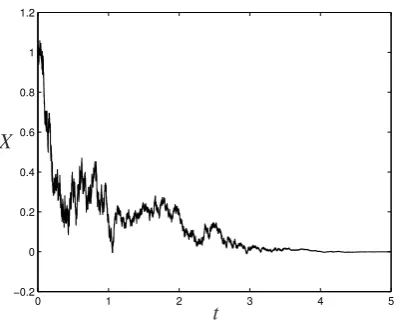
Consider the scalar case of (5.1)
dx.t /D
3x.t /C Z 0
x.tC /d
dtC
Z 0
x.tC /ddw.t / (5.6)
0 1 2 3 4 5 −0.2
0 0.2 0.4 0.6 0.8 1 1.2
[image:20.439.115.316.69.230.2]t X
Figure 1. The figure shows a stochastic trajectory generated by the Euler–Maruyama scheme for time step4tD10 5for the system (5.6).
Acknowledgments. The authors would like to thank the referee for his or her detailed comments and helpful suggestions.
Bibliography
[1] C. T. H. Baker and E. Buckwar, Numerical analysis of explicit one-step methods for stochastic delay differential equations,LMS J. Comput. Math.3(2000), 315–335. [2] C. T. H. Baker and E. Buckwar, Exponential stability inp-th mean of solutions, and
of convergent Euler-type solutions, of stochastic delay differential equations,J. Com-put. Appl. Math.184(2005), 404–427.
[3] E. Buckwar, Introduction to the numerical analysis of stochastic delay differential equations,J. Comput. Appl. Math.125(2000), 297-307.
[4] E. Buckwar, M. G. Riedler and P. E. Kloeden, The numerical stability of stochastic ordinary differential equations with additive noise, to appear inStoch. Dyn. [5] K. Burrage, P. Burrage and T. Mitsui, Numerical solutions of stochastic differential
equations – implematation and stability issues,J. Comput. Appl. Math.125(2000), 171–182.
[8] D. J. Higham, Mean-square and asymptotic stability of the stochastic theta methods, SIAM J. Numer. Anal.38(2000), 753–769.
[9] D. J. Higham, X. Mao and C. Yuan, Almost sure and Moment exponential stability in the numerical simulation of stochastic differential equations,SIAM J. Numer. Anal. 45(2007), 592–607.
[10] P. E. Kloeden and E. Platen,The Numerical Solution of Stochastic Differential Equa-tions, Springer-Verlag, Berlin, 1992.
[11] R. Sh. Liptser and A. N. Shiryaev,Theory of Martingales, Kluwer Academic Pub-lishers, Dordrecht, 1989.
[12] X. Mao, Approximate solutions for a class of stochastic evolution equations with variable delays—part II,Numer. Funct. Anal. Optim.15(1994), 65–76.
[13] X. Mao,Exponential Stability of Stochastic Differential Equations, Marcel Dekker, New York, 1994.
[14] X. Mao, Stochatic Differential Equations and Applications, Horwood, Chichester, 1997.
[15] X. Mao, LaSalle-type theorems for stochastic differential delay equations,J. Math. Anal. Appl.236(1999), 350–369.
[16] X. Mao, Stochastic versions of the LaSalle theorem,J. Differential Equations153 (1999), 175–195.
[17] X. Mao, The LaSalle-type theorems for stochastic functional differential equations, Nonlinear Stud.7(2000), 307–328.
[18] X. Mao, A note on the LaSalle-type theorems for stochastic differential delay equa-tions,J. Math. Anal. Appl.268(2002), 125–142.
[19] X. Mao, Numerical solutions of stochastic functional differential equations,LMS J. Comput. Math.6(2003) 141–161.
[20] X. Mao, Exponential stability of equidistant Euler–Maruyama approximations of stochastic differential delay equations,J. Comput. Appl. Math.200(2007), 297–316. [21] X. Mao and M. J. Rassias, Khasminskii-type theorems for stochastic differential
de-lay equations,Stoch. Anal. Appl.23(2005), 1045–1069.
[22] X. Mao and C. Yuan,Stochastic Differential Equations with Markovian Switching, Imperial College Press, London, 2006.
[23] S. -E. A. Mohammed,Stochastic Functional Differential Equations, Longman, Har-low, 1986.
[25] A. Rodkina and M. Basin, On delay-dependent stability for vector nonlinear stochas-tic delay-difference equations with Volterra diffusion term,Systems Control Lett.56 (2007), 423–430.
[26] A. Rodkina and H. Schurz, Almost sure asymptotic stability of drift-implicit -me-thods for bilinear ordinary stochastic differential equations inR1,J. Comput. Appl.
Math.180(2005), 13–31.
[27] A. Rodkina, H. Schurz and L. Shaikhet, Almost sure stability of some stochastic dynamical systems with memory,Discrete Contin. Dyn. Syst.21(2008), 571–593. [28] Y. Saito and T. Mitsui, T-stability of numerical scheme for stochastic differential
equations, in:Contributions in Numerical Mathematics, pp. 333–344, World Scien-tific Series in Applicable Analysis 2, World ScienScien-tific, Singapore, 1993.
[29] Y. Saito and T. Mitsui, Stability analysis of numerical schemes for stochastic differ-ential equations,SIAM J. Numer. Anal.33(1996), 2254–2267.
[30] H. Schurz, Preservation of probabilistic laws through Euler methods for Ornstein– Uhlenbeck process,Stoch. Anal. Appl.17(1999), 463–486.
[31] H. Schurz, Almost sure asymptotic stability and convergence of stochastic theta methods applied to systems of linear SDEs inRd, to appearRandom Oper. Stoch.
Equ.
[32] Y. Shen, Q. Luo and X. Mao, The improved LaSalle-type theorems for stochastic functional differential equations,J. Math. Anal. Appl.318(2006), 134–154. [33] A. N. Shiryaev,Probability, Springer-Verlag, Berlin, 1996.
[34] F. Wu and X. Mao, Numerical solutions of neutral stochastic functional differential equations,SIAM J. Numer. Anal.46(2008), 1821–1841.
[35] F. Wu, X. Mao and L. Szpruch, Almost sure exponential stability of numerical solu-tions for stochastic delay differential equasolu-tions,Numer. Math.115(2010), 681–697,
Received October 7, 2010; accepted March 2, 2011. Author information
Fuke Wu, School of Mathematics and Statistics, Huazhong University of Science and Technology, Wuhan, Hubei 430074, P. R. China.
E-mail:[email protected]
Xuerong Mao, Department of Mathematics and Statistics, University of Strathclyde, Glasgow G1 1XH, UK.
E-mail:[email protected]
Peter E. Kloeden, Department of Mathematics, Goethe University, 60054 Frankfurt am Main, Germany.