Condensate
G.R.M. Robb, E. Tesio, G.-L. Oppo, W.J. Firth, and T. Ackemann
SUPA and Department of Physics, University of Strathclyde, Glasgow G4 0NG, Scotland, UK
R. Bonifacio
INFN-LNF, Italy & Universidade Federal da Paraiba, Brazil (Dated: March 13, 2015)
Theoretical analysis of the optomechanics of degenerate bosonic atoms with a single feedback mirror shows that self-structuring occurs only above an input threshold which is quantum-mechanical in origin. This threshold also implies a lower limit to the size (period) of patterns which can be produced in a condensate for a given pump intensity. These thresholds are interpreted as due to quantum rigidity of Bose-Einstein condensates which has no classical counterpart. Above threshold, the condensate self-organizes into an ordered supersolid state with a spatial period self-selected by optical diffraction.
Self-organized patterns and structures which arise due to the simultaneous presence of optical nonlinearity and diffraction have been predicted and observed in a variety of media, including hot atomic vapours, for a number of years [1–5]. In the case of hot atomic vapours these phenomena rely solely on spatial modulation of the in-ternal states of the atoms (electronic or Zeeman states) with their centre-of-mass motion playing no significant role. In cold atomic gases the additional presence of op-tical dipole forces leads to density self-organization and removes the requirement for an intrinsic optical nonlin-earity. We will address the formation of a supersolid state in a quantum degenerate atomic gas from sponta-neous symmetry breaking. The supersolid forms due to interaction mediated by the optomechanical forces of the light field and has a length scale determined by diffrac-tion. Previously, optomechanical nonlinearity has been shown to give rise to collective atom-light interactions and instabilities which have been given a variety of names e.g. Collective Atomic Recoil Lasing (CARL) [6–8] and Superradiant Rayleigh Scattering (SRS) [9–11] but have similar physical characteristics to transversely pumped cavities, both with cold thermal and quantum degenerate matter [12–18]. The common features of these schemes are a pump beam which is scattered by the gas into an externally imposed mode (often selected by a cav-ity). The interference between this mode and the pump then provides a modulated light pattern, which via dipole forces leads to a spatial rearrangement of atoms. The emerging density gratings resulting from the interference of this mode and the pump then provide positive feed-back by scattering photons into the self-sustained mode. In these arrangements, the spatial scale of the emerging structure is predetermined by the light wavelength and the geometrical configuration. From the photonics and quantum optics point of view, cold atomic systems en-able the prospect of very low thresholds [19–22] offering the attractive prospect of all-optical control of symmetry breaking at the single photon level [19].
Alternative and naturally multimode schemes are pos-sible in cold atoms, where spatial organization emerges in the plane transverse to the propagation of a single beam, with self-selected scales. It is in fact expected that atomic transport due to dipole forces can lead to nonlinear effects in cold atoms analogous to the Kerr ef-fect in the hot-atoms case [23–25]. The study of trans-verse optomechanical instabilities in cold atoms has until recently been limited to the case where strong velocity damping is provided by optical molasses [20, 24, 25]. A similar optomechanical nonlinearity involving strong mo-mentum damping is also present in soft matter systems e.g. suspensions of nanoparticles [26–29], but compared to soft matter systems cold atoms have the advantage that the dynamics can be studied without viscous damp-ing of motion, allowdamp-ing for a coherent, dissipation-free evolution. Recently [30], it was demonstrated that a sys-tem comprising a cold, thermal gas of Rb atoms and a single feedback mirror could produce spontaneous sym-metry breaking resulting in hexagonal optical and atomic density patterns due to an instability arising from optical dipole forces in the absence of momentum damping. The theoretical analysis of this self-structuring process was described in [31] using a model where the cold atomic gas is described as a collisionless gas of classical parti-cles.
theoreti-cally in [23] and CARL-induced self-focussing in a BEC was investigated theoretically in [35]. In this letter we demonstrate that quantum effects can significantly affect the process of optomechanical diffractive self-structuring observed in [30] and described classically in [31]. In what follows we present a quantum model of the pattern formation/self-structuring process, highlight the specifi-cally quantum features which result and show that it can be described as a transition to a supersolid state with a self-selected spatial period.
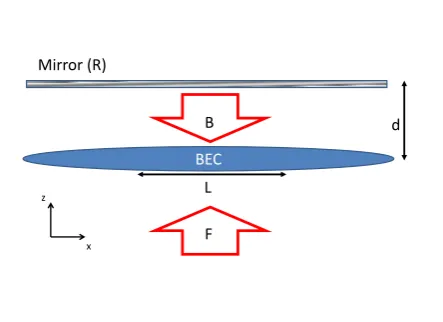
The setup considered is shown schematically in fig. 1, where a BEC is illuminated by an optical beam which, after passing through the gas, is reflected by a single feedback mirror. The two far off-resonant,
counterprop-BEC Mirror (R)
F
B d
L
x z
FIG. 1: Schematic diagram of the single mirror feedback scheme.
agating optical fields, represented by (F,B), produce an optical potential which can be written as
V(x) = ¯hδ
2 s(x, t) = ¯ hΓ∆
4 s(x, t) (1)
where δ = ω−ωa is the field-atom detuning, ω, ωa are the pump laser and atomic resonance frequencies respec-tively, ∆ = 2δ
Γ, Γ is the atomic transition linewidth ,
s= |F|2+|B|2
and |F, B|2= 1 ∆2
IF,B
Isat are the forward and backward field intensities scaled with respect to the saturation intensity at detuning δ. It has been assumed that ∆ 1 and that consequently s 1 so that the atoms remain in their ground state. In addition, longi-tudinal grating effects due to interference between the counterpropagating optical fields on the transverse pat-tern formation process are neglected, as in [30, 31]. In previous studies of pattern formation in Kerr media, e.g. [36], the effect of including longitudinal grating effects on transverse pattern formation is simply to reduce min-imum thresholds typically by approximately a factor of 2. Using eq. (1), the Schrodinger equation describing the evolution of the BEC wavefunction in this potential can
be written as
i∂ψ(x, t) ∂t =
− ¯h
2m ∂2
∂x2+
δ 2s(x, t)
ψ(x, t). (2)
where for simplicity we have neglected atomic collisions, so that the atom-light coupling is the dominant source of nonlinearity, and assumed an untrapped BEC. Exten-sions of this model to cases where both atom-light and atom-atom coupling (collisions) are included, and where a trapping potential is included will be the subject of fu-ture extended studies. We consider a transverse domain of lengthLso thatψ(x, t), F, Bare periodic with period L. In this case it is possible to writeψ(x, t), F, Bas
ψ(x, t) = X n
cn(t)einkLx (3)
(F, B)(x, z, t) = X n
(Fn(z, t), Bn(z, t))einkLx (4)
wherekL= 2Lπ is the wavenumber associated with trans-verse period/domain lengthLand nis an integer. Sub-stituting forψ(x, t), F(x, t), B(x, t) in eq. (2) using eq. (3) and eq. (4) results in
idcn(t) dt =ωrn
2c
n+ δ 2
X
m,p
FmFp∗+BmB∗p
cn−m+p (5)
where the intrinsically quantum parameterωr =
¯
hk2L
2m is
the “recoil frequency” associated with wavenumberkL. The evolution of the forward-propagating optical field in the BEC is described by
∂F(x, z, t) ∂z =−i
b0
2∆Lz
|ψ(x, t)|2F(x, z, t) (6)
where b0 is the optical thickness of the BEC cloud at
resonance,Lz is the longitudinal thickness of the cloud
Z L
0
|ψ(x, t)|2dx=L
and it has been assumed that the atomic gas is suffi-ciently thin that diffraction within it can be neglected (thin medium approximation). Substituting forψandF using eq. (3) and (4) respectively results in
∂Fn(z, t) ∂z =−i
b0
2∆Lz X
m,p
Fmcpc∗p−n+m. (7)
As the field propagates a distance 2dfrom the sample to the mirror and back, optical diffraction plays a cru-cial role by converting phase modulations to amplitude modulations and consequently optical dipole forces. The relation between the forward and backward fields when it leaves the BEC (wherez=Lz) is
Bn(z=Lz) =
√
RFn(z=Lz)e−in 2Θ
[image:2.595.66.288.237.398.2]where Θ = kL2d
k0 is the phase shift accumulated due to propagation from the BEC to the mirror and back when n= 1.
The evolution of the system is therefore completely described by eq. (5), (7) and (8).
Assuming that all spatially varying quantities (i.e. all modes with index6= 0) are small fluctuations and retain-ing only first-order terms in eq. (5) we obtain
idcn(t) dt =ωrn
2c
n
+ δ 2 F0F
∗
−n+B0B−∗n+F ∗
0Fn+B0∗Bn
. (9)
The forward field evolution, described by eq. (7) can sim-ilarly be approximated by
∂Fn(z, t) ∂z =−i
b0
2∆Lz
[F0(z, t)(c0c∗n+c ∗
0cn) +Fn(z, t)] (10) wheren6= 0 and the fact thatc0c∗0 = 1 (from
normalisa-tion ofψ) has been used. The spatially-uniform compo-nent of the field,F0, evolves according to
∂F0(z, t)
∂z =−i b0
2∆Lz F0(z, t)
which has the solution
F0(z, t) =F0(z= 0, t)e−i
b0z
2∆Lz
so eq. (10) can be solved forFn(z), giving
Fn(z=Lz) =−i b0
2∆F0(Lz)(c0c
∗
−n+c∗0cn). (11)
Substituting Fn and Bn into eq. (9) using eq. (11) and (8) respectively gives
dcn
dt =iωrn
2c
n+i b0p0Γ
4 sin(n
2Θ) c
0c∗−n+c ∗
0cn
(12)
where p0 = ∆12 Ipump
Isat is the pump saturation parameter. Looking for solutions c0c∗−n+c∗0cn
∝eλtresults in the dispersion relation
λ2+ωr2n4−n
2ω
rb0p0ΓR
2 sin(n
2Θ) = 0. (13)
Note that in the continuous limit where nkL ≡ q is a continuous wavenumber, then the dispersion relation in eq. (13) can be written as
λ2+ω2rq−ωrqb0p0ΓR
2 sin(q
2d/k
0) = 0. (14)
where ωrq =
¯
hq2
2m is the recoil frequency associated with emission and absorption of photons with transverse mo-mentum ¯hq. Consequently, an instability threshold con-dition Re(λ) = 0 can be written as a threshold in the pump saturation parameter
p0≡pth=
2ωrq
b0ΓRsin(q2d/k0)
(15)
In contrast to the instability threshold demonstrated here, the model described in [31], which assumed a cold classical gas of atoms, predicts a threshold ∝ T at low temperature i.e. zero threshold at zero temperature. The existence of a finite minimum threshold in the BEC case is therefore quantum mechanical in origin. The thresh-old may be interpreted physically as due to the intrinsic velocity of the BEC wavepacket i.e. the kinetic part of the Schrodinger equation, which acts to spread the wave-function and opposes the formation of any density modu-lation. This threshold can also be written as a threshold in wavenumberq < qdom ofqdom, where
qdom= r
mb0ΓRp0
¯
h . (16)
is the dominant wavenumber for which the instability growth rate is largest as sin(q2
domd/k0) = 1.
Con-sequently there exists a lower limit to the spatial size/period of the periodic structure, Lmin ≈ 2π/qdom, which the BEC will sustain. The growth rate, G(q) = Re(λ), is given by
G(q) =Re(λ) = r
ωrqb0p0ΓR
2 sin(q
2d/k
0)−ωr2q (17)
which requires sin (q2d/k
0)>0 forG(q)>0. Note that
far above threshold i.e. for pump intensities such that p0>> pth, the instability growth rate of eq. (17) reduces
to
G=Re(λ)≈
r
ωrqb0p0ΓR
2 sin(q
2d/k
0) (18)
where it has been assumed that sin(q2d/k
0)>0. It can
be shown that this growth rate is identical to that of the classical growth rate derived in [31] at zero temperature. Fig. 2 shows the dependence of pump threshold (pth)
on wavenumber (q2k0
d ) and, for a fixed pump inten-sity, the dependence of instability growth rate (G) on wavenumber as calculated from eq. (17). It can be seen that there are multiple instability regions or balloons which result from the argument of the sin(q2k
0/d)
chang-ing by multiples of 2π. In contrast to the prediction of the classical model [31], the instability balloons in the quantum case are not degenerate but have threshold min-ima which increase withq2. The dependence of thresh-old intensity on wavenumber is very different from that of the classical model of [31], which predicts instability balloons with a degenerate minimum threshold which be-comes zero at zero temperature. Note that the quantum model predicts a minimum threshold at q = 0, but the growth rate here is zero. There is a finite band of unsta-ble wavenumbersqwithq >0 with the maximum growth rate occurring atq=qdom.
0 2 4 6 8 10 12 14 16 0.0
0.2 0.4 0.6 0.8 1.0 1.2
p
th1e 8
(a)
0 2 4 6 8 10 12 14 16
q
2d/k
0 01 2 3 45 6 7 8
G
/s
−
1
(b)
FIG. 2: (a) Threshold pump intensity saturation parameter
pth as a function of q2k0/das calculated from eq. (15)(solid line) and from the classical model of [31], for a small but finite temperatureT = 1×10⁻¹²K (dashed line). (b) Growth rate
G as a function ofq2k0/d forp0 = 1.9×10⁻⁹ (dotted line in upper pane) as calculated from eq. (17) (solid line) and from the classical model of [31] forT = 1×10⁻¹²K (dashed line). Parameters used areb0= 20,|∆|= 100,d/k0= 2.48× 10⁻¹⁰m2,R= 0.99, Γ = 3.77×10⁷s−1.
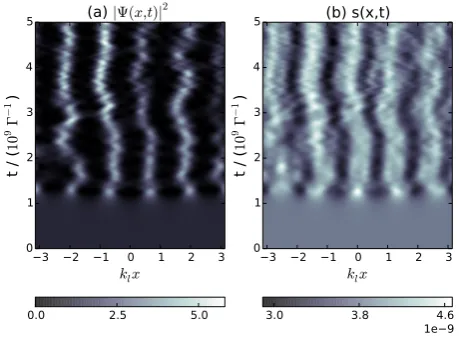
density distribution, |Ψ|2, for parameters such that the
pump intensity exceeds the threshold in eq. (15), result-ing in the simultaneous formation of a periodic modu-lation in light intensity and BEC density and initiated by noise. The dispersion relation eq.(13) predicts that for the parameters used, of all the modes included in the simulation those withn≤6 are above threshold. It can be seen that the modulation produced corresponds to n = 5, which has maximum growth rate due to the value of Θ used, as indicated by the dot in fig. 2 (b). In fig. 3, the pump field is red-detuned with respect to the atomic resonance (∆<0), which results in the BEC being attracted to regions of maximum light intensity. Conversely in fig. 4, the pump field is blue-detuned with respect to the atomic resonance (∆ >0), which results in the atoms being attracted to regions of minimum light intensity. Simulations of a cold classical gas would differ significantly from those shown in figs. 3 and 4 as they would show growth of larger-q patterns with shorter spa-tial periods. In both cases the pattern amplitude of the BEC grows exponentially and then fluctuates around a finite value, showing an asymptotic structured state.
In conclusion, we have demonstrated that when a zero-temperature BEC interacts with counterpropagating op-tical fields in the presence of a single feedback mirror, a self-structuring instability occurs which results in spon-taneous transverse modulation of the optical intensity and the BEC. In contrast to the case of a classical gas, in the case of the quantum gas/ BEC there is an in-stability threshold at zero-temperature which suppresses
3 2 1 0 1 2 3
k
lx
0 1 2 3 4 5
t /
(
10
9Γ
−
1
)
(a)
|Ψ(x,t
)|20 3 6
3 2 1 0 1 2 3
k
lx
0 1 2 3 4 5
t /
(
10
9Γ
−
1
)
(b) s(x,t)
3.2 4.0 4.8
[image:4.595.66.278.53.234.2]1e 9
FIG. 3: Evolution of (a) the BEC density distribution, |Ψ(x, t)|2, and (b) the optical intensity ,s(x, t), during the self-structuring instability when the pump-field is red-detuned. Parameters used are Θ =π/50, b0 = 20,∆ =−100,Γ/ωr = 2.53×10⁹, R= 0.99 andp
0= 1.9×10⁻⁹.
3 2 1 0 1 2 3
k
lx
01 2 3 4 5
t /
(
10
9Γ
−
1
)
(a)
|Ψ(x,t
)|20.0 2.5 5.0
3 2 1 0 1 2 3
k
lx
01 2 3 4 5
t /
(
10
9Γ
−
1
)
(b) s(x,t)
3.0 3.8 4.6
1e 9
FIG. 4: Evolution of (a) the BEC density distribution,
|Ψ(x, t)|2
, and (b) the optical intensity ,s(x, t), during the self-structuring instability when the pump-field is blue-detuned. Parameters used are as for fig. 3 with the exception that ∆ = 100.
[image:4.595.333.561.57.230.2] [image:4.595.333.563.346.515.2]interpre-tation of this limit is as a ‘healing length’ of structures in the coupled BEC-light system analogous to the usual healing length associated with the scattering length of a collisional BEC. Just as the healing length of a BEC is an important length scale for structures such as soli-tons in BECs [37, 38] this optomechanical healing length should play an analogous role for optomechanically in-duced structures similar to those proposed in e.g. [39] but which involve coherent lightandmatter.
Another interesting aspect of the results presented here is the connection with generic phase transition phenom-ena in quantum gases. Several recent experiments in-volving BECs in optical cavities [16, 34, 40] have ex-plored connections with Dicke Hamiltonian models and with associated phenomena e.g. transitions to a super-solid state [40]. It can be shown [41] that the BEC with single-mirror feedback scheme considered here can also be mapped onto an extended, multi-mode Dicke Hamilto-nian model. Similarly, the transition to a spatially mod-ulated state has characteristics of a transition to a super-solid in the sense of [40]. In common with [40] the tran-sition occurs due to long-range optically-mediated forces but an important distinction is that the spatially ordered ‘supersolid’ state observed here has a spatial period with a length scale which is self-selected and not externally imposed.
The authors acknowledge useful discussions with An-drew Daley and financial support from the Leverhulme Trust (research grant F/00273/0) and the Engineering and Physical Sciences Research Council (for GRMR -grant EP/H049339).
[1] M.C. Cross and P.C. Hohenberg, Rev. Mod. Phys. 65, 851 (1993)
[2] G. Grynberg, E. Le Bihan, P. Verkerk, P. Simoneau, J.R.R. Leite, D. Bloch, S. Le Boiteux and M. Ducloy, Opt. Commun.67, 363 (1988)
[3] G.L. Lippi, T. Ackemann, L.M. Hoffer and W. Lange, Chaos, Soliton & Fractals4, 1419 (1994) and 1433 (1994) [4] G. Giusfredi, J. F. Valley, R. Pon, G. Khitrova, H. M.
Gibbs, J. Opt. Soc. Am. B 5, 1181 (1988) [5] W.J. Firth, J. Mod. Opt.37, 151 (1990)
[6] R. Bonifacio and L. De Salvo, Nucl. Instrum. and Meth. in Phys. Res. A341, 360 (1994).
[7] C. von Cube, S. Slama, D. Kruse, C. Zimmermann, Ph.W. Courteille, G.R.M. Robb, N. Piovella, R. Boni-facio, Phys. Rev. Lett.93, 083601 (2004)
[8] S. Slama, S. Bux, G. Krenz, C. Zimmermann and Ph.W. Courteille, Phys. Rev. Lett.98, 053603 (2007) [9] S. Inouye, A.P. Chikkatur, D.M. Stamper-Kurn,
J. Stenger, D.E. Pritchard and W. Ketterle, Science285, 571 (1999)
[10] D. Schneble, Y. Torii, M. Boyd, E.W. Streed, D.E. Pritchard and W. Ketterle, Science300, 475 (2003) [11] H. Kessler, J. Klinder, M. Wolke, and A. Hemmerich,
Phys. Rev. Lett.113, 070404 (2014)
[12] P. Domokos and H. Ritsch, Phys. Rev. Lett.89, 253003 (2002)
[13] A. T. Black, H. W. Chan, and V. Vuleti´c, Phys. Rev. Lett.91, 203001 (2003).
[14] S. Gupta, K. L. Moore, K. W. Murch, and D. M. Stamper-Kurn, Phys. Rev. Lett.99, 213601 (2007) . [15] F. Brennecke, S. Ritter, T. Donner & T. Esslinger,
Sci-ence322, 235 (2008)
[16] K. Baumann, C. Guerlin, F. Brennecke and T. Esslinger, Nature464, 1301 (2010).
[17] T. Botter, D.W.C. Brooks, S. Schreppler, N. Brahms, and D.M. Stamper-Kurn, Phys. Rev. Lett. 110, 153001 (2013)—.
[18] H. Ritsch, P. Domokos, F. Brenneke and T. Esslinger Rev. Mod. Phys.85, 553 (2013).
[19] J.A. Greenberg, B.L. Schmittberger and D.J. Gauthier, Opt. Express19, 22535-22549 (2011).
[20] E. Tesio, G. R. M. Robb, T. Ackemann, W. J. Firth, and G.-L. Oppo, Phys. Rev. A86, 031801(R) (2012) [21] H. Tercas, J. T. Mendona, and R. Kaiser, Eur. Phys.
Lett.8953001 (2010)
[22] J. T. Mendonca and R. Kaiser, Phys. Rev. Lett.108, 033001 (2012).
[23] M. Saffman, Phys. Rev. Lett.81, 65 (1998).
[24] G. A. Muradyan, Y. Wang, W. Williams and M. Saffman, Nonlinear guided waves topical meeting technical digest, paper ThB29 (2005)
[25] M. Saffman and Y. Wang, Lect. Notes Phys.751, 361 (2008)
[26] P.W. Smith, A. Ashkin, and W.J. Tomlinson, Opt. Lett.
6, 284 (1981)
[27] A. Askhin, J.M. Dziedzic, and P.W. Smith, Opt. Lett.7, 276 (1982)
[28] S.M. Wiggins, G.R.M. Robb, B.W.J. McNeil, D.R. Jones, D.A. Jaroszynski and S.J. Jamieson, J. Mod. Opt. 49, 997 (2002) Phys. Rev. E67, 025603 (2003)
[29] P.J. Reece, E.M. Wright, and K. Dholakia, Phys. Rev. Lett.98, 203902 (2007)
[30] G. Labeyrie , E. Tesio, P. M. Gomes, G-L. Oppo, W.J. Firth, G.R.M. Robb , A.S. Arnold, R. Kaiser & T. Ack-emann, Nat. Phot.8321 (2014).
[31] E. Tesio, G.R.M. Robb, T. Ackemann, W.J. Firth and G.-L. Oppo, Phys. Rev. Lett.112, 043901 (2014). [32] N. Piovella, M. Gatelli and R. Bonifacio, Opt. Comm.
194, 167 (2001).
[33] L. Fallani, C. Fort, N. Piovella, M. M. Cola, F. S. Catal-iotti, M. Inguscio and R. Bonifacio, Phys. Rev. A 71, 033612 (2005).
[34] D. Schmidt, H. Tomczyk, S. Slama & C. Zimmermann, Phys. Rev. Lett.112, 115302 (2014).
[35] N. Piovella, L. Volpe, M. M. Cola & R. Bonifacio, Laser Physics17, 174 (2007)
[36] W. J. Firth, A. Fitzgerald and C. Pare, JOSA B7, 1087 (1990).
[37] L. Khaykovich, F. Schreck, G. Ferrari, T. Bourdel, J. Cubizolles, L. D. Carr, Y. Castin, C. Salomon, Science
2961290 (2002).
[38] K.E. Strecker, G. B. Partridge, A. G. Truscott, & R. G. Hulet, Nature417150 (2002).
[39] E. Tesio, G.R.M. Robb, T. Ackemann, W.J. Firth & G.-L. Oppo, Opt. Expr.21, 26144 (2013) .
[40] R. Mottl, F. Brennecke, K. Baumann, R. Landig, T. Don-ner & T. Esslinger, Science336, 1570 (2012).