. . . , '-, U' . >'• ^? JÏ »;>>-•.
- . . ' V v. '>'
COMMISSION OF THE EUROPEAN COMMUNITIES
Brussels, 18.11.1997 COM(97) 550 final
97/0302 (CNS)
Proposal for a
COUNCIL DECISION
'y-^xA y.-."3
adopting a multiannual framework programme for actions in the energy sector
(1998-2002) and
CONNECTED MEASURES
EXPLANATORY MEMORANDUM
INTRODUCTION 3
1. IMPROVING THE COHERENCE AND EFFECTIVENESS OF ENERGY POLICY 7
1.1 Generallogic 7
1.1.1 Horizontal actions 7
1.1.2 Thematic programmes 7
1.1.3 Co-ordination of energy components under other Community programmes
and policies 8
1.2 Structure of the framework programme 8
1.2.1 Legislative basis 8
1.2.2 Bodies 8
1.2.3 Management and control 9
1.3 Actions and programmes 10
1.3.1 Prospective analyses and market monitoring (cf.. Annex II) 10
1.3.2 International energy co-operation (cf. Annex III) 12
1.3.3 Promotion of renewable energy sources and implementation of a strategy and
Community action plan in this area (cf. Annex IV) 14
1.3.4 Encouragement of energy efficiency (see Annex V) 16
1.3.5 Promotion of clean and efficient use of solid fuels (cf. Annex VI) 17 1.3.6 Co-operation in the nuclear sector on safety, industrial collaboration with
Russia and the New Independent States, transport of radioactive
materials, including the fight against illicit trafficking) (cf. Annex VII) 18
1.4 Co-ordination with energy components of other Community Programmes and Policies 21
1.4.1 Support for research and technological development 21
1.4.2 Trans-European energy networks t 21
1.4.3 Other policies or programmes 22
1.5 General financial elements 22
2. IMPROVING THE CO-ORDINATION OF THE ENERGY COMPONENTS OF THE
VARIOUS COMMUNITY POLICIES 23
CONCLUSIONS 24
PROPOSAL FOR A COUNCIL DECISION
adopting
a multiannual framework programme for actions in the energy sector (1998 - 2002)
and connected measures
EXPLANATORY MEMORANDUM
INTRODUCTION
Calls for the establishment of a framework programme for actions undertaken as part of energy policy have been heard in the institutions on numerous occasions during discussions on this sector, culminating in a formal request by the «Council.1 On the occasion of their examination of the Commission communication on "An overall view of energy policy and actions",2 the European Parliament3 and the Economic and Social Committee4 expressed the same sentiment.
Developments related to energy - a vital sector for the economy of the Union and the well-being of the European citizen - require a response with a suitable energy strategy: The decision taken at the Denver Summit to convene a GS meeting in Moscow in the spring of 1998 which is entirely devoted to energy confirms, if there were any doubt, the importance that has to be attached to this sector and all the questions relating thereto.
The communication of 23 April 1997 on "An overall view of energy policy and actions", drawn up at the express request of the Council, clearly outlined the following situation:
I. The Union is, and will increasingly be, confronted with major challenges in terms of energy strategy:
a) By 2020, the degree of external dependency for energy supplies, currently standing at 50%, could reach, if current trends continue and no measures are taken, 80% for coal, 70% for natural gas and 90% for oil, the latter two
1 Council Resolution of 8 July 1996 on the White Paper "An energy policy for the European Union" (OJ No C 224, 1.8.1996) and Council Regulation (EC) No 701/97 adopting the SYNERGY programme (OJ No L 104, 22.4.1997).
2 COM(97)167finalof23.4.1997.
3 EP reference...
remaining the two main sources of energy used in Europe for the foreseeable future; moreover, this dependency has to be seen in a geopolitical context whose development is very difficult to predict and it should be noted in this connection that the analysis and planning group of the Council (COPLA) has been instructed by the Political Committee of the CFSP to devote its work in the second half of 1997 to the importance of the new geopolitical energy
situation for the European Union. A security of supply strategy based on
diversification of sources, the promotion of renewable energy sources indigenous to the Union, combined with rational use of energy is required, supported by «greater international co-operation and the development of trans-European energy network infrastructures connecting the Union to external supplies.
b) The need for vigorous action to improve the competitiveness of Union businesses, which are too often handicapped by energy costs higher than those borne by their non-European counterparts, particularly American companies (for instance, it is estimated that in the chemical sector European companies pay up to 45% more than their US counterparts).
c) The need to ensure that the development of the energy market is compatible with environmental objectives, given the concerns expressed by European citizens and the international commitments of the Community. The alarming level of pollution at the very heart of European cities and the impact of climate change on the environment and public health give a sharp reminder to governments and citizens about the urgent and far-reaching measures to be taken in the field of energy choices. The current discussions in the context of the Climate Change Convention and the measures which will have to be taken after the Kyoto Conference put a particular stress on this necessity. These decisions imply a profound change in consumer culture to be brought about through a voluntarist policy on supply and demand.
II. The Community is pursuing numerous actions in the energy field, but these are scattered:
a) either between different energy policy programmes set up at different times and in different circumstances;5
b) or over various Community policies, such as environment, taxation, external relations,6 internal market, structural policies, research or even agricultural policy.
This situation has arisen from the gradual development of the approach to energy questions within the Community and the desire to deal with all aspects of this complex question. The instruments established to this end have demonstrated their ability to
5 SAVE,, ALTENER, SYNERGY, ....
respond and overall their operations may be considered satisfactory. Such a scattering of actions does however have the following consequences:
• some lack of transparency for the parties involved;
• the risk of duplication;
• a danger of inconsistency between the various actions;
• management difficulties;
• use of resources which is not always optimum;
• missed opportunities for synergistic effects and for maximising complementarity of actions.
In order to respond effectively to the challenges and difficulties that have to be faced, Community energy policy should be both more focused and more integrated. The establishment of the internal market in gas and electricity in accordance with the principle of competing, open markets is a key element in this respect.
At the level of the actions undertaken by the Community, the concentration of
operations is the primary condition for an effective policy. In the case of energy, it means
that efforts must be focused on the following three priority objectives:
• security of supply;
• competitiveness;
• environmental protection.
Every energy related action, whether taken under the energy policy as such or under another Community policy, will have to contribute to these objectives.
However, if each of these objectives is pursued in a purely "operational" way, the limits would soon be reached and the objectives could even prove incompatible with each other. The complexity of the situation in which energy policy operates makes it necessary, perhaps more than in other fields, to strive for a satisfactory balance between the various political, economic and social factors in play. Only a genuinely integrated approach can take adequate account of all aspects of the problems to be solved, as has been shown for instance by the strategy adopted for the implementation of the "auto oil" programme.
It is also particularly significant that Agenda 2000 mentions that "The external dimension
of Community policies- on the environment or energy, for instance - will more than before become an integral component of its external policy".
Energy policy needs to be given higher priority. In order to maximise the benefit from the support given by the Union, actions relating to energy policy will have to be implemented in accordance with the following guidelines;
-• every Community action must contribute directly to the achievement of one or
more of the abovementioned priority objectives;
• significant improvement in co-ordination between all actions with an energy component;
• greater co-operation between the various interested parties within the Community institutions and in the Member States, in full accordance with the principle of
subsidiarity;
• ability to respond quickly to developments;
• clarification and simplification of procedures;
• strengthening of actions on the basis of priorities and needs.
Finally, it is essential that this principle of coherence and co-ordination be applied at all levels:
• in Community energy policy itself: the "energy" framework programme has been established with this in view (cf. Chapter 1);
• between the energy components found in a number of other Community policies which will be ensured by the establishment of an appropriate structure within the Commission (cf. Chapter 2); and the reinforcement of existing co-ordination.
• with the Member States and the interested parties.7
Care will also be taken to ensure that the external image of the framework programme is a coherent and integrated one. To this end, the Commission will identify key messages and target groups for all the information and communication actions organised under the programme. Actions aimed at the general public will also be organised, exploiting the information networks available in the Member States.
Co-operation with the Member States and interested parties is set to develop in the appropriate bodies provided for firstly by Commission Decision 96/642 of 8 November 1996 setting up an Energy Consultative Committee and secondly by the proposal for a Council Decision COM(97)436 concerning the organisation of co-operation around agreed Community energy objectives.
-1. IMPROVING THE COHERENCE AND EFFECTIVENESS OF ENERGY POLICY
. 1.1 General logic
The main aim of an Energy framework programme is to ensure the
coherence and effectiveness of actions undertaken under energy policy; it
will, then, be the effective instrument for rationalising the programmes stemming directly from that policy and obtaining the maximum benefit. As mentioned above, these programmes were drawn up and implemented at different times and in different circumstances: they now have to be incorporated into a more integrated, transparent and effective approach, established for a period of five years.
The logic of this approach will be based on the links between horizontal
actions and thematic actions or programmes. These two categories of
actions, described in greater detail in - Section 1.3 below, will be complementary and organised so as to focus on the priority objectives which will remain the constant point of reference for any operation carried out.
In terms of resources (cf. Section 1.5), the amounts allocated are determined by present financial perspectives. Beyond that period, reassessments and/or increases will have to be made on the basis of political requirements and priorities.
1.1.1 Horizontal actions
By their nature, these actions go beyond any specific programme, making a global contribution to the priority objectives. While they have their own purpose, they will also ensure that actions taken under the thematic programmes in the framework programme are co-ordinated and will contribute towards coherence with other Community policies. They cover:
• Prospective analyses and market monitoring
• International energy co-operation
1.1.2 Thematic programmes
These programmes correspond to specific priority themes under the Union's energy policy and are justified because they contribute to priority energy policy objectives, with a particular emphasis on the promotion of environmentally friendly technologies and sustainable development:
1) Promotion of renewable energy sources and implementation of a Community strategy and action plan until 2010
2) Promotion of energy efficiency and energy saving
4) Nuclear sector co-operation on safety, industrial co-operation with NIS, transport of radioactive materials, including measures to combat illegal trafficking
1.1.3 Co-ordination of energy components under other Community programmes and policies
This particularly concerns two types of action which are very important for the energy sector, in terms of both content and the scale of the resources employed, but which fall within a specific procedural framework and are not therefore included as such in this framework programme :
• Support for research and technological development (RTD)
• Trans-European energy networks
Attention will also be paid to improved co-ordination between all other policies or programmes whose area of activity include energy components, such as external relations (PHARE, TACIS, MEDA), structural fiinds or investment support.
1.2 Structure of the framework programme
1.2.1 Legislative basis
The implementation of the framework programme will be based on
• a basic decision setting out the general framework, its duration, its main financial elements and the implementing bodies; the annex to this decision " .. ., sets out on an indicative basis the spreading of resources between the different specific actions
• where necessary, specific measures designed to specify the objectives, contents and details of each of the actions in question and which, where appropriate, will replace the corresponding acts currently in force or in the course of being adopted (cf. Annexes II to VII).
The decision relating to the framework-programme itself will be based on Article 235 EC. Those specific actions whose particular focus is the promotion of environmental friendly technologies will be based on Article 130s, § 1, and the other ones will be based on Article 235. In order to maximise transparency and to ensure the degree of coherence necessary for the definition and implementation of the approach, it is important that these texts should be considered as a package.
1.2.2 Bodies
which itself is based on improved co-ordination, flexibility and availability of information.
The approach will be based on the setting-up of a single committee,
consultative in nature, for the Energy framework programme (horizontal
actions and thematic programmes). This single committee will cooperage with all the bodies involved, including the various committees mentioned below. It will actively contribute towards the co-ordination between energy measures undertaken under the various Community policies, and will examine the report drawn up periodically by the Commission on the co-ordination between actions.
However, given the wide range of questions to be dealt with, and their technical complexity, the working methods and organisation must be as
flexible as possible to ensure access to all the specialist skills required. It
will be for the single committee to organise its working procedures accordingly.
The establishment of this committee does not affect some of the bodies set up for a very specific purpose which will continue their work. This applies to, among others:
- the Consultative Committee on Energy;8
- the Committee for co-operation around agreed Community objectives;9 - the Guidelines Committee (trans-European energy networks);
- RTD management bodies set up in accordance with the procedures of the 4th and 5th RTD framework programmes.
1.2.3 Management and control
By among other things avoiding duplication of effort, integration of the approach, instruments and bodies will ensure:
• optimum management of resources, also guaranteed by recourse to costTbenefit analyses;
• complete transparency for all the parties involved (institutions, Member States, companies).
Systematic evaluation of the actions will be carried out at regular intervals. Every year, the Commission will review the implementation of the framework
8 Commission Decision 96/ 642 of 8 November 1996 setting up an Energy Consultative Committee, OJ NoL 292, 15.11.1996.
9 Proposal for a Council Decision COM(97)436 concerning the organisation of co-operation around agreed Community energy objectives.
9-programme and its specific parts, and make the appropriate changes in the implementation. In the third year of the framework programme and, in any event, before presenting its proposals modifying this framework programme or proposing subsequent programmes, the Commission will ask independent experts to carry out an overall external evaluation of the Community actions carried out under the Energy framework programme.
1.3 Actions and programmes
The implementation of the framework programme will rationalise to a significant extent all the actions and programmes referred to in points 1.1.1 and 1.1.2 above and provide a further benefit in the shape of greater synergy and complementarity between these actions and programmes. The objective of this section is to describe these actions and/or programmes and identify
developments or improvements which might be decided upon as policy
requirements and priorities evolve. In accordance with the Commission's recommendations on reinforcing the pre-accession strategy as mentioned in Agenda 2000, candidate countries will be given the opportunity to participate in all the actions and programmes undertaken under this framework programme.
Horizontal actions
1.3.1 Prospective analyses and market monitoring (cf.. Annex 11)
More than any other, energy policy cannot be conceived without taking account of the medium and long-term prospects. This need, underlined by the Commission in its Energy White Paper,10 was endorsed by the Council and the European Parliament in their examination of this document.
The studies, analyses, forecasts and connected work (dissemination and discussion of results) already form part of the Commission's activities concerned with the formulation of energy policy. To do this, the Commission relies on the expertise that it has promoted at the most distinguished European centres in this field. This makes it possible to avoid duplication of effort and exploit at the lowest cost the results of the work and the knowledge gained, funded by the various departments of the Commission and/or the Member States.
However, progress has to be made in the area of shared analyses: analysis in the energy field is currently in a transitional phase which makes it more difficult to carry out. The situation is changing in economic terms, given the gradual opening up of energy markets, the increasing importance of environmental constraints, and technological prospects calling for the development and application of new concepts and different methods taking into account work undertaken under the RTD Programme. As regards the framework programme, the new analysis must therefore go further,
10 « An energy policy for the EU" COM(95)682 final, 13.12.1995.
-10-strengthening co-operation between the Commission and the Member States on the forecasts and involving firms, academic circles and other sources of knowledge or experience in the work. The fundamental aim of this programme and of the actions proposed in response to this requirement is to ensure that decisions at national and Community level on energy matters can be taken on common analytical bases. The objective is clearly not to achieve standardisation but to align points of view so that those taking decisions have identical reference bases in terms of:
• economic studies and analyses;
• energy forecasts;
• the dynamics of energy systems.
In this context, particular attention should be paid to the effects of the implementation of the Single Currency, considering the positive impact on competitiveness which can be expected from "EURO-pricing" of oil.
This action, aimed at greater co-ordination of the factors to be taken into account, will be based on the development of an effective partnership between the Commission, the Member States and the other parties involved in the energy field and will find expression in a work programme covering the energy sector in the widest sense. The introduction of coherent analysis procedures will make it easier to identify the main questions arising in connection with the priority objectives of security of supply, competitiveness and environmental protection.
In this connection, the main areas for actions covered by this programme are:
(a) identification, at European level, of the major problems concerning future energy demand and production as well as energy policy, with special emphasis on:
• strategies for responding to the challenge of climate change in energy terms and more general questions relating to the environment (including an evaluation of the cost of possible responses);
• the dynamics of the opening up of energy markets and corresponding structures, particularly in terms of consequences for the future and behaviour of firms;
• world energy market trends and their influence on the external dependency of the European Union (in particular the anticipated significant increase in energy demand in Asia and Latin America);
(b) improved analytical capability so as to be able to identify energy trends and possible scenarios on a comparable basis in all Member States, having regard in particular to the evolution of market structures and the challenge posed by climate change.
-The need for action in this area is clearly in line with the priority objectives on energy matters, particularly as regards the environmental aspects (underlined again by the Council at its meeting on 27 May 1997) and the completion of the internal energy market, a key element for the competitiveness of European firms.
The action will reinforce the achievement of the energy policy objectives as outlined in the White Paper and will build on the efforts already underway. The annual appropriations necessary to implement these actions are indicated in the financial statement in Annexe II.
1.3.2 International energy co-operation (cf. Annex III)
The international dimension is assuming increasing importance in
energy questions affecting the Union.
The increasing dependency of the Union on its external suppliers above all raises the question of security of supply. The situation is moreover complicated by the emergence of energy-hungry markets in the developing countries, whereas the European market is expanding only slowly. The
competitiveness of European businesses in the face of these new markets is
also of paramount importance. The fact that the major environmental
problems connected with energy consumption now affect the whole planet
requires global co-operation which takes account ôf the circumstances of all the parties involved, including %the role of energy as a key element of
sustainable economic development. Finally, steps should be taken now to prepare for the changes that enlargement will inevitably bring for Union energy policy.
SYNERGY represents the main external element of the Energy framework programme. It constitutes the link between an internal policy and the external actions of the Community and is one of the main supports for penetration by Community firms of the major external markets. It is important in this connection to emphasise that with the technologies associated with renewable energy sources and the improvement in energy efficiency, the Union has significant industrial and employment potential which would be further strengthened if new outlets in third countries were opened up to trade with the Member States.
Compared with other Community instruments which might bè involved in external actions in the energy sector, SYNERGY will concentrate on the achievement at international level of the three objectives of the framework programme: global competitiveness, security of supply and environmental protection. Moreover, SYNERGY will seek to improve co-ordination, in the interests of greater efficiency, of the various international actions carried out by the Community in the energy field and ensure greater coherence with the work of international organisations in the sector.
fund co-operation on the formulation, preparation and implementation of energy policy in areas of mutual interest. However, SYNERGY does not fund actions relating to research and technological development, demonstration projects or energy infrastructure investment. Projects of this type can be financed under other Community instruments. Similarly, SYNERGY is not an instrument for assistance to or economic co-operation with third countries. SYNERGY actions mainly concern third countries facing energy challenges, mainly those in Central and Eastern Europe, the New Indépendant States, non-member countries in the Mediterranean basin, Latin America and Asia and the African, Caribbean and Pacific signatories to the Lomé Convention. SYNERGY can also cooperate with international organisations engaged in this sector (e.g. International Energy Agency, the Latin American Energy Organisation), international financial institutions (EE3, World Bank, EBRD) or developed countries (USA, Japan, Norway etc.) to initiate actions of mutual benefit in third countries. The programme will be more clearly slanted in favour of Community interests. It will therefore be possible for most actions to be initiated by the Union alone, including those in the field of energy supply as well as demand.
On the basis of these guidelines, a multiannual programme of actions to be initiated and a list of beneficiary countries are annexed to the decision adopting the SYNERGY programme. Under this multiannual programme specific action plans will then be established each year on the basis of:
• other Community programmes and instruments;
• actions carried out in certain third countries by the Member States;
• needs expressed by the national industries of the Member States;
• needs expressed by beneficiary countries.
To take account of the various complementary elements, these plans will be drawn up in a process of consultation of the departments concerned within the Commission then submitted to the single committee set up by the Council Decision establishing the Energy framework programme. This committee will also receive periodic reports on the implementation of the various programmes.
The co-operation will take the form of:
• advice on energy policy;
• visits by experts to bodies in third countries;
• energy studies and forecasts;
• assistance for international networks discussing and advising on energy
policy;
training actions (courses, seminars, technical missions);
-• co-ordination of the various Community instruments involved in international actions in the energy sector;
• dissemination of information, (brochures, newsletter);
• promotion of dialogue and exchanges of information and experience through conferences, seminars, etc.
The funding provided by SYNERGY could cover the total requirement of a particular project where it is in the interests of the Community alone or take the form of cofunding with another partner.
The total budget for this programme must be sufficient to contribute effectively to an improvement in the coherence and complementarity of the internal and external dimensions of Union policies, as stressed by the Commission in Agenda 2000. nThe breakdown of the required funding is
indicated in the Financial Statement in Annex III.
Thematic programmes
1.3.3 Promotion of renewable energy sources and implementation of a strategy and Community action plan in this area (cf. Annex IV)
Renewable energy sources (RES) help to protect the environment and ensure security of supply through diversification of sources. Their increased use will also help to achieve other Community objectives of major importance such as regional development, economic and social cohesion, employment and competitiveness.
The aim of this action, which adopts the main elements of the proposal already presented by the Commission concerning the ALTENERII programme,12 is to help increase use of renewable energies and hence of
their share in the Community's energy balance, including by facilitating the legal, socio-economic and administrative conditions required for the implementation of the White Paper and action plan for renewable energy sources up to 201013 being adopted by the Commission following the wide
ranging discussions on the 1996 Green Paper.14
Once these conditions have been determined, it will be easier to encourage private and public investment in the production and use of-energy from renewable sources. The economic penetration of renewable energy sources
11 Agenda 2000, Vol. 1, Part 1, Section IV.2 "A strong and coherent Europe".
12 COM(97) 87 final of 12.3.1997.
13 COM(97)...
will be helped by targeted actions aimed at increasing operator confidence through assistance with the preparation and presentation of projects and through the development of new funding possibilities (such as third party financing).
Specific actions eligible for funding, which will involve the promotion of market penetration of innovative environmentally friendly technologies, which have proved their value and effectiveness will cover among other things:
• monitoring of the implementation of the strategy and action plan regarding RES, and evaluation of the measures to be taken under this programme;
• market penetration of RES by facilitating, among other things, access to specialist advice, analysis of market prospects,' choice of location of projects, drawing up of funding plans; the projects will cover, among other things, biomass and waste, photovoltaic and thermal solar systems, solar power in buildings, small-scale hydroelectric projects, wind power and geothermal energy;
• promotion of product and equipment standardisation;
• extension of infrastructures for the development of RES in local and regional planning, design and evaluation, information, education and training;
• circulation of information with a view to improved co-ordination between international, Community, national, regional and local activities, as well as the pooling of experience and know-how;
• studies or other work aimed at implementing or complementing Community measures taken to develop the potential of the various renewable energy sources.
The contribution of the renewable energies to the primary energy requirements of the European Community is currently slightly below 6% and represents some 70 million tpe. In its abovementioned Green Paper, the Commission proposed a significant increase in the use of renewable energy sources by the year 2010. The proposed indicative target of a doubling of the share of renewable energies by 2010 has been confirmed during the consultation process and integrated in the White Paper.
This programme is a fundamental element of the implementation of the strategy and action plan for renewable energy sources which will give effect to the Paper. The budget available for the actions must be sufficient to make a significant contribution to the achievement of this Community objective. Details are outlined in the Financial Statement in Annexe IV. The increase proposed from 2000 onwards is aimed at taking full advantage, with the new financial perspectives, of the White Paper and the action plan. It should also be emphasised that the increased use of renewable energies will contribute to economic and social cohesion, particularly through the exploitation of local energy sources.
-1.3.4 Encouragement of energy efficiency (see Annex V)
In the medium and long term, prudent and rational end use of energy resources is, in terms of cost effectiveness, the best available solution for reducing CO2 emissions.
The programme SAVE II, adopted by the Council in December 1996,15 has
proved its effectiveness as a non-technological programme in promoting the rational use of energy in all consumer sectors. The previous programme (SAVE I) had already made an important contribution towards the Community's energy objectives, implementing a wide range of measures such as legislative acts, practical pilot projects, studies, monitoring and evaluation of progress on energy efficiency, dissemination of information and innovative mechanisms for funding and awarding contracts.
In connection with SAVE, the Council and the Commission have adopted nine directives on energy efficiency in domestic appliances, buildings and industry: This programme of legislation, as well as the other measures, will have to be continued.
Electricity is of particular importance in the energy sector, since its production accounts for around 35% of primary energy consumption and 30% of CO2 emissions. The end use of energy offers great potential for improving efficiency in all sectors of activity (domestic and industrial). The old PACE programme, a Community action programme to improve the efficiency of electricity use, adopted in 1989 by the Council, has been integrated in full into SAVE II. PACE provided for a range of measures to improve the energy efficiency of various types of equipment (domestic appliances, electric motors), to promote information for consumers on the purchase and use of efficient electrical equipment etc. ... These actions, which make a significant contribution to reducing CO2 emissions will have to be pursued under the new Energy framework programme. In this connection, particular attention could be paid to actions to promote energy management at regional and local level which could usefully be developed in conjunction with the City of the Future project.
In the context of enlargement, the benefits of measures linked to energy efficiency will take on a new dimension when the pricing policies and metering practices used in the applicant countries are more in line with market-oriented mechanisms.
If these objectives, which are particularly important given the priority accorded to environmental considerations, are to be achieved, the funds allocated for the SAVE II programme (whose period of application as currently fixed by the Decision of 16 December 1996 will be aligned with that of the Energy framework programme) will have to be increased accordingly
15 Council Decision of 16 December 1996 concerning a pluriannual programme for the promotion of
energy efficiency in the Community (SAVE II), OJ No L 335 of 24.12.1996.
in line with the new financial perspectives. Details of the estimated financial requirements are given in the Financial Statement in Annex V.
7.3.5 Promotion of clean and efficient use of solid fuels (cf. Annex VI)
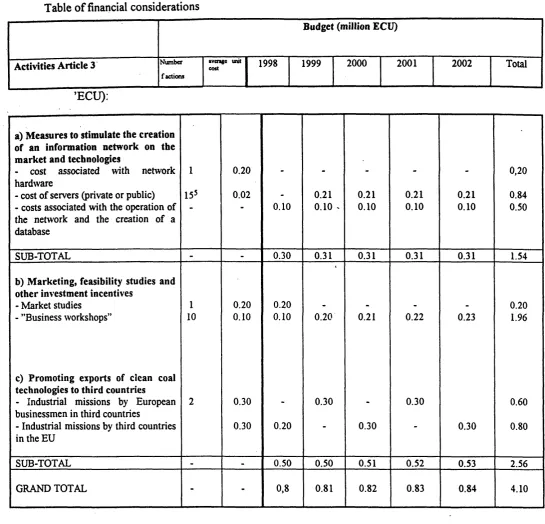
Solid fuels play à considerable part in the energy balance of the Union, and account for 30% of electricity generation. They play a major role in security of supply and, as a key element in the establishment of the internal market, effectively regulate the prices of other fuels such as natural gas. Maintaining diversification of the energy balance and access to all sources is crucial to security of supply but also to a balanced approach to the three priority objectives of Union energy policy. However, a prerequisite to this is the increased penetration of cleaner and more efficient technologies for solid fuels, in order to reduce pollutant emissions.
Clean and efficient solid fuel combustion technologies are rich in potential in terms of reducing emissions not only of CO2 but also SO2 and Nox, which cause acidification. The action proposed under the Energy framework programme (CARNOT) is intended to help achieve this objective. The Community must play a role in promoting the market penetration of these technologies, encouraging the companies in this sector to establish the necessary long term strategies with a view to replacing the thermal power stations currently in operation.
Encouraging the clean and efficient use of sold fuels is particularly urgent with the prospect of enlargement. Most of the applicant countries are large scale producers and consumers of solid fuels: in Poland, coal and lignite account for 76% of primary energy consumption and 94% of electricity generation. The corresponding figures for the Czech Republic are 62% and 76% respectively, and 19 and 27.5% for Hungary. In spite of the reforms carried out by these countries with a view to greater diversification, it is likely that a significant proportion of their production of solid fuels will continue. Conversion of the plants using these fuels is of mutual interest to the applicant countries and the Union in both economic and environmental terms. The experience of converting plants burning lignite in the new German Lander provides a good example of the potential contribution of lignite from the countries of Central and Eastern Europe to the energy supplies of an enlarged Europe. Technological co-operation on "clean coal" will help to integrate those countries into the European Union.
The year 2002 will see the expiry of the ECSC Treaty which has made a major contribution to economic and social expansion in Europe. The experience gained with the ECSC Treaty is an asset that the Community must exploit to the full. It is particularly important to ensure that the results of research already financed or currently under way under the ECSC are sufficiently exploited. This proposed action aims to bring new more environmentally friendly solid fuel technologies closer to the market.
Actions to promote the clean and efficient use of solid fuels are in line with the conclusions of the Amsterdam European Council on growth and
17-employment, which approved allocating financial resources from its reserves to 'coal' and 'steel' research on expiry of the ECSC Treaty. The proposed CARNOT action under the Energy framework programme will complement this future research activity.
Finally, for the technologies in question, the growth prospects on external
markets such as China, ASEAN, India etc. are rich in potential for European
companies, while at the same time helping to reduce greenhouse gas emissions, a problem affecting the whole world.
Details of the financing required for this programme are given in the Financial Statement in Annex VI.
1.3.6 Co-operation in the nuclear sector on safety, industrial collaboration with Russia and the New Independent States, and the transport of radioactive materials, including the fight against illicit trafficking (cf. Annex VII)
The nuclear sector is the subject of a number of Commission action programmes, mainly in the areas of research, technological development and education, nuclear safety, health protection, technical assistance and co-operation with the countries of Central and Eastern Europe and the New Independent States, the transport of radioactive materials and the implementation of safeguards. Although most of these operations do not fall under energy policy in the strict sense, three actions (co-operation on safeguards, industrial collaboration with the New Independent States and the transport of radioactive materials, including the fight against illicit trafficking) come directly under that policy and should therefore constitute a specific part of the Energy framework programme.
Given the existing provisions in the Euratom Treaty, the implementation of such action does not require the adoption of specific formal acts. However, continued funding should be provided for these actions, the need for which is beyond question.
Co-operation in relation tô the accounting and monitoring of nuclear materials (safeguards) as part of technical assistance to the New Independent States and Mongolia
The aim of these measures is to help to improve and computerise the system of accounting and safeguards at all levels: installation (site), regional centres, company headquarters and national systems.
In 1993, the Euratom Safeguards Directorate began to collaborate with Russian officials with responsibility in this area and, since 1994, specific projects have been drawn up. The results of this co-operation are certainly encouraging but it will have to be pursued for some time still to achieve the desired objectives. As regard Russian participation, apart from training and familiarisation, seven inspections and two measurement workshops have been organised. From these it emerges that the technical knowledge and experience of Russians working in the field of nuclear technology is
-considerable but the training requirements in relation to modern methods of organisation, evaluation and logistics are still great. As regards systems design, seven Russian experts worked for a period of eight weeks each in Luxembourg from October Ï993 to March 1994. Each period was followed by an examination and evaluation of their contributions and conclusions. Two seminars were organised within the European Union and a conference on nuclear safeguards in St Petersburg.
It is then useful to pursue measures relating to training and familiarisation in the techniques, methods, logistics and evaluation of modern nuclear safety. Co-operation should therefore continue between Russia and Euratom in this sector, particularly with a view to combating the illicit trafficking of radioactive materials. With the entry into force of the partnership and co-operation agreements with the New Indepedent States, these activities will be further extended.
In budget terms, the actions in question are funded under TACIS, but as the Commission has decided16 that their management should be the responsibility
of the services in charge of energy policy, it is proposed to examine transferring the corresponding appropriations to a budget heading specifically relating to energy policy.
Industrial co-operation with Russia and the NIS:
Nuclear energy now provides, with the required degree of security, a significant proportion of the electricity requirements of the Community, with significant environmental implications. The use of nuclear energy is however conceivable only if appropriate safety and industrial viability criteria are met. This is the case today in the Community, but it is reasonable to take a critical look at the situation in certain neighbouring countries, particularly Russia, the Ukraine and a number of others which have applied for membership, which may wish to expand their use of nuclear energy as their economies develop. It is therefore important to go beyond specific short term measures to improve the safety of nuclear plants in operation and examine ways of ensuring that in the longer term the use of nuclear energy is accompanied by all the necessary safety guarantees comparable to those used in the Union.
For some years the Commission has been carrying out studies and conducting working groups with experts in the European nuclear industry, focusing mainly on Russia at this stage, in order to gain a better knowledge of the present state of the local nuclear industry and define a possible approach to achieve a fundamental improvement in safety. This approach is based on the concept of transferring the culture of safety through industrial co-operation, which is particularly attractive for a country which wishes to expand its use of nuclear energy. The Commission is currently studying with the Russian authorities the technical, financial and legal barriers to the establishment of co-operation schemes between businesses. This process should lead by the
16 Commission Decision C(97)2879 of 24.9.1997 on the funding of Euratom nuclear safeguards.
19-beginning of 1998 to the definition of courses of action and proposals which it would be unwise not to pursue. This requires funding of more detailed studies of particular problems (e.g. the conditions required for investment, specific legal difficulties, etc.) and providing the means to solve generic problems. The objective for the Commission is to help establish industrial co-operation on the largest possible scale without becoming involved in carrying out specific projects which is a matter for the operators concerned.
Transport of radioactive materials
The production of electricity by means of nuclear power and the increasing use of radioactive materials in the health sector, industry or research requires such materials to be transported under conditions which guarantee the safety of the general population and workers in the industry; in order to take account of developments in the transport of radioactive materials, progress of technology and know-how and ever stricter obligations concerning radiological protection, international, Community and national laws will have to adapt to the new circumstances and requirements.
At the request of the European Parliament, the Commission set up in 1982 a standing group of experts in the field of the transport of radioactive materials to advise it on the studies and experiments to be carried out and the legislation to be drawn up in this sector. The most recent recommendation of this groups calls for the implementation of a five-year multiannual programme with appropriate funding. This programme should revolve around six fields of activity which would benefit from action at Community level:
• facilitating the functioning of the internal market by identifying the harmonisation measures that are required;
• contributing to the subsequent evolution of legislation through the development of experimentation and know-how;
• evaluating incidents occurring during transport and learning the lessons for the future;
• improving the coherence of emergency measures and the training of those involved;
• co-operating with the countries of Central and Eastern Europe "and the New Independent States to help them to improve the safety of transport in those countries;
• improving the public's knowledge, understanding and perception in this field.
The appropriation proposed for the various categories of nuclear action as described above for the period in question is outlined in the Financial Statement in Annex VII.
-1.4 Co-ordination with energy components of other Community programmes and policies
1.4.1 Support for research and technological development
Research and technological development, including demonstration, play an essential role in the elaboration of methods which offer high energy efficiency and new techniques for the exploitation of fossil, nuclear or renewable sources. In this connection, the Fourth Framework Programme for research and technological development, established by Articles 13 Of to 13 Op of the Treaty, includes for non-nuclear energies a research and energy development section (JOULE) and a "demonstration" section (THERMIE). These enable major projects in the field of new energy technologies to be carried out in conjunction with industry, research centres and universities in the Member States. An RTD programme in the field of nuclear safety and controlled thermonuclear fusion based on the Euratom Treaty has also been implemented with the participation of the Joint Research Centre. Given the context and specific structures in which these actions take place, their operating methods, bodies and implementing instruments will remain unchanged. It is however clear that there is a close link between energy RTD activities and the more market-oriented actions carried out under this framework programme. A special effort will therefore have to be made to improve co-ordination at the appropriate level between the Commission's departments and between the other parties involved. More specifically, a more formalised approach will be followed for increased co-operation and co-ordination between the Single Energy Committee and the equivalent structure which will be set up in the context of the Fifth RTD Framework Programme.
1.4.2 Trans-European energy networks
The trans-European networks are vital arteries for economic development, the working of the internal market and greater Community cohesion. Under the Treaty (Article 129b, c, d), the European Community has given itself powers relating to networks and, in the energy field, it has pursued a policy of developing these infrastructures in the electricity and natural gas sectors, on account also of the positive effects on security of Community energy supply and international co-operation. As regards Community cohesion in particular, the Commission is devoting a great deal of its attention to the energy problems arising from the special situation of the islands, archipelagos and extremely remote areas of the Community.17
Given the context and specific structures in which this action is being carried out, its methods of operation, bodies and implementing instruments will remain unchanged, as with research. A special effort is underway to further
17 Cf. for example the Report presented by the Commission on the progress achieved in implementing POSEIMA. COM(94)476 final of 09.12.1994.
improve co-ordination at the appropriate level between the Commission's departments and between the other parties involved.
7.4.3 Other policies or programmes
Some other policies, such as external relations (for instance in the context of the PHARE, TACIS or MEDA programmes), structural funds or investment support include in their area of activity important energy components. Special attention will then also be paid to improving operation and co-ordination between the Commission's departments in charge.
1.5 General financial elements
In absolute terms, the budget for energy policy as such is not large, not only in comparison with other chapters under heading 3 but also in relation to the sums set aside for energy measures undertaken under certain Community policies.
The main purpose of developing an integrated approach to energy policy is the rationalisation and improved co-ordination of actions. The establishment of the multiannual framework programme focusing on the three major priority objectives will facilitate the management and more transparent and
rigorous use of resources thus resulting in more effective actions on the
existing financial bases.
It is however essential that the Union should provide itself with sufficient resources to implement its policy priorities in the energy sector and that
provision should therefore be made for certain increases in anticipation of the
forthcoming financial perspective. This is moreover in line with the financial framework set out by the Commission in its memorandum on
Agenda 2000,18 which in Part 3 makes express provision for the development of a number of internal policies intended to serve priority objectives shared by all the Member States and where there is an obvious added value and refers in this connection to certain priority programmes, particularly ones linked with enlargement, innovation and the introduction of environment-friendly technologies whose allocations may be increased faster than GNP growth.
Given their potential not only in terms of environmental protection, of course, but also job creation, it is proposed to place particular emphasis on actions to promote renewable energies (ALTENER) and encourage energy efficiency (SAVE).
The table below gives an indicative breakdown in million ECU, without prejudice to any priorities which may be adopted, between the various actions and programmes. The estimated budgets, are outlined in detail in the Financial Statements in the Annex;
Energy markets analyses and monitoring
International co-operation in the energy sector
Renewable energy sources
Energy efficiency
Solid fuels sector
Nuclear security Total Nuclear security B7-535 1998 1.50 7.00 14.4 12.5 0.80 0.5 36.7 2.5 1999 1.53 7.14 15.6 12.8 0.81 0.51 38.39 2.5 2000 1.56 7.28 17 13.9 0.82 0.5? 41.08 2.5 2001 1.59 7.42 17 14.6 0.83 0.53 41.97 2.5 2002 1.62 7.57 17.1 14.6 0.84 0.54 42.47 2.5 Total 7.8 36.4 81.1 68.4 4.1 2.6 200.4 12.5
2. IMPROVING THE CO-ORDINATION OF THE ENERGY COMPONENTS OF THE VARIOUS COMMUNITY POLICIES
As stated in the introduction, the April 1997 communication on an overall view of energy policy and actions underlined the importance, including in terms of funding, of the energy component in a number of major Community policies. Co-ordination mechanisms already operate for example in relation to structural policies. Effective integration is not however possible without special attention being paid, to improving co-ordination between all the parties involved and the coherence of all actions, particularly within the Commission and its departments.
1) In accordance with its internal procedures, the Commission has formally decided to set up a network of the Directors-General concerned which will have the task of ensuring that:
• the policy or operational guidelines involving an energy dimension will be drawn up in accordance with the principles of consultation and transparency;
-• the actions implementing these guidelines and the allocation of resources relating thereto will be co-ordinated on a constant basis and assessed in the light of their
contribution to the priority objectives of energy policy.
2) Each year, the network of Directors-General will draw up a summary of all the
energy actions undertaken under the various Community policies. This report
will be transmitted to the committee established under the Energy framework programme for its consideration, as well as to other interested committees, and
will be made public thereafter. This will also ensure that the other European Institutions are kept informed.
A more formalised approach will be followed for increased operation and co-ordination between all committees which deal with programmes and policies which have an energy component. Automatic information exchange mechanisms will also be introduced.
It is expected that the establishment of a single committee for energy actions and programmes falling within the scope of this framework programme, will facilitate the co-ordination and coherence of actions undertaken at Community level. It would be important for Member States to undertake their own internal reviews of their system, in order to improve the links between national and Community bodies.
CONCLUSIONS
The Commission communication on an overall view of energy policy and actions represented a first step in response to the requests expressly made by the Council and the Member States for an integrated approach to Community energy policy.
Given the vital importance of the sector for the economic and social development of the Union and the high priority that should be attached to defining a coherent, transparent and effective European energy policy, the Commission considers that the introduction of the multiannual Energy framework programme along the lines proposed will give practical effect to this approach and provide an appropriate response at operational level to the requirements ascertained by the institutions and the Member States.
EUROPEAN COMMISSION
PROPOSAL FOR A COUNCIL DECISION
adopting a
MULTIANNUAL FRAMEWORK PROGRAMME FOR
ACTIONS IN THE ENERGY SECTOR
PROPOSAL FOR A COUNCIL DECISION ADOPTING A MULTIANNUAL FRAMEWORK PROGRAMME FOR ACTIONS IN THE ENERGY SECTOR
(1998-2002)
97/0302 (CNS)
THE COUNCIL OF THE EUROPEAN UNION,
Having regard to the Treaty establishing the European Community, in particular Article 235 thereof,
Having regard to the proposal from the Commission,1 Having regard to the opinion of the European Parliament,2
Having regard to the opinion of the Economic and Social Committee,3 Having regard to the opinion of the Committee of the Regions,4
Whereas the Commission communicated its views on the future of Community energy policy to the Council in its White Paper "An energy policy for the European Union" of
13 December 1995;5
Whereas the Commission communicated to the Council in its White Paper of.... 1997 its views on the implementation and monitoring of a Community strategy and action plan for renewable energy sources to the year 2010 with the aid of new technologies;6
Whereas the Council adopted the SAVE II programme on 16 December 19967 to boost energy efficiency initiatives in the Community with a view to reducing CO2 emissions;
Whereas the Council and the European Parliament adopted a decision on 26 April 1994 concerning the fourth framework programme of European Community activities in the field of research, technological development and demonstration (1994-1998)8 and a
4
5 COM(95) 682, 13.12.1995.
6 COM(97)
7 Decision 737/96/EC, OJ No L 335, 24.12.1996.
decision of the same date concerning a framework programme of Community activities in the field of research and training for the European Atomic Energy Community;9 whereas
the Commission adopted a proposal on the 5th framework programme of research and technological development on 30 April 1997;10
Whereas the Commission adopted and transmitted to the Council a communication on the energy dimension of climate change on 14 May 1997;11
Whereas the use of cleaner technologies contributes to the objectives of the Community strategy to combat acidification;12
Whereas energy is a vital factor in the economic and social development of the Community;
Whereas the Community's dependence on external energy supplies is set to increase significantly in the years to come;
Whereas the competitiveness of European business is heavily influenced by the level of energy costs;
Whereas it is necessary to the quality of life of citizens to ensure that the development of energy production and consumption is compatible with environmental protection objectives;
Whereas CO2 emissions must be reduced;
Whereas, particularly in view of the political uncertainties involved in the external supply markets, the Community must implement a coherent, effective energy policy geared to the medium and long-term prospects for economic development;
Whereas the actions taken under the energy policy should therefore be focused on specific priority objectives;
Whereas, in view of the strategic challenges facing the Community, these objectives should focus in particular on ensuring the security of supplies, completing the integration of the energy markets, enhancing the competitiveness of European business and the quest for environmentally sustainable economic development;
Whereas the balanced achievement of these objectives requires particular attention to be devoted to the transparency, coherence and coordination of all of the energy actions taken at Community level;
9 Council Decision 268/94(Euratom), OJ No L 115, 6.5.1994, page 31. 10 COM(97)142 final.
11 COM(97)196 final.
12 COM(97)88 final of 12.3.1997.
on
Whereas the Council stressed this need in its Resolution of 8 July 199613 on the White
Paper "An energy policy for the European Union";
Whereas the Council, when it adopted the Regulation adopting a programme to promote international cooperation in the energy sector,14 considered that it would be opportune for
the Commission to present a communication on all the Community programmes with an energy component, which could be followed by a proposal on the establishment of a framework programme for energy;
Whereas the Commission presented a communication: "An overall view of energy policy and actions",15 from which it emerges that the Community is pursuing a great many
actions, but that these are scattered either between different energy policy programmes or various Community policies;
Whereas it is necessary to ensure the management, complementarity and optimum use of budget resources;
Whereas only a truly integrated approach will enable proper account to be taken of all the aspects of the problems to be resolved;
Whereas this coherent, coordinated approach must apply both to energy policy as such and to the energy components of other Community policies;
Whereas it is therefore necessary to define and establish a multiannual framework programme for the actions taken under the Community's energy policy;
Whereas this framework programme should be implemented in the form of horizontal actions and thematic programmes;
Whereas the horizontal actions cover forward analyses, market monitoring and international energy cooperation;
Whereas the thematic programmes concern the promotion of renewable energy sources and the implementation of a Community strategy in this area, the promotion of energy efficiency, promotion of solid fuels and the safe use of nuclear energy;
Whereas, in view of the context and the specific structures within which energy actions relating to trans-European networks are conducted, the structures and the manner in which such actions are implemented must be maintained in the appropriate framework;
Whereas in view of the context and the specific structures within which energy actions relating to RTD are conducted, the structures and the manner in which such actions are implemented will continue to conform with the arrangements and procedures of the RTD
13 O J N o C 224, 1.8.1996.
framework programme; whereas, however, cooperation and coordination with the other structures must be enhanced;
Whereas the actions or programmes referred to above should be implemented where necessary by means of specific measures which, where appropriate, would replace the corresponding instruments currently in force;
Whereas the principle of seeking the greatest possible coherence calls for the setting up of a single committee of an advisory nature for the whole of the framework programme and its constituent actions;
Whereas, in view of the variety and technical complexity of the questions to be addressed, the single committee and the Commission should seek the assistance of appropriate experts where necessary;
Whereas the single committee will assist the Commission in ensuring the greatest possible transparency and the dissemination of information between all the parties concerned and ensure greater consistency of the energy actions taken under the various Community policies;
Whereas, notwithstanding a systematic, regular evaluation of the actions, the "energy" framework programme and its specific programmes should be the subject of a mid-term review by independent experts;
Whereas focusing the actions on the three major priority objectives of security of supply, competitiveness and protection of the environment will facilitate a more transparent and more efficient use of resources;
Whereas some additional funding could be decided in the light of the political choices and priorities adopted;
Whereas the funding of actions carried out in the priority areas of promotion of renewables (ALTENER programme) and energy efficiency (SAVE programme) in particular could be reviewed when the next financial perspective is drawn up;
Whereas, in keeping with the subsidiarity principle and the principle of proportionality pursuant to Article 3b of the Treaty, the above priority objectives of energy policy and the boosting and coordination of energy actions carried out under the energy policy proper and in the framework of other Community policies should, by their nature, be implemented at Community level; whereas this Decision is confined to the minimum required to achieve these goals;
Whereas the Treaty does not provide powers for the adoption of this Decision, the purpose of which is the coordination of all aspects of energy policy, other than those in Article 235; whereas the specific programmes which will implement this framework programme will each be adopted on the appropriate legal basis, in particular where their objective is the prudent and rational utilisation of natural resources referred to in Article 130r of the Treaty,
5
HAS DECIDED AS FOLLOWS:
Article 1
(lj A multiannual framework programme for Community actions in the field of energy, hereinafter referred to as the "framework programme", is hereby adopted for the period 1998-2002.
(2) The framework programme shall primarily contribute to the pursuit of the following priority objectives:
to guarantee the security of energy supplies;
. to ensure competitiveness;
to promote the compatibility of the development of the energy market with environmental protection objectives.
(3) The framework programme shall also contribute to greater transparency, coherence and coordination of all the Community's energy actions in the field of energy policy and ensure that they mesh effectively with the actions taken in the framework of other Community policies.
Article 2
(1) Notwithstanding the actions relating to energy conducted in the framework of research policy or trans-European networks respectively, the framework programme shall be implemented through six specific programmes of a horizontal or thematic nature corresponding to the following actions:
(a) development, in cooperation with the Member States, of a programme for regular monitoring of the evolution of the energy markets and trends, so that political decisions relating to energy can be taken on the basis of a joint analysis;
(b) reinforcement, within the area of competence of the framework programme, of international cooperation in the energy field in order to encourage, firstly, greater diversification of energy sources and, secondly, greater transparency and stability of the international gas and oil markets in particular;
(c) promotion of new and renewable energy sources and implementation of a Community strategy and action plan for renewable energy sources to the year 2010;
(d) encouragement of rational and efficient use of energy resources;