EFFECTIVENESS OF BRUNNSTROM APPROACHES
ON IMPROVING HAND FUNCTION IN RIGHT
HEMIPLEGIC PATIENTS
- (A COMPARATIVE STUDY)
Dissertation Submitted to
THE TAMIL NADU Dr. M. G. R. MEDICAL UNIVERSITY,
Chennai-32
towards partial fulfillment of the requirements of
MASTER OF PHYSIOTHERAPY
Degree programme
SUBMITTED BY
Reg. No. 27092314
P.P.G. COLLEGE OF PHYSIOTHERAPY
9/1, KEERANATHAM ROAD,
P.P.G. COLLEGE OF PHYSIOTHERAPY
9/1, KEERANATHAM ROAD,
SARAVANAMPATTI,
COIMBATORE-641035
THE DISSERTATION ENTITLED
EFFECTIVENESS OF BRUNNSTROM APPROACHES
ON IMPROVING HAND FUNCTION IN RIGHT
HEMIPLEGIC PATIENTS
- (A COMPARATIVE STUDY)
SUBMITTED BY
Reg. No. 27092314
Under the guidance of
Mrs. N. UMA, M.P.T (Neuro)., M.I.A.P.,
Associate Professor
Dissertation submitted to
THE TAMILNADU Dr. M. G. R. MEDICAL UNIVERSITY,
CHENNAI – 32.
Dissertation evaluated on ---
CERTIFICATE I
This is to certify that the Dissertation entitled
“EFFECTIVENESS OF BRUNNSTROM APPROACHES ON
IMPROVING HAND FUNCTION IN RIGHT HEMIPLEGIC
PATIENTS (A COMPARATIVE STUDY)” was carried out by
Reg.No. 27092314 P.P.G. COLLEGE OF PHYSIOTHERAPY,
Coimbatore-35, affiliated to THE TAMILNADU Dr. M. G. R.
MEDICAL UNIVERSITY, Chennai-32, under the guidance of
Mrs. N. UMA., M.P.T., M.I.A.P.,
CERTIFICATE II
This is to certify that the dissertation work “EFFECTIVENESS
OF BRUNNSTROM APPROACHES ON IMPROVING HAND
FUNCTION IN RIGHT HEMIPLEGIC PATIENTS (A
COMPARATIVE STUDY)” was carried out by Reg.No.27092314
P.P.G. COLLEGE OF PHYSIOTHERAPY Coimbatore-35, affiliated
to
THE TAMILNADU Dr. M. G. R. MEDICAL UNIVERSITY,
Chennai-32, under my Guidance and direct supervision.
ACKNOWLEDGEMENT
I give my thanks to GOD for providing me the wisdom and knowledge to complete my study successfully.
It is my bounded duty to express at the outset heartiest gratitude to my
PARENTS for their strong support, and encouragement that enabled me to turn this idea into a reality.
I express my sincere gratitude to our Chairman Dr. L. P. THANGAVELU, M.S., F. R.C.S., and Correspondent Mrs. SHANTHI THANGAVELU, M.A., P.P.G group of institutions, Coimbatore, for their encouragement and providing the to bring out the study.
With due respect, my most sincere thanks to Principal Prof. K. RAJASENTHIL M.P.T.,(Cardio-Resp)., M.I.A.P., Ph.D, who gave me his precious time and with his vast experience helped me to complete this dissertation successfully.
I express my special thanks to project guide and coordinator Mrs. N. UMA, M.P.T (Neuro)., M.I.A.P., Associate Professor for offering me perceptive inputs and guiding me entirely through the course of my work and helped me to complete this project work.
I extend my heartfelt gratitude to my PG coordinator
I express my thanks to each and every PATIENT who cooperated to fulfill this project work possible.
Last but not least I thank my friend Dr. Shanmugasundram, M.P.T (Neuro)., M.I.A.P., and MY FAMILY MEMBERS who provided support and encouragement throughout this work.
CONTENTS
S.No. Title Page No.
I INTRODUCTION
1.1 Introduction 1.2 Need for the study 1.3 Operational definitions 1.4 Aim of the study 1.5 Objectives of the study 1.6 Hypothesis 1 1 6 7 8 8 9
II REVIEW OF LITERATURE 10
III MATERIALS AND METHODOLOGY
3.1 Materials 3.2 Methodology
3.2.1. Study design 3.2.2. Sampling technique 3.2.3. Sample size
3.2.4. Study setting 3.2.5. Selection criteria
• Inclusion Criteria
• Exclusion Criteria
3.2.6. Study duration 3.2.7. Parameter 3.2.8. Statistical tool
3.2.9. Treatment technique
3.2.10. Procedure 18
21
IV DATA PRESENTATION 22
V DATA ANALYSIS AND INTERPRETATION 24
VI RESULTS 32
VII DISCUSSION 34
VIII SUMMARY AND CONCLUSION 36
IX LIMITATIONS AND SUGGESTIONS 37
X BIBLIOGRAPHY 38
XI APPENDIX
Appendix – I Appendix – II Appendix - III
LIST OF TABLES
Table No. Content Page No.
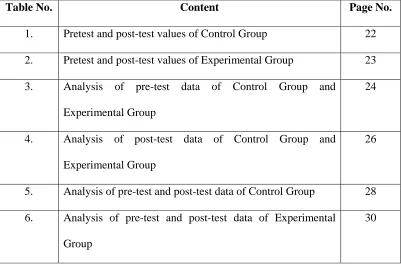
1. Pretest and post-test values of Control Group 22
2. Pretest and post-test values of Experimental Group 23 3. Analysis of pre-test data of Control Group and
Experimental Group
24
4. Analysis of post-test data of Control Group and Experimental Group
26
5. Analysis of pre-test and post-test data of Control Group 28 6. Analysis of pre-test and post-test data of Experimental
Group
LIST OF GRAPHS
Graph
No. Content Page No.
1. Comparison of pretest values of Control Group and Experimental Group
25
2. Comparison of post test values of Control Group and Experimental Group
27
3. Comparison of pretest and post test values of Control Group
29
4. Comparison of pretest and post test values of Experimental Group
ABSTRACT
OBJECTIVE : To find out the efficacy of Brunnstrom treatment approach on right handed hemiplegic patient.
DESIGN : Two group study designed with pre-test and post-test.
PARTICIPANTS : Thirty subjects aged 40 to 60 years with stroke under Brunnstorm recovery stage III were selected under purposive sampling Technique and assigned into two groups with 15 subjects each, one group received Brunnstrom treatment approach and the other group received conventional physiotherapy treatment.
OUTCOME MEASURE : Fugyl-Meyer motor scale assessment, is used to measure functional outcome before and after treatmentbefore and after treatment.
RESULTS : Statistical analysis done by using student ‘t’ test and independent ‘t’ test showed that there was significant improvement in subjects who received Brunnstrom treatment approach.
CONCLUSION : Hence, it can be concluded that Brunnstrom treatment approach is a intervention for improving functional activity on right hemiplegic patient.
1
CHAPTER - I
INTRODUCTION
Brain is the major organ of the Central Nervous system that has control center for all the body’s voluntary and involuntary activities. Adult brain weighs about 1.4 kg (3lb) constitutes about 2% of body weight, it receives about 17% of the cardiac output and consumes about 20% of the oxygen used by the entire body.
Brain is extremely sensitive to ischemia. Any insult to the vascular supply of brain renders to ischaemia. Ischaemic lesions of vascular origin were responsible for more neurological disorders, nerve cells will die within minutes when this happens and the part of the body controlled by these cells will fail to function properly as well.
A stroke is a common term used to refer ischaemic lesions of vascular origin “a rapidly developed clinical signs of cerebral function lasting more than 24 hrs leading to death with no apparent cause other than vascular origin”.
In south India, the incidence of stroke is 56.9/1000 population. Analysis of data from major urban university hospitals suggests that nearly 2% of all hospital cases, 4.5% of medical and 20% of neurological admission are from stroke.
Many stroke survivor demonstrate persistent and disabling upper limb deficits. These may include hanging of the limb side ways, loss of stability (shoulder dislocation) while weight bearing, loss of proprioception, limb drifting all times into the total pattern of spasticity. Therefore it is important to develop more effective methods for restoration of upper limb motor control following stroke.
Untreated cases of upper limb in stroke leads to permanent flexion contracture and renders the patient unable to perform activities of daily living.
Physiotherapy plays a vital role in rehabilitation of stroke patients. The integrated approach of physiotherapy rehabilitation includes Proprioceptive Neuromuscular Facilitation Technique, Roods Approach, Neuro Development Therapy Brunnstrom Movement Therapy. Aim of all these techniques is to maximize functional ability and prevent secondary complications to enable the patient to resume all activities in their own environment. There are other important treatment approaches such as Brunnstrom approach which improves functional movements on hand after stroke.
a) Brunnstorm Approach
Brunnstorm, a physical therapist, was particularly concerned with impaired motor control following stroke. Her method of developing this treatment approach gives therapist insight into the behaviors of a master clinician.
Principles of Brunnstorm approach
3
When no motion exists facilitate it using reflexes associated reactions proprioceptive facilitation or exteroceptive facilitation to develop muscle tension in preparation for voluntary movement.
When vouluntary effort produces a response ask the patient to hold (isometric) the contraction if successful asks for an eccentric (Controlled Lengthening) contraction and finally a concentric (Shortening) contraction.
Even when only partial movement is possible stress reversal of movement from flexion to extension in each treatment session.
Have the patient repeat correct movement once elicited to learn it. Practice should include functional activities to increase the willed aspect and to relate the sensations to goal-directed movement.
Stages of Brunnstrom approach
Stages Definitions
I Flaccidity no voluntary movements in the affected limb
II Hyperreflexia : emergence of spasticity and synergies, minimum voluntary movement in the affected limbs.
III Voluntary movement within synergy, spasticity increases to peak level
IV Isolated voluntary movements, spasticity and synergies decline
There are currently many types of PT interventions used to improve the functional hand movement of patients after stroke, namely Brunnstrom and passive movements.
Brunnstrom (1966, 1970) and Sawner (1992) also described the process of recovery following stroke-induced hemiplegic. The process was divided into 7 numbers of stages. Brunstrom approach or Movement therapy (Brunnstrom, 1970)
Brunnstrom approach is one form of neurological exercise therapy in the rehabilitation of stroke. Uses primitive synergistic patterns in training in attempting to improve motor control through central facilitation. Based on concept that damaged CNS regressed to phylogenetically older patterns of movements (limb synergies and primitive reflexes). Thus, synergies, primitive reflexes, and other abnormal movements are considered normal processes of recovery before normal patterns of movements are attained.
Patients are taught to use and voluntarily control the motor patterns available to them at a particular point during their recovery process (e.g., limb synergies). Enhances specific synergies through use of cutaneous /proprioceptive stimuli, central facilitation using Twitchell's recovery.
5
Limb physiotherapy included passive, assisted-active and active range-of-motion exercise for the hemiplegic limbs. This can be an effective management for prevention of limb contractures and spasticity and is recommended with AHCPR (1995). Self-assisted limb exercise is effective for reducing spasticity and shoulder protection (Davis, 1991).
Adams and coworkers (1994) recommended passive full-range-of-motion exercise for parlysed limb for potential reduction of complication for stroke patients.
1.2 NEED FOR STUDY
Stroke is one of the common condition occurring in middle age and old age persons. After stroke the brain forgets established normal movement pattern and adopts new, abnormal ones which are largely dictated by spasticity.
Both motor unit and muscle exhibit changes. The number of functioning motor units decreases to 50%, impaired firing rates and reduced force production, increased effort occur.
Owing the high incidence of MCA strokes Upper Limb is more frequently affected than Lower Limb. About 20% of individuals paralyzed by stroke fail to regain any functional use of the affected Upper Limb.
Many physiotherapy techniques are used in improving upper limb function. So the lost memory of movement is relearnt using repetitive sensory input. Conventional therapy and brunnstrom treatment approach are used in improving Upper Limb function.
7
1.3 OPERATIONAL DEFINITIONS Stroke
A sudden onset of focal neurological deficit resulting from ischemic or haemorrhagic lesions in the brain.
- WHO
Brunnstrom Approach
It is a therapeutic technique which may used to recover the stroke patients using primitive reflexes and inhibit the abnormal reflexes and facilitates the normal pattern using synergetic pattern.
- Trombly
Fugyl-Meyer Scale
A stroke assessment scale which measures the physical performance of upper extremity, lower extremity, balance sensation range of motion, etc.,
1.4 AIM OF THE STUDY
The aim of the study is to compare the effect of Brunnstrom Approach and conventional program in treatment of right hemiplegic mainly on hand functions.
1.5 OBJECTIVE OF THE STUDY
¾ To find the effectiveness of Brunnstrom Approach in improving hand functions in
right hemiplegic patients.
¾ To find the effectiveness of conventional approach in improving hand functions in
right hemiplegic patients.
¾ To compare the effectiveness Brunnstrom Approach conventional approach in
9
1.6 HYPOTHESIS Null Hypothesis
There is no significant difference between Brunnstrom Approach and conventional approach in mproving hand functions in right hemiplegia.
Alternate Hypothesis
CHAPTER - II
REVIEW OF LITERATURE
1. Fugl-Meyer Assessment Scale (1992)
Scandinavian Journal of Rehabilitation medicine (Molouin et al., 1994). It is motor common discriminative than the motor assessment scale.
2. Berglund K. Fugyl – MeyerA.r. (1994)
Upper extremity functions in hemiplegic. (Scandinavian Journal of Rehabilitation medicine). Fugyl – Meyer et al in 1994 is widely used adaptation of Brunnstrom’s Hemiplegic classification and progression record.
3. Nelson et al (1996).
The effects of occupationally embedded exercise on bilaterally assisted suspiration in persons with hemiplegia. (American Journals of Occupational Therapy). Patients who recovered comparatively rapidly after stroke may spontaneously achieves Brunnstrom III and IV stage. The patients graduate to handling a smaller ball, adopted games such as dice game. It is captured the patients attention and interest have been more effective than exercise.
4. Bohannon RW, Cook AC, Larkin PA, et al.1986; 10:43–44 (1996)
11
5. Reding M, David A, Volpe B, et.al., (1997)
In there study, by the analysis of MRI scan, report shows, the most of the stroke patient have more incident of right side hemispheric involvement.
6. Hafsteinsdóttir TB, Algra A, Kappelle LJ, Grypdonck MH (1998)
The Brunnstrom approach has an effective method in the care of stroke patients. Health care professionals need to reconsider the use of the Brunnstrom approach.
7. Susan B O Sullivan et al., (1998)
Weight bearing of the upper limb with extended elbow, in sitting and tapping over triceps facilitate holding in extension.
8. Duncan, et. al., (1998)
Fugl-Meyer motor assessment is widely used in outcome studies and a recommended assessment of motor funcion in clinical practice for post-stroke rehabilitation.
9. Platz. T, et.al., (1998)
10.Jocelyn E. Harris, OT, MSc (1998)
School of Rehabilitation Sciences, University of British Columbia, Vancouver, Canada, Rehabilitation Research Lab, G. F. Strong Rehab Centre, Vancouver, British Columbia, Canada
11.T Hafsteinsdottir, A Algra, L Kappelle, M Grypdonck (2000)
The Brunnstrom approach was found effective in the care of stroke patients in the hospital setting.
12.Premoselli S, Cesana L, Cerri C, et.al., (2001)
Study done with Right hemiplegic patients, which suggests mainly stroke cases are reported in 50-60 years of age and male population are more prone.
Methods. Ninety-three community-dwelling individuals with stroke. The Modified Ashworth Scale (tone), handheld dynamometry (isometric strength), monofilaments (sensation), Brief Pain Inventory (pain), Chedoke Arm and Hand Activity Inventory Motor Activity Log (paretic arm use), and Reintegration to Normal Living Index (participation) were used to form impairment and function models.
13.Twitchell. T et al (2002)
In 1951 he states that the patient who reached Brunnstrom stages III and IV within 10 days after stroke recovered completely compared to other stages.
13
14.Margaret Johnstone et al., (2002)
A hands-on examination of many patients immediately after the onset of a stroke strongly suggests that there is no spasticity, but from day one of onset of the stroke it begins to develop in some cases, It becomes the insure mountable barrier to restoration of normal movement.
15.Suzanne “Tink” Martin, Mary Kessler et.al., (2004)
Approximation and early weight bearing activities performed at the shoulder stimulates the muscle around the joint and assists in the development of joint stability.
16.Merly Roth Gresh et.al., (2006)
Weight bearing along with stimulation of deltoid/triceps may facilitate shoulder stability and elbow extension.
17. Guy L.Mc Cormack et.al (2008)
Percussing 3 to 5 times over the muscle stimulate the afferent muscle spindle and increase the tone of the underlying skeletal muscle.
18. Kwon SS. et. al., (2009)
measured over those of the Group B. This result conform validity and reliability of tapping therapy intervention.
19. Murray E.Brandstater et.al., (2010)
15
CHAPTER - III
MATERIALS AND METHODOLOGY
3.1 MATERIALS
¾ Couch ¾ Pillows ¾ Ball ¾ Stool
¾ Weighing machine ¾ Inch tape
¾ Chair
3.2 METHODOLOGY 3.2.1 Study Design
Comparative study design with pretest and post test.
3.2.2 Sampling Technique
Purposive random sampling
3.2.3 Sample Size
30 subjects which fulfill the inclusion criteria were taken.
Control Group : Consists of 15 subjects of right hemiplegic stroke treated with conventional approach.
3.2.4 Study Setting
Vijaya Multi Specialty Hospital, Vadapalani, Chennai.
3.2.5 Selection Criteria Inclusion Criteria
¾ Brunnstrom stage III
¾ Patients with left hemispheric involvement ¾ Age group 50-60 years
¾ Both male and female ¾ Ischemic stroke
¾ Middle cerebral artery (MCA) involvement
Exclusion Criteria
¾ Demyelinating and degenerative diseases of the brain ¾ Myelopathy
¾ Myopathy
¾ Paraneoplastic neurological syndromes ¾ Traumatic head injury
¾ Intra cranial tumours ¾ Charcot’s arthopathy ¾ Recent fracture ¾ Arthritis
¾ Acute cardio respiratory diseases ¾ Hearing deficit
17
3.2.6 Study Duration
5 months.
3.2.7 Parameters
Fugyl Meyer Scale assessment for physical performance.
3.2.8 Statistical Tools Intra Group Analysis
Statistical analysis is done by using Paired‘t’ test
s
n
d
t
=
s
=1
)
(
2 2−
−
∑
∑
n
n
d
d
d = difference between the pre-test Vs post test values d = mean difference
n= number of observations s = standard deviation
To compare Control Group and Experimental Group :
Statistical analysis is done by using Independent ‘t’ test
t =
(
)
(
)
(
)
2
n
n
X
X
X
X
S
2 1 2 2 2 2 1 1−
+
−
+
−
=
∑
∑
x1 = mean value of control group
x2 = mean value of experimental group
n1 = number of observations in control group
n2 = number of observations in experimental group
S = combined standard deviation
3.2.9 Treatment Technique Control Group
Conventional Approach
Passive Wrist Flexion and Extension Exercise
The patient in sitting or in lying position the therapist holds the patient hand and dos wrist flexion and extension exercise passively for ten to fifteen repetitions.
Passive FingersFlexion and Extension Exercise
Individual proximal and distal interphalangeal joint flexion and extension by the therapist for ten to fifteen repetitions.
Weight Bearing Exercises for Wrist and Hand
The patient weight bears in is affected wrist and hand with the support of therapist.
19
Experimental Group
Along with conventional approach, Brunnstrom approach is given to the experimental group patients.
Brunnstrom Technique
¾ When the patient has recovered to stage 2 and 3,the synergies or their components
are present and may be performed voluntarily.
¾ Hypertonicity is developing and reaches its peak in stage 3.
¾ Facilitation is provided through resistance to voluntary motion, verbal comments,
tapping and cutaneous stimulation.
¾ Weight-bearing on the affected arm may be employed to reinforce elbow
extension.
¾ The patient uses the normal hand to guide the affected hand, first enhance, to a
low stool positioned in front of him/her. A stand back or cushion is placed on the stool and a concavity is made in it to accommodate the fist. The patient’s body weight is shifted to the affected arm and the weight bearing facilitates elbow extensors.
¾ The treatment aim during stages 4 and 5 is to break away from the synergies by
mixing components from antagonistic synergies to perform new and increasingly complex patterns of the movements.
Flexor Synergy
¾ This patient lacks the supination component of the flexor synergy
¾ Resistance to flexion to the uninvolved leg causes extension of the involved
involved extremity. Recently this has been verified electromyo graphically (Fujiwara et al., 1999).
¾ Resisted grasp by the uninvolved hand causes a grasp reaction in the involved
hand. This is a example of mirror synkinsis.
¾ Actively or passively raising the affected on above the horizontal causes the
fingers to extend and abduct. This is souqe’s phenomenon .
¾ Resistance to abduction or adduction of the unaffected lower limb results in a
similar response in the opposite affected leg. This is raimiste’s phenomenon. ¾ Therapist supporting the patients arm to assist forward flexion of the trunk. The
shoulders become more flexed as a patient leans forward.
¾ Rowing the therapist guides the patient into the reverse motion of flexion and
supination.
¾ Developing arm extension through bilateral weight bearing.
Procedures to Develop Finger Extension
¾ Release the patient’s grasp by holding the thumb into extension and abduction. ¾ Still holding the thumb, slowly and rhythmically supinate and pronate the
forearm.
¾ Apply cutaneous stimulation over the dorsum of the hand while the forearm is
supinated .
¾ Slowly pronate the forearm and elevate the arm above horizontal to evoke a finger
extensor response (souque’s phenemon)
¾ After the finger can be voluntarily extended with the raised, gradually lower the
21
3.2.10 Procedure of the Study
After getting informed consent 30 subjects selected using purposive sampling techniques and assign into two groups.
CHAPTER IV
DATA PRESENTATION
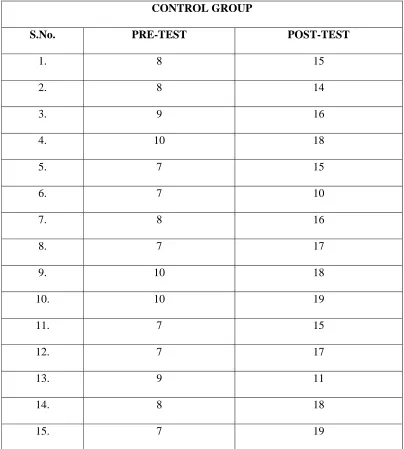
TABLE I
PRE TEST AND POST TEST VALUES OF CONTROL GROUP
CONTROL GROUP
S.No. PRE-TEST POST-TEST
1. 8 15
2. 8 14
3. 9 16
4. 10 18
5. 7 15
6. 7 10
7. 8 16
8. 7 17
9. 10 18
10. 10 19
11. 7 15
12. 7 17
13. 9 11
14. 8 18
23
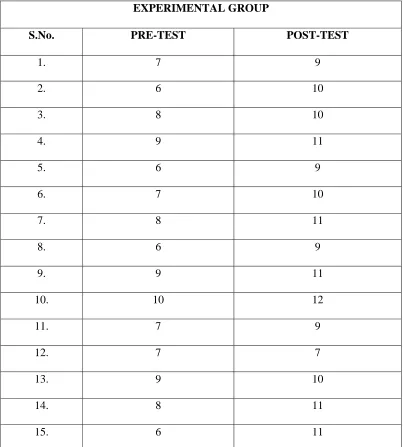
TABLE II
PRE TEST AND POST TEST VALUES OF
EXPERIMENTAL GROUP
EXPERIMENTAL GROUP
S.No. PRE-TEST POST-TEST
1. 7 9
2. 6 10
3. 8 10
4. 9 11
5. 6 9
6. 7 10
7. 8 11
8. 6 9
9. 9 11
10. 10 12
11. 7 9
12. 7 7
13. 9 10
14. 8 11
CHAPTER - V
[image:35.612.105.505.249.444.2]DATA ANALYSIS AND INTERPRETATION
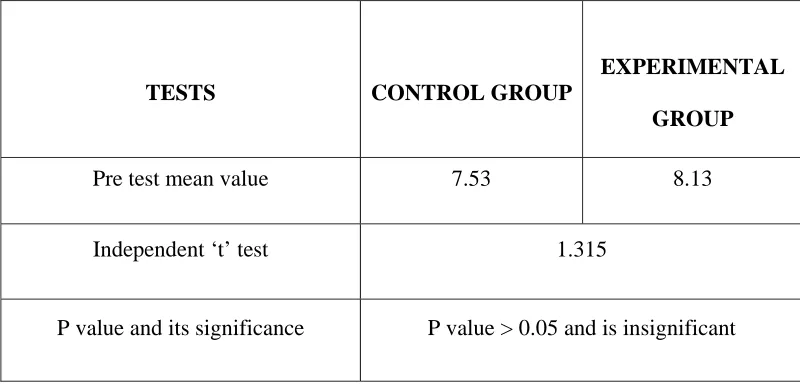
TABLE III
ANALYSIS OF PRE TEST DATA OF CONTROL GROUP AND EXPERIMENTAL GROUP
TESTS CONTROL GROUP
EXPERIMENTAL GROUP
Pre test mean value 7.53 8.13
Independent ‘t’ test 1.315
P value and its significance P value > 0.05 and is insignificant
25
GRAPH-I
PRE-TEST VALUES OF EXPERIMENTAL GROUP AND
CONTROL GROUP
7.53
8.13
0 1 2 3 4 5 6 7 8 9 10
TABLE IV
ANALYSIS OF POST TEST DATA OF CONTROL GROUP AND
EXPERIMENTAL GROUP
TESTS
CONTROL GROUP
EXPERIMENTAL GROUP
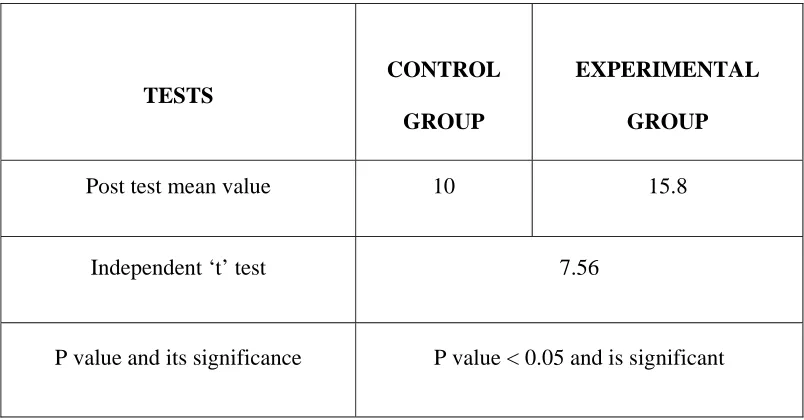
Post test mean value 10 15.8
Independent ‘t’ test 7.56
P value and its significance P value < 0.05 and is significant
27
GRAPH - II
POST-TEST VALUES OF CONTROL GROUP AND
EXPERIMENTAL GROUP
10
15.8
0 2 4 6 8 10 12 14 16 18
TABLE V
ANALYSIS OF PRETEST AND POSTTEST DATA OF
CONTROL GROUP
TESTS CONTROL GROUP
Control Group
Pre test mean value Post test mean value
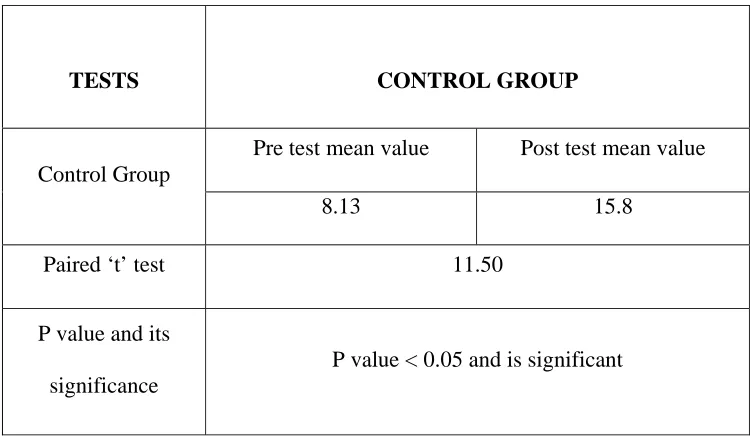
8.13 15.8
Paired ‘t’ test 11.50
P value and its significance
P value < 0.05 and is significant
29
GRAPH - III
PRE-TEST AND POST-TEST VALUES OF
CONTROL GROUP
8.13
15.8
0 2 4 6 8 10 12 14 16 18
TABLE VI
ANALYSIS OF PRETEST AND POSTTEST DATA
OF EXPERIMENTAL GROUP
TESTS EXPERIMENTAL GROUP
Experimental Group
Pre test mean value Post test mean value
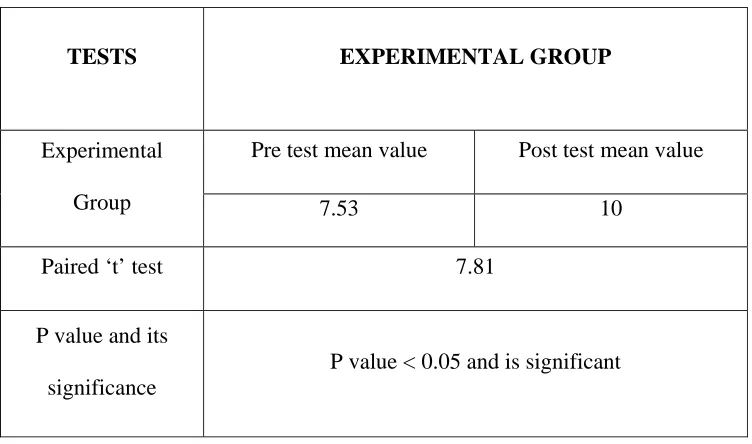
7.53 10
Paired ‘t’ test 7.81
P value and its significance
P value < 0.05 and is significant
31
GRAPH - IV
PRE-TEST AND POST-TEST VALUES OF
EXPERIMENTAL GROUP
7.53
10
0 2 4 6 8 10 12
Pretest Post test Pretest
CHAPTER - VI
RESULTS
While comparing the post test values of Control group and Experimental group using independent ‘t’ test, the calculated value is 7.56, whereas the critical value is 2.048, Since the alternate hypothesis is accepted, which shows that there exists a significant difference between the post test values of two groups.
When comparing the mean values of both, the post test mean value of Experimental group 15.8 is greater than the post test mean value of Control group 10 which confirms that Experimental group shows a significant improvement in functional activities than Control group.
Effectiveness of Control Group is elicited by comparing the pre test and post test values of Control group using paired ‘t’ test; the calculated value is 7.81 , whereas the critical value is 2.145. Since the calculated value is greater than the critical value, there exists a significant difference between the pretest and post test values of Control group. When comparing the mean values of both, the posttest mean value 10 is greater than the pre test mean value 7.53 which confirms that there is a significant improvement on hand function.
33
CHAPTER - VII
DISCUSSION
This is a comparative study between Brunnstrom Approach and conventional approach for right hemiplegic stroke patients. In the initial data analysis of the mean values of fugyl-meyer assessment scale values were found to be a significant thus it was concluded that there was a significant difference between both groups in pre and post test values.
La Fosse C, Troch M, Broeckx, 1998, Recent studies revealed that, right hemiplegic patient treated with Brunnstrom approach showed effective improvement in hand functions among stroke patient.
Hence, it is evident, conventional approach are effective ¾ Protects joints from adhesions and improves circulations. ¾ Stabilizes your joint motion.
¾ Improves your Range of motion, joint sensation.
With conventional approach the hand maintains joint range of motion prevents adhesions, increase the circulation and improves proprioceptive stimulations so it is more significant in stroke patients effectively.
35
Experimental group found to be more significant in Brunnstrem approach than in conventional approach.
Susan B O Sullivan et al., (1998)
Weight bearing of the upper limb with extended elbow, in sitting and tapping over triceps facilitate holding in extension.
Nelson, et. Al., (1996)
Patients who recovered comparatively rapidly after stroke may spontaneously achieves Brunnstrom III and IV stage. The patients graduate to handling a smaller ball, adopted games such as dice game. It is captured the patients attention and interest have been more effective than exercise.
Twitchell. T et al (2002).
In 1951 he states that the patient who reached Brunnstrom stages III and IV within 10 days after stroke recovered completely compared to other stages.
CHAPTER - VIII
SUMMARY AND
C
C
O
O
N
N
C
C
L
L
U
U
S
S
I
I
O
O
N
N
SUMMARY
This is a comparative study between Brunnstrom approach and conventional approach for right hemiplegic stroke patients. A double blind study of patients with right hemiplegic stroke patient. 30 patients were consecutively included; block- randomized in to two groups and stratified according to gender and hemispheric location. Control Group (15 patients) received physiotherapy in the hospital’s stroke unit according to Conventional approach, Experimental Group (15 patients) according to the Brunnstrom approach. Fugly-meyer assessment scale for physical performance is used as an outcome measure.
The results were statistically analyzed using paried and unpaired ‘t’ test. The results shows that there was a significant difference between Brunnstrom approach and conventional approach for right hemiplegic, in comparison of both the groups there is a significant effect in the group which was treated with brunnstrom techniques.
CONCLUSION
37
CHAPTER - IX
LIMITATION AND SUGGESTIONS
¾ The sample used was convenience that suited both methodological design and
time scale for the study, but further study can be done with large group.
¾ Only the Brunnstorm stage III is considered in this study, further research can
include other stages.
¾ Sample studied was small and the study reduces the general liability. Therefore
study with much large population is recommended.
¾ Undertaking all measurements manually it is inherent strength of the current
study. Although it is accepted that the introduced human error may be a potential threat to reliability of the reading. The use of mean value of trials should have reduced this error.
¾ The scales used for this study can be alter, in further study different scales can be
incorporated such as Functional Independence Measure (FIM), Berg Balance scale etc.
¾ For this study subjects with MCA involvement were included, further study can
be done with other territory involvement.
¾ Study conducted for a limited period (5 months), for more valid result duration
can be extended further more.
¾ Left hemispheric area was alone involved; further study can be done with right
CHAPTER - X
BIBLIOGRAPHY
1. A.B.TABY, Neurorehabilitation, Principles and practice, 2/e, 2001, Ahuja Publications.
2. CAROLE.B.LEWIS, Geriatric Physical Therapy and clinical approach, page 379-396.
3. CATHERINE A TROMBLY., Occupational therapy for physical dysfunction .-e/5.- Philadelphia: J .B Lippincott Williams and Wilkins, 2002
4. CATHERINE.A.TROMBLY, Neurophysical and development of treatment approaches, page 91-103.
5. DARCY ANN UMPHRED, Neurological Rehabilitation, 2/e, 1990, Mosby, page 772-776.
6. GLADY SAMUEL RAJ, Physical Therapy in Neuro conditions, 1/e, 2006, Jaypee Brothers, page 28-30.
7. JANET H. CARR, ROBERTA B. SHEPHARD, Stroke rehabilitation- 2/e - China: Butterworth, 2003. (168 p -173 p).
8. JOEL A DELISA – Editor, Physical Medicine and Rehabilitation Principles and Practice,4 /e, 1998, Lippincott , page 986-990.
9. JOEL A. DELISA, BRUCE M. GANS, Rehabilitation medicine: principles and practice. - 3/e. – Lippincott: Raven, 1998 (1185, 1179p)
39
12.KENNETH W. LINDSAY, Neurology and Neuro surgery illustrated, 4/e, 2004, Elsevier. page 239-269.
13.PATRICA.A.DOWNIE, Cash’sText book ofNeurology for physiotherapists, 4 /e, 2007, Jaypee, page 194,213-254.
14.PEDRETTI AND EARLY M: Occupational Therapy: Practice skills for physical dysfunction. 5th ed., Mosby, London, 2001.
15.RAYMOND D.ADAMS, Principles of Neurology, 6 /e, 1997, McGraw hill.
16.SAWNER K AND LA VIGNE J: Brunnstrom’s Movement Therapy in Hemiplegic: A neurophysiologic approach. 2nd edition., J.B. Lippincott Company, Philadelphia 1992
17.STUART.B.PORTER, Tidy’s physiotherapy, 13/e, 2003, Butterworth and Heinemann, page446.
18.SUSAN B.O’ SULLIVAN, Physical Rehabilitation, 5/e, 2006, Jaypee Brothers, page 388-755.
CHAPTER X
APPENDIX – I
CASE ASSESSMENT PROFORMA
CASE NO :
NAME :
SEX :
ADDRESS :
DATE OF ADMISSION :
DATE OF EVALUATION :
HISTORY :
ON OBSERVATION : ON EXAMINATION : TREATMENT : MEASUREMENT TOOL :
S.No. PRE TEST POST TEST
41
APPENDIX – II
PATIENT CONSENT FORM
TITLE: “EFFECTIVENESS OF BRUNNSTROM APPROACHES ON IMPROVING HAND FUNCTION IN RIGHT HEMIPLEGIC PATIENTS (A COMPARATIVE STUDY)”
INVESTIGATOR : _ _ _ _ _ _ _ _ _ _ _
PURPOSE OF THE STUDY
I_ _ _ _ _ _ _ _ _ _ _ _ _ _ _ _ , have been informed that this study will work towards achieving on the hand function in post-stroke conditions for me and other patients.
PROCEDURE
Each term of the study protocol has been explained to me in detail. I understand that during the procedure, I will be receiving the treatment for one time a day. I understand that I will have to take this treatment for four weeks.
CONFIDENTIALITY
I understand that medical information provided by this study will be confidential. If the data are used for publication in the medical literature or for teaching purposes, no names will be used and other literature such as audio or video tapes will be used only with permission.
RISK AND DISCOMFORT
I understand that there are no potential risks associated with this procedure, and understand that investigator will accompany me during this procedure. There are no known hazards associated with this procedure.
REFUSAL OR WITHDRAWL OF PARTICIPATION:
I understand that the decision my participation is wholly voluntary and I may refuse participate, may withdraw consent at any time during the study.
I also understand that the investigator may terminate my participation in the study at anytime after researcher has explained me the reasons to do so.
I ………. have explained to ……… ………. the purpose of the research, the procedures required and the possible risks and benefits, to the best of my ability.
43
I ………. Confirm that researcher has explained me the purpose of the research, the study procedure and the possible risks and benefits that I may experience. I have read and I have understood this consent to participate as a subject in this research project.
……….. ……… Subject Date
APPENDIX – III
BRUNNSTORM’S STAGES OF MOTOR RECOVERY
STAGES DEFINITIONS
I Flaccidity no voluntary movements in the affected limb
II Hyperreflexia : emergence of spasticity and synergies, minimum voluntary movement in the affected limbs.
III Voluntary movement within synergy, spasticity increases to peak level
IV Isolated voluntary movements, spasticity and synergies decline
45
FUGYL MEYER ASSESSMENT SCALE
Area Test Scoring
Maximum Possible
Score
Attained Score
Motor
I Reflex
a. biceps---
b. triceps---
0 - No reflex activity can be elicited
2 - Reflex activity can be elicited
4
II. Flexor Synergy
Elevation---Shoulder retraction-
Abduction (at least 90 ) --
External rotation ----
Elbow extension ----
0 - Cannot be performed at all
1 - Performed partly
2 - Performed faultlessly
Forearm supination---
III. Extensor Synergy
Shoulder adduction/internal rotation----
Elbow extension ----
Forearm pronation –
0 - Cannot be performed at all
1 - Performed partly
2 - Performed faultlessly
6
IV. Movement combining synergies
a. Hand to lumbar spine ---
b. Shoulder flexion to 90 elbow at 0 ---
1. - No specific action performed
2. - Hand must pass anterior superior iliac
spine
3. - Action is performed faultlessly
1. Arm is immediately abducted or elbow
flexes at start of motion.
2. Abduction or elbow flexion occurs in later
47
c. Pronation/supination of forearm with elbow
at 90 and shoulder at 0
phase of motion
3. Faultless motion
1. Correct position of should and elbow
cannot be attained, and/ or pronation or
supination can not be performed at all
2. Active pronation or supination can be
performed even within a limited range of
motion, and at the same time the shoulder
and elbow are collectly positioned.
3. Complete pronation and supination with
correct positions at elbow and shoulder.
V. Movement out of synergy
a. Shoulder abduction to 90 elbow at 0
0- Initial elbow flexion occurs or any
and foream pronated-
b. Shoulder flexion, 90 –180 elbow at 0 and
forearm in mid position
c. Pronation/supination of forearm elbow at 0 and
shoulder between 30 – 90 of flexion----
deviation from pronated forearm occurs.
1- Motion can be performed partly, or if
during motion, elbow is flexed or forearm
cannot be kept in pronation.
2- Faultless motion
0- Initial flexion elbow occurs or shoulder
abduction occurs
1- Elbow flexion or shoulder abduction,
occurs during shoulder flexion
2- Faultless motion
0- Supination and pronation cannot be
performed at all or elbow and shoulder
position cannot be attained
1- Elbow and shoulder properly positioned
49 limited range.
2- Faultless motion
VI. Normal reflex activity
Biceps and/or finger flexors and triceps---
(This stage, which can render the score of
two, is included only if the patient has a score
of 6 in stage V).
1. At least 2 of the 3 phase reflexes are
markedly hyperactive
2. One reflex markedly hyperactive or at
least 2 reflex are lively.
3. No more than one reflex is lively and none
are hyperactive.
2
VII.
a. Stability, elbow at 90 , shoulder at 0
a. 0- Patient cannot dorsiflex wrist to
b. Flexion/extens
c. ion, elbow at 90 ,
shoulder at 0
c. Stability, elbow at 0, shoulder at 30
d. Flexion/extension, elbow at 0, shoulder at 30
e. Cirumduction
required 15
1- Dorsiflex is accomplished, but no
resistance is taken
1. Position can be maintained with some
(slight) resistance.
b. 0- Volitional movement does not occur
1. Patient cannot actively move the wrist
joint throughout the total ROM.
2. Faultless, smooth movement
c. Scoring is the same as for item a
d. Scoring is the same as for item b
e. 0- Cannot be performed
51
2. Complete motion with smoothness
VIII.
a. Finger Mass Flexion
b. Finger Mass Extension
c. Grasp #1- MP joints extended and PIPS and
a) 0- No flexion occurs.
1- Some flexion, but not full motion
2- Complete active flexion ( compared with
unaffected hand)
b) 0- No extension occurs
1- Patient can release an active mass flexion
grasp
2- Full active extension.
c) 0- Required position cannot be acquired
1- Grasp is well
2. Grasp can be maintained against relatively
DIPS are flexed. Grasp is tested against resistance
d. Grasp #2 – patient is instructed to adduct
thumb, 1st carpometacarpophalangeal and
interphalangeal joint at 0
e. Grasp #3 – patient opposes the thumb pad
against the pad of index finger. A pencil is
interposed.
f. Grasp #4- the patients should grasp a
cylinder shaped object (small can), the volar
great resistance
d) 0- Function cannot be performed
1- Scrap of paper interposed between the
thumb and index finger can be kept in place,
but not against a slight a tug.
2- Paper is held firmly against a tug.
e) Scoring procedures are the same as for
Grasp #2.
f) Scoring procedures are the same as for
Grasp #2 and #3
g) Scoring procedures are the same as for
53 surface of the 1st and 2nd finger against each other
g. Grasp #5 – a spherical grasp
IX. Coordination/ speed – finger to nose (five
repetitions in rapid succession)
a. Tremor----
Dysmetria
c. Speed
a. 0- Marked tremor
2. Slight tremor
3. No tremor
b. 0- Pronounced or unsystematic
dysmetria
1. Slight or systematic dysmetria
2. Do dysmetria
c) 0- Activity is more than 6 seconds
longer than unaffected hand
1- 2 to 5 seconds longer than
unaffected hand
2. Less than 2 seconds difference.