FORMULATION AND EVALUATION OF
TICAGRELOR SUBLINGUAL TABLETS
A Dissertation submitted to
THE TAMILNADU Dr. M.G.R. MEDICAL UNIVERSITY CHENNAI-600 032
In partial fulfillment of the requirement for the award of degree of
MASTER OF PHARMACY
IN
BRANCH I - PHARMACEUTICS
Submitted By
C.A.MUNIYASAMY
(Reg.No: 261611303)
Under the guidance of
Dr.
A.ABDUL
HASAN
SATHALI,
M.Pharm.,
Ph.D.,
Department of PharmaceuticsCOLLEGE OF PHARMACY
MADURAI MEDICAL COLLEGE
MADURAI – 625 020
CERTIFICATE
This is to certify that the dissertation entitled “FORMULATION AND EVALUATION OF TICAGRELOR SUBLINGUAL TABLETS” is a bonafide work done by Mr.C.A.MUNIYASAMY (Reg.No:261611303), Department of Pharmaceutics, College of Pharmacy, Madurai Medical College in partial fulfillment of The TamilNadu Dr.M.G.R Medical University rules regulations for award of MASTER OF PHARMACY IN PHARMACEUTICS in under my guidance and supervision during the academic year 2017–2018.
Name & Signature of the Guide
Name & Signature of the Head of Department
ACKNOWLEDGEMENT
I first and foremost express my revered regard and obeisance
to ALMIGHTYGOD withwhoseblessings Iwasable tocompletemyproject
work.
I wish to thank the Almighty who has granted me an opportunity
to do higher studies in this noble field of pharmacy and blessed me with
the strength and intellecttopursuethisresearchwork.
It is my pleasure to express my respectful regards and
thanks to Dr.D.MARUDUPANDIAN, M.S., F.I.C.S., F.A.I.S., Dean,
Madurai Medical College, Madurai for providing all kinds of supportive
facilities required tocarry out myprojectwork.
I am thankful to Dr.V.DHANALAKSHMI. M.D., Vice Principal,
Madurai Medical College, Madurai for her support and encouragement to
carry out the work. It is my immense pleasure and honour to express my
deep sense of gratitude and heartfelt thanks to Prof. Dr. A.ABDUL
HASAN SATHALI, M.Pharm., Ph.D., Principal, college of pharmacy,
Madurai medical college for his excellence in guidance, contribution
and encouragement which helped me in the successful completion of
eachandeverystageofmyprojectwork.
I thank to Mr. Arun, Dr. C.Pandiyan., M.Pharm., Ph.D.,
Dr. R.Senthil Prabhu., M.Pharm., Ph.D., Mrs. D.Umamaheswari.,
M.Pharm, Mr.Prabhu., M.Pharm., Dept of Pharmaceutics for their support
I also extend my thanks to our department staff Mrs.Sophia,
Mrs.Tamilselvi, Mrs. Mumtaj, for their contribution throughout my project
work.
I express my heartiest thanks to Microlabs, Bangalore for
providingthedrugTicagrelorasgiftsampletocarryoutmyprojectwork.
I express my heartiest thanks to Madras pharmaceuticals,
Chennai. For providing the polymers and excipients as gift sample to carry
outmyprojectwork.
I also thank Nirmalgiri University, Kerala for their help in carrying out
the evaluation (X-ray diffraction) studies.
I also thank JSS College of Pharmacy, Ooty, for their help in
carrying out the evaluation of DSC studies.
I express my heartiest thanks to United Scientifics and universal
drugs& chemical suppliers for providing chemicals to carry out my project
work.
I also extend my thanks to the Department of Pharmaceutical
Chemistry MMC, Madurai For permitting me to carry out the IR
study and UV spectrophotometric studies in connection to my
dissertation work and Mr.Lakshmanan., Department of
Pharmaceutical Chemistry, to carry out UV spectrophotometric studies.
I also express my sincere thanks to Mrs.M.Kalaiarasi, Drug Testing
Laboratory, Chennai for their co-operation for my project work.
I would like to give my sincere thanks to my classmates
Mr. M. Selvakumar, Mrs. S.Sivapriya, Mr. R. Vignesh, Mr. S. Zameer for
their timely help and co-operation.
I also extend my thanks to all the staff members and P.G. Students of
Department of Pharmaceutical Chemistry Mr.A.Ponnudurai, Mr.S.Swathi,
Mr.A.Ashok kumar, Mr.Rajasekaran and Pharmacognosy students for their
Co- operation.
I express my whole hearted and sincere thanks to my seniors Mr.
M.Kesavan., M.Pharm, Ms. A.Lalitha., M.Pharm, Ms. Soniya., M.Pharm,
and Ms. R.Gayathri., M.Pharm, B.kathikeyan their moral support to carry
out my project work.
I sincerly thank to my UG friends Mr.P.Vinothkumar, Mr.R.Rjesh,
Mr.N.Ramanathan, Mr.A.Tamilmani, Mr.K.Raman, for their moral support to
carry out my project work.
Last but definitely not the least, I pledge my deepest sense of gratitude
towards my Father (Mr.C.Arumugam), my Mother (Mrs. A.Gandhi) and my
lovable brother (Mr. Kalidass) and sisters (Mrs. Rajagani Kalaivanan,
Ms. Gowthami) who stood with me, supporting in all my endeavors.
I am extremely thankful to the Library Madurai medical college and
staff of Chennai Xerox, Laser Point, for their kind co-operation regarding
printingand bindingof thisdissertationwork.
Place:
Date:
CONTENTS
CHAPTER NO
TITLE
PAGE NO
I INTRODUCTION 1-17
II SUBLINGUAL TABLETS – A REVIEW 18-38
III LITERATURE REVIEW 39-63
IV AIM OF THE WORK 64-65
V PLAN OF WORK 66-67
VI MATERIALS AND EQUIPMENTS 68-69
VII DRUG PROFILE 70-77
VIII EXCIPIENTS PROFILE 78-102
IX EXPERIMENTAL PROTOCOL 103-121
X RESULTS AND DISCUSSION
TABLES & FIGURES 122-133
XI SUMMARY AND CONCLUSION 134-136
LIST OF ABBREVIATIONS
% : Percentage
0C : Celsius
cm : Centimeter
FT-IR : Fourier transform infrared
gm : Gram
Hrs : Hours
IP : Indian Pharmacopoeia
KBr : Potassium Bromide
Log : Logarithm
mg : Milligram
ml : milliliter
mm : Millimeter
nm : Nanometer
µg : Microgram
pH : Potential of Hydrogen
RH : Relative Humidity
Rpm : Revolution per Minute
UV : Ultra Violet
DSC : Differential Scanning Colorimetry
PXRD : Powder X ray Diffraction
IR : Infra red
λmax : Maximum Absorbance
BCS : Biopharmaceutical Classification System
CDR : Cumulative Drug Release
e.g. : Example
Etc. : Excetra
FDA : Food and Drug Administration
mts : Minutes
ppm : Parts Per Million
CHAPTER I
CHAPTER I INTRODUCTION
Dept of Pharmaceutics, College of Pharmacy, MMC, Madurai-20 Page 1
INTRODUCTION
Development of a formulation involves a great deal of study and experimental work to get optimum results. While doing so we have to keep in mind various factors are considered like choice of excipients, drug bioavailability, drug stability in required dosage form, cost effectiveness, manufacturing aspects.
Now a day’s formulation research is breaking barriers of conventional methods. Present day’s drugs can be delivered with a convenience manner, performance and bioavailability.
The oral route of drug administration is the most convenient for patients, with tablets emerging as the most popular solid oral dosage form used today. Standard compressed, controlled-release and coated tablets are the most common form of solid oral dosages. A wide range and diversity of ingredients are often included in tablet formulations. A knowledge of the difference between tablet and capsule formulations should enable nurses to improve patient compliance with respect to solid oral dosage forms.
CHAPTER I INTRODUCTION
Dept of Pharmaceutics, College of Pharmacy, MMC, Madurai-20 Page 2
administration of therapeutic agents. This wide spread use of tablets have been achieved as a result of their convenience and also the diversity of tablet types. (Ruchita jaiswani et al.,2014)
Tablet is defined as a compressed solid dosage form containing medicaments with or without excipients. According to the Indian Pharmacopoeia Pharmaceutical tablets are solid, flat or biconvex dishes, unit dosage form, prepared by compressing a drugs or a mixture of drugs, with or without diluents. They vary in shape and differ greatly in size and weight, depending on amount of medicinal substances and the intended mode of administration. It is the most popular dosage form and 70% of the total medicines are dispensed in the form of Tablet. All medicaments are available in the Tablet form except where it is difficult to formulate or administer. Tablets are intended for oral administration. Some are swallowed whole or after being chewed, some are dissolved or dispersed in water before being administered and some are retained on mouth where the active medicament is liberated.
CHAPTER I INTRODUCTION
Dept of Pharmaceutics, College of Pharmacy, MMC, Madurai-20 Page 3
Oral route is the most desirable and preferred method of administering therapeutic agents for their systemic effects, but poorly solubility of drug is major challenge in pharmaceutical industry.
Up to 40% of orally administered drugs suffer from formulation difficulties related to their water insolubility. Dissolution rate, absorption, distribution and excretion of a moiety depend upon its solubility characteristics. Solubility is the phenomenon of dissolution of solid in liquid phase to give a homogenous system. Solubility is one of the important parameter to achieve desired concentration of drug in systemic circulation for pharmacological response to be shown. Poorly water soluble drugs often require high doses in order to reach therapeutic plasma concentrations after oral administration.
Low aqueous solubility is the major problem encountered with formulation development of new chemical entities. Any drug to be absorbed must be present in the form of an aqueous solution at the site of absorption. Water is the solvent of choice for liquid pharmaceutical formulations. Most of drugs are weakly acidic and weakly basic with poor aqueous solubility. (Kadam S.V et al., 2013)
CHAPTER I INTRODUCTION
Dept of Pharmaceutics, College of Pharmacy, MMC, Madurai-20 Page 4
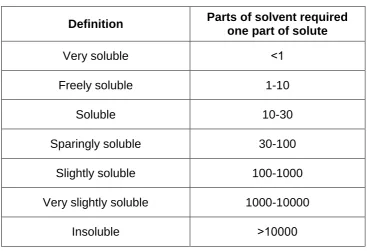
Solubility defines as:
Table-1. Definition of solubility
Definition Parts of solvent required one part of solute
Very soluble ˂1
Freely soluble 1-10
Soluble 10-30
Sparingly soluble 30-100
Slightly soluble 100-1000
Very slightly soluble 1000-10000
Insoluble ˃10000
[image:15.595.132.500.121.372.2]
On the basis of solubility, drugs are classified into four classes of the BCS classification. Solubility challenges are faced in the Class II and Class IV of the BCS system. BCS classification is a scientific framework which deals in classification of drug substance based on its aqueous solubility and permeability. (Sandeep Kumar et al., 2016)
Table-2. Biopharmaceutical drug classification system
Class Solublility Permeability Examples
I High High Metoprolol
II Low High Neteglinide
III High Low Cemetidin
CHAPTER I INTRODUCTION
Dept of Pharmaceutics, College of Pharmacy, MMC, Madurai-20 Page 5
To improve solubility and bioavailability of poorly soluble drug we use various methods or techniques like solid dispersion, complexation, liquidsolid, hydrotropy, sonocrystallization, self-emulsifying method, micronization, chemical modification, pH adjustment, co‐solvency, micellar solubilization etc. The purpose of this review article is to describe the techniques of solubilizaton for the attainment of effective absorption and improved bioavailability. (Kadam S.V et al., 2013)
FACTOR AFFECTING THE SOLUBILITY 1. Nature of solute and solvent:
The nature of solute and solvent depends on concentration of solute in specific quantity of solvent at specific temperature. Example: at room temperature in 100gm of water only 1gm of lead (II) chloride can be dissolved while 200 grams of zinc chloride can be dissolved.
2. Particle size:
Particle size affect on solubility. As article size decreases, the surface area to volume ratio increases. As the surface area of particle increases it causes greater interaction with solvent. The effect of particle size on solubility can be described by,
Log (S/S0) =
2 𝛾 𝑉 2.303 𝑅 𝑇 𝑟
Where,
CHAPTER I INTRODUCTION
Dept of Pharmaceutics, College of Pharmacy, MMC, Madurai-20 Page 6
ᵞ
is the surface tension of the solid r is the radius of the fine particle. T is absolute temperatureR is gas volume 3. Molecular size:
Solubility affected by molecular size of particle. The solubility of the substance is decreased when molecules have higher molecular weight and higher molecular size because larger molecules are more difficult to surround with solvent molecules in order to solvate the substance.
4. Temperature:
Solubility affected by temperature. If the solution process absorbs energy then the solubility will increase with increasing temperature. If the solution process releases energy then the solubility will decrease with increasing temperature
5. Pressure:
For solids and liquid solutes, solubility not affected by change in pressure but for gaseous solutes, solubility increases as pressure increases and decrease as pressure decrease.
SOLUBILITY ENHANCEMENT METHOD (Kadam S.V et al., 2013)
Various techniques have been used in attempt to improve solubility and dissolution rates of poorly water soluble drugs.
CHAPTER I INTRODUCTION
Dept of Pharmaceutics, College of Pharmacy, MMC, Madurai-20 Page 7
A. Particle Size Reduction B. Nanonization
C. Cosolvency D. Hydrotropy E. pH Adjustment F. Sonocrystallization
G. Supercritical Fluid (SCF) Process H. Solid Dispersion
I. Inclusion Complexation
J. Self-Emulsifying Or Self-Micro Emulsifying Systems K. Liquisolid Methods
A. PARTICLE SIZE REDUCTION
CHAPTER I INTRODUCTION
Dept of Pharmaceutics, College of Pharmacy, MMC, Madurai-20 Page 8
approaches for nearly insoluble drugs may not be able to enhance the solubility up to desired level.
B. COSOLVENCY
The solubility of poorly soluble drugs in water can be increased by mixing it with some water miscible solvent in which the drug is readily soluble. This process is known as cosolvency and the solvent used in combination are known as cosolvent. Cosolvent system works by reducing the interfacial tension between the aqueous solution and hydrophobic solute. It is also commonly known as solvent blending. There is a dramatic change in the solubility of drugs by addition of organic co-solvent into the water. The cosolvents are having hydrogen acceptor or donor groups with a small hydrocarbon region. The hydrophobic hydrocarbon region usually interferes with the hydrogen bonding network of water which consequently reduces the intermolecular attraction of water while the hydrophilic hydrogen bonds ensures water solubility. Currently, the water-soluble organic solvents are polyethylene glycol 400 (PEG 400), ethanol, propylene glycol, and glycerin. . For example, Procardia (nifidipine) was developed by Pfizer contains glycerin, peppermint oil, PEG 400 and sodium saccharin in soft gelatin capsules. The water insoluble solvents include long-chain triglycerides (i.e. peanut oil, corn oil, soybean oil, sesame oil, olive oil, peppermint oil, hydrogenated vegetable oil and hydrogenated soybean oil), medium-chain triglycerides (Miglyol 812), beeswax, d-α- tocopherol (vitamin E) and oleic acid.
C. SURFACTANTS
CHAPTER I INTRODUCTION
Dept of Pharmaceutics, College of Pharmacy, MMC, Madurai-20 Page 9
better wetting and salvation interaction. A wide variety of surfactants like Polyglycolized glyceride, Tweens, Spans, Polyoxyethylene stearates and synthetic block copolymers like Poly (propylene oxide)-poly (ethylene oxide)- poly (propylene oxide) like Poloxamers based micelles, Poly (beta-benzyl-L-aspartate)-b-poly (ethylene oxide), Poly (caprolactone)-b-poly (ethylene oxide) etc are very successful as excipient and carrier for dissolution enhancement. Improvement of drug solubility by using the amphiphilic surfactants is due to lowering surface tension between drug and solvent, improvement of wetting characteristics and micellar solubilization.
D. POLYMERIC ALTERATION:
CHAPTER I INTRODUCTION
Dept of Pharmaceutics, College of Pharmacy, MMC, Madurai-20 Page 10
E. SOLID DISPERSION METHOD (Kadam S.V et al., 2013)
Solid dispersion technology is the science of dispersing one or more active ingredients in an inert matrix in the solid stage to achieve an increased dissolution rate or sustained release of drug, altered solid state properties and improved stability.
CLASSIFICATION OF SOLID DISPERSION Solid dispersion classified in 3 groups;
First generation solid dispersions: In first generation solid dispersion,
formulation of eutectic mixtures or molecular dispersion improved the rate of drug release which in turn increases the bioavailability of poorly water soluble drugs. Disadvantage related formulation of crystalline solid does not release drug quickly. Example: Crystalline carriers: Urea, Sugars and Organic acids.
Second generation solid dispersion: In second generation we use amorphous state of carrier which improves drug release; likes fully synthetic polymers include povidone (PVP), polyethyleneglycols (PEG) and polymethacrylates. Natural product based polymers are mainly composed by cellulose derivatives, such as hydroxypropyl methylcellulose (HPMC), ethylcellulose or hydroxypropyl cellulose or starch derivates, like cyclodextrins.
Third generation solid dispersion:
CHAPTER I INTRODUCTION
Dept of Pharmaceutics, College of Pharmacy, MMC, Madurai-20 Page 11
MECHANISM OF SOLUBILITY ENHANCEMENT
a) Particles with Reduced Particle Size Preparation of solid dispersions results in particles with reduced
particle size and thus the surface area is improved and increased dissolution rate is attained. The ultimate result is improved bioavailability.
b) Particles with Improved Wettability
Wettability is improved during solid dispersion production. It has been suggested that the presentation of particles to the dissolution medium as physically separate entities may reduce aggregation. In addition, many of the carriers used for solid dispersions may have some wetting properties; hence, improved wetting may lead to reduced agglomeration and increased surface area.
c) Particles with Higher Porosity
Particles in solid dispersions have been found to have a higher degree of porosity. The increase in porosity also depends on the carrier properties; for instance, solid dispersions containing linear polymers produce larger and more porous particles than those containing reticular polymers and, therefore, result in a higher dissolution rate. The increased porosity of solid dispersion particles also hastens the drug release profile.
d) Drugs in Amorphous State:
CHAPTER I INTRODUCTION
Dept of Pharmaceutics, College of Pharmacy, MMC, Madurai-20 Page 12
supersaturated solutions after system dissolution, and it is speculated that, if drugs precipitate, it is as a metastable polymorphic form with higher solubility than the most stable crystal form.
e) Solubilization Effect:
The carrier material, as it dissolves, may have a solubilization effect on the drug. Enhancement in solubility and dissolution rate of poorly soluble drugs is related to the ability of carrier matrix to improve local drug solubility as well as wettability
SELECTION OF CARRIER:
One of the most important steps in the formulation and development of solid dispersion for various applications is selection of carrier. The properties of carrier have a major influence on dissolution characteristics of the drug. A material should possess following characteristics to be suitable carrier for increasing dissolution.
Freely water soluble with intrinsic rapid dissolution properties.
Non-toxic and pharmacologically inert
Thermal stability preferably with low melting point especially for melt
method
Solubility in variety of solvents and should pass through a vitreous
state upon solvent evaporation for the solvent method. Ability to increase aqueous solubility of drug.
Chemical compatibility and not forming a strongly bonded complex with
CHAPTER I INTRODUCTION
Dept of Pharmaceutics, College of Pharmacy, MMC, Madurai-20 Page 13
POLYMERS USED IN SOLID DISPERSIONS
A variety of polymers is offered as carriers for formulation of solid dispersion. Table 2.1 represents various categories and examples of carriers. Some polymers used in solid dispersions are as follows:
A) Polyethylene glycol (PEG):
The term polyethylene glycols refer to compounds that are obtained by reacting ethylene glycol with ethylene oxide. PEGs are commonly termed as polyethylene oxides, with a molecular weight (MW) usually falling in the range 200-3,00,000. For the manufacture of solid dispersions and solutions, PEGs with molecular weights of 1500-20,000 are usually employed. As the MW rises, so does the viscosity of the PEG. At MW of up to 600, PEGs are fluid, in the range 800 -1500 they have a consistency that is best described as vaseline-like, from 2000 to 6000 they are waxy and those with MW of 20,000 and above form hard, brittle crystals at room temperature. Their solubility in water is generally good, but reduces with MW. A meticulous advantage of PEGs for the solid dispersions is that they have good solubility in numerous organic solvents. The melting point of the PEGs of interest lies under 65 0C in every case (e.g. the m.p. of PEG 1000 is 30-400C, the m.p. of PEG 4000 is
50- 580C and the m.p.of PEG 20,000 is 60-630C .Additional attractive features
CHAPTER I INTRODUCTION
Dept of Pharmaceutics, College of Pharmacy, MMC, Madurai-20 Page 14
B) Polyvinyl Pyrrolidone (PVP):
PVPs have molecular weights ranging from 10,000 to 700,000. It is soluble in solvents like water, ethanol, chloroform and isopropyl alcohol. PVP is not suitable for preparation of solid dispersions prepared by melt method because it melts at a very high temperature above 275ºC, where it gets decomposed.
C) Polymers and Surface Active Agent Combinations:
The addition of surfactants to dissolution medium lower s the interfacial tension between drug and dissolution medium and promotes the wetting of the drug thereby they enhance the solubility and dissolution of drug. Ternary dispersion systems have higher dissolution rates than binary dispersion systems.
D) Cyclodextrins:
Cyclodextrins are primarily used to enhance solubility, chemical protection, taste masking and improved handling by the conversion of liquids into solids by entrapment of hydrophobic solute in hydrophilic cavity of CD. Advantages of CD include increasing the stability of the drug, release profile during gastrointestinal transit through modification of drug release site and time profile, decreasing local tissue irritation and masking unpleasant taste.
E) Phospholipids:
CHAPTER I INTRODUCTION
Dept of Pharmaceutics, College of Pharmacy, MMC, Madurai-20 Page 15
tissues include phosphotidyl ethanolamide, phosphotidyl serine and phosphotidyl glycerol. Naturally occuring lecithins contain both a saturated fatty acid and unsaturated fatty acids with some exceptions.
Methods of preparation of solid dispersions
Various methods used for preparation of solid dispersion system. These methods are given bellow.
1. Melting method 2. Solvent method
3. Melting solvent method (melt evaporation) 4. Melt extrusion methods
5. Lyophilization techniques 6. Melt agglomeration Process 7. The use of surfactant
8. Electrospinning
9. Super Critical Fluid (SCF) technology
1. Melting method
The melting or fusion method is the preparation of physical mixture of a drug and a water-soluble carrier and heating it directly until it melted. The melted mixture is then solidified rapidly in an ice-bath under vigorous stirring. The final solid mass is crushed, pulverized and sieved.
2. Solvent method
CHAPTER I INTRODUCTION
Dept of Pharmaceutics, College of Pharmacy, MMC, Madurai-20 Page 16
method is thermal decomposition of drugs or carriers can be prevented because of the relatively low temperatures required for the evaporation of organic solvents
3. Melting solvent method (melt evaporation)
It involves preparation of solid dispersions by dissolving the drug in a suitable liquid solvent and then incorporating the solution directly into the melt ofpolyethylene glycol, which is then evaporated until a clear, solvent free film is left. The film is further dried to constant weight. The 5 –10% (w/w) of liquid compounds can be incorporated into polyethylene glycol 6000 without significant loss of its solidproperty. It is possible that the selected solvent or dissolved drug may not be miscible with the melt of the polyethylene glycol. Also the liquid solvent used may affect the polymorphic form of the drug, which precipitates as the solid dispersion. This technique possesses unique advantages of both the fusion and solvent evaporation methods. From a practical standpoint, it is only limited to drugs with a low therapeutic dose e.g. below 50 mg.
ADVANTAGES OF SOLID DISPERSIONS: Generally, solid dispersion is mainly used
To reduced particle size. To improve wettability.
To improve porosity of drug.
To decrease the crystalline structure of drug in to amorphous
CHAPTER I INTRODUCTION
Dept of Pharmaceutics, College of Pharmacy, MMC, Madurai-20 Page 17
To improve dissolvability in water of a poorly water-soluble drug
in a pharmaceutical.
To mask the taste of the drug substance.
To prepare rapid disintegration oral tablets.
To obtain a homogenous distribution of small amount of drugs at
solid state.
To stabilize unstable drugs.
To dispense liquid or gaseous compounds.
To formulate a faster release priming dose in a sustained
release dosage form.
To formulate sustained release dosage or prolonged release
CHAPTER II
CHAPTER II SUBLINGUAL TABLET – A REVIEW
Dept of Pharmaceutics, College of Pharmacy, MMC, Madurai-20 Page 18
SUBLINGUAL TABLETS – A REVIEW
Drugs have been applied to the mucosa for topical application for many years. However, recently there has been interest in exploiting the oral cavity as a portal for delivering drugs to the systemic circulation.
Drug delivery through the sublingual route had emerged from the desire to provide rapid onset of pharmacological effect. Dysphasia (difficulty in swallowing) is a common problem of all age groups, especially geriatrics, pediatric, and patients who are mentally retarded, uncooperative, nauseated or on reduced liquid intake/diets have difficulties in swallowing these dosage forms. Sublingual drugs are administered under the tongue and reached directly in to the systemic circulation through the ventral surface of the tongue and floor of the mouth. The drug is rapidly absorbed into the reticulated vein that lies underneath the oral mucosa, and transported through the facial veins, internal jugular vein, and braciocephalic vein and then drained in to systemic circulation. Considering the oral cavity sublingual area is the most permeable part of the buccal cavity. The decreasing order of permeability in the buccal cavity is the sublingual, the buccal area (cheek), then the palatal area. The order is generally based upon the relative thickness and the extent of blood supply to the specific part. (Patil Vaishali A et al., 2015)
The sublingual route usually produces a faster onset of action than the orally ingested tablets and the portion absorbed through the sublingual blood vessels bypasses the hepatic first‐pass metabolic processes
CHAPTER II SUBLINGUAL TABLET – A REVIEW
Dept of Pharmaceutics, College of Pharmacy, MMC, Madurai-20 Page 19
the tablet is placed in under the tongue, the patient should avoid eating, drinking, smoking and possibly talking in order to keep the tablet in place. Systemic drug delivery through the sublingual route had emerged from the desire to provide immediate onset of pharmacological action.
Sublingual products have been designed for numerous indications ranging from migraine (for which rapid onset of action is important) to mental illness(for which patient compliance is important for treating chronic indications such as depression and schizophrenia) . Sublingual route provides 3-10 times greater absorption of the drug than oral route and is only surpassed by hypodermic injection. Sublingual route is very much appropriate for short-acting drugs.
Most of the sublingual drugs, which are absorbed by simple diffusion; here the sublingual area acts like a litmus paper readily soaking up the substances; however not all the substances are permeable and accessible to oral mucosa. Majority of drugs which are administered through sublingual route falls in the category of antianginal drug. Systemic drug delivery through the sublingual route had emerged from the desire to provide immediate onset of pharmacological effect.
By selecting the appropriate pharmaceutical excipients in the correct proportion, in combination with optimal manufacturing techniques the sublingual tablets could be prepared effectively.
ORAL MUCOSA
CHAPTER II SUBLINGUAL TABLET – A REVIEW
Dept of Pharmaceutics, College of Pharmacy, MMC, Madurai-20 Page 20
parenteral routes of drug delivery due to its rich blood supply, rapid onset of action, enhanced bioavailability, avoidance of the first pass and food effects, increased patient compliance, and ease of self-medication.
Oral mucosal drug absorption is governed by (a) the permeability of the oral mucous membrane and the anatomy of the underlying tissues, (b) the physicochemical properties of the drugs, and (c) the formulation design. The focus of this review is on the latter two points, as an understanding of these elements enables the selection of drug candidates suitable for oral mucosal delivery and optimizes drug delivery.
ANATOMICAL STRUCTURE OF THE ORAL MUCOSA
Figure-1: Anatomical structure of oral mucosa
CHAPTER II SUBLINGUAL TABLET – A REVIEW
Dept of Pharmaceutics, College of Pharmacy, MMC, Madurai-20 Page 21
mouth under the tongue and the buccal membrane lining the cheeks are commonly used for systemic drug delivery.
The mucosal lining consists of three distinct layers. The outermost layer is the epithelial membrane, which consists of stratified squamous epithelial cells and has a protective barrier function. The innermost layer of the epithelial membrane is called the basement membrane that replenishes the epithelium. Below the epithelium lies the lamina propria followed by the submucosa. The lamina propria is a hydrated and less dense layer of connective tissue containing collagen and elastic fibers. The oral submucosa is also richly supplied with blood vessels.
SUBLINGUAL GLANDS
Figure-2: Sublingual glands
CHAPTER II SUBLINGUAL TABLET – A REVIEW
Dept of Pharmaceutics, College of Pharmacy, MMC, Madurai-20 Page 22
create problem in swallowing the food and potential for food lodge in the throat increases. The absorption is transfer of the drug from its site of administration into systemic circulation, so it can be said that absorption is directly proportional layer thickness.
The absorption of the drug following this way Sublingual > Buccal > Gingival >Palatal. Due to high permeability and rich blood supply, the sublingual route can produce rapid onset of action so the drug with short delivery period can be delivered and dose regimen is frequent. The drug gets diluted in the saliva and from there the drug is adsorbed across the oral cavity. For example: Glyceryl nitrate-a potent coronary vasodilator which is used for rapid symptomatic relief of angina. After administration, its gets pharmacologically active after 1-2 minutes. Oral spray was found to provide rapid relief of symptom with first class metabolism. The extent of first class metabolism when compared to the sublingual spray decreased to 48% with sublingual tablets and 28% with the oral dose. ( Neha Narang et al., 2011)
MECHANISM OF SUBLINGUAL ADMINISTRATION:
Following sublingual administration, the drugs are absorbed across the mucous membrane by one of the following mechanisms:
Passive diffusion
Active or carrier-mediated transport
CHAPTER II SUBLINGUAL TABLET – A REVIEW
Dept of Pharmaceutics, College of Pharmacy, MMC, Madurai-20 Page 23
Figure-3: Mechanism of drug absorption
Although the process of passive diffusion is spontaneous, the rate of diffusion is dependent on the molecular weight and solubility of the drug, concentration gradient, temperature, the surface area of the membrane, and the proximity of the molecule to the membrane. When a drug exists in its unionized form in saliva, it is absorbed by passive diffusion. Physical models have been proposed to describe drug absorption from saliva through the lipid bilayer of the mucous membrane into systemic circulation. The rate of drug absorption across the mucous membrane is directly related to its partition coefficient. Some compounds, such as glutamic acid, L-ascorbic acid, nicotinic acid, and thiamine, are transported via a carrier-mediated process.
CHAPTER II SUBLINGUAL TABLET – A REVIEW
Dept of Pharmaceutics, College of Pharmacy, MMC, Madurai-20 Page 24
acidic stimulation of the salivary glands, with the accompanying vasodilatation, facilitates absorption and uptake into the circulatory system.
The mouth is lined with a mucous membrane which is covered with squamous epithelium and contains mucous glands. The sublingual mucosal tissue is similar to that of buccal mucosa. The salivary glands consist of lobules of cells which secrete saliva through the salivary ducts into the mouth. The three pairs of salivary glands are the parotid, the submandibular and the sublingual which lies on the floor of the mouth. The more acidic the taste is, greater the stimulation of salivary output; serving to avoid potential harm to acid‐sensitive tooth enamel by bathing the mouth in copious neutralizing fluid. The sublingual artery travels forward to the sublingual gland, it supplies the gland and branches to the neighboring muscles and to the mucous membranes of the mouth, tongue and gums. Two symmetrical branches travel behind the jawbone under the tongue to meet and join at its tip. Another branch meets and anastomoses with the submental branches of the facial artery. The sublingual artery stems from the lingual artery – the body's main blood supply to the tongue and the floor of the mouth – which arises from the external carotid artery. The proximity with the internal carotid artery allows fast access to its route supplying the greater part of the cerebral hemisphere.
CHAPTER II SUBLINGUAL TABLET – A REVIEW
Dept of Pharmaceutics, College of Pharmacy, MMC, Madurai-20 Page 25
while polar molecules travel through ionic channels present in the intercellular spaces of the epithelium, or aqueous pores present in the epithelial cells. For this reason, an understanding of a drug’s lipophilic or hydrophilic nature
during the developmental stage of the drug product appears to be the most useful index for evaluating its suitability for absorption across the oral mucosa. permeation and diffusion, and so are able to move freely between the tissues of the body. Active transportation into cells leads to rapid metabolisation of the substances. Molecules such as glucose (fructose) and amino acids are essential for cell metabolism and special mechanisms have evolved to facilitate their rapid diffusion and permeation across cell membranes. (Neha Narang et al., 2011)
SUITABILITY OF DRUG FOR PREPARATION OF SUBLINGUAL TABLET No bitter taste.
Dose lowers than 20 mg, e.g. nifedipine.
Small to moderate molecular weight. Good stability in water and saliva.
Partially no ionized at the oral cavities pH.
Under going first pass effect e.g. ketotifen fumarate.
Many drug properties could potentially affect the performance of
sublingual tablets like solubility, crystal morphology, particle size, hygroscopicity, compressibility and bulk density of drug.
Some drugs undergoes extensive first pass metabolism which results
CHAPTER II SUBLINGUAL TABLET – A REVIEW
Dept of Pharmaceutics, College of Pharmacy, MMC, Madurai-20 Page 26
Drugs that are unstable in parenteral preparation are suitable for
sublingual dosage form.
Many pharmaceuticals are designed for sublingual administration,
including cardiovascular drugs, steroids, barbiturates, enzymes, antiemetics, vitamins, minerals and vaccines Able to saturate the oral mucosa.
Should have lower bio availability are good candidates for sublingual
tablets
Frequent dosing of drugs unsuitable for sublingual tablets. Ability to permeate oral muosa.
FACTORS AFFECTING THE SUBLINGUAL ABSORPTION (Somya Sah et al., 2016)
Lipophilicity of drug: For a drug to be absorbed completely through
sublingual route, the drug must have slightly higher lipid solubility than that required for GI absorption is necessary for passive permeation. Solubility in salivary secretion: In addition to high lipid solubility, the
drug should be soluble in aqueous buccal fluids i.e. biphasic solubility of drug is necessary for absorption.
pH and pKa of the saliva: As the mean pH of the saliva is 6.0, this pH
favors the absorption of drugs which remain unionized. Also, the absorption of the drugs through the oral mucosa occurs if the pKa is greater than 2 for an acid and less than 10 for a base.
Binding to oral mucosa: Systemic availability of drugs that bind to
CHAPTER II SUBLINGUAL TABLET – A REVIEW
Dept of Pharmaceutics, College of Pharmacy, MMC, Madurai-20 Page 27
Thickness of oral epithelium: As the thickness of sublingual
epithelium is 100‐200 μm which is less as compared to buccal
thickness. So the absorption of drugs is faster due to thinner epithelium and also the immersion of drug in smaller volume of saliva.
IDEAL CHARACTERISTICS OF SUNLINGUAL TABLETS MOUTH FEEL
Mouth-feel is critical, and patients should receive a product that feels pleasant. Any large particles from the disintegrating tablet that are insoluble or slowly soluble in saliva would lead to an unpleasant gritty feeling. This can be overcome by keeping the majority of the particles below the detectable size limit. In some cases, certain flavors can improve mouth-feel perception, resulting in a product that is perceived as being less gritty, even if the only change is the flavor. Effervescence can be added to aid disintegration and improve mouth-feel by reducing the “dryness” of a product.
HYGROSCOPICITY
Several fast dissolving dosage forms are hygroscopic and cannot maintain physical integrity under normal conditions of temperature and humidity. Hence they need protection from humidity, which calls for specialized product packaging.
FRIABILITY
CHAPTER II SUBLINGUAL TABLET – A REVIEW
Dept of Pharmaceutics, College of Pharmacy, MMC, Madurai-20 Page 28
blister packing. To overcome this problem, some companies introduced more robust forms of fast dissolving tablets, such as Wowtab by Yamanouchi Shadlee and Dura Solve by CIMA labs.
DRUG SELECTION CRITERIA
Able to saturate the oral mucosa.
At least moderately non-ionized at oral cavity PH.
Have the ability to diffuse and partition into the epithelium of upper GIT. Small to moderate molecular weight.
Low dose drugs mostly less than 20 mg.
Should have good stability in saliva and water.
Should have lower bio availability are good candidates for sublingual
tablets.
Frequent dosing drugs are unsuitable for sublingual tablets. Ability to permeate oral mucosal tissue
Advantages
Rapid onset of action is achieved as compared to the oral route. Liver is bypassed and also drug is protected from metabolism due to
digestive enzymes of the middle gastro intestinal tract
Improved patient compliance due to the elimination of associated pain
with injections; administration of drugs in unconscious or incapacitated patients; convenience of administration as compared to injections or oral medications.
Low dosage gives high efficacy as hepatic first pass metabolism is
CHAPTER II SUBLINGUAL TABLET – A REVIEW
Dept of Pharmaceutics, College of Pharmacy, MMC, Madurai-20 Page 29
The large contact surface of the oral cavity contributes to rapid and
extensive drug absorption.
Due to rapidity in action these sublingual dosage forms are widely
used in emergency conditions e.g. asthma.
Rapid absorption and higher blood levels due to high vascularization
of the region and therefore particularly useful for administration of antianginal drugs.
They also present the advantage of providing fast dissolution or
disintegration in the oral cavity, without the need for water or chewing.
Disadvantages
Since sublingual administration of drugs interferes with eating,
drinking, and talking, this route is generally considered unsuitable for prolonged administration.
Although this site is not well suited to sustained‐delivery systems. Sublingual medication cannot be used when a patient is
uncooperative.
The patient should not smoke while taking sublingual medication,
because smoking causes vasoconstriction of the vessels. This will decrease the absorption of the medication.
Various types of sublingual dosage forms are available but tablets,
CHAPTER II SUBLINGUAL TABLET – A REVIEW
Dept of Pharmaceutics, College of Pharmacy, MMC, Madurai-20 Page 30
Requirements of sublingual tablets
Rate of absorption from the saliva solution Drug and dosage form stability
Mechanical strength of final product Taste, mouth feel, swallowing ability
Exhibit low sensitivity to environmental conditions such as humidity
and temperature
Allows the manufacture of tablet using conventional processing and
packaging equipment at low cost Overall bioavailability
Require no water for oral administration, yet dissolve/disintegrate in
mouth in a matter of seconds
Leave minimal or no residue in mouth after administration.
TECHNIQUES FOR PREPARATION OF SUBLINGUAL TABLETS (Somya Sah et al. 2016)
The formulation of sublingual tablets involves the selection of suitable excipients of bland taste that shall ultimately resulting in a rapid disintegrating tablet their by enhancing the dissolution of active ingredient. There are different types of techniques used for preparation of sublingual Tablets.
1. COMPRESSION MOLDING:
Tablets manufactured by the compression molding process exhibit rapid disintegration and dissolution, which is usually within 5–10 seconds.
CHAPTER II SUBLINGUAL TABLET – A REVIEW
Dept of Pharmaceutics, College of Pharmacy, MMC, Madurai-20 Page 31
Alternatively, the mechanical strength of the tablets may be enhanced by employing a suitable binder. However, the binder level should be optimized to avoid any deleterious effects on disintegration and dissolution of the tablets.
The formulations for the compression molding process typically contain soluble excipients to impart quick and complete dissolution, and taste modifiers for patient compliance. Molded tablets have also been prepared directly from a molten matrix, in which the drug is dissolved or dispersed (heat molding), or by evaporating the solvent from a drug solution or suspension at room pressure (no vacuum lyophilization).
The compression molding process involves moistening of the formulation blend with a solvent (usually hydro-alcoholic), followed by molding into tablets under low pressure. The moist tablets are finally dried. The lower compression pressure employed for molding and drying of the moist tablet produces a highly porous tablet structure with enhanced dissolution. The choice, ratio, and amount of granulating solvents are critical to the physicochemical characteristics, performance, and stability of the tablets, and should be optimized. Several patented technologies are also available for commercial manufacture of compression molded tablets.
2. DIRECT COMPRESSION:
CHAPTER II SUBLINGUAL TABLET – A REVIEW
Dept of Pharmaceutics, College of Pharmacy, MMC, Madurai-20 Page 32
The directly compressible sublingual tablet formulation contains directly compressible soluble excipients, a super disintegrant, and lubricant. It may also contain microcrystalline cellulose, dry binder, buffers, surface-active agents, sweeteners, and flavors. Sugar-based excipients are widely used as bulking agents because of their high aqueous solubility, sweetness, pleasant feeling in the mouth, and good taste-masking. Nearly all sublingual formulations incorporate some saccharide-based material. The choice of a suitable disintegrant and its amount are critical for achieving a fast disintegration and dissolution rate. Sometimes effervescent agents are used to increase disintegration and dissolution of sublingual tablets.
Several novel approaches of incorporating disintegrants and other soluble and/or insoluble excipients to obtain rapid dissolution and adequate mechanical strength are reported. One example is the Flashtab technology of multiparticulate actives (coated crystals and uncoated or coated microgranules). In these tablets, the simultaneous presence of a disintegrant with a high swelling or disintegrating force, defined as “disintegrating agent,”
and a substance with a low swelling force (starch, cellulose, and direct-compression sugar), defined as “swelling agent,” was claimed as the key
factor for the rapid disintegration of a tablet. The tablet manufactured by this technology is reported to have adequate mechanical strength.
Advantages
Low labor input A dry process
CHAPTER II SUBLINGUAL TABLET – A REVIEW
Dept of Pharmaceutics, College of Pharmacy, MMC, Madurai-20 Page 33
Disadvantages
Stratification may occur due to differences in particle size and bulk
density which results poor content uniformity.
A large dose drug may cause problem in direct compression. It
requires diluents. The tablet becomes large in size which is difficult to swallow and also costly.
During handling of dry materials static charge may form which may
present uniform distribution of drug.
Direct compression diluents may interact with the drug. For
example, amine drug with Lactose produce discoloration of tablet.
3. FREEZE DRYING (LYOPHILIZATION):
CHAPTER II SUBLINGUAL TABLET – A REVIEW
Dept of Pharmaceutics, College of Pharmacy, MMC, Madurai-20 Page 34
preserves the material for storage or transport.The resulting tablets are usually light and have highly porous structures that allow rapid dissolution or disintegration. The freeze-drying process may result in a product with an amorphous structure, leading to an enhanced dissolution rate. However, tablets manufactured by freeze drying process have poor stability at a higher temperature and humidity.
4. SPRAY DRYING:
In spray drying process, highly porous and fine powder can be produced and processing solvent is evaporated during process. Spray dryers are widely used in pharmaceuticals and biochemical process. Spray drying can be used to prepare rapidly disintegrating tablets by using support matrix such as hydrolyzed and non hydrolyzed gelatin and other components like Mannitol as bulking agent, sodium starch glycolate, Crosscarmellose sodium as disintegrants, acidic material like citric acid and alkali like sodium bicarbonate to enhance disintegration and dissolution. The tablet manufactured from this process, disintegrated in less than 20 seconds in an aqueous medium.
CHAPTER II SUBLINGUAL TABLET – A REVIEW
Dept of Pharmaceutics, College of Pharmacy, MMC, Madurai-20 Page 35
5. SUBLIMATION:
The key to rapid disintegration for mouth dissolving tablet is the presence of a porous structure in the tablet matrix. Conventional compressed tablet that contain highly water-soluble ingredients often fail to dissolve rapidly because of low porosity of the matrix. Hence, to generate porous matrix, volatile ingredients are used that are later subjected to a process of sublimation. The volatile material was then removed by sublimation and that result in formation of a porous matrix (approximately 30%).
Figure-5: Sublimation process
6. MASS EXTRUSION:
CHAPTER II SUBLINGUAL TABLET – A REVIEW
Dept of Pharmaceutics, College of Pharmacy, MMC, Madurai-20 Page 36
7. DISINTEGRATE ADDITION:
Disintegrate addition technique is one popular technique for formulating Fast-dissolving tablets because of its easy implementation and cost-effectiveness. The basic principle involved in formulating Fast-dissolving tablets by disintegrates addition technique is addition of superdisintegrants in optimum concentration so as to achieve mouth dissolving along with the good mouth feel.
Mechanism of Superdisintegrants
There are four main mechanisms for tablets disintegration as follows
1. Swelling
The most accepted general mechanism of action for tablet disintegration is swelling. The tablets with high porosity nature show poor disintegration due to have lack of adequate swelling force. On the other hand, sufficient swelling force is exerted in the tablet with low porosity. Note if the packing fraction is very high, fluid is unable to penetrate in the tablet and disintegration is again slows down.
2. Porosity of capillary action (Wicking)
CHAPTER II SUBLINGUAL TABLET – A REVIEW
Dept of Pharmaceutics, College of Pharmacy, MMC, Madurai-20 Page 37
3. Disintegrating particle due to repulsive forces
The another mechanism of tablet disintegration attempts to explain the swelling of tablet made with ‘non-swellable’ disintegrants. Particle repulsion theory based on the observation that non swelling particle also cause disintegration of tablets. Water is required for The electric repulsive forces between particles are the mechanism of disintegration. Wicking is secondary.
4. Due to deformation
During tablet compression, disintegrated particles get deformed and these deformed particles get into their normal structure when they come in contact with aqueous media or water. The swelling capacity of starch was improved when granules were extensively deformed during compression. This increase in size of the deformed particles produces a breakup of the tablet.
CHAPTER II SUBLINGUAL TABLET – A REVIEW
Dept of Pharmaceutics, College of Pharmacy, MMC, Madurai-20 Page 38
CHAPTER III
CHAPTER III LITERATURE REVIEW
Dept of Pharmaceutics, College of Pharmacy, MMC, Madurai-20 Page 39
LITERATURE REVIEW
Siji C et al (2018) prepared carvedilol sublingual tablets which is an
oral antihypertensive agent by direct compression using different
superdisintegrants like crosscarmellose sodium, crosspovidone, sodium
starch glycolate and the solubility enhanced by solid dispersion method.
Prepared tablets evaluated for thickness, uniformity of weight, hardness,
friability, wetting time, invitro disintegration time, drug content, invitro drug
release. The formulation F7 consist of superdisintegrant crosscarmellose
sodium 5% and drug polymer in the ratio 1:4 shows the maximum drug
release.
Harmanpreet singh et al (2017) prepared rizatriptan sublingual
tanblets by direct compression method using different bioadhesive polymers
such as sodium carboxy methyl cellulose, HPMC-K4M and chitosan at various
concentration ranging from 0.5-5% w/w along with sodium starch glycolate or
cross carmellose sodium as superdisintegrants at different concentration
ranging 2-8% w/w. The formulation batches containing 2% w/w chitosan along
with 2% w/w sodium starch glycolate or cross carmellose sodium which
disintegrate rapidly and slow high dissolution and ex vivo permeation. From
this the formulation showed increased the bioavailability and directly enter into
the systemic circulation.
Wafa Al Madhagi et al (2017) prepared glimepiride sublingual tablets
gives rapid drug absorption that can be used in emergency. The were
prepared by using different superdisintegrants like sodium starch glycolate,
CHAPTER III LITERATURE REVIEW
Dept of Pharmaceutics, College of Pharmacy, MMC, Madurai-20 Page 40
starch. The formulations contain binders like flulac and aerosil with
disintegration time 21 seconds give the suitable sublingual tablets.
Saroj Makwana et al (2017) developed sublingual tablets of
nicardipine hydrochloride used for the treatment of angina and it having low
bioavailability about 10-40% orally attributed to the hepatic first pass
metabolism. The solubility of nicardipine enhanced by carried solid dispersion
of drug and beta cyclodextrin complex. The sublingual tablets were prepared
direct compression method by using sodium starch glycolate, cross
carmellose sodium, cross povidone as superdisintegrants. The optimized
formulation showed in-vitro disintegration time was 41 seconds and 99.95%
drug release within the 8 minutes. Formulation containing 4% crosspovidone
and 2% PVP K-30 show highest disintegration time and ex-vivo permeation
was 96.81% within the 14 minutes.
Bhanja SB et al (2017) developed a sublingual tablet of Perindopril
which is an effective drug in the treatment of hypertension. Perindopril
containing tablets were prepared by direct compression method using
different ingredients such as Crospovidone, Sodium saccharin, Mannitol,
Microcrystalline cellulose, Talc and Magnesium stearate. The tablets were
evaluated for physical properties including Hardness, Weight variation,
Thickness, Friability, Drug content, Wetting time, Water absorption ratio,
In-vitro disintegration time, In-vitro dissolution study and also Drug release
kinetic study. The Hardness, Weight variation, Thickness, Friability and Drug
content of tablets were found to be acceptable according to pharmacopoeial
limits. An optimized tablet formulation was found, which provided short wetting
CHAPTER III LITERATURE REVIEW
Dept of Pharmaceutics, College of Pharmacy, MMC, Madurai-20 Page 41
98 sec. because of the amount of superdisintegrant i.e. crospovidone was
significantly affected the dependent variables like wetting time, Water
absorption ratio and In-vitro disintegration time. The best in-vitro drug release
was found to be in optimized formulation i.e.99.88% during the end of 12 min.
The in-vitro drug release data of all Perindopril sublingual tablets were
subjected to goodness of fit test by linear regression analysis according to
Zero order equation, first order equation, Higuchi’s equation and
Krosmeyer-Peppas equation to ascertain the mechanism of drug release.
Mohd Abdul Hadi et al (2017) developed sublingual administration of
felodipine (antihypertensive drug) offer suitable and practical approach in
serving the desired objective of faster disintegration and dissolution
characteristic with increase bioavailability and to know the effects of two
synthetic superdisintegrants like crospovidone and sodium starch glycollate
was done by taking different ratios. Prepared tablets were subjected to
different evaluation parameters such as hardness, thickness, friability, weight
variation, and drug content uniformity, in vitro disintegration time, wetting time,
in vitro dissolution studies and stability studies are carried out by using best
formulation. Thus, sublingual tablet of Felodipine could be an alternative route
to avoid gastrointestinal side effect as well as bypass hepatic first pass
metabolism. The formulated sublingual tablets may act as a potential alternate
for the Felodipine oral tablet.
Syed Suhaib Ahemed et al (2017) developed fast dissolving
sublingual tablets of gabapendin using superdisintegrants like
CHAPTER III LITERATURE REVIEW
Dept of Pharmaceutics, College of Pharmacy, MMC, Madurai-20 Page 42
All formulations were evaluated post compression parameters like hardness,
friability, drug content uniformity, dissolution test and disintegration test.
Pawar P P et al (2016) developed sublingual tablets of ondansetron
HCL is selective inhibiter of type 3 serotonin (5HT3) receptor & shows
antiemetic action. it is easier route of administration, it is also used in patients
of dysphasia (difficulty in swallowing). In the present study the research was
done for the replacement of superdisintegrants that are Cross carmalose
sodium & Sodium starch glycolate. The formulations were evaluated for
preformulation & post-formulation studies. The disintegration time was within
the range of 12 – 19 seconds & the results were satisfactory.
Somya Sah et al. (2016) Oral administration is one of the most
convenient forms for the intake of drug due to ease of administration,
painless, versatility, and paramount patient compliance. The demand of fast
disintegrating tablets has been growing, during the last decades especially for
geriatric and pediatric patients due to dysphasia. So the new drug delivery
known as orally disintegrating tablets came to existence. As nowadays most
of the people need effective relief within a short period of time so sublingual is
the most suitable form of administration. These tablets disintegrate and
dissolve rapidly in saliva due to interaction with our salivary enzymes.
Shailesh T Prajapath et al (2016) formulated sublingual tabets of
zolmitriptan. It is a 5-HT receptor agonist (1B/1D) used in the acute treatment
of migraine having low bioavailability about 40% orally due to hepatic first
pass metabolism. Sublingual tablets were prepared using ispaghula husk
powder, gellan gum, sodium alginate as super disintegrating polymers and
CHAPTER III LITERATURE REVIEW
Dept of Pharmaceutics, College of Pharmacy, MMC, Madurai-20 Page 43
compressible technique and evaluated for weight variation, thickness,
friability, content uniformity, hardness, disintegration time, wetting time,
in-vitro drug release, in-in-vitro and ex-vivo permeation study. The in-in-vitro
disintegration time of the optimized formulation was 9 ± 2 sec and all
formulations showed 100% of dissolution within 6 ± 2 min. Formulation
containing 4% of gellan gum showed highest disintegration and 2% of citric
acid formulation showed highest permeation 88% within 30 min and ex-vivo
permeation was 52% within 30 min. From this the sublingual tablet formulation
gives better results using natural super disintegrant for fast onset of action.
Shailesh T Prajapati et al (2016) prepared sublingual tablets of
sumatriptan succinate is a selective 5-hydroxytryptamine-1 receptor agonist
effective in the acute treatment of migraine headaches, having low
bioavailability of about 15% orally due to first-pass metabolism. The intensely
bitter taste of Sumatriptan succinate was masked and to formulated
fast-acting, taste-masked sublingual tablet formulation by solid dispersion method
with mannitol and ion exchange with Kyron T 114 because it releases the
drug in salivary pH. For a better feel in the mouth, menthol and sweetener Na
saccharine were added to the tablet formulation. The tablets were prepared
by direct compression and evaluated for weight variation, thickness, friability,
drug content, hardness, disintegration time, wetting time, in vitro drug release,
and in vitro permeation study. Optimized batches disintegrated in vitro within
28-34 s. Maximum drug release could be achieved with in 10 min for the solid
dispersion batches and 14-15 min for the ion-exchange batches with Kyron T
CHAPTER III LITERATURE REVIEW
Dept of Pharmaceutics, College of Pharmacy, MMC, Madurai-20 Page 44
sublingual tablets may act as a potential alternate for the Sumatriptan
succinate oral tablet.
Ahmed E Aboutlab et al (2016) formulated sublingual tablets of
domperidone (DMP), anti emetic drug having a poor oral bioavailability
(13-17%) due to extensive first pass metabolism. The solubility enhanced by solid
dispersions of DMP with Pluronic F-68 were prepared in different weight ratios
by fusion method and they were evaluated for their in vitro dissolution rate to
select the best ratio for final formulation. Then, solid dispersions were
formulated into sublingual tablets in combination with various soluble
excipients. Sublingual tablets were prepared by direct compression technique
and evaluated for their physical properties, in vitro dissolution rate and
kinetics of drug release. The best formulae were selected for in vivo studies in
rabbits in comparison with marketed oral tablets; Motinorm ®. Solid
dispersions of DMP with Pluronic F-68 in a weight ratio of 1:7 (w/w) showed
the highest dissolution rate and were selected for sublingual tablets
formulation. Sublingual tablets formulae S16 (containing Fructose and 10%
w/w Ac-Di-Sol) and S20 (containing Fructose and 10% w/w Explotab) showed
the best results and were selected for in vivo studies in rabbits. The selected
formulae showed marked enhancement of DMP bioavailability compared with
the commercial oral tablets; Motinorm ® , with relative bioavailability values of
432.49±10.13% and 409.32±11.59 % for S16 and S20, respectively. From the
results confirmed that sublingual tablets were an effective tool for DMP
delivery with marked enhancement of bioavailability.
Sardarmal Yadav et al (2015) developed sublingual tablets of ramipril