This is a repository copy of Local binary regression with spherical predictors.
White Rose Research Online URL for this paper:
http://eprints.whiterose.ac.uk/138926/
Version: Accepted Version
Article:
Di Marzio, M, Fensore, S, Panzera, A et al. (1 more author) (2019) Local binary regression
with spherical predictors. Statistics and Probability Letters, 144. pp. 30-36. ISSN
0167-7152
https://doi.org/10.1016/j.spl.2018.07.019
© 2018 Elsevier B.V. This manuscript version is made available under the CC-BY-NC-ND
4.0 license http://creativecommons.org/licenses/by-nc-nd/4.0/.
Reuse
This article is distributed under the terms of the Creative Commons Attribution-NonCommercial-NoDerivs (CC BY-NC-ND) licence. This licence only allows you to download this work and share it with others as long as you credit the authors, but you can’t change the article in any way or use it commercially. More
information and the full terms of the licence here: https://creativecommons.org/licenses/
Takedown
If you consider content in White Rose Research Online to be in breach of UK law, please notify us by
Local binary regression with spherical predictors
Marco Di Marzioa,∗, Stefania Fensorea, Agnese Panzerab, Charles C. Taylorc
aDSFPEQ, Universit´a di Chieti-Pescara, viale Pindaro 42, 65127 Pescara, Italy
bDiSIA, Universit´a di Firenze, viale Morgagni 59, 50134 Florence, Italy
cDepartment of Statistics, University of Leeds, Leeds LS2 9JT, UK
Abstract
We discuss some classes of local estimators for regression when the predictor lies
on the d-dimensional sphere and a binary response. In particular, we adapt the theory of
local polynomial regression and local likelihood estimation to deal with the problem at
hand. We provide asymptotic L2properties for some estimators in these classes along
with some simulations and a real-data application.
Keywords: Directional data, Local likelihood, Local polynomials, Spherical kernels,
Tangent-normal decomposition
MSC:
1. Introduction
Data lying on the unit hypersphere embedded inR
d, d≥2, arise in many scientific
fields. They are typically referred as directional or spherical data. Classical examples,
when d=2, are directions of winds and marine currents, and directions of flight of
birds from a point of release. Also, locations on the surface of the ordinary sphere
(d=3) are ubiquitous in Earth and planetary sciences. Fields of recent interest for
directional data include genome sequence representations, text analysis and clustering,
morphometrics, and computer vision, see, for example, Hamsici and Martinez (2007).
∗Corresponding author
Email addresses:[email protected](Marco Di Marzio),[email protected]
The non-linear nature of the hypersphere sets apart directional statistics from
stan-dard methods, which are typically designed for linear data. However, in the last few
decades directional statistics has greatly evolved, and now directional counterparts of
many classical statistical methods exist. Classical comprehensive accounts of
direc-tional statistics are provided by Batschelet (1981), Fisher et al. (1987), and Mardia and
Jupp (2008), and more recently by Ley and Verdebout (2017, 2018).
Kernel-based methods for regression estimation when the response is a linear
vari-able and the predictor has a directional nature have been recently studied. Indeed,
the absence of a boundary on a spherical domain makes smoothing methods – which
typically suffer from boundary bias – well-suited for analysing directional data. In
particular, the local polynomial regression for linear response has been studied by Di
Marzio et al. (2009) in the case of circular predictors, and by Di Marzio et al. (2014)
in the case of a general d-dimensional spherical predictor, as an intermediate step in
the spherical-spherical regression estimation. Then, this topic has been also studied by
Garc´ıa-Portugu´es et al. (2016) in the context of goodness-of-fit tests.
Conversely, the special case of a binary response and a directional predictor by
means of nonparametric regression methods seems to be unexplored, while for a
para-metric approach see Fernandes and Cardoso (2016) and references therein. The binary
regression problem, apart from being of interest per se, is also useful for classification
purposes. Nonparametric methods for classification of directional data, based on kernel
estimation of spherical densities, have been studied by Di Marzio et al. (2018b).
In the Euclidean setting, kernel-based estimators of the binary regression with a
linear predictor have been studied by Fan et al. (1995) and Signorini and Jones (2004),
who provided asymptotic properties of various versions of the estimators. The
dis-cussed methods essentially rely on local polynomial regression and a local likelihood
approach. In this paper we discuss both local polynomial and local likelihood
local-likelihood-based approach has been also investigated in Di Marzio et al. (2017) in the different
context of estimation of densities defined on the d-dimensional torus.
The paper is organized as follows. In Section 2 we recall a Taylor-like polynomial
to approximate functions having the unit hypersphere as their domain. In Section 3 we
discuss the adaptation of the theory of local polynomial regression with a directional
predictor to the binary response case, while, in Section 4 we propose the nonparametric
estimation using a locally weighted likelihood objective function. Finally, Section 5
collects some simulation examples and a real-data application.
2. Series expansion for functions on the sphere
LetS
d−1={xxx∈
R
d:||xxx||=1}denote the unit hypersphere embedded in
R
d, d≥2.
The tangent-normal decomposition provides a possible parametrization of a point on
S
d−1. Specifically, for fixed xxx∈
S
d−1, according to the tangent-normal decomposition,
any vector uuu∈S
d−1can be expressed as
u u
u(ξξξ,θ) =xxx cos(θ) +ξξξsin(θ),
whereθ is the angle between uuu and xxx, andξξξ is a unit vector orthogonal to xxx. Now,
lettingµddenote the Lebesgue measure ofS
d, with
ωd=µd
S
d= 2π(d+1)/2
Γ((d+1)/2),
and settingTxxx={ξξξ∈S
d−1:ξξξ ⊥xxx}, for a real-valued function g defined on
S
d−1, the
integration formula corresponding to the above parametrization is
Z
S
d−1g(uuu)dµd−1(uuu) =
Z π
0
sind−2(θ)dθ
Z
Txxx
g(uuu(ξξξ,θ))dµd−2(ξξξ). (1)
Moreover, letting ¯g(xxx):=g(xxx/||xxx||)be the homogeneous extension of g to R
{000d}, with 000dbeing the d-dimensional zero vector, we have that
∂ℓ
∂θℓg(uuu(ξξξ,θ))
θ=0
=D(ℓ) ξξξ g(xxx)¯ ,
whereD(ℓ)
ξξξ g(xxx)¯ is the directional derivative of orderℓof ¯g at xxx in the direction ofξξξ. ClearlyD(0)
ξξξ g(xxx) =¯ g(xxx), while, letting∇ℓg¯(xxx)be the matrix of the derivatives of total
orderℓof ¯g at xxx, one has
D(ℓ)
ξξξ g(xxx) =¯ ξξξ′∇ℓg¯(xxx)ξξξ ⊗(ℓ−1)
,
where aaa⊗ℓ stands for the Kroneckerian power of order ℓ of a vector aaa. Then, for
example, we haveD(1)
ξξξ g(xxx) =¯ ξξξ′∇g¯(xxx)and Dξξξ(2)g(xxx) =¯ ξξξ′∇2g¯(xxx)ξξξ, with ∇1g¯(xxx) and ∇2
¯
g(xxx)respectively being the gradient vector and the Hessian matrix of ¯g at xxx, while
D(3)
ξξξ g(xxx) =¯ ξξξ′∇3g¯(xxx)ξξξ⊗ξξξ, with aaa⊗aaa being the Kroneckerian product of the vector aaa
by itself.
Now, under suitable continuity assumptions, a Taylor-like expansion of a real
val-ued function g defined onS
d−1can be provided. Specifically, by assuming the
conti-nuity of∇ℓg¯(xxx), xxx∈S
d−1, forℓ∈(1, . . . ,p), a pth-order series expansion of g around xxx
yields
g(uuu)≈g(xxx) +
p
∑
ℓ=1
θℓ
ℓ!D
(ℓ)
ξξξ g(xxx)¯
=g(xxx) +
p
∑
ℓ=1
θℓ
ℓ!ξξξ ′∇ℓ
¯
g(xxx)ξξξ
⊗(ℓ−1)
. (2)
The above expansion has been employed for deriving the asymptotic properties of
ker-nel estimators for spherical densities by Hall et al. (1987) and Klemela (2000), to obtain
a component-wise local approximation of spherical-spherical regression by Di Marzio
et al. (2014), and to approximate the entries of skew-symmetric matrices and define
3. Local polynomial binary regression
Let(XXX,Y)be aS
d−1× {0,1}-valued random variable, and setλ(xxx) =P(Y =1|
X X
X=xxx). If independent copies(XXX1,Y1), . . . ,(XXXn,Yn)of(XXX,Y)are observed, by
ignor-ing the binary nature of YYY , a naive nonparametric estimation ofλ(xxx)can be performed
by using the local polynomial estimators with real-valued response and spherical
pre-dictor, which have been studied by Di Marzio et al. (2014).
In particular, following this approach, the regression function at XXXiis approximated
by a suitable pth degree polynomial around xxx∈S
d−1, and a local estimator ofλ(xxx)is
defined as the solution (for the zero order coefficient) of the minimization of a weighted
L2distance between the Yis and the approximating polynomial. Different values of p
give different estimators. Formally, by using expansion (2), a pth degree local
poly-nomial estimator ofλ at xxx∈S
d−1, say ˆλ(xxx; p), can be defined as the solution forβ 0
of
argmin
{β0,βββ1,...,βββp}
n
∑
i=1
(
Yi−β0−
p
∑
ℓ=1
θℓ i
ℓ ξξξ
′
iβββℓξξξ
⊗(ℓ−1)
i
)2
Kκ(xxx′XXXi), (3)
whereθi is the angle between XXXi and xxx, and the weight Kκ is a spherical kernel. A
spherical kernel can be essentially defined as a unimodal density havingS
d−1 as its
support, with rotational symmetry about its mean directionµµµ= (0, . . . ,0,1), and
con-centration parameterκ >0 such that asκ increases Kκ concentrates aroundµµµ. In
equation (3) the weight function emphasizes the contribution of the observations XXXis
which are closer to the estimation point xxx. Kernels of this form have been used by Hall
et al. (1987) for density estimation on the sphere and by Di Marzio et al. (2014) and Di
Marzio et al. (2018a) for spherical-spherical regression estimation.
Now, when p=0, the solution forβ0leads to the local constant estimator
ˆ
λ(xxx; 0) =∑
n
i=1YiKκ(xxx′XXXi)
∑n
i=1Kκ(xxx′XXXi)
, (4)
a suitable constraint (see Di Marzio et al. (2014) for details) can be expressed as
ˆ
λ(xxx; 1) =
n
∑
i=1
Wκ(xxx′XXXi)Yi,
where
Wκ(xxx′XXXi) =xxx′
(
n
∑
j=1
Kκ(xxx′XXXj)(xxx+θjξξξj)(xxx+θjξξξj)′
)−1
(xxx+θiξξξi)Kκ(xxx′XXXi).
Now, in order to discuss the asymptotic properties of the estimators, we need to
recall the spherical counterparts of the jth moment, j∈N, and the roughness of a
Euclidean kernel, which, for a kernel Kκ, respectively are
bj(κ) =ωd−2
Z π
0
Kκ(cos(θ))θjsind−2(θ)dθ,
and
ν0(κ) =ωd−2
Z π
0
Kκ2(cos(θ))sind−2(θ)dθ.
Let Tr(AAA)denote the trace of the matrix AAA, and use f to denote the common density
of the XXXis. Then, for the cases p=0 and p=1, by respectively using results in Theorem
1 and Theorem 2 in Di Marzio et al. (2014), we obtain the following
Result 1. Given theS
d−1× {0,1}-valued random sample(XXX
1,Y1), . . . ,(XXXn,Yn),
con-sider estimator ˆλ(xxx; p), xxx∈S
d−1. If
i) Kκ is a spherical kernel such that as n increases b2(κ)andν0(κ)/n both go to 0, and for j>2, bj(Kκ) =o(b2(κ));
ii) f(xxx)>0 and all the entries of∇f¯(xxx),∇λ¯(xxx), and∇2λ¯(xxx)are continuous,
then
E[λˆ(xxx; 0)]−λ(xxx) = b2(κ)
2(d−1) Tr n
∇2 ¯ λ(xxx)
o
+2∇
′
¯
λ(xxx)∇f¯(xxx)
f(xxx) !
+o(b2(κ)),
E[λˆ(xxx; 1)]−λ(xxx) = b2(κ)
2(d−1)Tr n
∇2 ¯ λ(xxx)
o
and, for both p=0 and p=1,
Var[λˆ(xxx; p)] =ν0(κ)
n
λ(xxx)(1−λ(xxx))
f(xxx) +o
ν
0(κ)
n
.
Remark 1. Recently, Garc´ıa-Portugu´es et al. (2016) proposed a different series
ex-pansion of the regression function with linear response and directional predictor, which generalizes the proposal of Di Marzio et al. (2009) in the circular case when p=1.
The optimization of the corresponding L2loss leads to a projected local linear
estima-tor which shares the asymptotic properties of the local linear estimaestima-tor of Di Marzio et al. (2014).
An optimal smoothing degree would minimize the asymptotic mean-squared error
of ˆλ(xxx; p), which is the sum of the leading terms of the asymptotic squared bias and the
asymptotic variance. Notice that the dependence of asymptotic bias and variance on
the concentration parameter cannot be generalized with respect to the kernel, because
it is not a scale factor.
For the important case of a von Mises-Fisher kernel (which can be regarded as the
spherical counterpart of the Gaussian kernel), and is defined onS
d−1as
Kκ(xxx′µµµ) = κ
d/2−1
(2π)d/2I
d/2−1(κ)
exp(κxxx′µµµ),
withIu(·)being the modified Bessel function of the first kind and order u, whenκis
big enough, and j∈N, the following approximations of bj(κ)andν0(κ)hold
bj(κ)∼
2j/2Γ((d+j−1)/2)
κj/2Γ((d−1)/2) , and ν0(κ)∼
κ(d−1)/2
2d−1π(d−1)/2. (5)
As a consequence, when Kκ is a von Mises-Fisher kernel, the asymptotic bias and the
asymptotic variance, for both p=0 and p=1, are
E[λˆ(xxx; p)]−λ(xxx) =O
1
κ
, and Var[λˆ(xxx; p)] =O κ
(d−1)/2
n !
.
Then, in the case of a von Mises-Fisher kernel, for both local constant and local
O(n2/(d+3))and gives a convergence rate of magnitude O(n−4/(d+3)). This is the same
rate attained by single bandwidth local constant and local linear estimators of a
real-valued regression function defined onR
d−1, when a second-order kernel is employed.
4. Local logistic regression via likelihood
The approach discussed in the previous section does not produce bona-fide
esti-mates when the polynomial degree is greater than 0. Despite the fact that a truncation
could be used for exploratory data analysis, the subsequent lack of differentiability may
be a serious issue. To take into account the binary nature of the response, one should
consider the estimator as the optimiser of a more suited objective function, such as the
log-likelihood one, instead of the least squares in(3).
Specifically, given theS
d−1× {0,1}-valued random sample(XXX
1,Y1), . . . ,(XXXn,Yn),
the log-likelihood connected with the binary regression is
n
∑
i=1
{Yilog(λ(XXXi)) + (1−Yi)log(1−λ(XXXi))}.
The locally weighted version, at xxx∈S
d−1, of the above log-likelihood can be
ex-pressed as
n
∑
i=1
Yilog
λ(XXX
i)
1−λ(XXXi)
+log(1−λ(XXXi))
Kκ(xxx′XXXi),
where Kκ(xxx′XXXi)is a spherical kernel with mean direction XXXi, and evaluated at xxx. Setting
δ=log(λ/(1−λ)), the above expression can be re-written as
n
∑
i=1
{Yiδ(XXXi)−log(1+exp(δ(XXXi)))}Kκ(xxx′XXXi),
and, approximatingδ(XXXi)around xxx in the local log-likelihood function by using
ex-pansion (2), a class of nonparametric estimators forλ(xxx)can be obtained. Specifically,
of ¯δ at xxx. Then, for fixed xxx∈S
d−1, by expressing XXX
iaccording to the tangent normal
decomposition, we define
qp(XXXi;β0,βββ1, . . . ,βββp) =β0+
p
∑
ℓ=1
θℓ i
ℓ!ξξξ ′
iβββℓξξξ⊗(ℓ−
1)
i .
Hence, under suitable smoothness assumptions, the p-degree expansion of the
log-likelihood can be expressed as
n
∑
i=1
Yiqp(XXXi;β0,βββ1, . . . ,βββp)−log(1+exp(qp(XXXi;β0,βββ1, . . . ,βββp))) Kκ(XXX′ixxx). (6)
It is interesting to note that, whenκ goes to 0, the kernel Kκ(xxx′XXXi)approaches
the uniform density and assigns the same weight to each sample point, for any xxx. As
a consequence, forκ going to 0, the local log-likelihood optimization reduces to the
standard logistic regression problem with spherical predictor.
Now, letting ˆβ0be the solution forβ0of the maximization of (6) with respect to
{β0,βββ1, . . . ,βββp}, a p-degree local polynomial estimator forλ(xxx)is
ˆ
λL(xxx; p) =
exp(βˆ0)
1+exp(βˆ0)
.
When p=0, the resulting estimator is the local constant one previously discussed,
while, when p=1, we obtain the spherical version of the local linear logistic estimator
studied in the Euclidean setting by Fan et al. (1995) and Signorini and Jones (2004).
A closed-form expression for ˆλL(xxx; 1)does not exist, but, obviously, distinctly from
ˆ
λ(xxx; 1), the estimator always takes value on[0,1].
Concerning the asymptotic properties, by reasoning as in Theorem 3 and Theorem
4 of Fan et al. (1995) with g being the logit link, and by using Result 1, we get the
following
Result 2. Given a S
d−1× {0,1}-valued random sample (XXX
1,Y1), . . . ,(XXXn,Yn),
con-sider the estimator ˆλL(xxx; 1), xxx∈S
hold, then
E[λˆL(xxx; 1)]−λ(xxx) = b2(κ)
2(d−1)Tr n
∇2 ¯ δ(xxx)
o
λ(xxx)(1−λ(xxx)) +o(b2(κ)),
and
Var[λˆL(xxx; 1)] =ν0(κ)
n
λ(xxx)(1−λ(xxx))
f(xxx) +o
ν
0(κ)
n
.
Notice that ˆλL(xxx; 1)shares both the asymptotic variance and the order of the
asymp-totic bias of ˆλ(xxx; p), p∈(0,1). Moreover, the asymptotic bias depends only onλ and
the derivatives of ¯λ but not on f , as it happens for ˆλ(xxx; 1).
Clearly, by virtue of Result 2, if a von Mises-Fisher kernel is employed as the
weight, by recalling the approximations in (3), the estimator attains the convergence
rate of order n−4/(d+3).
Concerning the selection ofκ, a possible way is to start from a least-squares
objec-tive function, and choose the value ofκwhich minimizes
n
∑
i=1
Yi−λˆ−i(XXXi;κ)
2
,
where ˆλ−i(XXXi;κ)stands for the estimate of λ at XXXi with the ith sample observation
removed. A more natural way is to start from the leave-one-out version of the local
log-likelihood, i.e. to select the value ofκmaximizing
n
∑
i=1
(
Yilog
ˆ
λ−i(XXXi;κ)
1−λˆ−i(XXXi;κ)
!
+log1−λˆ−i(XXXi;κ)
)
. (7)
Remark 2. A possible generalization of the discussed approach arises from
consider-ing different weights for successes and failures in the local log-likelihood expression, i.e.
n
∑
i=1
Yiqp XXXi;β0,βββ1, . . . ,βββp
Kκ1(xxx′XXXi)−log 1+exp(qp(XXXi;β0,βββ1, . . . ,βββp))
Kκ2(xxx′XXXi),
with Kκ1 and Kκ2 being spherical kernels giving weight to the observations of the pre-dictor corresponding to Y=1 and Y=0, respectively.
When p=0, the solution forβ0of the maximization of the above local log-likelihood
is defined by using the kernel estimators, say ˆf1(xxx;κ1)and ˆf2(xxx;κ2), of the spherical
densities f1and f2respectively characterizing the distributions of the predictor in the
spaces of successes and failures, based on random samples of respective sizes n1and
n2, i.e.
ˆ
λ(xxx;κ1,κ2) =
n1fˆ1(xxx;κ1)
n1fˆ1(xxx;κ1) +n2fˆ2(xxx;κ2)
. (8)
5. Numerical examples
5.1. Simulation
In this section we use simulation experiments to test the performance of the
pro-posed estimator for classification tasks. In particular, we consider the problem of
as-signing label 0 or 1 to an observation xxx∈S
d−1. To this end, we adopt the rule according
to which xxx is assigned to the population with label 1 if the estimate ofλ(xxx)is greater
or equal to 0.5.
We use vMF(µµµ,γ)to denote the von Mises-Fisher distribution onS
2with mean
directionµµµ (polar co-ordinates expressed in degrees) and concentration parameterγ.
We consider different experiments using the following scenarios, where samples of
sizes n1=n2=200 are respectively drawn from vMF(µµµ1,γ1)and vMF(µµµ2,γ2):
Scenario 1:µµµ1= (270,20),µµµ2= (270,−20)andγ1=γ2=10;
Scenario 2:µµµ1= (270,20),µµµ2= (270,−20)andγ1=γ2=20;
Scenario 3:µµµ1= (270,20),µµµ2= (220,−20),γ1=5 andγ2=10.
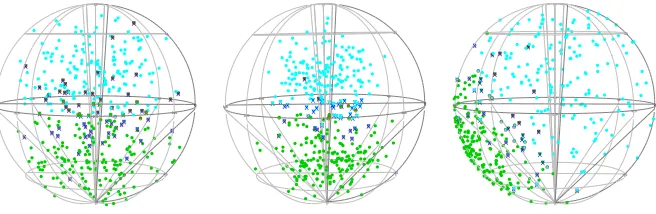
In Scenario 1 the populations, which share the longitude of the mean direction and
the value of the concentration parameter, generate rather overlapping groups. Scenario
2 refers to more concentrated populations generating more separated groups. Finally,
in Scenario 3 two well-separated groups are generated by populations with different
co-ordinates of the mean directions and different concentrations.
In the first experiment we consider the estimator (8) with Kκ1 and Kκ2 both being
von Fisher kernels. The smoothing degrees are selected using the von
-90 135 90 45 180 225 X O X O O X X O X OX O X XO X O O X XO O X O X O X O
XXOXO
X O X O O X XXX XO
O
X
270XO
XO O X XO X O X O O X X O
XOX O X O X O O X O O X O X X O X O X O O O X X XO O XX O X O X O X O XO O O
X XOXO
XO
XO XO
XO O X O O X XO 45 90 X O -45 315 O X O X 0 0 -90 135 90 45 180 225 O X
OOX X XXX
O
X
O
XXO
XO O X 270O O X O X XO X O X O O X X X X O X XX X X X O OX O X X X O X O X X X X X O X X X X X O
XOXXX X X
45 90 -45 315 0 0 -90
135 90 45
XX O X OO O X225 180 X O O X X O O X O X O X X O O X O O O X X X O X X X O OO O OX O X X O XO O OXO
[image:13.595.143.471.125.232.2]O X O X O X O X X O O X X O XO X O XX O X 270 -45 315 0 0 45 90
Figure 1: From left: Misclassified observations using KDE classification (marked by ‘X’) and using lo-cal likelihood with p=0 (marked by ‘o’) for one dataset drawn from vMF(µµµ111,γ1)(cyan points) and
vMF(µµµ222,γ2)(green points) in scenarios 1, 2 and 3.
we consider estimator (4). Also in this case we use the von Mises-Fisher kernel as
[image:13.595.174.440.580.629.2]the weight, by selecting the concentration parameter by least squares cross-validation.
Figure 1 illustrates the misclassified observations obtained according to the rule for
estimators (8) and (4) by using one dataset for each of the described scenarios. In
Table 1, for each experiment, we report as the accuracy measure the average
misclas-sification rate over 200 simulated datasets. The results show that the binary regression
estimator slightly outperforms the kernel density classifier (KDE), especially when the
groups are well-separated. Moreover, the results for n1=n2show that, in the
con-sidered scenarios, estimator (4) performs slightly better than the same estimator using
two concentration parameters (which leads to the same classification rule as the kernel
density one).
Table 1: Estimate of the misclassification rates for kernel density classification and local binary regression with p=0, using 200 samples of sizes n1=n2=200 respectively drawn from fj=vMF(µµµj,γj),j∈(1,2),
given in scenarios 1–3. For both classification rules we use a von Mises-Fisher kernel: for KDE,κ1andκ2 are selected according to the von Mises-Fisher reference rule, and for the local binary regression estimatorκ is selected by least squares cross validation.
Classification rule Misclassification rate
Scenario 1 Scenario 2 Scenario 3
KDE estimator 0.178 0.090 0.112
5.2. Handwritten digit recognition
We apply our methods to the digits dataset used in the StatLog project (Michie
et al., 1994). The dataset consists of 18,000 examples of the digits 0 to 9 (i.e. q=
10 classes) extracted from hand-written postcodes in Germany. These numbers were
initially digitised onto 16×16 images with 256 grey levels; examples are shown in
Figure 2. To enable meaningful comparisons with previously obtained results, we have
used the same train-test split of the data which has 900 examples of each number (0–9)
in the training set and the test set, and an averaging over 4×4 pixels resulting in 16
real-valued variables. These data were then transformed to the unit sphere by simply
[image:14.595.152.461.339.378.2]normalizing each observation replacing XXXiby XXXi/||XXXi||.
Figure 2: Examples of 10 handwritten, digitised digits with resolution 16×16 and 256 grey scales, extracted from postcodes in Germany (Michie et al., 1994).
Our implementation, which corresponds to a 1-degree local polyomial estimator,
used logistic regression with weights obtained from a spherical kernel. The smoothing
parameter was selected — for each pair of classes(j,k)∈ {0,1, . . . ,9} × {0,1, . . .,9}
—using cross-validation (i.e. Equation (7)), which yielded solutions for the smoothing
parameter ranging from 0.9 to 38.8. Then, for each element of the test set, we compute
the probability of membership of class j, given an alternative of class k, say Pjk with
Pjk=1−Pk j(also setting Pj j=1), using the correspondingκjk(=κk j)found by
cross-validation. Finally, we allocate this observation to the class argmaxkminjPjk. The error
rate for 9000 observations in the test set, was 0.043, which is much better than the
unweighted multinomial logistic regression (error 0.086), a simple linear discriminant
(0.114) and just better than the top rank classifier (k-nearest neighbour, with an error
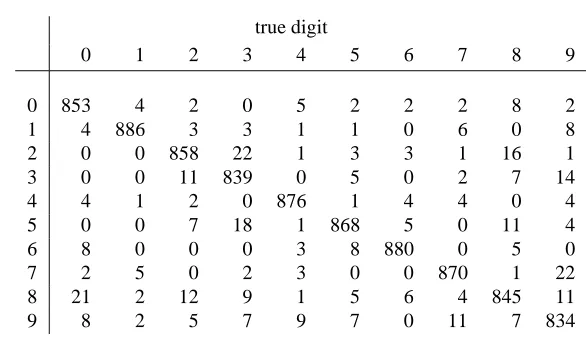
rate of 0.047) of those given in (Michie et al., 1994, p. 136). The confusion matrix
classification mistakes were to recognize an ”8” as a “0”, a “2” as a “3”, and a ”7” as a
”9”.
true digit
0 1 2 3 4 5 6 7 8 9
0 853 4 2 0 5 2 2 2 8 2
1 4 886 3 3 1 1 0 6 0 8
2 0 0 858 22 1 3 3 1 16 1
3 0 0 11 839 0 5 0 2 7 14
4 4 1 2 0 876 1 4 4 0 4
5 0 0 7 18 1 868 5 0 11 4
6 8 0 0 0 3 8 880 0 5 0
7 2 5 0 2 3 0 0 870 1 22
8 21 2 12 9 1 5 6 4 845 11
[image:15.595.155.448.157.330.2]9 8 2 5 7 9 7 0 11 7 834
Figure 3: Confusion matrix for local multinomial logistic classifier applied to German handwritten postcode digits. Columns represent true label, and rows the predicted label.
Although the error rate is very good, we note that this approach was
computation-ally intensive, with the multinomial logistic model entailing the estimation of q(q−
1)/2=45 smoothing parameters in the training phase, and a further fitting of nq(q−
1)/2=405,000 models in the testing phase. Whilst it would be straightforward to
consider p=2 (including interaction terms, if desired) this would take an excessive
amount of time without a common choice ofκacross all class pairs.
Using a classification rule based on a kernel density estimator, a single
smooth-ing parameter (for all classes) was selected by leave-one-out cross-validation on the
training data. This value ofκ (=140.6) was then used to classify the test data. For
this classifer, the error rate of 0.039 was unexpectedly somewhat better than the result
given in Michie et al. (1994) (0.068) for data which have not been transformed to the
sphere.
References
Di Marzio, M., Fensore, S., Panzera, A., Taylor, C.C., 2017. Circular local likelihood.
TEST 21, 1863–8260.
Di Marzio, M., Fensore, S., Panzera, A., Taylor, C.C., 2018. Kernel density
classifica-tion for spherical data, submitted.
Di Marzio, M., Panzera, A., Taylor, C.C., 2009. Local polynomial regression for
circu-lar predictors. Statistics & Probability Letters 79, 2066–2075.
Di Marzio, M., Panzera, A., Taylor, C.C., 2014. Nonparametric regression for spherical
data. Journal of the American Statistical Association 109, 748–763.
Di Marzio, M., Panzera, A., Taylor, C.C., 2018. Nonparametric rotations for
sphere-sphere regression. Journal of the American Statistical Association, forthcoming.
Fan, J., Heckman, N., Wand, M.P., 1995. Local Polynomial Kernel Regression for
Generalized Linear Models and Quasi-Likelihood Functions. Journal of the
Ameri-can Statistical Association 90, 141–150.
Fernandes, K., Cardoso, J.S., 2016. Discriminative directional classifiers.
Neurocom-puting 207, 141–149.
Fisher, N., Lewis, T., Embleton, B., 1987. Statistical Analysis of Spherical Data.
Cam-bridge University Press.
Garc´ıa-Portugu´es, E., Van Keilegom, I., Crujeiras, R.M., Gonz´alez-Manteiga, W.,
2016. Testing parametric models in linear-directional regression. Scandinavian
Jour-nal of Statistics 43, 1178–1191.
Hall, P., Watson, G., Cabrera, J., 1987. Kernel Density Estimation with Spherical Data.
Biometrika 74, 751–762.
Equivalency of Spherical and Normal Distributions in Classification. The Journal of
Machine Learning Research 8, 1583–1623.
Klemela, J., 2000. Estimation of densities and derivatives of densities with directional
data. Journal of Multivariate Analysis 73, 18–40.
Ley, C., Verdebout, T., 2017. Modern Directional Statistics. Chapman & Hall/CRC
Press, Boca Raton, Florida.
Ley, C., Verdebout, T., 2018. Applied Directional Statistics: Modern Methods and Case
Studies. Chapman & Hall/CRC Press, Boca Raton, Florida.
Mardia, K.V., Jupp, P.E., 2008. Directional Statistics. Chichester: J. Wiley.
Michie, D., Spiegelhalter, D.J. and Taylor, C.C. (eds) 1994. Machine Learning, Neural
and Statistical Classification. Chichester: Ellis Horwood.
Signorini, D.F., Jones, M.C., 2004. Kernel Estimators for Univariate Binary