City, University of London Institutional Repository
Citation
: Rahulamathavan, Y., C.-W. Phan, R., Veluru, S., Cumanan, K and Rajarajan, M.
(2013). Privacy-Preserving Multi-Class Support Vector Machine for Outsourcing the Data
Classification in Cloud. IEEE Transactions on Dependable and Secure Computing, 11(5), pp.
467-479. doi: 10.1109/TDSC.2013.51
This is the accepted version of the paper.
This version of the publication may differ from the final published
version.
Permanent repository link:
http://openaccess.city.ac.uk/4495/
Link to published version
: http://dx.doi.org/10.1109/TDSC.2013.51
Copyright and reuse:
City Research Online aims to make research
outputs of City, University of London available to a wider audience.
Copyright and Moral Rights remain with the author(s) and/or copyright
holders. URLs from City Research Online may be freely distributed and
linked to.
City Research Online: http://openaccess.city.ac.uk/ [email protected]
Privacy-Preserving Multi-Class Support
Vector Machine for Outsourcing the Data
Classification in Cloud
Yogachandran Rahulamathavan,
Member, IEEE
, Raphael C.-W. Phan, Suresh Veluru,
Kanapathippillai Cumanan,
Member, IEEE
, and Muttukrishnan Rajarajan,
Senior Member, IEEE
Abstract—Emerging cloud computing infrastructure replaces traditional outsourcing techniques and provides flexible services to clients at different locations via Internet. This leads to the requirement for data classification to be performed by potentially untrusted servers in the cloud. Within this context, classifier built by the server can be utilized by clients in order to classify their own data samples over the cloud. In this paper, we study a privacy-preserving (PP) data classification technique where the server is unable to learn any knowledge about clients’ input data samples while the server side classifier is also kept secret from the clients during the classification process. More specifically, to the best of our knowledge, we propose the first known client-server data classification protocol using support vector machine. The proposed protocol performs PP classification for both two-class and multi-class problems. The protocol exploits properties of Pailler homomorphic encryption and secure two-party computation. At the core of our protocol lies an efficient, novel protocol for securely obtaining the sign of Pailler encrypted numbers.
Index Terms—Privacy, data classification, cloud computing, support vector machine.
F
1
I
NTRODUCTIONIn machine learning and artificial intelligence, data classification is a problem of identifying the category of unknown data sample by a classifier which is built using a training set of known data samples. Building a good classifier requires a large number of valid train-ing samples; hence, it is not possible for individuals or small organizations to build their own classifier. Only viable solution to this problem is to outsource the data classification to third-party. Outsourcing the data classification mitigates the requirement of not only a large number of valid training data samples but also high computational and storage resources to clients (i.e. individuals or small organizations).
Recent advances in cloud computing replaces the traditional outsourcing techniques and provides var-ious services to the clients over the Internet in a flexible manner (i.e. on-demand, pay-per use) [1]. This leads to a new paradigm of service where a server in a cloud could offer data classification to clients. In particular, the server can automatically process and
• Yogachandran Rahulamathavan, Suresh Veluru and Muttukrishnan Rajarajan are with the School of Engineering and Mathematical Science, City University London, London, U.K. (e-mail: [email protected]; [email protected]; [email protected]) Raphael C.-W Phan is with Faculty of Engineering, Multimedia University, 63100 Cyberjaya, Malaysia. (e-mail: [email protected]). Kanapathippillai Cumanan is with the School of Electrical and Electronic Engineering, Newcastle University, Newcastle upon tyne, NE1 7RU, U.K. (e-mail: [email protected]).
classify the clients’ data samples remotely based on privately owned training data samples.
However, releasing the data samples owned by the clients to the cloud raises privacy concerns since the data processed in the cloud are often outsourced to untrusted-third-party-servers (servers) [2], [3]. Fur-thermore, the server may not wish to disclose any details or parameters of its training data set even if it offers classification service to the client. Hence, in this paper we propose a method which preserves the privacy of both the client data samples and the server’s training data while maximizing the benefits of the emerging cloud computing technology. The im-portance of cloud computing in the data classification can be categorized as follows:
1 the cloud is responsible for maintaining and up-dating training data set for classification
2 the cloud provides data classification as a service to any clients via Internet while preserving the privacy of client’s data
3 the cloud helps to offload substantial amount of computation of clients
classified and labeled to the matched class by a server using the classification parameters. Depending on the number of classes that the data samples are to be from, the SVM can be divided into two problems: two-class problem and multi-class problem.
In addition to the availability of a highly reliable SVM classification tool and easy access to cloud com-puting services, it is necessary to include security and privacy measures to ensure the privacy of the data provided by the client and the classification pa-rameters made available by the server are preserved. Hence, it is crucial to develop a privacy-preserving (PP) protocol for SVM whereby a client could seek a server to run the SVM classifier to classify an unla-beled data sample; while maintaining the following privacy guarantees for both the client and server:
• hide the client’s input data sample and the clas-sification result from server
• hide the server side classification parameters from the client
In practical scenarios, the client might be a general practitioner (GP) who runs a private medical clinic, whereas classification service could be provided by a national hospital in order to detect a disease from patients’ symptoms. This service could be provided by a hospital via Internet to any client.
In this paper, we present to the best of our knowl-edge, the first known client-server PP SVM protocol for both two-class and multi-class problems. More specifically, a client sends the input data sample in an encrypted format to the server. Then the server exploits the homomorphic encryption properties to perform the operations directly on the encrypted data sample. If there are any operations that cannot be handled by the homomorphic properties, then there will be a limited amount of interaction between the client and server based on two-party secure computa-tion protocol. We assume that both the client and the server will execute the protocol correctly in order to maintain their reputation, hence they will behave in a semi-honest manner, i.e. they are honest but curious, so privacy is a real issue.
The remainder of this paper is organized as follows: In Section 2, we describe conventional SVM, i.e. the steps involved in training the SVM and classification in the plain-domain (PD). In Section 3, we first briefly describe one of the building blocks i.e. homomorphic encryption, and show how SVM classification can be extended to work in the encrypted-domain (ED) for the two-class problem setting. In particular, the core idea of finding the sign of an encrypted number is described in Section 3. In Section 4, we extend the protocol for two-class problem to the multi-class problem. We analyze the performance of these ED techniques in Section 5. We review related works in Section 6. Conclusions are discussed in Section 7.
Notation. We use boldface lower case letters to denote vectors; (.)′ denotes the transpose operator;
∥.∥2 the Euclidean norm; ⌊.⌉ the nearest integer
ap-proximation; JmK the encryption of message m; and
sign(m)denotes sign of the numberm. The modular reduction operator is denoted bymod.
2
S
UPPORTV
ECTORM
ACHINESVM has been widely used in machine learning for data classification [10], [11], [20]. It has high gen-eralization ability which provides high reliability in real-world applications such as image processing [16], computer vision [12], text mining [14], natural lan-guage processing [17], bioinformatics [18] and many more. SVM has been invented to classify a two-class problem, however, it has been extended later on to a multi-class problem. In a two-class problem, the goal of SVM is to separate both classes by a function, which is obtained from the training data samples. The multi-class problem can be solved by decomposing the multi-class problem into multiple two-class subprob-lems [19]. We formulate the classification functions of both two-class and multi-class problems in the following subsections. These classification functions are crucial to derive the PP SVM proposed in Sections 3 and 4.
2.1 Two-class Problem
We start with a training set of points ˜xi ∈ Rn, i = 1, . . . , N where each point x˜i belongs to one of
the two classes denoted by a label yi ∈ {−1,+1}, i = 1, . . . , N. Using these training data samples we can train a SVM to classify an unlabeled test sample. Initially, the training data need to be normalized to keep the numeric values of training samples on the same scale. This will prevent the samples with a large original scale from biasing the solution. Let us denote the normalized training data samples as xi ∈ Rn, i= 1, . . . , N where,
xi =
˜ xi−x¯
σ2 ,∀i, (1)
where ¯x and σ denote the mean and standard devi-ation of the training data samples. Depending on the separability of the training data, the two-class prob-lem is further divided into two: linear classification problem and non-linear classification problem.
2.1.1 Linear Classification Problem
The goal of linear classification problem is to obtain two parallel hyperplanes as shown in Fig. 1, w′x+
b = −1 and w′x+b = +1, where w and b are the classification parameters obtained during the training process. Both hyperplanes separate the training data of the two classes such that the distance between those hyperplanes is maximized.
Fig. 1. Training data samples for two different classes are denoted by+and−signs.
the test sample is required to be normalized similar to (1) as
t=˜t−x¯
σ2 . (2)
Now the normalized test sample,t, can be substituted into the following classification function
f(t) =sign(w′t+b) =sign
( ∑
s∈S
αsysx′st+b
)
, (3)
where f(t) ∈ {−1,+1}, αi, i = 1, . . . , N are
La-grangian variables and xs, s= 1, . . . ,|S| are support
vectors. If f(t) = +1 then the test sample ˜tbelongs
to +ve class else it belongs to −ve class. Please note that a decision functiond(t)can be extracted from (3) as
d(t) =w′t+b=∑
s∈S
αsysx′st+b, (4)
where w′x+b = 0 denotes the decision-hyperplane which lies between the two hyperplanes (i.e.w′x+b=
−1and w′x+b= +1).
2.1.2 Non-linear Classification Problem
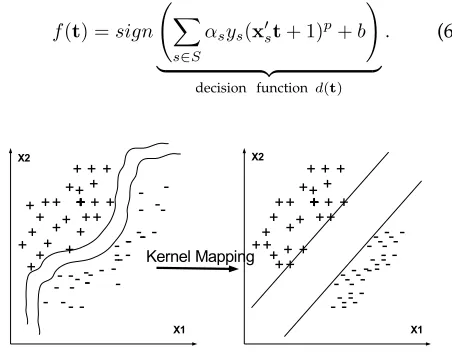
In the previous section, we have discussed the classifi-cation problem where the training data samples were linearly separable. However, it has been proven in the literature that the similar approach can be used for non-linear classification problems using kernel tricks [21], [22]. Hence, the non-linear classification algorithm is formally similar to linear classification algorithms except that the dot product in (3) (i.e.x′st) is replaced by a various non-linear kernel functions. These kernel functions map the data samples into a higher dimensional feature space; hence the non-linear classification problem transformed into non-linear classification problem (see Fig. 2). In this work, we only consider a polynomial kernel. Hence, the dot product between xsand tin (3) can be replaced as
x′st⇒K(xs,t)p= (x′st+ 1) p,
(5)
wherepdenotes the degree of the polynomial. Hence, the classification function in (3) can be modified as
f(t) =sign
( ∑
s∈S
αsys(x′st+ 1) p+b
)
| {z }
decision functiond(t)
[image:4.567.296.522.85.263.2]. (6)
Fig. 2. Non-linear classification problem converted into linear classification problem after the kernel mapping.
2.2 Multi-class Problem
In order to solve a multi-class problem using SVM, it has to be decoupled into multiple two-class subprob-lems. There are two classical approaches to decouple the multi-class problem: versus-all (1VA) and one-versus-one (1V1) [13], [15].
2.2.1 One-versus-all Approach.
For a givenNc number of classes, we form Nc
num-ber of subproblems. Hence, we train Nc number of
SVMs. Forjthsubproblem, we train a SVM usingjth
class training data samples as +ve class and all the remaining samples as−veclass. In the testing phase, for a given normalized test sample, t, the matching class,Mc, can be obtained by modifying (6) as
Mc= argmax j=1,...,Nc
∑
s∈Sj
αsys(x′st+ 1) p+b
j
, (7)
where subscript j denotes the variables associated with the jth subproblem. Hence, a subproblem with
the largest margin value for the decision function (i.e. ∑
s∈Sjαsys(x
′
st+ 1)p+bj) will be chosen.
2.2.2 One-versus-one Approach.
For this approach, we train Nc(Nc−1)
2 number of
sub-problems, where SVM for each subproblem trained using data only from two classes. If we consider training samples from classes i (i.e. +ve class) and
j (i.e. −ve class) for a given subproblem, then the classification function in (6) can be modified as
fi,j(t) =sign
∑
s∈Si,j
αsys(x′st+ 1) p+b
i,j
where subscript i, j denotes the variables associated with the (i, j)th subproblem. The matching class for
the given test sampletcan be obtained using majority voting approach as
Mc = argmax i=1,...,Nc
∑N
j=1,j̸=i fi,j(t)
, (9)
wherefj,i(t) =−fi,j(t),∀i, j.
3
C
LASSIFICATION IN THEE
NCRYPTED-D
OMAINWe consider a client-server model where the server maintains a data set with training samples and ob-tains the classification parameters required for the classification functions (i.e. (6), (7) and (9)). In this section, we show how to preserve the privacy of the test sample, t, and the classification result from the server and the SVM parameters from the client when the server executes the classification function to classify a test sample. Depending on the nature of the problem server executes one of the classification functions from (6), (7) and (9). First, let us explain the required building blocks in the next section.
3.1 Homomorphic Encryption
For concreteness and without loss of generality, our descriptions are based on the Paillier cryptosystem [9] although any other homomorphic encryption schemes could be used. The Paillier cryptosystem is a public-key encryption scheme. It’s provable semantic secu-rity is based on the decisional composite residuosity problem. Hence, it is mathematically intractable to decide whether an integerzis ann-residue modulon2
for some composite n, i.e. whether there exists some
y ∈Z∗n2 such that z=yn modn2. Letn=pq where
p and q are two large prime numbers. A message
m∈Zn can be encrypted using the Paillier
cryptosys-tem asJmK=gmrnmodn2whereg∈Z∗
n2andr∈Z∗n.
The Paillier cryptosystem is said to be an additively homomorphic cryptosystem because for some given encryptions,Jm1KandJm2K, the encryptionJm1+m2K
of the sum m1+m2 in the PD and the encryption
Jm1.αKof the product ofm1 with a constantαin the
PD can respectively be computed efficiently in the ED as
Jm1+m2K = Jm1KJm2K, Jm1.αK = Jm1Kα. (10)
[image:5.567.286.526.53.196.2]In the setting considered by this paper, the client distributes its public-key to the server while keeping its private-key secret. The server performs encryptions under this public-key and exploits the homomorphic properties of the Paillier cryptosystem to perform the required linear operations in the ED. However, only the client can decrypt any encrypted messages using its corresponding private-key.
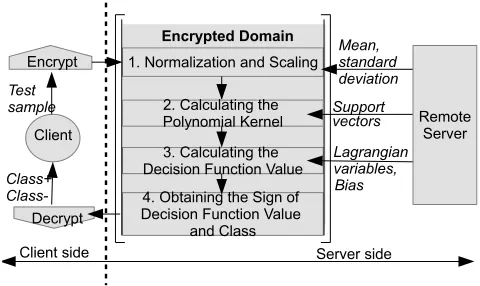
Fig. 3. The block diagram of proposed PP SVM.
3.2 Encrypting Negative Integer
To represent negative integers, we exploit cyclic prop-erty in modulo arithmetic. We represent−1 byn−1
sincen−1≡ −1 inmod n. When the message space ism ∈ Zn, we represent Paillier encryption of −m
using homomorphic property as follows:J−mK=J−1×
mK=JmK−1=JmKn−1. In the SVM classification problem
considered in the work, Paillier security parameter
n >> classif ication variables, hence, errors due to overflow can be avoided.
3.3 Two-class Problem in the Encrypted-domain
First we present our technique for SVM classification in the ED that solves the two-class problem. In par-ticular, we show how server can execute (6) when the test sample is in the ED. Let us assume that each class is represented by an associated string classi, i∈ {−,+}. Fig. 3 depicts the overview of the proposed PP SVM: client supplies a test sample in an encrypted format to the server. The server has the normalization parameters (i.e. mean and standard deviation) and the SVM parameters (i.e. support vectors, Lagrangian variables and bias) in the PD. Hence, the server executes the four steps shown in Fig. 3, in the ED, in order to classify the encrypted test sample.
Initially, the client encrypts each element of the test sample ˜t individually using the public-key and sendsJ˜tK to the server. In general, the training sam-ples, test sample and the variables involved in SVM classification are continuous data. Since the Paillier cryptosystem only supports integers, all the variables involved in the decision function (6) need to be quan-tized to the nearest integer value before encryption. However, if we quantize those variables without any preprocessing then this will deteriorate the classifi-cation accuracy. To address this issue, we scale the decision function in (6) using a positive numberγ2p+1
f(t) =sign
{
γ2p+1
[ ∑
s∈S
αsys(x′st+ 1) p+b
]} = sign
decision functiond(t)
z }| {
∑
s∈S
γ(αsys) [(γxs)′(γt) +γ21]p
| {z }
polynomial kernelKsp
+γ2p+1b
. (11) ∑
s∈S
γ(αsys)[(γxs)′(γt) +γ21]p+γ2p+1b ≈
∑
s∈S
⌊γαsys⌉
(
⌊γxs⌉′⌊γt⌉+⌊γ21⌉
)p
+⌊γ2p+1b⌉. (12)
large (i.e. γ >106) then the solution obtained before
and after the quantization of variables will be nearly equal as shown in (12). This result is crucial in order to obtain higher accuracy when executing (11) in the ED. Executing (11) in the ED involves four different steps (see Fig. 3). In the following subsections, we propose methods to compute those four steps in the ED when the test sample,˜t, is in encrypted format.
3.3.1 Step 1–Normalization and Scaling
As a first step, the test sample˜t= [˜t1, . . . ,˜tn]′ has to
be normalized as in (2). Let us define a mean vector
¯
x = [¯x1, . . . ,x¯n]′ and a normalized test sample as
t= [t1, . . . , tn]′. Hence, the scaled and normalized test
sample γtcan be written as
γt = γ
(˜
t−¯x
σ2
)
= γ
σ2˜t− γ¯x
σ2,
⇒γti =
γ σ2˜ti−
γx¯i
σ2, ∀i. (13)
However, these operations have to be performed in the ED by a server who receives only the encrypted test sample, J˜tK = [Jt˜1K, . . . ,J˜tnK]′, from the client.
Since the server knows the vector ¯x, and scalars γ
and σ in the PD, he can easily compute the val-ues −γx¯i
σ2 = (−1).
γx¯i
σ2 , ∀i and encrypt each of its
components by exploiting homomorphic properties asJ(−1).γx¯i
σ2K=J
γx¯i σ2K
(−1),∀i. Similarly, encryption of γ
σ2˜ti can be obtained asJσγ2t˜iK=J˜tiK γ
σ2,∀i. Hence, the
scaled and normalized value of the test sample in (13) can be obtained in the ED as follows:
JγtiK = J γ σ2˜ti−
γx¯i σ2 K =J
γ σ2˜tiK.J−
γx¯i σ2 K, ∀i,
= J˜tiK γ σ2.J
γx¯i σ2 K
(−1), ∀i.
(14)
Note that every computation in (14) is performed by the server without interacting the client. Now the server obtains normalized and scaled test sample in ED asJγtK= [Jγt1K, . . . ,JγtnK]′.
3.3.2 Step 2–Computing the Polynomial Kernel
The encrypted test sample JγtK is used to compute the polynomial kernel Ksp = [(γxs)′(γt) +γ21]p, ∀s
in (11) in the ED. Let us define the support vector
xs= [xs,1, . . . , xs,n]′,∀s. Consider a case whenp= 1,
for which we have,
Ks = [(γxs)′(γt) +γ21], ∀s,
= [(γxs,1).(γt1) +. . .+ (γxs,n).(γtn) +γ21], ∀s.
(15)
Thus, the server can compute (15) in the ED as
JKsK = J(γxs,1).(γt1) +. . .+ (γxs,n).(γtn) +γ21K,
= J(γxs,1).(γt1)K.....J(γxs,n).(γtn)K.Jγ21K,
= Jγt1Kγxs,1.....JγtnKγxs,n.Jγ21K,
(16)
∀s. This can be computed as follows: since the server knows the scalars,xs,i,∀s, i, in the PD, he can perform
the required multiplications by exploiting (10). For example, in order to multiply the first component, the server has to computeJγt1Kγxs,1. To obtain the sum of
all these products he has to multiply the encryptions of each component with other components. For the case p = 1, the server computes the kernel value without any interaction with the client. If p > 1
(i.e. Ksp) then, the kernel could be computed via a
secure two-party computation technique between the server and client. If the server sends JKsK to the
client then the client can decrypt it using her private-key, then raise the decrypted value by degreep and send the encryptedJKp
sKback to the server. However,
this will leak the server side SVM parameters to the client. Instead, the server blinds the encrypted JKsK
with some uniformly random elementrsfrom the PD
as JK˜sK = JKs.rsK = JKsKrs. Note that the server
generates a fresh random element rs for each JKsK.
Then server sends the blindedJK˜sKto the client. The
client decryptsJK˜sK using her private-key, computes
˜
Kp
s and sendsJK˜ p
sKback to the server. Now the server
can remove the random mask and computesJKp sKas
JKspK = JK˜spKr
−p
s , (17)
which provides the required results due to the follow-ing homomorphic relation:
JK˜p sK
r−p
s = JK˜p s.r−
p s K=JK
p s.r
p s.r−
p s K=JK
p sK.
Note that due to the blinding, the client does not learn the values ofKseven though she had access toK˜sin
3.3.3 Step 3–Calculating the Decision Function
The server can now execute the third step in Fig. 3 i.e. compute the value of the decision function in (11) in the ED as follows:
Jd(t)K = J∑
s∈S
γ(αsys)[(γxs)′(γt) +γ21]p+γ2p+1bK,
= J∑
s∈S
γ(αsys)Ksp+γ 2p+1bK,
= Jγ2p+1bK.∏ s∈S
JKspKγ(αsys). (18)
This can be done as follows. Since the server knows the values ofγand (αsys)in the PD, he can perform
the required multiplications using (10). As an exam-ple, in order to compute γ(αsys)Ksp in the ED the
server computes JKspKγ(αsys) for a given s. To obtain
the sum of all these products together withγ2p+1b, he
multiplies the encryptions with each other.
The only part missing now is the computation of sign value of d(t) and inform the matched class i.e.
class+ or class− to the client. Note that, this
classifi-cation result cannot be revealed to the server. In the next section, we describe the required secure protocol to obtain the classification result.
3.3.4 Step 4–Obtaining the Sign of the Value of the Decision Function
This section studies how to obtain a sign of Paillier en-crypted number. According to (11),f(t) =sign(d(t)). However, the server now has the value ofd(t)in the ED as in (18). Let us assume that |d(t)|<10l, l ∈Z
in the PD. Note that since the training and test data samples are normalized, the value of l can be deter-mined using the range of∑s∈Sαsys(x′st+ 1)p+band
the scaling factor γ2p+1 in (11).
Now the server computes a new variable in the ED as
JzK=J10l+d(t)K=J10lK.Jd(t)K. (19) Since|d(t)|<10l, the most significant digit ofzin PD
is either 1 (i.e. if d(t) >0) or 0 (i.e. if d(t)<0). Let us denote the most significant digit ofz as˜z∈ {1,0}. If z˜ = 1 then test sample belongs to class+ and if
˜
z= 0 then test sample belongs toclass−. Hence, the matched classMc, can be obtained as
Mc= ˜z.(class+−class−) +class−. (20)
The most significant digitz˜could be computed using the following linear operation:
˜
z= 10−l.[z−(z mod 10l)], (21)
where subtraction sets the least significant digits ofz
into0while the multiplication shifts the most signifi-cant digit down. Sincezin (19) is in the ED the server needs to obtain the z˜ in (21) in the ED. This can be
done as follows:
Jz˜K = J10−l.[z−(z mod 10l)]K,
= (JzK.Jz mod 10lK−1)10
−l
. (22)
However,z available at the server is encrypted; thus similar to the process leading to the server being able to compute (17), the server engages the client in a secure two-party computation protocol to compute
Jz mod 10lK.
The server blinds the JzK using an uniformly ran-dom valueras
JzrK = Jz+rK=JzK.JrK,
and this is sent to the client who decrypts the blinded
JzrK and reduces zr mod 10l. The result i.e. zr mod
10lis then encrypted and sent back to the server who
retrievesJz mod10lKas
Jz mod 10lK=Jz+r mod10lK.Jrmod 10lK−1JλK10l,
where λ ∈ {0,1} used to avoid the underflow (i.e.
λ = 0 if z +r mod 10l > r mod 10l or λ = 1
if z+r mod 10l < r mod 10l). The client knows z+r mod 10l in PD while server knows r mod 10l
in PD. Comparing two integers in private has been widely studied in literature [27], [28]. Now the server can computeJz˜Kusing (22). The matching class label of the test sample can be computed in the ED using
Jz˜Kand (20) as follows:
JMcK = Jz.˜(class+−class−) +class−K,
= Jz˜K(class+−class−).Jclass
−K. (23) NowJMcKcan be returned to the client who decrypts
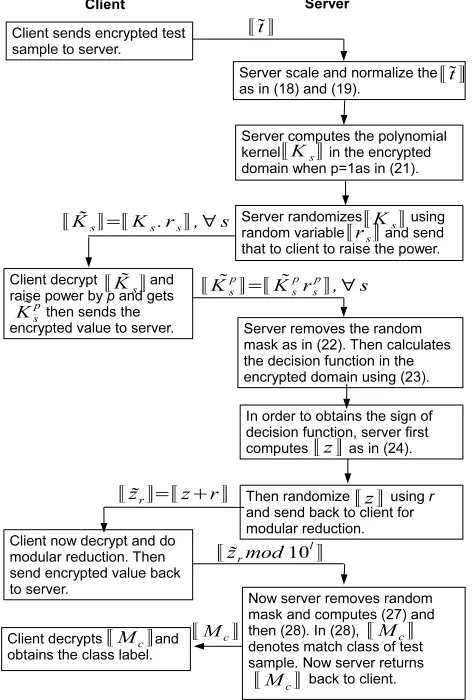
it to find the matched label of the test sample. Fig. 4 shows the flow diagram of the proposed method. Note that, since the classification process is in the ED, it is not feasible for the server to obtain the classification result in PD without prior knowledge of the test sample. The computational complexity during the interactions is always less than the computational complexity required to encrypt the test sample because the number of elements in the test sample is sufficiently larger than the number of support vectors (i.e.s ≪n). Hence, efficiency of the proposed algorithm only depends on the number of interaction between the client and server, where server interacts with a client only when the homomorphic properties are not sufficient to complete the task. Since the server masks the kernel value, JKsK, by
multiplying by random noise,rs, instead of addition,
number of interaction required to compute decision function in (18) is only one for any number of the polynomial (i.e.p >1).
3.3.5 Privacy Analysis of the Proposed Algorithm
Fig. 4. The flow diagram of the proposed algorithm.
server conducts the mathematical operations in the ED. Hence, the server cannot learn about the test sample, the intermediate results or the classification outcome. However, the homomorphic encryption is not sufficient to complete any non-linear operations such as exponentiation in the ED. Hence, the server and client securely interact with each other to perform any non-linear operations. For this interaction, we exploited a secure two-party computation technique and assumed that the parties are semi-honest.
In a semi-honest model, each party follows the rules of the protocol using its correct input. However, the parties are free to use the intermediate values obtained during the execution of the protocol in order to learn about other parties input [37]–[39]. However, a secure two-party protocol must satisfy the following privacy definition in a semi-honest model:
Privacy definition for the secure two-party computation:
a secure two-party protocol should not reveal more information to a semi-honest party than the informa-tion that can be induced by looking at that party’s input and output. The formal proof of the definition can be found in [36].
Let us verify whether the proposed two-party
com-putation satisfies the privacy definition. In our pro-tocol, the server cannot learn any information since all results are protected by Paillier homomorphic en-cryption. Hence, adversary in our model is a client. The adversary follows the protocol correctly, but try to infer the classification parameters of the server. The proposed algorithm composed of four steps: 1. normalization and scaling, 2. computing the polyno-mial kernel, 3. calculating the decision function and 4. obtaining the sign of the value of the decision function. Interaction between the client and server happens only in the Step 2 (when p > 1) and the Step 4. We now formally analyses whether the client can infer the server side parameters from these steps. Let us begin with Step 2 followed by Step 4.
In Step 2, the server interacts with the client in order to exponentiate the encrypted value when polynomial parameter p > 1. This interaction is more important than step 4 as it is directly including the support vec-tors of the training data during the computation, e.g (15). Let us consider the worse case scenario of semi-honest model where the adversary (client) trying infer support vectors by feeding selected input instead of actual test sample value during the interaction. There are|S|number of support vectors where each support vector containednnumber of elements. Lets assume a simple threat model to see whether an adversary can find the first element fromsth support vector xs i.e. xs,1∀s∈S. To verify this, lets assume, the client could
send the following test sample t = [1 0 0 0. . .0]T
in the encrypted format as many times as he can (assume that it is normalized) to the server. The server computes Ks in the ED. Since only one element in
the test sample is one and all other values are zeros,
Ks = γxs,1 +γ. However, the server blinds Ks by
multiplying it by a randomrs, hence, the client only
obtainsγxs,1rs+γrsat the end. Lets assume that the
client might know the scaling factorγ; hence only task left for the client is to extractxs,1fromxs,1rs+rs. Since
the server generates a randomrs∈Zn (i.e. whereZn
is a very large number) every time, it is infeasible for a client to distinguish thexs,1 fromxs,1rs+rs.
In Step 4, the server interacts with the client for modulo reduction in order to obtain the sign of the decision function d(t). Since, d(t) is included in z
in (19), revealing z may leak the decision function value to the client. Hence, the server adds random value r with z before sending it to the client. This randomization makes it infeasible for the client to extract any server side information. Hence, two-party protocols used in Step 2 and Step 4 satisfy the privacy definition.
4
M
ULTI-
CLASSP
ROBLEM IN THEE
NCRYPTED-
DOMAINsub-problems in Section 2.2. In the following subsections, we propose methods for both the approaches in the ED.
4.1 1VA Approach in the Encrypted-domain
In 1VA approach, the server has decoupled the Nc
-class problem into Nc-number of two-class
subprob-lems and obtained the corresponding support vectors, Lagrangian variables and bias for each subproblem in the PD. Any unlabeled test sample can be labeled according to the predicted class using (7) in the PD. However, in the ED the client could supply a test sample ˜t only in the ED. Hence, the server needs
to obtain the value of the decision function for each subproblem in the ED. A subproblem with the largest decision function value will be chosen and the test sample labeled to the corresponding class using (7). Let us define the value of the decision function (scaled version) of the jthsubproblem using (7) and (11) as
dj(t) =
∑
s∈Sj
(γαsys)[(γxs)′(γt) +γ21]p+γ2p+1bj. (24)
The server obtains the dj(t), j = 1, . . . , Nc in the ED
(i.e.Jdj(t)K, j= 1, . . . , Nc) using our methodology as
in (18). Hence, (7) can be redefined as
JMcK = Jargmax j=1,...,Nc
(dj(t))K. (25)
The only part remaining is to find the largest value among dj(t), ∀j and the corresponding class classj
from the EDJdj(t)K.
4.1.1 Finding the Largest Value in the Encrypted-domain
At this stage, the server has computedNc encrypted
values of decision functions. Hence, the aim now is to determine the largest value and the corresponding class based on (25) in the ED. Securely computing the maximum of two Paillier encrypted numbers was studied in [29]. We adopted the fundamental building blocks used in [29]. Let us explain how to obtain the maximum of two encrypted valuesJdi(t)KandJdj(t)K
where |di(t)|,|dj(t)| < 10l. To do this, the server
computes a positive new variablebi,j as follows:
Jbi,jK = J10l+1+di(t)−dj(t)K
= J10l+1KJdi(t)KJdj(t)K−1.
Let us denote the most significant digit of bi,j as˜bi,j,
where˜bi,j can be obtained using the following linear
operation:
˜bi,j = 10−l−1.[b
i,j−(bi,j mod10l+1)
]
.
Note that˜bi,jcan be0or1andb˜i,j= 0impliesdi(t)< dj(t). Now the server can obtain the largest value of
two values in the ED as
Jd∗(t)K=J˜bi,j.(di(t)−dj(t)) +dj(t)K (26)
using an interactive two-party computation protocol with the client, and encryption of the matched class corresponding to the winning subproblem is given by
Jclass∗K=J˜bi,j.(classi−classj) +classjK. (27)
We apply a straightforward recursive algorithm in Ta-ble 1 to obtain the largest value and the corresponding class out of N classes. This is returned to the client who decrypts it to find the matched class of the test sample.
TABLE 1
Algorithm 1: Finding the largest value and the corresponding class in the ED.
1.forn= 1 :N−1
2. Jdi(t)K←Jdn(t)K,Jdj(t)K←Jdn+1(t)K
3. JclassiK←JclassnK,JclassjK←Jclassn+1K
4. findmaximum Jd∗(t)K using (26)
5. findcorresponding class Jclass∗Kusing (27) 6. Jdn+1(t)K←Jd∗(t)K (overwrite)
7. Jclassn+1K←Jclass∗K (overwrite)
8.end
4.2 1V1 Approach in the Encrypted-domain
In the 1V1 approach, the server has Nc(Nc−1)
2 number
of SVMs, where each SVM was trained using the samples only from two classes. Then the test sample will be classified using each SVM. According to the majority voting approach as in (9), a class, which has the highest number of+vepredictions, will be chosen. For our context, (8) and (9) need to be computed in the ED. However, (8) can be computed in the ED using the approach described in Section 3.3. Hence, the server hasJfi,j(t)K, i, j= 1, . . . , Nc, i̸=j. Now server needs
to sum up the votes for each class in the ED as in (9), in order to find the class which obtained the majority voting. For anith class, summation of voting in the
ED can be performed by the server as
J
N
∑
j=1,j̸=i
fi,j(t)K = N
∏
j=1,j̸=i
Jfi,j(t)K, i= 1, . . . , Nc,
whereJfj,i(t)K=Jfi,j(t)K−1. What remains is to find
the largest value out of Nc in the ED and the
corre-sponding class (i.e. majority class). This can be done by the server using an approach similar to Algorithm 1 described in Table 1.
4.2.1 Computational Savings for the Client
collaboratively between two-parties. The proposed algorithm performs PP classification in the ED where the test sample and the classification result are known only to one party and the training features are known to another party. To the best of our knowledge, there is no one-party classification algorithm (i.e. traditional approach) in the literature which performs PP classi-fication in the ED. Hence, in this section, we show the saving in the two-party approach against the traditional approach.
Let us denote the computational power required for mathematical operations such as multiplication, addition and sign function are as cm, ca, and cs,
respectively. Let us denote the size of the test sample asn, and the number of support vectors required for data classification as|S|. Firstly, we analysis the two-class problem followed by the multi-two-class problem (see Table 2). The second column in Table 2 denotes computational cost for the client to run the data clas-sifier without cloud-server assistance (i.e. traditional approach). The third column denotes the computa-tional cost for the client in two-party approach. The fourth column, which is calculated by subtracting computational cost in the third column from the second column, denotes the computational saving for the client.
Since, n, |S| > 0, the client saves a substantial amount of computational power in two-party ap-proach. Let us now compute the computational sav-ings for multi-class problem. Let us denote the num-ber of classes in a multi-class problem asNc. Hence,
the multi-class problem can be decomposed into
Nc−, and Nc(N2c−1)−numbers of two-class
subprob-lems in 1VA approach and 1V1 approach, respectively. Hence, the computational savings for 1VA and 1V1 approaches are N{2(|S|+ 1)ca+ [|S|(n+ 2) + 1]cm},
and Nc(Nc−1)
2 {2(|S|+ 1)ca+ [|S|(n+ 2) + 1]cm},
re-spectively.
5
P
ERFORMANCEA
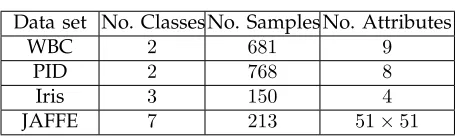
NALYSISIn this section, we compare the accuracy of the pro-posed ED methods with the conventional PD meth-ods. For the experiments, we consider three popular data sets from the UCI machine learning repository called the Wisconsin Breast Cancer (WBC), Puma Indian Diabetic (PID), and Iris data sets [23]. We also consider a popular facial expression data set called JAFFE [24]. The details of the data sets are given in Table 3. The WBC and PID data sets are medical data sets, and the Iris data set is about flowers while the JAFFE data set is a facial expression data set. The WBC data set contains 681 data samples where 444 samples are benign (non-cancerous) and
[image:10.567.291.521.73.142.2]237samples are malignant (cancerous). The each sam-ple of WBC data is composed with nine different attributes. The PID data set contains768data samples for two different classes: benign (500 samples) and
TABLE 3
The details of the data sets.
Data set No. ClassesNo. Samples No. Attributes
WBC 2 681 9
PID 2 768 8
Iris 3 150 4
JAFFE 7 213 51×51
malignant (268samples). The each sample in PID data set composed with eight different attributes. The Iris data set contains samples for three different classes: Setosa, Versicolour, and Virginica, where each class contains an equal number of data samples (i.e.50per class). The JAFFE data set contains facial images of ten Japanese females. Each subject in JAFFE database has six facial expressions [25], i.e. angry (AN), disgust (DI), fear (FE), happy (HA), sad (SA) and surprise (SU), and a neutral (NE) face. In total, there are 213
gray-scale facial expression images in this database, each with a pixel resolution of 256 ×256. For the purpose of computational efficiency, all the images were resized to51×51pixels.
For experiment purpose, we use the leave-one-out approach [26], that is, one data sample is removed from the data set and all the remaining samples are used for training the SVM. The removed sample will be used as a test sample. This procedure will be repeated for a different left out test sample each time until all the data samples in a data set are tested. In order to verify the proposed methods, we first conduct the experiments with the test sample in the PD. Later we repeat the experiments, however, the test sample now in the ED, in order to compare the performance.
5.1 Experiments in the Plain-Domain
In all experiments, we assume that the training data is not linearly separable and therefore, we use poly-nomial kernel method as in (6). First we consider the two-class case, which will then be followed by the multi-class case.
5.1.1 Two-class Case
We consider the WBC and PID data sets for two-class experiment. Tables 4 and 5 respectively depict the maximum classification accuracy of the WBC and PID data sets in the PD. In our settings, the maximum accuracy achieved using the WBC data set was98.24%
when p= 2. Total number of correctly classified be-nign and malignant samples were436 out of500and
TABLE 2
Total number of mathematical operations required for the client for the two-class classification in traditional and two-party approaches.
Traditional Approach Two-party Approach Savings
Step 1 n(ca+cm) 0 n(ca+cm)
Step 2 |S|(ncm+ca) +|S|(p−1)cm |S|(p−1)cm |S|(ncm+ca)
Step 3 2|S|cm+ (|S|+ 1)ca 0 2|S|cm+ (|S|+ 1)ca
Step 4 cs cs 0
Total (2|S|+n+ 1)ca+ [|S|(n+ 2) + 1]cm |S|(p−1)cm+cs (2|S|+n+ 1)ca
+|S|(p−1)cm+cs + [|S|(n+ 2) + 1]cm
TABLE 4
The classification accuracy achieved for the WBC data set whenp= 2in the PD.
WBC Accuracy
Benign(444) 98.20% (436)
Malignant(237) 98.31% (233)
Overall Accuracy(681) 98.24% (669)
TABLE 5
The classification accuracy achieved for the PID data set whenp= 3in the PD.
PID Accuracy
Benign(500) 90.20% (451)
Malignant(268) 80.97% (217)
Overall Accuracy(768) 86.98% (668)
5.1.2 Multi-class case
For the multi-class case, we considered the Iris and JAFFE data sets. Let us explain how we solve the multi-class problem using a simple example. Since the JAFFE data set has seven classes, the number of required SVMs to classify a test sample for 1VA and 1V1 approaches are 7 and 21, respectively. Ta-bles 6 and 7 show some examples for 1VA and 1VA approaches, respectively. In Table 6, decisional function values of seven different SVM classifiers for four different test samples are displayed. Each test sample is categorized to a class using (7) if the highest decision function value belongs to that class. The highest decision function value of the test sample 1
in Table 6 is 0.5070 and it corresponds to the AN-vs-all SVM, which means the test sample 1 can be categorized to the AN class. Similarly, test samples
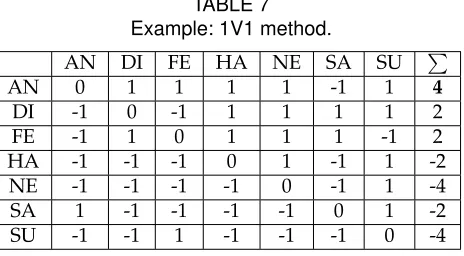
2, 3 and 4 are also classified to the AN class. Only one test sample has been considered in Table 7 as an example to demonstrate the 1V1 method. The 7 -class problem is now decoupled into 21 number of subproblems and Table 7 shows the sign of decisional function values using (8) for all subproblems. The sign values in Table 7 form a skew-symmetric matrix because fj,i(t) = −fi,j(t). The last column of Table
7 shows the summation of the sign values in each row. Using the majority-voting rule in (9) the AN class obtained maximum votes (i.e.4) and, therefore,
TABLE 6 Example: 1VA method.
Test image
1 2 3 4
AN-vs-all +0.5070 +1.0931 +0.4706 +0.4325 DI-vs-all -1.2123 +0.7910 -0.5935 -0.8492 FE-vs-all -1.4276 -2.3656 -1.3893 -2.0274 HA-vs-all -1.2985 -2.3203 -2.1607 -0.6268 NE-vs-all -2.0509 -2.8030 -2.1769 -1.7336 SA-vs-all -0.9503 -2.5222 -2.6247 -1.3851 SU-vs-all -1.9416 -1.8771 -1.8144 -1.1769
[image:11.567.291.523.419.547.2]the test sample considered for this example can be categorized to the AN class.
TABLE 7 Example: 1V1 method.
AN DI FE HA NE SA SU ∑
AN 0 1 1 1 1 -1 1 4
DI -1 0 -1 1 1 1 1 2
FE -1 1 0 1 1 1 -1 2
HA -1 -1 -1 0 1 -1 1 -2
NE -1 -1 -1 -1 0 -1 1 -4
SA 1 -1 -1 -1 -1 0 1 -2
SU -1 -1 1 -1 -1 -1 0 -4
TABLE 8
The classification accuracy achieved for the Iris data set in the PD.
Iris 1VA (p= 3) 1V1(p= 1)
Setosa(50) 84.00% (42) 98.00% 49
Versicolour (50) 78.00% (39) 74.00% 37
Virginica(50) 94.00% (47) 90.00% 45
Total(150) 85.33% (128) 87.33% (131)
TABLE 9
The classification accuracy achieved for the JAFFE data set in the PD.
1VA(p= 1) 1V1(p= 1)
AN (30) 93.33% (28) 100.00% (30)
DI (29) 93.10% (27) 89.66% (26)
FE (32) 90.63% (29) 84.38% (27)
HA (31) 87.10% (27) 83.87% (26)
NE (30) 100.00% (30) 93.33% (28)
SA (31) 90.32% (28) 90.32% (28)
SU (30) 90.00% (27) 86.67% (26)
Total (213) 92.02% (196) 89.67% (192)
5.2 Experiments in the Encrypted-domain
Our proposed PP SVM methods have been imple-mented in C++ using GNU GMP library version
4.2.4. Both the server and client were modeled as different threads of a single program, which passes the variables to each other. The program is tested on a computer with a3.40GHz Intel(R) Xeon(R) processor and 8GB of RAM running on Windows64−operating system. The size of the Paillier security parameter was
2048bits long.
As we mentioned in Section 3.3.1, the scaling factor
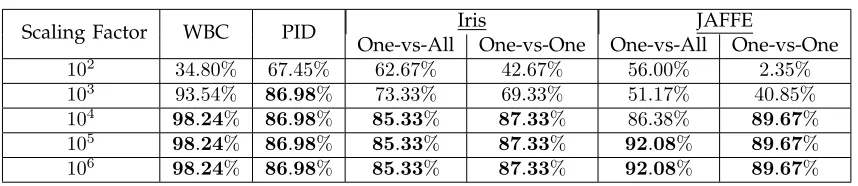
γhas an influence on the classification accuracy in the ED because the Paillier cryptosystem only encrypts integers. Table 10 shows the classification accuracy for all four data sets for various scaling factors in the ED. The crucial point is that the classification accuracy in the ED eventually becomes equal to the classification accuracy in the PD whenγ is at a sufficient level, in this case atS= 105. We also observed the
correspond-ing tables in the ED whenS= 105, which are the same
as in Tables 4, 5, 8 and 9. This shows that our proposed PP SVM enables classification to work, in fact, it achieves the same classification accuracy as in the PD, despite test samples having been encrypted, and, therefore, privacy of the test samples is guaranteed.
The scaling factor γ can be determined by the server. If we closely look at the classification function in equation (6), classification variables and test sample (i.e. αsys,xs, b and t) are normalized. In traditional
SVM classification, i.e. in PD, we approximate these variables and test samples to particular decimal points based on the accuracy required before computing the decision function in equation (6) (i.e. keeping the variables beyond a certain number of decimal points
will not make any significant difference in the output). The range of variables in the test sample should also lie in the same range as in the training sample. Hence, it is obvious for a server to obtain the number of decimal points required to provide a higher accuracy. In the example considered in this paper, five decimal points are sufficient, henceγvalue above105will not
make any difference in the classification results.
5.2.1 Communication Complexity
Since only the Paillier encrypted values are be-ing communicated between the server and client, the communication cost of the proposed algorithms highly depends on the size of the Paillier security parametern; in our implementationn= 2048, hence, the size of a Paillier ciphertext is 2048 bits. Hence, sending an encrypted test sample withN number of features consumes 2048N bits of bandwidth in the communication channel. In the proposed algorithm, the server interacts with the client for two times: for computing polynomial kernel and for computing the sign of an encrypted value. The server sends|S|
number of ciphertexts (i.e. equal to the total num-ber of support vectors) during the first interaction (i.e. polynomial kernel computation) while only one ciphertext in the last interaction. Hence, the com-munication cost for our algorithm is upper-bounded by the first interaction which requires 2048|S| bits of bandwidth. Since the number of support vectors should be less than the size of the data set, the worst case bandwidth requirement for WBC, PID, Iris, and JAFFE data sets are 1.394M B, 1.573M B, 0.3M B, and 0.436M B, respectively.
5.2.2 Computational Complexity
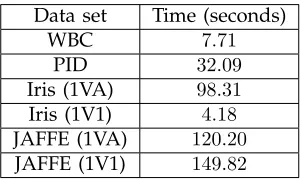
[image:12.567.330.480.601.692.2]We measure the computational complexity in terms of average runtime required for the proposed algo-rithms. Table 11 depicts the average computational time required for the proposed PP algorithms in order to complete the classification task in all four data sets. It is noted that the average computational time
TABLE 11
The average computational times required for all four data sets in the ED classification.
Data set Time (seconds)
WBC 7.71
PID 32.09
Iris (1VA) 98.31
Iris (1V1) 4.18
JAFFE (1VA) 120.20
JAFFE (1V1) 149.82
TABLE 10
Classification result of all four data sets in the ED for various scaling factorγ.
Scaling Factor WBC PID Iris JAFFE
One-vs-All One-vs-One One-vs-All One-vs-One
102 34.80% 67.45% 62.67% 42.67% 56.00% 2.35%
103 93.54% 86.98% 73.33% 69.33% 51.17% 40.85%
104 98.24% 86.98% 85.33% 87.33% 86.38% 89.67% 105 98.24% 86.98% 85.33% 87.33% 92.08% 89.67%
106 98.24% 86.98% 85.33% 87.33% 92.08% 89.67%
and the Iris 1VA problem (i.e. p = 3). Since there is no interaction required between the server and client, in order to compute the polynomial kernel when
p = 1, the average computational time required for the earlier problem is less than the later problem. It is also noted that the average computational time is increasing linearly with the number of support vectors used for classification problems when p > 1 (i.e. the WBC and PID data sets) or when p = 1 (i.e. JAFFE 1VA problem and JAFFE 1V1 problem).
6
R
ELATED WORKThere were several classification algorithms devel-oped in pattern recognition and machine learning for different applications [35]. However, only a few of them have been redesigned for PP classification in literature ( [4]–[7], [29]–[34] and references therein). In this section, we review some of the PP SVM literature. Majority of the work in the literature were developed for the distributed setting where different parties hold parts of the training data sets and securely train a common classifier without each party needing to disclose its own training data to other parties [4]– [7]. After the training, each party holds part of the classification parameters. In order to classify a new test sample, each party has to be involved equally to compute part of the kernel matrix and then all parties together, or the trusted third-party will classify the test sample. The works in [5]–[7] exploited the secure multi-party integer summation in order to compute the kernel matrix. Basically, each party generates a Gramm matrix using scalar products of training and test data samples. This Gramm matrix is later revealed to the trusted third party who will compute the kernel matrix and then classify the test sample. Revealing the Gramm matrix may leak the private data and, therefore, privacy cannot be entirely preserved.
The work in [4] proposed for the first time a strongly privacy-enhanced protocol for SVM using cryptographic primitives where the authors assumed that the training data is distributed. Hence, in order to preserve the privacy they developed a protocol to perform secure kernel sharing, prediction and training using secret sharing and homomorphic encryption techniques. At the end of the training, each party will hold a share of the secret. In the testing phase, all
parties collaboratively perform the classification using their shared secrets. At the end of the protocol, each party will hold the share of the predicted class label. Since the work is based on secret sharing, all parties must be involved in every operation of calculating the kernel values and predicting the class. Hence, it is suitable only for the distributed scenario and not for the client-server model considered in this paper. In the client-server model, the client just sends the test sample in the ED and is minimally involved in interactions with the server during the classification process.
The recent work in [8] discusses the issue of re-leasing the trained SVM classifier without violating the privacy of classification parameters. While the Gaussian kernel was considered therein, however, Taylor series was exploited to approximate the infinite dimension of the Gaussian kernel into finite dimen-sion for negligible performance loss. Since this works purely in the PD, it cannot be modified to the client-server scenario considered in this paper.
Note that all the early works in PP SVM classifi-cation are restricted only to the two-class problem. Hence, in this paper, we proposed for the first time a PP protocol not only for the two-class but that solves the multi-class problem.
7
C
ONCLUSIONSA
CKNOWLEDGEMENTSThe authors would like to thank the Associate Editor and the anonymous reviewers for their constructive comments that greatly improved the quality of this manuscript. This work was supported through the EPSRC Grants – “The Uncertainty of Identity: Linking Spatiotemporal Information Between Virtual and Real Worlds (EP/J005266/1)” and “TRUMP: A Trusted Mobile Platform for the Self-Management of Chronic Illness in Rural Areas (EP/J00068X/1)”.
R
EFERENCES[1] Sundareswaran, S., Squicciarini, A. C., Lin, D.: Ensuring dis-tributed accountability for data sharing in the cloud. In: IEEE Trans. Dependable and Secure Computing, vol. 9, no. 4, pp. 555–567. ( Jul.-Aug. 2012)
[2] Pearson, S., Charlesworth, A.: Accountability as a way forward for privacy protection in the cloud. In: Proc. First Int’l Conf. Cloud Computing. (2009)
[3] Pearson, S., Shen, Y., Mowbray, M.: A privacy manager for cloud computing. In: Proc. Int’l Conf. Cloud Computing (CloudCom), pp. 90–106. (2009)
[4] Lipmaa, H., Laur, S., Mielikainen, T.: Cryptographically private support vector machines. In: Proc. 12th ACM SIGKDD Int’l Conf. Knowledge Discovery and Data Mining, pp. 618–624, Philadelphia, USA. (Aug. 2006)
[5] Yu, H., Jiang, X., Vaidya. J.: Privacy-preserving SVM using nonlinear kernels on horizontally partitioned data. In: Proc. ACM Symp. Applied Computing (SAC). (2006)
[6] Yu, H., Vaidya, J., Jiang, X.: Privacy-preserving SVM classifi-cation on vertically partitioned data. In: Proc. 10th Pacific-Asia Conf. Knowledge Discovery and Data Mining (PAKDD). (2006) [7] Chen, K., Liu, L.: Privacy preserving data classification with rotation perturbation. In: ICDM, IEEE Computer Society, pp. 589–592. (2005)
[8] Lin, K-P., Chen, M-S.: On the design and analysis of the privacy-preserving SVM classifier. In: IEEE Trans. Knowledge and Data Engineering, vol. 23, no. 11, pp. 1704–1717. (Nov. 2011) [9] Paillier, P.: Public-key cryptosystems based on composite
de-gree residuosity classes. In: Stern, J. (ed.) EUROCRYPT 1999. LNCS, vol. 1592, pp. 223–238, Springer, Heidelberg. (1999) [10] Cortes, C., Vapnik, V.N.: Support-vector networks. In: Machine
Learning, vol. 20, no. 3, pp. 273–297. (1995)
[11] Vapnik, V. N.: An overview of statistical learning theory. In: IEEE Trans. Neural Netw. vol. 10, pp. 988–999. (1999) [12] Qian, H., Mao, Y., Xiang, W., Wang, Z.: Recognition of human
activities using SVM multi-class classifier. In: Pattern Recogni-tion Letters, vol. 31, pp. 100–111. (2010)
[13] Lei, H., Govindaraju, V.: Which is the best multiclass SVM method? An empirical study. In: Proc. 6th Int’l Conf. Multiple Classifier Systems, Springer-Verlag Berlin, Heidelberg, pp.156– 164. (2005)
[14] Tong, S., Koller, D.: Support vector machine active learning with applications to text classification. In: Journal of Machine Learning Research, Vol. 2, pp. 45–66. (2002)
[15] Hsu, C. -W., Lin, C. -J.: A comparison of methods for multi-class support vector machines. In: IEEE Trans. Neural Netw., vol. 13 no. 2, pp. 415–425. (2002)
[16] Kotsia, I., Pitas, I.: Facial expression recognition in image sequences using geometric deformation features and support vector machines. In: IEEE Trans. Image Process., vol. 16, no. 1, pp. 172–187. (2007)
[17] Bergsma, S., Lin, D., Schuurmans, D.: Improved natural lan-guage learning via variance-regularization support vector ma-chines. In: Proc. 14th Conf. Computational Natural Language Learning, pp. 172–181. (2010)
[18] Ben-Hur, A., Ong, C., Sonnenburg, S., Scholkopf, B., Ratsch, G.: Support vector machines and kernels for com-putational biology. In: PLoS Comcom-putational Biology — www.ploscompbiol.org, vol. 4, no. 10, pp. 1–10. (2008) [19] Platt, J., Cristianini, N., Shawe-Taylor, J.: Large margin DAGs
for multiclass classification. In: Advances in Neural Information Processing System, vol. 12, pp. 547–553. (2000)
[20] Burges, C. J. C.: A tutorial on support vector machines for pattern recognition. In: Data Min. Knowl. Discov., vol. 2, pp. 121–167. (1998)
[21] Vapnik, V. N.: The nature of statistical learning theory. In: Springer-Verlag New York, Inc., New York, USA. (1995) [22] Boser, B. E., Guyon, I., Vapnik, V. N.: A training algorithm for
optimal margin vlassifiers. COLT, pp. 144-152. (1992)
[23] Mangasarian, O. L., Street, W. N., and Wolberg, W. H.: Breast cancer diagnosis and prognosis via linear programming. In Operations Research, vol. 43, pp. 570–577. (Jul.-Aug. 1995) [24] Lyons, M.J., Budynek, J., Akamatsu, S.: Automatic
classifica-tion of single facial images. In: IEEE Trans. Pattern Anal. Mach. Intell., vol. 21, no. 12, pp. 1357–1362. (Dec. 1999)
[25] P. Ekman, W. Friesen: Facial Action Coding System. Consult-ing Psychologist Press, Palo Alto, CA. (1978)
[26] Cawley, G.C., Talbot, N.L.C.: Efficient leave-one-out cross-validation of kernel fisher discriminant classifiers. In: Pattern Recognition, vol. 36, no. 11, pp. 2585–2592. (2003)
[27] Damg˚ard, I., Geisler, M., Krigaard, M.: Efficient and secure comparison for online auctions. In: ACISP 2007. LNCS, vol. 4586, pp. 416–430. Springer, Heidelberg (2007)
[28] Garay, J. A., Schoenmakers, B., Villegas, J.: Practical and se-cure solutions for integer comparison. In: Okamoto, T., Wang, X. (eds.) PKC 2007. LNCS, vol. 4450, pp. 330–342. Springer, Heidelberg (2007)
[29] Erkin, Z., Franz, M., Guajardo, J., Katzenbeisser, S., Lagendijk, I., Toft. T.: Privacy-preserving face recognition. In privacy en-hancing technologies (PET09). LNCS, vol. 5672 pp 235–253. Springer. (2009)
[30] Rahulamathavan, Y., Phan, R. C.-W., Chambers, J. A., Parish, D.: Facial expression recognition in the encrypted-domain based on local fisher discriminant analysis. In: IEEE Trans. Affective Computing, vol. 4, no. 1, pp. 83–92. (Jan.-Mar., 2013) [31] Barni, M., Bianchi, T., Catalano, D., Raimondo, M. D., Labati, R. D., Failla, P., Fiore, D., Lazzeretti, R., Piuri, V., Scotti, F., Piva, A.: Privacy-preserving fingercode authentication. In Proc. 12th ACM workshop on Multimedia and security, New York, NY, USA, 231–240. (2010)
[32] Du, W., Zhan, Z.: Building decision tree classifier on private data. In Proc. IEEE Int’l Conf. Privacy, Security and Data Min-ing - vol. 14. Australian Computer Society, Inc., DarlMin-inghurst, Australia, 1–8. (2002)
[33] Barni, M., Failla, P., Lazzeretti, R., Sadeghi, A-R., Schneider, T.: Privacy preserving ECG classification with branching programs and neural networks. In: IEEE Trans. Information Forensics and Security, vol. 6, no. 2, pp. 452–468. (Jun. 2011)
[34] Barni, M., Orlandi, C., Piva, C.: A privacy-preserving protocol for neural network-based computation. In Proc. ACM Multime-dia and Security Workshop,26-27, Geneva, Switzerland. (Sept. 2006)
[35] Duda, R. O., Hart, P. E., and Stork, D. G.: Pattern classification and scene analysis 2nd ed. (1995)
[36] Goldreich, O.: Secure multiparty computation. (working draft), available: http://www.wisdom.wei zmann.ac.il/ oded/pp.html. (Sep. 1998)
[37] Kantarcioglu, M., Clifton, C.: Privacy-preserving distributed mining of association rules on horizontally partitioned Data. In: IEEE Trans Knowledge and Data Engineering, vol. 16, no. 9, pp. 1026–1037. (2004)
[38] Lindell, Y., Pinkas, B.: Privacy preserving data mining. In Advances in CryptologyCRYPTO 2000, pp. 36–54. Springer Berlin Heidelberg, (2000).