DEVELOPMENT OF ACTIVE STEERING
CONTROL BASED ON SLIDING MODE CONTROL
WITH THE INCLUSION OF AN OBSERVER
NG XUE YAN
ON SLIDING MODE CONTROL WITH THE INCLUSION OF
AN OBSERVER
NG XUE YAN
This report is submitted in partial fulfilment of the requirements
for the degree of
Bachelor of Electronic Engineering (Industrial Electronics) with
Honours
Faculty of Electronic and Computer Engineering
Universiti Teknikal Malaysia Melaka
Scanned by CamScanner
UNIVEnSTI TEKNIKAL MALAYSIA MELA KA
C
l!U~~I
FAKULTI KEJURUTERAAN ELEKTRONIK DAN KEJlJRIJ'I ERAAN KOMPUTERllOltANG l'ENGESAllAN STATUS LAl'OllAN
PRO.JEK SAR.JANA MUDA JI
Tajuk Projck DEVELOPMENT OF ACTIVE STEERING CONTROL BASED ON
SLIDING MODE CONTROL WITH THE INCLUSION OF AN
OBSERVER
Sesi Pengajian 6 I 7
Say a NG XUE YAN
(HURUF BESAR)
mengak."U membenarkan Laporan Projek Sarjana Muda ini disimpan di Perpustakaan dengan syarat-syarat kegunaan seperti berikut:
1. Laporan adalah hakmilik Universiti Teknikal Malaysia Melaka.
2. Perpustakaan dibenarkan membuat salinan untuk tujuan pengajian sahaja.
3. Perpustakaan dibenarkan membuat salinan laporan ini sebagai bahan pertukaran antara institusi
pengajian tinggi.
4. Sila tandakan ( .../ ) :
D
SULIT*D
TERllAD**[JJ
TIDAK TERHADGAN PENULIS)
. 1(1o/Wt:J.·
Tankh: ... .l ... .
*(Mengandungi maklumat yang berdarjah keselamatan atau kepentingan Malaysia seperti yang termaktub di dalam AKTA RAHSIA RASMI 1972)
.. (Mengandungi maklumat terhad yang telah ditentukan oleh organisasi/badan di mana penyelidikan dijalankan)
.
1/b(?o
f'J--
·
Scanned by CamScanner
"I declare that this report is the result of my own work except for quotes as cited in the references."
Signature
···f··
·
··
··
··
···
·
Author NG XUE YAN
Scanned by CamScanner
APPROVAL
"I hereby declare that I have read this thesis and in my opinion this thesis is sufficient
in terms of scope and quality for the award of Bachelor of Electronic Engineering
(Industrial Electronic) with Honours."
Signature
Supervisor Name D SADHIQIN BIN MOHD ISIRA
Special dedication to my beloved parents
Ng Kek Seng and Ong Guat Cheng
Their encouragement and guidance has always be an inspiration to me along this
i
ABSTRACT
ABSTRAK
iii
ACKNOWLEDGEMENTS
I have just completed my Final Year Project (FYP) and report. In the beginning, I
would like to take this opportunity to express my gratefulness to some organization
and individuals who kindly contributed for my final year project in UTeM. With the
cooperation and contributions from all parties, the objectives of the project which are
soft-skills, knowledge and experiences were gained accordingly even this is just part of
the whole project. Furthermore, I would like thank to my supervisor, Dr. Ahmad
Sad-hiqin Bin Mohd Isira for the proper guidance, cooperation and involvement throughout
my Final Year Project. His effort to ensure the successful and comfort ability of
stu-dents under his responsibility was simply not doubtful. Moreover, I would like to
extend my sincere acknowledgement to my parent and family members who have been
very supportive for the past one year. Their understanding and support in term of moral
and financial were entirely significance towards the project completion. Last but not
list, my appreciation goes to my fellow student in UTeM, especially for who are from
FKEKK. Their willingness to help, opinions and suggestions on some matters, advices
and technical knowledge are simply precious while doing upon completion of my final
TABLE OF CONTENTS
Declaration Approval Dedication
Abstract i
Abstrak ii
Acknowledgements iii
Table of Contents iv
List of Tables viii
List of Figures ix
CHAPTER 1 INTRODUCTION 1
1.1 Introduction 1
1.2 Project Overview 2
1.3 Objectives 3
1.4 Scope of Project 4
1.5 Methodology 4
1.6 Thesis Structure 6
CHAPTER 2 LITERATURE REVIEW
2.1 Introduction 7
2.2 Background 7
2.3 Research of Active Front Steering System 10
2.4 Vehicle Dynamics Modeling 11
2.4.1 Vehicle Axis System 11
2.4.2 Vehicle Models 13
v
2.5.1 Mathematical Modeling For a Single Track Model 16
2.5.2 Linearization for Constant Velocity and Small Angles 22
2.6 Seperation of Path Following and Disturbances Attenuation 26
2.7 Sliding Mode Control (SMC) 27
2.8 Controllability 28
2.9 State Feedback Observer 30
2.9.1 Sliding Mode Observer 31
2.10 Related Studies 33
2.11 Conclusion 36
CHAPTER 3 METHODOLOGY
3.1 Introduction 37
3.2 Process flow of Final Year Project (FYP) 38
3.3 Block Diagram of the Active Steering Control 40
3.4 Overview on Sliding Mode Control 41
3.4.1 Sliding Mode Control Design 41
3.4.2 Switching Surface Design 42
3.4.3 Stability of Sliding Mode 44
3.4.4 Controller Design 46
3.5 The Observer based on Sliding Mode Control (SMC) 50
3.6 Linear Quadratic Regulator (LQR) Controller 52
3.7 Observer based on Linear Quadratic Regulator (LQR) 53
3.8 Conclusion 53
CHAPTER 4 RESULTS AND DISCUSSIONS
4.1 Introduction 54
4.2.1 Disturbance Profile 1 56
4.2.2 Disturbance Profile 2 57
4.3 Results and Discussions 58
4.3.1 Performance of Sliding Mode Control (SMC). 58
4.3.2 Performance of The Single Track Car Model with Sliding Mode
Control (SMC) with Crosswind Disturbance 61
4.3.2(a) The Comparison between the Single Track Car Model
with Sliding Mode Control (SMC) and Single Track car
Model Without Controller 62
4.3.2(b) The Comparison between the Single Track Car Model with Sliding Mode Control (SMC) Single Track car
Model with Pole Placement Controller 64
4.3.2(c) The Comparison between the Single Track Car Model
with Sliding Mode Control (SMC) Single Track car
Model with Linear Quadratic Regulator (LQR) 66
4.3.2(d) The Comparison between the Single Track Car Model with Sliding Mode Control (SMC) Single Track car
Model with Sliding Mode Observer 68
4.3.2(e) The Comparison between the Single Track Car Model
with Sliding Mode Control (SMC) and Sliding Mode observer with Single Track car Model with Linear Quadratic Regulator (LQR) and Linear Quadratic
Regulator Observer 70
4.3.3 Performance of The Single Track Car Model with Sliding Mode
Control (SMC) with Braking Torque Disturbance 72
4.3.3(a) The Comparison between the Single Track Car Model
with Sliding Mode Control (SMC) and Single Track car
Model Without Controller 73
4.3.3(b) The Comparison between the Single Track Car Model with Sliding Mode Control (SMC) Single Track car
Model with Pole Placement Controller 75
4.3.3(c) The Comparison between the Single Track Car Model
with Sliding Mode Control (SMC) Single Track car
Model with Linear Quadratic Regulator (LQR) 77
4.3.3(d) The Comparison between the Single Track Car Model with Sliding Mode Control (SMC) Single Track car
vii
4.3.3(e) The Comparison between the Single Track Car Model
with Sliding Mode Control (SMC) and Sliding Mode observer with Single Track car Model with Linear Quadratic Regulator (LQR) and Linear Quadratic
Regulator Observer 81
4.4 Conclusion 83
CHAPTER 5 CONCLUSION AND FUTURE WORK
5.1 Conclusion 85
5.2 Recommendation for Future Work 86
References 87
APPENDICES 92
LIST OF TABLES
Page
ix
LIST OF FIGURES
[image:15.595.114.526.102.789.2]Page
Figure 1.1 Methodology FLow Chart. 5
Figure 2.1 (a) Schematic view of AFS system; (b) 3D-model of planetary
gear set and electric motor [1]. 11
Figure 2.2 Vehicle Axis System after SAE [2]. 12
Figure 2.3 Vehicle Axis System after SAE [2]. 13
Figure 2.4 Two Degree of Freedom Model [2]. 14
Figure 2.5 Three Degree of Freedom Model after Smith [2]. 14
Figure 2.6 Eight Degree of Freedom Model after Smith [2]. 15
Figure 2.7 Unknown rear and front axle lateral forces act on the car body
with mass m and moment of inertia J [3]. 15
Figure 2.8 The steering angleδF =δS+δCis composed of the command
δS, from the driver and the feedback controlled additional angle
δC. 17
Figure 2.9 Single Track Model for Car Steering. 17
Figure 2.10 Lateral forcesFytF at the front wheel in tire coordinates andFyF
in chassis coordinates. 18
Figure 2.11 The path following task. 26
Figure 2.12 The disturbance attenuation task. 26
Figure 2.13 Structure of an observer-based, or model-based controller,
whereLdenotes the observer gain andF the state feedback gain. 31
Figure 3.1 Methodology FLow Chart. 39
Figure 3.2 Block Diagram of the Active Steering Control. 40
Figure 4.1 Crosswind disturbance profile. 56
Figure 4.2 µ-split braking torque disturbance profile. 57
Figure 4.4 Comparison between all controller with Braking torque
disurbance. 60
Figure 4.5 Comparison between SMC controller and uncontrolled system
with crosswind disurbance. 62
Figure 4.6 Comparison between SMC controller and uncontrolled system
with crosswind disurbance. 63
Figure 4.7 Comparison between SMC controller and Pole Placement
Controller system with crosswind disurbance. 64
Figure 4.8 Comparison between SMC controller and Pole Placement
Controller system with crosswind disurbance. 65
Figure 4.9 Comparison between SMC controller and LQR Controller
system with crosswind disurbance. 66
Figure 4.10 Comparison between SMC controller and LQR Controller
system with crosswind disurbance. 67
Figure 4.11 Comparison between SMC controller and Sliding Mode
Observer system with crosswind disurbance. 68
Figure 4.12 Comparison between SMC controller and Sliding Mode
Observer system with crosswind disurbance. 69
Figure 4.13 Comparison between SMC controller, Sliding Mode Observer,
LQR controller and LQR observer system with crosswind
disurbance. 70
Figure 4.14 Comparison between SMC controller, Sliding Mode Observer,
LQR controller and LQR observer system with crosswind
disurbance. 71
Figure 4.15 Comparison between SMC controller and uncontrolled system
with braking torque disurbance. 73
Figure 4.16 Comparison between SMC controller and uncontrolled system
with braking torque disurbance. 74
Figure 4.17 Comparison between SMC controller and Pole Placement
Controller system with braking torque disurbance. 75
Figure 4.18 Comparison between SMC controller and Pole Placement
Controller system with braking torque disurbance. 76
Figure 4.19 Comparison between SMC controller and LQR Controller
xi
Figure 4.20 Comparison between SMC controller and LQR Controller
system with braking torque disurbance. 78
Figure 4.21 Comparison between SMC controller and Sliding Mode
Observer system with braking torque disurbance. 79
Figure 4.22 Comparison between SMC controller and Sliding Mode
Observer system with braking torque disurbance. 80
Figure 4.23 Comparison between SMC controller, Sliding Mode Observer,
LQR controller and LQR observer system with braking torque
disurbance. 81
Figure 4.24 Comparison between SMC controller, Sliding Mode Observer,
LQR controller and LQR observer system with braking torque
disurbance. 82
Figure A.1 The Uncontrolled System. 93
Figure A.2 The Pole Placement Controller System. 93
Figure A.3 The LQR Controller System. 94
Figure A.4 The LQR Observer System. 94
Figure A.5 The SMC Controller System. 95
CHAPTER 1
INTRODUCTION
1.1 Introduction
Nowadays, there is a common problem that will cause the road accident is losing
con-trol of a car at high speeds. Due to the driver’s failure to understand the many road
conditions and situations that could cause the road accidents are being happened in
term of loss of control. A small city car is not designed to be driven at highway speeds
at the same time that the car’s tires with poor grip will increase the chances of losing
control. A new driver or in young age and inexperience driver will not able to fully
control the car during there are the hidden dangers of disturbances.
Besides that, a well maintained vehicle will also have chances to lose control
due to external factors. There are many external disturbance that may cause a car to
lose control such as crosswind, braking torque rainy day, conditions of the road and
others. Although there are many controllers such as antilock brake system, traction
control, dynamic stability control and active steering are being installed on a vehicle,
these system is still unable to defy extreme forces. Thus, the active steering control is
developed in order to improve the drivability of a vehicle when there are any
distur-bances such as poor road adhesion and crosswinds.
Recently, there are a lot of the researches from all over the world are doing
research about the area of vehicle stability in sequence to the increasing of vehicle
capabilities. This includes the steering control by using different controller strategies
to improve safety and handling for the car steering in order to make sure that the
driver and the passenger are safe. There are a lot of analysis about the steering and
the controller strategy of the dynamic system. However, it is still difficult to value the
2
A complementary system for a front-steered vehicle that adds or subtracts a
component to the steering signal which is performed by the driver is known as a
steer-ing control system. An angular movement on the steersteer-ing wheel is the steersteer-ing signal
from the driver. The resulting steering angle is thus composed by the component
per-formed by the driver and the component contributed by the steering system. Thus, the
input of the system came from the front wheel angle of the driver. There are many types
of control strategy can be used to stabilize the vehicle during disturbances happened
whether using conventional controller such as PID, fuzzy logic control and sliding
mode control. In this project, a single track car mathematical model and Sliding Mode
Control are implemented and analyzed. The main aimed of this project is to implement
a steering aid system to help the driver.
1.2 Project Overview
There are already exist the driver assistant systems which use a braking method that
been applied on each wheel [4]. Due to the hardware that is consisting the exist of ABS
braking system with an additional yaw rate sensor and does not require a new actuator,
thus these systems are cheap.
There are several reasons that the causes of an active steering system is
consid-ered as a good alternative. The first reason is a torque which is tire force times lever
arm is generated to compensate yaw disturbance torques. The second reason is the
cause of the disturbance torque is the different friction coefficient, µ on the left and
right sides (µ-split braking). On the other side, the braking torque can be
compen-sated and a straight short braking path can be achieved by a steering torque. While the
third reason of an active steering should be a good alternative is energy conservation,
reduced wear of tires and brakes and smooth operation around zero correction.
Practically, braking systems are not capable of immediately react to an
emer-gency situation and cannot immediately compensate small errors. However, it will late
react in detected emergency situations when the car is close to skidding or rolling. The
active steering system is the only feasible way for continuous operation and also for
Due to modeling inaccuracies, the vehicle dynamics are subjected to various
uncertainties [5]. Thus, this situation is not capable to be handled by the conventional
linear control. Hence, by applying a robust controller to the vehicle system design, the
robust performance capabilities against uncertainties can be overcome.
The main aim of this project is to revise and define the automatic steering
con-trol of passenger cars for general lane-following maneuver. A 2-DOF concon-troller based
on H loop-shaping methodology is used by lateral vehicle control system is
success-fully designed [5]. The 2-DOF controller supplies good lane-keeping and lane-change
abilities on both curved and straight road segments. Moreover, it provides a
com-putationally efficient algorithm and does not require explicit knowledge of the vehicle
uncertainty. But, the test results show that the higher the vehicle’s speed, the less stable
the vehicle system.
1.3 Objectives
In order to measure the outcome of the project the goals are stated below:
1. To analyze a single-track car model.
2. To develop a controller and observer for a single track car that base on the
ro-bust control strategy which is Sliding Mode Control (SMC) to overcome uncertainties
and disturbances of a road handling.
3. To evaluate and analyze the performance of the single track car model with
a proposed controller and compared with others controller such as Linear Quadratic
Regulator (LQR).
The main objective for this project is to emphasize more on the performance
of the active steering control when there is a disturbance applied on the car. In order
to verify the performance of the proposed controller, various parameters such as slip
angle and yaw rate will be observed. Thus, the performance of the proposed controller
4
pole placement.
Theoretically, the stability of the proposed controller will be accomplished by
using the Lyapunov’s second method. The performance of the proposed controller will
be evaluated and analyzed by using MATLAB software and SIMULINK toolbox with
respect to various types of parameters.
1.4 Scope of Project
This project is focused on the car steering system and using the single track model as
the mathematical model which is described that all to represent the dynamic system
of the steering which lumping the front and rear tire into one side only [4]. The other
side of the car acts as the passive side due to both side which are left side and right
side of the car are symmetrical. The Sliding Mode Control technique is used to design
a new controller method in active steering. An active car steering system is evaluated
and analyzed on various disturbance profiles and road friction coefficient. The input
parameter of the car denoted by the front steering angleδf, the rear steering angleδr,
side slip angleβ and the yaw rateψ will be used for this active steering controller. As
for the result of the project it will be shown clearly in MATLAB/SIMULINK by
show-ing the comparison between controllable system and uncontrollable system. Besides
that, the performance of the proposed SMC will be compared with pole placement and
Linear Quadratic Regulator (LQR) techniques. In order to control the stability and to
reject unwanted steady state error of the sliding mode control technique used in this
project.
1.5 Methodology
There are certain procedures and methods are used in order to complete the research
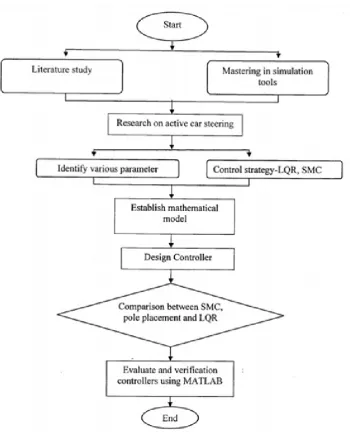
and make sure the project is running smoothly. Figure 1.1 shows the flow chart of the
project methodology. The study of the literature review is firstly done, mostly using
the IEEE database as the main source to find the papers and journals regarding to the
related field of this project. The book about the controller including modern strategy
mathematical model that will be used. The study on the MATLAB/SIMULINK
soft-ware has to be done in order to simulate the final results of the controller system. The
single track mathematical model is used in this research. This mathematical model is
very useful as to represent the dynamic system. After implementing the
mathemati-cal model to the MATLAB/SIMULINK, the simulation of controllable system can be
observed and analyzed. Then the controller is designed to enhance the stability and to
[image:22.595.122.473.241.679.2]reject the undesired steady state error.
6
1.6 Thesis Structure
The contents of this thesis are about the flow of the project report. This thesis consists
of five chapters. In the chapter I, the project overview which the objective, scope
of work, problem statement and project methodology are briefly deliberated which
purposely to provide the reader an understanding of the project introduction.
Chapter II, embracing the literature review of the project which includes the
conception, principle, perspective, and the method of the project that is used in
or-der to solve the problem occurs and any assumption that related with the research of
methodology.
Chapter III is about the investigation methodology of the project. This chapter
will discuss the method or approach that used in project development such as
mathe-matical modeling and also includes the software aspect.
Chapter IV discusses briefly on the observation, result and the analysis of the
project that the achievement during the development of project. This chapter also
consists of the final result of the project.
Chapter V covers the discussion of whole contents of the thesis and project
and the recommendation for improvement process in the future research and overall
CHAPTER 2
LITERATURE REVIEW
2.1 Introduction
The derivations on the modeling of the active car steering systems with linearization
model plant are presented in detail in this chapter. A mathematical derivation is
estab-lished in state space equation of the active car steering. Furthermore, the assumptions
that have been added to the single track car model will be described. In order to
differ-entiate dry and wet road performance, several values of road coefficient, µ are used.
The disturbance profiles which are considered as the disturbance input torque are also
presented in the end of this chapter.
2.2 Background
There are many researches on active safety systems for ground vehicles are having been
up to recent years due to motivated by the ever increasing demand for safety against car
accidents. The active safety systems are included active steering and independent brake
intervention. Active safety systems are developed based on the "by-wire" technologies
to drive the devices independently of the driver’s operation [6]. The by-wire driven
steering and braking systems which are dealt with this article are generated in large
quantities lately [7]. Hence, the by-wire driven active four wheel steering and active
braking system is assumed to be equipped in the vehicles. In order to improve vehicle
lateral stability, the yaw moment is directly controlled by direct yaw moment control
systems by generating differential braking forces between left and right wheels [6].
The lateral tire forces are controlled by the active four wheel steering systems by
gen-erating independent steer angles of front and rear wheels to improve vehicle handling
and stability. Usually, the performance of each control system depends on the status of
8
By modulating the lateral tire forces, the active steering can regulate the tire slip
angle and affect the vehicle handling behavior. There are three types of active steering
which are Active Front Steering (AFS) [8] [9] [10], Active Rear Steering (ARS) [11]
and Active Four Wheel Steering (W4S) [12]. By using disturbance observer control
method [8] [13], sliding mode control [14], predictive control [9], or other control
tech-niques, this latter may be established. By applying an additional steering angle to the
driver’s steer command, normally the active handling control will serve a steering
sup-port system. The AFS potential is usable once Steer-by-wire technology is established
because of the extra steering action.
The lateral acceleration of the front axle may be robustly triangularly decoupled
from the yaw rate dynamics [15]. This is because it is using only the front wheel
steering angle as a control input which is feeding back the yaw rate error through an
integrator. For braked and unbraked driving condition, a PI active steering control on
the yaw rate tracking error with different gains is used [16]. In order to ensure safety
also during a system failures,the active front steering is designed [17]. The wheel
steering angle,δf is the sum of the designed feedback control,δcand the driver input,
δp[18].
The development of electro actuated differentials allows for new control
strate-gies in vehicle systems dynamics control [19] [20]. The differential control system is
semi-active which the electronic control system can decide the locking torque
trans-ferred but not its direction [19]. While the transfered torque is generated from the
fastest wheel to the slowest one and the control operates when the rear wheels speed
difference exceeds a given threshold. A proportional-integral control law computes
the value on the measured and the desired rear wheel speed angular velocity. The
pro-posed controller is designed following the Internal Model Control approach and since
it can generate yaw moments of every amount and direction thus it is activated [20].
According to a Lyapunov analysis, it is electronically controlling the locking action of
the rear differential [18] [21].
An integrated control of active front steering and direct yaw moment which
program (ESP) is integrated with the active front wheel steering, active suspension and
active anti roll bar [23]. Four wheel steering are coordinated with wheel torque
dis-tribution by using an optimization approach is shown [24]. A non linear optimization
is approached to determine the optimal force to be exerted by each tire controlled by
active steering and brake pressures distribution [18] [25].
Active front steering is a newly developed mechatronic steering system for
pas-senger cars that realizes an electronically controlled superposition of an angle to the
hand steering wheel angle that is prescribed by the driver, cf [26].
A steering aid system integrated in cars is known as Active Steering. There
are many different systems with different control strategies on the market. The main
purpose is to improve safety and comfort of the vehicles by improving the stability and
handling of the steering. The actuators are still used to influence the mechanical system
even though the regulations demand a mechanical connection between the steering
wheel and the steering rack.
Active steering is an effective way that can improve drivers comfort and
han-dling. The vehicle handling and lateral stability can be controlled at the same time, if
both the external yaw moment and active steering angle are adopted [27].
Active steering can be said as an integrated steering support system for cars.
The system is like the steering on conventional cars but with additional functionality
which can withstand with disturbances. For example,µ-split which is a split adhesion
coefficient between wheels, wind gusts or decreased road adhesion conditions. There
are various types of systems are conceptual and not intended for the market. However,
BMW has a semi-mechanical system installed on the five hundred and thirty cars.
The main purpose for changing the steering characteristics of a car is to improve
safety and comfort of the vehicle. The following sections will describe a specific
10
2.3 Research of Active Front Steering System
The steering system can be said is an important role of making car convenient to handle
and enhance the vehicle stability. The steering system development has experienced
many stages,and the newest technology of steering system for passenger cars is the
Steer-by-Wire system (SBW). However, the Steer-by-Wire system is permitted by state
regulations because of it has not yet accepted by public consumers in the
considera-tion of the reliability and safety of the system. A newly technology for passenger cars
which is developed by BMW is Active Front Steering (AFS). This technology is
im-plementing an electronically controlled superposition of an angle to the hand steering
wheel angle which is prescribed by the driver. However, the connection of permanent
mechanical between steering wheel and road wheels are remained [1]. The vehicle
performance can be adjusted by AFS through intervening the road wheel angle in
con-dition of the driver have top priority.
For the active steering system, the variable steering gear ratio function will be
experienced by the driver first. Then perceive the improvement of steering portability
[1]. According to the vehicle’s motion state, AFS enables continuous and
situation-dependent variation of the steering ratio. Therefore, the maneuverability of the vehicle
at low speed and the stability at high speed are improved by the AFS. The performances
of the improvement of the stability with active steering system depend on the variation
quality of the steering ratio to a certain extent. Thus, the variable steering gear ratio
function is important to be investigated.
Active steering system is comprised of a double planetary gear and an electric
actuator motor additionally which is compared with traditional mechanical steering
system [1]. The AFS is reliable and safe due to all the links from the steering wheel to
road wheel are mechanical. AFS can ensure that the vehicle is under driver’s control
and make driver have a clear road feel. From the Figure 2.1 below shows that the
AFS’s planetary gear have two degrees of freedom (DOF), the planetary gear output
connects with the steering gear’s pinion and one input connects with the steering wheel
Figure 2.1: (a) Schematic view of AFS system; (b) 3D-model of planetary gear set and electric motor [1].
2.4 Vehicle Dynamics Modeling
According to the SAE standard which is described in SAE J670e, the vehicle axis
system used throughout the simulation [28]. First, the derivation of that model which
includes the tire model is discussed. The motion equations are converted into a state
space form for easily to do integration and a Third Order Runge-Kutta integration is
used as the integration algorithm. Lastly, in order to show its validity, the vehicle
model is verified against results from Smith et al. [2].
2.4.1 Vehicle Axis System
According to SAE J670e [28] as shown in Figure 2.2 below, the coordinate system is
used in vehicle dynamics modeling. The x-axis which is referred to the forward
direc-tion or the longitudinal direcdirec-tion. while the y-axis is referred to the lateral direcdirec-tion
which is positive when it points to the right of the driver. And lastly, the z-axis is
represented to the ground satisfying the right hand rule.
Only the X-Y plane of the vehicle is considered which among most studies
12
Figure 2.2: Vehicle Axis System after SAE [2].
used in the study of ride, pitch, and roll stability type problems [2]. The relevant
definitions for the variables associated with this research are defined in the following
list.
Longitudinal direction which is a forward moving direction of the vehicle.
There are two different types of methods to look at the forward direction. One of
them is with respect to the vehicle body itself and the another is with respect to a fixed
reference point. When dealing with acceleration and velocity of the vehicle, the
for-mer is often used. The latter is used during the location information of the vehicle with
respect to a starting point or an ending point is desired [2].
While the lateral direction is a sideways moving direction of the vehicle. Same
as the longitudinal direction, the lateral direction also has two ways of looking which
are with respect to the vehicle and with respect to a fixed reference point. The
ex-treme values of lateral acceleration or lateral velocity can decrease the stability and
controllability of vehicle.
The tire slip angle is equivalent to heading in a given direction but walking at
an angle to that direction by displacing each foot laterally. Because of the presence of
lateral forces the foot is displaced laterally.
Lastly, the body-slip angle is the angle between the X-axis and the velocity
vector that represents the instantaneous vehicle velocity at that point along the path
Although the concept is same, but each tire may have different slip angle at the same
time. Sometimes the body slip angle is calculated as the ratio of lateral velocity to
[image:30.595.158.486.157.383.2]longitudinal velocity [2].
Figure 2.3: Vehicle Axis System after SAE [2].
2.4.2 Vehicle Models
There are many types of degrees of freedom (DOF) which are associated with
vehi-cle dynamics. A two-degree-of-freedom bicyvehi-cle model is the most simplified vehivehi-cle
dynamic model which is representing the lateral and yaw motions. The idea for this
model is that sometimes the longitudinal direction is not necessary or desirable to be
included due to the lateral or yaw stability of the vehicle does not be affected by the
longitudinal direction. Usually this model is used in teaching purposes. Figure 2.4
14
Figure 2.4: Two Degree of Freedom Model [2].
While for a three-degree-of-freedom model, it adds longitudinal acceleration to
the model. Thus, it enables one to describe the full vehicle motion in the X-Y plane.
The longitudinal velocity, U, and the longitudinal force,Ft f andFtr, are included into
the model which is shown in the Figure 2.5. This is the model that is used in this
project [2].
Figure 2.5: Three Degree of Freedom Model after Smith [2].
Lastly, the symmetry in dynamic behavior between right and left sides is no
longer assumed for an eight-degree-of-freedom model. Instead of two tires, the
rota-tional degree of freedom for each of the four tires is considered in this vehicle model.
A rolling motion,φs is added between left and right sides of the vehicle. This model
is frequently used in the suspension design or ride comfort analysis, especially for the
[image:31.595.165.479.367.470.2]Figure 2.6: Eight Degree of Freedom Model after Smith [2].
2.5 Car Modeling
From the Figure 2.7 below shows that the car is modeled as a rigid body with mass
mand moment of inertiaJ with respect to a vertical axis through the center of gravity
(CG). The yaw angle ψ rotates the chassis coordinate system x,ywith respect to an
inertially fixed coordinate systemx0,y0. The yaw rate is r=ψ which is measured by
a yaw rate sensor. The yaw rate will be used as one of the state variables in the state
vectorx[29].
[image:32.595.182.462.521.704.2]16
The most significant uncertainties for modeling the motion of this vehicle are
the lateral forcesFyR which is at the rear axle andFyF which is at the front axle. The
lateral forces and rear axle are depended on the state x of the car. The front lateral
force depends on the front wheel steering angleδF. In the automotive literature there
are tire models that give the lateral forces. Yet, the forces are described in terms of
other quantities, such as the road friction coefficient µ. Therefore, the forcesFyR and
FyF directly as the uncertain quantities.
A position at a distance lp in front of the CG is needed to be chosen as the
lateral accelerationayPat this point does not depend onFyR. It is a calculation of a few
lines to find the position and the calculation is shown in (2.1).
lp= J
mlR (2.1)
Thus, the lateral acceleration is
ayP= l
mlRFyF(x,δF) (2.2)
wherel=lR+lF is the wheelbase which can be seen at Figure 2.7
2.5.1 Mathematical Modeling For a Single Track Model
In the Figure 2.8, it shows the implementation of a steering control system. The driver
is handling the main steering angle, δS from the steering wheel. An actuator sets a
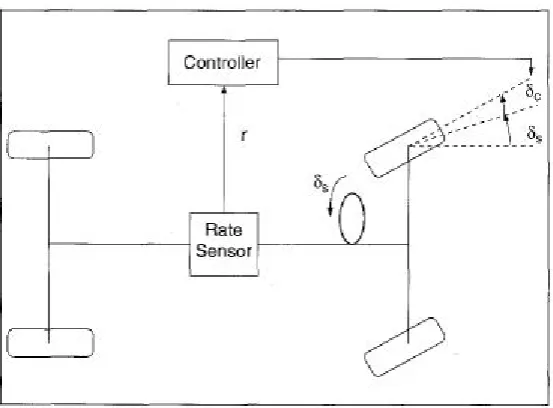
small corrective steering angle with input from a feedback controller. The yaw rate
and the superpositionδF =δS+δCis the main feedback signal which can be arranged
mechanically. The tire forces are depended on the state variables of the chassis and
Figure 2.8: The steering angleδF =δS+δCis composed of the commandδS, from the
driver and the feedback controlled additional angleδC.
A single track car model is used to describe the dynamics of vehicle steering.
By combining the two front wheels into one wheel which refers the center line of the
car, same as the two rear wheels, the single track model is obtained. Thus, in Figure
2.9 below shows the car model is reduced which describes the yaw rate and lateral
motions.
[image:34.595.154.494.523.691.2]18
The anglesδF andδR are referred to the front and rear steering angles
respec-tively. The distance between the center of gravity (CG) and the front axle is represented
aslF and rear axle is represented aslR. Thus, the wheelbase is referred to the sum of
the front axle and rear axle,l=lR+lF. The vehicle sideslip angle which is the angleβ
is the angle between the vehicle center line and the velocity vectorvat the CG. In the
horizontal plane which is shown in Figure 2.9 shows that an initially fixed coordinates
system(x0,y0)is together with a vehicle fixed coordinates system(x,y)that is rotated
by a yaw angleψ. In the dynamic equations, the yaw rater:=ψ will appear as a state
variable.
The model of automatic car steering will include the yaw angle ψ where the
position of the vehicle relative to the lane is considered. The forces which are the side
forcesFytF andFytR that are transmitted between the road surface and the car chassis
through the wheels are shown in Figure 2.9. The forces in the longitudinal direction of
[image:35.595.160.480.416.549.2]the tires are assumed to be zero for example the wheels are freely spinning.
Figure 2.10: Lateral forcesFytFat the front wheel in tire coordinates andFyF in chassis
coordinates.
The velocity vector vF which under a sideslip angleβF at the front axle with
respect to the longitudinal axis (x-axis) of the chassis is represented in Figure 2.10. A
function of the tire slip angleαF =δF−βF is known as the lateral forceFytF in tire
coordinates. The dominants component in chassis coordinates is shown in equation
FyF =FytFcosδF (2.3)
If it occurs symmetrically at the left and right wheel, the small retarding
com-ponentFxF =−FytFsinδF does not generate a yaw torque. The longitudinal effect is
compensated by speed control. The speed control is automatic or controlled by the
driver. In a static tire description, the tire side forces FytF is a function of the tire slip
angleαF.
FytF= f(αF) = f(δF−βF), (2.4)
FyF = f(δF−βF)cosδF (2.5)
The front wheels are indicated by the index F which it is replaced by R for the
rear wheels. The lateral force is zero, f(0) =0 if the velocity vectorvF is aligned with
the tire. The lateral force is close to saturate for αA >10. A control system cannot
overcome on the physical limits. Thus, design steering controllers is very important
for that only small tire sideslip angles occur.
The lateral forces at the front and rear axles are the inputs to the vehicle dynamics
which shown in equation below:
FyF =FytFcosδF
FyR=FytRcosδR
(2.6)
While for longitudinal force component:
20
These forces represents the sum of the forces at the left and right tire. Through
the dynamics model, the forces control state variables are β, v and r. The motions
equations for 3-Degree-of-Freedom in horizontal plane
are:-1. Lateral motion
mv(β+ψ)cosβ+mvsinβ =FyF+FyR (2.8)
2. Longitudinal motion
−mv(β+ψ)sinβ+mvcosβ =Fx (2.9) 3. Yaw motion
Jψ=FyFlF−FyRlR+MzD (2.10)
It is obtained from equations (2.8) to (2.10) withr:=ψ.
mv(β+r)
mv Jr =
-sinβcosβ0
cosβsinβ0
001 Fx FyF+FyR FyFlF−FyRlR+MzD
(2.11)
From the kinematic model which denotes the steering angles δF,δR and the
state variables β,randv, the sideslip anglesαF andαR at the front and rear tires are
obtained. TheβF andβR are the front and rear chassis sideslip angles. The velocity
components in the longitudinal direction of center line of the vehicle is equal
The yaw rate, r will affect the relationship between the velocity components and the center line, as it is shown as below:
vFsinβF =vsinβ+lFr
vRsinβR=vsinβ+lRr
(2.13)
By the corresponding terms from equation (2.12), the velocity terms vF and vR are
eliminated by division. So that, the kinematic model is
tanβF =
vsinβ+lFr
vcosβ =tanβ+
lFr
vcosβ
tanβR=
vsinβ+lRr
vcosβ =tanβ+
lRr
vcosβ
(2.14)
In Figure 2.10, it shows that the tire sideslip angles are
αF =δF−βF
αR=δR−βR (2.15)
By the non-linear tire model, the feedback-structured model is completed:
FytF= fF(αF)
FytR= fR(αR)
22
2.5.2 Linearization for Constant Velocity and Small Angles
The vehicle dynamics which is shown in equation (2.11) are nonlinear. By taking the
assumptionv=0, these equations can be linearized. It can be justified because of the
velocity, v is changing more slowly than the state variables r and β. The velocity, v
is now treated as an uncertain constant parameter. In addition, the force component
Fxsinβ is neglected. Next, the linearized version of equation (2.11)
is:-
˙
mv(β+r) ˙ Jr =
(FyF+FyR)cosβ
FyFlF−FyRlR+MzD
(2.17)
Due to the chassis sideslip angles such asβ,βF andβR are small, thus cosβ =1 and
becomes:-βF =β+lFr/v
βR=β+lRr/v
(2.18)
Then, the steering angles such as δF,δR are small as well, for the rear wheels the
cosδF =1 and cosδR=1. Thus,
FyF =FyF(αF)
FyR=FyR(αR)
(2.19)
The equations above are the unknown characteristics. Hence, the equation (2.17) will
become:-
˙
mv(β+r) ˙ Jr =
FyF(αF) +FyR(αR)
FyFlF−FyRlR+MzD
(2.20)
From the Figure 2.8 for the feedback control , the steering anglesδF is the sum
of the driver commandδswith the corrective angleδcwhich both of them are generated
by the feedback system. The relationship betweenδs,δcandαF,βF are demonstrated
by Figure 2.10.
The lateral tire forces are now linearized about a zero tire sideslip angle as in
equation (2.16) in order to allow for a linear analysis of the car.
FyF(αF) =µcF(αF)
FyR(αR) =µcR(αR)
(2.21)
The cornering stiffness is the slope cF and cR of the tire characteristic. The
friction coefficient µ <=1 is assumed that both the front and rear wheels are same.
The representative values of the friction coefficientµ are:
µ =1(dryroad)
µ =0.5(wetroad)
µ =0.15(icyroad)
Thus, equation (2.20) is interpreted forβ andrby substituting the linearized tire
char-acteristicsFyF andFyR:
˙ β ˙ r = µ
mv(cFαF+cRαR)−r
µ
J(cFlFαF+cRlRαR) + 1 JMzD
(2.22)
![Figure 2.1: (a) Schematic view of AFS system; (b) 3D-model of planetary gear set andelectric motor [1].](https://thumb-us.123doks.com/thumbv2/123dok_us/135142.13056/28.595.119.543.74.204/figure-schematic-view-afs-model-planetary-andelectric-motor.webp)
![Figure 2.2: Vehicle Axis System after SAE [2].](https://thumb-us.123doks.com/thumbv2/123dok_us/135142.13056/29.595.157.486.71.232/figure-vehicle-axis-system-after-sae.webp)
![Figure 2.3: Vehicle Axis System after SAE [2].](https://thumb-us.123doks.com/thumbv2/123dok_us/135142.13056/30.595.158.486.157.383/figure-vehicle-axis-system-after-sae.webp)
![Figure 2.4: Two Degree of Freedom Model [2].](https://thumb-us.123doks.com/thumbv2/123dok_us/135142.13056/31.595.165.479.367.470/figure-two-degree-of-freedom-model.webp)
![Figure 2.7: Unknown rear and front axle lateral forces act on the car body with massm and moment of inertia J [3].](https://thumb-us.123doks.com/thumbv2/123dok_us/135142.13056/32.595.171.473.79.301/figure-unknown-rear-lateral-forces-massm-moment-inertia.webp)