0022-538XI89/031460-05$02.00/0
Copyright© 1989,American Society for Microbiology
Inhibition
of RNase
H
Activity and
Viral
Replication
by Single
Mutations
in
the 3'
Region of Moloney
Murine Leukemia Virus
Reverse
Transcriptase
ROY REPASKE,1* JANET W. HARTLEY,2 MARK F.
KAVLICK,'
RAYMOND R. O'NEILL,3ANDJOAN B. AUSTIN2
Laboratory ofMolecular
Microbiology'
andLaboratory of Immunopathology,' National Instituteof Allergy and InfectiousDiseases, andDevelopmentaland Metabolic Neurology Branch, NationalInstitute of NeurologicalandCommunicative Disorders andStroke,3 Bethesda, Maryland20892 Received 1August 1988/Accepted 29November 1988
Selected conserved amino acidsin theputativeRNase Hdomain of reversetranscriptase (RT)weremodified inamolecularly cloned infectious provirus andin aMoloneymurine leukemia virus RTexpression vectorby site-directed mutagenesis. Substitution of either of two conserved aspartic acid residues in proviral DNA preventedproduction of infectiousparticlesintransfectedNIH3T3cells,and the same modificationsdepressed RT-associated RNase Hactivity by morethan25-fold with little or no effect on polymerase activity.
Reversetranscriptase (RT), encoded byamajor portion of the retroviral pol gene, possesses three catalytic activities
required for retroviral replication: RNA- and
DNA-depen-dent DNApolymerase and RNase H (14, 36). Thefunctional domain of RNA-dependent DNA polymerase has been as-signed to the N-terminal region of RT on the basis of results foravariety ofmutants(10, 11,26,32). Conserved retroviral amino acids have been identified in this region (16, 33), and these amino acids arefound in certain DNA viruses which express RNA-dependent DNA polymerase activity (17, 31, 33) aswell asin othergenetic elements havingputative RT
polymerases(13, 34). Thecorrelation ofpolymeraseactivity
with these conserved sequences suggests a functional role for these residues.
Johnsonetal.(8)proposed the C-terminal 160amino acids of Moloney murine leukemia virus (M-MuLV) RT as the RNase H domain on the basis of extensive amino acid homologywith Escherichia coli RNase H, although signifi-cantly fewer conserved sequences were found when align-ments included other RTs. Tanese and Goff (32) provided experimental support for this proposal by demonstrating with a series of linker insertion mutants that M-MuLV
polymerase and RNase H activities are associated with the
N- and C-terminal regions, respectively, of RT. In an
ex-panded sequence alignment ofE. coli RNase H with many
retroviralpol sequences (Fig. 1), eight invariant amino acid residues are present in all retroviral pol genes; of these, six residues (Fig. 1, stars) are common to both RTs and E. coli RNase H, and two (Fig. 1, carets) are unique to RT se-quences. For reference, the positions of the conserved amino acids within the sequence are identified in Fig. 1. Relatedness of these dispersed conserved amino acids is supported by their relative positions in the sequence as well as by the context of their highly conserved flanking amino acids (Fig. 1, underlines). For example, in region A, the
single conserved aspartic acid is usually flanked by Tyr or
Phe and Thr or Ser on theN-terminal side and by Gly and Ser on the C-terminal side. On the assumption that con-servedamino acids may be associated with important func-tional properties of the enzyme, certain amino acid residues
*Correspondingauthor.
in theAand Cregions(Fig.2)weremodifiedby site-directed
mutagenesis. Effects on M-MuLV replication and on
poly-merase andRNase H activities were evaluated.
Of the four amino acids modified (Fig. 2), two were conserved Aspresidues. Mutants 8-9 and 116 contained base changes which encodedGly instead of Aspin regionA and Cys instead of Asp in region C, respectively(Fig. 1 and 2). Mutant 0-4 is a double mutant containing the mutation present in 8-9 and an Asn-to-Asp change in region C (Asn was conserved only in RT sequences [Fig. 1]). The fourth mutant, 46-4, has a Leu residue replacing the Thr which occursinmostRTsequences and inE.coliRNase H(region C). The 46-4 mutation was also back-mutated (Leu->Thr,
designated 46-4R) to reestablish the normal sequence. M-1 wasthe control, withunmodified M-MuLV DNA sequences. Mutationswere introduced intoacloned, circularly permu-tated infectious M-MuLV provirus that was originally iso-latedfrom aHirtsupernatant (7) and cloned intopBR322 at the Sall site(provided by S. K. Chattopadhyay and cloned
by C.-M. Wei). Mutagenesis was performed on a 1.5-kilo-baseSphl segment(extendingfrom the SphI site in pBR322 to the same restriction site in pol of M-MuLV) subcloned into M13mpl8. The method of Zoller and Smith (38) was
used for oligonucleotide-directed mutagenesis with an
ap-propriatelymismatchedsyntheticoligodeoxyribonucleotide.
Theentire 1.5-kilobase mutated SphI insertwas sequenced
(24) to confirm that other mutations had not occurred. Deleted M-MuLV pBR322 was reconstructed with the mu-tated SphI fragment, Sall restricted to releasetheprovirus, and concatemerized forusein transfection.
Generation ofinfectious progeny virus by transfected NIH 3T3 cells was determined by the XC plaque assay (22). Transfection with each mutantDNA was performed with a confluent culture ofNIH 3T3 cells by the CaPO4 precipita-tion method (3). At 24 h, each transfected cell culture was rinsed with serum-free medium, trypsinized, and split. Rep-resentative resultsforsyncytium-inducing activity in the XC plaque assay in one setof dishes are presented in Table 1, column 1. Infectious virus from transfection with parental MoloneyM-1(positivecontrol)wasreadily detected. Onthe other hand, no XC plaques were found with transfected DNA from mutants 8-9 (four tests), 0-4 (six tests), or 116 1460
on November 10, 2019 by guest
http://jvi.asm.org/
A B
M-MuLV Ra-MuLV RSV BLV MMTV SRV MPMV sIV VIs LAV
HIV2(ROD) HTLV1
coli RNase H
M-MuLV Ra-MuLV RSV BLV
MMTV
SRV
IWMV sIV
VIs LAV
HIV2(ROD) HTLV1
coli RNase H
WYTDGSSLLQEGQRXAGAAVTTETEVIWAKALPAG!lSAQRAE.LIALTQALKMAZGKK
lYT-*GSSFLQEGQRKAGAAVTTETEVIWARALPAGTSAA^RA*LIALTQALKMAEGKR
VFT*ASSSTHXGVVVWREGPRWEIXEIADLGA
SVAQL*ARAVA4ALLLWPTTP
LFS*GATGRGAYCLWKDRLLDFQAVPAPE SAAKG*KAGLLAGLAAAPPEP
IFT*GSANGRSVTYIQGREPIIKENTQN TA^QA*IVAVITAFhEVSQS
VFT*AALVGSSTMAYTLADTTI*FQTNLN
*LQALIAVLSAFPNQPVFT*GUSTGMAAYTLTDTTIKFQTNLN
!SA^LV*LQALIAVLSAFPNQP
YYV*GSCSKQSKEGKAGYITDRGKDKVRVLEQT TNAQA*LEAFLMALTDSGPK YYT*GGKKNGRGSLGYIASTGEKFRIHEEG TNAQL*LRAIEEACKQGPEK FYV*GARETKLGKAGYVTNRGRQKVVTLTDT
TNAKT*LQAIRLALQNSGLE
FYT*GSCNRQSKEGKAGYVTDRGKDKVKKLEQT TNAQk*LPEAFAMALTDSGPKSSA*GSTSRAAYILWDKQILSQRSFPLPPPHX
SARA*LLGLLNGLSSARSWRC
IFT*GSCLGNPGPGGYGAILRYRGREKTFSAGYTRTTNNRM*LMAAIVALEALKEHCEC
LNVYTDSRYAFATAHIRGEIYRRRGLLTSEGKEIKNKDEILALLKALFLPKRLSIIH L^VYT**RYAFATAHIHGEIYKRRGLLTSEGREIKNKSEILALLKALILPKRLSITIH TAVVT**AFVAKMLLKMGQEGVPSTAAAFILEDALSQRSAMA
VAIWV**KYLYSLLRTLVLGAWLQPDPVPSYALLYKSLLRHPAI FALYT**KYVTGLFPEIETATLSPRTKIYTELRHLQRLIHKRQEKF LAIYT**AYLAHSIPLLETVAQIKHISETAKLFQCQQLIYNRSEPF LAIYT**AYLAHSIPLLETYAQIKHISETAKLFLQCQQLIYNRSIPF A^IIV**QYVMGIITGCPTESESRLVNQ IIEEMIK KTEIYVAWVPAHKG MAIVT**RYAYEFMLRNWDEEVIRNPIQARIMELVHNKEKIGVHWVPGHKG VAIVT**QYALGIIQAQPDKSESELVNQ IIEQLIK KEKVYLAWVPAHKG
VAIIV**QYVMGISASQPTESESKIVNQ IIEEMIK KEAIYVAWVPAHKG LAIFL**KYLYHYLRTLALGTFQGRSSQAPFQALLPRLLSRKVV
VILST**QYVRQGITQWIHNWKKRGWKTADKKPVKNVDLWQRLDAA
D
M-MuLV Ra-MuLV
RSV
BLV MMTV
SRV MPMV
sIV
VIs
LAV
HIV2(ROD) HTLV1
coli RNase H
I
CPGHQKGHSAE ARGNRMADQAARKAAITETPDTSTLL CLGHQKGDSAE ARG*RLA*QAAREAAIKTPPDTSTLL AVLHVRSHSEVPGFF TEG*DVA*SQATFQAY
VVGHVRSHSSASHPI ASL*NYV*QLL.. YIGHIRGHTGLPGPL AQG*AYA*SLTRIL..
YIGHVRAHSGLPGPI AHG*QKA*LATKTVASNINTNL.. YIGHVRAHSGLPGPI AQG*QRA*LATKIVASNINTNL..
IGG*QEI*HLVSQGIRQVL.. IPQ*EEI*RYISEIFL.. IGG*EQV*KLVSAGIRKVL IGG*QEV*HLVSQGIRQVL.. WLHHVRSHTNLPDPI SRL*ALT*ALLITPVLQL..
LGQHQIKWEWVKGHAGHPE*ERC*ELARAAAMNPTLEDTGYQVEV
FIG. 1. Amino acidhomologybetweenC-terminalM-MuLV RT sequences, otherretroviral pol sequences, and E.coli RNase H. Symbols indicateamino acids conserved in all sequences (*), conserved in all retroviralpolsequences but not in the E.coliRNase H sequence ( ^ ), andhighlyconserved (-). Letters A to E above the sequences indicate regions with clusters of homologous sequences. Sequences shown andnucleotide reference numbers correspondingtothefirstcodon are as follows: M-MuLV, 1458 (28);radiationMuLV (Ra-MuLV), 4172 (12);Rous sarcoma virus(RSV), 3841 (25); bovine leukemia virus (BLV), 3628 (23); murine mammary tumor virus (MMTV), 1366 (2); simian retrovirus (SRV),4602(18); Mason-Pfizer monkey virus (MPMV), 4590 (30); simian immunodeficiency virus (SIV), 3652 (1); visna lentivirus (VIS), 3416 (29);lymphadenopathy-associatedvirus (LAV), 3413 (37); humanimmunodeficiency virus[HIV2(ROD)],3695 (4); humanT-cell leukemiavirus(HTLV1), 3709 (27);andE.coliRNase H, 19 (9).
(one test) initially or after 2 to 10 subsequent cell culture
transfers.The results ofinfectivitytestsofsupernatant fluids
from NIH 3T3 or SC-1 (5) transfected cells were also
negative (data not shown). Unlike the negative results
ob-tainedwith these mutants, a small number of plaques were
obtained with mutant 46-4. Mutant 46-4, which had been
back-mutatedtowild-type sequence (46-4R), gave aplaque
countequal to thatobtained with the M-1 control.
Rescue ofreplication-defective ecotropic M-MuLV may be achieved by superinfection with competentXC-negative
helper viruses, such as amphotropic or mink cell
focus-forming (MCF) MuLVs (19). XC-negative, infectious
am-photropic MuLV (MuLV-A) was simultaneously added to
transfected cells in the second dish of each set (104-4 mink
S+L-focus-formingunitsof strain1504A)(6)toevaluate the
effect ofa helper virus (Table 1). Under these conditions,
virus was rescued from cells transfected with
replication-defective mutants 8-9, 0-4, and 116. Rescue could also be
effectedby cotransfection with MCF MuLV proviralDNA
(Table 1). Superinfection with MuLV-A produced no
in-crease in the number of XC plaques obtained with M-1 or
46-4Rtransfected DNAs. In contrast, a100-fold increasein the numberofplaques resultedfrom
superinfection
of mu-tant46-4. Amplificationof XC plaques suggests thatmuta-tion 46-4partially suppressedviral replication.
Virus rescued by superinfection with MuLV-A had
phe-notypic propertiesconsistent with those of M-MuLV:
inter-ference assays showed that the virusexpressedafunctional
ecotropic envelope(datanotshown),andrescuedvirusalso
retained the NB
tropism
of theparental
M-MuLV(data
not shown).Theeffect of the mutationsonthefunction of
polymerase
on November 10, 2019 by guest
http://jvi.asm.org/
[image:2.612.106.498.66.466.2]A 4158
M-MuLV TGG TACACGGAT GGA AGC ...(156bp)...
trp tyr thr asP gly ser
* * * * * *.
* * * GGT * *
gly
e * GGT *
gly
*
* * * * * *
* * * * *
C 4329
CTAAATGTT TAT ACTGAT AGC CGT TATGCT
leU asn val tyr thr asp ser arg tyr ala
* * * * * * * * * *
* * * * * * * * * *
* GAT *
asp
* * * *
* * * * CTA * *
leu
* * * * * TGC *
cys
FIG. 2. Mutations introduced in the C-terminal RT region of M-MuLV by site-directed mutagenesis. The normal M-MuLV proviral
sequencein theC-terminal region of RT, nucleotidesequencereferencenumbers, anddeduced amino acids(28)areshown with thefirst entry.
Mutantdesignations, nucleotide changes (underlined), and amino acid changesareindicated. Symbolsandabbreviations:*,normal M-MuLV sequencesin thatposition;A and C, regions corresponding tothose showninFig. 1; M-1, control with normal M-MuLV sequences which weremanipulated in thesame way asmutant sequences;bp, base pairs.
and RNase H activities was assessedwith cloned M-MuLV RT. For this purpose, vector pB6B15.23 (21), which ex-pressesanenzymaticallyactive RT fusion protein inE.coli, was used. Identical mutations describedforproviral DNAs
wereintroduced intotheexpression vectorby replacing the
BglII-SphI fragment in the vector with the equivalent
mu-tatedfragmentfromM13 containingthemutation. Designa-tions used formutant RTs are the same as those used for proviral DNA. Before RTactivities in E. coliextracts were
determined, itwasnecessary topurify theRTfusion protein
(DEAE-cellulose and phosphocellulose column[21])to elim-inate E. coli-associated DNA polymerase and RNase H
activities. Protein concentrations of the partially purified
enzymes weredetermined by directdensitometry of the RT protein bands on a 10% sodium dodecyl
sulfate-polyacryla-mide gel stained with Coomassie blue. Single 71-kilodalton reactive bands were identified by immunoblot analysis (35)
with RT-specific polyclonal rabbitantibody.
Specific activities forincorporation of each
3H-deoxynu-cleoside triphosphate [3H]dNTP) with its respective
ho-mopolymer template-primer pair were determined, since
mutation may haveaffected thepolymerase activity ofonly
one ofthe four nucleotide substrates. Reaction rates with
[image:3.612.99.514.69.208.2]poly(rI) oligo(dC)12 18 and poly(rC)
oligo(dG)12-18
wereTABLE 1. Detectionofreplication-defective M-MuLV mutants LogloXCplaquesperdish"aftersuperinfectionor Mutant cotransfection with:
([LgofDNA) MCFMuLV
Novir-us MuLV-A DNAb
NOne-C, _* ?-* _*
None
M-1(0.5) 3.0
M-1(0.1) 1.6 1.6
8-9(1.0) -, * 1.6
0-4(0.5) 2.6* 3.6*
116(0.5) 2.7
46-4(0.5) 1.0 2.9
46-4R(0.5) 2.2 2.4
"XCtestswereperformed5to 6daysafter transferof transfected NIH 3T3 cells.In some cases (*),105 SC-1cells were addedto the assay plates in an attempt toamplify virus.
bCultureswerecotransfectedwith 0.2 ,ug of AKR13 MCFMulLVproviral
DNA(providedby A. S. Khan). '-,Noplaques detectable.
increased by making a separate cocktail of preheated
poly(rI)oroligo(dG) (90°C, 1min) before thecorresponding
oligonucleotide or polynucleotide and dNTP were added. The reaction mixture (21) was modified by replacing NaCl with 55 mM KCI and increasing Nonidet P-40 to 0.09%. Polymerase activitywasmeasured by therateof incorpora-tion of[3H]dNTP in the trichloroacetic acid-insoluble frac-tion retainedby nitrocellulose filters.
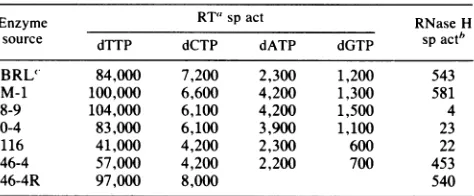
The rates of incorporation of each dNTP with mnutant enzymes8-9 and 0-4 are the same as the rates obtained with the unmodified control enzyme (M-1) andwith the reversed mutant(46-4R) (Table 2). Similar values were alsoobtained with the highly purified M-MuLV RT (Bethesda Research Laboratories). These data show that mutant enzymes 8-9 and 0-4 have normal polymerase activities witheach ofthe dNTPs. Consequently, mutations which caused proviral mutants 8-9 and 0-4 to be replication defective (Table 1) cannot be related to any change in polymerase activity. Enzymes 46-4 and 116 had RT activities with each dNTP substrate that were equivalent and about 50% lower than thoseof the normalcontrol, enzyme M-1 (Table 2). Provirus 46-4 was capable ofproducing infectious particles without helper virus, and provirus 116 was not (Table 1). The decreased polymerase activity observed, therefore, could
TABLE 2. RTand RNase Hactivities of normal andmutantenzymes
Enzyme RT" sp act RNaseH
source dTTP dCTP dATP dGTP spactb
BRL' 84,000 7,200 2,300 1,200 543
M-1 100,000 6,600 4,200 1,300 581
8-9 104,000 6,100 4,200 1,500 4
0-4 83,000 6,100 3,900 1,100 23
116 41,000 4,200 2,300 600 22
46-4 57,000 4,200 2,200 700 453
46-4R 97,000 8,000 540
" Assayforincorporation ofthespecificdNTP(0.019 mM)indicated. Each reaction was performed with the appropriate homopolymer polyribonucle-otide-oligodeoxyribonucleotide template-primer pair.Values are expressed as picomoles of[3H]dNTPincorporatedpermicrogramof enzymeproteinper 15 min.
b Picomolesofacid-soluble[3H]AMPreleasedpermicrogramof enzyme proteinper30 min.
'BRL,Bethesda Research Laboratories. M-1
8-9 0-4
46-4
116
* * *
* * *
* * *
on November 10, 2019 by guest
http://jvi.asm.org/
[image:3.612.65.300.549.668.2] [image:3.612.322.559.554.652.2]not by itself be a sufficient explanation for the replication defect inprovirus 116.
RNase H activity was measured by the release of tri-chloroacetic acid-soluble [3H]AMP from a [3H]RNA-DNA
M13 hybrid prepared with E.coli RNA polymerase (21). The assay was modified by the substitution of KCI for NaCl and the addition of0.1% Nonidet P-40. Enzymes with normal M-MuLV sequences (M-1, 46-4R, and BRL RT) solubilized
equal amounts of[3H]AMP per microgram ofenzyme
pro-tein in 30 min (Table 2). On the other hand, RNase H activitiesofmutantenzymes8-9, 0-4, and 116werereduced 25- to 130-fold. Inhibition may have been even greater,
because counts of released [3H]AMPjust exceeded
back-ground counts. The additional mutation (Asn to Asp) in mutant 8-9 whichproduced 0-4 had no detectable influence on RNase H activity; its effect, if any, could not be evalu-ated. Mutation 46-4 had little effect on RNase H activity. Modification of two adjacent amino acids (Fig. 2, Thr in mutant46-4 and Asp in mutant 116) produced dramatically different quantitative effects on RNase H activity. These results illustrate the amino acid specificity with regard to
function.
A direct correlation between mutations which severely
depressed RNase H activity and those which produced
defectivereplication of virus has been shown. In theputative
RNase H domain, substitution of either oftwo conserved Asp residues prevented productive infection of M-MuLV, apparently becauseofthe restricted RNaseHactivity. Such aresultwould beanticipatedinviewofthefunctional role of RNase Hin theretroviral life cycle (14,15,20),but it hasnot
beendirectly demonstrated by asingle codon sense change
in anotherwise complete viral sequence. These data do not address the question of whether the aspartic acids are constituents ofan active site or are required for
conforma-tionalintegrityof RNase H. However, they doidentify two
amino acids which could be targets for chemotherapeutic
intervention in retroviral infections.
WethankS. P. Goff forgenerously providingvectorpB6B15.23, S. K. Chattopadhyay for making available the infectious clone of M-MuLV, and A. S. Khanfor the cloneofAKR13MCF MuLV.
LITERATURE CITED
1. Chakrabarti; L., M. Guyader, M. Alizon, M. D. Daniel, R. C. Desrosiers, P. Tidlaus, and P.Sonigo. 1987. Sequence of simian immunodeficiency virus from macaque and its relationship to
other human and simian retroviruses. Nature (London) 328: 543-547.
2. Deen, K. C.,andR. W. Sweet. 1986. Murine mammarytumor
virus pol-related sequences in human DNA: characterization and sequencecomparisonwith thecomplete murine mammary tumorviruspolgene. J.Virol. 57:422-432.
3. Graham,F.L.,and A.J.vander Eb.1973. Anewtechniquefor the assayofinfectivity ofhuman adenovirus 5 DNA. Virology
52:456-467.
4. Guyader, M.,M.Emerman,P.Sonigo,F.Clavel,L.Montagnier,
and M. Alizon.1987.Genomeorganizationandtrans-activation ofthe humanimmunodeficiency virus type 2. Nature(London) 326:662-669.
5. Hartley, J. W.,and W. P. Rowe. 1975. Clonal cell lines froma
feralmouseembryo whichlackhost-rangerestriction for murine leukemiaviruses. Virology 65:28-134.
6. Hartley, J. W., and W. P. Rowe. 1976. Naturally occurring
murine leukemia viruses inwild mice:characterization ofa new
"amphotropic"class. J. Virol. 19:19-25.
7. Hirt, B. 1967. Selective extraction of polyoma DNA from infectedmousecell cultures. J. Mol. Biol. 26:365-369. 8. Johnson,M.S.,M. A.McClure,D.-F.Feng, J.Gray,andR. F.
Doolittle. 1986. Computer analysis of retroviral pol genes:
assignment of enzymatic functions to specific sequences and homologieswithnonviralproteins.Proc.Natl.Acad. Sci. USA 83:7648-7652.
9. Kanaya,S.,and R.J.Crouch. 1983. DNA sequenceofthe gene
coding for Escherichia coli ribonuclease H. J. Biol. Chem. 258:1276-1281.
10. Larder,B. A., D. J. M. Purifoy,K. L. Powell,and G.Darby.
1987. Site-specific mutagenesis of AIDS virus reverse tran-scriptase. Nature(London)327:716-717.
11. Levin, J. G.,S.C.Hu,A.Rein,L.I.Messer,and B.J.Gerwin. 1984. Murine leukemia virus mutant with aframeshift in the
reverse transcriptase coding region: implications forpolgene
structure.J. Virol. 51:470-478.
12. Merregaert,J.,M.Janowski,andE. P.Reddy.1987.Nucleotide sequence ofa radiationleukemia virus genome. Virology 158: 88-102.
13. Michel, F.,andB.F.Lang.1983.Mitochondrial class II introns encodeproteinsrelatedtothereversetranscriptasesof
retrovi-ruses. Nature(London)316:641-643.
14. Moelling, K., D. P. Bolognesi, H. Bauer, W. Busen, H. W. Plassmann,and P. Hausen. 1971. Association of viral reverse transcriptasewithanenzymedegradingRNAmoietyofRNA: DNA hybrids.Nature(London)234:240-243.
15. Omer,C.A.,and A. J. Faras.1982.Mechanism of release of the avianretrovirus tDNA'rPprimermolecule fromviral DNAby
ribonucleaseHduringreversetranscription. Cell30:797-805. 16. Patarca, R., and W. A. Haseltine. 1984. Sequence similarity
amongretroviruses-erratum. Nature(London)309:728. 17. Pfeiffer, P., and T. Holm. 1983. Involvement ofreverse
tran-scriptase in the replication of cauliflower mosaic virus: a de-tailed model andtestofsomeaspects.Cell 33:781-789. 18. Power,M.D., P. A.Marx,M. L.Bryant,M. B.Gardner,P.J.
Barr,andP. A.Luciw.1986. NucleotidesequenceofSRV-1,a
type Dsimianacquiredimmunedeficiency syndromeretrovirus. Science 231:1567-1572.
19. Rein, A.,B. M.Benjers,B.I. Gerwin,R. H.Bassin,andD. R. Slocum. 1979. Rescue and transmission ofa
replication-defec-tive variant of Moloney murine leukemia virus. J. Virol. 29: 494-500.
20. Resnick,R.,C.A.Omer,and A.J.Faras.1984. Involvementof retrovirus reverse transcriptase-associated RNase H in the initiationof strong-stop(+) DNAsynthesisandthegeneration of the longterminal repeat. J. Virol.51:813-821.
21. Roth,M. J., N. Tanese,andS. P. Goff. 1985. Purification and
characterization of murine retroviral reverse transcriptase
ex-pressedin E. coli. J. Biol. Chem. 260:9326-9335.
22. Rowe,W.P.,W. E.Pugh,andJ.W.Hartley.1970.Plaqueassay
techniquesformurine leukemia viruses.Virology42:1136-1139. 23. Sagata,N., T.Yasunaga, J.Tsuzuku-Kawamura,K.Ohishi,Y.
Ogawa,and Y. Ikawa. 1985. Completenucleotidesequenceof the genomeof bovineleukemia virus: itsevolutionary relation-ship to other retroviruses. Proc. Natl. Acad. Sci. USA 82: 677-681.
24. Sanger,F.,S.Nicklen,and A.R. Coulson. 1977. DNA
sequenc-ing with chain-terminating inhibitors. Proc. Natl. Acad. Sci.
USA74:5463-5467.
25. Schwartz, D. E., R. Tizard,and W. Gilbert. 1983. Nucleotide sequenceofRoussarcomavirus. Cell32:853-869.
26. Schwartzberg,P.,J.Colicelli,andS. P.Goff. 1984.Construction and analysis ofdeletion mutationsin thepolgeneof
Moloney
murine leukemia virus: a new viral functionrequired
for pro-ductive infection.Cell37:1043-1052.27. Seiki, M., S. Hattori, Y. Hirayama, and M. Yoshida. 1983.
Human adult T-cell leukemia virus: complete nucleotide
se-quence of theprovirusgenomeintegratedin leukemia cell DNA. Proc. Natl. Acad. Sci. USA80:3618-3622.
28. Shinnick,T. M., R. A.Lerner,andJ.G. Sutcliff. 1981. Nucle-otide sequence of Moloney murine leukemia virus. Nature
(London)293:543-548.
29. Sonigo, P., M. Alizon, K. Staskus, D. Klatzman, S. Cole, 0. Danos, E. Retzel, P. Tiollais, A. Haase, and S. Wain-Hobson. 1985.Nucleotide sequenceof the Visna lentivirus:relationship
tothe AIDSvirus. Cell42:369-382.
on November 10, 2019 by guest
http://jvi.asm.org/
30. Sonigo, P., C. Barker, E. Hunter, and S. Wain-Hobson. 1986. Nucleotidesequenceof Mason Pfizer monkey virus: an
immu-nosuppressive Dtyperetrovirus. Cell 45:375-385.
31. Summers,J.,and W.S.Mason.1982.Replication of thegenome
ofahepatitis B-like virus byreverse transcription ofanRNA
intermediate. Cell 29:403-415.
32. Tanese, N., and S. P. Goff. 1988. Domain structure of the Moloney murine leukemia virus reverse transcriptase:
muta-tionalanalysis andseparateexpression of DNA polymerase and RNase H activities. Proc. Natl. Acad. Sci. USA 85:1777-1781. 33. Toh, H., H. Hayashida, andT.Miyata. 1983. Sequence
homol-ogybetween retroviral reverse transcriptase and putative
po-lymerases ofhepatitis B virus and cauliflower mosaic virus. Nature (London) 305:827-829.
34. Toh, H., R. Kikuno, H.Hayashida,T.Miyata, W. Kugimiya,S. Inouye, S. Yuki, and K. Saigo. 1985. Close structural
resem-blancebetweenputativepolymerase of Drosophila transposable
genetic element 17.6 and polgeneproduct of Moloney murine
leukemia virus. EMBO J. 4:1267-1272.
35. Towbin, H., T. Staehelin, and J. Gordon. 1979.Electrophoretic transfer of proteins frompolyacrylamide gels tonitrocellulose sheets:procedure andsomeapplications. Proc. Natl. Acad. Sci.
USA76:4350-4354.
36. Verma, I. M. 1975. Studies on reversetranscriptase of RNA tumor viruses. III. Properties of purified Moloney murine
leu-kemia virus DNA polymerase and associated RNase H. J. Virol. 15:843-854.
37. Wain-Hobson,S., P. Sonigo, P. Danos, S. Cole, and M. Alizon. 1985. Nucleotide sequence of the AIDS virus, LAV. Cell 40:9-17.
38. Zoller, M. J., and M. Smith. 1984. Oligonucleotide-directed mutagenesis: asimple method usingtwooligonucleotide
prim-ersand asingle-stranded DNA template. DNA 3:479-488.