Abstract: Wireless Networks named as mesh network, ad hoc and sensor networks consists of number of nodes that are communicated with the infrastructure less environment with the no base station or central controller. It is transmitted the packet between the source and destination by multi hop communication. In Adhoc and sensor networks, the communication are depends on the following metrics such as energy efficient, battery constraints, bandwidth, security and the main drawback between the transmissions of packets in Quality of service because of wireless environment there is possibility of packet loss due the loss of link failures or in between some of other nodes has taken their packet and so, on. In ad hoc networks communication takes place more than one hop. In order to attain the maximum throughput, minimum delay, highest bandwidth and jitter (Variation of delay), our proposed protocol named as ODSP (On demand Secured Protocol) will attain above the mentioned metrics by make use of concept of monitoring, scheduling the packets and clustering in wireless networks.
Index Terms: Ad-hoc, Multihop,Networks, Secured communication, Transmission.
I. INTRODUCTION
In wireless Networks, if two nodes are communicating in an environment, without the protocol the packets won’t transmit. The nodes are in static if mesh protocol is used, if it is dynamic, nodes in the ad-hoc networks forms multi hop communication. The real time applications are emergency rescue operation and military operations[1] , in order to find difficult in communication between the nodes and coordination among all nodes.
The major issues and challenges in wireless network are 1. Nodes are dynamic in nature.
2. Bandwidth Constraints
3. Error prone broadcast communication.
4.Receiver Node are not within the range of Sender. 5. Energy in terms of power limited.
6.Control overhead
7.Depends on the unicast routing protocol 8.Scalability of resource management
Nodes are dynamic in nature means; there is possibility of
Revised Manuscript Received on June 07, 2019
P.Arivubrakan, Computer Science and Engineering, Vel Tech
Rangarajan Dr. Sagunthala R&D Institute of Science and
Technology.Avadi, Chennai,India.
S.Sundari, Computer Science and Engineering ,Vel Tech Rangarajan Dr. Sagunthala R&D Institute of Science and Technology.Avadi, Chennai,India.
lack of node link failures in wireless networks and also another major issue is the hidden fatal difficulty, the nodes of sender1 is not in the transmission range of sender2.there is possibility of packet loss, and also exposed problem occurs if the both sender are in the same range, there is possibility of clashes if both send the information to the receiver, our protocol is used to avoid the major issues in wireless network. The routing protocol[2] in wireless networks will make use of the Tree based and Mesh based protocol in organize to perform multicasting. Tree based routing protocol performs single path communication and the mesh based routing protocol will make use of multiple path for sending and receiving the packets for transmission. The Routing protocol are classified in to 3 major categories, Based on the multicast topology information, initialization of the broadcast session, Based on topology maintenance information., and Based on utilization of specific resources.
The multicast routing protocols can be divided into two major category [3]
1. Application Dependent 2. Application Independent
[image:1.595.250.542.591.836.2]Tree based routing protocol is further divided into source tree based and shared tree based routing protocol. In source tree based routing protocol, a tree is maintained between the sources while the source tree based routing protocol, only one tree is shared between all the sources. it is more scalable between all the tree based routing protocol[4]. The two operations will be performed in multicasting are the sender initiated and the receiver initiated routing protocol[5].
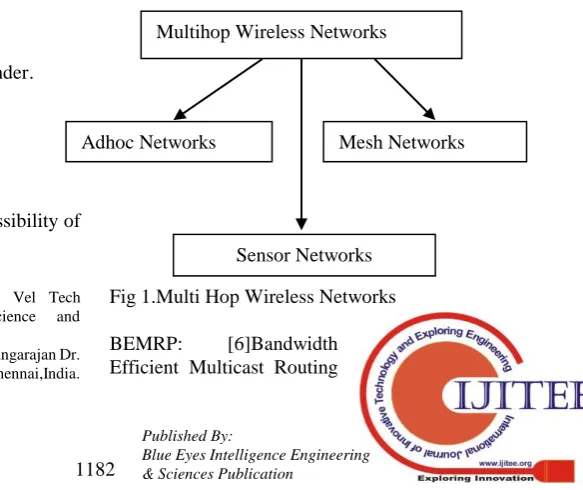
Fig 1.Multi Hop Wireless Networks
BEMRP: [6]Bandwidth
Efficient Multicast Routing
A Protocol Based Routing Technique for
Enhancing the Quality of Service in Multi Hop
Wireless Networks
P.Arivubrakan, S.Sundari
Multihop Wireless Networks
Adhoc Networks
Sensor Networks
Protocol, instead of giving importance to finding the shortest path , the sender has to look for the nearest neighboring node ,in order to reduce the number of control packets for transmission. Tree establishment and tree maintenance is used to discover the path. To remove the unwanted nodes, the route optimization is used. The disadvantage of the protocol is distance increases, there is possibility of path breaks in leads to delay and the number of packets decreases.
MZRP: Multicast Zone Routing Protocol, is to flooding the packets between nodes ,it searches the members of group monitored by zone routing techniques[7].In Routing zone, on demand approach is used for maintaining the table information of each node in the zone. it is the combination both on reactive and proactive routing protocol. The disadvantages of this protocol are zone size is increases there is possibility of packet loss. Tree establishment an maintenance are accepted over here. If the receiver is far away from the sender node, it takes time for joining in multicast tree[8].
MCEDAR: Multicast Core Extraction Distributed Ad-hoc Routing, the source based tree protocol more efficient and less in security. In order to increases the robustness, the core nodes are nominated to share their neighboring information up to 3 multi hops. It is mainly the concept of mesh infrastructure; the nodes are static in nature. Core nodes also called as minimum nominating nodes in the networks. Core nodes used the concept of piggy backing technique for the communication. The disadvantage of this protocol is more complex proportional to the performance in the network. DDM: Differential Destination Multicast Routing protocol is used for small nodes in the network. The destination node those who interested for the transmission will send information with unicast[9] routing protocol. It uses minimum memory requirement due to central policy As the number of destination node increases, the size of the network decreases.
[image:2.595.307.547.392.495.2]WBM: Weight Based Multicast Protocol is mainly focus on the weight of the entry point in the multi cast group. It is based on the join request by the control packet and joins reply by the data packet. The major disadvantage is location prediction may not work in all conditions[10]. Weight factor depends on the network load and the size of the group.
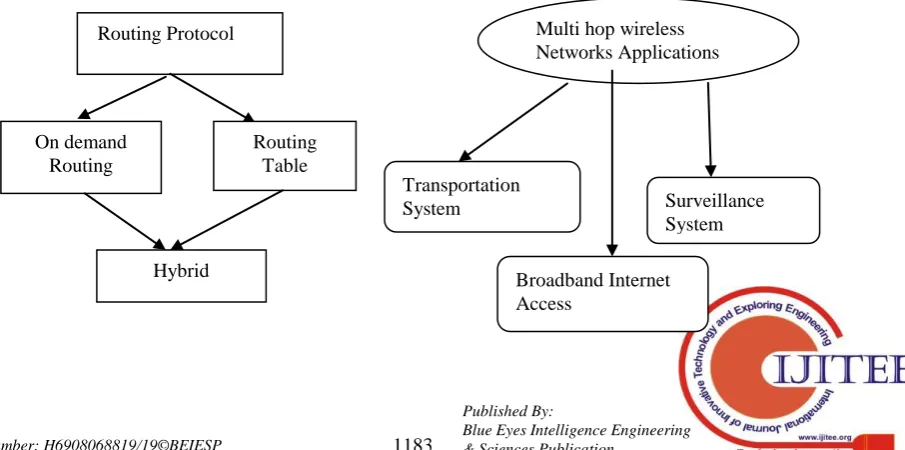
Fig.2 Routing Protocol Classification.
PLBMP: Preferred Link Based Multicast Protocol ,is selection of the set of wireless links to the nearby nodes called as preferred links, and the use of these links for transferring the packets. It is tree based protocol based on single path communication, here each node is maintaining 2 hops of topology information and able to form the multi cast tree. It’s have the two tables that is maintained as NNT (Neighbours-Neighbours Table) and CT(Connect Table).the nodes in the network periodically sends the beacon signal like a alert message. Once the packet checks the eligibility of forwarding a packet in terms of battery power, if not discards that node and retransmit the packet which having the highest power. It is also follow the piggy backing in order to receive acknowledgement, tree establishment removes the in consistency of the nodes and tree maintenance is there is node failure ,[11] it recover in that phase. The disadvantage is significant control overhead even in scarce of bandwidth.
ASTMRP: Adaptive Shared Tree Multicast Routing Protocol.[12]
A source tree as a rooted node makes it as source and shared tree node having multiple sources. But they are not stable in case of the source .it maintains the list is named as forward list contains the information about the sender ip addresses from which the receiver to get the control packets. It is scalable due to the shared tree but packet delivery ratio is decrease.
Fig.3 Routing Protocol Process.
ARAN: Authenticated Routing For Adhoc Networks, it is based on cryptographic certificates which eliminate all the attacks present in the network. The route request message is forwarded along with the certificate issued by[13] the source node, the route reply is established between the path which send by the route request. It is followed by the end to end authentication[14-20].
Monitoring Secured Optimization
Routing Protocol
Multi hop wireless Networks Applications
Transportation
System Surveillance
System
Broadband Internet Access
Routing Protocol
On demand Routing
Routing Table
[image:2.595.91.544.603.828.2]Fig.4 Application of Multi hop Communication
II. PROPOSED METHODOLOGY
A. ODSP
ODSP-On demand secured Protocol,
The protocol mainly based on the improving the packet delivery ratio and effectively make use of the bandwidth and the minimum delay attainment. The nodes are deployed in the environment as wireless. The n number of nodes participating in the communication as multi hop. The sender node sends information to the receiver via multi hop based on the parameter metric such as hop distance and bandwidth. The nodes send a broadcast message to the all the neighboring nodes by make use of the Route Request, in order to avoid the duplicate of the route request is received multiple times, we use RTS, Request to send , message is used via the Route Request for secured. Once the message received by the nodes, it again the send the Route Reply to make sure of the path initiated by the sender. Once the route establishment is finished, The RTS (Request to send) is sending to the final path, after receiving the CTS (Clear to Send).Once the CTS is received from the destination node it sends an information about the stability of the path for transmission
Once the path is established it will make use of scheduling of packets by time division multiple accesses (TDMA) for the benefits of packet loss.
In order to enhance the robustness of the protocol with high mobility, it is having two types of node, mesh node and another is the core node, each node should maintain the table information about the entry and exit of that corresponding range. The members join din that group want to broadcast the information about the joining based on the distance. It floods the Join Request message to the mesh node as anew node. The core node having the TTL Time to Live parameter to discover the other members, each node form a clustering mechanism as a tree head .
The ODSP is the security aware routing protocol is mainly based on the source node broadcasts a Route Request packet to the all the intermediate node around their range, after route request is received by the intermediate node, it does not have a route to the destination. It route reply packet is reversed by the destination node to the source node. In order to initiate the path, forward security mechanism is used, each packet is maintained the key which is attached to the route request message, if it is equal then the packet will be forwarded at the initial neighboring node. Otherwise the route request message is discarded[21-28].
The key is encrypted as well decrypted at the neighboring node.
Fig.5 Established Secured Path..
The execution of the routing protocol is mainly focused on the elimination of distributed denial of service attacks. It does not affect the presence multiple intruders corrupting the key table maintained by the node. It makes use of hash function to avoid the malicious nodes present in the network. The ODSP protocol makes use of sequence number to prevent the formation of loops in between the nodes[30].
B. Advantage
The ODSP in adhoc wireless networks having the benefits such as the detection of any unwanted nodes in the participation of communication between the source node and the destination node. If the route is established, the routing protocol is able to find the path and also ensure about the correctness of the route establishment. The adhoc wireless networks is dynamic, there is possibility of changing the topology, in order to determine of confidentially of network topology based on the key generated by the source node.The security is another major challenge in wireless networks, is to provide the secured communication between the nodes is monitoring by make use of scheduling the packets.
III. RESULTS AND DISCUSSION
NS2 is the network simulator used for the simulation of nodes in wired as well as wireless environment and it is open source software supported in windows operating systems by cygwin and Linux environment. The NS2 the language written in OTCL (Object oriented tool command language) and back end tool is C++.NAM ( Network Animator Window) window is to visualize the nodes , how the packets are transformed in that window.
The quality of service is defined as the performance metric by the user in the network. The throughput is
RTS RTS
DATA+key
ACK
SENDER Receiver
defined as quality of the number of bits per second. The implementation is based on the on demand secured routing protocol based on the parameter such as the nodes, packet delivery ratio.
The protocol is mainly find best path in order to identify the unwanted node and in the environment. The dark lines represent the best path.
s
Fig.6 Nodes detection at route establishment
S
Fig.7 Packets send between source and destination.
A.THROUGHPUT
The Throughput is the successfully message delivery between the source and the destination. It is measured by the bits per seconds. The number of nodes are successfully implemented in network simulator with the one malicious node present among the nodes in the environment. There is possibility of hacking the data between the source and destination, before packet transmission, the route is established by the route request message, the message transferred to the neighbor node along with the key which is generated by the source node, they will check the key with the route request message , if it is equal then the message is transferred to the another neighbouring node, it is continue, until it reaches destination, they keep on update the routing table about the entry and exit
of the node.once its reached to he destination node with the key value, then the transfer the route reply to the node along with the sequence number for guaranteed the path, once the route is established based on above criteiras, the data is transferred between the source and destination. Once the data is received by the destination node, acknowledgement is send by the receiver.
Fig.8 Throughput Attainment-ODSP
B.DELAY
The delay is minimal , compare with the other routing protocol.The average delay is based the maximum time taken by the transmission-time required for that completion.
Fig.9 Delay .
IV. CONCLUSION
The research paper is implemented the new technique as ODSP routing protocol with the attainment of highest packet delivery ratio when compare with other on demand protocol for secured communication. The major contribution towards the protocol is attainment of quality of service in more than one hop communication of wireless networks for secured way of establishment of route before transfer the packets. In future enhancement, number of nodes will be increased and applied in real time applications.
REFERENCES
1. Susan G Varghese,CijiPearl
Kurian,VI George “A Study of communication protocols and wireless networking systems D
BEST PATH
D BEST PATH
for lighting control applications”IEEE Xplore,Digital Library,2016.
2. P.Arivubrakan and V.R.Sharma Dulipala, “Sentry based node
detection technique for wireless sensor networks”,Science alert journal of artificial Intelligence,2012.
3. Christine E.Johnes,Krishna M.Sivalingam,Prathima Agrawal,Juh
Cheng Chen “ A survey of Energy Efficient Network Protocols For
Wireless Networks”,Springer Wireless Networks,vol 7,pp
343-358,2001.
4. Mohsiri Ur Rahman Salfi “A study of Mobile Ad-hoc Networks-Issues
and Challenges”,International Journal of Advanced Research in Computer Science,Vol 6,no 7,2015.
5. Sudha Singh,S.C.Dutta and D.K.Singh, “A study on Recent Research
Trends in MANET”,International journal of Research and Reviews in Computer Science,Vol 3,no 3,2012.
6. Hara.T and S.K.Madria, “Data Replication for improving Data
Accessibility in Ad-hoc Networks”,IEEE transaction on Mobile Computing,vol 5, no11,2006.
7. Jagadeesh kumar S.J.K,R.Saraswathi and R.Raja , “Improving the
performance of Mobile Ad-hoc Network using a combined credit risk and collaborative Watchdog Method”,Global journal of computer science and technology network web and security,vol 16,2013.
8. Jagtar Singh and Natasha Dhiman ,“A Review Paper on Introduction to
Mobile Ad-Hoc Networks ”,International Journal of Latest Trends in Engineering and Technology,vol2,2013.
9. cEugene Perevalov,Rick S.Blum, Xun Chen and Anthony Nigara ,
“Throughput Capacity of Ad Hoc Networks with Route Discovery”,EURASIP Journal on Wireless Communications and Networking,2007.
10. Lijun Qian,Dhadesugoor R.Vaman and Ning Song, “ QoS-Aware
Maximally Disjoint Routing in Power Controlled Multihop CDMA Wireless Ad Hoc Networks “,EURASIP Journal on wireless communications and Networking,2007.
11. Gayathry SS and R N Gaur , “Handling Selfishness in MANETs-A
Survey,International Journal of Advanced Research in Electrical ,Electronics and Instrumentation Engineering,vol 3,no11,2014.
12. Ritesh Dhanare and Sunita Varma Dr, “Replica Allocation in
MANETs for Eliminating Selfish Node ” ,International Journal of Scientific and Engineering Research ,vol 4,2013.
13. Kavitha Balamurugan,Chitra.K and A.Jawahar , “Performance
Evaluation of Hierarchical Routing Protocol with Multiple Transceivers and cluster based routing protocol in FSO MANET,TagaJournal ,vol 14,2018.
14. Mehdi Enshaei,Zurina Mohd Hanapi and Mohamed Othman , “A
Review :Mobile Ad hoc Networks
Challenges,Attacks,Security,Vulnerability and Routing Protocol ”,International journal on Communications Antenna and Propagation,vol 4,no 5,2014.
15. Lap Kong Law,Srikanth V.Krishnamurthy and Michalis Faloutsps , “A
Novel Adaptive Protocol for Lightweight Efficient Multicasting in ad hoc networks,Elsevier,Science Direct,Computer Networks,vol 51,pp 823-834,2007.
16. Kaan Bur and Cem Ersoy , “Performance Evaluation of a
mesh-evolving quality of service aware multicast routing protocol for mobile ad hoc networks ”,Performance Evaluation ,2009.
17. Jesus Friginal,David de Andres, Juan-Carlos Ruiz and Miquel
Martinez , “A survey of evaluation platforms for ad hoc routing protocols :A resilence perspective”,Elsevier,Computer Networks,vol 75,pp 395-413,2014.
18. Natarajan Meghanathan , “Minimum hop vs Minimum Edge based
Multicast routing for Mobile Ad hoc Networks, Advances in Wireless ,Mobile Networks and applications,2011
19. Samba sesay ,Zongkai yang and jianhua He , “A Survey on Mobile Ad
hoc wireless Network, Information Technology Journal,vol 3,pp 168-175,2004.
20. Geofrin Shirly and N Kumar , “A Survey on energy efficiency in Mobile
Ad hoc Networks”,International Journal of Engineering and Technology,vol 21,no2,2018.
21. F.Meng and C.Wang “Performance Analysis of Wireless Routing
Protocol under AMR environment” Journal of Computational Information Systems,2006.
22. N.Muthyala, Raghava rao.K and vijayalakshmi kakulapati “A study and
comparison of wireless Routing Protocols performance parameters “International journal of computer applications in Technology,2017.
23. L.chi,Z.hao,C.yao,yating Z.kun wang and Yushan sun “A Simulation
and Research of Routing Protocol for Adhoc Mobile networks.”,IEEE international conference on Information acquisition,2006.
24. Jayanti,Vikram Nandal “Routing Protocols in MANET:Comparative
study” IJCSMC,vol 3,Issue 7,pp 119-125,2014.
25. E.Raghuvaran “A survey paper on performance of routing protocols in
Wireless Ad-hoc Network”IJCSIT,vol5,pp 770-773,2014.
26. Mohamed Ben Ahmed,A.A.Boudhir,M.Bouhorma and K.Ben Ahmed
“Performance Study of Various Routing Protocols in VANET case study,International journal of future generation communication and engineering,vol 7,pp 231-240,2014.
27. Wentao wang,Feng guo,Fang Zheng,wan Tang and Jiangquing
Wang.”International journal of Multimedia and ubiquitous Engineering”,vol10,no 3,pp 181-202,2015.
28. Lei an,Aihura Li,Ling pang and Guangdong He “Analysis and
comparison of Routing protocol of Wireless sensor network” vol 12,no 10,2016.
AUTHORSPROFILE
P.Arivubrakan has been working as an assistant professor in the department of computer science and Engineering at Vel Tech Rangarajan Dr. Sagunthala R&D Institute of Science and Technology. Chennai and has published the papers in Scopus indexed journals. Specialization in pervasive computing Technologies. The Area of research such as wireless networks, sensor networks and IOT.