High-resolution error detection in the capture process of a single-electron pump
S. P. Giblin, P. See, A. Petrie, T. J. B. M. Janssen, I. Farrer, J. P. Griffiths, G. A. C. Jones, D. A. Ritchie, and M. Kataoka
Citation: Appl. Phys. Lett. 108, 023502 (2016); doi: 10.1063/1.4939250
View online: http://dx.doi.org/10.1063/1.4939250
View Table of Contents: http://aip.scitation.org/toc/apl/108/2
Published by the American Institute of Physics
Articles you may be interested in
Gigahertz single-electron pumping in silicon with an accuracy better than 9.2 parts in 107
Applied Physics Letters 109, 013101 (2016); 10.1063/1.4953872
Ultrafast voltage sampling using single-electron wavepackets
Applied Physics Letters 110, 102105 (2017); 10.1063/1.4978388
Validation of a quantized-current source with 0.2 ppm uncertainty
Applied Physics Letters 107, 103501 (2015); 10.1063/1.4930142
Accuracy of electron counting using a 7-junction electron pump
Applied Physics Letters 69, 1804 (1998); 10.1063/1.117492
Dopant-controlled single-electron pumping through a metallic island
Applied Physics Letters 108, 213107 (2016); 10.1063/1.4951679
Gigahertz single-hole transfer in Si tunable-barrier pumps
High-resolution error detection in the capture process of a single-electron
pump
S. P.Giblin,1P.See,1A.Petrie,1T. J. B. M.Janssen,1I.Farrer,2,a)J. P.Griffiths,2 G. A. C.Jones,2D. A.Ritchie,2and M.Kataoka1
1
National Physical Laboratory, Hampton Road, Teddington, Middlesex TW11 0LW, United Kingdom 2
Cavendish Laboratory, University of Cambridge, J J Thomson Avenue, Cambridge CB3 0HE, United Kingdom
(Received 22 October 2015; accepted 18 December 2015; published online 11 January 2016)
The dynamic capture of electrons in a semiconductor quantum dot (QD) by raising a potential barrier is a crucial stage in metrological quantized charge pumping. In this work, we use a quantum point contact (QPC) charge sensor to study errors in the electron capture process of a QD formed in a GaAs heterostructure. Using a two-step measurement protocol to compensate for 1/fnoise in the QPC current, and repeating the protocol more than 106times, we are able to resolve errors with probabilities of order 106. For the studied sample, one-electron capture is affected by errors in
30 out of every million cycles, while two-electron capture was performed more than 106times with only one error. For errors in one-electron capture, we detect both failure to capture an electron and capture of two electrons. Electron counting measurements are a valuable tool for investigating non-equilibrium charge capture dynamics, and necessary for validating the metrological accuracy of semiconductor electron pumps. [http://dx.doi.org/10.1063/1.4939250]
Laterally gated semiconductor quantum dots (QDs) have become a paradigmatic system for studying and manip-ulating charge carriers in tunable confining potentials. In one example, a dynamically gated QD can pump electrons from a source to a drain electrode,1–4generating an accurate quan-tized current with metrological application as a new realisa-tion of the ampere.5–8 In this application, the accuracy of electron trapping and ejection in the non-adiabatic regime is of key importance. We wish to transfer n electrons in response to a single gate voltage cycle, with an error rate less than 107. Recently, DC measurements8 have shown that
6108 electrons per second can be transferred through a QD with anaverageerror rate as low as 2107. To probe theindividualprobabilities Pn, mesoscopic charge detectors
need to be used to measure the number of electrons pumped onto charge sensing islands,9–12 with the lowest reported error probability, 104, achieved in a silicon QD pump.11 The error counting measurements on GaAs pumps9,10 were performed in zero magnetic field using superconducting sin-gle electron transistor (SET) charge detectors, and were therefore not able to access the regime of high accuracy pumping attained in fields>10 T.5,7,8Precise single-electron counting tests of semiconductor QD pumps in the high-field, high-accuracy pumping regime are clearly desirable to vali-date the DC pumping measurements, and also to approach the benchmark error probability of108 demonstrated for a slow adiabatic metallic pump.13
In this work, we focus on measuringPN, the probability
of loading the QD withNelectrons (distinguished fromPn,
the probability of pumping n electrons). There is good
experimental evidence that the ejection of electrons to the drain can be accomplished with a sufficiently low error rate to satisfy metrological criteria,14and furthermore theoretical treatments of the QD pumping process4,15–17 have shown thatnis determined during the loading stage. We use a quan-tum point contact (QPC) charge detector strongly coupled to the QD to probe the number of loaded electrons. The use of a QPC instead of a SET detector9,10 allows operation in strong magnetic fields. Electrons can be loaded with fast voltage waveforms, as used in high-speed pumping experi-ments5,8and then probed on millisecond time-scales required for high-fidelity readout. We use a 2-stage measurement pro-tocol to suppress the effect of 1/f noise in the QPC due to non-equilibrium charged defects,18 and we achieve a suffi-ciently high charge detection fidelity (probability of the charge detection yielding the right answer for N), to probe loading probabilities at the 106 level. Finally, we demon-strate good qualitative agreement between electron-detection measurements ofN, andhniextracted from the pumped cur-rent measured in a separate experiment.
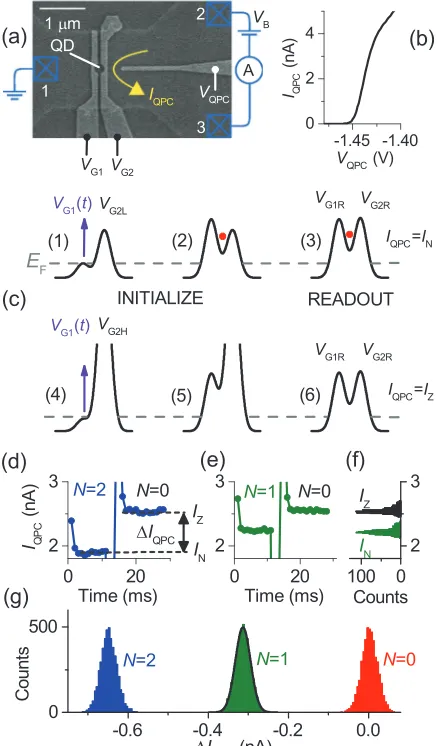
A scanning electron microscope image of a device simi-lar to the one used in this study is shown in Fig.1(a). The de-vice is fabricated on a GaAs/AlxGa1xAs wafer using optical
and electron-beam lithography and wet-chemical etching.2A 2-dimensional electron gas (2-DEG) with density 2:31011 cm2and mobility 2:28106 cm2V1s1is formed 90 nm
below the surface. The QD pump is similar to those used in previous high-precision measurements of the pumped cur-rent:5voltagesVG1andVG2applied to the entrance (left) and
exit (right) gates form a QD in the cut-out region between the gates. In this work, we introduce a third gate, biased with volt-ageVQPC, to form a QPC close to the QD. When the channel
between the QPC gate and the exit gate is biased close to pinch-off (Fig. 1(b)), the conductance of the channel probes
a)Current address: Department of Electronic and Electrical Engineering,
University of Sheffield, Mappin Street, Sheffield S13JD, United Kingdom. E-mail: [email protected].
the local charge environment and therefore the number of electrons in the QD.19We applied a source-drain bias voltage
VB¼1 mV across the QPC channel and measured the current
IQPCusing a room temperature transimpedance amplifier with
gain 106V/A and 400 Hz bandwidth. The amplifier output was continuously digitized by an integrating voltmeter with 1 ms aperture. All measurements were performed in a sorption-pumped helium-3 cryostat, at base temperature
300 mK. A magnetic field was applied perpendicular to the plane of the 2-DEG to enhance the current quantization.5,7,8,20 Our measurement protocol is illustrated by schematic potential diagrams in Fig.1(c). The QD is initialized (frame 1) by applying a voltageVG1ðtÞto the entrance gate, raising
the entrance barrier above the Fermi level of the source
electrode and trappingNelectrons in the QD.Nis tuned by the fixed exit gate voltage VG2L. Two types of entrance gate
ramp are used in the experiments, denoted “slow” (Fig.2(a)) and “fast” (Fig.2(d)), differing in rise-time by a factor105. The entrance gate ramp VG1ðtÞ terminates at VG1¼VG1R
(frame 2), with the electrons trapped in a deep potential well. Finally, VG2 is adjusted to its readout valueVG2R(frame 3),
and the QPC current INis measured following a 4 ms delay
to reject transient effects. This final adjustment is a conven-ience, which allows readout of the charge state at fixed pump gate voltages ½VG1R;VG2R independently of the tuning
pa-rameterVG2L.21
The noise spectrum of IQPC in the amplifier bandwidth
was dominated by a 1/fcontribution, as seen in previous stud-ies on similar QPC devices where the 1/fnoise was shown to be due to an ensemble of two-level fluctuators (TLFs).18As discussed later, discrete time-domain jumps inIQPCdue to the
action of single TLFs18,22 were also occasionally seen. To ensure high detection fidelity in the presence of the constant
FIG. 1. (a) SEM image of device and electrical connections to the measure-ment circuit. The crossed boxes numbered 1–3 indicate Ohmic contacts to the 2-DEG. (b) QPC pinch-off characteristic withVB¼1 mV. (c) Frames
(1–3): schematic potential landscape showing initialization of the QD with one electron. Frames (4–6): initialization of the QD with zero electrons. Frames (1–6) illustrate one measurement cycle. (d) Example of raw QPC current data for one measurement cycle, for the case of two electrons loaded into the QD, illustrating the difference signalDIQPC. (e) Same as (d), but one
electron is loaded into the QD. (f) Histograms of the QPC currents corre-sponding to zero and one electron, obtained from 950 measurement cycles spaced evenly over 15 h. Plots (d)–(f) share the same y-axis. (g) Histograms ofDIQPCfor 3 sets of 5000 cycles, withVG2Lset to0.65 V,0.616 V, and 0.59 V, to load, respectively, 0, 1, and 2 electrons into the QD. Solid black line: Gaussian fit to theN¼1 data.B¼12 T for all data in this figure.
FIG. 2. (a) Time dependence of the slow entrance gate loading waveform, measured on a sampling oscilloscope. (b) Loading probabilities for up to 3 electrons as a function of exit gate voltage using the slow load waveform. B¼12 T. Black data points denote values ofVG2Lwhere all the cycles yielded
the sameN. (c) Log-scale histogram ofDIQPCfor 1 847 154 cycles using the
slow waveform, at the exit gate voltage denoted by the vertical arrow marked “A” in graph (b). Vertical dotted lines show the thresholds for discriminating 0, 1, and 2 electrons, and shaded grey boxes show the64rwidth of distribu-tions obtained from short calibradistribu-tions runs similar to Fig.1(g). (d) Same as (a), but showing the fast loading waveform. (e) Same as (b), but using the fast waveform atB¼10 T. (f) Same as (c), but using the fast waveform, 1 045 310 cycles at the gate voltage indicated by “B” in (e). (g) 1 149 457 cycles at the gate voltage indicated by “C” in (e). Plots (f) and (g) share the same x-axis, andB¼10 T. Boxed numbers in plots (c), (f), and (g) indicate the number of counts for the relevantNafter filtering out artifacts.
[image:3.612.330.548.52.375.2] [image:3.612.65.284.60.433.2]1/f noise spectrum, we reference the QPC current (IN/ N
for smallN) to a second currentIZ.IZ is measured with the
QD initialised to a knownN¼0 state, by raising the entrance barrier with the exit gate set to a large negative valueVG2H
(frame 4). N is then determined from the difference
DIQPC¼INIZ. The series of frames (1–6) illustrate one
measurement cycle. Raw QPC current data are shown in Figs.
1(d)and1(e)for casesN¼2 andN¼1, respectively. Fig.1(f)
shows histograms of IN (green, lower peak) and IZ (black,
upper peak) for a set of measurement cycles loading one elec-tron, spread over 15 h. The effect of 1/f noise is visible as asymmetric broadening of the peaks, and the fidelity of meas-uringNusing theIN data alone is estimated as0:999. Fig.
1(g)shows histograms ofDIQPCobtained from 3 runs of 5000
cycles each, withVG2Lset to load approximately 0, 1, and 2
electrons using the slow loading waveform. The histograms form 3 widely separated peaks, which we identify withN¼0, 1, 2, which fitted well to normal distributions (shown for
N¼1) with standard deviationr¼20 pA. For these relatively short calibration runs of 5000 cycles, there were no outliers inconsistent with the normal distribution. Applying a simple thresholding algorithm to determineNfromDIQPC, the
intrin-sic probability Pfail of measuring the wrong value of N is
given by 1erfðDI1e=2 ffiffiffi
2
p
rÞ, where DI1e¼320 pA is the
separation between peaks. Pfail is weakly dependent on the
magnetic fieldB, and for the values ofB used in this study,
Pfail<108which is much smaller than the expected
statisti-cal uncertainty inPN. However, for very long runs, discrete
TLF jumps caused a non-Gaussian background to the distribu-tion ofDIQPC, requiring a more elaborate protocol than simple
thresholding to determinePN.23
In Figs.2(b)and2(e)we showPNðVG2LÞfor 0N3,
obtained from sets of 500 cycles for each VG2L using the
slow and fast loading waveforms, respectively. As expected from DC measurements with the pump in a magnetic field,5,7,8,20 there are a series of wide plateaus where one value of N dominates the loading statistics. This is high-lighted by color-coding data points black when all the cycles yielded the same value ofN. Comparable data have been pre-sented previously,9but at zero magnetic field where the re-gime of very accurate loading could not be accessed. We
calculatedhNi ¼PNPNfor the fast loading data, and fitted
it to both the decay cascade model4,15 (Fig.4(c), inset) and also a thermal equilibrium model.9,11 The decay cascade model yielded a better fit, as was also found at the much lower temperature of 25 mK.9The plateaus are considerably sharper using the slow loading pulse, consistent with pumped current measurements in which the rise time (proportional to the inverse of the pumping frequency) was varied in the 1
10 ns range.5Our technique allows the investigation of rise times over many orders of magnitude, including those too slow to generate a measurable pumped current. We note that the decay cascade model does not predict any rise-time de-pendence to the plateau shape,4,15 and the deterioration of the plateaus as the rise time is reduced5,8does not currently have a satisfactory explanation.
To assess the loading accuracy on the plateaus, we per-formed a number of long runs, comprising 106 cycles at fixed VG2L chosen to preferentially load always the same
desiredN,NDES¼1;1;2;1 for runs A, B, C, and D,
respec-tively. Only run A used the slow pulse. The quantity of inter-est is the number of timesN6¼NDES, an event we refer to as
an “error.” Histograms of DIQPC for three of these runs,
denoted A, B, and C, are presented in Figs. 2(c), 2(f), and
2(g), plotted on a log scale to highlight rare events. For each run, most of the counts comprise a Gaussian peak correspond-ing to N¼NDES, but for run B there is also a small N¼0
peak. For all the runs, there is a background of events, which are not statistically compatible with anyNstate. Examination of the rawIQPCðtÞdata for these events showed that most of
them could be attributed to TLF events well known to occur in our type of GaAs device.22Assuming that TLF events are not correlated with loading errors,PN;fN6¼NDESgwas
eval-uated from the small number of counts, indicated on Figs.
2(c),2(f), and2(g), withDIQPC within64rof the expected
value for a givenN6¼NDES, which could not be attributed to
TLF events.23From these data, we calculated the most proba-ble values for PN and estimated the asymmetric statistical FIG. 4. (a) Time dependence of the fast waveform used to load electrons. The negative-going part at the beginning of the waveform ejects any trapped electrons to the drain, but plays no role in the loading experiment. (b) Pumping waveform. (c) Comparison of average number of electrons loaded (points) with pumped current (line) in loading and pumping experiments, respectively. The inset shows the portion of the loading data from the main figure with a fit to the decay-cascade model.
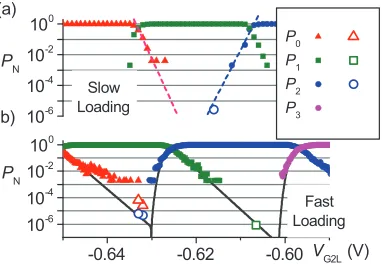
FIG. 3. (a) Solid points: thePNdata of Fig.2(b)re-plotted on a log scale.
Open point:P2calculated from the data of run A. Dotted lines are guide to
the eye. (b) Solid points: data of Fig.2(e)re-plotted on a log scale. Open points:P0;P1, andP2calculated from the data of runs B–D. Error bars are
[image:4.612.329.546.53.235.2] [image:4.612.80.271.54.186.2]uncertainties (68.27% confidence interval) from the Poisson distribution.24 For run B, P0¼ ð26:7þ65::10Þ 10
6;
P2¼ ð4:8þ32::21Þ 106 and for run C, P0¼P3¼ ð0þ10:6Þ 10
6;
P1¼ ð0:9þ20::07Þ 10
6.
PNfor runs A–D are plotted as open
points in Figs.3(a)and3(b)(the error bars are smaller than the data points), along with the data of Figs.2(b)and2(e) re-plotted on a log scale for comparison (solid points). For
NDES¼1, the measured error rates are almost an order of
magnitude larger than predicted by fits to the decay-cascade model (solid line in Fig. 3(b)).4,15 Additionally, the co-existence ofN¼0 andN¼2 errors at the same pump operat-ing point highlights the importance of electron countoperat-ing meas-urements, as these errors would partially cancel in an average current measurement. These data also show that caution should be exercised in using theoretical fits to low-resolution data5–8as a method of predicting the accuracy of a tunable-barrier electron pump on a quantized plateau.
Finally, we compare hNicomputed from the data set of Fig.2(e), with the normalised pump current IP=ef when the
load waveform was immediately followed by a pulse to eject the trapped electrons to the drain (pump waveform Fig.
4(b)).5,8 The fast load waveform is shown in Fig. 4(a) for comparison. The repetition frequency of the pump waveform was 280 MHz, generating a currentIP45 pA measured by
connecting the ammeter to contact 1 in Fig.1(a), and ground-ing contacts 2 and 3. The loadground-ing parts of the two waveforms had the same VG1ðtÞ profile (grey boxes in Figs. 4(a) and
4(b)). In Fig.4(c),hNiandIP=ef are plotted as a function of
exit gate voltage (for the case of the pumping data, the x-axis is the constant DC voltage applied to the exit gate). The rea-sonable agreement between the two measurements suggests that the electron loading experiment is probing the same dy-namical process, which determines the DC current in pumping experiments, and furthermore suggests that the wide quantised pumping plateaus seen here and in previous studies of QD pumps3–8are indeed due to transport of the same number of electrons in each pumping cycle. On the other hand, close ex-amination of Fig.4(c)shows that the transitions between pla-teaus are slightly broader in the loading experiment. This could be evidence for back-action of the QPC on the electron loading process, since the QPC source-drain bias voltage was not present during the pumping experiment. The irregularity in the transition fromhNi ¼0 to hNi ¼1 clearly visible in Fig.3(b)was not present in the DC measurements, and may be further evidence for back-action. Further studies will clar-ify the back-action of the QPC on the dynamic QD.
In summary, we have presented a simple device archi-tecture and measurement protocol for studying directly the loading statistics of a dynamic QD with high precision. By incorporating a reference measurement using a known charge state, 1/f noise in the QPC detector is compensated, and the number of electrons in the QD can be measured with an intrinsic fidelity exceeding 1108. This is a significant step towards validating semiconductor QD pumps as metro-logical current sources. Our device can also be used to study the QD initialization process over many orders of magnitude in barrier rise time, without constraints imposed by the need to measure a small DC current. This will help to clarify the role of quantum non-adiabaticity16,17,25 in the formation of the QD. Improvements to the control and readout electronics
will allow 107 cycles in a reasonable 12 h experimental run, reducing the statistical uncertainty in the measurement of small probabilities, and experimental precautions against TLFs, for example, biased cool-down,26should remove these unwanted artifacts in future experiments.
We would like to thank Akira Fujiwara, Joanna Waldie, and James Frake for useful discussions and Stephane Chretien for assistance with statistical analysis. This research was supported by the UK Department for Business, Innovation, and Skills and within the Joint Research Project “Quantum Ampere” (JRP SIB07) within the European Metrology Research Programme (EMRP). The EMRP is jointly funded by the EMRP participating countries within EURAMET and the European Union.
1
L. Kouwenhoven, A. Johnson, N. Van der Vaart, C. Harmans, and C. Foxon, “Quantized current in a quantum-dot turnstile using oscillating tun-nel barriers,”Phys. Rev. Lett.67, 1626 (1991).
2
M. D. Blumenthal, B. Kaestner, L. Li, S. P. Giblin, T. J. B. M. Janssen, M. Pepper, D. Anderson, G. A. C. Jones, and D. A. Ritchie, “Gigahertz quan-tized charge pumping,”Nat. Phys.3, 343–347 (2007).
3
B. Kaestner, V. Kashcheyevs, S. Amakawa, M. D. Blumenthal, L. Li, T. J. B. M. Janssen, G. Hein, K. Pierz, T. Weimann, U. Siegneret al., “Single-parameter nonadiabatic quantized charge pumping,” Phys. Rev. B 77, 153301 (2008).
4
A. Fujiwara, K. Nishiguchi, and Y. Ono, “Nanoampere charge pump by single-electron ratchet using silicon nanowire metal-oxide-semiconductor field-effect transistor,”Appl. Phys. Lett.92, 042102 (2008).
5
S. Giblin, M. Kataoka, J. Fletcher, P. See, T. Janssen, J. Griffiths, G. Jones, I. Farrer, and D. Ritchie, “Towards a quantum representation of the ampere using single electron pumps,”Nat. Commun.3, 930 (2012).
6A. Rossi, T. Tanttu, K. Y. Tan, I. Iisakka, R. Zhao, K. W. Chan, G. C.
Tettamanzi, S. Rogge, A. S. Dzurak, and M. Mottonen, “An accurate single-electron pump based on a highly tunable silicon quantum dot,”
Nano Lett.14, 3405–3411 (2014).
7
M.-H. Bae, Y.-H. Ahn, M. Seo, Y. Chung, J. Fletcher, S. Giblin, M. Kataoka, and N. Kim, “Precision measurement of a potential-profile tuna-ble single-electron pump,”Metrologia52, 195 (2015).
8
F. Stein, D. Drung, L. Fricke, H. Scherer, F. Hohls, C. Leicht, M. Goetz, C. Krause, R. Behr, E. Pesel, U. Siegner, F.-J. Ahlers, and H. W. Schumacher, “Validation of a quantized-current source with 0.2 ppm uncertainty,”Appl. Phys. Lett.107, 103501 (2015).
9
L. Fricke, M. Wulf, B. Kaestner, V. Kashcheyevs, J. Timoshenko, P. Nazarov, F. Hohls, P. Mirovsky, B. Mackrodt, R. Dolata, T. Weimann, K. Pierz, and H. W. Schumacher, “Counting statistics for electron capture in a dynamic quantum dot,”Phys. Rev. Lett.110, 126803 (2013).
10
L. Fricke, M. Wulf, B. Kaestner, F. Hohls, P. Mirovsky, B. Mackrodt, R. Dolata, T. Weimann, K. Pierz, U. Siegner, and H. W. Schumacher, “Self-referenced single-electron quantized current source,”Phys. Rev. Lett.112, 226803 (2014).
11
G. Yamahata, K. Nishiguchi, and A. Fujiwara, “Accuracy evaluation and mechanism crossover of single-electron transfer in si tunable-barrier turn-stiles,”Phys. Rev. B89, 165302 (2014).
12
T. Tanttu, A. Rossi, K. Y. Tan, K.-E. Huhtinen, K. W. Chan, M. M€ott€onen, and A. S. Dzurak, “Electron counting in a silicon single-electron pump,”New J. Phy.17, 103030 (2015); e-printarXiv:1502.04446
[cond-mat.mes-hall].
13M. W. Keller, J. M. Martinis, N. M. Zimmerman, and A. H. Steinbach,
“Accuracy of electron counting using a 7-junction electron pump,”Appl. Phys. Lett.69, 1804 (1996).
14S. Miyamoto, K. Nishiguchi, Y. Ono, K. M. Itoh, and A. Fujiwara,
“Escape dynamics of a few electrons in a single-electron ratchet using sili-con nanowire metal-oxide-semisili-conductor field-effect transistor,” Appl. Phys. Lett.93, 222103 (2008).
15
V. Kashcheyevs and B. Kaestner, “Universal decay cascade model for dynamic quantum dot initialization,”Phys. Rev. Lett.104, 186805 (2010).
16
V. Kashcheyevs and J. Timoshenko, “Quantum fluctuations and coherence in high-precision single-electron capture,”Phys. Rev. Lett.109, 216801 (2012).
17V. Kashcheyevs and J. Timoshenko, “Modeling of a tunable-barrier
non-adiabatic electron pump beyond the decay cascade model,” in 2014
Conference on Precision Electromagnetic Measurements (CPEM 2014) (IEEE, 2014), pp. 536–537.
18
F. Liefrink, J. Dijkhuis, and H. Van Houten, “Low-frequency noise in quantum point contacts,” Semicond. Sci. Technol. 9, 2178 (1994).
19
M. Field, C. Smith, M. Pepper, D. Ritchie, J. Frost, G. Jones, and D. Hasko, “Measurements of coulomb blockade with a noninvasive voltage probe,”Phys. Rev. Lett.70, 1311 (1993).
20
J. Fletcher, M. Kataoka, S. Giblin, S. Park, H.-S. Sim, P. See, D. Ritchie, J. Griffiths, G. Jones, H. Beere, and J. T. J. B. M. Janssen, “Stabilization of single-electron pumps by high magnetic fields,”Phys. Rev. B86, 155311 (2012).
21R. McNeil, M. Kataoka, C. Ford, C. Barnes, D. Anderson, G. Jones, I.
Farrer, and D. Ritchie, “On-demand single-electron transfer between dis-tant quantum dots,”Nature477, 439–442 (2011).
22D. Cobden, N. Patel, M. Pepper, D. Ritchie, J. Frost, and G. Jones, “Noise
and reproducible structure in a GaAs/AlxGa1x as one-dimensional
channel,”Phys. Rev. B44, 1938 (1991).
23See supplementary material at http://dx.doi.org/10.1063/1.4939250for a
description of the data filtering procedure.
24
N. L. Johnson, A. W. Kemp, and S. Kotz, Univariate Discrete Distributions, 2nd ed. (John Wiley & Sons, 1993), pp. 170–171.
25M. Kataoka, J. D. Fletcher, P. See, S. P. Giblin, T. J. B. M. Janssen, J. P.
Griffiths, G. A. C. Jones, I. Farrer, and D. A. Ritchie, “Tunable nonadia-batic excitation in a single-electron quantum dot,”Phys. Rev. Lett.106, 126801 (2011).
26M. Pioro-Ladrie`re, J. H. Davies, A. R. Long, A. S. Sachrajda, L.