UNIVERSITI TEKNIKAL MALAYSIA MELAKA
FEASABILITY STUDY OF USING VEGETABLE OIL AS A
CUTTING LUBRICANT ON CONVENTIONAL LATHE
MACHINE
This report submitted in accordance with requirement of the Universiti Teknikal Malaysia Melaka (UTeM) for the Bachelors of Manufacturing Engineering
Technology (Process and Technology) with Honour.
By
ABDULLAH HAZIQ BIN MOHD AZMAN B071410690
930904-01-6365
iii
DECLARATION
I hereby, declared this report entitled Feasibility Study of Using Vegtable Oil as a Cutting Lubricant during Machining on Convential Lathe Machineis the results of my own research except as cited in references.
Signature : ……….
iv
APPROVAL
This report is submitted to the Faculty of Engineering Technology of UTeM as a partial fulfillment of the requirements for the degree of Bachelor of Manufacturing Engineering Technology (Process and Technology) with Honors. The member of the supervisory is as follow:
v
DEDICATION
vi
ACKNOWLEDGEMENT
Bismillahirrahmanirrahim,
Peace upon you, in the name of ALLAH, The Most Compassionate, The Most Merciful. Salawat and Salaam to our beloved Prophet, Nabi Muhammad S.A.W. With the completion of this thesis report, praise to Allah, by Him who given the chances and wisdoms.
I would like to thank to my supervisor Madam Umi Hayati Binti Ahmad for the guidance, encouragement and finance support throughout completing this project. Sincere appreciation for sharing and teaching me the knowledge and experience skills, I would like to thank to all technicians that involved throughout the project. For believing in me and give full support of my education, I would like to give my highest gratitude my mother, Mrs Surida Binti Osman and my Father, Mr Mohd Azman Bin Ibrahim. Without them, I wouldn’t even be here today.
vii
ABSTRACT
viii
ABSTRAK
Didalam proses pemesinan, kehausan mata alat adalah sebuah fenomena semula jadi yang akan mengakibatkan kegagalan mata alat pemotong. Pembentukan bahan semasa pemotongan di antara muka mata alat dan bendakerja akan meningktkan kenaikan suhu pemotongan yang tinggi. Keadaan ini akan menurunkan jangka hayat mata alat dan kualiti permukaan bendakerja yang dimesin. Penggunaan cecair penyejuk yang banyak dan berterusan bagi mengurangkan geseran antara mata alat dan bendakerja akan menimbulkan beberapa masalah pada alam sekitar. Pengenalan aplikasi kuantiti pelincir minimum (MQL) sebagai teknik alternatif yang menggunakan jumlah minyak pelincir
yang sangat sedikit (30ml/h) boleh dijadikan pengganti bagi pemesinan kering dan juga sebagai alternatif untuk cecair penyejuk yang banyak. Dalam penyelidikan ini penggunaan minyak canola sebagai pelincir pemotongan dengan menggunakan MQL telah dinilai
ix
TABLE OF CONTENT
DECLARATION iii
APPROVAL iv
DEDICATION v
ACKNOWLEDGEMENT vi
ABSTRACT vii
ABSTRAK viii
TABLE OF CONTENT ix
LIST OF FIGURES xii
LIST OF TABLES xv
CHAPTER 1 : INTRODUCTION 1
1.1 Introduction 1
1.2 Background 2
1.3 Problem statement 5
1.4 Objective of research 5
1.5 Scope of research 6
CHAPTER 2 : LITERATURE REVIEW 7
2.1 Minimum Quantity Lubrication (MQL) 7
2.1.1 Principle of MQL 7
2.1.2 MQL External Feed 10
2.1.3 MQL Internal Feed 11
x
2.1.5 Cutting Fluid for MQL 14
2.1.6 Machine tool for MQL 16
2.2 Tool Wear 17
2.2.1 Flank Wear 18
2.2.2 Crater Wear 18
2.2.3 Built Up-Edge 19
2.2.4 Notch Wear 19
2.2.5 Plastic Deformation 20
2.2.6 Thermal Crack 20
2.2.7 Edge Chipping/Breakage 21
2.3 Surface Roughness 21
2.4 Mild Steel 23
2.5 Carbon Steel 25
CHAPTER 3 : METHODOLOGY 26
3.1 Introduction 26
3.2 Process Flow 27
3.2.1 First Phase 28
3.2.2 Second Phase 29
3.2.3 Third Phase 29
3.2.4 Fourth Phase 31
CHAPTER 4 : RESULT AND DISCUSSION 34
4.1 Introduction 34
xi
4.2.1 Mild Steel (770 rpm) 35
4.2.2 Mild Steel (900 rpm) 36
4.2.3 Mild Steel (1170 rpm) 37
4.2.4 Carbon Steel (770 rpm) 40
4.2.5 Carbon Steel (900 rpm) 41
4.2.6 Carbon Steel (1170 rpm) 42
4.3 Tool Wear 44
4.3.1 Mild Steel (Synthetic Oil Coolant and Canola Oil + 2 wt % ZDDP) 46
4.3.2 Carbon Steel (Synthetic Oil Coolant and Canola Oil + 2 wt % ZDDP) 48
4.4 Chip Formation 50
CHAPTER 5 : CONCLUSION & RECOMENDATION 53
5.1 Conclusion 53
5.2 Recomendation for future work 54
REFERENCES 55
xii
LIST OF FIGURES
FIGURE TITLE PAGES
[image:12.612.117.527.135.705.2]Figure 1.1 Shows cutting fluid is used on machining process 2
Figure 1.2 The fatty acid chemical structure 3
Figure 1.3 Classification of water-soluble fluid 4
Figure 2.1 Benefit of Dry Machining 8
Figure 2.2 Metal working fluid cost in metal machining 9 Figure 2.3 Advantages and Disadvantage of External Feed 11 Figure 2.4 External and Internal feed ilustration comaprison 11
Figure 2.5 Internal Feed Illustration 12
Figure 2.6 Metalworking fluid requirement as a functi 13
Figure 2.7 Example of synthetic ester oil 15
Figure 2.8 Flank wear example 18
Figure 2.9 Crater wear example 19
Figure 2.10 Built-up edge example 19
Figure 2.11 Notch wear example 20
Figure 2.12 Plastic deformation example 21
Figure 2.13 Thermal crack example 21
Figure 2.14 Edge chipping/breakage example 22
Figure 2.15 Surface roughness texture 24
Figure 2.16 Example of mild steel 25
Figure 2.17 Example of Carbon Steel 26
Figure 3.1 Project flowchart 28
Figure 3.2 Canola oil 29
Figure 3.3 Cemented Carbide Tool Bit 30
Figure 3.4 Conventional Lathe Machine Specification 31
xiii
Figure 3.6 Mitutoyo Surface Roughness Tester 33
Figure 3.7 Tool maker microscope 34
Figure 4.1 The part that have been machined 35
Figure 4.2 Result of surface roughness for mild steel
with 770 rpm spindle speed 35
Figure 4.3 Average surface roughness for mild steel
with 770 rpm spindle speed 36
Figure 4.4 Result of surface roughness for mild steel
with 900 rpm spindle speed 36
Figure 4.5 Average surface roughness for mild steel
with 900 rpm spindle speed 37
Figure 4.6 Result of surface roughness for mild steel
with 1170 rpm spindle speed 37
Figure 4.7 Average surface roughness for mild steel
with 1170 rpm spindle speed 38
Figure 4.8 Result of surface roughness on different RPM 39 Figure 4.9 Average surface roughness for carbon steel
with 770 rpm spindle speed 40
Figure 4.10 Average surface roughness for carbon steel
with 770 rpm spindle speed 40
Figure 4.11 Result of surface roughness for Carbon Steel
with 900 rpm spindle speed 41
Figure 4.12 Average surface roughness for carbon steel
with 770 rpm spindle speed 41
Figure 4.13 Result of surface roughness for Carbon Steel
with 1170 rpm spindle speed 42
Figure 4.14 Average surface roughness for carbon steel
with 770 rpm spindle speed 42
Figure 4.15 Result of surface roughness on different RPM 43
Figure 4.16 Cemented carbide tool bit 44
xiv
Figure 4.18 Canola Oil + 2 wt % ZDDP 46
Figure 4.19 Area of tool bit wear on mild steel 47
Figure 4.20 Synthetic oil coolant 48
Figure 4.21 Canola oil + 2 wt % ZDDP 48
Figure 4.22 Area of tool bit wear on carbon steel 49 Figure 4.23 Comparison of tool wear between material 49
Figure 4.24 Chip formation for mild steel 51
Figure 4.25 Chip formation for mild steel 51
Figure 4.26 Chip formation for carbon steel 51
xv
LIST OF TABLES
TABLE TITLE PAGES
Table 4.1 Usage of the tool bit side 45
Table 4.2 Table of tool wear for mild steel 46
Table 4.3 Table of tool wear for carbon steel 48
1
CHAPTER 1
INTRODUCTION
1.1
Introduction
2
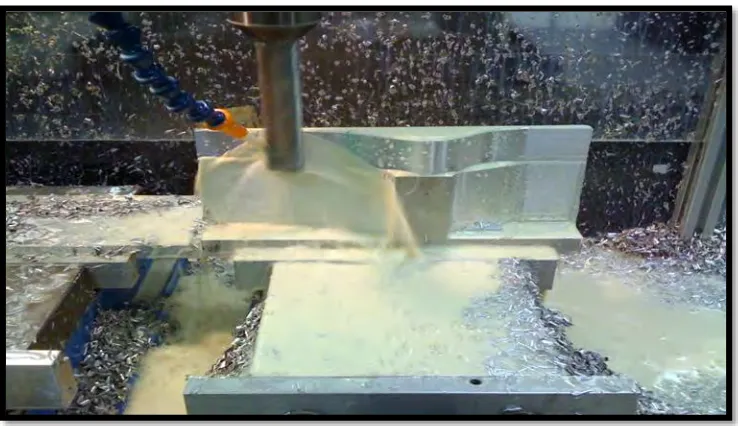
during the transfer. This demonstrate the cutting lubricant isn't a decent synthetic to our condition and furthermore to human body.
This study is to investigate other alternative chemical to replace the cutting fluid lubricant so that it can free from harmful substance that can effect whether the human or the environment. In this study, we will used vegetable based oil as cutting lubricant to investigate the surface roughness and tool wear.
[image:17.612.142.511.216.429.2]
Figure 1.1: Shows cutting fluid is used on machining process.
1.2 Background
3
Figure 1.2: The fatty acid chemical structure
(Shashidhara and Jayaram, 2010) state that triglyceride structure gives attractive qualities to boundary lubrication. It is because of their long and polar fatty acid chains, which give high strength lubricant films that interface unequivocally with metallic surfaces, decreasing both contact and wear. Lubricant are utilized as a part of numerous differing territories; along these lines, their ecological adequacy has turned out to be progressively critical. Essentially cutting lubricant are partitioned into three primary group that is:
I. Neat cutting Oil II. Water-Soluble fluid III. Gases
4
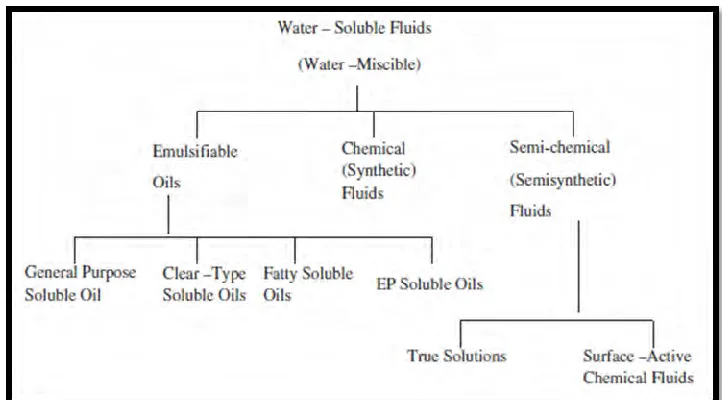
Figure 1.3: Classification of water-soluble fluid (Adapted from (Lawal et al., 2012))
Many study and investigation are being done to develop new bio-based cutting fluid so that the cutting fluid can be environment friendly and also the increase in need for renewable and biodegradable lubricants is highly expected.
5
1.3 Problem statement
At present, cutting fluid is being use without control as long the product that being machined is okay and can function as planned. Cutting fluids have been utilized as a part of machining procedures to diminish the temperature during machining by splashing the coolant into the machining zone straight forwardly on the cutting tool and the part. However, cutting fluids are earth disagreeable, expensive, and conceivably toxic (Safian et al., 2009). To achieve sustainable manufacturing, this are thing that we need to look and find a solution. The dry machining is one of the solution but dry machining will cause you large amount of money as the capital investment.
As cutting fluid are unpredictable in their composition, they may cause bothering or sensitivity. Microbial poisons are likewise produced by microscopic organisms and growths exhibit, especially in water-solvent cutting liquids according to (Lawal et al., 2012). This toxins and bacteria can cause harmful to the user in long term period. If the user are played with the cutting fluid every day, is not impossible that the user will get effected with the bacteria and can get dieses with it. However in this study, canola oil will be used as the cutting lubricant to perform machining process on conventional lathe machine. There a lot of things that we can compared to get the result.
1.4 Objective of research
The intention of this research study is:
a) To find an alternative cutting lubricant that environment friendly b) To investigate the surface roughness and tool wear of mild steel and
6
1.5 Scope of research
In this research, things included and limitation of the project are being discussed. The area of study is surface roughness and tool wear. The machine that will be used is conventional lathe machine. This is due to easy preparation of the machine. This machine also can do different kind of process that we will use when running the experiment. The process that will involve in this experiment is turning and facing. The two process will use the same cutting tool and the same parameter. At the end of the process, the result of the tool wear is compared between the tool bit that are being used in this experiment.
After finish the tool wear analysis, the part will be examined on the surface roughness of the product. The surface roughness tester will be used to determine the value of the roughness on the surface. Then the part will be compared whether the canola oil cutting lubricant is good or the synthetic cutting oil is good. The amount of the lubricant that will be use is also will be the same.
7
CHAPTER 2
LITERATURE REVIEW
2.1 Minimum Quantity Lubrication (MQL)
2.1.1 Principle of MQL
Regular metal working fluid delivery framework give liquids to work zone in volumes which "surge" the work zone these liquids are sifted then recycled through the framework. Minimum Quantity Lubrication delivery framework gives low volumes of liquids to the process. Minimum Quantity Lubrication (MQL) passes by many names. It has been alluded to as "Minimal Quantity Lubrication", "Near Dry Machining" or "NDM", "Smaller scale Lubrication" or "Microlubrification", "Miniaturized scale Dosing", and now and then even gets inaccurately alluded to as "Mist Coolant." Minimum Quantity Lubrication (MQL) is an option to the utilization of conventional metal working liquids (MWFs) in machining.
8
Figure 2.1: Benefit of Dry Machining (Adapted from (Weinert et al., 2004))
The main purposes of a cutting lubricant in wet machining operations are to cool, to lubricate, and to remove the chips. The quantity of coolant used currently are getting more and more every single day. The MQL is introduced by manufacture to overcome the cutting lubricant used in the industry nowadays. A definition of MQL has not yet been specified in standards and guidelines. There is no fixed ways to do the MQL. It depends on how you see where the point that can reduce the amount of cutting lubricant used. Usually the type of cutting lubricant used in MQL is biodegradable oil that not harmful to the environment. (Weinert et al., 2004) also said the media utilized by a large straight oil, however a few applications have additionally used an emulsion or water. These fluid media are bolstered to the device as well as machining point in small amounts.
9
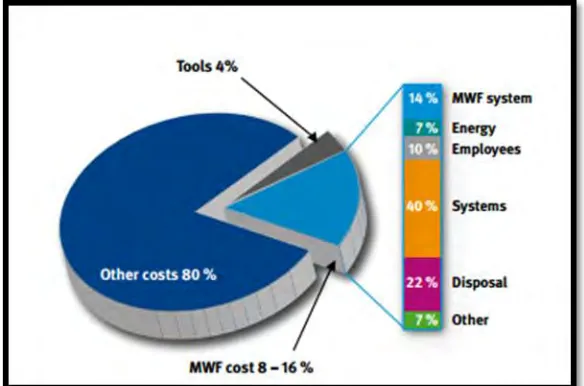
[image:24.612.180.472.259.452.2]stage. The immense lowering of lubricant volume utilize brings about almost chips and dry work piece. This enormously diminish well being risks created by the outflows of cutting ointment liquids in took in air and on the skin of representatives at their workshop. Cutting oil liquids don't spread all through the area around the machine, therefore making for a cleaner workshop. Expenses made by regular surge lubricant (e.g. maintenance, inspection, disposal of cutting fluid and preparation) are not any more an issue with MQL. The average percentages of these costs in the whole cost of wet processing are shown in Figure 2.1.
Figure 2.2: Metal working fluid cost in metal machining (Adapted from (Deutsche Gesetzliche Unfallversicherung, 2010))
The cost-inflating aspects of conventional flood lubrication can be reduce when MQL is used. This results in:
I. Decreasing volume of metalworking liquid utilize
II. Lowering in the work load for watching and cutting lubricant maintenance III. No need to plan and dispose of used cutting lunricant fluids use
IV. Lessening in the work required for cleaning the handled pieces