Short communication
Remote multi-camera system for in situ observations of behaviour
and predator/prey interactions of marine benthic macrofauna
DAVID J. MILLS1 GERALD VERDOUW2 STEWART D. FRUSHER1
1Tasmanian Aquaculture and Fisheries Institute
University of Tasmania Private Bag 49
Hobart
TAS 7001, Australia
email: [email protected]
2SciElex
Unit 2, 3 Mertonvale Circuit Kingston
TAS 7053, Australia
Abstract There are few options for obtaining in-formation on intra- and inter-species behavioural interactions between marine animals other than di-rect observation. Underwater video and infrared lighting can be used to overcome some of the biases and limitations associated with diver observations. We outline the assembly and application of a multi-camera underwater video system consisting largely of moderately priced components produced for the security surveillance industry. Signals from up to eight cameras on the seafloor are processed on a floating pontoon into a single video stream and trans-mitted to a remote monitoring station for viewing or recording. High-red and infrared lights are used for night viewing to minimise disturbance. Experiments incorporating this system have provided high-qual-ity data on predation and behaviour of lobsters. Keywords underwater video; animal behaviour; predator/prey interactions
INTRODUCTION
With the building emphasis on multi-species and ecosystem-based management of fisheries (Constable 2001), behaviour and interactions at the level of individuals have been increasingly recog-nised as key issues in understanding ecosystem function, organisation, and response to perturbation (Piraino et al. 2002; Butler 2003). Models capable of capturing the dynamics of individuals within a system (e.g., Werner et al. 2001; Butler 2003) depend on data collected at a resolution only attainable through direct observation.
Direct observations of marine animal behaviour are restricted to varying degrees by the harsh operating environment. Physiological limits to dive duration and physical limits to range of visibility complicate such studies under water. Behaviour of animals being observed is likely to be altered by the close proximity of divers (e.g., Rutecki et al. 1983). These difficulties are compounded when observing animals such as lobsters that are most active at night (Mills et al. 2004). Not only does diving become more hazardous, animals are also likely to respond to the presence of visible light required for obser-vation.
Underwater video, time-lapse recording tech-nology, and lighting at wavelengths invisible to animals have been adopted to overcome these problems. The use of single camera, fixed video systems has enabled constant monitoring of a limited area for periods of hours to days (Chapman & Howard 1979; Burrows et al. 1999; Jury et al. 2001). Although the use of video overcomes many of the problems and biases associated with diver observations, a single, fixed camera has a limited field of view. This problem is compounded at night when field of view is further limited by lighting. Possibilities to overcome this limitation include the use of remotely controlled cameras with zoom, pan and tilt functions, or the use of multiple cameras. We chose to adopt the latter as we believe it offers a simple, robust system with greater versatility. This paper provides details of a multi-camera system M04083; Online publication date 31 May 2005
Received 31 March 2004; accepted 26 August 2004
348 New Zealand Journal of Marine and Freshwater Research, 2005, Vol. 39
constructed predominantly using off-the-shelf items designed for the security surveillance industry. System assembly
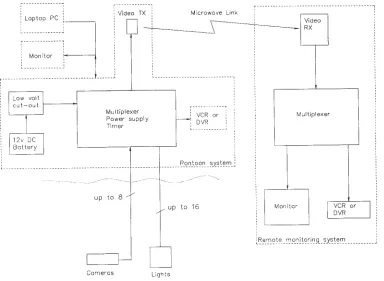
The camera system has three main component types: an underwater system consisting of cameras and lights; a surface pontoon system including power supply, video processor and transmitter; and a remote monitoring system including video receiver, decoder, and recording device (Fig. 1).
Cameras were low light (0.05 lux) black and white 1/3¢¢ CCD (charge couple device) image sensors with a 3.6 mm lens (GoVideo 3619 modules) providing a 42° viewing angle in water. Black and white CCDs were used as they have a broader wave-length detection capability than colour modules, enabling viewing with infrared light. Camera modules were protected in waterproof housings, and linked to the surface system by 30 m polyurethane-sheathed copper cables. To guarantee a clean power
supply for the cameras, a switch-mode DC-DC converter (Cosel ZUS151212) was fitted providing regulated 12 V DC.
We constructed high-red lights emitting a wave-length of 680 nm and infrared lights with wavewave-length of 845 nm for use in different circumstances. Choice of wavelength of lighting sources is critical. Absorption of light in water increases dramatically as wavelength increases into the red region of the visible spectrum, and then increases exponentially at infrared wavelengths. Increases are particularly marked at c. 700 nm for red light and 850 nm for infrared light (Kirk 1994). Applying formulae presented in Kirk (1994) we find that in water 72% of 680 nm high-red light is transmitted at a distance of 1 m and this reduces to 14% at infrared wave-lengths of 845 nm.
All lights consisted of an array of 40 high intensity light emitting diodes (max. radiant intensity c. 120 mW/sr @ 100 mA) encapsulated in resin for
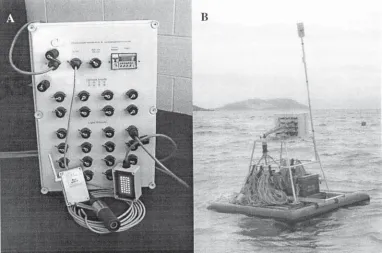
[image:2.496.58.442.48.329.2]Fig. 2 A, Main multiplexer, power supply and timer unit with weatherproof connectors for camera inputs (eight
connectors) power supply to lights (16 connectors) and multiplexer control, transmitter out and power in from batter-ies (one connector each). Also shown are a camera (lower centre) transmitter (lower left) and high-red light (lower right). B, Pontoon with light and camera cables coiled on frame ready for deployment. A moulded plastic hood covers the top of the system once deployment is complete.
protection and waterproofing, and connected to the pontoon system via a 30 m polyurethane-sheathed cable. Two of these lights were deployed with each camera and together are capable of effectively illuminating an area of seafloor not greater than 0.8
¥ 0.8 m from a distance of c. 0.8 m.
Camera and light cables are connected on the surface pontoon to a weatherproof housing (Fig. 2A) containing the camera power supply, a timer to allow lights to be switched on and off when appropriate, and a multiplexer. A duplex time-division multi-plexer (AND MPC8DX) is central to the functioning of this system. The multiplexer receives the signals from up to eight cameras simultaneously, samples the video inputs from each camera sequentially, and interleaves sampled frames into one composite video signal. This coded signal from all cameras can then be recorded directly on a single recording medium, or transmitted to a remote monitoring station. To view the signal, whether live or from videotape, a decoding multiplexer reassembles the frames into single camera video streams. Images can be viewed with several cameras displayed on a split screen, or
a single camera can be viewed in full-screen resolution. The penalty for using a multiplexed signal is that the frame rate from each camera is reduced to a degree defined by the number of cameras being monitored. For example, when recording 24 h of footage to a 3 h videotape with eight cameras connected, a frame is captured from each camera at c. 1 s intervals. Multiplexer settings, including individual camera brightness and contrast, frame capture rate, and on-screen displays can be adjusted using a laptop computer interfaced to the multiplexer via a weatherproof connector on the housing.
[image:3.496.60.442.51.304.2]350 New Zealand Journal of Marine and Freshwater Research, 2005, Vol. 39 prevents over-discharge and subsequent damage to
the batteries.
The camera signals are transmitted to a remote monitoring station using a microwave video link operating in the 2.4 GHz license-free band. Output power is low (10 mW) and transmission range varies greatly depending on weather, location, and antenna type. With a directional parabolic antenna on the receiver, range may be up to 1.6 km. Although this short transmission range was suited to our application, a system with a range of in excess of 10 km could be built using a video server coupled with a wireless network hub. The remote monitoring station may be set up on a boat or on land, and consists of a video receiver, multiplexer to decode video signals, a monitor, and a recording device. Camera signals can be recorded using a 12 V time-lapse VCR (e.g., Mitsubishi HS-7424EDC) or similar digital device. Where there is no convenient site to establish a remote station, the signal can be recorded on the pontoon. This system has the disadvantage that access to the pontoon is required to change recording media.
The pontoon base was constructed from three squares, one inside another, of welded polyethylene tubing (250 mm diam., 12 mm wall thickness). The outer square has sides of 1.7 m. This provides sufficient buoyancy and stability to support the camera system and up to two people during battery changes and deployment. Cameras and lights are deployed by lowering them to the seafloor through a 0.3 ¥ 0.3 m hole in the centre of the pontoon. An aluminium frame supports the weatherproof housing (and recording device if used) c. 1 m above the water surface. A plastic hood (not shown in Fig. 2B) is placed over the housing once the system is deployed. The pontoon is held in place and stabilised by three anchors connected by chain and rope to the sides of the pontoon. This prevents the pontoon from turning and tangling camera and light cables. The system can be deployed by three operators in a vessel as small as 7 m. Operators should consider the potential navigational hazard presented by the pontoon, and provide navigation lighting as prescribed by local regulations.
This system has the capacity to generate immense quantities of video data. For review purposes, a video signal splitter was built that enabled the signal to be fed to two multiplexers, and thus up to eight cameras could be viewed simultaneously on two split screens. When an event of interest occurred, single cameras were brought up in full screen view for detailed observation. Signals recorded in 24 h time-lapse
were reviewed at standard video speed, thus taking a minimum of 3 h to review 24 h of footage from up to eight cameras.
System applications
Using this system we have observed and quantified behaviours and interactions between lobsters and predators that were previously unknown and difficult to observe by other methods. Oliver et al. (2005) monitored the fate of tethered lobsters, identifying major predators (Fig. 3A) and determining survival time and diel variations in predation rates. These same data were used to test the validity of tethering trials in determining spatial variability in survival rates (Gardner et al. 2004), and showed that without detailed information on predator suite composition, tethering results could be very misleading. Lobster catch rates in traps are routinely used as a measure of abundance for stock assessment purposes, and a simple linear relationship between catch and abun-dance is assumed. Green (2002) used this camera system to observe behaviour of lobsters in and around traps (Fig. 3B), and demonstrated that the trap catch was influenced by a complex mosaic of interactions before, during, and after entering a trap, with only 13% of the observed lobsters being caught. These experiments illustrate the versatility of the multi-camera approach, using the cameras to observe simultaneous experimental replicates (Oliver et al. 2005), or to build a composite picture of a larger area with images from several perspectives (Green 2002). Different lighting sources were used in the two experiments. Green (2002) was interested in lobster behaviour and interactions between lobsters. The anatomy of Jasus edwardsii eyes is such that they are incapable of perceiving red light of wavelength greater than 600 nm (Meyer-Rochow & Tiang 1984). Accordingly, high-red lights were used without concerns about influencing behaviour. As the extinction of high-red light in water is substantially lower than that of infrared light (Kirk 1994), high-red lights provide brighter illumination than infrahigh-red lights for the same power consumption. Oliver et al. (2005) were interested in the behaviour of lobster predators including fish and octopus. The complex eyes of these predators can likely perceive high-red light, so infrared lights were used.
Fig. 3 A, Adult wild lobster observed at night under infrared light just after capturing a small tethered lobster. B,
Lobster trap viewed from above at night using high-red light. One lobster is exiting the pot, while several other lobsters can be seen within the pot.
systems as described in this paper will become an integral component of research to address questions relating to ecosystem-based management and the effects of fishing on the marine environment.
ACKNOWLEDGMENTS
Construction of the camera system was funded through grants from the Ian Potter Foundation, Australia and the Australian Research Council. The manuscript was im-proved by the useful comments of two anonymous ref-erees.
REFERENCES
Burrows, M. T.; Kawai, K.; Hughes, R. N. 1999: Forag-ing by mobile predators on a rocky shore: under-water TV observations of movement of blennies Lipophrys pholis and crabs Carcinus maenas. Marine Ecology Progress Series 187: 237–250. Butler, M. J. 2003: Incorporating ecological process and
environmental change into spiny lobster popula-tion models using a spatially-explicit, individual-based approach. Fisheries Research 65: 63–79. Chapman, C. J.; Howard, F. G. 1979: Field observations
of the emergence rhythm of the Norway Lobster Nephrops norvegicus, using different methods. Marine Biology 51: 157–165.
Constable, A. 2001: The ecosystem approach to manag-ing fisheries: achievmanag-ing conservation objectives for predators of fished species. CCAMLR Science 8: 37–64.
Gardner, C.; MacDiarmid, A. B.; Mills, D. J.; Oliver, M. D.; Stewart, R. 2004: Evaluating the release and survival of juvenile rock lobsters released for enhancement purposes. Final report (FRDC 2000/ 185) to the Fisheries Research and Development Corporation, Australia. 145 p. (available from h t t p : / / w w w . u t a s . e d u . a u / t a f i / TAFI_Download.htm)
Green, N. 2002: Video analysis of the behaviour of the southern rock lobster Jasus edwardsii to traps. Unpublished Honours thesis, University of Tas-mania, Australia. 112 p.
Jury, S. H.; Howell, H; O’Grady, D. F.; Watson, W. H. 2001: Lobster trap video: in situ video surveil-lance of the behaviour of Homarus americanus in and around traps. Marine and Freshwater Re-search 52: 1125–1132.
Kirk, J. T. O. 1994: Light and photosynthesis in aquatic ecosystems. England, Cambridge University Press. 509 p.
Meyer-Rochow, V. B.; Tiang, K. M. 1984: The eye of Jasus edwardsii (Crustacea, Decapoda, Palinuridae): electrophysiology, histology, and visual behavior. Zoologica 45: 1–85.
[image:5.496.42.460.51.227.2]352 New Zealand Journal of Marine and Freshwater Research, 2005, Vol. 39 Oliver, M. D.; Stewart, R.; Mills, D. J.; MacDiarmid, A.
B.; Gardner, C. 2005: Stock enhancement of rock lobsters (Jasus edwardsii): timing of predation on naïve juvenile lobsters immediately after release. New Zealand Journal of Marine and Freshwater Research 39: 391–397.
Piraino, S.; Fanelli, G.; Boero, F. 2002: Variability of species’ roles in marine communities: change of paradigms for conservation priorities. Marine Bi-ology 140: 1067–1074.
Rutecki, T. L.; Schneeberger, P. J.; Jude, D. J. 1983: Diver and underwater television observations of fish behaviour in a Great Lakes commercial trap net. Journal of Great Lakes Research 9: 359– 364.