Quality Enhancement Themes:
The First Year Experience
Printed copies of current publications are available from: Linney Direct
Adamsway Mansfield NG18 4FN
Tel 01623 450788 Fax 01623 450481
The First Year Experience
Curriculum design for the first year
enhancement led and learner centred. It was developed through a partnership of the Scottish Funding Council (SFC), Universities Scotland, the National Union of Students in Scotland (NUS Scotland) and the Quality Assurance Agency for Higher Education (QAA) Scotland. The Higher Education Academy has also joined that partnership. The
Enhancement Themes are a key element of a five-part framework, which has been designed to provide an integrated approach to quality assurance and enhancement. The
Enhancement Themes support learners and staff at all levels in enhancing higher education in Scotland; they draw on developing innovative practice within the UK and internationally. The five elements of the framework are:
z a comprehensive programme of subject-level reviews undertaken by higher education institutions (HEIs) themselves; guidance is published by the SFC (www.sfc.ac.uk)
z enhancement-led institutional review (ELIR), run by QAA Scotland (www.qaa.ac.uk/reviews/ELIR)
z improved forms of public information about quality; guidance is provided by the SFC (www.sfc.ac.uk)
z a greater voice for students in institutional quality systems, supported by a national development service - student participation in quality scotland (sparqs)
(www.sparqs.org.uk)
z a national programme of Enhancement Themes aimed at developing and sharing good practice to enhance the student learning experience, facilitated by QAA Scotland (www.enhancementthemes.ac.uk).
The topics for the Enhancement Themes are identified through consultation with the sector and implemented by steering committees whose members are drawn from the sector and the student body. The steering committees have the task of establishing a programme of development activities, which draw on national and international good practice. Publications emerging from each Theme are intended to provide important reference points for HEIs in the ongoing strategic enhancement of their teaching and learning provision. Full details of each Theme, its steering committee, the range of research and development activities as well as the outcomes are published on the Enhancement Themes website (www.enhancementthemes.ac.uk).
1 Executive summary 2
2 Introduction 6
3 Background and the project process 7
4 Key findings from the literature 8
5 Findings from staff workshops, student focus groups and
case studies 11
5.1 Staff workshops 11
5.2 Student focus groups 12
5.3 Case studies 13
6 Discussion 24
6.1 The need for early formative feedback and active learning approaches 24
6.2 Student involvement in curriculum design 25
6.3 Curricular structure 26
7 Conclusions 28
8 Recommendations 29
8.1 For managers and policy-makers 29
8.2 For academics and practitioners 29
8.3 For students 30
9 References 31
10 Appendices 37
10.1 Appendix 1: Curriculum design for the first year - literature review 37
10.2 Appendix 2: Full case studies 61
10.3 Appendix 3: Short case studies 91
10.4 Appendix 4: Quality Enhancement Themes First Year
Acknowledgements
The authors would like to express their thanks to:
z staff who contributed to workshops at the Enhancement Themes Conference 2007 and the Staff and Educational Development Association (SEDA) Spring
Conference 2007
z students who contributed to focus groups held at Queen Margaret University between April and June 2007
z all staff who contributed case studies, whether contained in this final report or not
z colleagues from the other First-Year Experience Enhancement Theme projects, and an anonymous peer reviewer for feedback on the project
z Professor Terry Mayes and other QAA Scotland staff for advice on progress of the project
z Valerie McKeown and Wendy Stewart for their administrative support and for proof-reading this work
1 Executive summary
This report outlines the work and outcomes of a practice-focused development project 'Curriculum design for the first year'. The project was one of nine funded by the Quality Assurance Agency for Higher Education (QAA) under the First-Year Experience
Enhancement Theme of the Scottish quality enhancement agenda.
The stages of this curriculum design project included: completing a literature review; running staff workshops to gather and disseminate information; holding student focus groups to gather students, views and experiences of the curriculum; collecting case studies of interest to the sector; and reporting findings to the sector.
Key findings from the literature are presented in this report. They include the need to adopt student-centred active learning strategies (Harvey, Drew and Smith, 2006; Oliver-Hoyo and Allen, 2005; Barefoot, 2002) and the importance of providing early formative feedback to students (Davidson and Young, 2005; Barefoot, 2002). Many suggestions for improving learning and teaching strategies have been adopted at module level, but could be implemented strategically across the breadth of a
programme curriculum. Kift and Nelson (2005) supported this view and argued that it is equally important to support these principles with systemic university-wide change, including administrative and support programmes that are also integrated with the curriculum and student needs.
In synthesising the literature, an 'ideal' curriculum design process appears to be described, if not rigorously evaluated. Students, graduates and employers should be consulted to inform the overall programme aim and to identify students' abilities on entry. A 'bird's-eye' view is advocated where discipline-specific and transferable knowledge and skills are developed within and across modules or units. Current pedagogical principles should be used developmentally to facilitate a progression of learning over the first year in particular and throughout the course. The success of this as an overall strategy should be evaluated in relation to student engagement and empowerment. However, most academics are overwhelmed by the different agendas being promoted in higher education (HE), and may lack the time, confidence and support to initiate change within current HE infrastructures (McGoldrick, 2002; Oliver, 2002).
At the workshops, staff expressed their views of what an ideal first-year curriculum would look like. Many staff agreed that taking a coordinated programme-level approach was important. First-year curricula that incorporate small-group work and the use of problem-based learning (PBL) were favoured, as was a commitment to offering early formative feedback to students. Other important elements of an ideal first-year
curriculum included maximising student choice, for example through involving students in curriculum design, and clear communication between staff and students about all elements of the curriculum, which was thought to be key.
student engagement can be fostered. Opportunities should be created for students to have personal contact with staff in their first year. Many staff also emphasised the importance of ensuring that the first-year curriculum enabled students to enjoy their learning experience.
These ideal elements of the curriculum described by staff largely overlapped with the literature, and there were many references to the areas covered by all the practice-focused development projects funded by QAA under the First-Year Experience
Enhancement Theme (see Appendix 4 for full list). Interestingly, peer support, personal development planning and enjoyment, which were all mentioned by staff, did not feature so highly in the literature.
Within the three student focus groups, students made many comments about aspects of university life outside the curriculum. However, in relation to the curriculum, they made many comments about their desire to receive quicker feedback on assessed work. Two key points were made in these focus groups. One was the need for more challenging work in the first year. Many students did not feel stretched by the first-year curriculum they had experienced, and described going backwards from the demands of school. The second key point was that students reported not being involved at all in curriculum design other than feeding back on module or programme evaluation forms. Where end-of-course evaluation is carried out, students often have no way of knowing whether their feedback influences curriculum design, and changes are most often made for the benefit of following cohorts of students. However, students reported their interest in being involved more closely in timetabling aspects of the curriculum.
The eight full case studies presented here are from six Scottish universities (Edinburgh, Napier, Queen Margaret, Robert Gordon, Stirling and Strathclyde), one Irish institution (University College, Dublin) and one American institution (Elon University, North
Carolina). The case studies cover the following disciplines: Biological and Environmental Science, Biology, Computing and Mathematics, Education, Environmental Justice, Geography, Mechanical Engineering, Nursing, Philosophy and Physics.
The key issues raised within the case studies are presented in sections that explore: an overview of the nature of the case studies; the rationale for curriculum redesign; student engagement; student empowerment; student involvement in curriculum design; evaluation of changes to curriculum design; useful lessons for others in the HE sector; factors that facilitated the progress of the work; barriers to progress; and dissemination of case study examples.
Other sources of agreement centred on the importance of adopting active learning and PBL approaches (literature, staff and case studies). Finally, there was also some agreement that the use of learning communities could be helpful in the first-year curriculum for enhancing transferable skills and a sense of belonging (literature and case studies).
Many issues were raised in the information gathered from the literature, staff workshops, student focus groups and case studies, and the complexity of first-year curriculum design and the breadth of the data collected makes giving simple messages almost impossible. However, a number of key themes were discussed. They included: the importance of active learning approaches in the first-year curriculum; the importance of student involvement in curriculum design; the paucity of rigorous evaluation and research into the first-year curriculum; and the need for specific research into the structure of the first-year curriculum.
Thorough root and branch redesign was considered to be the favoured approach to changing a first-year programme curriculum. However, this would be a significant undertaking requiring support across a discipline and institution for substantial redesign changes to be undertaken and sustained. In less than optimal circumstances, it may be more pragmatic to suggest selecting several of the key issues identified in table 1 (page 10) or within the recommendations contained in this report (section 8) and try to embed these within a module initially before tackling issues at programme level.
However, comprehensive change of a first-year curriculum is likely to have more
dramatic effects on student engagement and empowerment, as demonstrated in some of the case studies presented here.
A strong note of caution is needed regarding the paucity of rigorous research and evaluation into first-year curriculum design. Many debates are taking place anecdotally about which particular approaches to the first-year experience are desirable, but there is little research to back many of these views. It is with this caution in mind that we suggest recommendations.
Key recommendations for managers and policy-makers
Staff need support in the form of:
z dedicated time for curriculum redesign; involving students often takes longer than more traditional models of staff-driven curriculum design
z strong institutional messages to raise the status of the first-year experience
z institutional structures that reward positive examples of curricular change
Key recommendations for academics and practitioners
There is a need for:
z a comprehensive approach to first-year programme curriculum design
z pragmatism: where the context makes it difficult to take a comprehensive approach to curriculum design, it is suggested that individuals or programme teams could select several of the key elements identified in table 1 (page 10) or from the case studies in Appendices 2 and 3, and start by making changes in these areas
z commitment to first-year students being co-designers of their own learning
z further evaluation and research of first-year curriculum design, including student involvement.
Key recommendations for students
There is a need for students to:
z become partners in curriculum design by communicating ideas to tutors and feeding back on experiences
z be able to influence their curriculum and not always that of students in following years
z ask staff for the opportunity to become more involved in the design of their own learning
2 Introduction
This report outlines the work and outcomes of a practice-focused development project on 'Curriculum design for the first year'. It was one of nine projects funded by QAA under the First-Year Experience Enhancement Theme of the Scottish quality
enhancement agenda.
3 Background and the
project process
The Scottish quality enhancement agenda includes the promotion of a number of Enhancement Themes. Many of the previous Enhancement Themes have reported on their work in documents and resources useful to the HE sector. Within the Enhancement Theme of the First-Year Experience, QAA Scotland commissioned nine projects to work on different important areas of the first-year experience. Seven of these projects used a similar approach: completing a literature review, holding workshops to gather and disseminate information, collecting case studies of interest to the sector, and reporting findings to the sector. This report constitutes part of the dissemination process for the curriculum design project's findings.
The full literature review for the curriculum design project can be found in Appendix 1. Workshops were held to gather information and disseminate early findings: two at the Scottish Annual Enhancement Themes Conference in March 2007, and one at the Staff and Educational Development Association (SEDA) Conference in May 2007.
From the end of 2006 through to June 2007, case studies were collected of interesting work that practitioners were doing to engage students in, and through, curriculum design. Emails asking for examples were sent to the following: key institutional contacts with a remit for first-year work within each of the Scottish universities; the QAA register of first-year practitioners; Higher Education Academy (HEA) subject centres; and specific individuals with an interest in first-year curriculum design. This was not a comprehensive gathering of examples, but was realistic within the project timeframe. In total, we
gathered information for 25 case studies. Eight of these were selected to be included as full case studies in this report on the basis of their transferability to other settings, the level of student engagement fostered, their level of interest to the sector, and whether the work had been evaluated. Five others that also contain interesting features of curriculum design are included in Appendix 3 as short case studies.
Although not a mandatory part of the project remit, the project team was concerned to ensure that students' views were investigated. In an attempt to hear more about student involvement and engagement in and through curriculum design, three focus groups were held with students at Queen Margaret University (QMU). In addition, all of the practitioners submitting case studies were asked explicitly about student engagement, empowerment and involvement.
4 Key findings from the literature
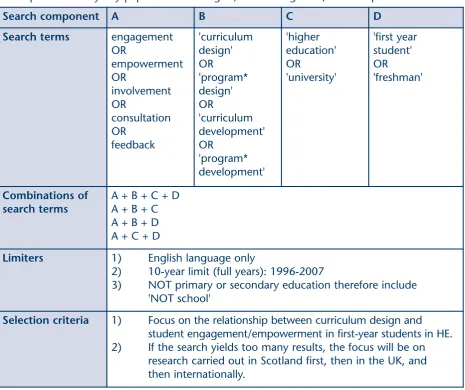
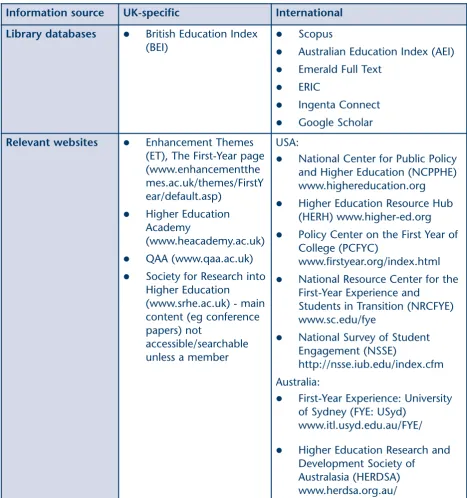
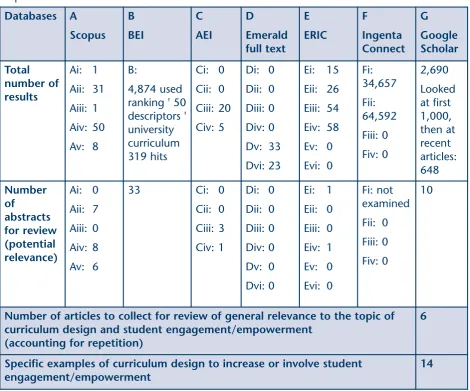
A literature review was completed in February 2007. The main findings are presented briefly here; the full review is available in Appendix 1. Since the focus of the literature review was on first-year curriculum design and the links to student engagement and empowerment, it was essential to establish terms of reference for those three components of the study: student engagement, student empowerment and the curriculum.
A recent briefing paper described student engagement in terms of 'attitude and commitment to study' (Piper, 2006, p 1). This is supported by staff who associate student engagement with behaviours (for example attending, actively participating, doing work out of class, interacting with peers) and attitudes (for example motivated, enthusiastic, sharing responsibility for learning) (Solomides and Martin, 2005).
Empowerment suggests learners taking control of their own learning (Piper, 2006). Interestingly, the attributes that may enable them to do so have been closely associated with employability - that is transferable skills, intellectual qualities, personal
characteristics and career orientation (Helsby, 2002) - and are those attributes that many programmes seek to develop in their students.
Curriculum is defined in quite different ways by different stakeholders. Fraser and Bosanquet (2006) explored definitions proposed by academic staff. Their analysis suggested four categories of conceptualising the curriculum: structure and content of a unit or subject; structure and content of a programme; learning experiences; and a dynamic interaction and collaboration between student and teacher. Within the literature there were examples of authors referring to the first two of these definitions, but less reference to the latter two.
The literature review focused on these key themes rather than on more numerous learning, teaching and assessment strategies, which were addressed in other associated projects. Literature identified through the rigorous search strategy was broadly divided into three main areas: curriculum design that aims to engage or empower students at module level; curriculum design that aims to engage or empower students at
Literature relating to curriculum design at programme level was limited. Several projects/authors advocated the strategic use of learning, teaching and assessment strategies to increase integration, independence and collaboration among students (Helsby, 2002, Skills PlusBeder, 1997; Lines, 2005). Kift and Nelson (2005) acknowledged the importance of redesigning curricula in line with current pedagogical principles. However, they also argued that it is equally important to support these principles with systemic university-wide change, including administrative and support programmes that are also integrated with the curriculum and student needs. They set out six principles of curriculum renewal to enhance student engagement: engaging learning environments; long-term strategies for programme development rather than piecemeal modification; taking account of student needs; cumulatively developing skills required on graduation; facilitating reflection, independence and self-management; and aligning curriculum, administrative and support services to ensure an institution-wide approach.
The literature contained very few instances of students being involved in curriculum design; the only two examples were from the United States (Lundstrom, Mariappan and Berry, 1996; Auerbach, 1992). More frequently, stakeholders from industry were
consulted. Where students were involved, they tended to be consulted at the redesign stage (Oliver, 2002). In UK universities, student evaluation at module and
course/programme level is common practice. It is an expectation that periodic
programme reviews and revisions to curricula will take account of and respond to this feedback. However, the relationship between student evaluation and curriculum design is, unfortunately, poorly documented in the literature. Furthermore, students are often unaware of any impact their views may have over changes to the curriculum. A more satisfactory means of 'closing the loop' may be to offer ongoing opportunities for student feedback by incorporating evaluation into the curriculum and learning and teaching activities (Davidson and Young, 2005). Participatory action research may provide the ideal mechanism for serious student involvement in evaluation and design processes, while also empowering students (Bovill et al, forthcoming; Carr and Kemmis, 1986; Moore, 2004).
Oliver (2002) also reported that some academic staff were concerned that first-year students may not be knowledgeable enough about the whole first-year programme to be able to contribute meaningfully to curriculum design. Views of whether students should be involved in curriculum design vary and are likely to be linked to how individuals define curriculum. For those adopting Fraser and Bosanquet's (2006)
definition of curriculum as a 'dynamic interaction and collaboration between student and teacher', student involvement is likely to be emphasised. Fraser and Bosanquet implied that reducing specific documented structures and content provides more room for involving and collaborating with students in their learning, leading to greater engagement and empowerment.
Therefore, many of the findings need to be treated with care. More robust research and evaluation of first-year curriculum design is needed if academic staff and managers are to be convinced of the need to implement change in their discipline or institution.
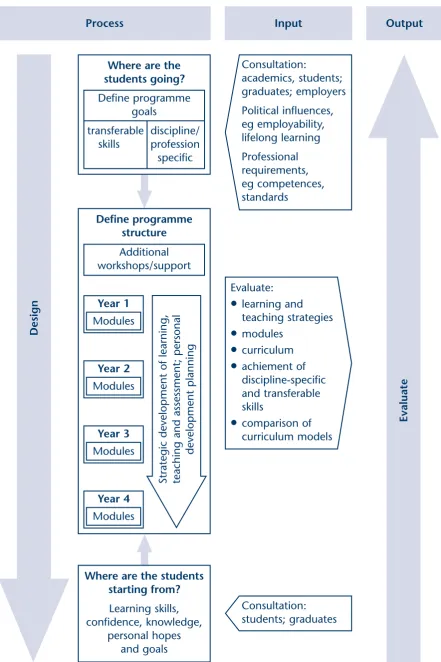
Following synthesis of the literature, an 'ideal' curriculum design process has been described (Appendix 1, p 37). Students, graduates and employers should be consulted to inform the overall programme aim and to identify students' abilities on entry. A 'bird's-eye' view is advocated where discipline-specific and transferable knowledge and skills are developed within and across modules or units. Current pedagogical principles should be used developmentally to facilitate a progression of learning over the first year in particular and throughout the course. The success of this as an overall strategy should be evaluated in relation to student engagement and empowerment. The key elements of 'ideal' first-year curriculum design outlined in the literature are summarised in table 1.
Key features of an 'ideal' first-year curriculum from the literature:
z orientation of students to increase social and academic engagement,
'connectedness' to university, sense of direction and future career (Beder, 1997)
z development of learning skills (Lines, 2005; Harvey, Drew and Smith, 2006)
z student-centred, active learning through problem-based, project-based and group learning (Beder, 1997; Harvey, Drew and Smith, 2006)
z collaborative learning or learning communities to enhance transferable skills and lend a sense of belonging (Barefoot, 2002; Lines, 2005)
z formative assessment and feedback (Yorke, 2003; Nicol and Macfarlane-Dick, 2006)
z progressive skills development (Jantzi and Austin, 2005)
z time and structures for reflecting on learning (Jantzi and Austin, 2005). Table 1: key features of an 'ideal' first-year curriculum from the literature
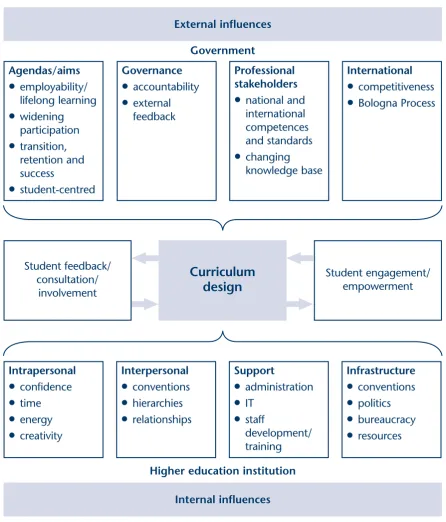
While many of these ideas have appeal for academics, there are many internal and external barriers to implementation. In contrast to the 'ideal' curriculum design process, literature relating to actual practice suggests that most academics are overwhelmed by the different agendas being promoted in HE, and may lack the time, confidence and support to initiate change within current HE infrastructures (McGoldrick, 2002; Oliver, 2002).
Internal influences exist at interpersonal, historical and organisational levels - for
example, resistance from team members, lack of ownership of modules because of high staff turnover, and laborious bureaucratic procedures that limit change and flexibility of delivery (Oliver, 2002). External barriers were also identified, including numerous and sometimes conflicting agendas disseminated from the Government through professional bodies and higher education institutions (HEIs). These included widening participation, increasing employability and lifelong learning, changing professional requirements, and ensuring student ownership (McGoldrick, 2002; Shaw, 2002). As Kift (2004) described, many higher educators are change-weary or change-averse.
5 Findings from staff workshops,
student focus groups and
case studies
This section reports on findings from eight full case studies, five small case studies, three staff workshops at national conferences and three student focus groups at QMU. The report of the First-Year Experience sector-wide discussion project Student expectations, experiences and reflections on the first yearindicates that although students referred to issues under consideration by all the Enhancement Theme's projects, hardly any discussion that took place with students focused specifically on curriculum design.
55..11
SSttaaffff w
wo
orrkksshho
oppss
The staff workshops offered an opportunity to disseminate some of the early findings from the work of this project, which were predominantly based on the literature review (see section 4 and Appendix 1). However, the workshops also offered staff an
opportunity to describe their vision of what an 'ideal' first-year curriculum should look like. The most commonly mentioned themes and features described by staff are presented in table 2.
Key features of an 'ideal' first-year curriculum gathered from staff in workshops:
z coordinated programme-level approach
z small-group work
z problem-based learning (PBL)
z student choice
z early formative feedback
z using the most experienced staff to teach first-year students
z involving students in curriculum design
z opportunities for students to have personal contact with staff
z clear communication between staff and students about all elements of the curriculum
z enjoyment.
These ideal elements of the curriculum described by staff largely overlapped with the literature. Indeed, staff may have been influenced by the literature they had read. Interestingly, peer support, PDP and enjoyment did not feature so highly in the literature.
55..22
SSttuuddeenntt ffo
occuuss ggrro
ouuppss
In focus groups with first-year students at QMU, participants were asked about their experience at university and whether they had been involved in designing the first-year curriculum in any way. Students commented on elements of the curriculum such as assessment - for example, they made many comments about their desire to receive quicker feedback on assessed work. However, in common with the sector-wide discussion project on student expectations, experiences and reflections, students had more to say about non-curricular issues than about the curriculum.1
Nevertheless, two key points were made in these focus groups. One was the need for more challenging work in the first year. Many students did not feel stretched by the first-year curriculum they had experienced, and described going backwards from the
demands of school (this was also consistent with findings from the project on student expectations, experiences and reflections). It may be worth referring here to various theories outlining the 'teacher-expectancy effect' (Jussim and Harber, 2005; Rosenthal and Jacobson, 1992), where students tend to meet the expectations of their tutors. This theory suggests that if we have higher expectations of our students, they are more likely to enhance their performance to meet those expectations.
The second key point raised was that students reported not being involved at all in curriculum design other than feeding back on module or programme evaluation forms. However, all the students in the three focus groups reported their interest in being involved more closely, particularly in timetabling aspects of the curriculum.
The key elements of an 'ideal' first-year curriculum outlined by students in the focus groups are summarised in table 3.
Key features of an 'ideal' first-year curriculum gathered from students in focus groups:
z more attention on assessment and timely feedback
z more challenging work
z involving students in curriculum design in a role that is 'more than just feedback'
z student participation in designing timetabling and curricular structure. Table 3: key features of an 'ideal' first-year curriculum gathered from students in focus groups
1In the case of QMU students, not only did they offer substantial feedback about information technology
55..33
C
Caassee ssttuuddiieess
This section presents findings from eight full case studies (see Appendix 2 for the complete case studies) and from five short case studies; the latter included some
interesting features of curriculum design, but for a number of reasons were not included as full case studies (see further details in Appendix 3). Some of the studies describe curriculum design at programme level, some at module level, and some at both. These different interpretations of the levels at which curriculum design takes place are
consistent with the work of Fraser and Bosanquet (2006), who highlighted the variety of ways in which staff define curriculum.
Most of the case studies do not describe active involvement of students in first-year curriculum design, although there are several interesting examples where students have adopted a more active role in either leading or collaborating with staff in first-year curriculum design.
The eight full case studies presented are from six Scottish universities (Edinburgh, Napier, Queen Margaret, Robert Gordon, Stirling and Strathclyde), one Irish institution (University College, Dublin) and one American institution (Elon University, North Carolina). The case studies cover the following disciplines:
z Biological and Environmental Science
z Biology
z Computing and Mathematics
z Education
z Environmental Justice
z Geography
z Mechanical Engineering
z Nursing
z Philosophy
z Physics
They also include reference to interdisciplinary and foundation courses. The wide range of disciplines covered is in part because several case studies describe work in more than one area.
The key issues raised within the case studies are presented in the following sub-sections:
z brief overview of the nature of the case studies
z rationales for curriculum redesign
z student engagement
z student empowerment
z student involvement in first-year curriculum design
z evaluation of changes to curriculum design
z barriers to progress
z dissemination of case study examples.
The elements contributing to an 'ideal' first-year curriculum contained within these case studies are summarised in table 4 and explained more fully in the following sub-sections.
Key features of an 'ideal' first-year curriculum gathered from the case studies:
z inclusive of diversity
z relevance to students - using students' own experiences as a focus for learning and as a basis for curriculum design
z alignment of intended learning outcomes with assessment and learning approach
z students to be members of a learning community
z social networks to build student confidence
z active learning approaches, including small-group work, modelling and simulation, structured tasks, problem-based learning
z early and regular feedback
z continuous assessment
z incentives for students to engage with the work
z use of learning contracts
z use of electronic voting systems (EVS)
z use of computer software to break down barriers to learning
z physical redesign of learning spaces
z increased student choice through, for example, personalised routes of study and within assessments
z student participation in real and authentic projects, including curriculum design
z giving students more responsibility
z listening to student voices and ensuring that these views effect change.
5.3.1 Brief overview of the nature of the case studies
Case study 1: Simon Bates, University of Edinburgh, Physics
Over the last eight years, Simon Bates and colleagues have been developing a blended learning approach in their first-year programme. There are approximately 250 students in each first year, the staff's aim has been to use the best of face-to-face teaching approaches and interactive technology to support learning. Students are given a high level of choice as to the topics they study and therefore which route they take through the course.
Case study 2: Jane Brown, Napier University, Edinburgh, Nursing
Over the last six years, Jane Brown and colleagues have been adapting a core module for all first-year pre-registration nursing students. Key elements emphasised include:
continuity of tutors; considerate timetabling; a comprehensive module handbook, including learning outcomes for each class that link explicitly to assessment; and a staged assessment process that involves early and regular formative feedback.
Case study 3: Eurig Scandrett, Queen Margaret University, Edinburgh, Environmental Justice
The Higher Education Certificate (HE Cert) in Environmental Justice runs as a
collaboration between Friends of the Earth Scotland and QMU to support communities tackling local environmental issues by building the capacity of key activists. The focus of the HE Cert is to provide students with an academically rigorous and practically useful course that uses a Freirean pedagogical approach (Freire, 1993). Students' own
experiences of environmental problems are integrated throughout the course and used as the foundation for dialogue with other forms of knowledge. Therefore, students' experiences guide the design of the curriculum throughout the first year.
Case study 4: Roger McDermott, Robert Gordon University, Aberdeen, Computing and Mathematics
Staff have adapted elements of the first year in a way that has changed how students perceive the subject of computer programming. They have introduced a new
programming package called 'Alice' in a first-year introductory module to help students to engage in the subject and overcome 'troublesome knowledge' (Meyer and Land, 2003). The software has helped students to undertake programming through a
storytelling approach rather than through the use of algorithms. Divergent assessment has also been adopted, which enables students to generate their own individual
Case study 5: Carol Salt, University of Stirling, Biological and Environmental Sciences
Four years ago, staff began redesigning the first-year programmes. Six modules form a common foundation to many of the programmes offered. Two new modules that have been introduced, dedicated to practical laboratory and field skills, use group working as one of their key approaches.
In Environmental Sciences, the first and second-year modules have been restructured to emphasise current global environmental issues, which are explored in terms of the underlying science, social and economic aspects and potential solutions. Two modules in Biological Sciences have enhanced the relevance of the syllabus of fundamental scientific aspects of biology by introducing topical issues into lectures and assignments. In all six modules, the teaching of skills and subject-specific content is closely aligned to the learning outcomes. Assessment is continuous over each semester and is based on a mix of laboratory and field reports, essays, oral presentations and tests/exams.
Case study 6: Jim Boyle, University of Strathclyde, Mechanical Engineering
Staff have undertaken 14 years of continual redesign of the first-year mechanical engineering programme to ensure a more integrated and coherent programme. The curriculum emphasises group work, active and collaborative learning, problem-based learning and teaching by questioning (supported by electronic voting systems). The curriculum redesign has also involved physical redesign of some of the teaching spaces so that there are purpose-built teaching studios for mathematics and IT-related subjects. These spaces are ideal for combining access to electronic media and small and large-group work. Staff have reported much higher attendance at classes, and higher student retention rates.
Case study 7: Niamh Moore, University College, Dublin, Geography
Staff identified some key elements and themes they wanted to change in the first-year Introduction to Human Geography module. They moved to a thematically-based module with continuous assessment and adopted an active learning approach that includes small-group work, interactive discussion online and enquiry-based learning within quite large class sizes. Students became central partners in the module preparation. Three undergraduates were employed for six weeks to research and develop content for the virtual learning environment (VLE).
Case study 8: Peter Felten, Elon University, North Carolina, United States
5.3.2 Rationales for curriculum redesign
In the case studies, the rationales given by staff for redesigning first-year modules and programmes varied, but with some recurring themes. Staff mentioned concerns about poor student attendance (case studies 2, 6 and 7) and a desire to move away from lecturing to large numbers of students (case studies 2 and 7). There was also a mention of adapting courses to be more inclusive of the diversity of first-year students and to better enable students to develop the diverse skills they will need on leaving university (case studies 1, 5, 7 and short case study iii).
There were concerns about levels of student engagement (case studies 2, 4, 6 and 7) and, related to this concern, a desire to create a more relevant curriculum (case studies 3 and 5). As Carol Salt stated, 'changes to the syllabus, to increase its relevance to current issues, were made to promote student interest and make modules attractive optional choices for students from other departments'.
The rationale for redesigning the curriculum was also influenced by institutional policies, and there was a mention of the need to achieve teaching efficiencies through closer integration of first-year modules (case study 5). Some staff expressed the view that redesign gave them an opportunity to improve on an original curriculum design that did not explicitly align learning outcomes with assessment and learning approaches
(case studies 2 and 7). One case study emphasised making changes to first-year curriculum design in order to increase student involvement as members of curriculum redesign teams (case study 8). Finally, staff in one case study outlined the influence of visiting other institutions in demonstrating '…very strongly to us that this approach would work, as well as being much more engaging' (case study 6).
5.3.3 Student engagement
The examples in the case studies suggested a number of approaches to engaging
students. Many focused on pedagogically engaging techniques, such as peer instruction, small-group work, modelling and simulation, structured tasks and problem-based
learning (case studies 1, 3, 4 and 6; short case studies i and iv). Early and regular feedback to students was another approach used to engage students (case study 2 and short case study i). Related to this, several examples demonstrated the use of continuous assessment (case studies 5 and 7). One example outlined offering incentives to students in the form of a small proportion of marks towards an assignment if they demonstrated preparation for tutorials and engagement in the work (case study 7).
Other approaches included the use of learning contracts which emphasised that if face-to-face time was spent in interactive exercises, more content needed to be covered in students' own time (case study 1). Electronic voting systems have also been used very effectively in large classes to increase interaction and engagement, as has significant physical redesign of teaching spaces to enable the use of more exciting and interactive teaching approaches (case studies 1 and 6).
Students on the HE Cert Environmental Justice are required to be involved in a community-based or trade union campaign or project. They present this project to others at induction, and the tutor guides the discussion into progressively more analytical questions (using Freirean methodology). The generative themes which result across the group provide a basis for interpreting environmental justice. These are linked into relevant parts of the existing curriculum or added to through additional inputs. The campaigns and projects become the focus of the teaching, learning and assessment throughout the course and students learn from each other - in person or via WebCT - as well as from course material. The example from Computing and Mathematics has engaged students through using software to promote a different approach to learning that breaks down barriers to learning 'troublesome knowledge' in the subject (case study 4). As Roger McDermott explained:
An important claim for…[Alice]…software is that it facilitates a change in the underlying subject metaphor from one based on the implementation of
mathematical algorithms to one based on storytelling. This helps to engage the imagination of the students and allows them to see the subject in a new and accessible way.
Another key approach to engage students is through increasing student choice, by enabling personalised routes of study (case study 1) and creative freedom within assessments (case study 4). Finally, the importance of students participating in real projects that involve real course design was emphasised. Students are more likely to be engaged where they can see that their suggestions are making changes to real courses (case study 8).
5.3.4 Student empowerment
Perhaps unsurprisingly, within the case studies, descriptions of student engagement specifically through curriculum design overlapped with more general descriptions of student engagement. However, the ways in which staff thought that the first-year curriculum added to the themes of engagement by empowering students included ensuring that students were active (case study 6). As Jim Boyle described, 'the students now have an active role in each class…they contribute to the class, and through their discussion and response to questions, guide the delivery of the class continuously. Implicitly, all these techniques reinforce student formative self-assessment' (see also short case study ii).
Small-group work and problem-based learning were thought to contribute to student empowerment where, for example, students had to negotiate their own working groups (case studies 1 and 5). Using students' own experience as the basis for learning,
although raised in the discussion of engagement, was thought to have the potential to go further and empower students (case study 3).
We have found that it often takes time for students to develop the confidence (and the language) to express pedagogical ideas clearly. Many seem at first to doubt that we will take them seriously. In most course design projects, a moment comes when students suddenly realise that they are being heard. We have begun to structure our course design projects to include an early and public point when students are making an important decision, such as selecting the textbook. This moment typically changes the dynamic of the design group, empowering students to be active participants and showing faculty the value of listening to students.
5.3.5 Student involvement in first-year curriculum design
The most common route through which students' views influenced first-year curriculum design was course feedback questionnaires at the end of modules or programmes (case studies 1, 2 and 4). Other approaches included:
z course feedback at a later stage after a course had finished and where students had had a chance to transfer knowledge and skills to other settings (case study 4)
z student surveys using electronic voting systems (case studies 1 and 6)
z student focus groups (case study 1)
z student-staff consultative committees (case study 5).
Carol Salt reported that 'while students have so far not been involved in curriculum design we have recently started a debate in our student-staff consultative committee on how students would like to see the new Enhancement Theme of research-led teaching shape the future curriculum'.
One challenge with these approaches is that feedback from first-year students generally informs curriculum design for subsequent cohorts of students, which can prevent some students from wanting to become actively involved. Hence it is important to integrate student feedback in an ongoing process throughout the first year (short case study v). Only three of the eight full case studies described students being actively involved in curriculum design (case studies 3, 7 and 8). These were the only case studies submitted to the project team that included examples of student involvement in designing first-year curricula. This echoed the student focus group findings, where students reported few opportunities to be involved in curriculum design.
The following quotes illuminate some of the approaches adopted in the case studies. Peter Felten reported that:
Elon has a tradition of involving students in all aspects of university life and governance. Recently we began exploring how to involve students systematically in course design. Faculty who have adopted this approach believe that students have expertise or experiences that will illuminate the course design process. Some faculty are most interested in how to help students learn difficult or complex course material; in this case, students involved in course design assist the faculty member in understanding how and why novices struggle to learn specific knowledge or processes. Other faculty involve students as a way to better
the design process is itself educational, potentially transforming not only the course but also the students and faculty who work together to design a course. Niamh Moore explained that:
…three undergraduate students who had successfully completed their second year were employed to develop module content. At that point, the overall framework of the module was in place and the coordinators provided the students with…four case study themes. They were then given free rein to source/develop content that they would view as appropriate and helpful for learning. Weekly meetings took place to review progress, resolve difficulties and provide general guidance. The students were provided with access to iMac computers, video cameras, digital photo cameras and the internet and were encouraged to demonstrate a range of research skills that they had learnt during their studies…. They were given full control of the design of the Virtual Learning Environment.
At the end of the internship, the coordinators reviewed the portal developed and discussed with the students how the material would be used and adjusted if necessary…. We advertised the positions within the department to our
second-year students and asked them to let us know if they were interested. We then asked them to submit their curriculum vitae and some ideas in writing about how they would approach sourcing case study material. We shortlisted six students and went through an interview process with them.
Finally, Eurig Scandrett described how students design aspects of their own curricula through ongoing dialogue between tutor and student: '…students are involved in dialogical methods to design curriculum on an ongoing basis. In addition, course materials have been selected and partially written by students…'.
5.3.6 Evaluation of changes to curriculum design
Some of the case studies had adopted research-based approaches to evaluating the curriculum (case studies 6, 7 and 8). The most thorough evaluations were well planned, adopting a research approach using qualitative or quantitative methods, or both, within a mixed-methods evaluation. One example involved use of a systematic evaluation using several tools in order to triangulate data and provide an ongoing profile of the process (case study 7). A pre-module questionnaire was employed to determine students' experiences of teaching. This was followed by mid-point and end-of-module questionnaires and focus groups to determine students' learning and levels of
engagement. Engagement was evaluated by asking questions about whether students applied knowledge to their own experiences and discussed the module with people outside the class, and how flexible they were to learning. To ascertain the staff perspective, module coordinators kept teaching logs.
Similarly, another case study involved the use of pre and post-project interviews, individual written journals documenting the process, and student work products. Staff also compared the course syllabus and materials before and after the design project as a means of tracking changes to content and organisation (case study 8).
This demonstrated a change from a bi-modal distribution (with lower mode representing disengaged students) to a uni-modal distribution with clustering just above average. Many of the case studies collected student feedback during the module, or more commonly at the end of it (case studies 2, 5 and 7). In one case, staff carried out a quantitative evaluation through non-parametric analysis of responses to questionnaires (case study 4). Another example talked of the efficiency with which staff collected 'high volume, real time' feedback from students during their module by using electronic voting systems (case study 6). Using EVS as a method of generating student feedback offered a multiplicity of opportunities, particularly as students expressed their enthusiasm for these voting systems.
Staff often looked to assessment results as an output measurement of change. Two of the case studies gave examples of this (case studies 2 and 6). One demonstrated a shift in mark distribution (case study 6), and the other showed an improved pass rate with a change in assessment frequency (case study 2). Obviously, it is important to consider these results in the context of other alterations to the programme.
Finally, other means of evaluating success were measured through student activity, such as the volume and frequency of online self-assessments, attendance and enrolment. Carol Salt reported considerably increased usage statistics on voluntary self-assessment tests after modification to the course (case study 5).
5.3.7 Useful lessons for others in the higher education sector
Staff outlined a variety of lessons for the HE sector. Three respondents stated that the first-year curriculum should be designed in such a way as to facilitate interactivity and engagement in active, collaborative learning (case studies 1, 6 and 7). Teaching methods using EVS, group work, problem-solving and online tasks, for example, were seen as being broadly transferable and important for improving learning. Another significant point was that the curriculum should facilitate social networks to help to build student confidence, which can nourish enthusiasm for learning (case study 7). As Niamh Moore stated, 'Being among "friends" gives them a vested interest in attendance, promotes their willingness to engage in self-directed and peer learning through group regulation of learning activities'. This view mirrored that of Beder (1997) cited in the literature review. Ensuring the relevance of the curriculum was another feature emphasised as important (case studies 3 and 5). Topicality can stimulate student interest and establish links with employment. Interest may also be improved by using a variety of assessment strategies, such as divergent assessment (case study 4).
Some of the case studies also outlined the need for commitment from staff to ensure the success of curriculum change. One emphasised the positive experience of collaboration with an external partner to develop a very relevant curriculum suited to a specific purpose (case study 3). Another lesson was the need to factor in plenty of time to involve students in curriculum design (case study 8).
5.3.8 Factors facilitating the progress of the work
Interested and enthusiastic support from colleagues was identified as the most important facilitator for staff leading curricular change. Peers who were sympathetic to innovations and could see their potential provided a real motivating force for continuing. One respondent commented on the value of a 'collective spirit' among her colleagues, which helped to move the initiative forward (case study 5). However, in addition to the moral support gained from those with positive attitudes, colleagues helped individuals to navigate complex university structures, procedures and regulations. They also helped to make links with other colleagues who have been successful in implementing innovations or changes.
Significant progress had been made by individuals who had received advice and support from educational developers, who also acted as facilitators and encouragers. In one instance, the project was part of a larger initiative led by the educational development unit (case study 8). One of the short case studies outlined a process of working with educational developers, but also with the HEA subject centre (short case study v). Learning technologists were also thought to be essential, where the design of electronic resources was key to activities that would engage students (case study 1).
Only one respondent mentioned funding for their work, but such monetary support enabled the team to develop learning materials (case study 7).
Institutional recognition of initiatives lent status to those who led curricular changes. This may have been simply through acknowledgement of the importance of initiatives. Those with senior or honorary positions, such as teaching fellows, may have been able to influence peers.
5.3.9 Barriers to progress
The case studies outlined a number of challenges for first-year curriculum design. More than half of them included discussions about staffing levels, as first-year class sizes have become increasingly larger. Others referred to the difficulties of teaching and giving feedback to large numbers of students in a manner that would encourage student engagement (case study 5).
The staff time required to implement these initiatives was an issue, with some staff referring to other conflicting demands on their time. One respondent from a research-intensive university drew attention to the time and energy required of individuals to focus on curricular changes when expected to keep up research activity - a well-known situation in the UK HE context (case study 1). As mentioned above, one case study suggested that the additional time necessary to involve students in course design may act as a barrier. For example, it may mean planning programme review well in advance of the start date for a programme (case study 8).
Three of our eight respondents were of the opinion that sometimes their colleagues' attitudes were not entirely supportive of their first-year work (case studies 2, 6 and 7). For example, they had experienced cynicism or scepticism from some colleagues, who viewed their innovations as 'fads' or as processes which would result in a
programmes rather than as providing the foundations of knowledge essential for students developing effective study skills. This led to the work being devalued, despite its essential role in enabling learning on wider degree programmes (case study 2). Another respondent referred to the need for innovative approaches to programme approval from institutions.
The view that university processes and structures may present barriers if they are too inflexible was shared by several respondents (case studies 3 and 4). One respondent in particular found some difficulty in dealing with 'rules' related to admissions, finance and administration, which were based on the way more 'traditional' programmes ran (case study 3). Another agreed that radical changes within a 'conventional' curricular framework had presented problems. These findings reinforce the view of Kift and Nelson (2005), who suggested that systemic, university-wide changes should accompany
curriculum redesign to ensure that administration and support are integrated with the curriculum and respond to student needs.
An important factor in engaging students in course design was the acknowledgement that real empowerment required a change of roles for both staff and students, resulting in altered dynamics in relationships and changes to power within planning groups. As Peter Felten argued: 'involving students also requires significant role shifts for both faculty (who must be willing to share some power over the course) and students (who do not always take themselves or the process seriously)'.
This could sometimes present problems if students lacked experience and understanding of context and issues. Eurig Scandrett (case study 3) has attempted to give students full responsibility for determining topics for group study, but found this more difficult for students who were younger and had little personal experience from which to draw. While this may be a generally applicable observation, it was particularly relevant for this programme, which was designed for individuals who were preparing for their roles as political activists.
5.3.10 Dissemination of case study examples
6 Discussion
In bringing together findings from the literature, staff workshops, student focus groups and case studies from practice, the messages presented are complex. The lack of agreement about how to define curriculum is a clue to the complexity of first-year curriculum design, so it was unlikely that this project would be able to present simple results indicating 'quick-fix' approaches. Nevertheless, several issues are worthy of further discussion in this section:
z the need for early formative feedback and active learning approaches
z student involvement in curriculum design
z curricular structure.
66..11
TThhee nneeeedd ffo
orr eeaarrllyy ffo
orrm
maattiivvee ffeeeeddbbaacckk aanndd aaccttiivvee
lleeaarrnniinngg aapppprro
oaacchheess
A recurring theme throughout the work of this project was the importance of giving students early and regular formative feedback. Calls for early formative feedback in the first year came from the literature, staff workshops, student focus groups and the case studies. Indeed, the shared view that formative feedback plays a crucial role in first-year students' engagement and empowerment suggests that it should be an integral part of every curriculum in the first year.
Where students receive early formative feedback, they become more aware of how they are progressing and therefore are more able to become informed and self-directed learners. Whittaker (2008), in section 14 of her report on the First-Year Experience project on transition, has also advocated more formative assessment and feedback; changing the pace of the first year to allow more time for development of skills, attitudes and strategies to improve success in later years; and increasing the level of academic challenge through problem-based, enquiry-based and collaborative learning. This issue has been addressed in more depth in the First-Year Experience project report by Nicol (2008) on formative assessment.
Another key area of agreement within the work of the curriculum design project was the importance of using active learning approaches to ensure that students become
engaged right from the start of their university experience. Small-group work,
problem-based learning, enquiry-based learning and other experiential forms of learning were all mentioned as critical ways of ensuring that students become more active in the learning process. Most of these approaches are implicitly student-centred or student-led and suggest greater student choice. But they need not imply a reduction in the level or demands of learning in the disciplines. Indeed, the concerns raised by students
Active learning approaches often make learning more relevant to students, and this contributes to student engagement and empowerment (Brown, Collins and Duguid, 1989; Rogers and Freiberg, 1969; Marton and Saljo, 1997). This moves from views of empowerment linked to transferable skills towards other definitions of student
empowerment that are more political. These more political definitions of empowerment suggest that students are empowered through freedom to learn, involving personal and community transformatory change (see for example Freire, 1993; Giroux, 1981; Rogers and Freiberg, 1969).
66..22
SSttuuddeenntt iinnvvo
ollvveem
meenntt iinn ccuurrrriiccuulluum
m ddeessiiggnn
One of the ways in which students could be engaged and empowered is through greater participation in curriculum design. Calls for student involvement in curriculum design go back as far as the early twentieth century, when Dewey (1916) outlined the desirability of co-created curricula in schools. Collaborative curriculum design has also been emphasised by writers contributing to critical pedagogy discourse (see for example Apple, 1986 and 1981; Darder, Baltonado and Torres, 2003; Giroux, 1981). However, there have been few calls for co-created curricula within HE outside of language teaching (Breen and Littlejohn, 2000), despite Fraser and Bosanquet's (2006) research, which suggested that some academics define curriculum as a dynamic interaction and collaboration between student and teacher. Certainly in the literature review for this project (see Appendix 1) the literature specifically on first-year curriculum design contained very few references to collaborative curriculum design.
The views expressed in the student focus groups suggested that students were most interested in contributing to timetabling matters. Views from the staff workshops also suggested that student feedback was usually about logistics and delivering, and not so much about academic content. It is important to encourage students to ensure that their voices are heard within curriculum design. One project which has been trying to ensure that the student voice is heard within the pedagogical approaches being adopted is the 'Hearing the Student Voice' project (Napier University et al, 2006).
Questions were asked in staff workshops about whether students know enough to contribute meaningfully to curriculum design. This question has also been raised within the literature on collaborative curriculum design (Slembrouck, 2000). However, as with anything students are asked to be part of, adequate preparation is essential for them to be able to complete the task they have been set. Peter Felten, in case study 8, described the early stages of working with students, where they lacked confidence in what they could contribute, but how - when well managed - students could gain confidence over time through stepped progress and feedback from peers and tutors.
There are challenges to involving students. For example, if one group of students suggests a redesign of the first year, but previous students have liked the curriculum as it is, should changes be made? The answer to this probably depends on the attitude of the tutor as to what degree of control students should have over the design of the curriculum that influences their learning. Slembrouck (2000) raised a number of other questions that may be posed, including: how will different levels of student contribution be mediated without leading to frustration? Also, how will a student-designed curriculum link to a final
and are bound to have some members who are dominant and others who contribute less. The challenge is perhaps less about achieving equality and more about responding sensitively to the diversity of views in a curriculum design group.
In terms of how student-designed curricula can link to assessment, the most obvious response is to ensure that students are involved in designing the assessment, with guidance from staff to help to ensure that elements of the curriculum are constructively aligned (Biggs, 2003). Wherever possible, changes on the basis of student feedback should affect that group of students rather than subsequent ones. Involving students meaningfully can contribute to their engagement and ownership of the learning process. The levels of possible student involvement are many and range from no involvement through to students being in control of designing the curriculum. Most staff and students will collaborate in between these extremes, and all of the case studies contained in Appendices 2 and 3 illustrate slightly different levels of student feedback and involvement.
When setting out on this project, the team hoped to explore not only how students were being engaged and empowered through the first-year curriculum, but also how being involved in co-designing the first-year curriculum had contributed to their engagement and empowerment. However, there was little in the literature on the first-year curriculum and on the HE curriculum outlining student involvement (Barnett and Coate, 2005; Breen and Littlejohn, 2000), and only a handful of examples that contributed to our understanding in this area. Indeed, where evaluation has been carried out, it has tended to focus on the outcomes of design change in the first-year curriculum. There is still little known about how taking part in curriculum design affects students who have been involved. Anecdotally, there were reports of increased confidence and improved negotiation skills among students involved in curriculum design projects, but more research is needed into whether these experiences engage or empower students.
66..33
C
Cuurrrriiccuullaarr ssttrruuccttuurree
The final area that warrants some discussion is curricular structure. As discussed earlier, many teaching and learning approaches likely to be implemented at modular level could be adopted more strategically across programme-level curricula. Attention was also drawn to Kift and Nelson's (2005) view that systematic university-wide change was needed rather than fragmented approaches.
However, nowhere in the literature review or during staff workshops were issues of common foundation courses in the first year or debates about different modular structures within the first-year curriculum discussed in any depth. Yet individual academic staff raised a number of debates about the structure of the first-year curriculum as being of interest.
Engineering staff at the University of Birmingham described the advantage of being able to use the most experienced lecturers to teach first-year courses where the longer, less intense modular structure was used (Hawwash, 2007). They also described having moved away from specific modules in mathematics towards embedding mathematics in other modules and teaching it when it was needed. This was reported to work well in the first year, but raised issues in the second year because of varied levels of
mathematical knowledge among students. They also mentioned that accreditors of courses were more assured that mathematics was being covered where they could see a specific module rather than a subject being 'hidden' within related modules.
Another issue connected to curricular structure is the four-year degree in Scotland. Within Scottish degrees the first year is often viewed differently to that in three-year degrees. Kochanowska and Johnston (2008), in their First-Year Experience project report on student expectations, experiences and reflections, have indicated that there is a need to explore further the Scottish four-year degree programme and ascertain the purposes of the first year in such a programme.
7 Conclusions
Thorough root and branch redesign is considered to be the favoured approach to changing the curriculum of a first-year programme. However, this is a significant undertaking requiring support across a discipline and institution in order for substantial redesign changes to be undertaken and sustained. Many contexts lack the facilitating factors reported by staff in the case studies for this project, and a number of barriers to change may well exist.
In less than optimal circumstances, it may be more pragmatic to suggest selecting several of the key issues identified in table 1 (page 10) or within the recommendations below and try to embed these within a module before tackling issues at programme level. However, comprehensive change of a first-year curriculum is likely to have more dramatic effects on student engagement and empowerment, as seen in the case studies presented in this report.
Engagement of students through active learning approaches and involving them in curriculum design were issues discussed in many of the various project stages. Key features of first-year curricula with the potential to engage and empower
students include:
z a student-focused curriculum
z a curriculum that is responsive to student needs
z involving students as co-designers of their own curriculum
z a first-year curriculum in which learning is enjoyable.
A strong note of caution is needed regarding the paucity of rigorous research and evaluation into first-year curriculum design. Many debates have been taking place anecdotally about which particular approaches to the first-year experience are desirable, but there has been little research to back many of these views. One area where this was found to be particularly the case was the issue of curricular structure. This was an area of interest to a selected group of individuals, but to our knowledge, there has been virtually no research on the most effective ways of structuring the first-year curriculum to
enhance student engagement and empowerment.
8 Recommendations
On the basis of the findings presented in this report we make the following recommendations.
88..11
FFo
orr m
maannaaggeerrss aanndd ppo
olliiccyy-m
maakkeerrss
It is important for those in senior positions within HEIs and HE-related organisations to support and facilitate first-year curriculum design that engages and empowers students. In order to take a comprehensive approach to first-year curriculum design, staff need support in the form of:
z dedicated time for curriculum redesign, with acknowledgement that involving students often takes longer than more traditional models of staff-driven curriculum design
z strong institutional messages and key champions to raise the status of the first-year experience
z institutional structures that recognise and reward positive examples of curriculum change and facilitate innovative design of the first-year curriculum
z resources for further robust evaluation and research into first-year curriculum design, particularly in the area of curricular structure.
88..22
FFo
orr aaccaaddeem
miiccss aanndd pprraaccttiittiio
onneerrss
There is a need for:
z a coherent, comprehensive approach to first-year programme curriculum design, which takes account of all the key elements that contribute to student engagement and empowerment
z pragmatism - where the context makes it difficult to take a comprehensive
approach to curriculum design, it is suggested that individuals or programme teams could select several of the key elements identified in table 1 (page 10) or from the case studies in Appendices 2 and 3, and start by making changes in these areas
z commitment to first-year students being co-designers of their own learning experiences; this includes the need to improve communication to enable partnership styles of working, and recognising the need to provide regular opportunities for first years to make an input into their own learning and first-year curriculum
88..33
FFo
orr ssttuuddeennttss
There is a need for students to:
z become partners in curriculum design by communicating ideas to tutors and feeding back on experiences
z be able to influence their own curriculum and not always that of students in following years
z ask staff for the opportunity to become more involved in the design of their own learning
9 References
Apple, M (1981) On analysing hegemony in Giroux, H, Penna, A and Pinar, W (eds)
Curriculum and instruction alternatives in education,Berkeley, CA: McCutchen Publishing Apple, M (1986) Teachers and texts: a political economy of class and gender relations in educationNew York: Routledge
Auerbach, E (1992) Making meaning, making change. Participatory curriculum development for adult ESL literacyLanguage in Education: Theory and Practice, 78, Washington DC: National Clearinghouse on Literacy Education
Barefoot, B (2002) National Survey of First-Year Curricular Practices: Summary of Findings. Brevard, North Carolina: Policy Center on the First Year of College, available at:
www.firstyear.org/survey/curricular/pdf/Final_Summary_Curricular.pdf (accessed April 2008)
Barnett, R and Coate, K (2005) Engaging the curriculum in higher education,
Maidenhead: Society for Research into Higher Education (SRHE)/Open University Press