POSITION,
THE COMMAND OF
EXPRESSIVE SPACE
the function of ritual and legitimacy
instanced in late twentieth century
Australian theatre.
by Garry Fry
A thesis submitted for the award of Doctor of Philosophy
Abstract.
Position often appears in common parlance; for example, marketing talk of ‘product positioning’ or people ‘positioned well’ to attempt this or that. Recent work in sociology has attempted to make use of the notion of position within, for example, social representation and social emergence theories.
This thesis posits a series of interlocking mechanisms built on the idea that the motivation to gain and maintain position is the fundamental motivation of human behaviour. The mechanisms presented are drawn from a number of sources, the work on ‘distinction’ of Pierre Bourdieu and of Victor Turner on ‘rituals of affliction’ and ‘social drama’ being of particular importance. These interlocking mechanisms examine the operations of ritual activities in relation to legitimacy claims, the relationship between group membership and the construction of identity and the demarcation of style to effect delimitations of positional claim. Together they explain social tensions requiring constant reflexive and sometimes redressive action to maintain relative social stability. They also explain those periods of major transformation where social ‘balance’ is irrevocably disrupted and a new stability is sought. The thesis examines such transformations as a shift in a ‘space of possible ideas’. The case study of this thesis describes such a transformation.
This case study describes relative stability in the configuration of professional adult theatre companies in Adelaide in the first half of the nineties. It then describes how this period of ‘stasis’ reflects a significant break in theatre practice that occurred in Australia from the late sixties and proceeded through the seventies. This break amounted to a transformation in the shape of the ‘space of possible ideas’ arising from a social drama. A discussion of the contribution to this change by the Nimrod Theatre in Sydney and the Australian Performing Group in Melbourne completes the case study.
Contents
Contents ...5
Table of Figures...9
P A R T 1. ARGUMENT, STRUCTURE AND METHOD...11
Chapter 1. Purpose and Outline of Study... 13
The Layout of the Thesis... 15
An Early Interest Leads to a Hypothesis... 17
The Value of Theatre as a Sociological Case Study... 20
Niche Decisions: What They Are, Where They Come From... 22
Chapter 2. Sociological Standpoints and Main Theoretical Themes... 25
Situational Analysis and Rational Action Theory... 26
The Manchester School...29
Structure and Process...31
Field Theory... 32
‘Life Environment’ and the ‘Space of Possible Ideas’... 33
Related Research...34
Sociology of A rt... 36
Sociology Of Theatre... 40
Theoretical Scaffolding... 43
Chapter 3. Methodology: Problems and Decisions... 47
Being Inside, Remaining Outside: Experience as Data and the Scientific Method... 47
Paradox as Method... 50
Fieldwork...53
‘Fables of Identity’ ...55
P A R T 2. I AND/OR WE: THE POSITIONAL DETERMINATION OF ALIENATION AND IDENTITY...59
Chapter 4. Conferred Identity and Selfhood...64
Identity: Problems and Definitions... 64
Self-Description and Selfhood - Impulse... 66
Position and the ‘Problem’ of Maintaining Identity...68
Identification - Deliberation... 71
Chapter 5. Alienation: the Obverse of Position... 76
Alienation... 77
Chelsea - An Identity Fable... 79
Position, Resilience and Group Membership...82
The Romantic Tale of Alienation... 85
P A R T 3. GROUPS, CLAIMS AND CONFIGURATIONS...91
Meta-Identity and Consistency of Positional Action... 95
Chapter 6. A Configuration of Theatre... 96
Adelaide and SA: A Cultural Thumbnail Sketch... 96
Omissions from the Picture... 98
Some Major National Cultural Patterns Reflected in Adelaide...102
The Legitimating Feedback Loop... 104
Funded Adult Theatre in Adelaide: A Sketch of the Constellation...105
Status and Rhetoric: an Evolution of Values... 108
Style, Tactics and Legitimacy... 112
Chapter 7. Legitimacy and Style... 117
Ideology, Knowledge, Style and Symbol... 118
Style, Need and the Tests of Legitimacy... 121
Defining the Position of Theatre Companies... 124
Aphorisms as Stylistic Keys for Position Definition... 125
‘Excellence’ ...126
Art Practice and Isolation -Recognition and the Individual... 128
Positioning as the Adoption of Style...130
Chapter 8. The Indissoluble Circle: Position, Groups and Selfhood... 136
Positioning and G roups... 136
The Story of Larry and Ben - an Identity Fable...138
Centres and Rims...139
The Space of Possible Ideas... 143
Social Drama... 149
P A R T 4. HOW THE IDEAS SPACE CHANGED... 153
Chapter 9. The ‘Established’ Theatrical Aesthetic - the State of Ideas before the Break... 158
The ‘Established’ Theatrical Aesthetic... 158
Out From Under the Supernova: the Temperament of Theatrical Emancipation in Australia Post '67 with US Sidelights Post '16...163
A Significant Break... 172
Chapter 10. Theatre as Ritual... 175
The Workshop/Rehearsal Space... 177
The Ritual Practice of Entertainment...179
Ritual as a Social Therapeutic Operating in Theatre... 182
Chapter 11. What it Took to Shift the Space: the Ritual Focus Transformed... 189
The Seminal Event and Lights: Roots of Stylistic Change... 190
Some Themes in the Social Dramatic Breach: the New Identification Thickens...193
Politics and Ugliness... 193
The Ocker: Confronting the Affliction... 197
Using the Foreign: Building the Skills to Maintain the Position...200
Governance, Ideology and Purpose... 203
Bell's and Wherrett’s Hamlet at the Pram: the Definition Clarified...210
Capture the Style and Sustain the Legitimacy... 213
Leaving the Ocker Behind: Seasoning the Definition...217
Chapter 12. Picturing Transformation in the Space of Possible Ideas - an Education of Perception...224
A Transformation in The Space of Possible Ideas Depicted... 225
The Education of Perception...230
Chapter 13. Ideology, Belonging and Legitimacy: the Contribution of the Unacknowledged to the Maintenance of
Legitimacy...241
Com m onsense... 242
Intersubjectivity...244
Thoughtful Institutions... 246
Chapter 14. Legitimation Crises... 256
Cornered by Their Definition... 257
The APG ’s Final Moments...260
Rhetoric and Legitimacy: Crises at the Nimrod...264
The Descendent Ideas... 268
Renewing the ‘W ay of Seeing’...271
Managed Transformation and Liminal Spaces... 273
Chapter 15. Position Change and the Education of Perception: Back to the Adelaide Configuration... 275
Present Vacuums ... and the P a s t...275
Changes for the STC SA...280
The Perception of Position and the Role of the Normative... 281
Ambition Confronts the Paradigm... 283
Tradition, the Paradigm and the Education of Perception...286
Conditions for an Education of Perception... 287
Conclusion... 292
A Series of Interlocking Mechanisms... 294
Im plications...299
Appendix 1 - The Story of Larry and Ben - Scenario developed by Andrew Lovering and David Temme... 303
Appendix 2 - Conditions for a Functional Analysis of Social Group Cohesion... 305
Bibliography of Primary Sources...306
List of Inte rview s... 306
Adelaide, during the period pre 1990...306
The Stage Company...306
Troupe Theatre Company... 306
Adelaide, during the period 1990 - 1995... 306
State Theatre Company of South Australia... 306
Junction Theatre Company... 306
Red Shed Theatre Company...307
Vitastatistix Theatre Company... 307
Doppio Teatro...307
Other Theatre Practitioners and Arts Bureaucrats... 307
Melbourne, during the Australian Performing Group period... 307
Australian Performing Group... 307
La Mama307 Other Theatre Practitioners and Arts Bureaucrats... 307
Sydney, during the Nimrod period...308
Nimrod Theatre Company...308
Sydney, during the late Nimrod and immediate post-Nimrod period...308
Griffin Theatre Company...308
Belvoir Street Theatre - Company B ...308
Other Theatre Practitioners... 308
Archival Bibliography... 309
Plays Cited as ‘Fables of Identity’... 310
Table of Figures
Figure 1 Figure 2
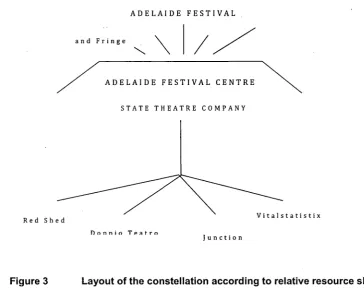
Figure 3 Figure 4 Figure 5 Figure 6
Figure 7
Figure 8
Figure 9
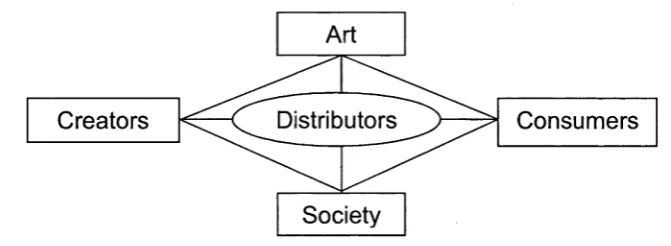
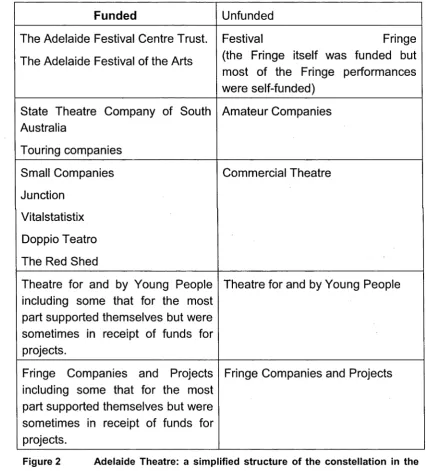
The Cultural Diamond... 38 Adelaide Theatre: a simplified structure of the constellation in the first half of the nineties... 97
P A R T 1.
Chapter 1. Purpose and Outline of Study.
[Jo] shuffles slowly into Mr. George's gallery, and stands huddled together in a bundle, looking all about the floor. He seems to know that they have an inclination to shrink from him, partly for what he is, and partly for what he has caused. He, too, shrinks from them. He is not of the same order of things, not of the same place in creation. He is of no order
and no place - neither of the beasts, nor of humanity.1
In Dickens’s Bleak House, Jo is "moved on" and "moved on" with never a place allowed for he.
"... Never done nothing to get myself into no trouble, 'cept in not moving on ... But I'm a-moving on now. I'm a-moving on to the berryin'-ground - that's the move as I'm up to." 2
The positions others occupy do not admit Jo. Jo is excluded and does not believe himself to warrant inclusion. What chain of social circumstances delivers Jo to his "berryin'-ground" while others accede to presidencies, coup leadership, membership of the tennis club, roles as actors or placements as accountants or lurking lawyer Tulkinghorns3? How do these circumstantial chains apply to the groups within which we find meaning, purpose and identity? How do the same mechanisms mean exclusion or alienation for others? This thesis argues that the motivation to establish, maintain and to improve position lies at the base of these mechanisms.
This study proposes a series of such mechanisms, most drawn from existing theories including those of Pierre Bourdieu, Victor Turner, Northrop Frye and others. The thesis goes on to describe how they interlock and how this interlocking can be explained by the positional motivation. The thesis further describes how the chains of action to which such interlocking mechanisms of group behaviour give rise, transmit and transform culture. These theories seem to me to explain best both my own professional experience of the interactions amongst theatre companies occupying the same geo-polity and the interactions I observe in general amongst groups occupying roughly the same space. I apply them here to the interwoven groups that form the case studies of this work.
Dickens, C. Bleak House. Thomas Nelson and Sons Ltd., undated edition; first published in book form, 1853, p 676.
Ibid, p 669.
A case study of theatre in Adelaide in the first half of the 1990s and of two companies, one in Sydney, the Nimrod Theatre Company (Nimrod), and the other in Melbourne, the Australian Performing Group (APG) are used to support and exemplify the interlocking mechanisms I will describe. Together the Nimrod and the APG laid down a legitimating framework for subsequent work in theatre and for major changes in the style, purpose and practice of theatre across the country. For this groundwork, I call them 'lights' and through which their style and ideological outlooks became touchstones for legitimacy in the Australian theatrical scene in the coming decades, against which others increasingly defined themselves.
Though each company came to an end by the eighties, each had significantly influenced the ‘space of possible ideas’4 a term borrowed (and adapted) from Pierre Bourdieu. This effect exemplifies an aspect of the legitimising processes that later companies adopted, the APG had been formative and nurturing of the work of many of the major figures in the Australian industry and its light remained to legitimise many other forms of theatre in the Australian context including community, street and workers’ theatre, circus and many other especially liberationist forms of theatre. The Nimrod style came to represent a central thrust of theatrical style in this country for a generation. Both companies legitimised major support for Australian writers and theatre artists and came to represent a watershed in Australian theatre practice.
Beside these studies I use two dramas developed with young people that elucidate the motivating force of position, displaying how it engages and shapes behaviour on the one hand and on the other can become the agent of exclusion and isolation, the two dramas achieve their insights through observation of, and reflection on, schoolyard behaviour. The first observes the dissolution of a group through its own rigidity in dealing with the extra-collectivity aspiration of one of its central members. The second of these dramas displays the fear of alienation as the price of failure in the task of positioning oneself in one’s life environment. It is this fear and the oblivion it portends that makes position the fundamental motivation.
This is a sociological perspective on theatrical activity so it contributes to the sociology of art and within that, theatre. Yet, theatrical activity is a field within and beside other and sometimes encompassing fields so we may expect that the mechanisms exposed will relate to other fields. In fact, the
perspective adopted within this thesis, is that the interlocking mechanisms argued here are generally applicable sociologically.
The Layout of the Thesis
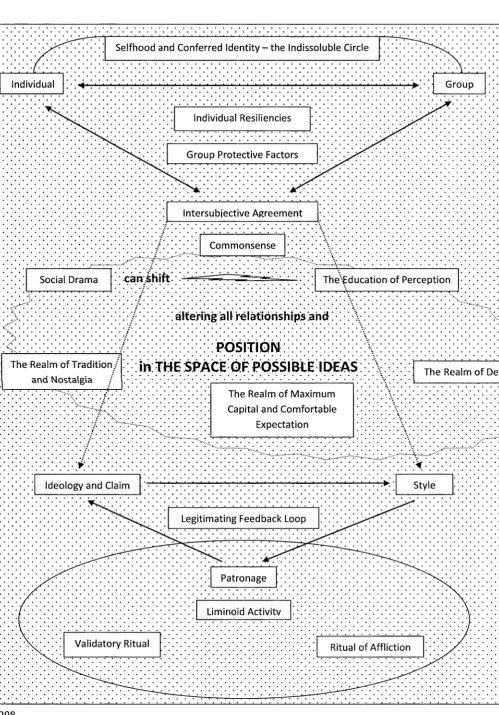
The layout of the thesis in five parts tracks a series of interlocking sociological mechanisms capturing the operation of positional drive (diagrammatically presented on page 298). It does this against a dual case study showing the configuration of adult professional theatre in Adelaide in the first half of the 1990s and a major shift in the theatre style that occurred in Australia post 1967. This shift featured in particular the work of the APG in Melbourne and the Nimrod in Sydney. The layout endeavours to display the interlocking nature of these mechanisms in the following way.
The first Part provides the present argument, the sociological standpoints of the thesis and the methodological problems and decisions.
In Part Two, / and/or We: the Positional Determination of Identity, I begin the argument proper by considering the question of identity, how it is constructed in individuals and the overriding human anxiety about exclusion.
In the first chapter of the part, the central questions raised are: where does individual agency operate and when does broader membership confer identity. I conclude that neither question can be answered in isolation from the other since agency operates in response to position, which is an entity defined by groups. Therefore, the argument builds upon a notion of the indissolubility of self and collectivity, while allowing that the adoption of persona, acts of identification and the action of self-description give rise to agency and the sensation of a continuing selfhood.
The second chapter focuses on the fear of exclusion and uses the first of two fables of identity, short plays devised with young people to illustrate this. The chapter describes alienation and shows how resilience studies tie the resilience of the individual into the protective actions of the group. It shows how when this cooperative action doesn’t work, alienation can result. This conclusion further ties an understanding of identity and group processes to position and operations underlying it. Finally, the chapter uses the work of Northrop Frye on romance showing that this literary form encapsulates the human desire for an integrated identity and life’s travail/quest is towards it.
space of possible ideas. In the first chapter of the part, these legitimacy concerns are presented with regard to a configuration of theatre companies operating within Adelaide, a bounded geo-polity, in the first half of the nineties. This configuration exhibits the legitimating strategies each company adopts in the ongoing task of conserving or enhancing their specific positions.
I show how claims to legitimacy for theatre companies are conceived as the purposes of theatre and that the style adopted by each company sustains these claims in a legitimating feedback loop with patronage. The success of the claims indicates a ritual concord between the companies and their varying areas of patronage through acceptance of the style. A series of legitimacy tests operates as the acceptance or rejection of style. As occupation of space involves the attachment to particular ideas along with the defence and promulgation of these against others, ideology becomes the basis of positional defence and thus in constant tension with legitimacy.
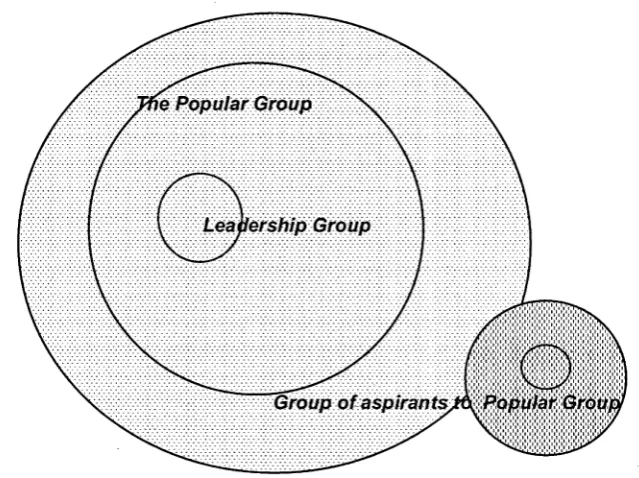
Finally, with the second identity fable I look more closely at the structure of groups. This lays the basis for a schematic presentation of the space of possible ideas, the location of available positional claims by either groups or individuals. The fable also illustrates the breakup of a group under pressure of desertion by a central member. This allows us to see the working out of a social drama, an idea that becomes a major descriptor for the next part.
In the first chapter of Part Four, I provide an introduction to the sharp break with the established theatrical pattern and theatrical aesthetic in the late sixties that lay the groundwork for the configuration of theatre possible in the 1990s. This break shows a transformation beginning, while Chapter Eleven will show the nature of the transformation in terms of how the Nimrod and the APG lay the legitimating groundwork for subsequent theatre in Australia.
Changed ritual processes and themes reflected the working through in theatre of a social drama that shaped a transformation in the space of possible ideas. The final chapter of the part shows the change schematically presenting the space of possible ideas in transformation. In Part Five, Legitimacy, the tension between the surface ideological claim and the motivation and necessity to use this as a positional strategy leads to the need to submerge the apparent incongruity of claim and position. This Part begins with this problem and describes groups as the vessels of intersubjective and unacknowledged norms that surface in various and often-unassailable forms such as commonsense.
Once claimed and sustained, positions can be defended too rigidly as the second identity fable demonstrated. This part moves on to show the legitimation crises experienced by both the Nimrod and the APG. Both endings are portrayed as resulting from identity problems, the APG through its inability to redefine itself to adapt to critical circumstances and the Nimrod through making an ill-conceived adaptation.
The final chapter of this Part returns to the configuration in Adelaide. It sketches how the influence of the lights registered in Adelaide and then completes the story by looking at a positional change to all-Australian programming that occurred in the major company, the State Theatre Company of South Australia (STCSA), during the mid-nineties, directly ensuing the period of the configuration studied. This action, the rebranding of the STCSA as the Australian Playhouse concludes the thesis by viewing this unsuccessful attempt at an education of perception by contrast with the successful ones of the lights. This contrast emphasises the nature of transformation in the space of possible ideas.
An Early Interest Leads to a Hypothesis.
performance and, even, poster design. Furthermore, in observing the task and team focus of production and rehearsal, I was observing not only work tailored as efficiently and skilfully as possible to a goal but also an exhibition of practice that would allow a claim to professionalism.
In a later chapter, I will discuss the gradual waning of amateurism as a central force in theatre production in Adelaide and the subsequent growth of professionalism (see page 101). Primarily, payment for the acting task defines professionalism. This brings with it the notions of talent, skilled craft and flair that in turn imply, inter alia, systems of audition and contract, organised training and product-responsive knowledge, skill and attitude applied to production and rehearsal processes. However, professionalism can be precarious in this industry. Unemployment is generally very high. Thus, members of the profession will keenly protect a claim to professionalism and all will want to act in a way that exhibits the rightness of their claim to professional status.
Thus, it is in the nature of professionalism itself and in the claims to it of actors and others with skills in the production of theatre that the influence of surrounding culture may be found. These claims are predicated on the demand for theatrical product issuing from the surrounding culture, the skills required to satisfy this demand and the demand limitations that determine unemployment levels. Patronage economically enables a niche for cultural expression available to which individuals and groups may make claims. In the case I was observing, these claims were professional claims.
‘Professionalism’ is one of those ideas that seem to sit above critique; it is a self-evident judgement in which the terms are considered, therefore, understood or axiomatic: this is professional, that is not. In our culture,
‘professionalism’ itself is seen, whatever the field, as a necessary attribute of value.
However, nothing sits outside culture adding value quietly and seamlessly or objectively and innocently observing. No art, journalism or academic disquisition is unaffected by the cultural enmeshment and interactivity of lives. Culture is an artefact of society varying from place to place, providing a lavish and intricate display of adaptation to the life environment in every niche of habitation. Professionalism, claims to it and the produced objects of its activity are all part of this display.
Thus, the investigation shifted from a study of the effect of culture on rehearsal practices to how theatre companies and their claims about their practice present a case study of claims on social space in general.
the overall decisions of theatre companies (now with the supposition that, except in the case of box office crisis, management and artistic direction will act in concert) reflect the constraints of culture. This interest took me away from a study of decisions made in the rehearsal room and I became focussed upon another aspect of this nexus: i.e., the way theatre companies take and hold a niche in the patronage for theatre available in a definable geo-polity such as a city.
Thus, a description of the fundamental significance of the legitimation processes adopted by companies within a definable geo-polity and the ways in which these feed into the rehearsal process became a more fruitful study. Or rather, how rehearsal processes and content decisions are integrally bound up with the legitimation processes of the company. Interviews in which I had been engaged with theatre practitioners, could now simply elicit practitioners’ views about the objects of their work and its settings. This was because these views could be recognised and interpreted as legitimation claims and that it was now impossible to understand such claims, in any walk of life, as simply statements of belief or of political analysis or principle or best practice. As such, these statements provide their utterers with tools of interaction with the culture generally and with their fellow practitioners and the patronage in particular. Amongst practitioners, they operate more as code delimiting the range of style that can be adopted in production to suit the niche they occupy or to which they aspire. Claims have to be understood as social necessity, a surface display of the original and largely hidden position-specific motivation to action.
These claims appeared as mechanisms of position annexation and maintenance by individuals and groups. Further, these mechanisms seemed to be associated with other legitimating and ritualised processes and tensions operating within fields of activity and changing at ‘punctuated’ rates over time.5 This shift in the investigation marked the adoption of a
thesis study and the beginning of a plan for that investigation. The hypothesis that now took form was this:
Claims about objectives and motivating beliefs and the significance of these claims within the fields of action in which they are situated, are part of a mechanism of social belonging and placement, i.e. position, rather than what they are professed to be, namely statements about purpose purported to be rationally congruent with practice.
The Value of Theatre as a Sociological Case Study.
Such a conclusion has implications for the understanding of theatrical product. Clearly all aesthetic products are culturally indicative, allusive, interpretive and derivative. What may not be fully grasped is the interactivity of product, survival and culture. Product choices and the aesthetic decisions that flow from them arise from the niche decisions of theatre companies. These decisions depend on the establishment of legitimacy. Thus, a significant realm of aesthetic understanding is socio political. Aesthetic understanding depends on social understanding.
Theatre companies' claims to legitimacy are bound up in, but not congruent with, their identity formations. The latter in turn have implications for rehearsal processes. Accordingly, though the rehearsal room is no longer the focus of my study, decisions within it remain entirely relevant. I would hope that a study of these linkages might cast light on mechanisms of influence between aesthetic activity and cultural context. However, my present concern is to propose and explicate the linkages and trust that they may be applied to any field of cultural production or indeed social activity.
In Victor Turner's terms, theatre is a ‘liminoid’ activity, i.e. it occurs at the margins of everyday life and bears resemblance to the ‘liminal’ activity of pre-industrial societies where ritual occurred at the margins occupying an essential role in the maintenance of community stability. Much of its purpose is to do with raking over the coals of human existence and reflecting, even agonising over, experience. Thus theatre is a field of endeavour that makes especially visible certain other aspects of the mechanisms I wish to discuss that are much more hidden in the business environment perhaps or within politics or within the management offices of theatre itself.
In referring to theatre as a liminoid activity, Turner centres for our consideration this marginal or liminal nature and attaches to it a series of operations that he would suggest are important to social health. Such operations that art provides allow our curiosity about ourselves to be indulged, expanded,' rechannelled and sometimes satisfied. We travel onward in our understanding of our circumstances and even achieve some plateaux from where to approach the next epoch. In these moments, we collectively reflect upon our debates, interactions and blindnesses.
liminality for while this collective reflection is happening, we struggle to maintain our place in the world. In striving, we present our identity, the personal structures whereby we fashion the confidence with which we carry out the tasks of maintenance and attack. Our identities though only function if they are returned to us intact through the filters of other eyes and through the acceptance of our social desire for membership. As individuals, we are caught in the tension of maintaining and asserting both an inner conception of ourselves and the tacit rules and taboos that together mould our personality and yet can feel very different. Likewise, social groupings seek the legitimacy of others and larger encompassing groups (or, as I will describe them, meta-identifications) while wishing to maintain, as Pierre Bourdieu would put it, social distinction.
As part of this identifying or distinguishing process, Bourdieu would view theatre as much more a part of ordinary activity, as having a role in the universal badging of human distinction as he puts it; that is our distinguishing of ourselves as members of one class or portion of a class from another. Here is the paradox. Theatres are just so and their activities necessarily embody legitimising and positioning processes. Yet they also possess this a socially reflexive quality.
I will argue that both are necessarily true and that while we distinguish ourselves by what we see and what we wear and how we speak and by the vehicle we drive, with theatre we also seek an opportunity to review our lives and the patterns of existence we pursue. As we are entertained, we are also chastened or reinforced in our reflections on our actions. As we group ourselves in others' eyes according to the position we are maintaining or wish to attain, we are also reviewing our actions in our life environment. We may still move Jo on to the "berryin-ground" but in reading Bleak House we reflect upon the collective actions that have that ultimate alienating result and we debate as to our part in that.
Review, reflection, redress - reflexive activity of all kinds - occurs in all human existence. What Turner observes and describes as rituals of affliction that occur to redress imbalances in the actions of individuals in tribal life and then expands to view as the larger sweeps of 'social dramas', are occurring in multiple micro-spaces in our complex society. These are reflexive moments, when the wheels of action reverse for consideration, redress, change and so on. These 'tribal' moments, to force an analogy, are everywhere. Theatre just makes them more obvious and as theatrical people are more marginal, the existence on the edge of social annihilation is keener. Alienation is more palpable ...
"I never done nothink yit . . . t o get myself into no trouble. I never was in no other trouble at all, sir - sept not knowin' nothink and starwation." 6
Jo knows nothink and here is a good large part of his problem. Legitimacy depends on possessing some ideological knowledge and capacity that establishes claim and sets up a relationship of owed and owing within a group. Without ideas that are vested by individuals in the task of belonging, there is no legitimacy for them and no position is possible. All groups exist within a space of possible ideas that is delimited by the circumstances of the time but that varies over time. The operations of legitimising position occur within the constraints of this space. So do the redressive and reflective operations of liminal activities. However, the latter do possess transformative potential.
Niche Decisions: What They Are, Where They Come From.
Understanding the niche decisions of Australian theatre in the nineties must derive from the historical context of the watershed decisions of the late sixties and seventies (and encapsulated in the work of the Nimrod and the APG), which occurred in Sydney and Melbourne particularly. Not because they were necessarily better or worse than those which occurred in Adelaide, Brisbane, Newcastle or anywhere else at the time but because they became emblematic of the major modes of theatrical production which would gain legitimacy over the ensuing years.
These decisions can be understood within the context of quests for national identity and to that extent are indicative of much that we now understand as post-colonial, a term often mistakenly thought to embrace only the emergent third world countries. Yet the concentration on language, the appropriation of iconoclastic styles and methods to the purpose of redefinition, the determination to recreate on stage a local context and the surrounding rhetoric of pejorative denunciation of established forms especially where they reflected the outer emblems of colonial culture, accent in particular, are all features of post-colonial responses.
The Australian experience in this regard is an especially Anglo Irish response with specific recognitions of emergent indigenous and migrant experience. It is interesting to compare this with the style of national artistic rediscovery that occurred in the United States in the teens and
twenties. Where Australia during this period did not experience an enduring modern emergence from the realist and melodramatic forms of the nineteenth century the United States had. As a result, it was a sophisticated self-consciously modern response to the earlier styles.
By contrast, the Australian emergence of the sixties/seventies was much rawer and embraced, though with parodic purpose, those nineteenth century forms such as vaudeville and melodrama that had been successful in forging a theatrical identity. It therefore took time during the years after the great vaudevillian/melodramatic resuscitations, The Legend of King
O'Malley (‘proto’-Nimrod at the National Institute of Dramatic Art) and
Marvellous Melbourne (APG), to develop the same level of sophisticated
response - or rather for the more sophisticated responses to become part of the identity formation and so the legitimating process. The American experience did have post-colonial aspects to it as I shall describe yet more prominent was also a confident flexing of the stylistic and intellectual muscle in the work without the same need and desire for cultural uprising. Nimrod and the APG soon came to function as models for theatrical styles, programming, governance and technique. While both stood for the new nationalism of Australian theatre, both were also quite different in many respects, the differences tending to model and legitimate varying ideological pathways for other ventures.
The scene in Adelaide during the first half of the nineties represents an evolution from these models. This study describes one ‘slice’ of the theatrical scene as it appeared and developed in Adelaide during this time. The scene as described had its antecedents in the professional and local theatrical ventures of the late seventies and eighties, especially the Stage Co and Troupe. These companies though having their own energy and originality had likenesses to the Nimrod and the APG respectively and exemplified the modelling that these companies provided. How they fed into the present scene and contributed to the theatrical configuration under consideration is an aspect of this discussion of the evolution of models. The opportunities available for the legitimation of theatrical activity are many. They certainly exist in performance and in publicity and promotion, in lobbying and in social contact. They also exist, for instance, in the subtle and not so subtle mechanisms of interpersonal behaviour: in reciprocation, in denigration and in partnership.
these processes and others. Cultural affiliation also predetermines what is available economically and socially.
Therefore, while style is predicated upon the purpose that arises from the background social class milieu, it is style, and the symbols of which it is composed, that bear the burden of the legitimating process. This circle of dependence, which relates the materiality of survival to the intangibility of style, is the key whereby these discourses at the margin, the liminal reflexivity in social activity and the notion of legitimacy intersect. For style is the outward carriage of identity and it is at the subjective level of identity that we form our conception of our role as a player in life's drama.
Chapter 2. Sociological Standpoints and Main Theoretical
Themes.
This chapter begins with an account of the standpoints in sociological theory from which the analysis is developed. These are Field Theory, the observation of tension between social structure and discord in the Manchester School and Situational Analysis. The thesis is specifically characterised as a transformational process theory as opposed to a structural one. Recent theoretical developments bearing on the arguments presented here are appraised with explanation as to their bearing on this work. Since the cases studied occur within the field of theatre, analysis requires the additional scaffold of concepts from theatrical and related discourses. Maria Shevtsova’s work on the ‘sociology of theatre’ provides a pathway to combine the sociological and theatrical perspectives. An introduction to the main theoretical elements of the enquiry follows presented with reference to the major theorists cited. The work of Dick Hebdige sets out the demarcating action of style in groups while Stuart Hall’s work unravels some of the difficulties surrounding the idea of individual identity in relation to group and normative pressure. Pierre Bourdieu’s work on distinction furthers these ideas and allows me to introduce the notion of a space of possible ideas based on his space of possibles within which these demarcations operate. Jurgen Habermas’s work on the speech act and legitimacy underlines the pressures on legitimacy claims experienced by individuals and groups. Victor Turner’s work on ritual and social drama introduces the significance of ritual within this picture of group occupation of expressive and economic space. The discussion suggests how ritual and social drama operate within demarcations and provide the resolution of problems arising out of the rigidity of claims. Walter Benjamin’s ideas on the effect of technology on art show the effect of underlying change on culturally significant objects and observances.
The idea of alienation is recognised as a major result of exclusion or the failure to achieve sufficient position; it is Jo’s desperate problem in Bleak
House and the opening quote of the thesis. Northrop Frye describes the
role of alienation in romance underlining its significance as a story to which humans continuously and reflexively return in theatre and other forms of art and popular culture.
Situational Analysis and Rational Action Theory
This thesis summons up the debate between situational analysis on the one hand and rational choice on the other. Criticism of situational analysis is that it is a vague idea, unable to separate factors and therefore delivering little predictability when applied to the real world of social or economic analysis. Conversely, the idea of ‘rational choice’ purports to provide this predictability. This thesis offers a view of the underlying mechanisms that shape ‘situations’ built on a positional conception of motivation. The intention is to challenge our perception that motivation is hydra-headed and to propose that whatever the motivational variety we appear to observe, position is the key motivator. However, this does not necessarily make human choice ‘rational’ or predictable. It does point to mechanisms offering possible routes to greater predictability.
Goldthorpe in his Rational Action Theory for Sociology 7 prefers the
nomenclature Rational Action Theory to Rational Choice. His task in this article is to examine the species of rational action theory (which, with delight, he refers to as RATs) and to compare the differences amongst them. He sees the varieties as those having relatively “strong [or] weak rationality requirements”, “situational [or] procedural rationality” or with claims to a “general [or] special theory of action” .8
In his examination, the question arises as to the cognitive basis of action. Goldthorpe reports R. Bourdon, a proponent of a RAT cognitivist model, as asking for a “cognitive sociology” or “a new sociology of knowledge” .9 The
argument underlying such a study arises from a dichotomy between ‘objective’ and ‘subjective’ rationality, 10 ‘outside the skin’ or ‘inside the skin’
determining factors. In other words, how might we explain the appearance of ‘false beliefs’, i.e. beliefs, like cargo cults that do not match objective
Goldthorpe, John H., "Rational Action Theory for Sociology"; The British Journal of Sociology, V49 No2, June 1998, p 167-192.
Ibid, p 169. Ibid, p 182.
truth? Do we refer to a psychological/cognitive explanation and suppose that there is a limitation to our “information-processing capacities” 11 or do
we seek a sociological/situational explanation in which our conclusions and actions are determined by the information available in our life environment? It is in the latter sociological/situational way that Popper, Goldthorpe cites12, takes us back to the situation as the site of study and urges that the methodological task lays there.
The relevance or otherwise of RAT comes back to the understanding we give to ‘rational’. Is rational to be understood as action flowing to outcomes based on cost-benefit assessments according to pre- established and conscious utilitarian goals?
rational action ... [is] ... outcome-oriented or
‘consequentialist’ ... in the sense that it derives from some kind of cost-benefit evaluation made by actors of the different courses of action that are available to them relative to their goals . . . 13
This would be action based on verifiable information, action clearly not of the kind assumed to be on display in the case of cargo cults for example. Even at the severe end of utilitarian definitions of rationality, there is an acceptance that complete access to truth is not possible and notions such as that of “bounded rationality” appear. 14
This conception constrains RAT. Goldthorpe offers two examples. Farming that is no longer economic (due to say, climatic change or price and cost shifts) but continues because ‘traditional’ ways of life are chosen, does not pass a consequentialist test of rationality. Similarly, continuing to act according to a social norm when such action fails to provide for an individual’s welfare would not pass such a test. In these circumstances at least, Goldthorpe suggests that RAT has reached a limit. 15
Arguments around RAT come down to identifiable testability problems. Where actions cannot be demonstrated as having utility, such as in the case of the farmer continuing to farm after continuing and disastrous cost shifts, then do we say that the actor is irrational or is it that the theory of rationality is itself too narrow to understand the utility achieved by the supposed ‘irrational’ action? Moreover, might it be that the irrationality
11
12
13 14 15
Op. cit., Goldthorpe, p 182. Ibid., p 174.
Op cit., Goldthorpe, p 179.
Simon, H. A., Models of Bounded Rationality. MIT Press, 1982. Quoted in Goldthorpe, op cit; p 171.
goes back to a psychological or biological perversity? Conversely, consider if researchers adopt the context or situation as the site for testability. Adopting the situation broadens the definition of rationality beyond the directly observable and often economic consequential utility of an action. This tactic seems to drive us down a path of infinite reframing to reinterpret successively each action. The reinterpretation, in this scenario, will of course include those actions previously thought ‘rational’ since the theory that so deemed them is now itself deemed sectional and cultural. What a maze! How can the RAT proceed within it?
Would such reframing be infinite? Is the quest for perfect understanding of an action or perfect representation of its rationality our task? Some RATs wonder whether rationality really disappears or whether, in fact, a historiographic or cultural reframing can indicate the area of social interaction within which an underlying rationality can be discovered. Goldthorpe adds in a note:
There would by now [1998] seem clear indications ... that
attempts to address this issue at the level of abstract societal or cultural typologies are of limited value, and that it is far more illuminating to investigate empirically, across societies and cultures, those more particular structures and processes -at the level of social networks, group affili-ations and institutions - by which patterns of action are guided into conformity with specified standards of rationality or are deflected from them.16
Such discussion indicates that a situational logic can successively uncover domains of social action that enable understanding of successive layers of response by individuals and groups to their perceived immediate circumstances, their situation or, as I will term it, ‘life environment’. Goldthorpe invokes the study of “social networks, group affiliations and institutions” as areas where empirical work can and does occur out of which the rationality concept may cast light on the irrational itself and so reveai deeper imperatives in human interaction. These domains are consequent on, first, known circumstances, and then, as Popper would have it, beliefs. 17 Here rationality, as we can usefully understand it,
becomes irrelevant. The positional theory of this thesis strongly asserts situational analysis finding a consequentialist version of RAT too special to allow the broader discussion about social mechanisms to proceed.
16
17
Op. cit., Goldthorpe, p 189.
The Manchester School
The situational approach has an antecedent in anthropology in the orientation of the Manchester School anthropologists following Max Gluckman at the University of Manchester in the 1950s and sixties and thereafter. This school of anthropological thought pursued a different mode of analysis to the mainstream of structural and functional anthropological analysis. Gluckman and his followers saw conflict as a productive way into analysis as opposed to social structure and individual role and function. Conflict presupposes social states and actors in tension, groups in discord and competing policies. Such a research policy will explain structural and functional phenomena in terms of change and continuity. The mechanisms that flow from this approach will relate the site of tension to the overarching structures that will or won’t be maintained by the social responses to the tension at the site. Naturally, the tension at the site is the situation containing the actors, their beliefs and circumstances and their interactions across groups.
In A Celebration of Demons: Exorcism and the Aesthetics of Healing in Sri
Lanka18, Bruce Kapferer takes a ‘situational analysis’ (also known as
‘extended-case analysis’) attitude to the methodology developed by ‘the Manchester School’. His idea in Celebration is that the essence of a society does not simply underlie or explain its practices, such as, for example, the ritual practices of healing. By extension, we can allow the argument to refer to social actions beyond overtly delimited practices such as these. So we may say, following Kapferer, that the structures and functions of society do not on their own explain the actions of social actors. Rather the practices, ritual and otherwise, of social actors and beyond that the actions of its groups and individuals have the potential to transform, question, rigidify and otherwise influence the supposed structure. That is, uncovering the ‘structure’ of a society will not reveal its operation. Rather it establishes a view of its workings at a time in its flow reflecting a range of ideational perceptions of the world allowable by the society at that time and in that political and geographic environment. This ideational range provides a series of expressive and active responses to the life environment allowing a specific set of niches or positions that are available for the people and its groups that may appear in the lived short term as a settled or normative structure. So that to develop an understanding of a society that goes beyond merely capturing its structure at a point in time,
Kapferer argues that one must examine the discordances in the social connections as much as the systems.
This point can again extend to argue that it is the mechanisms of change and continuity in tension, which include structures, discordances and more, that are the proper foci of a theory of social workings. Such a theory would include an explanation of structure at an observed point in time along with the discordances that have the potential to destabilise it or to call into action mechanisms that will reinforce its rigidity.
The notion of discordance is a persuasive one. It presupposes a dominant structure or layout of social power and a concomitant will to retain it. This
is concord. Changes within or without, changes arising from new
technology or irritated, unsatisfied individuals or from groups that somehow have a more persuasive view of the world are all discord. The idea of discordance, then, starts from the ‘given’ at any time and is the change factor. Though I will not argue with this, since I find it persuasive, the premise is somehow rooted in our perception of dominants that persist or are overturned. It may be that the recurrence of ‘overturning’ itself, ‘overturning’ as continuity is how we should or could be viewing this flux. This would mean that a concord/discord explanation is merely a more conscious method of constructing a social flux mechanism than structure theories with revolutionary moments tacked on. Let’s bear this in mind. Victor Turner exemplifies this Manchester School approach.
That the pervasive theme of the book [Schism and Continuity] is conflict and the resolution of conflict arises from my predilection for the views, fast becoming a theory, of that school of British anthropologists who are coming to regard a social system as a ‘field of tension, full of ambivalence, of co operation and contrasting struggle’. For these anthropologists a social system is not a static model, a harmonious pattern, not the conceptual product of a monistic outlook. A social system is a field of forces ... whose power to persist is generated by its own socially transmuted conflicts.19
The approach supports and guides my own sense of individuals and groups contending for position. In this conception, there is limited expressive and economic space. Both are limited by available and allowable ideas. Position is essential within them to maintain a sense of
19
self. Disruption of selfhood can be understood as alienation and loss of position or it can be fought contributing to the “field of tension ... and contrasting struggle” in Gluckman’s words quoted by Turner above or felt socially as, in Turner’s terms, an affliction. The latter can lead to schism and the need as in Turner’s statement above for “socially transmuted conflicts”.
Structure and Process.
The thesis explored here postulates social process and transformation rather than social structure. The ideas of the Manchester school with regard conflict and the preference for situational analysis over rational action indicate the concentration on tension and change rather than stasis and underlying form.
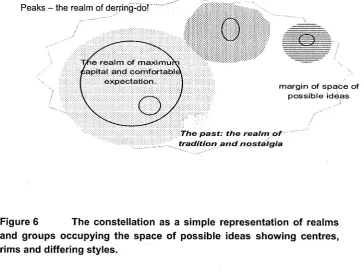
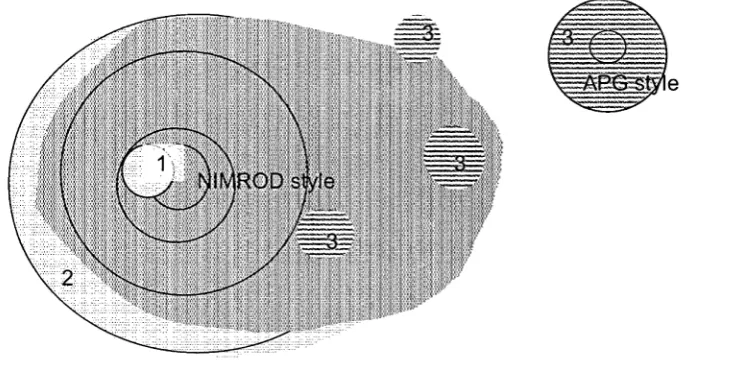
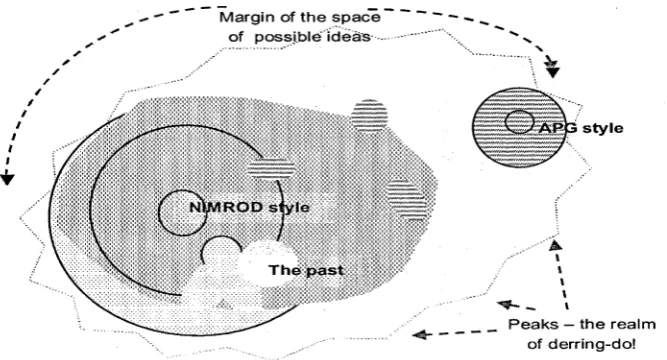
There are ideas in this thesis that have the ‘look’ of theoretical ‘structures’. These include meta-identity, centre and rim and space of possible ideas (these and other terms I will define as they arise within the explication of interlocked mechanisms). They are structures only in the sense that they can be pictured (as I have in various figures) as representing a social formation and, by representing, are concepts enabling thought. As such, they are metaphors from which facts can be adduced and upon which facts can be placed. Theoretical structures are metaphors in this sense.
These structures are static only insofar as they describe phenomena that continue to be observed in social relations and only so long as they adequately describe observed phenomena. More importantly within this thesis, they describe collectivities, institutionalisations of ideologies and interactions at multiple levels that exist in ongoing tension within fields demarcated by styles sustaining claims of right. So stasis that can be observed as continuous and thus erroneously thought of as structure is only the momentary social balance of tensions amongst social entities that I have dubbed ‘ideas’, ‘selfhoods’, ‘groups’, ‘meta-identities’, ‘fields’, ‘spaces’ and so on. However, that balancing is actually processual and the appearance of stasis is a descriptive convenience. As I will show, all of these ideas are aspects of transformational process. All can be and must be pictured in flux.
it has undergone to maintain this position during that period. Since structure suggests stasis, it is eschewed in this study.
If anything is continuous, it is the nature of the process not the structure. I will attempt to describe mechanisms of process that explain the working out of these tensions. Therefore, the term I use in distinction to structure is ‘interlocking mechanism’ and terms such as ‘field’ or ‘meta-identity’ describe formations arising from positional interaction and tension.
Field Theory
I characterise this study as a ‘field theory’ following Kurt Lewin. A field theory is multi-factorial, topological, other-fields connected and transformational.20 It is also contemporaneous; it has valence and vectors
flowing from need and goal. It is positional as it is based on individuals with goals and needs in a ‘life space’ and their distance from the resources that will satisfy these. In relation to groups, theorists will add group cohesion to these factors and ideology is a factor for groups in the mounting of positional claims.
In this case, the field studied is a definable entity: professional ‘adult’ theatre in an Australian capital city. Studying such a field involves the theoretical organisation of a number of influencing factors. This is its multi-factorial nature. Understanding these factors as contributing to tensions over a definable space gives us its topology while placement of the field in relation to overlapping, superstructural and contained fields gives us its other-field connectedness. Finally, providing a theory of how change occurs within the field renders to us its modes of transformation. Lewin offers an understanding of Field Theory as method:
Field theory is probably best characterized as a method: namely, a method of analysing causal relations and of building
scientific constructs. This method of analysing causal
relations can be expressed in the form of general statements about the “nature” of the conditions of change 21
Thus, the field is a way of understanding and describing interlocking factors that have causal relationships. The picture is one of
Shepherd, Clovis R., Small Groups: Some Sociological Perspectives, Chandler Publishing Company, 1964, p 25.
interrelationship from the individual to the group, to the meta-identity and back again. This is not to describe cause as linear. The interrelationships are in continual tension with pressures for stasis and pressures for change. As far as we are able, the task is to build an understanding of mechanisms that operate together in a continuing flow emanating from the primary drive to belong and be recognised as belonging within the life environment.
‘Life Environment’ and the ‘Space of Possible Ideas’.
I use extensively herein the terms ‘life environment’ and the ‘space of possible ideas’.
Life environment refers to the contingent facts of each individual’s experience. Thus, the geographic space they occupy is included along with the historical and emotional world that is contingent with their being. This is similar to ‘lifeworld’, as Habermas terms it, in that the world as it is experienced is embraced not some objectively determined world. However, ‘life environment’ allows for facts in the world around the individual that affect the individual but of which the individual may be unaware or that operate outside their expectation. To this extent, ‘life environment’ contains more than the more phenomenological ‘lifeworld’. Other terms also overlap. Lewin’s ‘life space’, in particular has relevance to the sociological background to this work and is closer to Habermas’s lifeworld. During Lewin’s life he gradually expanded this idea until it included all elements that exist as affecting an individual’s or a group’s life. Lewin was very conscious of the interactivity of these life-determining factors. Importantly, each of these terms share the inclusion of beliefs individuals will have about their world. Lewin’s term, ‘life space’ is closer to my ‘life environment’. However both his and Habermas’s term are different from the idea of social space put forward here as the ‘space of possible ideas’ and based on Bourdieu’s ‘space of possibles’. The life environment is a personal individual experience and perspective while a social space contains such perceptions while existing as the combined projection of mutually involved life environments. Moreover, the term ‘life space’ is too close to that of ‘space of possible ideas’. I was finding out about the life environment in my interviews, while my inferences and surrounding studies were about the social spaces they occupied.
positions in the space of possible ideas is a constant process of stylistic demarcation and legitimation. It is the subject of discussion in these pages.
The space is never in stasis but it is delimited. The ideas of dominant groups, the constant tension arising from positional activity in fields and society as a whole and irreversible change arising from natural, technological, social or cultural events determine its delimitations. These delimitations, however, are not solid, each exert constant pressure transforming the space. Though an ideational space, the space of possible ideas overlays and intersects with a resource space. Except for its ecological aspects, which will ultimately determine the overlaid ideas, dominant groups control the resource space.
Related Research
Recent theories that are both processual and field theories include social emergence, social capital and social representation theories. All bear similarities to the present work, which shares many of their interests and concerns and the following is a brief survey of the points of contact with two of them: social emergence and social representation.
Work on “social emergence theory” has parallels to this work. Social emergence theory attempts to find mechanisms that explain how social entities such as groups and other ‘structures’ emerge from the interactions of individual agents. It is process concerned and conscious of adaptation.
It is widely acknowledged in sociology today that social theory must be centrally concerned with process and mechanism ... Nonetheless, sociologists have found it difficult to develop an adequate theory for capturing social processes, and even more difficult has been the empirical study of social processes. As a result, much of modern sociology neglects
process ... Complex dynamical systems can provide tools to
explore these processes; they are “dynamical” because
processes of change over time are of central interest22
This quote illustrates some of the parallels to which I refer: the focus on process and mechanism, complexity and transformation over time. Other parallels include, as abovementioned, interactionism, the symbolic nature
22
of interaction and the effect of multiple interaction on meta-systems such as groups and institutions. Sawyer urges also that systems operating at higher levels (groups and institutions) manifest laws that cannot occur at lower levels such as the level of the individual. This is seen as a property of complexity and that the reverse statement, that such laws can be seen as operating at lower levels is a reductionist property.23
In this thesis, I explicitly claim that the motivation of position operates as a fundamental driver at both these levels, the level of the individual in interaction and of the group and above, similarly in interaction. I would accept that many of the mechanisms discussed here are properties of social systems and not of individuals. However, my assertion of primacy for a positional motivation causes me to step back from suggesting greater convergence between social emergence theory and this thesis than I have already detailed. It leads me to an assumption of greater continuity of action between less and more complex levels of social organisation (including the level of the individual) than social emergence theory admits. In this regard, the theory offered here has strong allegiances with social representation theory. Social representation theory first acknowledges environmental and circumstantial weight on both individuals and groups. It observes how such weight leads to ‘social representations’ by groups in contrast to other groups and meta-identities in society. The combined effect is of claim to position based on an ideational projection of the circumstances presented by the life environment. So, for example, in studies of illegal immigration, social representation emanates from categories to do with place of origin, illegality, race and work status. For people and groups sharing such representation the positional task is to find ways of attaining a more powerful position in which to find expression for an expanded representation, finding satisfaction in the present status or negotiating some other representation in between. Choices may include assertion of illegality as a reverse legitimacy, seeking legal status or finding the separate-but-within status of many ghettoised communities.24
The social representation approach, argued by Alain Clemence in the following quote, considers the arrangement of social groupings according to positions taken up by social actors vis-a-vis public debates.
Thus, social positioning is not only the expression of an opinion, it is also a way to process information in order to
Ibid., p 4.
adapt what we think to what the society thinks. Consequently, it provides the means for articulating the variations between intergroups [sic] beliefs and knowledge with the temporary crystallization of a network of meanings in a given public
sphere25
Thus in taking attitudinal positions on welfare, AIDS, domestic violence or the worth of a novel, social actors refer to “common points of reference” 26
taken from their “social space”27. Ultimately, the point of reference then arises from group and other orientations. Clemence’s construction can be applied to the work I set out here. His orientation is an ontology of communication and appears to focus on the social representations adopted in relation to argumentation.
Social representation theory is conceptualised as “Lewinian” 28 and so has
a field approach in common with this thesis. However, I prefer the notion of style to social representation because the latter suggests more or less discrete units of agreement within ongoing debates while style is a claim sustaining posture suffused into the very habit and orientation of action. Though social representation theory recognises the deep and often automatic nature of representations, I am concerned with the nature of the unacknowledged, unspoken and incongruent aspects of action in contrast with the expressions of claim that I term ideology. Thus, there is much harmony between social representation theory and the present work. I would hope that future work can bridge the gaps and make possible the insights of each approach for the other.
Sociology o f Art
Within the sociology of art, several streams of thinking align with this thesis. Firstly, it would not be possible to put forward the sociological view underpinning this thesis without appreciating and accepting the existence of art worlds as a prior consideration to the idea of artist as auteur. That is, the para-mystical view of the gifted artist as separated from the productive capacity of others is not a possible stance with regard to the ideas and formulations I present here. The major current trend of
Clemence, Alain, “Social Positioning and Social Representations” in Deaux, Kay, and Philogene, Gina, Representations of the Social: Bridging Theoretical Traditions. Blackwell Publishing, 2001, p 87.
Ibid., p 83. Ibid.