1 FutureGrid - a reconfigurable testbed for Cloud, HPC and
Grid Computing 1
Geoffrey C. Fox, Gregor von Laszewski, Javier Diaz, Kate Keahey, Jose Fortes, Renato Figueiredo, Shava Smallen, Warren Smith, and Andrew Grimshaw
1.1 Overview . . . 2
1.1.1 Sponsor/Program background . . . 3
1.1.2 Historical Aspects of Clouds - Grids - HPC . . . 3
1.2 Hardware Resources . . . 4
1.3 Software Services . . . 5
1.3.1 Architecture Overview . . . 9
1.3.2 Access Services . . . 10
1.3.2.1 Access Service Demand . . . 11
1.3.2.2 Infrastructure as a Service . . . 11
1.3.2.3 Platform as a Service . . . 14
1.3.3 Management Services . . . 16
1.3.3.1 Dynamic Image Provisioning with RAIN . . 16
1.3.3.2 Monitoring, Information, and Performance Services . . . 23
1.3.4 Experiment and Project Management . . . 25
1.3.4.1 Interactive Experiment Management . . . 26
1.3.4.2 Workflow-Based Experiment Management . . 26
1.3.4.3 DevOps-Based Experiment Management . . 27
1.3.4.4 Rain-Based Experiment Management . . . . 27
1.3.5 Operations Services . . . 27
1.3.6 Development Services . . . 28
1.3.7 Portal . . . 28
1.4 Service Deployment . . . 29
1.5 Applications using FutureGrid . . . 29
1.5.1 Privacy preserving gene read mapping using hybrid cloud . . . 30
1.5.2 SAGA on FutureGrid . . . 32
1.6 Optimizing MapReduce . . . 33
1.7 Sensor Cloud . . . 34
1.7.1 FutureGrid as a test bed for XSEDE (eXtreme Science and Engineering Discovery Environment) . . . 34
1.8 Educational Outreach . . . 38 1.9 Operational Lessons. We have already learnt several
unex-pected lessons. . . 40
Bibliography 43
Chapter 1
FutureGrid - a reconfigurable testbed
for Cloud, HPC and Grid Computing
Geoffrey C. Fox
Pervasive Technology Institute, Indiana University 2729 E 10th St., Bloomington, IN 47408, U.S.A.
Gregor von Laszewski
Pervasive Technology Institute, Indiana University 2729 E 10th St., Bloomington, IN 47408, U.S.A. E-mail: [email protected]
Javier Diaz
Pervasive Technology Institute, Indiana University 2729 E 10th St., Bloomington, IN 47408, U.S.A.
Kate Keahey
Argonne National Laboratory, Argonne, IL
Jose Fortes
University of Florida, Gainesville, FL
Renato Figueiredo
University of Florida, Gainesville, FL
Shava Smallen
San Diego Super Computing Center, San Diego, CA
Warren Smith
Texas Advanced Computing Center, Austin, TX
Andrew Grimshaw
University of Virginia, Charlottesville, VA
1.1 Overview . . . 2
1.1.1 Sponsor/Program background . . . 3
1.1.2 Historical Aspects of Clouds - Grids - HPC . . . 3
1.2 Hardware Resources . . . 3
1.3 Software Services . . . 4
1.3.1 Architecture Overview . . . 8
1.3.2 Access Services . . . 10
1.3.2.1 Access Service Demand . . . 11
1.3.2.2 Infrastructure as a Service . . . 11
1.3.2.3 Platform as a Service . . . 14
1.3.3 Management Services . . . 16
1.3.3.1 Dynamic Image Provisioning with RAIN . . . 16
1.3.3.2 Monitoring, Information, and Performance Services . . . . 23
1.3.4 Experiment and Project Management . . . 25
1.3.4.1 Interactive Experiment Management . . . 26
1.3.4.2 Workflow-Based Experiment Management . . . 26
1.3.4.3 DevOps-Based Experiment Management . . . 26
1.3.4.4 Rain-Based Experiment Management . . . 27
1.3.5 Operations Services . . . 27
1.3.6 Development Services . . . 28
1.3.7 Portal . . . 28
1.4 Service Deployment . . . 28
1.5 Applications using FutureGrid . . . 29
1.5.1 Privacy preserving gene read mapping using hybrid cloud . . . 30
1.5.2 SAGA on FutureGrid . . . 32
1.6 Optimizing MapReduce . . . 33
1.7 Sensor Cloud . . . 33
1.7.1 FutureGrid as a test bed for XSEDE (eXtreme Science and Engi-neering Discovery Environment) . . . 34
1.8 Educational Outreach . . . 38
1.9 Operational Lessons. We have already learnt several unexpected lessons. 40 Acknowledgement . . . 41
xf
1.1
Overview
The FutureGrid project [vLFW+10] mission is to enable experimental work that advances:
• innovation and scientific understanding of distributed computing and parallel computing paradigms,
• the engineering science of middleware that enables these paradigms,
• the use and drivers of these paradigms by important applications, and,
• the education of a new generation of students and workforce on the use of these paradigms and their applications.
The implementation of the mission includes
• identified Infrastructure as a Service (IaaS) and Platform as a Service (PaaS) core software with supported use,
• a growing list of software from FutureGrid partners and users, and
• educational outreach. ¡
Thereby the FutureGrid project provides a capability that makes it possi-ble for researchers to tackle complex research challenges in computational and computer and computational science related to the use and technology of High Performance Computing (HPC) systems, Grids [FK99], and clouds [AFG+09, KH11]. Topics range from programming models, scheduling,
vir-tualization, middleware, storage systems, interface design and cybersecurity, to the optimization of Grid-enabled andxfgg cloud-enabled computational schemes for researchers in astronomy, chemistry, biology, engineering, atmo-spheric science and epidemiology.
1.1.1
Sponsor/Program background
FutureGrid [wwwb] is sponsored by the National Science Foundation un-der Grant No. 0910812 [nsf09] to Indiana University for “FutureGrid: An Experimental, High-Performance Grid Test-bed.” FutureGrid forms part of NSF’s national high-performance cyberinfrastructure XSEDE [xse12]. It in-creases the capability of the XSEDE to support innovative computer science research requiring access to lower levels of the grid software stack, the net-working software stack, and to virtualization and workflow orchestration tools as well as new programming models like MapReduce [DG08]. As it supports interactive use, it is well suited for testing and supporting distributed system and scientific computing classes. Education and broader outreach activities include the dissemination of curricular materials on the use of FutureGrid, pre-packaged FutureGrid virtual machines (appliances) configured for par-ticular course modules, and educational modules based on virtual appliance networks and social networking technologies [SBC+03, BFLK11].
Partners in the FutureGrid project include U. Chicago, U. Florida, San Diego Supercomputer Center - UC San Diego, U. Southern California, U. Texas at Austin, U. Tennessee at Knoxville, U. of Virginia, Purdue I., T-U. Dresden, and Grid5000 [imp12b]. These cover hardware, software and bench-marking.
1.1.2
Historical Aspects of Clouds - Grids - HPC
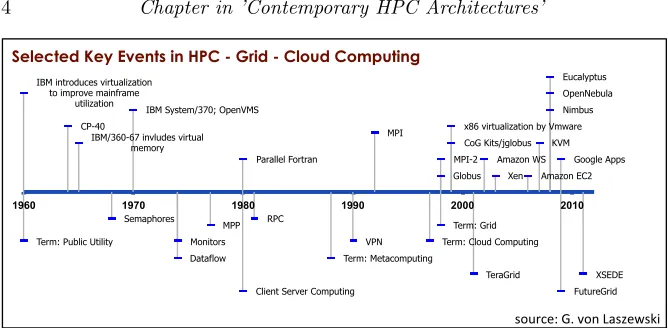
IBM introduces virtualization to improve mainframe
utilization CP-40
IBM/360-67 invludes virtual memory
Semaphores
IBM System/370; OpenVMS
RPC
Dataflow Monitors MPP
Client Server Computing Parallel Fortran
VPN Term: Cloud Computing Term: Metacomputing
Globus
Term: Grid
x86 virtualization by Vmware
FutureGrid XSEDE TeraGrid Amazon WS Amazon EC2 Google Apps Eucalyptus OpenNebula Nimbus
Term: Public Utility
MPI
MPI-2 Xen
KVM CoG Kits/jglobus
1960 1970 1980 1990 2000 2010
Selected Key Events in HPC - Grid - Cloud Computing
[image:8.612.142.476.116.280.2]source: G. von Laszewski
FIGURE 1.1: Selected key events in HPC, Grid, and Cloud computing
1.2
Hardware Resources
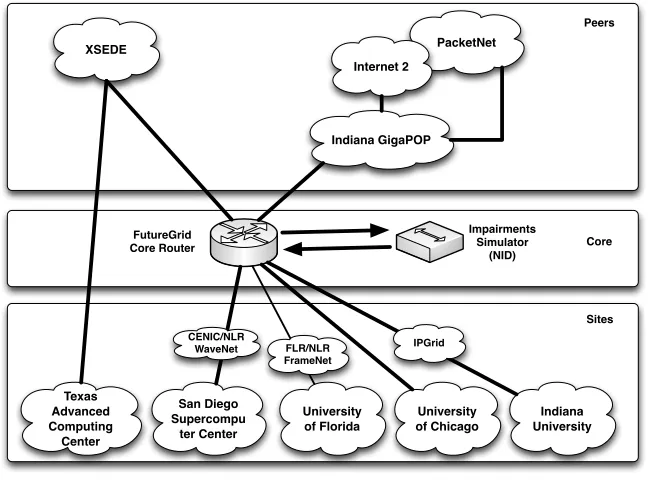
FutureGrid (FG) is a national-scale Grid and cloud test-bed facility that includes a number of computational resources at distributed locations (see Table 1.1). The FutureGrid network is unique and can lend itself to a mul-titude of experiments specifically for evaluating middleware technologies and experiment management services [vLFW+10]. This network can be dedicated
XSEDE PacketNet Internet 2
Indiana GigaPOP
FutureGrid Core Router
Impairments Simulator
(NID)
Core Peers
Sites
Texas Advanced Computing
Center
San Diego Supercompu
ter Center
University of Chicago
Indiana University University
of Florida CENIC/NLR
WaveNet FLR/NLR FrameNet
[image:9.612.149.473.141.382.2]IPGrid
FIGURE 1.2: Network Infrastructure of FutureGrid
1.3
Software Services
In order for FG to operate we have to conduct a number of activities related to developing, deploying and supporting the software for FG.
The goal set by FG is to provide a “an experimental Grid, Cloud, and HPC testbed”. This goal has naturally a direct impact on our software de-sign, architecture, and deployment. Hence, we revisit some of the elementary requirements influenced by the user community, various access models and services, and the desire to be able to conduct a variety of reproducible exper-iments. These requirements include:
Support a Diverse User Community. As part of our initial
investiga-tions, we have identified a number of different user communities that will benefit from a testbed such as FG. Naturally, the desire to support these communities governs our software design and the access to FG in general. We support the following communities:
TABLE 1.1: Current Compute Resources of FutureGrid as of April 2012
Name System Nodes CPU’s Cores TFLOPS RAM Site
Type GB
india IBM iDataplex 128 256 1024 11 3072 IU hotel IBM iDataplex 84 168 672 7 2016 UC sierra IBM iDataplex 84 168 672 7 2688 SDSC foxtrot IBM iDataplex 32 64 256 3 768 UF alamo Dell PowerEdge 96 192 768 8 1152 TACC xray Cray XT5m 1 168 672 6 1344 IU bravo HP Proliant 16 32 128 1.7 3072 IU delta GPU Cluster 16 32 192 TBD 3072 IU
14336∗
Total 457 1080 4384 >43.7 17184
14336∗ *GPUS
TABLE 1.2: Storage Resources of FutureGrid as of April. 2012
System Type Capacity(TB) File System Site
Xanadu 360 180 NFS IU
DDN 6620 120 GPFS UC
Sunfire x4170 96 ZFS SDSC
Dell MD3000 30 NFS TACC
IBM dx360 M3 24 NFS UF
• Middleware developers that investigate the development of middleware and services for Cloud and Grid computing;
• System administrators that investigate technologies that they wish to deploy into their own infrastructure;
• Educators that like to expose their students to software and services to Cloud and Grid computing technologies as offered on the FG; and
• Application users that like to test out services developed by application and middleware developers.
To support this diverse community we have identified a number of key re-quirements we will be focusing on as part of FutureGrid.
Support for Shifting Technology Base. One of the observations that
motivated FG is the rapidly developing technologies in the cloud and Grid that may have profound impact on how we develop the next generation scientific applications keeping these new developments in mind. The introduction of virtualization [AA06, CB09, cC05], Infras-tructure as a Service (IaaS), and Platform as a Service (PaaS) paradigms [LKN+09, KH11] calls for the ability to have access to software tools and
Support a Diverse Set of Interface Methods. Based on this technology shift and the interest posed by the various user communities to have easy interfaces to a testbed, we need to develop, as part of our software activities, appropriate interface tools and services. The interfaces include command line tools, APIs, libraries and services. In addition, many users would like access to these new technologies through portals or GUIs.
Support a Diverse Set of Access Methods. While in previous decades
the focus has been to provide convenient libraries, tools, and Web ser-vices we currently see an expansion into infrastructure and platform as services. Thus, a new generation of tools and services are provided as abstractions to a higher level of services, potentially replacing the traditional OS. Thus, we will not only offer access to Infrastructure as a Service (IaaS) framework, but we will also invest in providing PaaS endpoints, thereby allowing access to a new kind of abstraction.
Support a Diverse Set of Access Services.ue to the rapid development of
new tools, services, and frameworks within the Grid and cloud communi-ties, it is important to facilitate a multitude of such environments. This includes access to IaaS frameworks such as Nimbus [wwwc], Eucalyp-tus [wwwf], OpenNebula [wwwg], OpenStack [wwwh]; PaaS frameworks such as Hadoop [wwwa]; and additional services and tools like Unicore [OR02] and Genesis II [imp12a], that are provided and supported by the FG team members. Hence, users will have the ability to investigate a number of different frameworks as part of their activities on FG.
Support of Traditional Services. We provide a number of additional
ser-vices that users are accustomed to. This includes High Performance Computing (HPC) services [Com12], but also access to backup and stor-age. Naturally, we provide services for user support as part of a portal with access to information including a ticket system.
Support for Persistent Services and Endpoints. One of the potential
assets of FG is the ability to expose a number of students and prac-titioners to the new frameworks offered. However, the entry to set up such systems may have to be low in order to interest others in using such technologies. Hence, it is important to offer a number of persistent services and endpoints of such frameworks. Furthermore, we must make it easy for the teachers and administrators of FG to manage member-ship and access rights to such endpoints. In addition, we are interested in providing a number of “standard” images for educational purposes that can be used for teaching about particular aspects.
Support for Raining/Dynamic Provisioning. As we are not only
services, we we need to offer dynamic provisioning within FG not only within an IaaS framework, such as Nimbus, Eucalyptus or OpenStack, but also any OS we choose. Furthermore this concept can be expanded to provision additional platforms and services. Hence, we use the term “raining” instead of just dynamic provisioning to indicate that we strive to dynamically provision not only on the OS level, but also on the ser-vice and platform level [vLFW+10]. This combination will will allow us
to provide efficient assignment of resources to services governed by user needs. Thus, if there is no demand for running Eucalyptus staged images, the resources devoted to the Eucalyptus cloud can be de-registered and assigned to a different service. An additional aspect of our “rain” tool that we are developing is to specify the mapping onto specific resources, allowing us to compare services on the same hardware.
Support for a Viral User Contribution Model. User contributions are
possible at several levels. First, the development of shared images that are instantiated as part of an IaaS framework. Second, the development of middleware, either in the IaaS or PaaS models, that can be rained onto FG. Third, the creation of workflows that utilize a combination of the services offered as part of sophisticated experiment workflows, which we will explain in more detail later. Fourth, through the contribution of educational material.
One of the important features to recognize is that FG distinguishes itself from current available systems. This includes traditional compute centers such as XSEDE [xse12], but also well known IaaS offerings, such as Amazon [Amaa].
In contrast to Amazon, we provide alternatives to the IaaS framework, but the biggest benefit stems from two unique features of FG. In FG we intend to allow the mapping of specific resources as part of the service instantiation. Thus, we can measure more realistically performance impacts of the middle-ware and the services developed by the FG testbed user. Furthermore, we allow authorized users a much greater level of access to resources by allowing the creation of images that can not only be placed in a virtual machine (VM) but also be run on the “bare” hardware.
1.3.1
Architecture Overview
To support our requirements we have devised a flexible software architec-ture enabling us to gradually introduce and expand components in support of our mission. We distinguish the following components:
Fabric: The Fabric layer contains the hardware resources, including the FG
computational resources, storage servers, and network infrastructure in-cluding the network impairment device.
Development and Support Fabric/Resources: Additional resources are
set aside that are helping us with the development and support of op-erational services. This includes servers for portals, ticket systems, task management systems, code repositories, a machine to host an LDAP [KV04] server and other services. It is important to recognize that such services should not be hosted on the “cluster” resources that constitute the main FG Fabric as an outage of the cluster would affect important operational services.
Operations Services: In order to effectively communicate and conduct
de-velopment effort, the following elementary services have been provided: a website, a development wiki, a task management system to coordinate the software development tasks and a ticket system. In addition, we need to provide security and accounting services to deal with authentication, authorization and auditing.
Base Software and Services: The FG Base services contain a number of
services we rely on when developing software in support of the FG mis-sion. This includes Software that is very close to the FG Fabric and includes tools like Moab [Com12], xCAT [wwwj], and also the base OS. This category of services will enable us to build experiment management systems utilizing dynamic provisioning.
Management Services: The management services are centered around FG
experiments and the overall system integration, including information services and raining/dynamic provisioning (see Section 1.3.3) software stacks and environments on the Fabric.
Access Services: FG user services contain variety of services. They include
IaaS, PaaS, SaaS, and classical Libraries that provide a service as an infrastructure to the users such as accessing MPI [SOHL+98] and others
(see Section 1.3.2).
User Contributed Services (as part of additional Services): The
software as part of services or experiments within FG. Thus, we expect that the FG User Contributed Services will grow over time while en-hancing areas that we have not explicitly targeted ourselves. Instead, we provide mechanisms for community users to integrate their contribu-tions into FG offered services. The only difference to these services may be the level of support offered in contrast to other FG services.
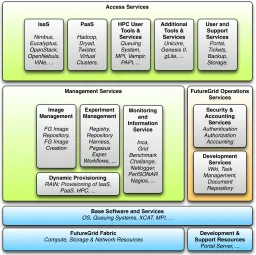
[image:14.612.183.439.257.512.2]Together these components build our layers architecture view as depicted in Figure 1.3.
Base Software and Services
OS, Queuing Systems, XCAT, MPI, ...
Access Services
Management Services FutureGrid Operations Services Development Services Wiki, Task Management, Document Repository User and Support Services Portal, Tickets, Backup, Storage, PaaS Hadoop, Dryad, Twister, Virtual Clusters, ... Additional Tools & Services Unicore, Genesis II, gLite, ... Image Management FG Image Repository, FG Image Creation Experiment Management Registry, Repository Harness, Pegasus Exper. Workflows, ... Dynamic Provisioning
RAIN: Provisioning of IaaS, PaaS, HPC, ...
Monitoring and Information Service Inca, Grid Benchmark Challange, Netlogger, PerfSONAR Nagios, ... FutureGrid Fabric
Compute, Storage & Network Resources
Development & Support Resources
Portal Server, ...
IaaS Nimbus, Eucalyptus, OpenStack, OpenNebula, ViNe, ... Security & Accounting Services Authentication Authorization Accounting HPC User Tools & Services Queuing System, MPI, Vampir, PAPI, ...
FIGURE 1.3: FutureGrid Software Architecture
1.3.2
Access Services
Next we will be focusing our attention towards the access services. As part of the access services, we distinguish the following areas:
• PaaS (Platform as a Service): Delivery of a computing platform and solution stack;
• Grid: Deliver services to support the creation of virtual organizations contributing resources;
• HPCC (High Performance Computing Cluster): Traditional high perfor-mance computing cluster environment; and
• User and Support Services: Delivery of services to enable user support.
1.3.2.1 Access Service Demand
The question arises which services should we offer in FutureGrid? To an-swer this question we have we identified user demand within the community as part of our project application process within FutureGrid. At registration time of a project, the project owner is presented with a number of choices of technologies that are most useful for their project or they desire to have access to. Project owners were able to choose multiple items. We obtained the following result while analyzing the requests from project owners: (a) Nimbus: (53.2%), (b) Eucalyptus: (50.8%), (c) Hadoop: (37.3%), (d) High Performance Computing Environment: (35.7%), (e) MapReduce: (33.3%), (f) Common Ter-aGrid Software Stack: (27%), (g) Genesis II: (16.7%), (h) Twister: (15.9%), (i) OpenStack: (12.7%), (j) OpenNebula: (11.1%), (k) Unicore 6: (10.3%), (l) gLite: (9.5%)
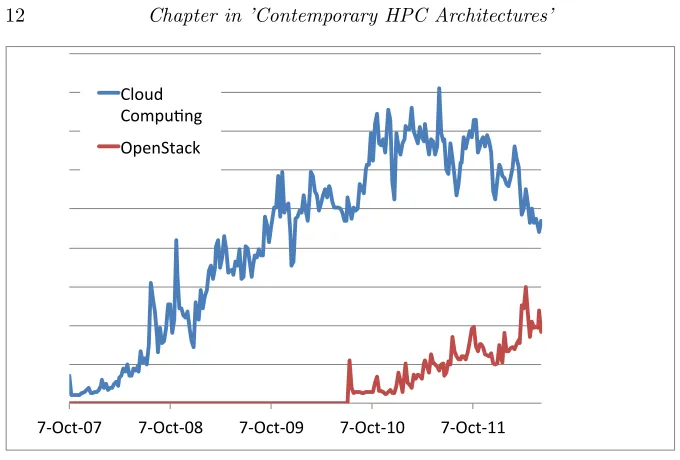
Please note that the the data is only collected for each project owner and does not contain information gathered by members of projects or other FutureGrid users. We observed over time only slight changes in the request to these services. However, most recently we have seen significant increased demand for OpenStack. As part of this monitoring activity, we intend to be flexible in what we offer on FutureGrid and work with the community to strive towards fulfilling services needs that fall within our project goals. We realize that gathering this information may be biased as we gather the information from our current set of users and therefore we are also monitoring the com-munity actively (see Figure 1.4). This helps us attracting new users and adopt our strategies towards community needs [vLDWF12].
1.3.2.2 Infrastructure as a Service
In contrast to the traditional offering of supercomputer centers, FutureGrid provides a variety of Infrastructure as a Service (IaaS) frameworks on its resources. IaaS allows to abstract the physical hardware and offer users instead access to virtual machines that are than mapped onto the hardware. Currently, one of the special features of FutureGrid is to provide not only one IaaS framework, but several of them.
7-‐Oct-‐07 7-‐Oct-‐08 7-‐Oct-‐09 7-‐Oct-‐10 7-‐Oct-‐11 Cloud
[image:16.612.140.480.112.342.2]Compu2ng OpenStack
FIGURE 1.4: Google Trends shows popularity of OpenStack to be
signifi-cantly rising
evaluating and identifying the IaaS and deployment strategies best suited for their applications. While on the surface client tools seem to offer similar capa-bilities, the difference may be in how such frameworks are implemented and how they perform and scale as part of an application integration. The cur-rent IaaS frameworks that are offered on FutureGrid include Nimbus [wwwc], OpenStack [wwwh] and Eucalyptus [wwwf]. Some of our own project also use OpenNebula [wwwg] but we have not yet made it publicly available.
Nimbus.The Nimbus project [wwwc] consists of an IaaS (Nimbus
Infrastur-cuture) and a PaaS component (Nimbus Platform).
Nimbus Infrastructure provides both compute and storage cloud compati-ble with Amazon Web Service’s Elastic Compute Cloud (EC2) [Amaa] and Simple Storage Service (S3) [Amab], respectively. Nimbus targets features of interest to the scientific community such as support for proxy credentials, enhanced scheduling options, and fast deployment of large virtual clusters. These features make it easy for scientific projects to experiment with Fu-tureGrid Nimbus installations. Further, both Nimbus compute (Workspace Service [KFF+05]) and storage (Cumulus [BFLK10]) cloud components are provided as a high-quality, highly configurable and extensible open source im-plementation which allows students and scientists to modify them in order to experiment with new capabilities as has been done in [MKF11, RTM+10].
Nimbus Patform[KF08, BFLK11] is an integrated set of tools that allow users to provision resources across multiple infrastructure clouds, create virtual clus-ters across those clouds, as well as scale to demand. Coordinated deployment of complex resource configuration across multiple clouds is accomplished with Nimbus cloudinit.d [BFLK11] which allows users to develop a launchplan for such complex deployment once and then execute it many times. The Nim-bus context broker [BFLK11] coordinates secure creation of “one click” vir-tual clusters, potentially distributed over multiple clouds. These services allow users to combine resources provisioned from Nimbus, OpenStack, and Ama-zon Web Services clouds and are designed to be extended to support other IaaS providers. We are in the process of developing multi-cloud autoscaling services which will further facilitate access to FutureGrid cloud resources.
Eucalyptus.Eucalyptus [wwwf] is a popular IaaS framework that has been
commercialized since this project started. Our current deployment contains two independent services on India and Sierra allowing research in the de-velopment of heterogeneous cloud environments. Performance comparisons of Eucalyptus 2 to Openstack and Eucalyptus 3 have shon that it is no longer competitive. Hence we have recently updated from Eucalyptus 2 to Eucalyptus 3. The ability to conduct such performance experiments on the same resources to gather this information is a significant strength of FutureGrid. Our results were presented at the Eucalyptus users group meeting in 2012 and positively received not only by the community but also by the Eucalyptus team as it gave insight in how our user community uses the various IaaS frameworks and can compare them with each other.
OpenStack. Most recently OpenStack [wwwh] has been introduced to the
community. It is driven by the community and has received a significant com-munity backing not only by the academic, but also by the industrial commu-nity. The quality of the code base is rapidly improving. By now OpenStack has released a quite stable set of components that can be used to build sig-nificantly large clouds. The recent OpenStack user’s community meeting was attended by 1000 users. This in addition to the rising trend (see Figure 1.4) proves that FutureGrid must support OpenStack on its resources.
ViNe: User Level Virtual Networks.ViNe [TF06] is a project developed
at University of Florida that implements routing and other communication mechanisms needed to deploy a user-level virtual network. ViNe is partic-ularly appealing for cloud computing because it allows the establishment of wide-area virtual networks supporting symmetric communication among pub-lic and private network resources (even when they are behind firewalls), does not require changes to either the physical network or the OS of machines, and has low virtualization overheads. ViNe can provide communication among Fu-tureGrid and external resources (including those with private IP addresses) without the need to reconfigure the (FutureGrid) physical network infrastruc-ture.
virtual cluster (launched through Nimbus) across 3 FG (sierra, foxtrot, and hotel) and 3 Grid’5000 (Rennes, Lille, and Sophia) sites [imp12b]. The virtual cluster consisted of 750 VMs (1500 cores), and executed BLAST on Hadoop (CloudBLAST) with speedup of up to 870X [MTF09].
In the second phase, ViNe efforts focused on adding management capabilities to the existing code. The goal is to make it easy for FG users to configure and operate ViNe software, without the needed overlay networks expertise. In the third phase, building on the management capabilities implemented pre-viously, high level management services (e.g., end-to-end QoS, overlay network performance self-optimization, recovery in the presence of faults, etc) will be developed.
1.3.2.3 Platform as a Service
In addition to the IaaS, FutureGrid offers also the ability to provide Platforms as a Service to the users. Platforms typically include a well defined solution stack such as a customizes operating system, a programming language exe-cution environment, databases, as well as platforms related to data analysis, such as map/reduce, Grid Computing, and even High Performance Comput-ing (HPC). Once committed to a platform, users rely on the platform to be deployed and develop their applications against such platforms. As each of these platforms could be differently installed and managed it is sometimes beneficial to be able to install them in a different fashion. Thus although we have provided a number of default implementations, users are typically able to assemble their own platforms to increase performance while targeting available resources for specific application performance characteristics.
MapReduce.Within FutureGrid we provide a number of ways on how users
can access MapReduce [DG08]. First we allow users to use the Hadoop-based Map/Reduce platform [wwwa] hosted on bare metal. However we also allow users to stage their own personalized versions of Hadoop as to allow modifica-tions and research to take place as part of improvements to the Hadoop code base. In addition we also provide Hadoop as part of our dynamic provisioning service in order to simplify performance experimentations.
Hadoop is a very popular PaaS that provides users with the map/reduce framework. In addition to installing Hadoop on systems, FutureGrid has also deployed myHadoop [KTB11], a set of scripts developed by SDSC that makes it easy to submit Hadoop jobs through the FutureGrid batch queue systems. It is also easy to customize and allows users to make their own copy and adjust default Hadoop settings or to specify an alternate Hadoop implementation. This is important, as some users may want to experiment with modified ver-sions of Hadoop.
High Performance Computing Services. To emphasize high-level
that will later on be deployed in XSEDE. Hence providing regular HPC ser-vices such as access to a queuing system and being able to run MPI programs is possible. In addition to such bare metal services, we have also developed examples on how such queuing systems can be set up via a single command-line tool in a cloud environment on for example OpenStack. This is important for future activities where users may experiment with queueing strategies and federated data centers while simulating an XSEDE like infrastructure in the Cloud.
Grid Services. FutureGrid also offers a number of Grid services including
access to Unicore, and Genesis II. Not surprisingly the demand for Globus was relatively low, as they have been available for some time on XSEDE and the users of such services seem to utilize the far larger XSEDE resources. Most of the demand for Globus stems form the workflow community that tries to also integrate FutureGrid into their workflows while relying on Grid services, as well as the interoperability research community that investigates tools to increase interoperability within Grid environments.
More interestingly for our community is the Globus Provision tool [glo12] for deploying fully configured Globus environments within Cloud environments. It is designed to be simple to use, and will allow you to deploy common Globus services, such as GridFTP and GRAM, in just minutes. Globus Provision will also take care of generating user accounts, certificates, and setting up auxiliary services. Globus Provision can deploy these services in any combination you need. For example, you could deploy a single GridFTP server, a Condor pool [con] with ten worker nodes and a GRAM server, or 30 GridFTP servers to teach a tutorial where each student needs their own GridFTP server to play around with. Once these services are deployed, you can dynamically add and remove software, hosts, and user accounts. We have made the current version of Globus provisioning available on FutureGrid, but have not yet received much feedback about its functionality and usage.
Symmetric Multiprocessing.Symmetric Multiprocessing (SMP) has been
a fundamental driver in HPC, furthering the availability of parallel processing architectures to commodity multi-core technology. While this multi-core age has continued Moore’s Law, the growth rate of cores has been lackluster at best. Cache coherent Non-Uniform Memory Access (ccNUMA) architectures, specifically based on the newest x86 processors, have the ability to turn a commodity cluster into a single, large-scale supercomputer. These ccNUMA machines provide large-scale multiprocessing and relative ease of use for data and compute intensive scientific applications, but the costs associated with such supercomputers make them prohibitively expensive for the vast majority of potential users.
analysis. Experiments conducted on futureGrid using HPCC benchmarks show only a 4-6% drop in efficiency when compared to native cluster performance.
PAPI and Vampir To support the development of performance based
ex-perimentation on FutureGrid we have deployed a number of tools for the user. This includes Vampir [vam12] and PAPI.
PAPI is an acronym for Performance Application Programming Interface [pap12]. The PAPI Project is being developed at the University of Tennessee’s Innovative Computing Laboratory in their Computer Science Department. This project was created to design, standardize, and implement a portable and efficient API (Application Programming Interface) to access the hard-ware performance counters found on most modern microprocessors. PAPI is at this time enhanced to be able to work also in virtual machines.
Vampir provides a manageable framework for analysis, which enables devel-opers to quickly display program behavior at any level of detail. Detailed performance data obtained from a parallel program execution can be ana-lyzed with a collection of different performance views. Intuitive navigation and zooming are the key features of the tool, which help to quickly identify inefficient or faulty parts of a program code. Vampir implements optimized event analysis algorithms and customizable displays which enable a fast and interactive rendering of very complex performance monitoring data.
1.3.3
Management Services
1.3.3.1 Dynamic Image Provisioning with RAIN
Cloud computing has become an important driver for delivering infrastructure as a service (IaaS) to users with on-demand requests for customized environ-ments and sophisticated software stacks. As we support a number of different IaaS frameworks we have to consider the following issues:
1. Resources need to be managed within each IaaS
2. Resources have to be assigned to each IaaS
3. Sharing of resources and reallocating them is an integral part of Future-Grids services.
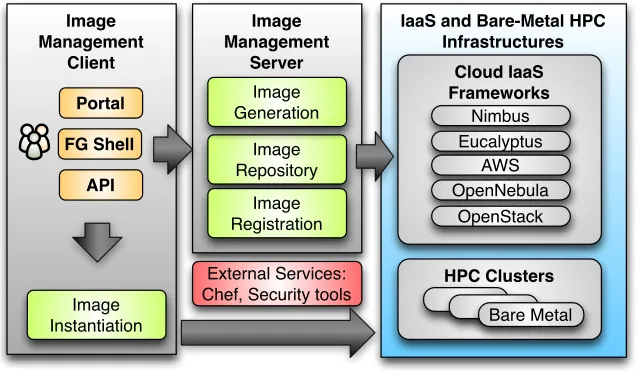
Within the FutureGrid project, we are devising a framework that allows this level of customization for administrators and users. The FutureGrid archi-tecture, depicted in Figure 1.3, shows the two components, namely Image Management andDynamic Provisioning, that are tightly interwoven to allow users to dynamically provision images on bare-metal and virtualized infras-tructures.
(b) sharing the images via a repository, (c) registering the image into the infrastructure, and (d) image instantiation (see Figure 1.5). The problem of targeting not one, but multiple infrastructures amplifies the need for tools supporting these processes. Without them, only the most experienced users will be able to manage them under great investment of time.
Our design targets an end-to-end workflow to support users in creating ab-stract image management across different infrastructures easily [DvLWF12, DYvL+11]. This includes images for Eucalyptus, Nimbus, OpenStack,
Open-Nebula, Amazon, and bare-metal. To summarize the idea behind our design, we prefer users to be able to specify a list of requirements such as an OS, an architecture, software, and libraries in order to generate a personalized abstract image. This image is generic enough that through manipulations it can be adapted for several IaaS or HPC infrastructures with little effort by the users. It will support the management of images for Nimbus [wwwc], Eu-calyptus [wwwf], OpenStack [wwwh], and bare-metal HPC infrastructures as they are either already deployed in FG or going to be deployed as in the case of OpenNebula [wwwg].
By supporting this image management workflow, our framework eases the use of IaaS and HPC frameworks and infrastructures for performance experi-ments based on abstract image management and uniform image registration. Consequently, users can build their own customized environments very eas-ily. The complex processes of the underlying infrastructures are managed by our sophisticated software tools and services. Besides being able to manage images for IaaS frameworks, we also allow the registration and deployment of images onto bare-metal by the user. This level of functionality is typi-cally not offered in a HPC infrastructure. However, our approach provides users with the ability to create their own environments changing the paradigm of administrator-controlled dynamic provisioning to user-controlled dynamic provisioning. Thus, users obtain access to a testbed with the ability to man-age state-of-the-art software stacks that would otherwise not be supported in typical compute centers. Security is also considered by vetting images before they are registered in an infrastructure.
The capabilities provided by our image management framework are advan-tageous to support repeatable performance experiments across a variety of infrastructures. To support a modular design we have devised a component for each process. This includes an image generation component to create im-ages following user requirements, an image repository component to store, catalog and share images, and an image registration component for prepar-ing, uploading and registering images into specific infrastructures such as HPC or different clouds.
management server has the task to generate, store, and register the images with the infrastructure. The image management server also interfaces with external services, such as configuration management services to simplify the configuration steps, authentication and authorization, and a service to verify the validity of an image including security checks.
One important feature in our design is how we are not simply storing an image but rather focusing on the way an image is created through abstract templating. Thus, it is possible at any time to regenerate an image based on the template describing the software stack and services for a given image. This enables us also to optimize the storage needs for users to manage many images. Instead of storing each image individually, we could just store the template or a pedigree of templates used to generate the images.
To aid storage reduction, our design includes data to assist in measuring us-age and performance. This data can be used to purge rarely used imus-ages, while they can be recreated on-demand by leveraging the use of templating. Moreover, the use of abstract image templating will allow us to automat-ically generate images for a variety of hypervisors and hardware platforms on-demand. Autonomous services could be added to reduce the time needed to create images or deploy them in advance. Reusing images among groups of users and the introduction of a cache as part of the image generation will reduce the memory footprint or avoid the generation all together if an image with the same properties is already available.
Image Generation. The image generation provides the first step in our
image management process allowing users to create images according to their specifications. As already mentioned, the benefit of our image generation tools and services is that we are not just targeting a single infrastructure type but a range of them.
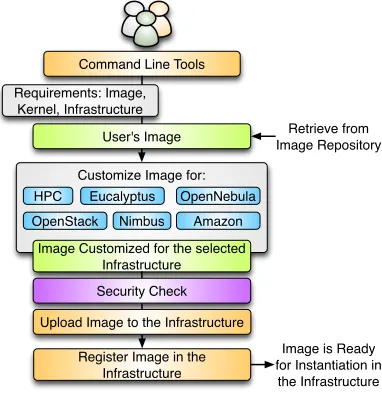
The process is depicted in Figure 1.6. Users initiate the process by specify-ing their requirements. These requirements can include the selection of the OS type, version, architecture, software, services, and more. First, the image generation tool searches into the image repository to identify a base image to be cloned, and if there is no good candidate, the base image is created from scratch. Once we have a base image, the image generation tool installs the software required by the user. This software must be in the official OS reposi-tories or in the FG software repository. The later contains software developed by the FG team or other approved software. The installation procedure can be aided by Chef [CHEa], a configuration management tool to ensure the software is installed and configured properly. After updating the image, it is stored in the image repository and becomes available for registration into one of the supported infrastructures. Our tool is general to deal with installation particularities of different operating systems and architectures.
One feature of our design is to either create images from scratch or by cloning already created base images we locate in our repository.
images provided by the different OSes, such as yum for CentOS and deboos-trap for Ubuntu. To deal with different OSes and architectures, we use cloud technologies. Consequently, an image is created with all user specified pack-ages inside a VM instantiated on-demand. Therefore, multiple users can create multiple images for different operating systems concurrently; obviously, this approach provides us with great flexibility, architecture independence, and high scalability.
We can speed-up the process of generating an image by not starting from scratch but by using an image already stored in the repository. We have tagged such candidate images in the repository as base images. Consequently, modi-fications include installation or update of the packages that the user requires. Our design can utilize either VMs or a physical machine to chroot into the image to conduct this step.
Advanced features of our design include the automatic upgrade or update of images stored in the repository. The old image can be deleted after the user verifies the validity of the new image.
Image Repository. The image repository [DvLW+11] catalogs and stores
images in a unified repository. It offers a common interface for distinguishing image types for different IaaS frameworks but also bare-metal images. This allows us to include a diverse set of images contributed not only by the FG development team but also by the user community that generates such images and wishes to share them. The images are augmented with information about the software stack installed on them including versions, libraries, and available services. This information is maintained in the catalog and can be searched by users and/or other FG services. Users looking for a specific image can discover available images fitting their needs using the catalog interface. In addition, users can also upload customized images, share them among other users, and dynamically provision them. Through these mechanisms we expect our image repository to grow through community contributed images. Metadata included in the repository includes information about properties of the images, the access permission by users and the usage. Access permissions allow the image owner to determine who can access this image from the repos-itory. The simplest types of sharing include private to owner, shared with the public or shared with a set of people defined by a group/project. Usage infor-mation is available as part of the metadata to allow inforinfor-mation about usage to be recorded. This includes how many times an image was accessed and by whom.
Image Registration.Once the image has been created and stored into the
infrastruc-Image Management
Client
IaaS and Bare-Metal HPC Infrastructures
HPC Clusters Image
Management Server
API
Cloud IaaS Frameworks
Bare Metal Image
Repository Image Generation
External Services: Chef, Security tools
Image Registration
FG Shell Portal
Image Instantiation
Nimbus Eucalyptus
AWS OpenNebula
[image:24.612.152.471.143.331.2]OpenStack
FIGURE 1.5: Architecture of Rain to conduct image provisioning on IaaS
and bare-metal
ture. Often we find differences between them requiring us to provide further customizations, security check, the upload of the image to the infrastructure repository, and registering it. These customizations include the configuration of network IP, DNS, file system table, and kernel modules. Additional config-uration is performed depending on the targeted deployed infrastructure. In the HPC infrastructure the images are converted to network bootable im-ages to be provisioned on bare-metal machines. Here, the customization pro-cess configures the image, so it can be integrated into the pool of deployable images accessible by the scheduler. In our case this is Moab. Hence, if such an image is specified as part of the job description the scheduler will conduct the provisioning of the image for us. These images are stateless and the sys-tem is restored by reverting to a default OS once the running job requiring a customized image is completed.
Images targeted for cloud infrastructures need to be converted into VM disks. These images also need some additional configuration to enable VM’s con-textualization in the selected cloud. Our plan is to support the main IaaS clouds, namely Eucalyptus, Nimbus, OpenStack, OpenNebula, and Amazon Web Service (AWS). As our tool is extensible, we can also support other cloud frameworks.
dur-ing the image generation process or to configure additional services. Modified images need to go through some additional tests before they can be registered in the infrastructure. To perform these security tests, we plan to create a high level platform for instantiating the images in a controlled environment such as a VM with limited network access. Hence, we can perform some tests to verify the integrity of the image, detect vulnerabilities and possible malicious software
If the image passes all the tests, it is tagged as approved. To provide au-thentication and authorization images may interface with the FG account management. The process of registering an image only needs to be done once per infrastructure. Therefore, after registering an image in a particular infras-tructure, it can be used anytime to instantiate as many VMs or in case of HPC as many physical machines as available to meet the users requirements.
Customize Image for:
OpenStack Eucalyptus
Nimbus
OpenNebula
Amazon Command Line Tools
Retrieve from Image Repository User's Image
Register Image in the Infrastructure HPC
Image Customized for the selected Infrastructure
Image is Ready for Instantiation in the Infrastructure Upload Image to the Infrastructure
Security Check Requirements: Image,
[image:25.612.216.407.310.507.2]Kernel, Infrastructure
FIGURE 1.6: Image Registration
Dynamic Provisioning with RAIN Due to the variety of services and
limited resources accessible in FG, it is necessary to enable a mechanism to provision needed services onto available resources and suspend or shutdown services that are not utilized. This includes the assignment of resources to different IaaS and PaaS frameworks. We we need to develop a convenient abstraction that allows us to hide the many underlying tools and services to accomplish this task. We observed the following needs from the FutureGrid user community:
2. In contrast to IaaS environments, we are not just interested in provision-ing an image as part of the virtualized environment. Instead, we would like to be able to “provision” the entire IaaS framework.
3. In contrast to environments based on a single operating system, we would like to manage the deployment on multiple base OS including the choice of which virtualization technology is used.
4. In contrast to just focusing on virtualized environments, we would also like to enable an environment allowing performance comparisons be-tween the virtualized and the non-virtualized versions of applications, e.g. comparing HPC, vs. IaaS frameworks. Hence, it is important to rec-ognize that this comprehensive view of “raining” an environment is a significant contribution of FG and allows comparative studies that are otherwise not easily possible.
We have developed, as first step to address this challenge, a sophisticated im-age manim-agement toolkit that allows us to not only provision virtual machines, but also provision directly onto bare-metal [DvLWF12]. Thus, we use the term rainingto indicate that we can place arbitrary software stack onto a resource. The toolkit to do so is calledrain.
Rain will make it possible to compare the benefits of IaaS, PaaS performance issues, as well as evaluating which applications can benefit from such environ-ments and how they must be efficiently configured. As part of this process, we allow the generation of abstract images and universal image registration with the various infrastructures including Nimbus, Eucalyptus, OpenNebula, OpenStack, but also bare-metal via the HPC services. It is one of the unique features about FutureGrid to provide an essential component to make compar-isons between the different infrastructures more easily possible [vLDWF12]. Our toolkit rain is tasked with simplifying the creation and deployment of customized environments.
Internally rain may use a multitude of tools and components suitable to con-duct the task indicated by the command line tool. This may include Moab, xCAT, TakTuk [tak12], and even IaaS frameworks where appropriate. It is important to recognize that, in order to allow repeatable experiments, the rain command will have to interact with a multitude of services. In future, rain will allow specifically the recording of the resources participating in the experiment. Eventually, the experiment can be shared with other users and replicated.
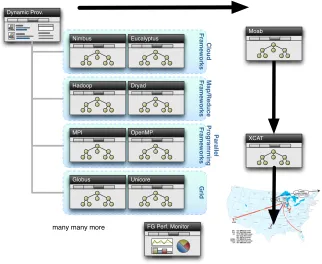
As a result, rain is a pivotal process in making the FG deployment unique and applicable to any set of scientific researchers requiring rapid deployment IaaS, PaaS, and HPC environments (see Figure 1.7). Thus, rain will offer the following main features:
• Create customized environments on demand.
• Move resources from one infrastructure to another by changing the image they are running plus doing needed changes in the framework.
• Ease the system administrator burden for creating deployable images.
• Access to repeatable experiments.
Examples for “raining” are the deployment of an Hadoop cluster to run an experiment, the instantiation of a set of VMs with an specific OS, or the deployment of a virtual cluster based on SLURM [?, wwwi]. We envision that commands such as
fg-rain --hadoop -x india -m 10 -j jobscript.sh
fg-rain -os ubuntu11.04 -s sierra -m 25 -I
fg-rain --cluster slurm -x sierra -m 34
will be transparent enough for users to achieve provisioning on both bare metal and virtualized infrastructures (cloud). It is obvious that such a command will be extremely powerful and provide an important mechanism for abstracting the many different tools and services that are needed to accomplish the task. In this way, users don’t need to be aware of the underlining details of each infrastructure. Hence, the command rain will provide the high level interface to the FG fabric, which is essential to create deployment workflows in a simple fashion.
1.3.3.2 Monitoring, Information, and Performance Services
A critical component of FutureGrid is the ability to monitor the expected behavior of its systems and services. This is especially important due to the experimental nature of the FutureGrid mission. Monitoring activities in Fu-tureGrid include testing the functionality and performance of FuFu-tureGrid ser-vices using Inca, collecting usage data with Netlogger, cluster monitoring with Ganglia, and network monitoring with perfSONAR and SNAPP. Administra-tors and users can then easily access the monitoring data generated by each tool through the user portal. Programmatic access to the monitoring data is also available through each of the tools and work is ongoing to integrate the monitoring data into a common messaging system using AMQP for easier ac-cess. Each monitoring tool is described further in the subsections below. We also provide performance tools, PAPI and Vampir, into the image generation process for both virtual and bare-metal images.
Inca. Inca [SEHO07] is a monitoring framework designed to detect
Ma
p
/R
e
d
u
c
e
Frameworks
Cloud
Frameworks
Nimbus
XCAT Dynamic Prov.
FG Perf. Monitor Eucalyptus
Hadoop Dryad
Pa
ra
lle
l
Pr
o
g
ra
m
m
in
g
Frameworks
MPI OpenMP
Grid
Globus Unicore
many many more
[image:28.612.150.472.168.432.2]Moab
FIGURE 1.7: The concept of raining allows to dynamically provision images
on bare-metal, but also in virtualized environments. This allows performance experiments between virtualized and non virtualized infrastructures.
PGCC, the FG Portal, SSH, Torque/Moab, Unicore, VampirTrace, Wiki, and XCAT. It also collects performance measurements for each of the Cloud tools and HPCC performance data from the HPC partitions.
Netlogger. Netlogger [TJC+98] is a tool for debugging and analyzing the
performance of complex distributed applications. It is currently being lever-aged to collect privileged usage data (number of deploy VMs and number of unique users) using small probes that execute with administrator credentials every hour for each of the Cloud tools: Eucalyptus, Nimbus, and Openstack.
Ganglia.Ganglia [MCC04] is a cluster monitoring tool used to monitor each
of the FutureGrid clusters. It collects CPU, memory, disk, and network usage statistics for each cluster node. The monitoring data is then aggregated and published at a centralized Ganglia server.
perfSONAR.perfSONAR [HBB+05] is an infrastructure for network
infras-tructure to perform a full mesh of BWCTL measurements (regularly-scheduled Iperf measurements). Currently, we have a basic setup of sixty second 1G TCP measurements that are run every two hours.
SNAPPSNAPP [SNA07] is a network statistical data collection and
visual-ization tool that is used to collect high-performance, high-resolution SNMP data from the FutureGrid network.
1.3.4
Experiment and Project Management
Users obtain access to FutureGrid by submitting projects describing the na-ture and merit of their activity. Currently most projects tax Funa-tureGrid not in number of resources requested but in the nature and support of requested soft-ware and these issues are used in evaluation. We do not approve projects such as production science that are more suitable for other XSEDE sites. There are currently no restrictions on nationality or type (academic, government, industry) of users. We require however that the use of FutureGrid be doc-umented and results be shared with the community. The FutureGrid portal https://portal.futuregrid.org/ [wwwb] has an open list of all projects, their results, papers on its development and reports on its progress.
FutureGrid allows both federated and non federated experiments. Due to the variety of technologies that are supported not all of them integrate yet well into a completely federated environment. We base our federated infrastructure on LDAP where possible, while using public keys. Surprisingly, it was relatively easy so far to provide an IdP (Identity Provider) based on a simple verification process that included a google search on academic publications, participation in source code development of established projects, or lookup on university Web sites. We also identified that we have users that are and probably never will be part of the US campus bridging IdP based on InCommon. An OpenID can be used to be associated with the portal account, effectively providing SSO with services such as Googledocs. This is especially of importance as we believe that in order to support the long tail of science we need to interface with such tools as they provide via google scholar, and collaborative document preparation popular in the education community.
Experiments are currently done as part of projects that are vetted and ap-proved. Once a project is approved users can conduct experiments. A result of such experiments can be a template that can be used to reproduce such an experiment or even an image that others can use by reusing the software stack promoted by this image.
we are using the term rain and developed the fg-rain prototype that not only places the OS on the resources (virtualized and non-virtualized) but also assembles the OS and the software stack as part of an image generation process[vLFW+10, DvLW+11, DvLWF12].
1.3.4.1 Interactive Experiment Management
The design philosophy of this set of tools is a Unix-style one where a user can use a set of independent tools together (via the command line or a script) to accomplish a complex goal.
Interactive experiment management is currently an ongoing research activity within FutureGrid. Various approaches to this exist within FutureGrid. One of these approaches is to create an experiment harness with existing and new tools such as TakTuk and the FutureGrid Host List Manager. These tools are used in conjunction with other tools such as Torque and Nimbus provision-ing commands and even the Unix script command. TakTuk is a cluster fork or parallel shell type tool developed as part of the Grid 5000 project. The TakTuk user interface is a command line program that allows a user to easily and efficiently execute commands on sets of remote computer systems and transmit the output of these commands back to the TakTuk program. TACC developed the Host List Manager - a set of command line programs that dis-covers what FutureGrid resources have been provisioned to a user (via Torque and Nimbus), organizes resources into groups (based on the tag(s) that the user assigns to each resource), and generates host list files for use by TakTuk or similar parallel shell tools.
A FutureGrid user can therefore use Torque and Nimbus commands to pro-vision resources, use the Host List Manager to organize those resources into groups, execute commands on the resources via TakTuk, and record their entire session via the Unix script program.
TakTuk and the Host List Manager have been deployed on the Alamo, Hotel, India, and Sierra FutureGrid clusters and are available in production to Fu-tureGrid users. The deployment includes the software itself and modules for including the software into a user’s environment.
1.3.4.2 Workflow-Based Experiment Management
1.3.4.3 DevOps-Based Experiment Management
In addition to the experiment management strategies listed above, we also support experiment management with tools that recently have become syn-onymous with DevOps. Here templates, scripts, or recipies are used to formu-late in a tempformu-lated fashion deployment descriptions to coordinate the creation of an experiment environment that includes resources as part of the compute fabric, the operating system and/or virtuualization environments, and the in-stantiation of high-level platforms as part of the overall deployed experimental services. Such a mechanism is possible while leverageing tools such as Puppet or chef as well as integrating them as part of our RAIN toolkit. The goal is to create small test deployments that with little effort can be rained onto larger resource fabrics when desired. It also allows the total reconfiguration of the environment while proposing the model of “nothing installed on the ma-chine”. Hence such an experiment management framework could also be used to bootstrap the previous two Management frameworks that are positioned at a higher level and require certain software to be readily be available.
1.3.4.4 Rain-Based Experiment Management
As one of the key components and services of FutureGrid is to dynamically provision operating systems, IaaS, and PaaS frameworks onto different re-sources, as well as the dynamic allocation based on user demand, it will be possible to create and recreate environments and experiment resources based on predifined specifications. This will help in setting up suitable experiment frameworks that allow comparision of features across infrastructures, plat-forms, operating systems, and other high level tools. Hence it builds an ele-mentary basic unit that can be used in workflow-based, interactive, as well as DevOps-based experiments. Without doubt one of the most sophisticated services planed and offered in FutureGrid. To facilitate ease of use we take the ideas presented in [vLYH+09] and expose the funtionlity throug a convenient comand shell while also working towards integraton into a portal.
1.3.5
Operations Services
Authentication and Authorization. We have devised our authentication
InCommon, for account vetting, but found that vetting accounts so far was not that much work and that the attributes provided by InCommon does at this time not allow us to eliminate our account vetting activities as confirmed by experts from the InCommon community.
Cloud Accounting. An important part for FG is to be able to present
accounting information for our deployed cloud environments. This has been surprisingly more challenging as we originally anticipated. First, the cloud frameworks support for accounting is minimal or non-existing. In addition, we are also investigating mechanisms to not only parse and monitor Eucalyp-tus logs, but also to identify that we can integrate that information into a system such as Gold. However, the developers of Gold have recently discon-tinued support for it and recommend instead a commercial solution. We will reevaluate our strategy as it was based on Gold.
HPC Accounting. Accounting on HPC systems is important to identify how
the systems were used and utilized. Although integration with the XSEDE central repository would be possible, we identified together with University of Buffalo several challenges. First, the metrics we are interested in such as VM monitoring and utilization are not in the database and require a signifi-cant modification. Second due to the reconfigurable nature of FutureGrid the number of nodes associated to the HPC services is not static and does not fit the current analysis and recoding model. Third, the type of jobs we ran is not as typical and CPU bound. For example we find many users testing sci-entific workflows instead of conducting large scale number crunching on our resources.
Intelligent Resource Adaptations. Once we have accounting information
we will start an effort on utilizing the accounting information to integrate it into a dynamic provisioning mechanism as part of RAIN. E.g. if we detect that users do not want to use HPC resources or Eucalyptus resources, the machines hosting the compute nodes for these services can be assigned to for example Nimbus if Nimbus reports to us hat more resources are needed. This will lead to a metascheduler for cloud and HPC resources.
1.3.6
Development Services
Due to the size of the project it is important to provide a good infrastructure in support of our collaborative efforts. This includes the deployment of a task management system, a wiki, and a continuous integration environment.
1.3.7
Portal
1.4
Service Deployment
[image:33.612.151.470.241.432.2]In Table 1.3 we list elementary services that have been deployed on which resources in FG.
TABLE 1.3: Deployed services
India Sierra Hotel Foxtrot Alamo Xray Bravo Echo
myHadoop (d) (d) (d)
Nimbus (d) (d) (d) (d)
Eucalyptus (d) (d)
ViNe (i) (d) (i) (d) (i)
Genesis II (d) (d) (d) (d)
Unicore (d) (d) (d)
MPI (d) (d) (d) (d) (d) (d) (d)
OpenMP (d)
ScaleMP (d)
Ganglia (d) (d)
Pegasus (i) (i) (i) (i) (i)
Inca (d) (d) (d) (d) (d) (d)
Portal (i) (i) (i) (i) (i) (i)
PAPI (d)
Vampir (d) (a)
Vampir Trace (d) (d)
RAIN (d)
Legend:
(d) deployed (a) can be made available upon request (i) information available in the portal
1.5
Applications using FutureGrid
More than 220 projects and 920 users are registered in FutureGrid. These projects cover a wide range from application to technology and from research to education. Recent projects have focused on integration testing for XSEDE, image management and dynamic provisioning on bare metal [DvLWF12], scal-ability test for cloud provisioning [vLDWF12]. These projects are ground braking as they introduce a testbed environment for XSEDE an also allow user facing dynamic provisioning, something that is not normally offered by other resources. The scalability experiment showed certain limitations with standard cloud setups for use cases typical for scientific applications.
project must report their success and findings on the FutureGrid Web site [wwwb]. Currently, our portal is quite streamlined for the entire workflow related to user account creation, project creation, and reporting. In addition application user forums can be established for the projects if the project lead wishes. This makes it possible to have projects created in just a very short time period. In the next sections we will present some selected projects. To see all of the projects conducted on FutureGrid we recommend to visit the FutureGrid portal.
1.5.1
Privacy preserving gene read mapping using hybrid
cloud
An example project investigationg security aspects of hybrid clouds is found at [Cheb]. In this project the researchers study the possibility of doing reads mapping using hybrid cloud, in order to utilize public computing resources while preserving the data privacy. The topic of this research is very timely in order to address requirements about privacy in bioinformatics as more and data are generated. The tem conducting this research also intends to increase the data processing speed in the area of bioinformatics andreplace current read mapping tools. A typical experiment on FutureGrid will run for about two to three days.
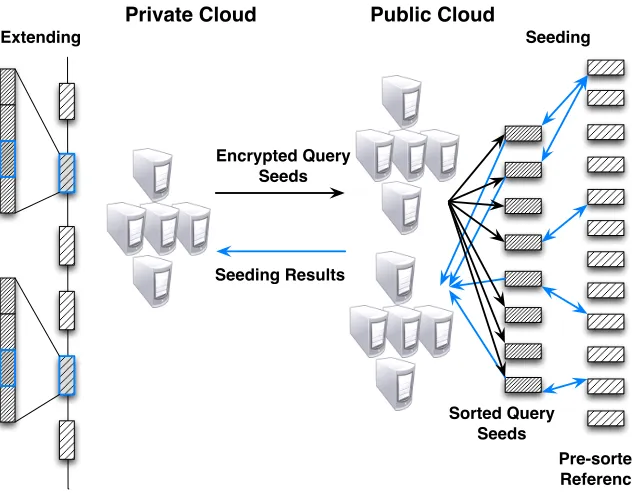
One of the most important analyses on human DNA sequences is read map-ping, which aligns a large number of short DNA sequences (called reads) produced by sequencers to a reference human genome. The analysis involves intensive computation (calculating edit distances over millions upon billions of sequences) and therefore needs to be outsourced to low-cost commercial clouds. This asks for scalable privacy-preserving techniques to protect the sensitive information sequencing reads contain. Such a demand cannot be met by the existing techniques, which are either too heavyweight to sustain data-intensive computations or vulnerable to identification attacks. Our re-search, however, shows that simple solutions can be found by leveraging the special features of the mapping task, which only cares about small edit dis-tances, and those of the cloud platform, which is designed to perform a large amount of simple, parallelizable computation. We implemented and evaluated such new techniques on a hybrid cloud platforms built on FutureGrid. In our experiments, we utilized specially-designed techniques based on the classic “seed-and-extend” method to achieve secure and scalable read mapping. The high-level design of our techniques is illustrated in Figure 1.8.
Here, the public cloud on FutureGrid is delegated the computation over en-crypted read datasets, while the private cloud directly works on the data. Our idea is to let the private cloud undertake a small amount of the workload to reduce the complexity of the computation that needs to
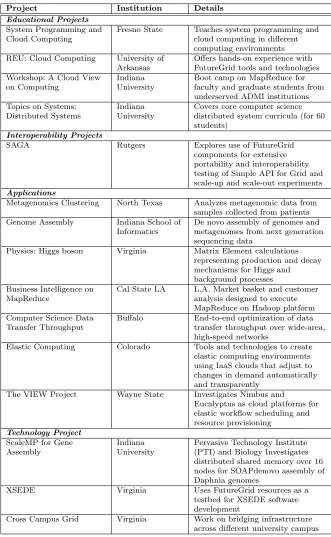
TABLE 1.4: Selected FutureGrid Projects
Project Institution Details
Educational Projects
System Programming and Cloud Computing
Fresno State Teaches system programming and cloud computing in different computing environments REU: Cloud Computing University of
Arkansas
Offers hands-on experience with FutureGrid tools and technologies Workshop: A Cloud View
on Computing
Indiana University
Boot camp on MapReduce for faculty and graduate students from underserved ADMI institutions Topics on Systems:
Distributed Systems
Indiana University
Covers core computer science distributed system curricula (for 60 students)
Interoperability Projects
SAGA Rutgers Explores use of FutureGrid
components for extensive portability and interoperability testing of Simple API for Grid and scale-up and scale-out experiments
Applications
Metagenomics Clustering North Texas Analyzes metagenomic data from samples collected from patients Genome Assembly Indiana School of
Informatics
De novo assembly of genomes and metagenomes from next generation sequencing data
Physics: Higgs boson Virginia Matrix Element calculations representing production and decay mechanisms for Higgs and background processes Business Intelligence on
MapReduce
Cal State LA L.A. Market basket and customer analysis designed to execute MapReduce on Hadoop platform Computer Science Data
Transfer Throughput
Buffalo End-to-end optimization of data transfer throughput over wide-area, high-speed networks
Elastic Computing Colorado Tools and technologies to create elastic computing environments using IaaS clouds that adjust to changes in demand automatically and transparently
The VIEW Project Wayne State Investigates Nimbus and
Eucalyptus as cloud platforms for elastic workflow scheduling and resource provisioning
Technology Project
ScaleMP for Gene Assembly
Indiana University
Pervasive Technology Institute (PTI) and Biology Investigates distributed shared memory over 16 nodes for SOAPdenovo assembly of Daphnia genomes
XSEDE Virginia Uses FutureGrid resources as a
testbed for XSEDE software development
Encrypted Query Seeds
Seeding Results Extending
Private Cloud Public Cloud
Seeding
Sorted Query Seeds
[image:36.612.152.468.138.386.2]Pre-sorted Reference
FIGURE 1.8: Using a public and private cloud for gener read mapping
while using the following two modes: First, a virtual mode in which 20 nodes of FutureGrid wer used as the public cloud and 1 node was configured as pri-vate cloud. Second, a real mode, in which nodes on FutureGrid were used as the public cloud and the computing system within the School of Informatics and Computing as the private cloud.
Our experiments demonstrate that our techniques are both secure and scal-able. We successfully mapped 10 million real human microbiome reads to the largest human chromosome over this hybrid cloud. The public cloud took about 15 minutes to conduct the seeding and the private cloud spent about 20 minutes on the extension. Over 96/