This is a repository copy of
Is antibiotic prophylaxis to prevent infective endocarditis
worthwhile?
.
White Rose Research Online URL for this paper:
http://eprints.whiterose.ac.uk/123995/
Version: Accepted Version
Article:
Dayer, M. and Thornhill, M. orcid.org/0000-0003-0681-4083 (2017) Is antibiotic prophylaxis
to prevent infective endocarditis worthwhile? Journal of Infection and Chemotherapy.
https://doi.org/10.1016/j.jiac.2017.10.006
[email protected] https://eprints.whiterose.ac.uk/
Reuse
This article is distributed under the terms of the Creative Commons Attribution-NonCommercial-NoDerivs (CC BY-NC-ND) licence. This licence only allows you to download this work and share it with others as long as you credit the authors, but you can’t change the article in any way or use it commercially. More
information and the full terms of the licence here: https://creativecommons.org/licenses/
Takedown
If you consider content in White Rose Research Online to be in breach of UK law, please notify us by
Elsevier Editorial System(tm) for Journal of Infection and Chemotherapy
Manuscript Draft
Manuscript Number: JIC-D-17-00361R1
Title: Is Antibiotic Prophylaxis to Prevent Infective Endocarditis Worthwhile?
Article Type: Review Article
Keywords: Infective endocarditis; Antibiotic prophylaxis
Corresponding Author: Dr. Mark Dayer, PhD FRCP
Corresponding Author's Institution: Taunton and Somerset NHS Trust
First Author: Mark Dayer, PhD FRCP
Order of Authors: Mark Dayer, PhD FRCP
1 2 3 4 5 6 7 8 9 10 11 12 13 14 15 16 17 18 19 20 21 22 23 24 25 26 27 28 29 30 31 32 33 34 35 36 37 38 39 40 41 42 43 44 45 46 47 48 49 50 51 52 53 54 55 56 57 58 59 60 61 62 63 64 65
Is
Antibiotic
Prophylaxis
to
Prevent
Infective
Endocarditis
Worthwhile?
Dr Mark Dayer
1and Professor Martin Thornhill
2Taunton and Somerset NHS Trust
Musgrove Park Hospital
Taunton
TA1 5DA
[email protected]
Professor of Translational Research in Dentistry
Academic Unit of Oral & Maxillofacial Medicine & Surgery
University of Sheffield School of Clinical Dentistry
Claremont Crescent
Sheffield
1 2 3 4 5 6 7 8 9 10 11 12 13 14 15 16 17 18 19 20 21 22 23 24 25 26 27 28 29 30 31 32 33 34 35 36 37 38 39 40 41 42 43 44 45 46 47 48 49 50 51 52 53 54 55 56 57 58 59 60 61 62 63 64 65
Conflicts of Interest
1 2 3 4 5 6 7 8 9 10 11 12 13 14 15 16 17 18 19 20 21 22 23 24 25 26 27 28 29 30 31 32 33 34 35 36 37 38 39 40 41 42 43 44 45 46 47 48 49 50 51 52 53 54 55 56 57 58 59 60 61 62 63 64 65
Abstract
1 2 3 4 5 6 7 8 9 10 11 12 13 14 15 16 17 18 19 20 21 22 23 24 25 26 27 28 29 30 31 32 33 34 35 36 37 38 39 40 41 42 43 44 45 46 47 48 49 50 51 52 53 54 55 56 57 58 59 60 61 62 63 64 65
Infective Endocarditis
Infective endocarditis is a rare infection, affecting around 5-10 people per 100,000 per
annum.[1-3] It has a high morbidity, typically requiring prolonged courses of antibiotics and
often valve replacement surgery. Mortality is also high, not only in hospital, but also in the
first year after discharge. Consequently, this is a disease that is important to prevent, and
for many years antibiotic prophylaxis prior to invasive, particularly dental, procedures has
been normal practice across the world.
In Japan, a recent survey of 513 cases has described the epidemiology of the disease
between 2007 and 2009.[4] The most common age of presentation was 61-80 years. 62%
were men. 11% died. 69% of cases had known underlying heart disease; 36% of cases were
related to native valve disease. Periodontitis / tooth decay was noted in 25%, and dental
treatment was identified as a predisposing factor in 16% of cases, although the timing of
intervention was not given. Approximately 1/3
rdhad AP, but it was unclear in another 1/3
rdwhether AP was used or not. Oral viridans group Streptococci
(OVGS) were identified as the
causative organism in 26% of cases. This is a relatively high percentage compared with other
contemporary studies,[5, 6]
IE
[7]
1 2 3 4 5 6 7 8 9 10 11 12 13 14 15 16 17 18 19 20 21 22 23 24 25 26 27 28 29 30 31 32 33 34 35 36 37 38 39 40 41 42 43 44 45 46 47 48 49 50 51 52 53 54 55 56 57 58 59 60 61 62 63 64 65
The Origins of Antibiotic Prophylaxis
In 1923 Lewis and Grant first suggested that infective endocarditis (IE) might be caused by bacteria released into the circulation during a dental procedure.[8] In 1935, Okell and Elliot confirmed that this was the case, isolating Streptococcus viridans in blood cultures in 84/138 (61%) of individuals.[9] Shortly after this, in 1941, the first recorded use of antibiotic prophylaxis (AP) took place.[10] In 1955 the American Heart Association (AHA) issued the first guidelines, I medical and dental practice to protect patients with rheumatic or congenital heart disease by
[11]
But, whereas many guidelines in other aspects of cardiology are clearly evidence based , guidelines for AP to prevent IE have largely been based on consensus. In 1962, Hook and Kaye stated T
H
appears to be a reasonable approach to the problem and the consensus of opinion strongly supports
.[12]
Since the original AHA guidelines, there have been many revisions and, furthermore, guidelines have been developed around the world to suit local populations. There is now considerable variation between countries as to what is recommended.
1 2 3 4 5 6 7 8 9 10 11 12 13 14 15 16 17 18 19 20 21 22 23 24 25 26 27 28 29 30 31 32 33 34 35 36 37 38 39 40 41 42 43 44 45 46 47 48 49 50 51 52 53 54 55 56 57 58 59 60 61 62 63 64 65
The Evidence for Antibiotic Prophylaxis
Antibiotic prophylaxis was initially based upon the assumption that giving antibiotics to individuals susceptible to IE, prior to a procedure known to release bacteria into the bloodstream, would reduce the risk of developing IE subsequently.
A number of different types of experiment have been performed to try to ascertain the efficacy of AP:
1. Animal studies.
2. The impact of antibiotics prior to dental, or other, procedures on bacteraemias in humans. 3. Case control and cohort studies.
4. Studies using administrative databases before and after changes to guidelines.
1 2 3 4 5 6 7 8 9 10 11 12 13 14 15 16 17 18 19 20 21 22 23 24 25 26 27 28 29 30 31 32 33 34 35 36 37 38 39 40 41 42 43 44 45 46 47 48 49 50 51 52 53 54 55 56 57 58 59 60 61 62 63 64 65
Animal Studies
David Durack and colleagues published the first animal model studies demonstrating that infective endocarditis might be prevented with prophylactic antibiotics in the early 1970s. In 1973, Durack and Petersdorf described an animal model of endocarditis. In this model, a polyethylene catheter was passed into the right side of the heart via the jugular vein, or the left side via the carotid artery and secured in place. After 1-3 days 108 colony-forming units of Streptococcus viridans was given intravenously. It was reported that this procedure produced endocarditis in every animal. To determine the efficacy of antibiotic prophylaxis, antibiotics were given orally, intramuscularly or intravenously, depending on the antibiotic. Procaine penicillin was successful in preventing Streptococcal endocarditis.[17] Other groups soon replicated the results. However, there has never been, to our knowledge, a systematic review of these studies.
1 2 3 4 5 6 7 8 9 10 11 12 13 14 15 16 17 18 19 20 21 22 23 24 25 26 27 28 29 30 31 32 33 34 35 36 37 38 39 40 41 42 43 44 45 46 47 48 49 50 51 52 53 54 55 56 57 58 59 60 61 62 63 64 65
The Impact of Antibiotic Prophylaxis Prior to Dental or Other Procedures on Bacteraemias in
Humans
The impact of antibiotic prophylaxis prior to dental or other procedures on the development of bacteraemias in humans has been extensively studied. However, the effects of antibiotics are controversial, with some studies reporting a positive effect, and others not. More recent studies, carefully performed, have demonstrated that amoxicillin can reduce the frequency of bacteraemias, but that it is not 100% effective.[18, 19] Importantly, a number of more recent studies have suggested that clindamycin may not be particularly effective.[19, 20]
What has also become clear is that everyday activities, such as tooth-brushing, dental flossing and chewing,[18, 21-23] can also release bacteria into the bloodstream, although the frequency of bacteraemia is less than after a dental extraction and the duration less, suggesting that the magnitude of bacteraemia is also less. The frequency and magnitude of bacteraemia caused by daily activities is also likely to be influenced by the state of oral hygiene and presence of periodontal disease. Indeed, individuals with markers of poor oral hygiene are 4-8 times more likely to develop a bacteraemia with organisms that can cause IE following tooth brushing than those with better standards of oral hygiene.[24]
1 2 3 4 5 6 7 8 9 10 11 12 13 14 15 16 17 18 19 20 21 22 23 24 25 26 27 28 29 30 31 32 33 34 35 36 37 38 39 40 41 42 43 44 45 46 47 48 49 50 51 52 53 54 55 56 57 58 59 60 61 62 63 64 65
Case Control and Cohort Studies
Case control and cohort studies have been undertaken in an effort to understand whether dental procedures can cause IE and also whether AP might be effective.
Horstkotte in 1986 compared 229 patients with prosthetic heart valves in whom 287 procedures were performed and who had AP, with 304 patients with prosthetic heart valves in whom 390 similar interventions were performed and who did not have AP.[25] In the first group no patient developed IE. In the second group, 6 developed IE within 14 days. This study has been cited frequently as evidence that AP works. However, due to the limited information contained within the study, more recent reviews have discounted it.[26]
Imperiale and Horowitz published a very small case control study in 1990.[27] They enrolled 8 patients with “high-risk” lesions who had IE for the first time on a native valve within 12 weeks of a dental procedure. They were matched with 3 patients who had also undergone a dental procedure and who had a similar valve lesion and age. AP was used by 1/8 patients and by 15/24 controls. They concluded that AP offered protection from IE. It is hard to draw conclusions from such a small study.
Van Der Meer et al. published two linked studies from the Netherlands in 1992. The first was an observational study of 427 cases with late prosthetic or native valve infective endocarditis.[28] 275 were eligible for AP with previously known valve disease or a prosthetic valve. Only 31 had undergone any invasive procedure within the previous 30 days. 8 of these had had AP. This study suggested that medical and dental procedures were responsible for only a small proportion of cases of IE and also that AP is inconsistently applied in the real world. The second study was a case-control study that examined the efficacy of antibiotic prophylaxis to prevent IE in patients with native valve disease.[29] 48 patients who developed IE within 180 days of a medical or dental procedure requiring AP were compared with 200 age-matched controls who had a relevant procedure but did not develop IE. Most patients and controls had undergone a dental procedure. AP was given to 8/48 cases and 26/200 controls. It was estimated that AP, when given to patients who had not had IE before, reduced the risk of developing IE within 30 days by 49%. However, it was noted, in the discussion, that 9/10 patients who developed IE did not develop IE as a consequence of a procedure, meaning that AP would only prevent a minority of cases.
Lacassin et al compared 171 cases of IE with 171 controls matched for age, sex and underlying heart condition.[30] They found no increased risk of IE for dental procedures as a whole, although scaling and root canal treatment came close to reaching conventional levels of significance. 48 subjects with known heart disease underwent a dental procedure (26 cases and 22 controls). 6 cases and 6 controls received AP. For Streptococcus viridans and those with negative blood cultures 3/18 cases received AP whereas 6/22 controls did. Although there was some evidence of protection therefore, this did not reach statistical significance.
Strom et al. published a case-control study in 1998. Patients with community acquired IE not associated with intravenous drug use were compared with healthy controls matched for age, sex and neighbourhood of residence. It was concluded that dental procedures were no more frequent in patients with IE than controls and that AP would be unlikely to prevent many cases, even if 100% effective.[31]
1 2 3 4 5 6 7 8 9 10 11 12 13 14 15 16 17 18 19 20 21 22 23 24 25 26 27 28 29 30 31 32 33 34 35 36 37 38 39 40 41 42 43 44 45 46 47 48 49 50 51 52 53 54 55 56 57 58 59 60 61 62 63 64 65
Studies Using Administrative Databases Before and After Changes to Guidelines
In recent times data collected at a national level has become available for analysis and has enabled researchers to assess the impact of guideline changes on the rates of infective endocarditis. We have recently reviewed this literature,[32] and further studies have been published since. The data is complex to interpret and conflicting in its conclusions.
It is first instructive to review the guideline changes that have been studied.
In 2007, the American Heart Association released new guidelines for antibiotic prophylaxis.[33] The previous iteration in 1997[34] had recommended antibiotic prophylaxis for patients at high risk, including those with prosthetic valves, previous bacterial endocarditis, complex cyanotic congenital heart disease and surgical shunts used to correct complex congenital heart disease. They also recommended antibiotic prophylaxis for patients deemed to be at moderate risk of developing endocarditis. These included patients with congenital heart disease, acquired valvular heart disease and hypertrophic cardiomyopathy. The 2007 guidance restricted antibiotic prophylaxis to those at high risk of developing or suffering an adverse outcome from IE. They also modified the criteria slightly, with more detail regarding congenital heart disease, and including patients who had undergone cardiac transplantation and had evidence of valve disease in the high-risk cohort.
The impact of this guideline change has been examined in both the United States and also Canada. Bikdeli et al. looked at Medicare beneficiaries in the United States.[35] Medicare patients are those aged greater than or equal to 65 years only. A total of 52,145 patients were hospitalised with a principal diagnosis of IE during the study period. They noted that the rates of infective endocarditis were falling, and that the fall appeared to accelerate after the guideline change.
Pant et al. used the Nationwide Inpatient Sample database.[36] This is a representative sample of all patients looked after in the US, and comprises about 20% of the population. In this study, the rates of infective endocarditis were rising, but there was no acceleration in the rate of rise after the guideline change. However, they reported that the incidence of endocarditis caused by all Streptococci (not just OVGS) did accelerate after the guideline change.
De Simone et al. also looked at the Nationwide Inpatient Sample, but they used different codes to Pant to identify patients more likely to have OVGS.[37] In contrast to the previous study, they found that the rates of infective endocarditis likely to be due to OVGS were falling after the guideline change.
Mackie et al. looked at the changes in Canada, except for patients in Quebec and the Northern Territories.[38] They noted a gradual rise in the of cases of infective endocarditis. The rate of rise did not change after the new guidelines were introduced. However, there was a trend that endocarditis cases likely to be due to OVGS were rising following the guideline change, whereas before there was a clear decline in the number of cases.[39]
Most recently, Toyoda et al. published one of the most detailed studies looking at the impact of the 2007 guidelines in the US.[6] They looked at trends in California and New York only. They noted no change in the number of cases of OVGS endocarditis, and a slight fall in the total number of cases of endocarditis since the guideline change.
1 2 3 4 5 6 7 8 9 10 11 12 13 14 15 16 17 18 19 20 21 22 23 24 25 26 27 28 29 30 31 32 33 34 35 36 37 38 39 40 41 42 43 44 45 46 47 48 49 50 51 52 53 54 55 56 57 58 59 60 61 62 63 64 65
is that no assessment of antibiotic prescribing was made, and therefore the impact of the guideline change on clinical practice was unclear. This study demonstrated that the percentage of patients at moderate risk given AP fell dramatically and significantly after the introduction of the guidelines, from 64.6% to 8.6%. However, it cannot be assumed that these results can be generalised across the United States.
The European Society of Cardiology updated its 2004 guidelines[41] for the prevention of IE in 2009.[42] They adopted a similar approach to the Americans, moving from advising that patients at moderate or high risk should have AP, to just recommending it for patients at high risk.
Van den Brink et al. looked at the incidence of IE in the Netherlands before and after the ESC guideline change in 2009 using their National Healthcare Insurance Database.[43] There was a steady growth in the number of cases of IE over the time period, with no change in the rate of rise after 2009. However, as a sub-analysis, they also performed an in-depth review of all patients admitted with IE in 3 district general hospitals. They noted that there was a significant increase in the proportion of cases due to Streptococci after 2009 when compared with the time period before, from 31.1% to 53.2% (p=0.0031).
Keller et al. used Nationwide Inpatient Statistics to look at the change in IE incidence in Germany between 2005 and 2014.[3] These cover about 25% of the patients in Germany. In contrast to the van den Brink study, they demonstrated a significant rate of rise in the number of cases of IE after 2009. When they looked in more detail at cases due to Streptococci, however, there was no change in the rate of rise.
In March 2008 the National Institute for Health and Care Excellence published their recommendations regarding the use of AP in England.[44] To everyone’s surprise they recommended that AP should no longer be used, citing the lack of strong evidence for its efficacy, and expressing concerns about potential side effects from the use of AP, the potential development of antibiotic resistance, and the cost. The UK went from prescribing AP widely to patients at moderate and high risk of IE to not using AP at all.[45]
Our group have investigated the impact of this change, publishing articles in the BMJ in 2011[46] and the Lancet in 2015 using Hospital Episode Statistics.[2] We have demonstrated that since the introduction of the NICE guidelines there has been a dramatic fall in antibiotic prescribing, from an average of 10,900 prescriptions per month before the guidelines were introduced, to 2,236 prescriptions per month (p<0.0001). We also showed that, starting in March 2008, the number of cases of infective endocarditis increased significantly above the projected historical trend, by 0.11 cases per 10 million people per month (95% CI 0.05-0.16, p<0.0001). To date, this is the only study to have looked at the impact of stopping AP for those at high-risk of IE as well as those at moderate-risk. It is also the only study to have looked at the effect of guideline change on AP prescribing as well as incidence of IE.
1 2 3 4 5 6 7 8 9 10 11 12 13 14 15 16 17 18 19 20 21 22 23 24 25 26 27 28 29 30 31 32 33 34 35 36 37 38 39 40 41 42 43 44 45 46 47 48 49 50 51 52 53 54 55 56 57 58 59 60 61 62 63 64 65
It is also important to realise that there are no ICD-9 or 10 codes that identify OVGS specifically. Again, codes used to identify cases of Streptococcal, and particularly OVGS endocarditis vary markedly between studies, making comparison difficult (Table 2).
Finally, these studies are observational and cannot explain the changes observed. Over the time periods studied there have been many changes, other than to guidelines for AP. Some of these, such as a growing and ageing society, better diagnostic techniques and the increasing use of new medical technologies such as percutaneous prosthetic valve insertion, may naturally tend to increase rates of endocarditis. Other changes, such as a focus on practices to reduce healthcare associated infection, most notably espoused by such organisations as the Institute for Healthcare Improvement, may tend to reduce rates.
1 2 3 4 5 6 7 8 9 10 11 12 13 14 15 16 17 18 19 20 21 22 23 24 25 26 27 28 29 30 31 32 33 34 35 36 37 38 39 40 41 42 43 44 45 46 47 48 49 50 51 52 53 54 55 56 57 58 59 60 61 62 63 64 65
Studies Using Administrative Databases to Determine the Impact of Prophylaxis Prior to
Procedures in At-Risk Individuals
It is clear from some of the cohort studies that AP is given inconsistently, i.e. not all patients recommended for AP by guidelines are given AP in real life. By combining prescribing data, dental procedure data, and hospital record data it should be possible to observe whether AP is effective or not. It does require quite sophisticated administrative systems, and often requires particular permissions to allow the synthesis of data across databases to avoid transgressing data protection regulations.
The first of these such studies, and we are aware of at least one other which is in progress, has recently been accepted for publication. Tubiana et al.[47] identified 138,076 individuals with a prosthetic valve in France, and followed them for a total of 285,034 person-years. 69,303 individuals underwent 103,463 dental procedures which had an indication for AP. However, AP was given in only 50.5% of these cases. A total 267 patients developed IE likely to have been caused by OVGS during the follow-up period. Of these, a total of 4 patients developed IE within 3 months of an invasive dental procedure after receiving AP, whereas 10 who did not receive AP developed IE within 3 months of the procedure. This difference approached, but did not reach significance (p=0.08).
This study is important. It again suggests that AP may be effective, but importantly confirms that, firstly AP is given inconsistently in the real world, and also that even if AP is effective it is unlikely to prevent large numbers of cases of IE. It is imperative that this study is replicated in other countries where such data is available.
1 2 3 4 5 6 7 8 9 10 11 12 13 14 15 16 17 18 19 20 21 22 23 24 25 26 27 28 29 30 31 32 33 34 35 36 37 38 39 40 41 42 43 44 45 46 47 48 49 50 51 52 53 54 55 56 57 58 59 60 61 62 63 64 65
What are the risks and costs of AP?
In order to determine if AP should be recommended, it is not enough to simply assess whether or not AP can prevent cases of IE. It is also important to understand the potential adverse effects of giving AP.
In the UK, we Y C
amoxicillin and clindamycin as antibiotic prophylaxis.[48] Y C care professionals when adverse drug reactions are recorded, particularly after the introduction of a medication or if there has been a severe side effect. Over a 34-year period, there were no fatal reactions recorded with a single 3g oral dose of Amoxicillin and we could find no other reports of a fatal reaction in the world-wide literature either. For clindamycin given as a single 600mg dose orally, however, we identified 13 fatal reactions per million prescriptions. Most were due to Clostridium Difficile infection. If you believe that AP is effective, then it is easy to recommend amoxicillin as AP, as the risks of a fatal complication are extremely low. However, if a patient requires Clindamycin, then the decision to give AP is a little more nuanced, and is likely to require a more careful discussion with the patient.
Combining data from the Lancet paper with the Yellow Card data enabled us to determine the cost-effectiveness of AP.[49] We demonstrated that for patients at high-risk, AP would only have to prevent 3 cases every 2 years to be cost effective.
1 2 3 4 5 6 7 8 9 10 11 12 13 14 15 16 17 18 19 20 21 22 23 24 25 26 27 28 29 30 31 32 33 34 35 36 37 38 39 40 41 42 43 44 45 46 47 48 49 50 51 52 53 54 55 56 57 58 59 60 61 62 63 64 65
Conclusions
It remains unclear as to whether AP is effective. It is a subject which divides clinicians. A quote by Stuart Chase, an American economist, is For those who believe, no proof is necessary. For
There are no adequately powered randomised controlled clinical trials (RCTs) to help inform decision making in this field, and due to the rarity of the disease, there may never be. Therefore, a different approach is required, as elegantly discussed by Thomas Freiden in an article in the New England Journal of Medicine.[51]
What is required is a synthesis of the evidence that does exist, followed by an honest balancing of the risks and benefits. We believe that when the evidence is taken as a whole it is impossible to exclude the possibility that AP does have an impact, albeit small. Furthermore, AP, particularly amoxicillin appears safe. Because IE is a devastating illness, very few cases have to be prevented to make it cost effective. There are clearly concerns about the promotion of antibiotic resistance and the overall costs of healthcare, but AP is cheap and the recommended dosing regimens are likely to minimise the development of antibiotic resistance.
1 2 3 4 5 6 7 8 9 10 11 12 13 14 15 16 17 18 19 20 21 22 23 24 25 26 27 28 29 30 31 32 33 34 35 36 37 38 39 40 41 42 43 44 45 46 47 48 49 50 51 52 53 54 55 56 57 58 59 60 61 62 63 64 65
References
1.
Hoen B and Duval X. Clinical practice. Infective endocarditis. N Engl J Med.
2013;368:1425-33.
2.
Dayer MJ, Jones S, Prendergast B, Baddour LM, Lockhart PB and Thornhill MH.
Incidence of infective endocarditis in england, 2000-13: A secular trend, interrupted
time-series analysis. Lancet. 2015;385:1219-28.
3.
Keller K, von Bardeleben RS, Ostad MA, Hobohm L, Munzel T, Konstantinides S and
Lankeit M. Temporal trends in the prevalence of infective endocarditis in germany between
2005 and 2014. Am J Cardiol. 2017;119:317-22.
4.
Nakatani S, Mitsutake K, Ohara T, Kokubo Y, Yamamoto H, Hanai S and Investigators
C. Recent picture of infective endocarditis in japan--lessons from cardiac disease registration
(cadre-ie). Circ J. 2013;77:1558-64.
5.
Slipczuk L, Codolosa JN, Davila CD, Romero-Corral A, Yun J, Pressman GS and
Figueredo VM. Infective endocarditis epidemiology over five decades: A systematic review.
PLoS One. 2013;8:e82665.
6.
Toyoda N, Chikwe J, Itagaki S, Gelijns AC, Adams DH and Egorova NN. Trends in
infective endocarditis in california and new york state, 1998-2013. JAMA. 2017;317:1652-60.
7.
Iwakura K. Current profile of infective endocarditis in japan. Circ J. 2013;77:1411-3.
8.
Lewis T and Grant R. Observations relating to subacute infective endocarditis. Heart.
1923;10:21-77.
9.
Okell CC and Elliott SD. Bacteraemia and oral sepsis: With special reference to the
aetiology of subacute endocarditis. Lancet. 1935;226:869-72.
10.
Thomas CB, France R and Reichsman F. Prophylactic use of sulfanilamide. JAMA.
1941;116:551-60.
11.
Jones TD, Baumgartner L, Bellows MT, Breese BB, Kuttner AG, McCarty M and
Rammelkamp CH. Prevention of rheumatic fever and bacterial endocarditis through control
of streptococcal infections. Circulation. 1955;11:317-20.
12.
Hook EW and Kaye D. Prophylaxis of bacterial endocarditis. J Chronic Dis.
1962;15:635-46.
13.
Guidelines on the prevention and treatment of infective endocarditis. JCS. 2008.
14.
Wilson W, Taubert KA, Gewitz M, Lockhart PB, Baddour LM, Levison M, Bolger A,
Cabell CH, Takahashi M, Baltimore RS, Newburger JW, Strom BL, Tani LY, Gerber M, Bonow
RO, Pallasch T, Shulman ST, Rowley AH, Burns JC, Ferrieri P, Gardner T, Goff D, Durack DT
and American Heart A. Prevention of infective endocarditis: Guidelines from the american
heart association: A guideline from the american heart association rheumatic fever,
endocarditis and kawasaki disease committee, council on cardiovascular disease in the
young, and the council on clinical cardiology, council on cardiovascular surgery and
anesthesia, and the quality of care and outcomes research interdisciplinary working group. J
Am Dent Assoc. 2008;139 Suppl:3S-24S.
1 2 3 4 5 6 7 8 9 10 11 12 13 14 15 16 17 18 19 20 21 22 23 24 25 26 27 28 29 30 31 32 33 34 35 36 37 38 39 40 41 42 43 44 45 46 47 48 49 50 51 52 53 54 55 56 57 58 59 60 61 62 63 64 65
and Walker DM. 2015 esc guidelines for the management of infective endocarditis: The task
force for the management of infective endocarditis of the european society of cardiology
(esc). Endorsed by: European association for cardio-thoracic surgery (eacts), the european
association of nuclear medicine (eanm). Eur Heart J. 2015;36:3075-128.
16.
Prophylaxis against infective endocardits. National institute for health and care
excellence. 2008.
17.
Durack DT and Petersdorf RG. Chemotherapy of experimental streptococcal
endocarditis. I. Comparison of commonly recommended prophylactic regimens. J Clin
Invest. 1973;52:592-8.
18.
Lockhart PB, Brennan MT, Sasser HC, Fox PC, Paster BJ and Bahrani-Mougeot FK.
Bacteremia
associated
with
toothbrushing
and
dental
extraction.
Circulation.
2008;117:3118-25.
19.
Limeres Posse J, Alvarez Fernandez M, Fernandez Feijoo J, Medina Henriquez J,
Lockhart PB, Chu VH and Diz Dios P. Intravenous amoxicillin/clavulanate for the prevention
of bacteraemia following dental procedures: A randomized clinical trial. J Antimicrob
Chemother. 2016;71:2022-30.
20.
Diz Dios P, Tomas Carmona I, Limeres Posse J, Medina Henriquez J, Fernandez Feijoo
J and Alvarez Fernandez M. Comparative efficacies of amoxicillin, clindamycin, and
moxifloxacin in prevention of bacteremia following dental extractions. Antimicrob Agents
Chemother. 2006;50:2996-3002.
21.
Mougeot FK, Saunders SE, Brennan MT and Lockhart PB. Associations between
bacteremia from oral sources and distant-site infections: Tooth brushing versus single tooth
extraction. Oral Surg Oral Med Oral Pathol Oral Radiol. 2015;119:430-5.
22.
Maharaj B, Coovadia Y and Vayej AC. An investigation of the frequency of
bacteraemia following dental extraction, tooth brushing and chewing. Cardiovasc J Afr.
2012;23:340-4.
23.
Tomas I, Diz P, Tobias A, Scully C and Donos N. Periodontal health status and
bacteraemia from daily oral activities: Systematic review/meta-analysis. J Clin Periodontol.
2012;39:213-28.
24.
Lockhart PB, Brennan MT, Thornhill M, Michalowicz BS, Noll J, Bahrani-Mougeot FK
and Sasser HC. Poor oral hygiene as a risk factor for infective endocarditis-related
bacteremia. J Am Dent Assoc. 2009;140:1238-44.
25.
Horstkotte D, Friedrichs W, Pippert H, Bircks W and Loogen F. [benefits of
endocarditis prevention in patients with prosthetic heart valves]. Z Kardiol. 1986;75:8-11.
26.
Oliver R, Roberts GJ, Hooper L and Worthington HV. Antibiotics for the prophylaxis of
bacterial endocarditis in dentistry. Cochrane Database Syst Rev. 2008, doi
10.1002/14651858.CD003813.pub3:CD003813.
27.
Imperiale TF and Horwitz RI. Does prophylaxis prevent postdental infective
endocarditis? A controlled evaluation of protective efficacy. Am J Med. 1990;88:131-6.
28.
Van der Meer JT, Thompson J, Valkenburg HA and Michel MF. Epidemiology of
bacterial endocarditis in the netherlands. Ii. Antecedent procedures and use of prophylaxis.
Arch Intern Med. 1992;152:1869-73.
1 2 3 4 5 6 7 8 9 10 11 12 13 14 15 16 17 18 19 20 21 22 23 24 25 26 27 28 29 30 31 32 33 34 35 36 37 38 39 40 41 42 43 44 45 46 47 48 49 50 51 52 53 54 55 56 57 58 59 60 61 62 63 64 65
30.
Lacassin F, Hoen B, Leport C, Selton-Suty C, Delahaye F, Goulet V, Etienne J and
Briancon S. Procedures associated with infective endocarditis in adults. A case control study.
Eur Heart J. 1995;16:1968-74.
31.
Strom BL, Abrutyn E, Berlin JA, Kinman JL, Feldman RS, Stolley PD, Levison ME,
Korzeniowski OM and Kaye D. Dental and cardiac risk factors for infective endocarditis. A
population-based, case-control study. Ann Intern Med. 1998;129:761-9.
32.
Cahill TJ, Harrison JL, Jewell P, Onakpoya I, Chambers JB, Dayer M, Lockhart P,
Roberts N, Shanson D, Thornhill M, Heneghan CJ and Prendergast BD. Antibiotic prophylaxis
for infective endocarditis: A systematic review and meta-analysis. Heart. 2017;103:937-44.
33.
Wilson W, Taubert KA, Gewitz M, Lockhart PB, Baddour LM, Levison M, Bolger A,
Cabell CH, Takahashi M, Baltimore RS, Newburger JW, Strom BL, Tani LY, Gerber M, Bonow
RO, Pallasch T, Shulman ST, Rowley AH, Burns JC, Ferrieri P, Gardner T, Goff D, Durack DT,
American Heart Association Rheumatic Fever E, Kawasaki Disease Committee CoCDitY,
Council on Clinical C, Council on Cardiovascular S, Anesthesia, Quality of C, Outcomes
Research Interdisciplinary Working G and American Dental A. Prevention of infective
endocarditis: Guidelines from the american heart association: A guideline from the
american heart association rheumatic fever, endocarditis and kawasaki disease committee,
council on cardiovascular disease in the young, and the council on clinical cardiology, council
on cardiovascular surgery and anesthesia, and the quality of care and outcomes research
interdisciplinary working group. J Am Dent Assoc. 2007;138:739-45, 47-60.
34.
Dajani AS, Taubert KA, Wilson W, Bolger AF, Bayer A, Ferrieri P, Gewitz MH, Shulman
ST, Nouri S, Newburger JW, Hutto C, Pallasch TJ, Gage TW, Levison ME, Peter G and Zuccaro
G, Jr. Prevention of bacterial endocarditis: Recommendations by the american heart
association. Clin Infect Dis. 1997;25:1448-58.
35.
Bikdeli B, Wang Y, Kim N, Desai MM, Quagliarello V and Krumholz HM. Trends in
hospitalization rates and outcomes of endocarditis among medicare beneficiaries. J Am Coll
Cardiol. 2013;62:2217-26.
36.
Pant S, Patel NJ, Deshmukh A, Golwala H, Patel N, Badheka A, Hirsch GA and Mehta
JL. Trends in infective endocarditis incidence, microbiology, and valve replacement in the
united states from 2000 to 2011. J Am Coll Cardiol. 2015;65:2070-6.
37.
DeSimone DC, Tleyjeh IM, Correa de Sa DD, Anavekar NS, Lahr BD, Sohail MR,
Steckelberg JM, Wilson WR, Baddour LM and Mayo Cardiovascular Infections Study G.
Incidence of infective endocarditis due to viridans group streptococci before and after the
2007 american heart association's prevention guidelines: An extended evaluation of the
olmsted county, minnesota, population and nationwide inpatient sample. Mayo Clin Proc.
2015;90:874-81.
38.
Mackie AS, Liu W, Savu A, Marelli AJ and Kaul P. Infective endocarditis
hospitalizations before and after the 2007 american heart association prophylaxis
guidelines. Can J Cardiol. 2016;32:942-8.
39.
Mackie AS, Liu W, Savu A, Marelli AJ and Kaul P. Reply to letter from thornhill et
al.-infective endocarditis hospitalizations before and after the 2007 american heart association
prophylaxis guidelines. Can J Cardiol. 2016;32:1578 e11.
1 2 3 4 5 6 7 8 9 10 11 12 13 14 15 16 17 18 19 20 21 22 23 24 25 26 27 28 29 30 31 32 33 34 35 36 37 38 39 40 41 42 43 44 45 46 47 48 49 50 51 52 53 54 55 56 57 58 59 60 61 62 63 64 65
41.
Horstkotte D, Follath F, Gutschik E, Lengyel M, Oto A, Pavie A, Soler-Soler J, Thiene G,
von Graevenitz A, Priori SG, Garcia MA, Blanc JJ, Budaj A, Cowie M, Dean V, Deckers J,
Fernandez Burgos E, Lekakis J, Lindahl B, Mazzotta G, Morais J, Oto A, Smiseth OA, Lekakis J,
Vahanian A, Delahaye F, Parkhomenko A, Filipatos G, Aldershvile J, Vardas P, Task Force
Members on Infective Endocarditis of the European Society of C, Guidelines ESCCfP and
Document R. Guidelines on prevention, diagnosis and treatment of infective endocarditis
executive summary; the task force on infective endocarditis of the european society of
cardiology. Eur Heart J. 2004;25:267-76.
42.
Habib G, Hoen B, Tornos P, Thuny F, Prendergast B, Vilacosta I, Moreillon P, de Jesus
Antunes M, Thilen U, Lekakis J, Lengyel M, Muller L, Naber CK, Nihoyannopoulos P, Moritz A,
Zamorano JL and Guidelines ESCCfP. Guidelines on the prevention, diagnosis, and treatment
of infective endocarditis (new version 2009): The task force on the prevention, diagnosis,
and treatment of infective endocarditis of the european society of cardiology (esc).
Endorsed by the european society of clinical microbiology and infectious diseases (escmid)
and the international society of chemotherapy (isc) for infection and cancer. Eur Heart J.
2009;30:2369-413.
43.
van den Brink FS, Swaans MJ, Hoogendijk MG, Alipour A, Kelder JC, Jaarsma W,
Eefting FD, Groenmeijer B, Funke Kupper AJ and ten Berg JM. Increased incidence of
infective endocarditis after the 2009 european society of cardiology guideline update: A
nationwide study in the netherlands. European Heart Journal: Quality of Care and Clinical
Outcomes. 2016;3:141-7.
44.
Prophylaxis against infective endocarditis. Antimicrobial prophylaxis against infective
endocarditis in adults and children undergoing interventional procedures. NICE Clinical
Guideline 64. 2008.
45.
Ramsdale DR, Turner-Stokes L, Advisory Group of the British Cardiac Society Clinical
Practice C, Effectiveness RCPC and Evaluation U. Prophylaxis and treatment of infective
endocarditis in adults: A concise guide. Clin Med. 2004;4:545-50.
46.
Thornhill MH, Dayer MJ, Forde JM, Corey GR, Chu VH, Couper DJ and Lockhart PB.
Impact of the nice guideline recommending cessation of antibiotic prophylaxis for
prevention of infective endocarditis: Before and after study. BMJ. 2011;342:d2392.
47.
Tubiana S, Blotiere P, Hoen B, Lesclous P, Millot S, Rudant J, Weill A, Coste J, Alla F,
Duval X and Bichat C. Dental procedures, antibiotic prophylaxis and endocarditis among
individuals with cardiac prosthetic valves: A nationwide population-based cohort and
case-crossover study. BMJ. 2017;358:jXXXX.
48.
Thornhill MH, Dayer MJ, Prendergast B, Baddour LM, Jones S and Lockhart PB.
Incidence and nature of adverse reactions to antibiotics used as endocarditis prophylaxis. J
Antimicrob Chemother. 2015;70:2382-8.
49.
Franklin M, Wailoo A, Dayer MJ, Jones S, Prendergast B, Baddour LM, Lockhart PB
and Thornhill MH. The cost-effectiveness of antibiotic prophylaxis for patients at risk of
infective endocarditis. Circulation. 2016;134:1568-78.
50.
Opatowski L, Mandel J, Varon E, Boelle PY, Temime L and Guillemot D. Antibiotic
dose impact on resistance selection in the community: A mathematical model of
beta-lactams and streptococcus pneumoniae dynamics. Antimicrob Agents Chemother.
2010;54:2330-7.
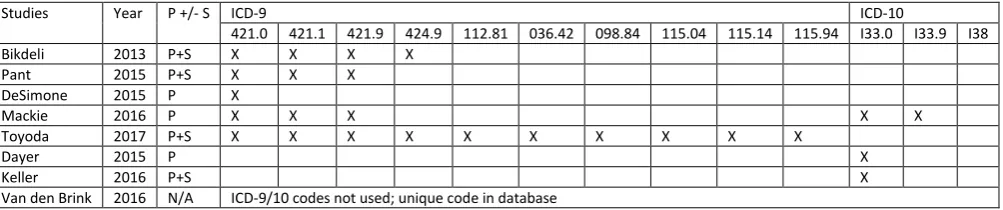
Table 1
Codes used to identify cases of infective endocarditis
Studies Year P +/- S ICD-9 ICD-10
421.0 421.1 421.9 424.9 112.81 036.42 098.84 115.04 115.14 115.94 I33.0 I33.9 I38 Bikdeli 2013 P+S X X X X
Pant 2015 P+S X X X DeSimone 2015 P X
Mackie 2016 P X X X X X
Toyoda 2017 P+S X X X X X X X X X X
Dayer 2015 P X
Keller 2016 P+S X
Van den Brink 2016 N/A ICD-9/10 codes not used; unique code in database
[image:22.842.75.577.128.233.2]P Code searched for in primary position only; P+S Codes searched for in any position
Table 2
Codes used to identify oral viridans group Streptococci (OVGS)
* Positive predictive value for OVGS: 84% (68-100%)
Studies Year ICD-9 ICD-10
0380 0382 0410 04100 04101 04102 04103 04104 04105 04109 B95.0 B95.1 B95.2 B95.3 B95.4 B95.5 A40.8 A40.9 A49.1 Bikdeli 2013 None
Pant 2015 X X X X X X X X X X
DeSimone 2015 X X
Mackie 2016 X X X X X X X X
Toyoda* 2017 X X
Dayer 2015 None
Keller 2016 X X X X X X