Copyrightq1997, American Society for Microbiology
Biological Properties of Pseudorecombinant and Recombinant
Strains Created with Cucumber Mosaic Virus and
Tomato Aspermy Virus
KATALIN SALA´ NKI,1* ISABELLE CARRE`RE,2MIREILLE JACQUEMOND,2 ERVIN BALA´ ZS,1ANDMARK TEPFER3
Agricultural Biotechnology Center, Institute for Plant Sciences, H-2101 Go¨do¨llo¨, Hungary,1and
Station de Pathologie Ve´ge´tale, INRA, Domaine St. Maurice, F-84143 Montfavet Cedex,2
and Laboratoire de Biologie Cellulaire, INRA, Versailles,
F-78026 Versailles Cedex,3France
Received 8 October 1996/Accepted 1 February 1997
Cucumber mosaic virus (CMV) and tomato aspermy virus (TAV) are closely related cucumoviruses. We have made pseudorecombinant viruses in which the RNAs 3 of these two viruses have been exchanged and recom-binant viruses containing chimeric RNA 3 molecules, in which the coat proteins and the 3*-end regions of CMV and TAV have been exchanged, giving rise to recombinants designated RT3 and TR3. The replication prop-erties and the cell-to-cell and long-distance movement patterns of these pseudorecombinant and recombinant viruses were examined in different hosts. All the viruses were able to replicate and accumulate RNA 4 in protoplasts. The pseudorecombinants and the R1R2RT3 recombinant infected tobacco systemically, but the R1R2TR3 recombinant was not detectable, even in the inoculated leaves. Comparison of the abilities of the viruses to replicate in protoplasts and intact cucumber plants suggests that cell-to-cell movement factors are also encoded by RNAs 1 and/or 2. Major determinants of symptom severity in Nicotiana glutinosa are localized on the 3*part of RNA 3, and in Nicotiana benthamiana, more severe symptoms were observed with the T1T2R3 strain than with the others tested.
Cucumber mosaic virus (CMV) and tomato aspermy virus (TAV) are both members of the genus Cucumovirus. The ge-nome organization of the different cucumoviruses is similar, consisting of three mRNAs. RNAs 1 and 2 encode components of the viral RNA replicase complex (12). RNA 2 also encodes a protein (designated 2b) that recently was shown to be in-volved in symptom expression and long-distance movement in cucumber (8). RNA 3 encodes two proteins, the 3a protein, which is a movement protein (MP) (7, 16), and the viral coat protein (CP), which is translated from subgenomic RNA 4.
CMV strains are classed in two subgroups that can be dis-tinguished by their host range, symptomatology, serology, and sequence similarity (for a review, see reference 22). Within each subgroup, nucleotide sequences are more than 90% iden-tical, while the differences between subgroup I and II strains are greater, since they are on the order of 60 to 70% identical (22). CMV and TAV differ in both host range and symptom-atology (15). However, the degree of identity between different segments of the TAV genome and subgroup I and II CMV strains is similar to that between CMV subgroups (1). None-theless, there is a clear difference in the compatibility of the different genome segments that distinguishes TAV from both CMV subgroups. All three genomic RNAs of subgroup I and II CMV strains can be interchanged to create viable pseu-dorecombinant viruses. In contrast, RNA 3 can be exchanged between CMV and TAV (11) but not RNAs 1 and 2 (25).
Although considerable information has been obtained con-cerning the genetic determinants of the pathological properties of certain CMV strains, much less is known concerning the differences in the pathological properties of TAV and CMV.
Some distinguishing features were mapped to specific RNAs by using a pseudorecombinant composed of RNAs 1 and 2 of the V strain of TAV (V-TAV) and RNA 3 of a subgroup II CMV strain, Q-CMV (11). They showed, in particular, that the immunity of cucumber to V-TAV could be attributed to RNAs 1 and 2, since a pseudorecombinant composed of RNAs 1 and 2 of V-TAV and RNA 3 of Q-CMV (T1T2Q3) was also unable to infect this host. However, they did not determine whether this apparent immunity was due to the inability to replicate in cucumber cells or to the lack of cell-to-cell movement. More recently, Taliansky and Garcia-Arenal (31) have studied 1-TAV, which differs from V-TAV in that it can spread within the infected leaf on cucumber and is clearly distinguished from CMV by the fact that 1-TAV is unable to infect cucumber systemically. They showed that systemic spread of 1-TAV in cucumber could be complemented by CMV CP.
In the present work, we have created reciprocal pseudo-recombinants between a subgroup II strain of CMV (R-CMV) and a strain of TAV (P-TAV) that has properties more like V-TAV than 1-TAV, since, as shown below, it is unable to spread within the inoculated leaf of cucumber. We have also created recombinant strains, in which the RNA 3 is composed of parts of P-TAV and R-CMV RNA 3. The different strains created were used to map host range and symptomatology determinants that distinguish these two viruses.
MATERIALS AND METHODS
Viruses and plants.R-CMV (14) and P-TAV (26) have been described pre-viously. The pseudorecombinant virus containing RNAs 1 and 2 of P-TAV and RNA 3 of R-CMV (T1T2R3) was created as described by Peden and Symons (23), by mixing extensively gel-purified viral RNAs. The other pseudorecombi-nant virus, as well as those containing chimeric RNA 3, were created by using infectious in vitro transcripts. Virus isolates were propagated in Nicotiana taba-cum L. cv. Xanthi nc plants. The viruses were purified as described by Lot et al. (19). RNA was extracted from purified virions with phenol and sodium dodecyl sulfate. Different Nicotiana species (N. tabacum L. cv. Xanthi nc, N. benthamiana
* Corresponding author. Mailing address: Agricultural Biotechnol-ogy Center, Institute for Plant Sciences, P.O. Box 411, H-2101 Go¨-do¨llo¨, Hungary. Phone: 36 28 420 521. Fax: 36 28 420 096.
3597
on November 9, 2019 by guest
http://jvi.asm.org/
Domin., N. clevelandii Gray, and N. glutinosa L.), cucumbers (Cucumis sativus L. cv. Marketer or Straight eight), and Chenopodium quinoa Wildd. plants were grown either in the greenhouse or in a growth chamber (14 h of light at 218C and 10 h of darkness at 168C).
Recombinant plasmids, generation of mutants, chimeric recombinants, and in vitro transcription.Plasmids with cDNA clones corresponding to the full-length RNA 1 (pR1), RNA 2 (pR2), and RNA 3 (pR3) of R-CMV were synthesized exactly as described by Hayes and Buck (13) and cloned into pUC13. The sequence of pR3 has been described elsewhere (4). The recombinant plasmid containing the cDNA clone of the full-length RNA 3 of P-TAV (pT3) has been described previously (26). An NdeI restriction site was introduced into pT3 and pR3 just preceding the start codon of the CP gene. The oligonucleotides 59CA CACACTCTCATATGGCCCAAA39(corresponding to nucleotides [nt] 1215 to 1237) and 59TTTGTCCATATGCACACTGAG39(complementary to nt 1215 to 1235) (modified nucleotides are underlined) were used, respectively, for oligo-nucleotide-directed mutagenesis of pT3 and pR3 as described by Kunkel et al. (17) by using a Muta-Gene kit (Bio-Rad). Mutants were identified by sequencing DNA in the regions of interest. The resulting clones were designated pT3/Nde and pR3/Nde. The pair of reciprocal chimeras was constructed by using the common NdeI site and the BamHI site that is beyond the 39end in the cDNA clones. The resulting clones will be referred to as pTR and pRT. Thus, pTR contains the 59noncoding region, the MP gene, and the intergenic region of pT3, as well as the CP gene and the 39noncoding region of pR3, while pRT is the converse of pTR, with the 59part of pR3 and the 39part of pT3. All the different plasmids (pR1, pR2, pR3, pT3, pR3/Nde, pT3/Nde, pRT, and pTR) were di-gested with BamHI, prior to transcription in vitro as described previously (26). Plant inoculation.Fully expanded cotyledons of 10-day-old cucumber seed-lings were lightly dusted with celite and rub inoculated with purified viral RNAs or in vitro transcripts. Similarly, Nicotiana and Chenopodium plants were inoc-ulated at the three (N. tabacum and N. benthamiana)- or six (N. clevelandii and Chenopodium)-leaf stage. Different total viral RNAs were inoculated at 100
mg/ml in 50 mM Na2HPO4, pH 8.6. For inoculation with RNA transcripts, 2 to
5mg of each transcript was used per plant in 50 mM Na2HPO4, pH 8.6.
Recom-binant viruses were tested under confinement conditions in accordance with national regulations.
Preparation and transfection of protoplasts.Protoplasts were isolated from fully expanded cotyledons or mature leaves of cucumber plants or fully expanded N. tabacum leaves and purified in K3 medium containing 0.4 M sucrose, as described by Nagy and Maliga (20). Protoplast transfection with RNA transcripts was carried out as described by Saunders et al. (28). Briefly, 400ml of a protoplast suspension of 53105protoplasts/ml was electroporated with 2 to 5mg of each
transcript.
Analysis of plants and protoplasts.The lesions on Chenopodium plants were examined 6 days after inoculation. Total RNA was extracted from 200 mg of fresh tobacco leaf tissue 6 days (inoculated leaves) or 14 to 20 days (systemic leaves) after inoculation, as described by White and Kaper (32). About 100 ng of RNA was denatured with formaldehyde and formamide, electrophoresed in formaldehyde-containing agarose gels, and blotted onto nylon membranes (27). Northern blot analysis was performed with random-primed,32P-labelled DNA
fragments isolated from pT3, pR3, and pR3/Nde. Different specific probes were as follows: for the MP gene of R-CMV, the KpnI-HpaI fragment of pR3 (nt 610 to 920); for the CP gene of R-CMV, the NdeI-HindIII fragment of pR3/Nde (nt 1225 to 1530); for the R-CMV 39terminus, the NruI-BamHI fragment of pR3 (nt 1930 to 2207); for the MP gene of P-TAV, the ScaI-NcoI fragment of pT3 (nt 690 to 1025); for the CP gene of P-TAV, the XbaI-DraI fragment of pT3 (nt 1220 to 1645); for the P-TAV 39-terminus, the SphI-BamHI fragment of pT3 (nt 1894 to 2222).
RESULTS
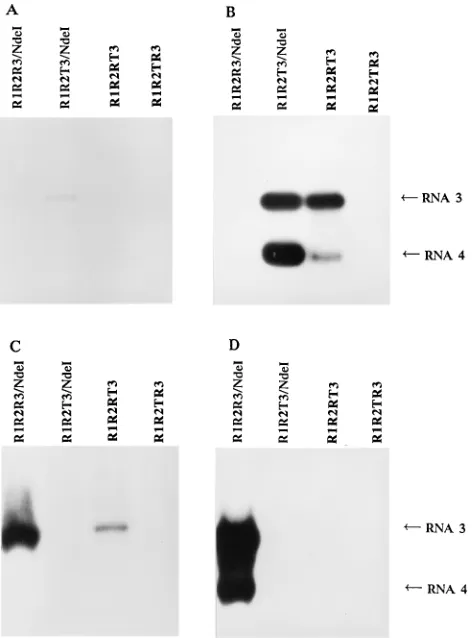
Construction of CMV and TAV RNA 3 derivatives and eval-uation of their infectivity. We have generated two mutants (pT3/Nde and pR3/Nde) in order to have a common NdeI restriction site at the same position in pT3 and pR3. This site, at the beginning of the CP coding sequence, was chosen as least likely to interfere with replication of RNA 3 or synthesis of RNA 4 (3). The infectivity and biological properties of in vitro transcripts derived from the mutated clones were the same as those of the wild-type clones (not shown). The mutant clones, pT3/Nde and pR3/Nde, were used to construct two chimeric clones, pRT3 and pTR3. The replication efficiencies of the different mutants and recombinants coinoculated with R1 and R2 in vitro transcripts were tested in N. tabacum protoplasts. When Northern blots prepared with total RNAs extracted 24 h after transfection were hybridized with probes specific for the 39 portion of RNAs 3 and 4 of R-CMV or
P-TAV, the expected hybridization patterns were observed (Fig. 1). Although the stoichiometry of RNAs 3 and 4 varied in different experiments, in all cases both RNAs were replicated in protoplasts transfected with the different mixtures of in vitro transcripts (R1R2R3/Nde, R1R2T3/Nde, R1R2RT3, and R1R2TR3), showing that the recombinant RNA 3 molecules could be replicated normally. However, as is often the case, the levels of viral RNAs in transcript-transfected protoplasts were much lower than those in protoplasts transfected with viral RNAs extracted from infected plants. The small RNA hybrid-izing with the probes can be attributed to RNA 5, composed of the 39-terminal nucleotides of RNAs 2 and 3 (2).
Plants of several different species (N. tabacum, N.
clevelan-dii, N. benthamiana, and C. quinoa) were infected with the
[image:2.612.333.538.68.228.2]chimeric and control in vitro RNA transcripts. When inocu-lated with R1 and R2 transcripts on the different hosts, the T3/Nde and R3/Nde controls and the RT3 chimera were reg-ularly found to be infectious, showing symptoms on the inoc-ulated leaves of Chenopodium and on the inocinoc-ulated and sys-temically infected leaves of the Nicotiana species, while we did not observe any sign of infection with in vitro transcripts of the TR3 chimera on the different hosts in at least three indepen-dent inoculation assays using different templates and different transcription reactions. In addition, the preparation of R1R2TR3 that replicated in protoplasts (Fig. 1) was not infectious on in-oculated plants. The Northern analysis of the RNA extracted from inoculated leaves of N. tabacum confirmed this observa-tion (Fig. 2). No viral RNA was detected in plants infected with the R1R2TR3 transcripts, while we could detect the appropri-ate RNAs in all other infected plants. In the tobacco plants infected with the R1R2RT chimeric virus, RNA 4 consistently accumulated to lower levels than RNA 3. The ratio of the amount of RNA 3 to the amount of RNA 4 was the same after virus purification. When plants were inoculated with in vitro transcripts in the experiments described above, symptoms were not expressed consistently. Much clearer results were obtained when virus purified from plants inoculated with the transcripts was used as inoculum. Thus, the different viruses were purified from N. tabacum plants, and the RNAs extracted from purified FIG. 1. Northern blot analysis of progeny viral RNA in total RNAs of to-bacco protoplasts. Protoplasts were transfected with in vitro transcripts from cDNA clones of R-CMV RNAs 1 and 2, together with transcripts from cDNA clones pT3/Nde, pR3/Nde, pTR, and pRT. Protoplasts were also either mock transfected or transfected with viral RNAs purified from plants infected with P-TAV or R-CMV. (A) Results with a probe specific for the 39end of TAV RNA 3; (B) results with a probe specific to the 39end of CMV RNA 3. The positions of RNAs 1, 2, 3, and 4 are indicated.
on November 9, 2019 by guest
http://jvi.asm.org/
viruses were used to inoculate several host species, as de-scribed below and summarized in Table 1.
Inoculation of N. tabacum and N. benthamiana plants.The symptoms induced on N. tabacum by the two parental strains were relatively similar, with etch on the inoculated leaves and a diffuse mosaic on systemic leaves. Similar results, with minor differences in the intensity of mosaic, were observed with the other strains: R1R2T3/Nde, T1T2R3, and R1R2RT3 (results
not shown). On N. benthamiana, the symptoms induced by R-CMV and P-TAV were similar—mild mosaic and moderate stunting—although TAV induced leaf distortion that was not observed with the other strains. With the strains R1R2T3/Nde and R1R2RT3, symptoms similar to those observed with the wild-type R-CMV were induced. In contrast, plants inoculat-ed with the strain T1T2R3 exhibitinoculat-ed much more severe stunt-ing. Northern analysis of the viral RNA in the infected plants showed that similar levels were present with all strains (not shown); thus, the more severe symptoms observed with T1T2R3 are not due to increased virus.
Inoculation of N. glutinosa plants.N. glutinosa is particularly
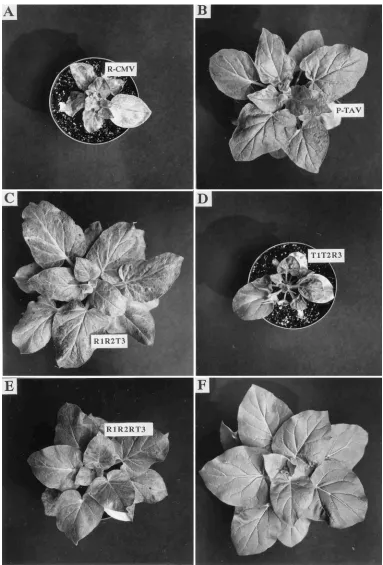
interesting for testing the strains under study, since the symp-toms induced by CMV and TAV are clearly different on this host. R-CMV causes mosaic, leaf blistering, and severe stunt-ing, while P-TAV causes a milder mosaic, little or no leaf blistering, and no stunting (Fig. 3). The symptoms induced by the pseudorecombinant T1T2R3 had the same general appear-ance as those of plants infected with R-CMV, while the pseu-dorecombinant R1R2T3/Nde induced symptoms similar to those of P-TAV, showing that the severe stunting observed with R-CMV is due to RNA 3. The plants inoculated with the recombinant R1R2RT3 also expressed mild symptoms, quite similar to those of P-TAV. Since this strain differs from R-CMV only by the CP gene and 39noncoding region of RNA 3, this suggests that this part of CMV RNA 3 is essential for inducing severe stunting on this species.
Inoculation of cucumber protoplasts and plants.When viral RNAs purified from the five strains were used to transfect cucumber cotyledon protoplasts, no differences in the amount of RNA could be observed 1 day after transfection, showing that all of the different viral RNAs were replicated efficiently (Fig. 4A). Similar results were obtained with protoplasts iso-lated from mature cucumber leaves (data not shown). Cotyle-dons of cucumber plants were also inoculated with the same purified viral RNAs. Only the virus strains containing the first two RNAs of CMV could be detected in the inoculated cu-cumber cotyledons (Fig. 4B), and local lesions were observed only on the cotyledons of the same plants. This suggests that the inability of P-TAV to spread in the inoculated cotyle-dons can be attributed to RNAs 1 and/or 2. Moreover, sys-temic symptoms and viral RNA in the syssys-temic leaves were detected only in plants infected with R-CMV (data not shown). Since the sole difference between R1R2R3 and R1R2RT3 lies within the 39half of RNA 3, this suggests that the CP gene of P-TAV is inefficient for long-distance move-ment in cucumber.
[image:3.612.61.297.69.388.2]FIG. 2. Northern blot analysis of viral RNA in the inoculated leaves of N. tabacum plants. Total nucleic acids were extracted from the leaves of tobacco plants inoculated with in vitro transcripts from cDNA clones of R-CMV RNAs 1 and 2, together with in vitro transcripts from cDNA clones of pT3/Nde, pR3/Nde, pTR, and pRT. (A) P-TAV 3a MP-specific probe; (B) P-TAV CP-specific probe; (C) R-CMV 3a MP-CP-specific probe; (D) R-CMV CP-CP-specific probe. The positions of RNAs 3 and 4 are indicated.
TABLE 1. Symptoms induced by wild-type, pseudorecombinant, and recombinant viruses
Plant
P-TAVa R-CMV T1T2R3/Nde R1R2T3/Nde R1R2RT3 R1R2TR3
N. tabacum Mosaicb Mosaic Mosaic Mosaic Mosaic —c N. glutinosa Mosaic Mosaic, blistering,
stunting Mosaic, blistering,stunting Mosaic Mosaic — N. benthamiana Mosaic, distortion,
stunting Mosaic, stunting Mosaic, strongstunting Mosaic, stunting Mosaic, stunting — Cucumber — Local and systemic
mosaic — Local mosaic Local mosaic — aTAV-derived and CMV-derived RNA 3 sequences are indicated by thick lines and thin lines, respectively.
bOnly systemic symptoms are shown for the three Nicotiana species. All in vitro transcripts were able to replicate normally in N. tabacum protoplasts. c—, absence of detectable infection.
on November 9, 2019 by guest
http://jvi.asm.org/
DISCUSSION
After inoculation of Chenopodium and different Nicotiana species with TR3 and RT3 in vitro transcripts in the presence of R1 and R2 transcripts, we were able to detect only the R1R2RT3 recombinant strain, either in the inoculated leaves
of Chenopodium and N. tabacum or in the systemically infected leaves of N. tabacum. Thus, the R1R2TR3 recombinant virus is able to replicate in initially infected cells, as shown by the protoplast experiments, but is deficient in cell-to-cell move-ment in a common host of CMV and TAV. This was unex-FIG. 3. Typical symptoms elicited on N. glutinosa by R-CMV, P-TAV, R1R2T3/Nde pseudorecombinant virus, T1T2R3 pseudorecombinant virus, R1R2RT3 recombinant virus, and mock inoculation (F) (3 weeks after inoculation).
on November 9, 2019 by guest
http://jvi.asm.org/
[image:4.612.115.498.66.631.2]pected, since the MP and the CP of much more distantly related viruses (tobamo- and bromoviruses) can be exchanged to create viable recombinant viruses (6). However, if for to-bamo- and bromoviruses, functional CP is not strictly required for cell-to-cell movement (5, 9, 30), the requirement for both functional 3a MP and CP in cucumoviruses is more stringent. Among the various CMV RNA 3 mutants tested (3, 29, 31), only one RNA 3 mutant, bearing a small deletion from CP amino acid position 15 to 40, was able to move within the inoculated leaves of tobacco plants (29), whereas insertion of a single amino acid between residues 23 and 24 of the CP pre-vented movement within inoculated cucumber leaves (31). It has also been shown recently that the 2a protein may play a role in cell-to-cell movement of CMV (21). So it is possible that the efficient spread of cucumoviruses from the initially infected cells may require specific interactions among several cucumoviral proteins, 2a, 3a MP, and CP. In this case, the inability of R1R2TR3 to infect plants could be due to improper interaction among the 3a MP of P-TAV, the 2a protein, the CP of R-CMV, and finally, the recombinant viral RNA itself. Clearly, further study is required to elucidate the interactions among the protein and RNA determinants of cell-to-cell move-ment of cucumoviruses.
In cucumber protoplasts, P-TAV and the T1T2R3 pseu-dorecombinant, which were otherwise unable to invade the inoculated leaves of cucumber plants, replicated with the same efficiency as R-CMV, R1R2T3, and R1R2RT3, which were all able to infect at least the inoculated leaves of cucumber. Since R-CMV and P-TAV can infect cucumber cells while T1T2R3 cannot spread within the inoculated leaves, this suggests that functions encoded by CMV RNAs 1 and/or 2 are essential for cell-to-cell spread in this species. This could perhaps be related to the previous observations that functions encoded by CMV RNA 1 are involved in both the localization of the N strain of CMV in tobacco (18) and the rate of cell-to-cell movement in zucchini (10). Despite the fact that they carry a functional 2b gene, which plays a role in the long-distance movement of CMV in cucumber (8), the R1R2T3 and R1R2RT3 strains
cannot infect cucumber plants systemically, although they do so in other species where viral RNA is encapsidated and mi-grates normally in the noninoculated leaves. One possible ex-planation would be that the TAV capsid is unable to interact with some component(s) specific to cucumber, preventing mi-gration from the infected cotyledons. This is consistent with the observation that the CMV capsid can complement systemic spread of TAV in cucumber (31).
Comparison of the abilities of the different strains to induce distinctive symptoms on the three Nicotiana species tested here shows clearly that RNA 3, and in particular the part including the CP gene, plays a role in determining the nature and gravity of symptoms that distinguish CMV and TAV (Table 1). In particular, the CMV CP gene appears to be a prime determi-nant of the stunting induced by R-CMV on N. glutinosa. How-ever, since Ding et al. (8) have shown that the 2b gene product is necessary to induce stunting in this species by a closely related CMV strain (Q-CMV), both the 2b gene and the CP gene would be necessary to induce stunting, but since the 2b gene is present in TAV as well as CMV, in the comparison carried out here the CP gene is the distinguishing factor.
The striking result obtained with inoculations of N.
ben-thamiana was the observation of symptoms that were worse
with the T1T2R3 strain than with the others. Although TAV-CMV pseudorecombinant strains have not been described in nature, it is reasonable to expect that they could exist. This is suggested by the results of Perry and Francki (24), who have shown in coinoculation experiments that, in the presence of TAV RNAs 1 and 2, CMV RNA 3 has a competitive advantage over TAV RNA 3. It is also pertinent that a naturally occurring pseudorecombinant of CMV and peanut stunt cucumovirus has recently been described (33). It would be of interest to create further recombinant strains, in order to determine in more detail which part of CMV RNA 3 is involved in symptom worsening, since this would allow evaluation of whether the potential for recombination in plants expressing a CMV CP gene on infection with TAV could lead to novel virus variants that could have more severe effects on certain host plants. From a biosecurity perspective, it is also of note that the TR3 recombinant RNA 3 was unable to go beyond infection of initially infected cells, suggesting that at least this recombinant would not be expected to survive if it occurred in the field.
ACKNOWLEDGMENTS
This research was partially supported by research grants to M.J. and M.T. from the French ministry of Agriculture and to M.T. and E.B. from the French Ministry of Foreign Affairs and the Hungarian Na-tional Committee for Technical Development (Balaton Program). K.S. was partially supported by the OTKA 19316 grant.
REFERENCES
1. Bernal, J. J., E. Moriones, and F. Garcia-Arenal. 1991. Evolutionary rela-tionships in the cucumoviruses: nucleotide sequence of tomato aspermy virus RNA 1. J. Gen. Virol. 72:2191–2195.
2. Blanchard, C. L., P. M. Boyce, and B. J. Anderson. 1996. Cucumber mosaic virus RNA 5 is a mixed population derived from the conserved 39-terminal regions of genomic RNAs 2 and 3. Virology 217:598–601.
3. Boccard, F., and D. C. Baulcombe. 1993. Mutational analysis of cis-acting sequences and gene function in RNA 3 of cucumber mosaic virus. Virology 193:563–578.
4. Carre`re, I. 1993. Contribution a` l’e´tude de l’ARN 3 du virus de la mosaı¨que du concombre: roˆle dans la symptomatologie et le transport du virus. Ph.D. thesis. Universite´ de Paris XI, Paris, France.
5. Dawson, W. O., P. Bubrick, and G. L. Grantham. 1988. Modifications of the tobacco mosaic virus coat protein gene affecting replication, movement, and symptomatology. Phytopathology 78:783–789.
[image:5.612.71.286.68.232.2]6. De Jong, W., and P. Ahlquist. 1992. A hybrid plant RNA virus made by transferring the noncapsid movement protein from a rod-shaped to an ico-sahedral virus is competent for systemic infection. Proc. Natl. Acad. Sci. USA 89:6808–6812.
FIG. 4. Northern blot analysis of progeny viral RNA in total RNAs of trans-fected protoplasts and inoculated plants of cucumber. Viral RNAs purified from N. tabacum plants infected with strain R1R2R3/Nde, R1R2T3/Nde, R1R2RT3, P-TAV, or T1T2R3 were used to transfect cucumber cotyledon protoplasts and to inoculate cucumber seedling cotyledons. The blots were hybridized with a mixed probe, specific to the 39ends of both R-CMV and P-TAV. The positions of RNAs 1, 2, 3, and 4 are indicated. (A) Cucumber cotyledon protoplasts transfected with purified viral RNA. A lane with RNA from mock-transfected protoplasts and one with 50 ng of purified R-CMV RNA are also shown. (B) Cucumber cotyledons inoculated with purified viral RNA. Lanes with RNA from mock-inoculated cotyledons are also shown.
on November 9, 2019 by guest
http://jvi.asm.org/
7. Ding, B., Q. Li, L. Nguyen, P. Palukaitis, and W. J. Lucas. 1995. Cucumber mosaic virus 3a protein potentiates cell-to-cell trafficking of CMV RNA in tobacco plants. Virology 207:345–353.
8. Ding, S.-W., W. Li, and R. H. Symons. 1995. A novel naturally-occurring hybrid gene encoded by a plant RNA virus facilitates long distance virus movement. EMBO J. 14:5762–5772.
9. Flasinski, S., A. Dzianott, S. Pratt, and J. Bujarski. 1995. Mutational anal-ysis of the coat protein gene of brome mosaic virus: effect on replication and movement in barley and in Chenopodium hybridum. Mol. Plant-Microbe Interact. 8:23–31.
10. Gal-On, A., I. Kaplan, M. Roossinck, and P. Palukaitis. 1994. The kinetics of infection of zucchini squash by cucumber mosaic virus indicate a function for RNA1 in virus movement. Virology 205:280–289.
11. Habili, N., and R. I. B. Francki. 1974. Comparative studies on tomato aspermy and cucumber mosaic viruses. III. Further studies on relationship and construction of a virus from parts of the two viral genomes. Virology 61:443–449.
12. Hayes, R. J., and K. W. Buck. 1990. Complete replication of a eukaryotic virus RNA in vitro by a purified RNA-dependent RNA polymerase. Cell 63:363–368.
13. Hayes, R. J., and K. W. Buck. 1990. Infectious cucumber mosaic virus RNA transcribed in vitro from clones obtained from cDNA amplified using the polymerase chain reaction. J. Gen. Virol. 71:2503–2508.
14. Jacquemond, M., and H. Lot. 1981. L’ARN satellite du virus de la mosaı¨que du concombre. I. Comparaison de l’aptitude a` induire la ne´crose de la tomate d’ARN satellites isole´s de plusieurs souches de virus. Agronomie 1:927–932.
15. Kaper, J. M., and H. E. Waterworth. 1981. Cucumoviruses, p. 258–332. In E. Kurstak (ed.), Handbook of plant virus infection and comparative diagnosis. Elsevier, Amsterdam, The Netherlands.
16. Kaplan, I. B., M. H. Shintaku, Q. Li, L. Zhang, L. E. Marsh, and P. Palukaitis.1995. Complementation of movement-defective mutants in trans-genic tobacco expressing the cucumber mosaic virus movement gene. Virol-ogy 209:188–199.
17. Kunkel, T. A., J. D. Roberts, and R. A. Zakour. 1987. Rapid and efficient site-specific mutagenesis without phenotypic selection. Methods Enzymol. 154:367–382.
18. Lakshman, D. K., and D. Gonsalves. 1985. Genetic analysis of two large-lesion isolates of cucumber mosaic virus. Phytopathology 75:758–762. 19. Lot, H., J. Marrou, J. B. Quiot, and C. Esvan. 1972. Contribution a` l’e´tude
du virus de la mosaı¨que du concombre (CMV). I. Me´thode de purification
rapide du virus. Ann. Phytopathol. 4:25–38.
20. Nagy, J. I., and P. Maliga. 1976. Callus induction and plant regeneration from mesophyll protoplasts of Nicotiana sylvestris. Z. Pflanzenphysiol. 78: 453–455.
21. Nguyen, L., W. J. Lucas, B. Ding, and M. Zaitlin. 1996. Viral RNA trafficking is inhibited in replicase-mediated resistant transgenic tobacco plants. Proc. Natl. Acad. Sci. USA 93:12643–12647.
22. Palukaitis, P., M. J. Roossinck, R. G. Dietzgen, and R. I. B. Francki. 1992. Cucumber mosaic virus. Adv. Virus Res. 41:281–348.
23. Peden, K. W. C., and R. H. Symons. 1973. Cucumber mosaic virus contains a functionally divided genome. Virology 53:487–492.
24. Perry, K. L., and R. I. P. Francki. 1992. Insect-mediated transmission of mixed and reassorted cucumovirus genomic RNAs. J. Gen. Virol. 73:2105– 2114.
25. Rao, A. L. N., and R. I. B. Francki. 1981. Comparative studies on tomato aspermy and cucumber mosaic viruses. VI. Partial compatibility of genome segments for the two viruses. Virology 114:573–575.
26. Salanki, K., E. Balazs, and J. Burgyan. 1994. Nucleotide sequence and infectious in vitro transcripts of RNA 3 of tomato aspermy virus pepper isolate. Virus Res. 33:281–289.
27. Sambrook, J., E. F. Fritsch, and T. Maniatis. 1989. Molecular cloning: a laboratory manual. Cold Spring Harbor Laboratory, Cold Spring Harbor, N.Y.
28. Saunders, J. A., C. R. Smith, and J. M. Kaper. 1989. Effects of electropo-ration pulse wave on the incorpoelectropo-ration of viral RNA into tobacco proto-plasts. BioTechniques 7:1124–1131.
29. Suzuki, M., S. Kuwata, J. Kataoka, C. Masuta, N. Nitta, and Y. Takanami. 1991. Functional analysis of deletion mutants of cucumber mosaic virus RNA 3 using an in vitro transcription system. Virology 183:106–113.
30. Takamatsu, N., M. Ishikawa, T. Meshi, and Y. Okada. 1987. Expression of bacterial chloramphenicol-acetyl-transferase gene in tobacco plants medi-ated by TMV-RNA. EMBO J. 6:307–311.
31. Talianski, M. E., and F. Garcia-Arenal. 1995. Role of cucumovirus capsid protein in long-distance movement within the infected plant. J. Virol. 69: 916–922.
32. White, J. L., and J. M. Kaper. 1989. A simple method for detection of viral satellite RNAs in small tissue samples. J. Virol. Methods 23:83–94. 33. White, P. S., F. Morales, and M. J. Roossinck. 1995. Interspecific
reassort-ment of genomic segreassort-ments in the evolution of cucumoviruses. Virology 207:334–337.