Cost-Effective Resource Allocation and
Throughput Maximization in Mobile
Cloudlets and Distributed Clouds
Qiufen Xia
May 2017
Declaration
This thesis is a presentation of the original work except where otherwise stated. I completed this work jointly with my supervisor, Professor Weifa Liang. My contri-bution to the work is around 80%.
Qiufen Xia 16/05/2017
Acknowledgments
This thesis is the result of three and a half years of work whereby I have been accom-panied and supported by many people. I would like to express my gratitude to them here.
First and foremost I would like to express my sincere gratitude to my supervi-sor, Professor Weifa Liang, for the continuous support of my Ph.D study and re-search with his excellent guidance, patience, and immense knowledge. He taught and guided me to become a qualified researcher through expert supervision with his perceptive insight and valuable experience. I thank him for the systematic guidance and great effort he put into training me in the scientific field.
I would like to thank the other members in my supervisor panel, Professor Bren-dan McKay, Associate Professor Bingbing Zhou, and Professor Jiannong Cao for the support to make this thesis possible.
I wish to thank the people in the Research School of Computer Science at The Australian National University, for their generous help and assistance in various aspects. Janette Rawlinson, Di Wellach-Smith, Shaw Tyi Tan, Jadon Radcliffe, James Fellows, Elspeth Davies, and Trina Merrell, deserve to be especially appreciated.
I am grateful to my friends, Anila Sahar Butt, Elly Liang, Rui Wang, Honglin Yu, Grace Xu, Ting Cao, Xiaojiang Ren, Wenzheng Xu, Richa Awasthy, Narjess Afzaly, Sara Salem Hamouda, Mohammadreza Jooyandeh, Kunshan Wang, Yuchao Dai, Jing Zhang, Meitian Huang, Mike Jia, Ying-Hsang Liu, Yu Ma, etc. for their great friend-ship and kind help during my years at ANU. Their friendfriend-ship makes my time in Australia more colorful and warm.
I express my special thankfulness to my beloved husband Zichuan Xu, for his love, support, tolerance and accompany in my life. He helped me throughout my
whole Ph.D. study, contributed a lot to my studies, and deserves recognition for any achievement on my past.
Publications
Journal
[1] Qiufen Xia, Weifa Liang, and Zichuan Xu. Data locality-aware query evaluation for big data analytics in distributed clouds. The Computer Journal, pp: 1-19, 2017. [2] Qiufen Xia, Weifa Liang, Zichuan Xu. Minimizing the operational cost of dis-tributed clouds via community-aware user data placements of social networks. Com-puter Networks, Vol. 112, pp: 263-278, 2017.
[3] Qiufen Xia, Zichuan Xu, Weifa Liang, and Albert Zomaya. Collaboration- and fairness-aware big data management in distributed clouds. IEEE Transactions on Par-allel and Distributed Systems(TPDS), Vol. 27, No. 7, pp: 1941-1953, 2016.
[4] Zichuan Xu, Weifa Liang, and Qiufen Xia. Efficient embedding of virtual net-works to clouds via exploring periodic resource demands. IEEE Transactions on Cloud Computing(TCC), Vol. PP, No. 99, 2016.
Conference
[1] Qiufen Xia, Weifa Liang, and Zichuan Xu. QoS-aware data replications and place-ments for query evaluation of big data analytics. Proc. of IEEE International Conference on Communications(ICC), 2017.
[2] Qiufen Xia, Weifa Liang, Zichuan Xu, and Bingbing Zhou. Online algorithms for location-aware task offloading in multi-tiered mobile clouds. Proc. of IEEE/ACM International Conference on Utility and Cloud Computing(UCC), 2014.
[3] Qiufen Xia, Weifa Liang, and Zichuan Xu. Data locality-aware query evaluation for big data analytics in distributed clouds. Proc. of IEEE International Conference on
Advanced Cloud and Big Data(CBD), 2014.
[4] Qiufen Xia, Weifa Liang, and Wenzheng Xu. Throughput maximization for online request admissions in mobile cloudlets. Proc. of IEEE International Conference on Local Computer Networks(LCN), 2013.
[5] Zichuan Xu, Weifa Liang, and Qiufen Xia. Electricity cost minimization in dis-tributed clouds by exploring heterogeneities of cloud resources and user demands. Proc. of IEEE International Conference on Parallel and Distributed Systems (ICPADS), 2015.
Abstract
With the advance in communication networks and the use explosion of mobile de-vices, distributed clouds consisting of many small and medium datacenters in geo-graphical locations and cloudlets defined as “mini” datacenters are envisioned as the next-generation cloud computing platform. In particular, distributed clouds enable disaster-resilient and scalable services by scaling the services into multiple datacen-ters, while cloudlets allow pervasive and continuous services with low access delay by further enabling mobile users to access the services within their proximity. To re-alize the promises provided by distributed clouds and mobile cloudlets, it is urgently to optimize various system performance of distributed clouds and cloudlets, such as system throughput and operational cost by developing efficient solutions. In this the-sis, we aim to devise novel solutions to maximize the system throughput of mobile cloudlets, and minimize the operational costs of distributed clouds, while meeting the resource capacity constraints and users’ resource demands. This however poses great challenges, that is, (1) how to maximize the system throughput of a mobile cloudlet, considering that a mobile cloudlet has limited resources to serve energy-constrained mobile devices, (2) how to efficiently and effectively manage and evalu-ate big data in distributed clouds, and (3) how to efficiently allocevalu-ate the resources of a distributed cloud to meet the resource demands of various users. Existing studies mainly focused on implementing systems and lacked systematic optimization meth-ods to optimize the performance of distributed clouds and mobile cloudlets. Novel techniques and approaches for performance optimization of distributed clouds and mobile cloudlets are desperately needed. To address these challenges, this thesis makes the following contributions.
We firstly study online request admissions in a cloudlet with the aim of maxi-mizing the system throughput, assuming that future user requests are not known in
advance. We propose a novel admission cost model to accurately model dynamic resource consumption, and devise efficient algorithms for online request admissions. We secondly study a novel collaboration- and fairness-aware big data manage-ment problem in a distributed cloud to maximize the system throughput, while min-imizing the operational cost of service providers, subject to resource capacities and users’ fairness constraints, for which, we propose a novel optimization framework and devise a fast yet scalable approximation algorithm with an approximation ratio. We thirdly investigate online query evaluation for big data analysis in a dis-tributed cloud to maximize the query acceptance ratio, while minimizing the query evaluation cost. For this problem, we propose a novel metric to model the costs of dif-ferent resource consumptions in datacenters, and devise efficient online algorithms under both unsplittable and splittable source data assumptions.
We fourthly address the problem of community-aware data placement of online social networks into a distributed cloud, with the aim of minimizing the operational cost of the cloud service provider, and devise a fast yet scalable algorithm for the problem, by leveraging the close community concept that considers both user read rates and update rates. We also deal with social network evolutions, by developing a dynamic evaluation algorithm for the problem.
Contents
Acknowledgments vii
Publications ix
Abstract xi
1 Introduction 1
1.1 Distributed Clouds and Mobile Cloudlets . . . 1
1.2 Cost-Effective Resource Allocation and Throughput Maximization . . . 3
1.3 Research Topics . . . 7
1.3.1 Throughput Maximization of Mobile Cloudlets . . . 8
1.3.2 Collaboration- and Fairness-Aware Big Data Management in Distributed Clouds . . . 10
1.3.3 Cost Minimization of Evaluating Big Data Analytic Queries in Distributed Clouds . . . 12
1.3.4 Cost Minimization of Distributed Clouds via Community-Aware User Data Placements of Social Networks . . . 15
1.4 Thesis Contributions . . . 17
1.5 Thesis Organization . . . 19
2 Throughput Maximization for Online Request Admissions in Mobile Cloudlets 21 2.1 Introduction . . . 21
2.2 Preliminaries . . . 22
2.2.1 System Model . . . 23
2.2.2 Problem Definitions . . . 24 2.3 Algorithm for the Online Request Throughput Maximization Problem . 25
2.3.1 Admission Cost Modelling . . . 26
2.3.2 Admission Policy . . . 27
2.3.3 Algorithm Description . . . 27
2.4 Algorithm for the Batch Requests Throughput Maximization Problem . 28 2.5 Performance Evaluation . . . 31
2.5.1 Simulation Settings . . . 31
2.5.2 Performance Evaluation of the Proposed Algorithms . . . 33
2.5.3 Impact of Important Parameters on the Performance . . . 35
2.6 Summary . . . 36
3 Collaboration- and Fairness-Aware Big Data Management in Distributed Clouds 39 3.1 Introduction . . . 39
3.2 Preliminaries . . . 41
3.2.1 System Model . . . 41
3.2.2 Collaborations in Big Data Management . . . 44
3.2.3 Cost Model . . . 45
3.2.4 Problem Definition . . . 46
3.3 Approximation Algorithm . . . 47
3.3.1 An Optimization Framework . . . 47
3.3.2 Algorithm Description . . . 52
3.3.3 Analysis of the Proposed Algorithm . . . 53
3.4 Performance Evaluation . . . 58
3.4.1 Simulation Settings . . . 58
3.4.2 Performance Evaluation of the Proposed Algorithm . . . 59
3.4.3 Impact of Important Parameters on the Performance . . . 61
Contents xv
4 Cost Minimization of Big Data Analytic Query Evaluation in Distributed
Clouds 65
4.1 Introduction . . . 65
4.2 Preliminaries . . . 69
4.2.1 System Model . . . 69
4.2.2 Query Evaluation . . . 71
4.2.3 Problem Definitions . . . 73
4.3 Algorithm with Unsplittable Source Data . . . 74
4.3.1 Algorithm Overview . . . 74
4.3.2 Identification of a SetVP of Potential Datacenters . . . 75
4.3.3 Selecting a SubsetVS ofVP . . . 77
4.4 Algorithm with Splittable Source Data . . . 81
4.5 Performance Evaluation . . . 84
4.5.1 Simulation Settings . . . 84
4.5.2 Performance Evaluation of the Proposed Algorithms . . . 85
4.5.3 Impact of Important Parameters on the Performance . . . 89
4.6 Summary . . . 97
5 Cost Minimization of Distributed Clouds via Community-Aware Data Place-ments 99 5.1 Introduction . . . 99
5.2 Preliminaries . . . 102
5.2.1 System Model . . . 103
5.2.2 Cost Model . . . 105
5.2.3 Problem Definitions . . . 107
5.3 Algorithm for the Community-Aware User Data Placement Problem . . 107
5.3.1 Algorithm Overview . . . 108
5.3.2 A Novel Community Fitness Metric . . . 108
5.3.4 Algorithm Description . . . 112 5.3.5 Analysis of the Proposed Algorithm . . . 114 5.4 Algorithm for the Online Community-Aware User Data Placement
Problem . . . 117 5.5 Performance Evaluation . . . 122 5.5.1 Experiment Settings . . . 122 5.5.2 Performance Evaluation of Algorithms in Static Social Networks 124 5.5.3 Performance Evaluation of Algorithm in Dynamic Social
Net-works . . . 131 5.6 Summary . . . 134
6 Conclusions and Future Directions 137
6.1 Summary of Contributions . . . 137 6.2 Future Directions . . . 139
List of Figures
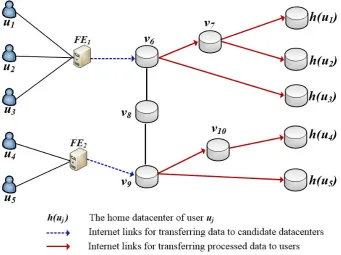
1.1 An example of mobile cloud computing and distributed clouds . . . 2
2.1 The system model of mobile cloud computing . . . 23
2.2 Performance evaluations of different algorithms. . . 34
2.3 The impact of values of a on the system throughput of algorithms
Online-OBO and Online-Batch with various maximum occupation periods atT =8, 000 time slots. . . 35
2.4 The impact ofq on the system throughput of algorithms Online-OBO
andOnline-Batchwith various maximum occupation periods atT =
8, 000 time slots. . . 36
3.1 A big data management system . . . 43
3.2 An example of the construction of an auxiliary flow network Gf =
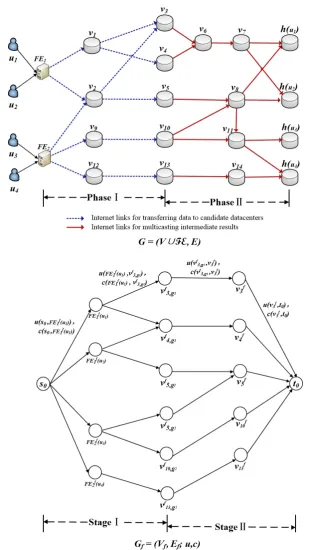
(Vf,Ef;u,c), where users u1 and u2 are in group g1, users u3 and u4 are in group g2, i.e., g1 = {u1,u2},g2= {u3,u4}, the sets of candidate datacenters of usersu1,u2,u3andu4areDC(u1) ={v3,v4},DC(u2) =
{v4,v5}, DC(u3) = {v5,v10}, and DC(u4) = {v13}, respectively. The home datacenters ofu1,u2,u3andu4areh(u1),h(u2),h(u3)andh(u4), respectively. . . 50
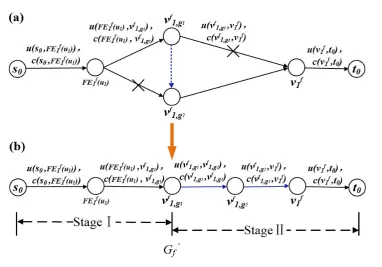
3.3 An example of the augmented auxiliary graphG0
f, where useru1is in
groups g1 and g2, the candidate datacenter of u1 is v1, the front-end server ofu1 isFE1(u1). . . 52
3.4 The performance of algorithmsAppro-Alg,Greedy-Alg, andRandom-Alg, in terms of system throughput, the amounts of data placed, the oper-ational cost, and the average cost for placing one unit of data. . . 60
3.5 Impact ofq on the performance of algorithmAppro-Alg, where q is a
ratio of the number of users who have data to be placed to the number of users in a group. . . 61
3.6 Impacts of group size |g| of each group on the performance of algo-rithmAppro-Alg. . . 62 3.7 Impacts of the number of datacenters on the performance of algorithm
Appro-Alg. . . 63
4.1 A motivation example of query evaluation for big data analytics. . . 66
4.2 An example of the auxiliary directed flow graphG0 in stage 2 of algo-rithm 4, where VQ is the set of datacenters in which the source data
of queryQare located,VP is a set of potential datacenters for
evaluat-ing Q, VS ✓ VP is the set of datacenters for the evaluation of Q, and
the highlighted edges are the edges via which data are replicated to their destination datacenter. Notice thatVP is identified by stage 1 of
algorithm 4, andVS (⇢VP) is computed in its stage 2. . . 78
4.3 Performance evaluation of different algorithms. . . 86
4.4 Impacts of the number of datacenters on the performance of algorithm
DL-Unsplittableover various monitoring periods. . . 89 4.5 Impacts of the number of datacenters on the performance of algorithm
DL-Splittableover various monitoring periods. . . 90 4.6 The impact of the number of source data locations on the performance
of algorithmDL-Unsplittableover different monitoring periods. . . . 93 4.7 The impact of the number source data locations on the performance of
LIST OF FIGURES xix
4.8 The impact ofaandbon the query acceptance ratio and the accumula-tive communication cost of algorithmDL-Splittable underT = 800 time slots. . . 96
5.1 An example of community-aware user data placements in a distributed cloud. . . 105 5.2 An example of the community identification. . . 113 5.3 The performance of different algorithms in terms of the operational
cost (US dollars) and running time (milliseconds) on real social net-works: Facebook, WikiVote, and Twitter, under q=0.03. . . 125
5.4 The impact of the number K of slave replicas on the operational cost (US dollars) and running time (milliseconds) of algorithmsDPCI,TOPR,
MFMC, and Random for different social networks: Facebook, WikiVote, and Twitter underq =0.03. . . 126 5.5 The impact of the thresholdq on the performance of algorithm DPCI
on different social networks: Facebook, WikiVote, and Twitter. . . 129 5.6 The impact of the parameters a and b on the operational cost (US
dollars) of algorithmDPCIunderq =0.03. . . 130
5.7 The impact of changing percentages on the accumulative operational costs (US dollars) and the running times (milliseconds) of algorithms
Online-DPCIandDPCIwithq =0.03 andd =0.006. . . 132 5.8 The impact of different metrics on the operational cost (US dollars) of
algorithmDPCIfor static social networks. . . 133 5.9 The impact of different metrics on the accumulative operational cost
List of Tables
2.1 Parameters of requests . . . 32
5.1 The size of social networksGs and the size of their condensed graphs
Gv with different values ofq. . . 127
5.2 The impact of different metrics on the running times (milliseconds) of algorithmDPCIfor static social networks and algorithm Online-DPCI
for dynamic social networks. . . 135
Chapter1
Introduction
In this chapter, we first introduce a cloud computing system architecture consisting of mobile cloudlets and distributed clouds, we then demonstrate cost-effective re-source allocations and throughput maximization in mobile cloudlets and distributed clouds. We thirdly discuss research topics in cost-effective resource allocations and throughput maximization. We finally state the expected contributions and organiza-tion of this thesis.
1
.
1
Distributed Clouds and Mobile Cloudlets
Over the past decade, cloud computing has come to be seen as a promising paradigm for providing various elastic and inexpensive services, ranging from popular on-line storage services, and virtual desktops, to state-of-the-art big data analysis by leveraging the abundant storage, computing, and network resources in a few pow-erful centralized datacenters. Recently, advances in communication networks and the ever growing usage of portable mobile devices have witnessed conventional central-ized clouds with large-scale centralcentral-ized datacenters further revolutioncentral-ized to become some promising platforms that are capable of rapidly scaling and delivering high reliable services. This has manifested in two key developments: distributed clouds consisting of many small and medium-sized datacenters that are located at differ-ent geographical locations and interconnected by wide-area networks, and mobile cloudlets defined as “mini” datacenters that can be accessed through WiFi and are close to mobile users. Specifically, the geographical locations of datacenters that
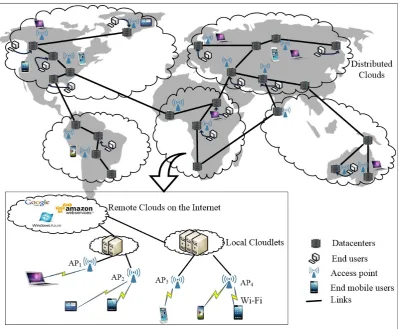
form distributed clouds permit computation closer to users, which can reduce net-work capacity needs for high-bandwidth applications and reduce the access latency compared to traditional centralized datacenters. Furthermore, serving as a comple-mentary platform to distributed clouds, cloudlets can further move cloud resources within the proximity of users, thereby supporting pervasive and continuous services for mobile users with lower communication overhead and access delay. In this thesis we consider such a cloud computing system architecture that consists of both dis-tributed clouds and mobile cloudlets, as shown in Figure 1.1. The system consists of two tiers: Thetop tierconsists of geographically distributed datacenters intercon-nected by high-speed links, and thebottom tierconsists of wireless access points (APs) and cloudlets that are clusters of servers.
§1.2 Cost-Effective Resource Allocation and Throughput Maximization 3
In top tier of the system architecture, distributed clouds have been demonstrated to be a successful platform for making current cloud services more cost-effective, eco-sustainable, and disaster-resilient [4]. A distributed cloud can have many data-centers located in different geographical locations, enabling pervasive access of cloud services for various users such as enterprises, organizations, and individual users. For example, millions of social network users can access cloud resources globally to meet their ever-growing resource demands. Furthermore, more and more enterprise users with constituent companies around the world nowadays outsource their big data to distributed clouds to facilitate big data analytics for decision-making and risk-reduction. The adoption of distributed clouds is not only eco-sustainable due to the much lower energy consumption, but also resilient to natural disasters and power outages due to the swift recovery capability of the network.
In bottom tier of the system architecture, cloudlets are trusted, resource-rich com-puters or clusters of comcom-puters that are well-connected to the Internet and can be accessed by nearby mobile devices for various pervasive mobile services, such as augmented reality, speech recognition, navigation, natural language translation and machine learning [100]. The cloudlets enable ubiquitous and pervasive services with low access delays and high data-transfer speeds, which are ideal platforms for reliev-ing resource poverty of mobile devices and providreliev-ing services for mobile users. With the deployment of cloudlets, we are able to address the resource poverty of mobile devices, by offloading computing-intensive applications to their nearby resource-rich cloudlets, while also meeting the demand of mobile users for real-time interactive response times, through low-latency, one-hop, high-bandwidth wireless access to the cloudlet.
1
.
2
Cost-Effective Resource Allocation and Throughput
Max-imization
should be jointly optimized.
Cost-effective resource allocation plays a vital role in optimizing the system per-formance. In particular, in the top tier, with the increasing popularity of social net-working and big data analytics applications, cloud service providers incur the sig-nificant operational cost to provide adequate and available computing, storage, and network resources across a distributed cloud. For example, the cost of Hadoop data management system, including hardware, software, and other expenses, comes to about US$1, 000 a terabyte [42]. To minimize the operational cost, it is vital to opti-mize the performance of distributed clouds via efficient and cost-effective resource allocations and scheduling. In the bottom tier, although cloudlets have distinct ad-vantages in providing computing, storage, and bandwidth resources to mobile users, saving energy consumption and extending the battery life of mobile devices, the limited resource capacities of cloudlets negatively impact the cloudlet performance with substantial increases in mobile users. Efficiently allocating cloudlet resources to mobile users such that the system throughputis maximized thus is crucial, where the system throughput is the ratio of the number of admitted tasks to the number of tasks arriving in the system during a given time.
Performing cost-effective resource allocation and throughput maximization in a cloud computing system consisting of both distributed clouds and cloudlets poses several significant challenges as follows.
§1.2 Cost-Effective Resource Allocation and Throughput Maximization 5
• Big data management in a distributed cloud is a major challenge, which is to determine the efficient location of users’ big data and other dynamic applica-tion data, so that as many users as possible can be served. At first glance, the problem of big data placement seems simple: check a user’s location, and migrate the user’s data to his/her closest datacenter. However, this simple heuristic ignores the cost of cloud service providers, and neglects the features of big data applications of users. The first feature is that as communication and collaboration are increasingly important to modern big data applications, more and more users share data and analysis results with each other to save the user cost of big data analytics. For example, a metropolitan retail chain consists of many collaborative retailers, each of them not only generates large volume of data about customer mobility, but they also need intermediate re-sults from its collaborators to better understand in-store traffic patterns and optimize product placements and staffing levels throughout the day, and to measure the impact of advertising and special promotions. The second feature is that users typically have their QoS requirements. Fair allocation of cloud resources to different users is crucial, otherwise, unfair allocation may result in unsatisfied users no longer using the service, the service provider may then fall into disrepute, and its revenue will be significantly reduced. The third feature is that processing and analyzing the placed big data require massive comput-ing resource. However, the computcomput-ing resource in each datacenter typically is limited. If the data placed in a datacenter cannot be processed as required, the overhead on migrating the placed data to other datacenters for processing will be high.
network resources across multiple datacenters. However, traditional data pro-cessing techniques cannot be adopted for big data analytics due to the large volume and complexity of the datasets that are dynamically generated and col-lected. In contrast, the distributed cloud provides an excellent platform for this by satisfying the resource demands of queries. As the computing capability of a single datacenter in distributed clouds is limited, and query evaluation can be made only when the resource requirement of the query is met, and fur-ther, the original data required by the query must be co-located with the query, the original data on which the query will be evaluated have to be replicated to the datacenter that can satisfy the resource requirement of the query. This however will incur a great communication cost among datacenters by replicat-ing the source data of a query from the datacenters where the source data are originally stored to the datacenters with abundant resource where the query will be evaluated. Therefore, selecting suitable datacenters to undertake the big data analytics and to admit as many queries as possible such that the re-source requirements of queries are satisfied and the communication cost for evaluating admitted queries are minimized, are the very first issue that should be considered.
§1.3 Research Topics 7
the partitions to a set of datacenters in a distributed cloud. However, there are other aspects for OSN users in leveraging distributed cloud resources that must be reconciled. First, online social network providers want to minimize the cost spent in provisioning cloud resources, e.g., they may wish to minimize the stor-age cost when replicating user data to more than one datacenter, or minimize the inter-datacenter communication cost when users at one datacenter request data of others that are hosted at different datacenters. Second, the providers hope to provide social users with satisfactory QoS. To this end, they may want to place the data of people who have intensive interactions to the same datacen-ter, or a set of nearby datacenters. Third, the providers may also be concerned with data availability, e.g., ensuring the number of users’ data replicas is no fewer than a specified threshold across the whole distributed cloud. Address-ing all such demands of cost, QoS, and data availability is further complicated by the fact that online social networks continuously experience changing dy-namics, e.g., new users join, existing users leave the social network, or some users change their read or update rates.
To tackle the above-mentioned challenges, this thesis will devise performance-optimized algorithms for both mobile cloudlets and distributed clouds. The distinc-tions of the work here from existing ones lie in: (1) this thesis focuses on the system throughput maximization of a cloudlet, by proposing a novel cost model, admission policies, and efficient algorithms; and (2) this thesis incorporates diverse resource demands of users, data sharing, resource allocation fairness requirements of users, and social relationships of users, when utilizing cloud services in a distributed cloud. The solutions are evaluated by simulations, using both real and synthetic data.
1
.
3
Research Topics
service providers is minimized through cost-effective resource allocations, this thesis focuses on proposing efficient solutions to the following topics: (1) throughput maxi-mization of a cloudlet in mobile cloud computing, (2) collaboration and ensuring fair resource allocation for users for big data management in a distributed cloud, (3) cost minimization of query evaluation for big data analytics in a distributed cloud, and (4) operational cost minimization of a distributed cloud for data placement of online social networks. Notice that these four topics are requisite for performance optimiza-tion in the mobile cloudlets and distributed clouds. Since mobile cloudlets, as illus-trated in the bottom tier of Figure 1.1, are at times under pressure to provide services to all tasks of mobile users, solutions to topic (1) ensures that the cloudlet can admit and process as many tasks as possible during a given time period by cost-effective resource allocation, which maximize the profit of cloud service providers. Similarly, due to the increasing resource demands of big data analysis applications and online social networking applications, as shown in top tier of the cloud computing system in Figure 1.1, solutions to topic (2) guarantee the system throughput maximization while minimizing the operational cost of cloud service providers, where the com-puting capacity constraint of each datacenter, the bandwidth capacity constraint of each link, and the fairness requirements of users are integrated. Solutions to topic (3) promise satisfactory resource demands for query evaluations on big data and the maximum query acceptance ratio, and solutions to topic (4) assure a minimum oper-ational cost for placing data and data replicas of social users into a distributed cloud, integrating the dynamic feature of online social networks. Detailed summaries of the topics in these problems, and the distinctions between them and existing studies are as follows.
1.3.1 Throughput Maximization of Mobile Cloudlets
§1.3 Research Topics 9
admission control algorithms for MCC is especially challenging, given the limited yet highly demanded resources and the mobility of users. Considerable research effort has been directed on this issue in the past few years. Much existing literature focused on developing admission control policies and resource allocation strategies. For ex-ample, researchers investigated the admission control problem based on the Markov Decision Process. They aimed to either maximize the revenue of the system or min-imize the cost of service providers based on the prediction information [2, 50, 73]. Specifically, Hoang et al. [50] proposed a linear programming solution to the problem by considering the QoS requirements of mobile users with the aim of maximizing the revenue of the service providers. Liang et al. [73] formulated the adaptive resource allocation problem as a semi-Markov decision process to capture the arrivals and departures of users dynamically, with the objective of maximizing the rewards of the overall system through a balance between the resource utilization and the resource cost. Abundo et al. [2] employed the Markov forward-looking admission control policy for a service broker to maximize profits of resource providers while guaran-teeing the QoS requirements of admitted users. Almeidaa et al. [5] presented a joint admission control and resource allocation scheme by formulating a convex optimiza-tion problem with the objective of minimizing the cost of the service provider, i.e., maximizing the revenue of the provider.
such an optimal operating point is difficult due to its dependence on experimental data.
Unlike existing studies in literature, we here deal with cloudlet resource alloca-tions by responding to user requests without the knowledge of future request ar-rivals. For which, we first design a novel admission cost model to accurately capture the dynamic features of a cloudlet. Specifically, due to the fact that resources in a cloudlet are consumed dynamically and their capacities are typically finite, the cost of admitting a new request not only depends on the workload of the cloudlet but also the amount of resource demands of the request. Building such an admission cost model that models dynamic resource consumptions therefore is an imperative. We then devise online algorithms by jointly allocating multiple types of resources in cloudlets to user requests, considering that user requests usually require multiple types of resources such as computing, storage, and network resources. Efficient ad-mission policies that consider these types of resources are key, as the availability of these resources jointly determines which requests should be admitted or rejected.
1.3.2 Collaboration- and Fairness-Aware Big Data Management in Dis-tributed Clouds
§1.3 Research Topics 11
of updating and reading data by exploring trade-offs among the multiple optimiza-tion objectives. They solved the problem by decomposing it into two sub-problems - placement of master replicas and placement of slave replicas - and solving these two sub-problems separately, thereby deriving a sub-optimal solution to the prob-lem. Yuan et al. [129] provided an algorithm for data placement in scientific cloud workloads, which grouped a set of datasets in multiple datacenters first, and then dynamically clustered newly generated datasets to the most appropriate datacenters based on data dependencies. Liu et al. [75] proposed a data placement strategy for scientific workflows by exploring data correlation, aimed at minimizing the com-munication overhead incurred by data movement. Agarwal et al. [3] proposed an automated data placement mechanism named Volley for geo-distributed cloud ser-vices, where the objective was to minimize the user-perceived latency.
locations. Such data must be fairly placed to the distributed cloud, otherwise, biased data placement may severely degrade access time, leading to degradation of the rep-utation of service providers, thereby potentially reducing the revenue of the service providers; and (3) we consider various types of resources with different capacities of a distributed cloud, by designing efficient resource allocation and provisioning mechanisms for collaboration- and fairness-aware big data management. Naive re-source allocation methods that neglect rere-source capacities will incur high overheads on migrating the placed data to other datacenters, if its current datacenter not have adequate available resources.
1.3.3 Cost Minimization of Evaluating Big Data Analytic Queries in Dis-tributed Clouds
mas-§1.3 Research Topics 13
evaluation cost.
There are several studies that focused on geo-distributed data analytics [48, 53, 91, 93, 111, 112]. For example, Heintz et al [48] considered streaming data analyt-ics by designing aggregation algorithms to optimize WAN traffic and the delay in obtaining the analysis results. Pu et al [91] proposed a system to reduce query re-sponse times by optimizing the placement of both data and queries, and devised an online heuristic to redistribute datasets among the datacenters prior to query arrivals and to place the queries to reduce their response times. Rabkinet al [93] considered real-time analysis of data that is continuously created across wide-area networks. Vulimiri et al [112] considered the problem of evaluating big-data queries on data distributed in a wide-area network, they designed an architecture and algorithms to optimize query execution plans and data replication to minimize bandwidth cost, by formulating the problems into an integer linear program (ILP) or a non-linear integer program (NLIP), which however might not be scalable if the problem size is large. These studies however limit their discussions on specific big-data analytics such as real-time streaming data analytics in geo-distributed datacenters [48, 93], or only fo-cused on bandwidth resource capacities while ignored the computing capacity of datacenters [91, 111, 112].
§1.3 Research Topics 15
maximize the query acceptance ratio and minimize the accumulative communication cost for evaluating the admitted queries.
1.3.4 Cost Minimization of Distributed Clouds via Community-Aware User Data Placements of Social Networks
clustered newly generated datasets to the most appropriate datacenters based on data dependencies. Unfortunately, these cited methods mainly placed user data at a user-level granularity, which may lead to inefficient solutions for large-scale social networks with tens of millions of users, as most of them formulated their problems as (mixed) integer linear programming problems [36] or as maximum-flow based multi-way partitioning problems that resulted in poor scalability [60, 128], and their algorithms typically took prohibitive running time [60, 61, 128], and thus were only suitable to small- and medium-size datacenters. It must be mentioned that some of them focused only on the communication cost [36, 61, 75], while others considered only social interactions among users in distributed clouds [3, 36, 75, 129]. None of these mentioned works has taken into account both user read and update rates at the same time [3, 36, 75, 128, 129]. On the other hand, there are several studies of large-scale graph partitioning [65, 109, 127] by adopting traditionally graph partition-ing methods [109, 127], while ignorpartition-ing user data updatpartition-ing in dynamic graphs [109]. Furthermore, the mentioned studies mainly focused on user data management in a single datacenter, which is different from the optimization problem in a distributed cloud we deal with in this thesis. We study community-aware user data placements of large-scale social networks to a distributed cloud with the objective to minimize the operational cost, by leveraging the close community concept that groups user data of a social network into different cohesive groups, by their users interactions with each other and the update rates on their user data.
§1.4 Thesis Contributions 17
these users and the running time for data placement. For which, we devise a novel community fitness metric that considers both user read rates and update rates to de-tect close communities. The second issue is that the dynamic features of online social networks should be studied, as in reality social networks evolve over time; e.g., new users join, existing users leave, and some users change their read or update rates. All these changes have impacts on data placement strategies of online social networks. Making data placements based on these features is vital to minimize the operational cost of cloud service providers. To this end, we propose a novel algorithm for data placement of dynamic social networks into distributed clouds.
1
.
4
Thesis Contributions
The main contributions of this thesis are to systematically study the throughput maximization and operational cost minimization in mobile cloudlets and distributed clouds, by formulating non-trivial optimization problems, proposing new cost mod-els, and developing novel optimization frameworks and algorithms to the problems. The proposed techniques enable optimized system performance by maximizing the throughput of mobile cloudlets and minimizing operational costs of cloud service providers via efficient resource allocations of mobile cloudlets and distributed clouds. Specifically, the main contributions of this thesis are described as follows.
• Big data management in the distributed cloud environment is studied in Chap-ter 3. The process of big data management consists of placing data, processing data, and transmitting the intermediate results of data processing to collabora-tive users located at different geographical locations. Contributions involved in this topic are as follows: (1) the dynamic generation of big data is considered; (2) fairness among collaborative users when allocating resources is incorpo-rated; (3) the computing capacity of datacenters and the bandwidth capacity of links are considered; and (4) high system throughput and low operational cost of the cloud service provider are achieved.
• Data locality may result in a waste of resources. For example, most of the computing resource of a datacenter with less popular data may stay idle. This low resource utility then causes more servers to be activated and hence higher operational costs for cloud service providers. To enable high performance of distributed clouds, Chapter 4 studies the problem of cost-effective big data pro-cessing by jointly considering data locality and computing capacity constraints of datacenters. Contributions include: (1) online query evaluation problems for big data analytics in distributed clouds are formulated; (2) a novel metric to model the usage cost of query evaluation is proposed by incorporating the workloads among datacenter and the resource demands of different queries; (3) efficient online algorithms for query evaluation are devised under both unsplit-table and splitunsplit-table source data assumptions; and (4) a high query acceptance ratio and low accumulative communication cost are reached.
§1.5 Thesis Organization 19
rates and update rates of user data; (2) the dynamic nature of online social networks is integrated, e.g., new users can join, existing users leave the network, and some users change their read or update rates over time; and (3) fast yet scalable algorithms for the problems are proposed and empirically evaluated.
1
.
5
Thesis Organization
Chapter2
Throughput Maximization for
Online Request Admissions in
Mobile Cloudlets
2
.
1
Introduction
Many mobile devices such as smart phones and tablets are becoming increasingly popular, people now depend heavily on them to run various applications such as image processing, facebook, twitter, games, and emails for social and business pur-poses. However, due to small sizes and being powered by batteries, these portable and lightweight mobile devices have only limited energy to support their operations. To mitigate the severe energy constraint on mobile devices is to make use of the rich resources provided by mobile cloud computing (MCC) platforms. That is to offload data and computationally expensive tasks from mobile devices to cloud platforms through wireless networks [26, 22, 69].
In MCC environments, wireless mobile devices access the cloud through wireless communication such as WiFi, 3G/4G, etc. However, it is well known that wireless communication is unreliable and constrained by its bandwidth. The long delay of data transfer between a mobile device and the cloud is unavoidable. Thus, offloading tasks from mobile devices to the cloud is not always a smart choice since the cloud is typically far from mobile users. To overcome the long delay by offloading tasks to the
remote clouds, the cloud has to be moved closer to the mobile users in the form of the cloudlet [126], which consists of trusted, resource rich servers in vicinities of mobile users (e.g., near or co-located with a wireless access point) [100, 110]. Although a cloudlet may mitigate the delay latency, it does suffer serious drawbacks too. As the resources in a cloudlet are not as abundant as that in a powerful cloud, a cloudlet may run out of its resources quickly if its resources are carelessly allocated. Particularly, when many requests are executed at the same time, this will lead to the cloudlet overloaded.
In this chapter, we focus on developing efficient control algorithms for online request admissions in the MCC environments with an objective to maximize the system throughput of the cloudlets, where each request can be represented by a de-mand resource vector in which each component is the amount of a specific resource demanded by the request. We first propose a novel admission cost model to model different resource consumptions in a cloudlet. We then devise efficient control al-gorithms for online request admissions based on the proposed resource cost model. We finally conduct experiments by simulations to evaluate the performance of the proposed algorithms. Experimental results indicate that the proposed algorithms are very promising, in comparison with other heuristics.
The remainder of this chapter is organized as follows. The system model and problem definitions are introduced in Section 2.2. The online request and batch admission algorithms are proposed in Section 2.3 and Section 2.4, respectively. The performance evaluation of the proposed algorithms will be conducted in Section 2.5, and a summary is given in Section 2.6.
2
.
2
Preliminaries
§2.2 Preliminaries 23
2.2.1 System Model
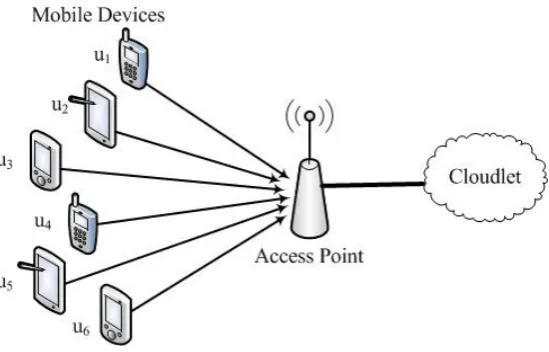
We consider a mobile cloudlet computing environment as shown in Fig. 2.1, where a cloudlet connecting to a remote powerful cloud computing platform through the Internet provides cloud services to a set of local wireless mobile users. Denote by
{ui | 1 i N} the set of local mobile users, where N is the number of mobile
[image:45.595.182.457.257.433.2]users. Due to stringent constraints on mobile devices such as limited battery lifetime,
Figure 2.1: The system model of mobile cloud computing
limited storage, and relatively weak computation capability, mobile users usually offload their computing intensive or large volume of data storage tasks to the cloudlet to save the limited resources of mobile devices. To this end, mobile users first send their requests in terms of amounts of resources needed to the cloudlet. The cloudlet then decides whether to admit the requests according to its resource availability and the admission costs of these requests. For the sake of convenience, we assume that time is slotted into equal time slots. We further assume that the system has no knowledge on the future request generation and arrival rates. The acceptance or rejection of a request by the system is made at the beginning of each time slott.
More specifically, we assume that the cloudlet providesKdifferent resources. Let Ckbe the capacity of resourcekfor allkwith 1kK. LetH(t) =hH1(t), . . . ,HK(t)i
our discussions we assume that H(t)is given. Let A(t) =hA1(t), . . . ,AK(t)ibe the
vector of available resources in the cloudlet at time slot t, then Ak(t) = Ck Hk(t)
for all k with 1 k K. Denote by ri(t) = hri,1(t), . . . , ri,K(t);tii the amounts of
resource demanded by a requestri(t)at time slot t, whereri,k(t)2 Z is the amount
of resource k requested and ti is the occupation period of the requested resources.
We further assume that requests arrive one by one and usehr1, . . . ,rNito denote the
sequence of requests.
Within each time slot, we consider two different request admission scenarios: one is that only one request is evaluated, that is, the admission control algorithm will determine whether the request is admitted, depending on not only whether there are enough available resources for the request but also whether it is too high to admit the request in terms of the admission cost. The other is that multiple requests are evaluated, i.e., a set of requests will be admitted at each time slot.
2.2.2 Problem Definitions
Given a mobile cloudlet, each mobile user ui sends its requestri(t) at time slott to
the cloudlet. Each requestri(t)consists of a set of specified amounts of resource
de-mands on the cloudlet and the occupation periodti, i.e.,ri(t) =hri,1(t), . . . ,ri,K(t);tii,
whereri,k(t)is the amount of resourcekneeded. Assuming that requests arrive one
by one, and there is no knowledge of future request generation and arrival rates.
§2.3 Algorithm for the Online Request Throughput Maximization Problem 25
cloudlet may last more than one time slot. If it cannot be finished within the cur-rent time slot, it will continue occupying the system resources at the next time slot until it finally finishes. In other words, we assume that the request scheduling is non-preemptive scheduling.
Theonline batch requests throughput maximization problemis to maximize the system throughput if multiple requests, instead of one request, will be admitted per time slot.
As each ofK different resources in a cloudlet can be treated as one dimension of a K-dimension bin with capacity Ck of dimension k, the online request throughput
maximization problem is equivalent to packing as many online requests as possible without knowing of future requests. If each request can be implemented within a single time slot, then its occupied resources can be released at the next time slot. Clearly, this special case of the problem is an online bin packing problem which is hard [23]. Thus, the online request throughput maximization problem is NP-hard, too. Meanwhile, the online request throughput maximization problem is a special case of the online batch requests throughput maximization problem when there is only one request considered at each time slot, thus, the latter is NP-hard, too.
2
.
3
Algorithm for the Online Request Throughput
Maximiza-tion Problem
In this section, an algorithm for the online request throughput maximization problem is devised. Let ri(t) = hri,1(t), . . . ,ri,K(t);tiibe the request being considered at this
moment. The system proceeds as follows. It first checks whether the requested amount of each resourceri,k(t)can be met by the system. If not, the request is rejected
rejected; otherwise, it is admitted by the cloudlet. In the following we propose the admission cost modelling of processing a request.
2.3.1 Admission Cost Modelling
We here model the admission cost of each demanded resourcekas a convex function of the quantity of the resource with an increasing marginal cost. Typically, the ability of a type of resource to provide services to mobile users decreases with the increase of its utilization ratio, as the resource with high resource utilization has a higher probability of violating user resource demands or Service Level Agreements. With the decrease of its ability, its cost of admitting a request is marginally increasing That is, the cost of allocating a unit specific resource to a request increases with the demand quantity of that resource. The unit admission cost of using resource k with demandri,k(t)(6=0) by requestri(t)is defined as follows.
z(ri,k(t),Hk(t)) =a
Hk(t)
Ck
k (a
ri,k(t)
Ck
k 1), (2.1)
whereak >1 is a constant andHk(t)is the amount of resourcekoccupied by
admit-ted requests at time slott prior to requestri(t).
From Eq. (2.1), it can be seen that z(ri,k(t),Hk(t)) is in the range of (0,ak 1].
Notice that the unit admission cost of demanding a resource is closely related to the demanding quantities of that resource. That is, a higher ri,k(t)means a higher
admission cost ofri(t).
Denote byg(ri(t),H(t))the admission costof a requestri(t)with occupation period
ti for all resources at time slott, then
g(ri(t),H(t)) =ti· K
Â
k=1
z(ri,k(t),Hk(t)|ri,k(t)6=0)
=ti· K
Â
k=1 aHk
(t)
Ck
k (a
ri,k(t)
Ck
k 1).
§2.3 Algorithm for the Online Request Throughput Maximization Problem 27
2.3.2 Admission Policy
Given a requestri(t), there is an admission control strategy that determines whether
it will be admitted. That is, for each requestri(t), a thresholdBkof the unit admission
cost of using resourcekis given. Recall that the value range of a unit admission cost of using resource k is in (0,ak 1], Bk thus is in the range of (0,ak 1]. Let qk be
a constant with qk 2 (0, 1], Bk can be rewritten as (ak 1)·qk. For each request, a
threshold of the average admission cost Bof using all demanded resources is also given, which is B = q·(a 1) = q·(maxk=1,...,K{ak} 1), whereq 2 (0, 1]. Let||ri(t)|| be
the number of resources requested by requestri(t), then||ri(t)||K. Thus, a request
ri(t)is admitted if it meets the following two inequalities:
(i) z(ri,k(t),Hk(t)) Bk for each its demanded amount of resource k, ri,k(t) with
ri,k(t)6=0;
(ii) g(ri(t),H(t))
||ri(t)||·ti B.
2.3.3 Algorithm Description
As mentioned in the previous subsection, the online request throughput maximiza-tion problem is equivalent to the onlineK-dimensional bin packing problem. Mean-while, different dimensions (e.g., wireless communication bandwidth requirement, and the number of CPU instructions) have different attributes, we reduce this K-dimensional bin packing problem to one dimension bin packing problem with admis-sion control by introducing the admisadmis-sion cost (see Eq. (2.2)). The detailed algorithm is described inAlgorithm1, which is also referred to asAlgorithm Online-OBO.
Theorem 1 Given a mobile cloudlet environment and an online admission request sequence,
there is an online algorithm for the request throughput maximization problem, which takes
O(K)time per request at each time slot.
Proof FollowingAlgorithm1, there is only a single requestri(t)per time slot to be
Algorithm 1Algorithm for the online request throughput maximization problem
Input: Bk, B, an arrival request ri(t), the occupied information H(t) of resources at
time slott, whereri(t) =hri,1(t), . . . ,ri,K(t);tiiand 1kK. Output: Admit or reject requestri(t).
1: /* The admission cost of requestri(t)*/;
g(ri(t),H(t)) 0;
2: foreachri,k(t)inri(t)do
3: Calculate Ak(t) Ck Hk(t), which is the available amount of resourcek; 4: ifri,k(t)> Ak(t)then
5: Reject requestri(t); 6: EXIT;
7: else
8: ifri,k(t)6=0then
9: Calculate the costz(ri,k(t),Hk(t))by Eq. (2.1);
10: if z(ri,k(t),Hk(t)) Bk then
11: g(ri(t),H(t)) g(ri(t),H(t))+ti·z(ri,k(t),Hk(t))
12: else
13: Reject the request;
14: EXIT;
15: if g(ri(t),H(t))
||ri(t)||·ti Bthen
16: /* Update the amounts of occupied resources */; H(t) hH1(t) +ri,1(t), . . . ,HK(t) +ri,K(t)i;
17: return Admit request ri(t)
18: else
19: Reject requestri(t); 20: EXIT;
admitted. If yes, it takesO(K)time to update the amounts of occupied and available
system resources. Otherwise, the request is rejected. Thus, the Algorithm 1 takes O(K)time to decide whether to admit a requestri(t)at time slott.
2
.
4
Algorithm for the Batch Requests Throughput
Maximiza-tion Problem
In this section, we deal with multiple request admissions at each time slot by propos-ing an algorithm. Specifically, let DS(t) be the set of requests arrived at time slot
§2.4 Algorithm for the Batch Requests Throughput Maximization Problem 29
The basic idea for the online batch requests maximization problem is to admit a set of requests one by one using a greedy strategy, according to the admission criteria made by the system. Specifically, given the available resources A(t) and occupied resources H(t) at time slot t, let DS(t)and DS0(t) be the set of requests arriving at time slottand the subset of these requests to be admitted by the system, respectively, whereDS0(t)✓DS(t).
The proposed algorithm proceeds as follows. Initially, DS0(t) = ∆. For each request r 2 DS(t), compute its unit admission cost based on H(t), using the similar
admission criteria as we set for a single request in the previous section, Eq. (2.1) and Eq. (2.2). If a request does not meet the criteria, it is rejected and removed from DS(t). Otherwise, it becomes a candidate to be admitted. A candidate request with the minimum admission cost is then identified. If two candidate requests have the same minimum admission cost, the one with a smaller occupation period will be chosen to add to the admission set DS0(t), and DS(t) = DS(t) DS0(t). Let rt
1 be the request that has been admitted with 1 t1 |DS(t)|. The system then updates its available resources A0(t) = hA1(t) rt
1,1(t), . . . ,AK(t) rt1,K(t)i. The algorithm continues to identify the next request from DS(t) {rt1(t)} based on the updated available resourcesA0(t)to see whether it can be admitted. This procedure continues untilDS(t) =∆.
The detailed algorithm is described in Algorithm2, which is also referred to as
Algorithm Online-Batch.
Lemma 1 If a request is rejected in an iteration of thewhileloop ofAlgorithm2, it will not be admitted in the rest of iterations at time slot t, i.e, it is removed from further consideration
at time slot t.
Proof We show this by contradiction. Assume that a request ri(t) is rejected in an
Algorithm 2Algorithm for the online batch requests throughput maximization prob-lem
Input: A set of requestsDS(t),Bk, B,H(t) ={H1(t), . . . ,HK(t)}. Output: a subset of admitted requestsDS0(t)✓ DS(t)at time slott.
1: U DS;DS0(t) ∆; H0(t) H(t); 2: whileU6=∆do
3: /* A variable indicating the minimum admission cost */; min_cost •;
4: /* A variable indicating the index of the request with the minimum admission cost */; i0 •;
5: foreach requestri(t)inU do
6: /* The admission cost by processing requestri(t)*/;
g(ri(t),H0(t)) 0;
7: foreachri,k(t)inri(t)do
8: Calculate the available amount of resourcek: A0
k(t) Ck Hk0(t);
9: ifri,k(t)> A0k(t)then
10: U U {ri(t)}; Reject requestri(t);
11: else
12: Calculate the unit admission costz(ri,k(t),Hk(t))ofri(t)by Eq. (2.1);
13: ifz(ri,k(t),Hk(t))>Bk then
14: U U {ri(t)}; Reject requestri(t);
15: else
16: g(ri(t),H0(t)) g(ri(t),H0(t))+ti·z(ri,k(t),Hk(t));
17: if g(ri(t),H0(t))
||ri(t)||·ti > Bthen
18: U U {ri(t)}; Reject requestri(t);
19: if g(ri(t),H0(t))
||ri(t)||·ti < min_cost then 20: min_cost g(ri(t),H0(t))
||ri(t)||·ti ;
21: i0 i;
22: else
23: if g(ri(t),H0(t))
||ri(t)||·ti =min_costthen
24: Select the request ri0(t) with a smaller occupation period between the two requests, i.e.,min_cost g(ri0(t),H0(t))
||ri0(t)||·ti0 ;
25: i0 i0;
26: DS0(t) DS0(t)[{ri0(t)}whereri0(t)has the minimum admission cost; 27: U U {ri(t)};
28: Update the amounts of occupied resources H0(t) by taking the occupied
re-sources byri(t)intoH0(t);
§2.5 Performance Evaluation 31
resource k becomes smaller and smaller with more and more requests being added to DS0(t); or (ii) the total admission cost ofri(t) is beyond the threshold. For each resource it requested, the resource becomes less than that of it in the iteration that ri(t) is rejected, the admission cost becomes larger in comparison with the one in
which it was rejected for the first time, i.e, its admission cost is still larger than the given threshold, so it will be rejected.
Theorem 2 Given a cloudlet environment, there is an online algorithm for the batch requests throughput maximization problem that takes O(K|DS(t)|2) time at each time slot, where
DS(t)is the set of requests at time slot t.
Proof Following Algorithm 2, within thewhile loop, updating the information of occupied resources and calculating the amounts of available resources take O(K)
time, while checking whether the demanded amounts of resourcekof the request can be met takesO(K)time. It finally takesO(K)time to decide whether the admission
cost g(ri(t),ri,k(t))of each required resource satisfies the threshold requirement. In
total, there are |DS(t)|iterations. Thus, Algorithm2 takes Âi=|DS(t)1 |O(i·K) = O(K· |DS(t)|2)time.
2
.
5
Performance Evaluation
In this section, we evaluate the performance of the proposed algorithms and investi-gate the impact of different parameters on the algorithm performance.
2.5.1 Simulation Settings
Recall that Bk = qk·(ak 1) and B = q·(a 1) in the section 2.3.2, in our
default settings, we assume that all resources have the same threshold Bk = B. We
set qk = q = 0.3 and ak = a = 4 for algorithms Online-OBO and Online-Batch.
The number of server n is 16 in the default setting. Unless otherwise specified, we will adopt these default settings in our simulations. Each value in all figures is the average of the results by applying the nominated algorithm for 20 different request sequences.
We assume that each time slot lasts 10 seconds [100] and the system monitoring time period is T = 8, 000 time slots. We further assume that only a single request
is evaluated at each time slot for the online request throughput maximization prob-lem, while the number of requests at each time slot is randomly generated within the range of[2, 10]for the online batch requests throughput maximization problem. The requirements of resources by each request are set according to Amazon Small Instance [6] settings. If a request does require resource k, then the required amount of resourcekis generated randomly within the range of resourceklisted in Table. 2.1, of which themaximum occupation periodtmaxmeans the demanded occupation period
for the system resources of a request is at mosttmax.
Table 2.1: Parameters of requests
Type One-by-one Batch
CPU power (GHz) [1, 6] [1, 6] Memory (MB) [1, 400] [1, 400]
Storage (GB) [0.06, 1.2] [0.06, 1.2] Bandwidth (Mbps) [0.05, 1.5] [0.05, 1.5] Maximum occupation period (time slots) 20 20
We consider two heuristics as our evaluation benchmarks. The first heuristic ad-mits requests according to the First-Come-First-Service strategy, and a request will be admitted as long as the cloudlet can fulfill its resource demands, otherwise the request will be rejected immediately. We refer to this algorithm as FCFS-OBO and
§2.5 Performance Evaluation 33
batch requests throughput maximization problem, respectively. The second heuris-tic [104] considers the request consolidation problem in a virtualized heterogeneous server system with an aim to minimize the operation energy consumption of servers. The proposed solution finds an optimal operating point which occurs at 70% CPU utilization and 50% disk utilization from profiling data through the calculating of the Euclidean distance between the optimal point and the current workload alloca-tion [104]. As their objective is to minimize the energy consumpalloca-tion of the system, we aim to maximize the system throughput in a cloudlet environment, we treat the optimal point as the one that fully utilizes all resources in the system. That is, the optimal point for each resource is the capacity of the resource. We refer to the mod-ified algorithms as algorithms Euclidean-OBO and Euclidean-Batch for the two problems.
2.5.2 Performance Evaluation of the Proposed Algorithms
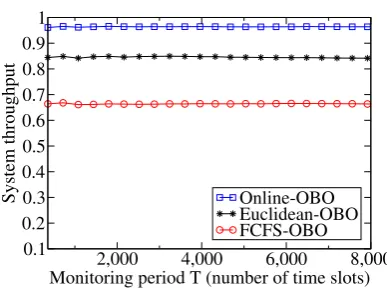
We first evaluate the proposed algorithms against the benchmark algorithms in the default parameter settings under different monitoring periods and with various max-imum occupation periods of requests. The performance curves of these algorithms are plotted in Fig. 2.2. From Fig. 2.2(a) and Fig. 2.2(b) we can see that the proposed al-gorithmsOnline-OBOandOnline-Batchoutperform their counterparts Euclidean-OBO,FCFS-OBO,Euclidean-Batch andFCFS-Batchin terms of the system through-put over different monitoring periods T. For example, the system throughput of
2,000 4,000 6,000 8,000 Monitoring period T (number of time slots) 0.1 0.2 0.3 0.4 0.5 0.6 0.7 0.8 0.9 1
System throughput Online-OBO
Euclidean-OBO FCFS-OBO
(a) The system throughput of algorithms
Online-OBO,Euclidean-OBOandFCFS-OBOover different monitoring periods
2,000 4,000 6,000 8,000 Monitoring period T (number of time slots) 0.1 0.2 0.3 0.4 0.5 0.6 0.7 0.8 0.9 1
System throughput Online-Batch Euclidean-Batch FCFS-Batch
(b) The system throughput of algorithms
Online-Batch, Euclidean-Batch and
FCFS-Batch over different monitoring
peri-ods
20 25 30 35 40 45 50
Maximum occupation period of requests (time slots) 0.1 0.2 0.3 0.4 0.5 0.6 0.7 0.8 0.9 1
System throughput Online-OBO Euclidean-OBO FCFS-OBO
(c) The system throughput of algorithms
Online-OBO, Euclidean-OBO and FCFS-OBO
with various maximum occupation periods at T=8, 000 time slots
20 25 30 35 40 45 50
Maximum occupation period of requests (time slots) 0.1 0.2 0.3 0.4 0.5 0.6 0.7 0.8 0.9 1
System throughput Online-Batch Euclidean-Batch FCFS-Batch
(d) The system throughput of algorithms
Online-Batch, Euclidean-Batch and
FCFS-Batch with various maximum
occu-pation periods atT=8, 000 time slots
Figure 2.2: Performance evaluations of different algorithms.
In contrast, the other two heuristics failed to reject such requests. In addition, from Fig. 2.2(c) and Fig. 2.2(d), it can be seen that the proposed algorithms Online-OBO
and Online-Batch significantly outperform all the other mentioned algorithms in terms of the system throughput with various maximum occupation periods tmax of
requests for a given monitoring periodT =8, 000 time slots. It can also be seen from
Fig. 2.2(c) and Fig. 2.2(d) that the system throughput decreases with the increase of the tmax, because a longer occupation period of a request leads to a higher load to
[image:56.595.75.269.113.257.2] [image:56.595.285.477.118.255.2]§2.5 Performance Evaluation 35
2.5.3 Impact of Important Parameters on the Performance
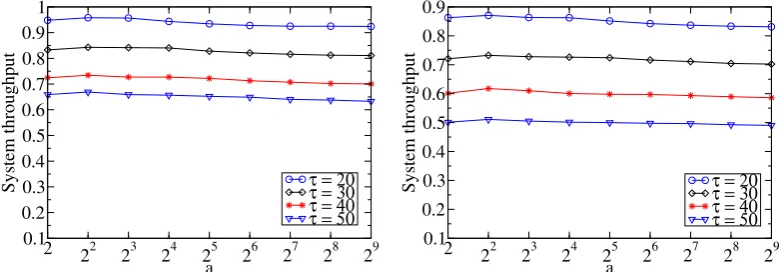
We then study the impact of different parameters on the algorithm performance under different maximum occupation periodstmaxatT =8, 000 time slots as follows. Impact of parameter a: We first investigate the impact of the value of a on the system throughput by varying a from 2 to 29. Fig. 2.3 plots the performance curves of algorithms Online-OBO and Online-Batch with various maximum occupation periods tmax. For the sake of convenience, we use t to represent tmax in Fig. 2.3,
from which it can be seen that the system throughput increases with the growth ofa. Specifically, the system throughput reaches the peak ata=4, and follows decreasing.
We thus seta =4 in our default setting. Notice that the system throughput decreases
with the growth oftmaxof requests, the arguments are similar as we did in Fig. 2.2(c)
and Fig. 2.2(d).
2 22
23 24 25 26 27 28 29
a 0.1 0.2 0.3 0.4 0.5 0.6 0.7 0.8 0.9 1
System throughput τ = 20τ = 30
τ = 40 τ = 50
(a) The impact ofaon the system throughput of algorithmOnline-OBOwith various maximum occupation periods
2 22
23 24 25 26 27 28 29
a 0.1 0.2 0.3 0.4 0.5 0.6 0.7 0.8 0.9
System throughput τ = 20τ = 30
τ = 40 τ = 50
[image:57.595.123.514.405.541.2](b) The impact ofaon the system throughput of algorithmOnline-Batchwith various maxi-mum occupation periods
Figure 2.3: The impact of values of a on the system throughput of algorithms
Online-OBOand Online-Batch with various maximum occupation periods at T =
8, 000 time slots.
Impact of parameterq: We then evaluate the impact of the threshold coefficient q in Bk = B = q·(a 1)on the system throughput of algorithms Online-OBOand
Online-Batch by varying q from 0.1 to 0.9. Fig. 2.4 (a) and Fig. 2.4 (b) imply that
then keeps stable untilq =0.5 and decreases subsequently. We thus chooseq =0.3.
Recall thata =4, the thresholdBk = B=q·(a 1) =0.9 in our default setting. The
system throughput varies with the change of the threshold, this is because the system tends to reject requests when the threshold is small, thereby reducing the system throughput. However, when the threshold is large, requests with higher resource demands can be admitted, which lead to a reduction of the system throughput due to the large resource demands of such requests. That is, the optimal system throughput arises only when the threshold neither large nor small. Also, the system throughput decreases with the increase of tmax, following the similar arguments as we did in
Fig. 2.2(c) and Fig. 2.2(d).
@ @ @ @ @ @ @ @
@
0.1 0.2 0.3 0.4 0.5 0.6 0.7 0.8 0.9
θ 0.1 0.2 0.3 0.4 0.5 0.6 0.7 0.8 0.9 1
System throughput ττ = 20 = 30 τ = 40
@ @ τ = 50
(a) The impact ofqon the system throughput of
algorithm Online-OBOwith various maximum occupation periods
@
@ @ @ @
@ @ @ @
0.1 0.2 0.3 0.4 0.5 0.6 0.7 0.8 0.9
θ 0.1 0.2 0.3 0.4 0.5 0.6 0.7 0.8 0.9 1
System throughput τ = 20
τ = 30 τ = 40 @ @
τ = 50
(b) The impact ofq on the system throughput
of algorithmOnline-Batchwith various maxi-mum occupation periods
Figure 2.4: The impact ofqon the system throughput of algorithmsOnline-OBOand
Online-Batchwith various maximum occupation periods atT=8, 000 time slots.