Open Access
R E S E A R C H
Bio
Med
Central
© 2010 Ahn et al; licensee BioMed Central Ltd. This is an Open Access article distributed under the terms of the Creative Commons At-tribution License (http://creativecommons.org/licenses/by/2.0), which permits unrestricted use, distribution, and reproduction in any medium, provided the original work is properly cited.Research
The RNA binding protein HuR does not interact
directly with HIV-1 reverse transcriptase and does
not affect reverse transcription in vitro
Jinwoo Ahn
1, In-Ja L Byeon
1, Sanjeewa Dharmasena
2, Kelly Huber
2, Jason Concel
1, Angela M Gronenborn*
1and
Nicolas Sluis-Cremer*
2Abstract
Background: Lemay et al recently reported that the RNA binding protein HuR directly interacts with the ribonuclease H (RNase H) domain of HIV-1 reverse transcriptase (RT) and influences the efficiency of viral reverse transcription (Lemay et al., 2008, Retrovirology 5:47). HuR is a member of the embryonic lethal abnormal vision protein family and contains 3 RNA recognition motifs (RRMs) that bind AU-rich elements (AREs). To define the structural determinants of the HuR-RT interaction and to elucidate the mechanism(s) by which HuR influences HIV-1 reverse transcription activity
in vitro, we cloned and purified full-length HuR as well as three additional protein constructs that contained the N-terminal and internal RRMs, the internal and C-N-terminal RRMs, or the C-N-terminal RRM only.
Results: All four HuR proteins were purified and characterized by biophysical methods. They are well structured and exist as monomers in solution. No direct protein-protein interaction between HuR and HIV-1 RT was detected using NMR titrations with 15N labeled HuR variants or the 15N labeled RNase H domain of HIV-1 RT. Furthermore, HuR did not
significantly affect the kinetics of HIV-1 reverse transcription in vitro, even on RNA templates that contain AREs. Conclusions: Our results suggest that HuR does not impact HIV-1 replication through a direct protein-protein interaction with the viral RT.
Background
Reverse transcription of the viral single-stranded (+) RNA genome into double-stranded DNA is a critical step in the HIV-1 life-cycle. Although the viral proteins nucle-ocapsid, matrix, integrase, tat, nef and vif may participate in the regulation and/or efficiency of reverse transcrip-tion [1-6], synthesis of the nascent HIV-1 DNA is entirely carried-out by the DNA polymerase and ribonuclease H (RNase H) activities of HIV-1 reverse transcriptase (RT). HIV-1 RT is an asymmetric heterodimer composed of 66 kDa (p66) and 51 kDa (p51) subunits [7]. The p66 subunit can be subdivided into DNA polymerase, connection and
RNase H domains. The p51 subunit is derived from p66 by HIV-1 protease cleavage of the C-terminal RNase H domain. The p66/p51 HIV-1 RT heterodimer contains one DNA polymerization active site and one RNase H active site, which both reside in the p66 subunit in spa-tially distinct regions [7].
Recent studies suggest that host cell proteins may also play an important role in the timing and efficiency of HIV-1 reverse transcription [8-12]. For example, a genome-wide siRNA analysis conducted by König et al
identified ~30 host cell factors that directly influence either the initiation or kinetics of reverse transcription [8]. However, by its nature, this study did not distinguish direct physical interactions from indirect effects between these host cell factors and any of the viral proteins pres-ent in the reverse transcription complex in infected cells. By contrast, in other reports, several host cell proteins, such as HuR, AKAP149 and TRIM37 have all been impli-* Correspondence: [email protected]
1 Department of Structural Biology, Division of Infectious Diseases, University of
Pittsburgh School of Medicine, Pittsburgh, PA 15261, USA
2 Department of Medicine, Division of Infectious Diseases, University of
cated in direct contacts with HIV-1 RT that impact viral replication [9,10,12]. Validation and comprehensive anal-ysis of these putative RT-host protein interactions are important for a thorough understanding of viral replica-tion and for drug discovery efforts that target HIV-host protein interactions.
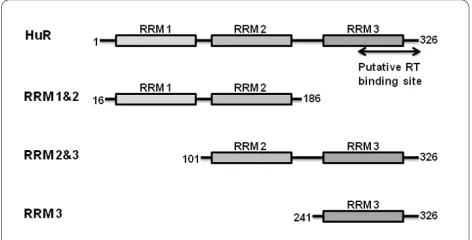
The present study was devised to structurally charac-terize the interaction between HuR and HIV-1 RT that was recently described by Lemay et al [9], who identified HuR and HIV-1 RT association in a yeast two-hybrid screen and confirmed the interaction by a homogenous time-resolved fluorescence binding assay. The authors mapped the HIV-1 RT-HuR binding sites to the RNase H domain of RT and to the C-terminus of HuR (see Fig. 1). Importantly, siRNA knockdown of HuR expression in HeLa P4.2 cells was reported to greatly impair both the early and late steps of viral reverse transcription. To fur-ther define the structural determinants of the HIV-1 RT-HuR interaction at the atomic level and to elucidate the mechanism(s) by which HuR influences HIV-1 reverse transcription activity in vitro, we prepared and character-ized four HuR protein constructs and investigated their RT interaction by biophysical methods. We did not find any evidence for a direct interaction between HIV-1 RT and HuR by NMR chemical shift mapping in the 1H,15
N-heteronuclear single quantum coherence (HSQC) spectra of 15N-labeled HuR or 15N-labeled HIV-1 RT RNase H
upon titration with unlabeled RT or HuR. Furthermore, HuR did not affect the kinetics of HIV-1 reverse tran-scription in vitro. Taken together, our results suggest that HuR does not impact HIV-1 replication through a direct interaction with the viral RT.
Results
Purification and characterization of HuR
HuR belongs to the Hu family of mRNA stabilizing pro-teins that interact with AU-rich elements (ARE), sharing
significant sequence similarity with the Drosophila RNA-binding protein ELAV (embryonic lethal abnormal vision) [13]. The 326 amino acid protein contains three RNA recognition motifs (RRMs), two in the N-terminal half and a third at the C-terminus, separated by a basic ~60 residue linker region (Fig. 1). HuR recognizes a core element of 27 nucleotides in the RNA that contain AUUUA, AUUUUA and AUUUUUA motifs [14-16]. RRM 1 and RRM 2 contribute most of the binding energy in HuR-ARE complex formation [14], while RRM 3 may be responsible for cooperative assembly of HuR oligom-ers on RNA [17]. In addition, RRM 3 of HuR was reported by Lemay et al to directly interact with the RNase H domain of HIV-1 RT [9].
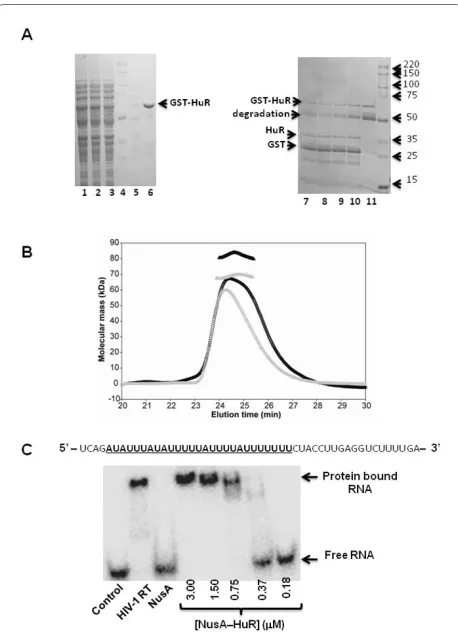
To further define the structural determinants of the HuR-RT interaction and to elucidate the mechanism(s) by which HuR influences HIV-1 reverse transcription activity in vitro, we prepared HuR N-terminal fusion pro-teins with glutathione S-transferase (GST) and NusA. The GST-HuR fusion protein was unstable after purifica-tion and underwent substantial degradapurifica-tion at room tem-perature (Fig. 2A). In contrast, the NusA-HuR fusion was stable and was used in the NMR and HIV-1 RT DNA syn-thesis reactions described below. We also cloned the RRM 1&2, RRM 2&3, or RRM 3 domains of HuR as N-terminal fusion proteins with NusA (Fig. 1). These domain constructs exhibited sufficient stability after cleavage by TEV protease and removal of the NusA tag for structural characterization by NMR.
The quaternary states of NusA-HuR and NusA-RRM 3 were assessed by multi-angle light scattering (Fig. 2B). Both proteins were found to exist as monomers in solu-tion and the molecular masses of HuR and NusA-RRM 3 were determined as 82.2 and 68.9 kDa, respec-tively. These values are within ± 15% of the predicted masses of 99 kDa for HuR and 73 kDa for NusA-RRM 3. We did not find any evidence for HuR dimer for-mation, in contrast to a previous report that suggested HuR homodimerization prior to RNA binding [18]. Fur-thermore, we show that NusA-HuR binds a synthetic RNA template that contains AREs (Fig. 2C), indicating that the fusion does not interfere with the RNA binding activity of HuR.
Probing the interaction between HIV-1 RT and HuR by NMR
We used 1H,15N-HSQC NMR spectroscopy [19,20] to
probe whether a direct interaction between HIV-1 RT and HuR could be identified in vitro. Several different proteins were investigated: (i) the 15N-labeled RRM 3
domain of HuR was titrated with full-length HIV-1 RT (Fig. 3A); (ii) the 15N-labeled RRM 1&2 of HuR was
titrated with the RNase H domain of HIV-1 RT (Fig. 3B); and (iii) the 15N-labeled RNase H domain of HIV-1 RT
was titrated with NusA-HuR (Fig. 3C). All three 15
N-Figure 1 Schematic representation of HuR constructs used this
study. The three RRM domains are depicted by boxes and the
[image:2.595.56.292.561.681.2]labeled proteins exhibited well-dispersed 1H,15N-HSQC
spectra, indicative of well-folded, stable structures. No changes in their 1H,15N-HSQC spectra were observed
[image:3.595.301.540.92.578.2]upon titration with the unlabelled binding partners up to a two-fold molar excess. It, therefore, is highly unlikely that direct protein-protein contacts are present for any of the above protein pairs.
Figure 2 Purification and biophysical characterization of GST-
and NusA-HuR. (A) Analysis of the expression and purification of
GST-HuR by SDS PAGE. Lanes 1 and 2 illustrate total protein and total solu-ble protein after E. coli cell lysis, respectively, lane 3 shows the flow-through fraction of the glutathione sepharose column, lane 4 contains molecular weight markers and lane 5 is the eluate during the column wash. Purified GST-HuR eluted from the glutathione sepharose column with 20 mM glutathione is shown in lane 6 and lanes 7-10 contain pu-rified GST-HuR that was incubated with 0.15, 0.1, 0.05 and 0.03 units of thrombin, respectively, for 1 h at room temperature. Lane 11 contains purified GST-HuR incubated for 1 h in buffer at room temperature in the absence of thrombin. (B) Size-exclusion multi-angle light scatter-ing analysis of NusA-HuR (black) and NusA-RRM 3 (grey). The elution profiles (circles) and the predicted molecular masses obtained from the light-scattering measurements (triangles) are shown. Both proteins were found to exist > 90% as monomers in solution. (C) Gel-shift assay of HuR binding to single-stranded RNA. The sequence of the RNA used in this experiment is shown above the autoradiograph. The ARE se-quence is highlighted and underlined. HIV-1 RT and NusA were includ-ed as controls in this experiment.
Figure 3 1H,15N-HSQC NMR analyses to probe for binding
be-tween HIV-1 RT and HuR. (A) Superimposed 1H,15N-HSQC spectra of
[image:3.595.59.288.94.410.2]HuR does not impact the DNA synthesis efficiency of HIV-1 RT in vitro
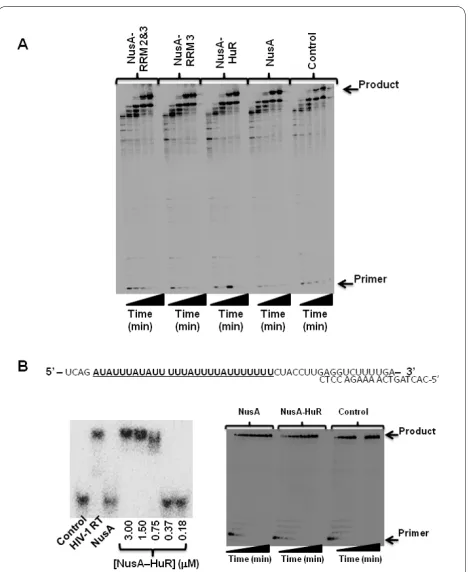
Although our NMR data exclude the presence of direct physical protein-protein contacts between HIV-1 RT and HuR, indirect effects from one protein to the other may occur, possibly mediated by RNA. To investigate this pos-sibility, we carried out HIV-1 RT DNA synthesis reac-tions using two different template/primer (T/P) substrates. In the first, we used a long heteropolymeric RNA template, corresponding to the HIV-1 sequence used for (-) strong stop DNA synthesis, that was primed with an 18 nucleotide DNA primer. In this assay, 173-nucleotide incorporation events are needed to produce the full-length DNA product, allowing multiple dNTP additions [21,22]. Importantly, this template does not contain AREs that would interfere with HuR binding to the RNA (data not shown). DNA synthesis reactions car-ried out with this T/P in the presence of NusA-HuR, NusA-RRM 3 or NusA-RRM 2&3 were not significantly different from the control reaction in the presence of NusA only (Fig. 4A). Next, we investigated HIV-1 RT DNA synthesis on a T/P substrate that contains AREs (Fig. 4B). Gel-shift assays confirmed that HuR bound to this T/P (Fig. 4B). However, the binding of HuR to the RNA did not appear to significantly affect the efficiency of HIV-1 RT reverse transcription on this T/P substrate either (Fig. 4B).
Discussion
Lemay et al identified HuR as a binding partner for HIV-1 RT in a yeast two-hybrid screen of a random primed cDNA library derived from CEMC7 lymphocytes, and a physical interaction in vitro was proposed based on time-resolved fluorescence data [9]. In the reported fluores-cence experiment, serial dilutions of GST-HuR (or GST alone) were incubated with a constant amount of C-ter-minal hexahistidine tagged HIV-1 RT for 24 hours at 4°C. Subsequently, the interaction was probed by fluorescence energy transfer using anti-GST antibodies conjugated with the donor TBPEu3+ and anti-hexahistidine
antibod-ies conjugated with the acceptor XL665. In our experi-ments, we discovered that the GST-HuR fusion protein is not stable in solution for extended periods and is subject to degradation, casting doubt on the validity of the above interpretation. Indeed, Lemay et al. may have looked at an interaction, most-likely a non-specific one, between HIV-1 RT and a degraded/unfolded form of GST-HuR. In this regard it is well known that marginally stable proteins are prone to aggregation, a non-specific protein-protein interaction. It should be noted, however, that Lemay et al
cloned HuR into the pGEX-4T-1 vector whereas we cloned it into the pGEX-2T vector. The resultant fusion proteins are identical in amino acid sequence except that the Lemay et al construct contains an additional proline
residue located between the thrombin cleavage site and N-terminus of HuR. Although unlikely, this minor differ-ence could contribute to differdiffer-ences in the relative solu-tion stabilities of the GST-HuR constructs used in the two different studies.
Lemay et al. also reported that knockdown of HuR expression in HeLa P4.2 cells by RNA interference inhib-ited both the early and late steps of HIV-1 reverse tran-scription. While this could be caused by a direct effect of HuR on reverse transcription, it also could arise via indi-rect effects on other host cell factors that are important in HIV-1 replication. For example, it is well documented that tumor-necrosis factor-alpha (TNF-α) levels in cells significantly impact HIV-1 replication [23-26] and that the expression of many inflammatory cytokines, includ-ing TNF-α, is tightly regulated at the post-transcriptional level by HuR [27]. Interestingly, several studies have
dem-Figure 4 Steady-state DNA synthesis by HIV-1 RT in the presence
of NusA-HuR. (A) HIV-1 RT DNA synthesis on a heteropolymeric RNA
[image:4.595.306.540.93.379.2]onstrated that HuR may undergo post-translational phos-phorylation at S202 and/or S242 [28,29]. Therefore, one cannot rule out the possibility that Lemay et al identified an interaction between a post-translationally modified HuR protein and HIV-1 RT in their yeast-two hybrid screen, and that this interaction may be of biological rele-vance.
In summary, the NMR chemical shift titration experi-ments with purified proteins, presented in this report, demonstrate unambiguously that no direct protein-pro-tein interactions between HIV-1 RT and HuR are present
in vitro up to concentrations of ~200 μM. It should be noted that the RT used in our study is derived from an LAI isolate (group M, subtype B), whereas the RT used in the Lemay et al study was derived from a BH10 isolate (group M, subtype B). There are amino acid differences between these two isolates in their RNase H domains at codons 447 [N (BH10) T S (LAI)], 461 (K T R), 468 (P T T), 471 (N T D), 482 (Y T H) and 559 (V T I). However, all of these substitutions exist as polymorphisms in the RT subtype B sequences deposited in the Stanford HIV data-base. Furthermore, although we found no evidence for a direct protein-protein interaction between HuR and HIV-1 RT in this study, an indirect interaction may be mediated by RNA. However, we could not detect any influence of HuR on HIV-1 RT DNA synthesis, even on T/P substrates that contain AREs and bound both HIV-1 RT and HuR (Fig. 4B). Therefore, our results suggest that HuR does not interfere with HIV-1 replication through a direct interaction with the viral reverse transcription complex, but through indirect effects possibly mediated via unidentified host factors and/or RNA.
In the search for host-pathogen interactions, a bur-geoning field in modern virology, many potential interac-tions have been identified for HIV-1 in the last 2 or 3 years through high through-put screens [8-10,12,30,31]. Our present follow up study using purified proteins illu-minates some of the potential pitfalls associated with such approaches, and highlights the urgent need to carry out stringent biophysical validation of any putative inter-action.
Methods
Cloning
The cDNA encoding HuR (National Center for Biotech-nology Information Reference Sequence NM_001419) was purchased from Open Biosystems (Rockford, IL) and from Origene Technologies (Rockville, MD). DNA encoding full-length HuR (residues 1-326) was cloned between the EcoR1 and Xho1 restriction sites of pET43A (EMD Chemicals Inc., San Diego, CA) and between the BamH1 and EcoR1 restriction sites of pGEX-2T (GE Healthcare, Piscataway NJ). A TEV protease recognition sequence (ENLYFQS) was engineered at the C-terminus
of the NusA fusion protein in pET43A. Constructs cod-ing for both RRM 1&2 (residues 16-186) and RRM 3 (res-idues 241-326) domains of HuR were cloned between the EcoRI and XhoI restriction sites of pET21a (EMD Chem-icals Inc., San Diego, CA). The coding sequence for the RNase H domain of RT (residues 433-560) was amplified and cloned between EcoRI and XhoI restriction sites of pET32a (EMD Chemicals Inc., San Diego, CA) and was modified to include a TEV Protease recognition site at the C-terminus of thioredoxin [32]. The integrity of all clones was assessed by full-length sequencing of the respective plasmids.
Protein expression and purification
The HuR constructs as well as the RNase H domain of HIV-1 RT were expressed in E. coli Rosetta 2 (DE3), cul-tured in Luria-Bertani media. Protein expression was induced by the addition of 0.4 mM IPTG, and the cells were grown at 18°C for 16 to 20 h. Cells were opened using a microfluidizer (Newton, MA), and proteins were purified using 5 mL Ni-NTA columns. Aggregated mate-rial was removed by gel-filtration column chromatogra-phy using Hi-Load Superdex200 16/60 (GE Healthcare, Piscataway, NJ) equilibrated with a buffer containing 25 mM sodium phosphate, pH 7.5, 150 mM NaCl, 10% glyc-erol, 1 mM DTT, and 0.02% sodium azide. NusA-HuR and NusA-RRM 3 were further purified on a Hi-Trap QP column (GE Healthcare, Piscataway, NJ) at pH 7.5 using a 0-1 M NaCl gradient. NusA-RRM 1&2 was further puri-fied on a Hi-Trap SP column (GE Healthcare, Piscataway, NJ) at pH 6.5 using a 0-1 M NaCl gradient. The RNase H domain of HIV-1 RT was obtained after TEV protease digestion of the TRX fusion protein and purified on a Hi-Trap SP column (GE Healthcare, Piscataway, NJ) at pH 7.5 using a 0-1 M NaCl gradient. Buffer exchange was carried out using Amicon concentrators (Millipore, Bill-erica, MA), and proteins were stored at 4°C in solution. GST-HuR and HIV-1 RT were purified as described pre-viously [9,33,34]. For isotopic labeling, proteins were expressed as described above in modified minimal media using 15NH
4Cl as the sole nitrogen source. The [15
N]-labeled HuR RRM 3 and HuR RRM 1&2 used in NMR experiments contained extra amino acids (LEHHHHHH) at their C-termini, while the [15N]-labeled HIV-1 RT
RNase H domain NMR sample contained two additional amino acids (EF) at its N-terminus.
Multi-angle light scattering
flow-rate of 0.5 ml/min at room temperature and eluted with 25 mM sodium phosphate buffer, pH 7.5, containing 150 mM NaCl, 10 mM β-mercaptoethanol, 0.02% sodium azide and 5% glycerol. Total protein amounts loaded were 100 μL of 7.8 mg/mL NusA-RRM 3 and 100 μL of 1.1 mg/ mL NusA-HuR.
NMR spectroscopy
For the NMR experiments, 30-200 μM uniformly- [15
N]-labeled protein samples without and with equimolar or two-fold molar amounts of the proposed binding partner were prepared using the identical buffer (25 mM sodium phosphate buffer, pH 7.5, containing 150 mM NaCl, 10 mM β-mercaptoethanol, 0.02% sodium azide, 5% glycerol and 7% 2H
2O). All 1H,15N-HSQC NMR experiments [16]
were performed at 17°C on a Bruker Avance 600 MHz spectrometer, equipped with a 5 mm triple resonance and z-axis gradient cryoprobe.
Gel Mobility Shift Assays
Gel mobility shift assays were used to evaluate the bind-ing interaction between HuR and RNA. In these assays, the amount of RNA-bound HuR present in solution is assessed by native gel electrophoresis. HuR (0-3 μM total) was equilibrated with 100 nM of 32P-labeled RNA for 1 hr
in 50 mM Tris pH 7.5, 50 mM KCl at 37°C. Samples were then loaded on a 7% polyacrylamide gel in 40 mM Tris-acetate, pH 8.0, containing 1 mM EDTA. Gels were run at room temperature for 30 min (100 V constant voltage), and radioactivity was quantified using a Bio-Rad GS525 Molecular Imager (Bio-Rad Laboratories, Inc., Hercules, CA).
HIV-1 RT DNA synthesis reactions
The heteropolymeric RNA-dependent DNA polymerase T/P corresponding to the HIV-1 sequence used for (-) strong stop DNA synthesis was prepared as described previously [21,22]. The 18 nucleotide DNA oligonucle-otide primer used in this experiment is complementary to the HIV-1 tRNALys3 primer binding site and was 5'-end
radiolabelled with γ- [32P]-ATP prior to annealing to the
RNA template. DNA polymerization reactions were car-ried out by incubating 50 nM HIV-1 RT with 3 μM NusA-HuR in 50 mM Tris-HCl (pH 8.0), 50 mM KCl for 5 min before the addition of 20 nM T/P, containing 1 μM dNTP and 10 mM MgCl2. After defined incubation periods, ali-quots were removed and the reaction was quenched with equal volumes of gel loading dye. Products were sepa-rated by denaturing gel electrophoresis and radioactivity was quantified with a Bio-Rad GS525 Molecular Imager.
Competing interests
The authors declare that they have no competing interests.
Authors' contributions
Conceived and designed the experiments: JA, IJLB, AMG and NSC. Performed the experiments: JA, IJLB, SD, KH and JC. Analyzed the data: JA, IJLB, AMG and NSC. Wrote the paper: JA, IJLB, AMG and NSC.
Acknowledgements
We thank Dr. Rieko Ishima for useful discussions about RNaseH and Mike Delk for NMR technical support. This work is a contribution from the Pittsburgh Cen-ter for HIV Protein InCen-teractions and was supported by the National Institutes of Health Grant (GM082251).
Author Details
1Department of Structural Biology, Division of Infectious Diseases, University of
Pittsburgh School of Medicine, Pittsburgh, PA 15261, USA and 2Department of
Medicine, Division of Infectious Diseases, University of Pittsburgh School of Medicine, Pittsburgh, PA 15261, USA
References
1. Aiken C, Trono D: Nef stimulates human immunodeficiency virus type 1 proviral DNA synthesis. J Virol 1995, 69:5048-5056.
2. Goncalves J, Korin Y, Zack J, Gabuzda D: Role of Vif in human immunodeficiency virus type 1 reverse transcription. J Virol 1996, 70:8701-8709.
3. Harrich D, Ulich C, García-Martínez LF, Gaynor RB: Tat is required for efficient HIV-1 reverse transcription. EMBO J 1997, 16:1224-1235. 4. Kiernan RE, Ono A, Englund G, Freed EO: Role of matrix in an early
postentry step in the human immunodeficiency virus type 1 life cycle.
J Virol 1998, 72:4116-4126.
5. Wu X, Liu H, Xiao H, Conway JA, Hehl E, Kalpana GV, Prasad V, Kappes JC: Human immunodeficiency virus type 1 integrase protein promotes reverse transcription through specific interactions with the nucleoprotein reverse transcription complex. J Virol 1999, 73:2126-2135.
6. Weiss S, König B, Morikawa Y, Jones I: Recombinant HIV-1 nucleocapsid protein p15 produced as a fusion protein with glutathione S-transferase in Escherichia coli mediates dimerization and enhances reverse transcription of retroviral RNA. Gene 1992, 121:203-212. 7. Kohlstaedt LA, Wang J, Friedman JM, Rice PA, Steitz TA: Crystal structure
at 3.5 A resolution of HIV-1 reverse transcriptase complexed with an inhibitor. Science 1992, 256:1783-1790.
8. König R, Zhou Y, Elleder D, Diamond TL, Bonamy GM, Irelan JT, Chiang CY, Tu BP, De Jesus PD, Lilley CE, Seidel S, Opaluch AM, Caldwell JS, Weitzman MD, Kuhen KL, Bandyopadhyay S, Ideker T, Orth AP, Miraglia LJ, Bushman FD, Young JA, Chanda SK: Global analysis of host-pathogen interactions that regulate early-stage HIV-1 replication. Cell 2008, 135:49-60. 9. Lemay J, Maidou-Peindara P, Bader T, Ennifar E, Rain JC, Benarous R, Liu LX:
HuR interacts with human immunodeficiency virus type 1 reverse transcriptase, and modulates reverse transcription in infected cells.
Retrovirology 2008, 5:47-61.
10. Lemay J, Maidou-Peindara P, Cancio R, Ennifar E, Coadou G, Maga G, Rain JC, Benarous R, Liu LX: AKAP149 binds to HIV-1 reverse transcriptase and is involved in the reverse transcription. J Mol Biol 2008, 383:783-796.
11. Warrilow D, Meredith L, Davis A, Burrell C, Li P, Harrich D: Cell factors stimulate human immunodeficiency virus type 1 reverse transcription in vitro. J Virol 2008, 82:1425-1437.
12. Tabah A, Tardiff K, Mansky L: Characterization of a novel TRIM protein that possesses anti-HIV-1 activity [abstract]. 16th Conference on Retroviruses and Opportunistic Infections, February 8-11, 2009. Montreal, Canada .
13. Liu J, Dalmau J, Szabo A, Rosenfeld M, Huber J, Furneaux H: Paraneoplastic encephalomyelitis antigens bind to the AU-rich elements of mRNA. Neurology 1995, 45:544-550.
14. Ma WJ, Cheng S, Campbell C, Wright A, Furneaux H: Cloning and characterization of HuR, a ubiquitously expressed Elav-like protein. J Biol Chem 1996, 271:8144-8151.
Received: 22 February 2010 Accepted: 7 May 2010 Published: 7 May 2010
This article is available from: http://www.retrovirology.com/content/7/1/40 © 2010 Ahn et al; licensee BioMed Central Ltd.
15. Meisner NC, Hackermüller J, Uhl V, Aszódi A, Jaritz M, Auer M: mRNA openers and closers: modulating AU-rich element-controlled mRNA stability by a molecular switch in mRNA secondary structure.
Chembiochem 2004, 5:1432-1447.
16. López de Silanes I, Zhan M, Lal A, Yang X, Gorospe M: Identification of a target RNA motif for RNA-binding protein HuR. Proc Natl Acad Sci USA
2004, 101:2987-2992.
17. Fialcowitz-White EJ, Brewer BY, Ballin JD, Willis CD, Toth EA, Wilson GM: Specific protein domains mediate cooperative assembly of HuR oligomers on AU-rich mRNA-destabilizing sequences. J Biol Chem 2007, 282:20948-20959.
18. Meisner NC, Hintersteiner M, Mueller K, Bauer R, Seifert JM, Naegeli HU, Ottl J, Oberer L, Guenat C, Moss S, Harrer N, Woisetschlaeger M, Buehler C, Uhl V, Auer M: Identification and mechanistic characterization of low-molecular-weight inhibitors for HuR. Nat Chem Biol 2007, 3:508-515. 19. Bodenhausen G, Ruben DJ: Natural abundance nitrogen-15 NMR by
enhanced hetero-nuclear spectroscopy. Chem Phys Lett 1980, 69:185-189.
20. Mori S, Abeygunawardana C, Johnson MO, Vanzijl PCM: Improved Sensitivity of HSQC Spectra of Exchanging Protons at Short Interscan Delays Using a New Fast HSQC (FHSQC) Detection Scheme That Avoids Water Saturation. J Magn Reson Series B 1995, 108:194-98.
21. Brehm JH, Mellors JW, Sluis-Cremer N: Mechanism by which a glutamine to leucine substitution at residue 509 in the ribonuclease H domain of HIV-1 reverse transcriptase confers zidovudine resistance. Biochemistry
2008, 47:14020-14027.
22. Sluis-Cremer N, Arion D, Parikh U, Koontz D, Schinazi RF, Mellors JW, Parniak MA: The azido group is not the primary determinant of 3'-azido-3'-deoxythymidine (AZT) responsible for the excision phenotype of AZT-resistant HIV-1. J Biol Chem 2005, 280:29047-29052.
23. Michihiko S, Yamamoto N, Shinozaki F, Shimada K, Soma G, Kobayashi N: Augmentation of in-vitro HIV replication in peripheral blood mononuclear cells of AIDS and ARC patients by tumor necrosis factor.
Lancet 1989, 27:1206-1207.
24. Mellors JW, Griffith BP, Ortiz MA, Landry ML, Ryan JL: Tumor necrosis factor-alpha/cachectin enhances human immunodeficiency virus type 1 replication in primary macrophages. J Infect Dis 1991, 163:78-82. 25. Li Q, Gebhard K, Schacker T, Henry K, Haase AT: The relationship between
tumor necrosis factor and human immunodeficiency virus gene expression in lymphoid tissue. J Virol 1997, 71:7080-7082.
26. Lane BR, Markovitz DM, Woodford NL, Rochford R, Strieter RM, Coffey MJ: TNF-alpha inhibits HIV-1 replication in peripheral blood monocytes and alveolar macrophages by inducing the production of RANTES and decreasing C-C chemokine receptor 5 (CCR5) expression. J Immunol
1999, 163:3653-3661.
27. Seko Y, Cole S, Kasprzak W, Shapiro BA, Ragheb JA: The role of cytokine mRNA stability in the pathogenesis of autoimmune disease.
Autoimmun Rev 2006, 5:299-305.
28. Kim HH, Yang X, Kuwano Y, Gorospe M: Modification at HuR(S242) alters HuR localization and proliferative influence. Cell Cycle 2008,
7:3371-3377.
29. Kim HH, Abdelmohsen K, Lal A, Pullmann R Jr, Yang X, Galban S, Srikantan S, Martindale JL, Blethrow J, Shokat KM, Gorospe M: Nuclear HuR accumulation through phosphorylation by Cdk1. Genes Dev 2008, 22:1804-1815.
30. Brass AL, Dykxhoorn DM, Benita Y, Yan N, Engelman A, Xavier RJ, Lieberman J, Elledge SJ: Identification of host proteins required for HIV infection through a functional genomic screen. Science 2008, 319:921-926.
31. Zhou H, Xu M, Huang Q, Gates AT, Zhang XD, Castle JC, Stec E, Ferrer M, Strulovici B, Hazuda DJ, Espeseth AS: Genome-scale RNAi screen for host factors required for HIV replication. Cell Host Microbe 2008, 4:495-504. 32. Ahn J, Byeon IJ, Byeon CH, Gronenborn AM: Insight into the structural basis of pro- and antiapoptotic p53 modulation by ASPP proteins. J Biol Chem 2009, 284:13812-13822.
33. Le Grice SF, Cameron CE, Benkovic SJ: Purification and characterization of human immunodeficiency virus type 1 reverse transcriptase.
Methods Enzymol 1995, 262:130-144.
34. Le Grice SF, Gruninger-Leitch F: Rapid purification of homodimer and heterodimer HIV-1 reverse transcriptase by metal chelate affinity chromatography. Eur J Biochem 1990, 187:307-314.
doi: 10.1186/1742-4690-7-40