City, University of London Institutional Repository
Citation
:
Larbig-Wust, Christine (2010). Measuring customer involvement in new servicedevelopments. (Unpublished Doctoral thesis, City University London)
This is the unspecified version of the paper.
This version of the publication may differ from the final published
version.
Permanent repository link:
http://openaccess.city.ac.uk/1140/Link to published version
:
Copyright and reuse:
City Research Online aims to make research
outputs of City, University of London available to a wider audience.
Copyright and Moral Rights remain with the author(s) and/or copyright
holders. URLs from City Research Online may be freely distributed and
linked to.
City Research Online: http://openaccess.city.ac.uk/ [email protected]
Measuring Customer Involvement in
New Service Development Projects
A thesis submitted to Cass Business School City University of London for the degree of
Doctor of Philosophy (PhD) in the Faculty of Management.
March 2010
Christine Larbig-Wüst
Contents
1
Introduction ... 12
1.1 Introduction ... 12
1.2 Customer Involvement in New Service Development ... 14
1.2.1 Definition of the Concept ... 14
1.2.2 Benefits and Challenges ... 15
1.2.3 Examples ... 17
1.3 Research Aims and Theoretical Foundations of Research ... 19
1.3.1 Research Aims ... 19
1.3.2 Theoretical and Conceptual Foundations of Research ... 23
1.4 Dissertation Outline ... 29
2
New Services and New Services Development – A Review ... 31
2.1 Introduction ... 31
2.2 New Services ... 31
2.3 New Service Development ... 33
2.3.1 Introduction ... 33
2.3.2 New Service Development – A Chronology of Tasks ... 33
2.3.3 New Service Development – A Network of Actors ... 34
2.3.4 New Service Development - A Learning Process ... 36
3
Customer Involvement in New Service Development – A
Review ... 40
3.1 Introduction ... 40
3.2 Facets of Customer Involvement in New Service Development ... 41
3.2.1 Methods of Customer Involvement... 41
3.2.2 Objectives of Customer Involvement ... 42
3.2.3 Level of Customer Involvement ... 44
3.2.4 Stages of Customer Involvement ... 46
3.2.5 Characteristics of Customers ... 47
3.3 Customer Knowledge Creation in NSD... 50
3.4 Antecedents to Customer Involvement in New Service Development ... 55
4
Measuring Customer Involvement in New Service
Development... 62
4.1 Customer Knowledge Creation in New Service Development ... 62
4.1.1 Effect of Level of Customer Involvement on Increase in Customer Knowledge Stock and Service Concept Adaptations ... 63
4.1.2 Moderating Effect of Prior Stock Customer Knowledge ... 65
4.1.3 Effect of Increase in Stock of Customer Knowledge on Service Concept Adaptations ... 66
4.1.4 Mediating Effect of Increase in Stock of Customer Knowledge and Service Concept Adaptations on New Service Outcomes ... 68
4.1.5 Moderating Effect of Service Concept Adaptations ... 75
4.1.6 Control Variable ... 76
4.2 Antecedents to Customer Involvement in New Services Development Stages ... 78
4.2.1 Antecedents on the Firm Level ... 79
4.2.2 Antecedents on the Project Level... 84
4.3 Customer-Involvement Management Practices ... 88
4.3.1 Methods of Customer Involvement... 90
4.3.2 Stages of Customer Involvement ... 94
5
Research Methodology ... 95
5.1 Definition of Constructs... 95
5.2 Development of Constructs ... 96
5.2.1 Field Interviews... 96
5.2.2 Measures of Constructs ... 103
5.2.3 Types of Relationship between Latent Constructs and their Items ... 108
5.2.4 Assessing the Validity and Reliability of Measures ... 120
5.2.5 Face and Content Validity... 120
5.2.6 Construct Validity ... 125
5.2.7 Reliability ... 128
5.2.8 Dimensionality of Constructs... 129
5.2.9 Nomological Validity ... 130
5.2.10 Common Method Variance ... 131
5.3 Sample and Data Collection ... 137
5.3.1 Data Collection Strategy ... 137
5.3.2 Description of Sample ... 138
6
Analysis and Results ... 143
6.1.1 Frequencies and Mean Values ... 143
6.1.2 Characteristics of Service Businesses and New Service Projects ... 151
6.1.3 Customer Involvement related to New Service Outcomes ... 155
6.1.4 Techniques of Analysis ... 160
6.2 Model of Customer Knowledge Creation ... 165
6.2.1 Measurement Model ... 165
6.2.2 Structural Model ... 166
6.2.3 Direct Effects ... 167
6.2.4 Moderating Effects ... 169
6.2.5 The Rival Model – Direct Effect of Customer Involvement on New Service Success and Sustainable Competitive Advantage ... 173
6.2.6 Extended Analysis – Direct Effect of Increase in Explicit Customer Knowledge Stock on New Service Outcomes ... 177
6.3 Model of Antecedents to Customer Involvement in New Service Development ... 179
6.3.1 Measurement Model ... 179
6.3.2 Structural Model ... 181
6.4 Analysis on Customer Involvement Management Practices ... 183
6.4.1 Introduction ... 183
6.4.2 Determination of Cluster Variate ... 184
6.4.3 Types of Customer Involvement Management Practices ... 186
6.4.4 Validation and Reliability of Cluster Solutions ... 189
6.4.5 Cluster Typology... 198
6.4.6 Jackknife Cross-Validation of Cluster Typology ... 202
6.4.7 Characterizing Groups of Customer-Involvement Management Practices in NSD ... 203
6.4.8 Impact of Customer Involvement Practices ... 204
7
Discussion and Managerial Implications of Research ... 211
7.1 Discussion ... 212
7.1.1 Customer Involvement and Its Role in Successful NSD ... 212
7.1.2 Customer Knowledge – A Key Success Factor in NSD ... 216
7.1.3 Cultural Antecedents of Customer Involvement in NSD ... 221
7.1.4 Innovativeness and Customer Involvement in NSD ... 225
7.2 Managerial Implications ... 228
8
Limitations and Suggestions for Future Research ... 233
List of Figures
Figure 1 Conceptual and Theoretical Foundations of Research ... 27
Figure 2: Research Concepts... 30
Figure 3: NSD as Learning Process ... 38
Figure 4: Facets of Customer Involvement in NSD ... 48
Figure 5: Model of Customer Knowledge Creation... 62
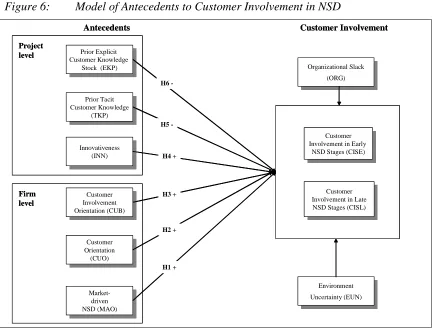
Figure 6: Model of Antecedents to Customer Involvement in NSD ... 78
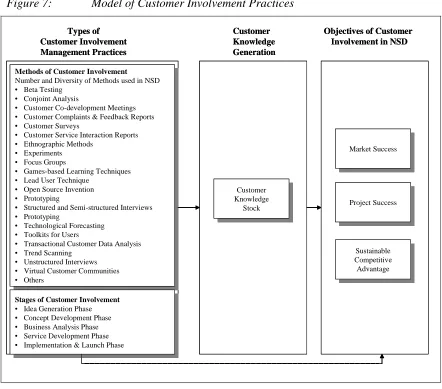
Figure 7: Model of Customer Involvement Practices ... 89
Figure 8: Job Titles of Key Informants ... 133
Figure 9: Overview of Industry Origin of Sample ... 139
Figure 10: Strength of Customer Focus ... 145
Figure 11: Level and Stages of Customer Involvement in NSD Projects ... 146
Figure 12: Usage of Methods ... 147
Figure 13: Number of Methods Used Throughout NSD... 149
Figure 14: New Service Outcomes ... 150
Figure 15: New Service Outcomes in Relation to Degree of Customer Involvement ... 156
Figure 16: Results of Direct Effect Model ... 168
Figure 17: Results of Hypothesized Model... 170
Figure 18: Results of Extended Model ... 178
Figure 19: Results of Direct Effects of Antecedents to Customer Involvement ... 182
Figure 20: Process of Analysis... 184
Figure 21: Pattern of Clusters in terms of Using Methods in NSD ... 193
Figure 22: Pattern of Clusters regarding Diversity of Methods and Stages ... 193
List of Tables
Table 1: List of Methods of Customer Involvement in NSD ... 91
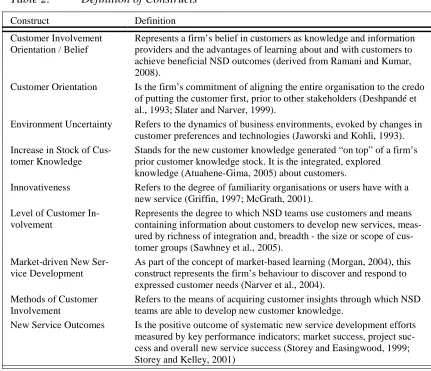
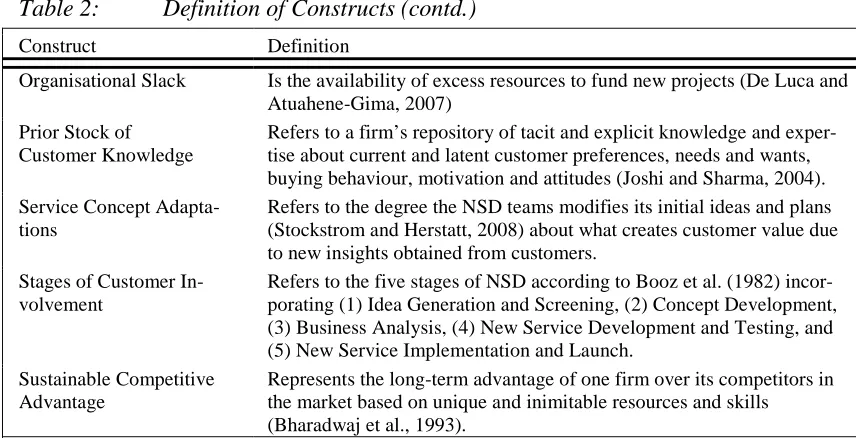
Table 2: Definition of Constructs ... 95
Table 3: Comparison of Formative and Reflective Measurement Models . 115 Table 4: Summary of Results ... 119
Table 5: Overview of Industry Origin of Sample Frame and Target Population ... 138
Table 6: Usefulness of Methods ... 148
Table 7: New Service Outcomes in Relation to Stages of Customer Involvement ... 157
Table 8: Usage of Customer Methods in Relation to New Service Outcomes ... 158
Table 9: Measurement Model ... 166
Table 10: Test Results on Type of Moderation Effect of EKP and TKP ... 172
Table 11: Multiple Mediator Test ... 175
Table 12: Individual Indirect Effects of Mediators ... 176
Table 13: Measurement Model ... 180
Table 14: Results of Cross-Validation Analysis of Four-Cluster Solution .. 191
Table 15: Correlations Between Corresponding Structure rs ... 195
Table 16: Hit Rates for Cross-Typology Clustering ... 196
Table 17: Results of Discriminant Analysis ... 199
Table 18: Loadings of Discriminant Functions ... 200
Table 19: Jackknife Cross-Validation of Four-Cluster Solution ... 202
Table 20: Results of Four Groups pertaining to TKA, EKA and SCM ... 205
Table 21: Usage and Usefulness of Customer Involvement Methods ... 207
List of Equations
Equation 1: Reflective Specification of the Relationship ... 109
Equation 2: Formative Specification of the Relationship ... 109
Equation 3: Content Validity Rate (CVR) ... 124
Equation 4: Number of Methods Used in NSD ... 185
Equation 5: Diversity of Methods Used in NSD... 186
Equation 6: Remaining Within-Groups Heterogeneity of Cluster Solution .... 192
List of Appendices
Appendix 1: Customer Activities at Stages in New Service Development
Stages ... 266
Appendix 2: Research on Customer Involvement in New Service Development... 267
Appendix 3: Questionnaire Items to Measure Customer Involvement ... 275
Appendix 4: Pool of Items Measuring Customer Involvement in NSD... 286
Appendix 5: Results of Expert Survey ... 287
Appendix 6: Definitions of Customer Involvement Methods ... 288
Appendix 7: List of Interviews ... 289
Appendix 8: Reliability Analysis of Latent Constructs... 290
Appendix 9: Results of Principal Component Analysis ... 291
Appendix 10: Factor Loadings of Manifest Variables of Customer Knowledge Creation Model ... 292
Appendix 11: Factor Loadings of Manifest Variables of Customer Involvement Antecedents Model ... 293
Appendix 12: Correlations Matrix of Principal Component Analysis ... 294
Appendix 13: Results of Harman's One Factor Test ... 295
Appendix 14: Common Method Bias Test of Customer Knowledge Creation Model ... 296
Appendix 15: Common Method Bias Test of Model of Antecedents of Customer Involvement Stages ... 297
Appendix 16: Measures of Sampling Adequacy and Partial Correlations ... 298
Appendix 17: Comparison of the Formative and Reflective Model of Level of Customer Involvement in NSD ... 299
Appendix 18: Comparison of the Formative and Reflective Model of Customer Involvement in NSD Phases ... 301
Appendix 19: Collinearity Diagnostics of Formative Indicators of Level of Customer Involvement in NSD (CUI) ... 302
Appendix 20: Correlation Matrix and Descriptive Statistics of Measures ... 303
Appendix 21: Summary of Effects of the Hypothesized Model ... 305
Appendix 22: Summary of Effects of the Hypothesized Model Including Relationships between Level of Customer Involvement and Outcome Variables ... 306
Appendix 23: Summary of Effects of Extended Model ... 307
Appendix 24: Results of the Customer Knowledge Creation Model ... 308
Appendix 26: Direct Effect Model of Prior Customer Knowledge Stock ... 310
Appendix 27: Partial Moderation Effect Model of Prior Customer Knowledge Stock ... 310
Appendix 28: Characteristics of Customer Involvement Methods ... 311
Appendix 29: Correlation Coefficients of Proxy Variables in Cluster Analysis . 311 Appendix 30: Results of Agglomeration Schedule of Ward’s Method ... 312
Appendix 31: Predictive Validity of Four-Cluster Solution ... 312
Appendix 32: Predictive Validity of Five-Cluster Solution ... 313
Appendix 33: Final Cluster Centres of Four-Cluster Solution ... 313
Appendix 34: Test of Population Covariance Matrices ... 314
Appendix 35: Test Results of Four-Cluster Solution ... 314
Appendix 36: Characteristics of Groups pertaining to Cluster Variate ... 315
Appendix 37: Characteristics of Groups related to Environment, Innovation and Firm Culture... 316
Appendix 38: Results of the Model of Antecedents ... 317
Appendix 39: Explained Variance (R²), Communality, Redundancy, Effect Size, Prediction Relevance (Q²) and Goodness-of-fit Index ... 317
Appendix 40: Comparison of Sample and Non-Sample Respondents ... 318
Appendix 41: Type of Customers Served ... 318
Appendix 42: Countries... 319
Appendix 43: Size of NSD Project measured by Number of Team Members.... 319
Appendix 44: Comparison of Early and Late Respondents ... 320
Appendix 45: Differences between Groups of Respondents with regard to Key Variables of Research Models ... 321
Declaration
The author hereby declares that no portion of the work referred to in this thesis has been
submitted in support of an application for another degree or qualification of this or any
other university or other institute of learning.
Christine Larbig-Wüst
Copyright
Copyright in text of this thesis rests with the author. Copies either in full, or of extracts,
may be made only in accordance with instructions given by the author and lodged in the
City University Library. Details can be obtained from the Librarian. This page must
form part of any such copies made. Further copies of copies made in accordance with
Dedication and Acknowledgements
I would not have carried out the doctoral programme had it not been for the support,
expertise, flexibility and patience of my supervisors Chris Storey and Caroline Wiertz,
who took on the task of guiding me through a peerless learning process. I am grateful
that they took the time for discussions even on a short notice and provided me
profes-sional and mental support throughout this learning process.
Thanks also to the Cass Faculty of Management staff, students, and, my friends,
Kalliroy Boutsikakis and Anvita Kumar, who have been generous with their advice and
support.
Special thanks for providing me support in London go to my friends Barbara, Carlos,
Pia, Claudine and Ted who always seek to ease my daily workload.
Many thanks to my colleagues Dieter Hottiger, Christoph Harnisch and Douglas
MacKevett who helped me with their expertise to run statistical analyses and write up
the thesis.
Last but not least, many thanks to my family, Axel and Tim Prauser, my sisters Ulrike
and Angelika, and my friends Helen, Waltraud, and Birgit who encouraged me every
step of the way and had absolute faith that I would achieve my goal.
Abstract
Service marketing managers are being required to develop new services that succeed in the market and are valuable for customers. Services Marketing literature therefore stresses the need to innovate with customers and to integrate their view into the new service developed. However, consensus about the positive effects of customer involve-ment in new service developinvolve-ment (NSD) has not been reached. Drawing on the theory of organisational knowledge creation and the concept of marketing orientation, we ar-gue that customer involvement is not related to successful new services per se. Howev-er, we propose it contributes to the increase of a firm’s customer knowledge stock, the tacit and explicit dimension. The study results demonstrate that the increase in a firm’s tacit customer knowledge stock significantly affects market success, project success and sustainable competitive advantage, while the increase of explicit customer knowledge stock positively influences the acceptance of new service concept ideas initiated by cus-tomers. Both the explicit and tacit customer knowledge stock is positively influenced by the level of customer involvement.
Furthermore, the internal resource-based antecedents to customer involvement decisions are investigated. Our findings illustrate that a firm’s prior tacit knowledge about cus-tomers inhibits integration of cuscus-tomers in NSD, whereas prior explicit customer knowledge positively affects customer involvement. As for market-driven NSD, cus-tomer orientation, and project innovativeness, the study shows different effects on stag-es of customer involvement.
Finally, the research reveals that service firms manage customer involvement differently related to the facets of the construct, namely (1) methods and (2) stages of customer involvement. Distinct management approaches are compared and contrasted to unearth salient decision parameters.
The research is based on interviews, one expert survey and one main survey, incorporat-ing 131 respondents of diverse service firms in nine countries. Responses have been analysed in two structural equation models by Partial Least Squares (PLS) and explored by cluster analysis.
1
Introduction
1.1
Introduction
Services are important for the wealth of modern economies. The provision of services
accounts for more than fifty per cent of Gross Domestic Product (GDP) in each Member
State of the European Union (EUROSTAT, 2009). In 2005, the relative growth of
ser-vices (3.7 per cent) led the U.S. economy (Bureau of Economic Analysis U.S.
Depart-ment of Commerce, 2006). Commercial service innovations significantly contributed to
this economic growth (Department of Trade and Industry (DTI), 2007).
Moreover, the European Commission has proved a positive relationship between
Knowledge Intense Business Services (KIBS), such as computer services and Research
& Development (R&D) services, and national innovation performance (European
Commission, 2008). However, firms offering KIBS and R&D services are not the sole
innovative service providers. Evidence on a firm level demonstrate that successful and
innovative firms can be found throughout the services sectors in every OECD country
(Organisation for Economic Co-operation and Development, 2005); a fact that has
raised the interest of researchers in Services Marketing for the past few decades.
Given today’s dynamic markets (e.g. Fitzsimmons and Fitzsimmons, 2000; Edvardsson
et al., 2000; Zeithaml et al., 2006), evoked by market deregulations, heightened
custom-er expectations, the entrance of new technologies and the growing demand of scustom-ervices
(De Brentani, 1995; Lovelock et al, 2001; Zeithaml et al., 2006), service providers
con-stantly need to enhance and expand their product portfolio to stay competitive.
features that fulfil customer needs (Johne and Storey, 1998). One of the major
challeng-es a service provider facchalleng-es in this regard is the identification of market needs to rchalleng-espond
accordingly (De Brentani, 1991) and reduce risk of market failure.
Failure rates of new service development tend to be high. Clancy and Shulman (1991)
report a new service failure rate of 80%, for instance, in the financial service industry.
Storey and Kelley (2001) disclose in their study that 30% of new service development
projects of service firms in UK did not meet objectives, caused by the lack of an
effi-cient development process and upfront homework (e.g. Alam and Perry, 2002; De
Brentani, 1991), and the dearth of customer orientation and input (Martin and Horne,
1995).
A common and straightforward approach to integrate the customer’s view into the new
service is to solicit customers to provide information about their preferences and needs
to be transformed in appropriate service features and processes by the service company.
Thus, customers become an integral part of firms’ NSD process (e.g. Alam and Perry,
2002; Parasuraman, 1987; Skiba and Herstatt, 2008). However, previous research in this
field has demonstrated that integrating users can either lead to positive new service
de-velopment outcomes (e.g. Martin and Horne, 1995; Sandén et al., 2006) or may distract
firms from inventing successful new services (e.g. Enkel et al., 2005); a controversy that
is taken up in section 1.2.2.
We believe that looking into the concept of customer involvement in new service
devel-opment through the lens of a customer’s participative role in NSD does not dwell on
what customers contribute to co-development of new services, the co-operative act of
incorpo-rates the generation, exchange and application of market knowledge (Day, 1999).
Ap-proaching the question about successful customer integration from the perspective of
customer knowledge creation lies at the heart of this thesis. In this context, we address
several aspects, as outlined in chapter 1.3.1.
1.2
Customer Involvement in New Service Development
This chapter provides an overview of existing definitions on customer involvement
since it may help the reader to understand why customer involvement is associated with
the act of customer knowledge creation. It provides the basis of the definition used in
this research. Further specialist definitions are introduced later.
The point of departure of our research is the rationales of working with customers in
NSD. A literature review on benefits and challenges introduces into the concept and
outlines important considerations on success and failures associated with customer
co-innovation that are addressed in the research aims of this thesis. Subsequently, two
re-cent examples illustrate the multiple facets of the concept and its integration in the
or-ganisation’s culture.
1.2.1 Definition of the Concept
Due to fragmented literature on the construct (Alam, 2006a) and various perspectives
adopted by researchers in the past, consensus about a consistent definition has not been
reached. “Customer involvement”, “customer integration”, “customer interaction” and
“customer participation” have often been used interchangeably referring to the
custom-er’s role as active information provider (e.g. Alam and Perry, 2002; Alam, 2006a;
Cermak and File, 1994; Fang, 2008; Gales and Mansour-Cole, 1991; Kristensson et al.,
inte-grated to contribute to a firm’s knowledge creation process, as creator” or
“co-developer” (Emden et al, 2006; Fang, 2008;Jeppesen and Molin, 2003; Sawhney et al.,
2005). While the first definitions refer to the act of learning more about customers by
applying typical market research methods, the latter represents the idea of shifting part
of the responsibility of customer knowledge creation to the buyer (Edvardsson et al.,
2006).
Even though these definitions refer to distinct forms of customer input, that is to say
knowledge or information, they both reflect that customer involvement is associated
with the customer’s intellectual contribution to new service development (Matthing et
al, 2004). The degree to which customers may intellectually contribute to the new
ser-vice is managed in conjunction with time-related and methodical considerations to
achieve pre-set NSD objectives (Sandén et al., 2006). Thus, we define customer
in-volvement in NSD as “the successful generation and application of customer knowledge
(intelligence) in new service development projects by managing level, stages and
meth-ods of customer integration”.
1.2.2 Benefits and Challenges
A firm’s primary aim of involving customers in NSD is to develop novel services that
meet the requirements and needs of the market. It has been demonstrated by multiple
researchers that the integration of customers is an important success factor in NSD (De
Brentani, 1989; De Brentani, 1991; De Brentani, 1995). By integrating the voice of the
customer into NSD, firms increase their understanding of user needs and wishes (e.g.
Anderson and Crocca, 1993; Sinkula, 1994; Veryzer, 1998) which improves product
quality (Damodaran, 1996). Customer involvement may also help in reducing
testing by customers can take place during the innovation process (e.g. Gupta and
Wilemon, 1990; Iansiti and MacCormak, 1997). Numerous researchers stress that
cus-tomers help to develop superior and differentiated new services when their creativity is
harnessed (e.g. Alam and Perry, 2002; Magnusson, 2003; Matthing et al., 2006; Ulwick,
2002; Von Hippel, 1986; Wikström, 1996).
Moreover, when interacting with customers directly, NSD managers may tap into
cus-tomers’ mental schemas. By sharing mutual suggestions, understanding about individual
perspectives and sense making of the information provided can be improved (Boland,
1978). This implies a cognitive process within which both parties, customers and NSD
teams, can extend their “frame of reference”, i.e. what they have experienced in the
past.
It has also been recognised that collaboration with customers helps to disseminate
inno-vation rapidly. The interaction process educates customers about specifications,
attrib-utes, and use of novel service (e.g. Alam, 2006b; Damodaran, 1996). Thus, customers
may act as early adopters and promote usage of service. This behaviour is seen as an
indication of their loyalty to the service firm. Customers may feel appreciated when
firms listen to what they have to say (Alam, 2006b).
Despite these cogent benefits of customer involvement, service firms need to be aware
of numerous challenges. When involving customers in the development process,
knowledge is exchanged between firm and customers (Nambisan, 2002). Since both
parties contribute to knowledge production, each party may claim the ownership of the
resulting service (Hipp and Herstatt, 2006). Furthermore, when “over-listening to
only a niche market (Enkel et al., 2005) resulting in unfavourable cost-and-benefit
rela-tions (Campbell and Cooper, 1999). Further arguments raised against customer
in-volvement are based on the notion about customers not having sufficient technical
knowledge to produce innovations (Christensen and Bower, 1996) and not being able to
articulate latent needs (Leonard and Rayport, 1997). In addition, buyers may not detach
themselves from what they know, i.e. customers are unable to imagine alternatives or
future functions of utilised services (Campbell and Cooper, 1999; Enkel et al, 2005;
Ettlie, 1986; Gales and Mansour-Cole, 1991).
The review on benefits and challenges illustrates that customer involvement in NSD is
discussed controversially. Kujala (2003) asserts that methods and level of customer
in-volvement need to be carefully managed during NSD in order to develop successful
new services. The following examples illustrate how customer involvement could be
organised successfully, and how the concept is incorporated in the firm’s orientation
towards customer value creation.
1.2.3 Examples
In October 2005, Bank of America reshaped consumer banking in the United States
when developing its “Keep the Change” service. The bank rounds the amount of each
purchase a customer makes with their Visa debit card to the next dollar, and
automati-cally transfers the difference to the customer’s savings account. The insight for Keep the
Change began as the bank conducted observations of families at their homes. The bank
witnessed that many people already rounded their checkbook entries to the nearest
dol-lar for convenience reasons. Besides, they became aware that the particudol-lar customer
difficulties controlling their impulse buying. The concept has been developed and tested
with larger numbers of individuals through surveys. The name of the novel service was
actually suggested by a customer focus group participant. It was also a member of the
focus group who had proposed getting people to dig for change in the cushions of a
couch. Bank of America took the idea and created a custom-made, 20-foot-long red
velvet couch guaranteed to attract attention upon service launch (Tekes, 2007).
Since autumn 2009, the Swiss Railway Corporation SBB has been transforming its way
of integrating customers in product and service development decisions. Until then, the
firm focused on customer surveys and feedback reports to improve its service offerings.
The national transport service provider, which transports approx. 322 million passengers
and 54 million net tons of freight per year, has decided to shift partial responsibility of
creating and changing transport services to a customer advisory board. The board
con-sists of twenty-nine customers representing the population of Switzerland. The board
members meet three times a year and discuss topics of high interest to passengers. The
dialogue with its customers often spawns ideas that the product and service management
has never thought of. None of the board’s proposals is to be rejected by corporate
repre-sentatives because of being “unrealistic”. Not only does the monopolist aim for
improv-ing and redesignimprov-ing its service offerimprov-ings, it attempts to revamp its customer focus. The
customer advisory board is organisationally attached to the head of main line traffic, to
place more weight on the board’s suggestions. As one of its first moves, the board
de-cided to develop a new online platform to discuss problems from a customer standpoint
sparse. However, the entity is expected to change the way new ideas are brought
for-ward for adding more value to transport services (Interview, T. Ebinger, 2009).
In summary, the previously stated benefits, challenges and examples illustrate that
cus-tomer involvement in NSD
- is associated with customer knowledge generation and a firm’s pursuit of creat-ing customer value;
- encompasses decisions on appropriate methods and level of involvement in dif-ferent NSD phases to achieve pre-set objectives and to work with customers
ef-fectively;
- may either postively or negatively affect development of new services.
These points of departure set the framework of this thesis. We do attempt to provide a
more detailed view on the intricate concept, which is described in the following section.
1.3
Research Aims and Theoretical Foundations of Research
1.3.1 Research Aims
Based upon the previous outline, the research objective is threefold. First, the research
aims to develop a conceptualisation of customer involvement in new service
develop-ment in the knowledge creation context. We contend that the existing concepts of
cus-tomer involvement do not address the essence of the construct. Proponents of cuscus-tomer
involvement in NSD agree that interacting with customers directly leads to successful
new services. With its ability to explain the construct and its role in NSD this view is
clearly limited and should be expanded. Knowledge about customers exists within firms
before any interaction with customers (Blazevic and Lievens, 2008). By integrating
in previous NSD projects and while they were delivering the service. We adapt this
view and attempt to demonstrate that market intelligence generation - the use of
cus-tomer research techniques, i.e. cuscus-tomer involvement in NSD, does not lead to
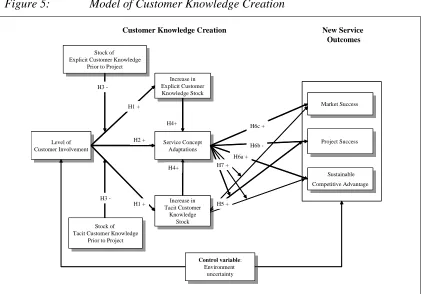
success-ful outcomes of NSD initiatives as such, but is mediated by the increase of stock of
cus-tomer knowledge (new knowledge). Based on this assumption, we expect the following
possible results:
(1) CKt < CK0 => ∆ CK = 0 or negative; no effect of customer involvement
(2) CKt > CK0 => ∆ CK = positive; positive effect of customer involvement
Where CK0 is the stock of customer knowledge prior to project and CKt is defined as the
stock of customer knowledge at the end of the project. The difference between the two
knowledge stocks determines the increase in customer knowledge (∆ CK).
Since knowledge is considered as an important resource that helps to achieve
competi-tive advantage in conjunction with other resources, we examine the interplay of internal
resource-based factors affecting customer involvement. These antecedents may
intensi-fy or inhibit customer collaboration. Examining and discussing their impact on facets of
customer involvement sheds light on the relative importance of factors that influence a
firm’s pursuit of collaborative customer value creation.
Our research on the relationships associated with antecedents to customer involvement
and customer knowledge creation is explorative and predictive by nature. We attempt to
gain insights on the existence of causes and effects related to the constructs instead of
Second, existing literature on customer involvement in NSD focuses on one or two
as-pects of the construct, e.g. beneficial methods of involvement. Even though there is
some literature on the specific facets on how, when, why and to what degree customers
are integrated in NSD, there is silence on how these crucial questions are interrelated to
create successful new services. These questions determine key decisions of NSD
execu-tives to manage customer involvement in NSD. In this context, we attempt to enhance
understanding of alternative customer-involvement management approaches. Contrary
to existing research, we contend that there is more than one strategy-related option
lead-ing to positive results. Hence, the study focuses on explorlead-ing similarities and differences
of approaches, and their beneficial outcomes.
Third, we measure customer involvement and customer knowledge creation in the
con-text of three different new service outcomes. It has been argued in the literature that
success of NSD and rationales of customer collaboration in innovation are manifold. To
be in the position to govern customer integration, NSD decision makers need to have
valid marketing metrics available (Matthing et al., 2004) that are related to the outcomes
of customer interactions. The study therefore attempts to enrich the debate on effective
work with customers.
The research questions distilled from the discussion are the following:
- “How do the level, stages and method of customer involvement contribute to a firm’s knowledge about customers and affect the success of new service
devel-opment projects?”
- “What are differences and similarities of existing customer-involvement man-agement practices?”
Based upon these research questions, our study contributes to the concept on market
orientation (Narver et al., 2004) and organisational knowledge creation in the
innova-tion performance context (Moorman and Miner, 1997) by developing valid metrics of
customer involvement in NSD (Martin and Horne, 1995) and exploring intangible
re-sources that affect customer value co-creation (Vargo and Lusch, 2004). Detailed
con-tributions of this study are described in chapter 7.
Some of this research will confirm existing results from new service and product
devel-opment and service marketing literature, but this is the first time that the facets of
cus-tomer involvement are measured from a knowledge-creation perspective and the distinct
effects of internal antecedents on customer involvement are examined.
The unit of analysis of our work are NSD projects, since project teams are an important
potential site for organisational learning (Keegan and Turner, 2001). By
institutionalis-ing new routines, information and processes, they benefit from experience and insights
they gained in the past (Nonaka and Takeuchi, 1995).
Associated with previously stated contributions we subsequently describe the theoretical
framework of this thesis. The framework contains the approach of viewing the concept
of customer involvement in NSD from a learning and knowledge creation perspective.
This perspective expands the view of market orientation, which emphasizes the
behav-iour of acquiring, disseminating and responding to market information. On the one
market-based learning. On the other hand, it guides decisions on how to innovate with
customers.
1.3.2 Theoretical and Conceptual Foundations of Research
Our research arises from the imperative that market-oriented firms need to generate and
act on market intelligence. Researchers consider this as the act of using traditional
mar-ket research tools and marmar-ket databases, employing high-touch techniques such as
working closely with lead users, visiting customers and benchmarking of customer
val-ue creation processes (Kohli and Jaworski, 1990; Slater and Narver, 2000). The
defini-tion accrues from the nodefini-tion that organisadefini-tions need to (1) develop knowledge about
current and future needs of customers, (2) disseminate it within the organisation, and (3)
act on it to compete successfully in the market (Kohli et al., 1993; Kohli and Jaworski,
1990). The authors stress that the three behavioural constructs allows one to assess the
degree to which an organisation is market-oriented and echoes the implementation of
the marketing concept. Narver and Slater complement the view of Kohli and Jaworski
by proposing that market orientation is a form of corporate culture that provides norms
for behaviour regarding customer and competitor orientations and interfunctional
coor-dination. They define market orientation as the firm’s culture and commitment to the
continuous creation of superior customer value (Narver and Slater, 1990; Slater and
Narver, 1994). “Specifically this entails collecting and coordinating information on
customers, competitors, and other significant market influences (such as regulators and
suppliers) to use in building superior customer value” (Slater and Narver, 1994).
Both definitions share the idea of acquiring and acting on relevant information and
knowledge about markets in order to direct marketing efforts. This view has been
investi-gate the effect of market orientation on product innovation. Both studies address the
controversial debate on whether market orientation leads solely to incremental
innova-tion. This relationship has been constituted in the literature due to the prevalent notion
that customer orientation lies at the heart of market orientation and is concerned with
achieving high customer satisfaction. Christensen and Bower (1996) state that
constant-ly focussing on customers and satisfying them with appropriate products - that is, being
customer-led - may restrain firms from developing radical new products and services
because they fail to anticipate needs of future markets. Slater and Narver (1998)
empha-size that being customer-led is part of customer orientation and as such, it is an
im-portant element of market orientation. However, according to the authors, the
philoso-phy of market orientation goes beyond satisfying expressed needs to understanding and
satisfying customers’ latent needs, and thus, is longer term in focus. Narver et al. (2004)
have developed this distinction further. They introduce two terms: (1) proactive market
orientation which is based on the philosophy of leading customers by anticipating and
acting on their latent needs, i.e. developing products new to the market, and (2)
respon-sive market orientation which refers to a firm’s propensity to be market-driven, i.e.
de-veloping products aiming to satisfy expressed existing needs of customers. However,
although related to new product and service development, the identification of latent
and expressed customer needs should be distinguished from innovation, the successful
implementation of new services and products (Hurley and Hull, 1998). Innovation is a
business function that coexists with market orientation (Han et al., 1998) based upon
organisational learning (Baker and Sinkula, 2007) and refers to the appropriate
Researchers argue that innovation stems from an innovative strategy (Han et al., 1998;
Li and Atuahene-Gima, 2001) and a culture that implies special capabilities of
imple-menting new ideas associated with insights gained from the environment (Hurley and
Hull, 1998), e.g. market opportunities.
It is worth noting that innovation literature emphasizes the synergistic effect of market
orientation and organisational learning. This effect has been addressed in the previous
works of marketing researchers (Sinkula, 1994; Slater and Narver, 1995). The authors
note that the behavioural elements of the market orientation are compatible with gaining
external knowledge (Day, 1994a). Furthermore, market-oriented organisations provide
the cultural framework from which a learning orientation can develop (Slater and
Nar-ver, 1995), and hence can be described as learning-oriented organisations. Researchers
define the inherent pursuit of learning about markets as market-based organisational
learning (e.g. Hoe, 2008; Morgan, 2004). The concept contains “the learning values,
capabilities, processes and behaviours that facilitate the dynamic fit between
organisa-tions and their marketplace environments” (Morgan, 2004). It captures important
ele-ments of organisational learning required to respond to a marketplace appropriately:
(1) Learning values reflect the understanding that market information is a critical input
for firms’ development process. These values support organisational cognition by
di-recting the content and interpretation of knowledge in the dimensions of market
orienta-tion (Kok et al, 2003). (2) Capabilities refer to competencies gained from engaging in
mechanisms and processes for planned learning (Slater and Narver, 1994). These
capa-bilities encapsulate knowledge and skills as well as technical and managerial knowledge
systems, which enable learning about markets through information processing
organised systems based on marketing behaviour and are founded upon a pattern or
stream of decisions (Morgan, 2004). (4) Behaviour refers to the activities that underlie
the generation and dissemination of market intelligence and the associated response by
all parties within the firm (e.g. Jaworski and Kohli, 1993; Kohli and Jaworski, 1990;
Morgan, 2004). These activities are frequently summarised by the term
“market-sensing” (e.g. Day, 1994b). The evaluation of these activities leads to enhanced
knowledge and skills in a firm and determines the search for missing knowledge (Kok et
al., 2003).
Related activities can be found in the theory of knowledge management, namely
acqui-sition, creation, storage, transfer and application of knowledge (e.g. Alavi and Leidner,
2001; Davenport and Prusak, 1998). Knowledge management (KM) refers to
“identify-ing and leverag“identify-ing the collective knowledge in an organisation to help the organisation
compete” (Alavi and Leidner, 2001 referring to Von Krogh, 1998). KM enables
organi-sations to gain access to the knowledge held by individuals and groups. It also involves
the discovery and resolution of opportunities or problems, and the generation of
innova-tions (e.g. Matusik and Hill, 1998) within the context of NPD/NSD (Nonaka and
Takeuchi, 1995). Learning to be able to exploit opportunities is based on coordinated
search procedures (knowledge acquisition) and is encapsulated in a firm’s dynamic
ca-pabilities (Zahra and George, 2002; Zott, 2001) of which absorptive capacity is an
im-portant part of (Cohen and Levinthal, 1990). These capabilities are a prerequisite of
gaining competitive advantage.
Absorptive capacity, “the ability to recognize the value of new information, assimilate
it, and apply it to commercial ends”, stems from the stock of knowledge within firms
knowledge stock strengthens the ability to learn (Barney, 1991; Teece and Pisano,
2004). By doing so, the stock of knowledge becomes a unique resource that
comple-ments another valuable organisational resource, namely market orientation (Hurley and
Hult, 1998).
As previously noted, researchers argue that customer involvement in NSD is associated
with learning about buyers, their stated and latent needs, preferences, wishes, and values
(Edvardsson et al., Matthing et al, 2004) and the act of knowledge co-creation to
devel-op new services (Blazevic and Lievens, 2004). We conclude from this that the concept
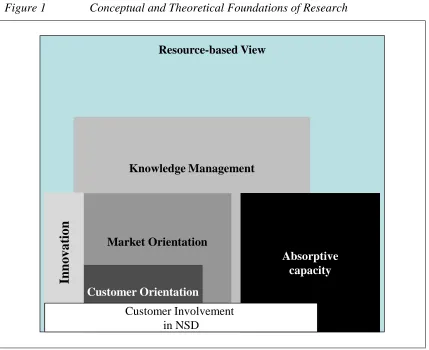
of this study is concerned with the research streams of market orientation,
[image:29.595.109.538.394.744.2]organisation-al learning, knowledge management and innovation (Figure 1).
Figure 1 Conceptual and Theoretical Foundations of Research
Resource-based View
Knowledge Management
Market Orientation
Customer Orientation
Absorptive capacity
Customer Involvement in NSD
In
n
o
v
a
ti
o
All concepts are based on the assumption that internal resources and capabilities, such
as absorptive capacity, determine the internal environment facilitating the achievement
of competitive advantages. Hence, the research models of this thesis build on these
the-oretical concepts and refer to them respectively.
In the next section, we describe the structure of the dissertation and the content of the
1.4
Dissertation Outline
After the introductory chapter, this dissertation outlines the general understanding of the
constructs within which customer involvement in NSD is embedded: (1) new services
and (2) new service development. Chapter 2 describes different perspectives elaborating
the foundations of the concept we study. First, we provide a definition of new services
referring to the degree of newness manifested in a firm’s new service strategy. Second,
we describe three distinct perspectives of new service development: NSD as a (1)
se-quence of tasks, (2) network of individuals and (3) learning process. The chapter
at-tempts to shed light on the organisation and the core elements of NSD.
In chapter 3, existing research on customer involvement in new service development is
summarized. Furthermore, we address current research gaps stressing the need of this
research.
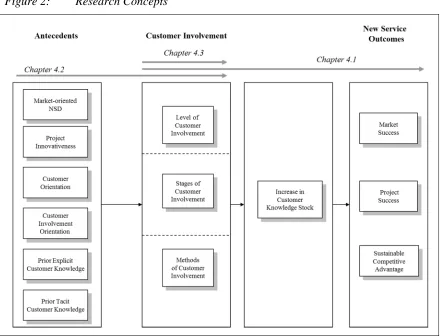
Chapter 4 outlines the concepts of customer involvement in three research models or
parts. The parts are interrelated, but may also be viewed as separate studies. We first
conceptualize the relationships of customer involvement, stock of customer knowledge
and new service outcomes. Then, we hypothesize the relationships between internal
determinants and customer involvement in NSD stages. Finally, we explore distinct
customer involvement management approaches pertaining to the methods and stages of
customer involvement in NSD. Figure 2 illustrates the content of the three sections and
their relationship.
In chapter 5, we report on the development of our constructs and research methodology.
This empirical research is based on expert interviews, an expert survey and a main
The subsequent chapter summarizes the findings of the three studies. Chapter 7
discuss-es our rdiscuss-esults in detail and outlindiscuss-es theoretical and managerial implications. In chapter
8, we point to limitations of our study and suggest approaches for future research. We
close with a synopsis of the main findings about customer involvement in NSD in
[image:32.595.109.549.235.571.2]chap-ter 9.
2
New Services and New Services Development – A Review
2.1
Introduction
Looking into “new services” and “new service development” is central to this research.
We therefore account for this by introducing viewpoints and approaches towards these
two important services marketing realms.
2.2
New Services
In recent years, service competition and development of new services that create
cus-tomer value have become a major challenge in almost every industry. Firms must offer
services to differentiate themselves and adapt to the requirements of prospering service
economies. Services, chiefly associated with service industries and companies whose
core product is a service such as financial services, health care, telecommunication
ser-vices and information technology, refer to “deeds, processes, and performances”
(Zeithaml et al, 2006). Services include “all economic activities whose output is not a
physical product or construction, is generally consumed at the time it is produced, and
provides added value in forms (such as convenience, amusement, timeliness, comfort or
health) that are essentially intangible concerns of its first purchaser” (Quinn et al,
1987). A service is more than its core functions, i.e. the service product or offering,
which is purchased (Johne and Storey, 1998). It also refers to customer service, a
ser-vice or augmented offer that supports a company’s core products (Zeithaml et al., 2006)
and derived services that are provided by any physical good or service offer (Lusch and
Vargo, 2006). The broad perspective on what a service is reflects the wide area of
Easing-total offering from the viewpoint of a customer are crucial for success of novel services.
By seeing services from the customers’ perspective, service managers may identify the
utility or value customers receive by using the service, which is the basis for service
competition (Grönroos, 1990).
Within the past decades, service industries have extended their R&D spending
continu-ally. Although most service firms do not have a formal R&D department, they do
under-take this kind of activity to deliver a stream of new services (Commission of the
Euro-pean Communities, 2007). The growth in R&D investments could be explained by the
circumstance that services can be easily copied resulting in recurrent new service
devel-opment activities to strengthen a firm’s competitive advantage (Easingwood, 1986).
Upon new service strategy definition, firms lay the groundwork for innovations. They
will be in a better position to plan both its development activities and growth on new
services. New service strategies distinguish novel services by their degree of newness
(Zeithaml et al., 2006). Service innovativeness or newness refers “to the degree of
fa-miliarity organizations or users have with a service” incorporating totally new, or
dis-continuous, product/service innovation and simple line extensions or minor
adapta-tions/adjustments that are of an evolutionary, or incremental, nature (e.g. Griffin, 1997).
Distinguishing novel services by newness is vital, since it accounts for the potential
lev-els of risk and uncertainty associated with new service development (De Brentani,
2.3
New Service Development
2.3.1 Introduction
In the literature on Services Marketing, the words “service innovation” and “new
ser-vice development” (NSD) are often used interchangeably, referring to the act of
success-fully inventing and commercialising service products, which are new to the supplier
(Johne and Storey, 1998).
New service development (NSD) is a crucial element within services marketing and a
firm’s new service strategy. The concept is intricate since it incorporates complex
inter-action processes. Key to understanding the interplay of its elements – tasks, actors,
re-sources and knowledge, determinants of successful NSD initiatives, are three different
research approaches prevalent in existing service marketing literature: (1) task and
deci-sion orientation, (2) network concept orientation, and (3) learning process orientation.
2.3.2 New Service Development – A Chronology of Tasks
Much of the research into the NSD has focused on the sequence of different stages in
the development process to account for the necessity of proficiency in successful NSD
(e.g. De Brentani, 1995). Within this formal procedure, series of tasks are executed
dur-ing consecutive and separated or concurrent phases (e.g. Davis, 1993). The NSD
pro-cess is similar to its generic equivalent – new product development - although the
im-portance of the stages may vary due to unique characteristics of services (Johne and
Storey, 1998). Many models have followed the stage-gate process of Booz et al. (1982)
who distinguish five operational phases: (1) idea generation, (2) concept development
and evaluation, (3) business analysis, (4) service development and testing and (5)
mar-ket testing and launch. Each step in the process refers to a checkpoint specifying
de-velopment (Zeithaml et al., 2006). Thus, managers are in the position to allocate
re-sources and manage people and efforts towards the expected results of each phase.
Much of the research has looked into the organisation of different stages in the
devel-opment process (e.g. Scheuing and Johnson, 1989). The debate has revolved around
what stages should be carried out sequentially or concurrently (Alam and Perry, 2002)
to speed up the development process, an important internal performance measure for
achieving “time to market” objectives (Storey and Kelly, 2001). As a corollary to this
process-oriented view, research has started to examine how firms reconcile this process
with their marketing concept to develop market-oriented products and services. This can
be achieved by defining activities that could be performed by customers at each NSD
phase (Appendix 1). Consequently, the new service development process becomes
cus-tomer-oriented (Alam and Perry, 2002).
In recent years, two new perspectives on the NSD process have emerged in the
market-ing literature: (1) the concept of a social network, and (2) the behavioural and cognitive
view of organisational learning.
2.3.3 New Service Development – A Network of Actors
Creativity is a fundamental ingredient in NSD that can be boosted when people join
forces (Beirne and Cormack, 2009). Throughout the NSD process, individuals, e.g.
em-ployees and customers, collaborate and have a share in creating the new service.
Indis-putably, people should be managed to exert their individual contribution to new ideas
and concepts, and to achieve high NSD team performance. Since collaboration is
outcomes: first, who needs to be involved in NSD and second, how should they interact
to create successful new services.
The former concerns the determination of internal and, more important, external actors,
and their roles in NSD, because interdependences within organisations as well as
be-tween organisations and their environment have a significant impact on the service
in-novation process. For example, companies depend on acceptance of their products and
services by their target markets. On the other hand, customers desire products and
ser-vices that satisfy their needs. The exchange of information - internal and external - is
one key factor in this context. The ethos of services is interactivity and relationships.
Services, by their very nature, are developed and consumed as a process with a
multi-plicity of actors (Syson and Perks, 2004): (1) employees, (2) (potential) customers, (3)
suppliers/distributors and (4) boundary spanners – individuals within the organization
who serve as mediators of communication between the NSD team and outside sources
(Lievens and Moenaert, 2000). Actors are defined as those individuals, groups and
or-ganisations that have access to or are in control of resources, i.e. physical, intangible,
financial and human assets. By interacting with each other, they become an integral part
of a network (Syson and Perks, 2004).
The latter refers to the form of interaction that affects the facilitation of resource
ex-change between actors, e.g. obtaining access to specialized skills of customers involved
in NSD. Kristensson et al. (2004, 7) illustrate this effect in their work on user creativity
in NSD: “A deepened interaction between a user and a company may increase the
like-lihood of making new combinations of previously disconnected and unrelated
informa-tional elements. This is because a user who interacts with a company will gain access to
op-portunity of combining this information with the sticky information about the user’s own
needs and setting of use. If users are given information about need-related aspects of a
certain product, then a user can incubate this knowledge and, if motivated, can combine
it with personal needs in the environment“. Thus, interactions are vital in the NSD
pro-cess and a key element of networks (Syson and Perks, 2004).
In summary, the social network perspective illuminates the value of actors and their
interactions in the service innovation process. Unlike the task-oriented view, the social
network perspective is more dynamic and can be more valuable in identifying and
nur-turing appropriate relationships (Syson and Perks, 2004). Furthermore, this view is
helpful for the design of the arena for networks (Gummesson, 2006); that is to say,
de-termining how value is co-created by actors.
2.3.4 New Service Development - A Learning Process
Recent research has addressed the aspect of organisational learning in NSD literature
(e.g. Matthing et al, 2004; Roberts et al., 2005; Stevens and Dimitriadis, 2004) stressing
that knowledge creation needs to be coordinated effectively to achieve desired
knowledge outcomes. While innovating, NSD team members share and improve ideas,
interpret information, experiment and test, tell stories, apply intuitions and share
experi-ences. By doing so, they build collective new knowledge that has the potential to affect
behaviour (Slater and Narver, 1995 adapted from Huber, 1991), and produce new
infer-ences (Nonaka and Takeuchi, 1995). This implies managing the tension between
knowledge previously institutionalised and emerging new knowledge (March, 1991).
Since key characteristics of organisational learning are capabilities and knowledge
knowledge use (e.g. Demarest, 1997; Nonaka and Takeuchi, 1995), the knowledge
crea-tion perspective unleashes new ways of managing the NSD process. According to this
view, NSD managers may focus on what type of knowledge is required and how it
should be combined with capabilities to create customer value. For example, changes in
the marketplace call for a review of existing procedures and the way firms deliver value
to their customers. To respond to these changes effectively, NSD managers conceive the
necessity of changing “routinized actions” and rules leading to cognitive conflicts at the
individual level (Stevens and Dimitriadis, 2004).
By sharing and linking cognitive conflicts and individual perspectives, the NSD team
achieves convergence of representations that lead to new inferences. This learning
pro-cess is based on the diversity in capabilities and knowledge of employees and
custom-ers/suppliers that stimulates new ideas and helps to gain new insights through different
perspectives (Blazevic and Lievens, 2004 adapted from Easterby-Smith, 1997; Garvin,
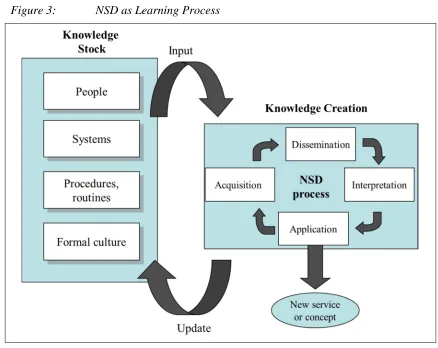
1993). The new service product and update of a firm's stock of knowledge are results of
this knowledge-creation activity (Madhavan and Grover, 1998; Moorman and Miner,
1997). Using existing stock of knowledge and continuously generating new knowledge
are fundamental elements of an organisational learning cycle (March, 1991). Figure 3
illustrates the relationship of knowledge stock and knowledge creation in the context of
new service development. Nonaka and Takeuchi (1995, 3) emphasize the dynamic and
asset-related aspects of knowledge creation: “By organizational knowledge creation we
mean the capability of a company as a whole to create new knowledge, disseminate it
Figure 3: NSD as Learning Process
To summarize, new services are defined by their degree of newness and reflect a firm’s
new service strategy, which influences its new service development initiatives. Three
distinct approaches to expound new service development are prevalent in the literature.
Viewed as a chronology of phases, the service innovation process emphasizes the
coor-dination of tasks and decisions. The network perspective highlights the coorcoor-dination of
people and the importance of managing social interactions. The third view on new
ser-vice development underlines the relationship of innovation and knowledge creation; i.e.
learning.
We consider the network and the knowledge creation perspective as the centre of this
thesis. The customer is viewed as a relevant actor that should be included in NSD (e.g.
out-comes. As a pivotal component, we regard the form of customer interaction, defined as
facets of customer involvement. Hence, an extensive literature review on methods,
stag-es, level and objectives of customer involvement was conducted. It shows the state of
research of managing forms of customer integration that imbues the entire study, and
particularly the third model.
Customer involvement in innovation per se is not a new concept. What is new is the
recognition that customers are knowledge co-creators (e.g. Blazevic and Lievens, 2008;
Prandelli et al., 2008). Hence, our literature review contains a section on customer
knowledge creation manifested in our first model. Finally, since knowledge is a
re-source that creates effects when combined with other firm rere-sources (Kogut and Zander,
1992), e.g. market orientation, we investigate its relative impact on customer
involve-ment. Hence, section 3.4 introduces the resource-based antecedents to customer
3
Customer Involvement in New Service Development – A Review
3.1
Introduction
Although our definition indicates that customer involvement in NSD goes beyond
tradi-tional marketing research, the annual statistic of ESOMAR is the most comprehensive
global source of indicating the significance and use of customer involvement practices.
In 2007, firms spent approx. USD 28 billion on market research. The largest share of
investments is accounted for new product and service development research (ESOMAR,
2008, 59).
The idea of integrating customers in commercial development activities has its
founda-tion in the resource dependence theory (Gruner and Homburg, 2000; Kausch, 2007).
The theory proposes that firms actively determine their own fate by attempting to gain
control over environmental resources. Since customers are viewed as knowledge
carri-ers, i.e. resource-owncarri-ers, firms become dependent on them. Thus, they will seek to
manage dependence and reduce the resulting uncertainty by purposely structuring their
exchange relationships through (semi-)formal links (Pfeffer and Salancik, 1978; Ulrich
and Barney, 1984).
In the past few decades, this view has become an important element of the concept of
market orientation. The central point of this concept is the acquisition and dissemination
of market knowledge, i.e. knowledge about competitors and customers (Marinova,
2004). By employing customer research techniques, firms may collect information to
develop market-oriented products and services (Kok et al, 2003).
The imperative of involving customers in innovation activities has initially been
customer” and its integration in new products has been viewed as a central element in
NPD, because of high failure rates of new products. Some companies claim a maximum
failure rate of 10 per cent (Trott, 2005). However, because of the inherent characteristics
of services, integrating customers in NSD becomes even more important than in NPD.
Services are typically produced and consumed simultaneously. Thus, customer
partici-pation at some level is inevitable in service delivery and co-creation (Zeithaml et al.,
2006). However since customer involvement is a multifaceted construct, managers face
the challenge of determining the “ideal” way of working with customers.
Numerous studies, most of them qualitative in nature, have attempted to shed light on
this issue by looking into how customers are involved in NSD (e.g. Alam, 2006a;
Bam-forth and Brookes, 2002; Durgee et al., 1998; Griffin and Hauser, 1993). Even though
these studies clearly demonstrate the usefulness of particular methods, they have not
brought up a conceptual framework within which the facets of this phenomenon are
embedded. One of the most comprehensive studies has been conducted by Ian Alam.
According to the author, four perspectives describe the concept: (1) modes or methods
of involvement, (2) objectives of involvement, (3) intensity of involvement, and (4)
NSD stages (Alam, 2002). These dimensions set the scope of management decisions on
customer knowledge co-creation to develop successful new services.
3.2
Facets of Customer Involvement in New Service Development
3.2.1 Methods of Customer Involvement
Market-oriented organisations need to develop new intelligence about market
require-ments (Kohli and Jaworski, 1990; Narver and Slater, 1990). This will be achieved by