Full Terms & Conditions of access and use can be found at
http://www.tandfonline.com/action/journalInformation?journalCode=cjhd20
Download by: [Royal Hallamshire Hospital] Date: 11 August 2016, At: 04:38
Journal of Human Development and Capabilities
A Multi-Disciplinary Journal for People-Centered Development
ISSN: 1945-2829 (Print) 1945-2837 (Online) Journal homepage: http://www.tandfonline.com/loi/cjhd20
How Do Aspirations Matter?
Caroline Sarojini Hart
To cite this article: Caroline Sarojini Hart (2016): How Do Aspirations Matter?, Journal of Human Development and Capabilities, DOI: 10.1080/19452829.2016.1199540
To link to this article: http://dx.doi.org/10.1080/19452829.2016.1199540
© 2016 The Author(s). Published by Informa UK Limited, trading as Taylor & Francis Group
Published online: 05 Jul 2016.
Submit your article to this journal
Article views: 136
View related articles
ABSTRACT This paper explores the complex roles of aspirations in relation to human development, drawing upon the capability approach. The paper examines the notion of feasibility of aspirations and the impact feasibility judgements have on aspiration formation and aspiration realization, in terms of both capabilities and functionings. In particular this paper extends existing theory by building on Hart’s dynamic multi-dimensional model of aspiration and Hart’s aspiration set (2012. Aspiration, Education and Social Justice - Applying Sen and Bourdieu. London: Bloomsbury). The theorization builds on empirical work, undertaken in the UK, seeking to understand pupils’ aspirations on leaving school and college at age 17–19 as well as reviewing wider empirical and theoretical literature in thisfield. The discussion contributes to capability theory by extending understanding regarding first, the way that aspirations are connected to capabilities and functionings, secondly, the processes by which aspirations are converted into capabilities and thirdly, how certain capabilities become functionings. The paper reflects on the criteria that inform choices about the cultivation and selection of different aspirations on individual and collective bases. In concluding the paper the question of, “how do aspirations matter?” is addressed. Ultimately, an argument is made for the need to“reclaim”a rich multi-dimensional concept of aspiration in order to pursue human development andflourishing for all.
KEYWORDS Capability approach, Aspirations, Feasibility, Judgement, Human development, Well-being, Capabilities, Functionings
Introduction
Drawing on the capability approach, this paper is focused on building understanding of the nature of aspirations in relation to human development (Sen1992,1999). Outside of the capability literature, measures of aspiration have mainly been linked to educational and career-related achievements (Sewell and Shah 1968; Marjoribanks 1998, 2002; Carter
2001; Appadurai 2004; Hart 2004, 2012; Fuller 2009; Rose and Baird 2013; Hoskins and Barker 2014). According to Carter, “educational aspirations have mostly been studied as a predictor of a variety of outcomes, most notably in relation to education attain-ment and/or attrition”(2001, 11).1For example, comparisons have been made between
© 2016 The Author(s). Published by Informa UK Limited, trading as Taylor & Francis Group
This is an Open Access article distributed under the terms of the Creative Commons Attribution License (http:// creativecommons.org/licenses/by/4.0/), which permits unrestricted use, distribution, and reproduction in any medium, provided the original work is properly cited.
fathers’ education and income and offspring’s aspirations for their own education and working lives (Blau and Duncan1967).
UK policy discourses have similarly tended to position aspirations solely in terms of edu-cational attainment and employment (HEFCE22003,2005,2012; DfES32003,2006; Watts and Bridges2004; Watts2006; Hart2012). A recent report by the National Careers Council for England argues for the need to,“encourage ambition and meet the needs of an aspira-tional nation where opportunity is not blocked by self-doubt, ignorance or confusion” (2013, 12). The report goes on to note the “misalignment of the British youth labour market”judging that, “the ambitions of two infive young people were unrealistic, with young people from disadvantaged backgrounds being nearly twice as likely to suffer from such confusion as their more prosperous counterparts”(ibid., 8). Here misalignment is framed as“confusion”rather than a difference of priority.4This constitutes a kind of hi-jacking and limited framing of aspiration in policy. British Prime Minister, David Cameron (2012, speech, 10 October) has spoken of an“aspiration nation”seeking to shift individual goals towardsfilling labour market gaps through promises of economic reward, and the fear of unemployment. This narrow economic instrumental positioning of aspirations can be viewed as corrosive as it erodes the possibility and value of wider aspirations.
Assumptions are made in government discourses about the possibility of ranking and raising aspirations, but aspirations can relate to many aspects of life. The following quotes indicate some of the young people’s aspirations from Hart’s research (2012),
“I want to be debt-free;” “I want to get out of this city;” “I want to be a drug dealer;”
“I want to be a good Muslim;” “I want to go to university;” “I want tofind inner peace.” These contrasting and diverse aspirations, from young people in UK schools and colleges, resonate with Arun Appadurai’s view that,“aspirations are never simply individual. They are always formed in interaction and in the thick of life”(2004, 67). Hoskins and Barker (2014) found evidence offive common aspirations in their study of 15–19 year olds in two UK state secondary schools (N= 88) including making a difference, personal happi-ness, job satisfaction, status and wealth, indicating that educational and career aspirations were not the only aspirations deemed important. Indeed, there are many forms of aspiration and their roots and purposes vary significantly. For example, on a broader social level, space exploration may be motivated by national priorities for international status and recognition, whereas social movements may be driven by desires to transform society in pursuit of justice in some way. Ladwig, in Unterhalter, Ladwig, and Jeffrey (2014) has argued that in policy arenas, “the rhetoric of aspiration ultimately serves as a diversion from the reality of increasing social exclusion and inequality” (140). Bourdieu and Passeron (2000), Skeggs (2005), Allen and Hollingworth (2013), Reay, David, and Ball (2005) and Reay (1998, 2001), among many other notable sociologists, have all identified the reproduction of class relations through education despite the policy rhetoric. Fuller (2009) concluded from her study of gender, class and aspirations that,“whilst class may indicate what economic resources a family has available it cannot tell us what values and aspirations a family or student has or whether ambitions or dreams will be realised” (161). It is argued here that for fully human development we need a multi-dimensional view of aspiration and a deeper understanding of the combination of influences that precede and shape aspirations and their relationship to capabilities and functionings.
What Are Aspirations?
emotion, idealism or pragmatism? The answers are not at all straightforward since there are many interpretations and applications of the notion of aspiration (Sewell and Shah1968; Ray 2003; Appadurai 2004; Watts and Bridges 2004; Burchardt 2009; Fuller 2009; Ibrahim2011; Hart2012). In different contexts it might be argued that aspirations can be all of these things and more. I would argue that aspirations are future-oriented, driven by conscious and unconscious motivations and they are indicative of an individual or group’s commitments towards a particular trajectory or end point.
Figure 1shows that an individual’s agency with regard to their aspirations may vary from high to low depending on whether their aspirations are in conflict with significant others (such as parents, teachers or senior co-workers). Individuals may enjoy different degrees of agency and control in relation to their aspirations and this is echoed by Slack (2003). Some aspirations may have come about with apparently little influence from others, whilst some aspirations may stem from the strong persuasion of others, or dominant discourses that encourage particular aspirations. Figure 1also illustrates that individuals may have short, medium and long-term aspirations and these may vary in importance both to the individual and to significant others. Furthermore the wave models changing or oscillating aspirations over time.5
Hart’s research (2004,2012) found that aspirations are held concurrently and are rela-tional, they are dynamic, often connected to other aspirations held by the individual as well as by others. Aspirations are multi-dimensional, varying in importance and time-scale. Aspirations may be latent (unarticulated, evolving, abstract and uncertain) and can surface suddenly or emerge slowly. Aspirations may, for example, be institutional, political, legal and shared by family members. Aspirations may relate to home, school, work, national or international life. Whilst aspirations are future-oriented they may also pertain to the continuity of a present state of being. For example, “I want to stay young,” “keep fit,” “be with you forever….” Aspirations change.6 Not all aspirations are in the interests of others and some individuals’ aspirations may provoke criticism, harm or offence. Not all can be condoned in a morally just society that wishes to pre-serve the dignity of all.
The Capability to Aspire
An individual might set their aspirations in relation to what they know they can achieve or they might set aspirations more ambitiously to strive for ways of being and doing they are
not sure of realizing. Some individuals might aspire in a non-specified way in terms of wanting “a better life,” whereas others might strive for specific transformative social change, such as a change in the law.
Hart’s UK study of 580 male and female students aged 17–19 found that one in four indi-viduals reported having aspirations they had never shared with anyone else and a third of the young people said they were sometimes afraid to tell other people about their aspirations (Hart2012). An individual’s revealed aspirations therefore only give a partial view of an indi-vidual’s“aspiration set”(Hart2012). I have proposed that concealed, or unshared, aspirations may also form important elements of an individual’s aspiration set.7Furthermore, aspirations are shaped and constrained by many factors but this is not necessarily readily apparent. Nuss-baum observes, “habit, fear, low expectations and unjust backgrounds deform people’s choices and even their wishes for their own lives”(Nussbaum2005, 114). Hence, both revealed and concealed aspirations may also include a sub-set of“adapted aspirations.”
Aspiring is a sentient and emotive process. Indeed, we are sentient beings—imagining how wefit, what we are capable of and how we feel. Where an individual is able to identify one or more aspirations that they hold, revealed or concealed, this offers evidence of the capability to aspire. Most individuals will be able to demonstrate the functioning of aspiring through the expression of one or more aspirations. However, this tells us little about the full range of the individual’s capability to aspire and constraints or oppressive roots of aspira-tion may not be readily explicit. Aspiraaspira-tions are often born out of unequal power relaaspira-tions that constrain humans to mould themselves in ways that suit perceived expectations of nor-malcy and acceptability. Thinking about future-oriented goals requires at least a basic level of capability in relation to being able to anticipate andimaginethe future and exercise prac-tical reason.8 Martha Nussbaum’s list of Central Human Capabilities (2005, 2011) is immensely helpful in this respect; several capabilities in her list support the development of the complex capability to aspire.
Aspiration and Contentment
variously aspiring, accepting or unsure of their future desires. Moreover, contentment may reflect a dormant status where aspirations in these aspects of life might develop later, perhaps when conditions are more favourable (or again linked to different life stages and so on). Though there may be different reasons why an individual opts for“contentment” not all of these are necessarily positive. It may be an adapted preference due to little per-ceived prospect of change. Aspiration likewise may be born of ambition or optimism but also out of pessimism, frustration or the need to escape a present way of life.
For example, Ray posits that failed aspirations may lead to fatalism (in other words, an acquiescent contentment). Someone may think it is impossible to change their social class and so does not aspire to do so. In another example, someone may reach what I term an
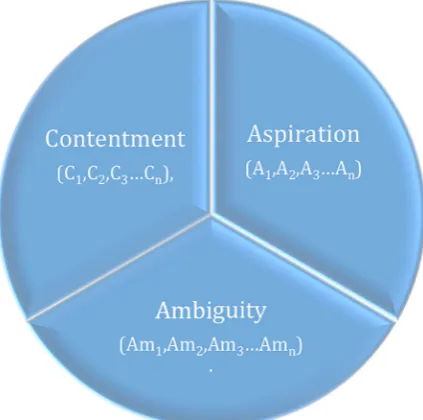
“aspiration plateau” where they have no further aspirations perhaps due to significant accomplishments, past failure, ill health or other priorities.Figure 2illustrates this concep-tualization of the varying balance between aspiration, contentment and ambiguity that indi-viduals may experience during their lives. The sets for contentment (C1, C2, C3,…, Cn),
aspiration (A1, A2, A3,…, An) and ambiguity (Am1, Am2, Am3,…, Amn) aim to illustrate
that there may be different roots of contentment, aspiration and ambiguity for different aspects of a given individual’s life.
Ray developed the idea of a multi-dimensional“aspiration window”and suggests that an,
[image:6.493.140.352.61.271.2]“individual draws her aspirations from the lives, achievements, or ideals of those who exist in her aspirations window”(2003, 2). He argues that these aspirations may relate to many dimensions of life and that individuals might self-impose restrictions and/or weigh the odds of achieving certain goals, based partially on the observation of others. Hodkinson and Sparkes (1996) have described“horizons for action”as another metaphor for the way in which individuals identify the zone of possible action in relation to the ways they might live their lives and the goals they seek to attain. The conceptualizations of Ray and Hod-kinson et al. resonate with Bridges view that:
in choosing what they will do, how they will spend their time or resources or what kind of life they will lead people are affected by, or take into account, for example, what they can afford, the likely responses of others to their choice and the values and prac-tices which shape them and the communities in which they live. (Bridges2006, 1) Ray also argues that the degree of social mobility in a society is likely to impact on the scale of the aspiration window, in other words if it looks like others similar to the individual succeed in achieving particular goals. Insightfully, Oyserman and Markus (1990) concluded from their empirical studies that individuals imagine not only the future they want for them-selves (aspirations) but also the“possible selves”they fear. They argue that avoiding certain kinds of futures is an important impetus for action alongside motivations to achieve desired
“possible selves”(112).
Webb observes that, “there is no one definitive account of what it is to hope”(Webb
2007, 80). In his work on the nature of hope, Webb (2008) has identified a typology of modes of hoping.9Whilst hoping might be viewed as distinct from aspiring, I draw on just two of his modes of hoping to illustrate the way that individuals may enact aspiring based on different judgements of the possibilities of success. This is informative as I take the discussion forward in the next section to consider further how, as individuals and groups, decisions are made about what aspirations are developed in the first place, and whether these receive support in the phases of transition to first capabilities, and then functionings. Webb (2008) describes“estimative hope”and“resolute hope”both as
“hope directed toward an object of desire which is future-oriented and deemed to be of sig-nificance to the hoper”(203). The distinction comes in the behaviours associated with the two modes of hoping: estimative hopers identify,“some hopes may be worth the risk of actively pursuing if, on the basis of one’s probable estimate, these are deemed more than fair gambles”(ibid., 203). However, resolute hopers,“strive to realize goals that the estima-tive hoper would have dismissed as less than fair gambles” (ibid., 203). Whilst Webb’s modes of hoping are aligned with Ray’s idea of weighing up the odds it highlights that different individuals may approach the task in more or less risk averse ways. Indeed, Webb observes,“our hopes may be active or passive, patient or critical, private or collec-tive, grounded in the evidence or resolute in spite of it, socially conservative or socially transformative”(2007, 80). It is also the case, I suggest, that the same individual may be more or less risk averse in relation to different aspects of their life, or in relation to others, or in collective decision-making. Although I am not suggesting that aspiring is the same as hoping (though they bear similarities), this reflection becomes particularly sig-nificant when individuals are tasked with making judgements in relation to aspirations which affect individuals beyond themselves (a point to which I will return later).
Connecting Aspirations to Capabilities and Functionings
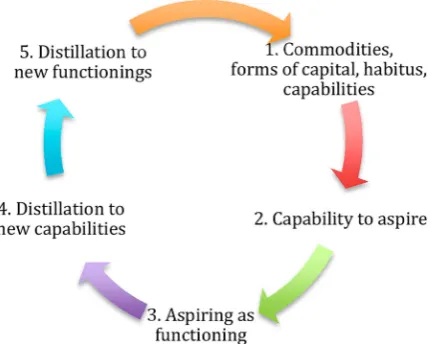
Having given a broad overview of my conceptualization of aspirations, I now move to con-sider how aspirations are connected to capabilities and functionings. It is not enough to look solely at the functioning of aspiring in order to understand an individual’s agency and freedom. It is also crucial to understand the degrees of freedom to aspire enjoyed by indi-viduals, alongside the chances of transforming the aspiration into a capability. The function-ing of aspirfunction-ing arguably sits between the freedom to aspire and the capability to achieve the particular aspiration. Thus aspirations are powerfully situated as the forerunners to many capabilities (Figure 3).
roots of values. Bourdieu argued that our (pre)dispositions may be strongly influenced by what he termed, habitus, cultural and other forms of capital, our interactions with others and the configurations of power relations in different fields that we encounter. Through pro-cesses of socialization individuals are inculcated with the traditions, customs, norms, values and practices of their families and communities. How deterministic these disposi-tions and influences are has been a question troubling sociologists for many years, but one that deserves attention as we think about aspiration and capability formation.
Bourdieu’s work complements Sen’s capability approach by offering a more dynamic interactive understanding of the conversion factors helping and hindering the development of aspirations and capabilities.10The choice of aspirations might be influenced to varying degrees by what Bourdieu called the“habitus”of an individual. Habitus is related to the cultural and familial roots from which a person grows. Bourdieu explained that habitus,
“operates below the level of calculation and consciousness”and that the, “conditions of existence”influence the formation of habitus which is manifested in the agent’s“tastes, practices and works thus constituting a particular lifestyle”(2010, 167). “The habitus is necessarily internalized and converted into a disposition that generates meaningful practices and meaning-giving perceptions”(Bourdieu2010, 166). This could impact on the kinds of aspirations that individuals, including those in roles of public office,find meaningful.
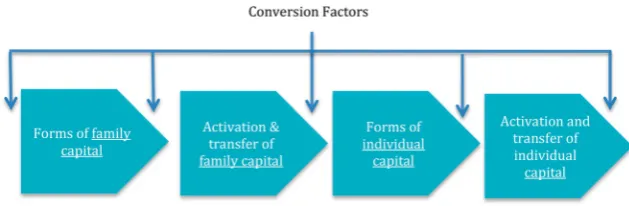
[image:8.493.140.356.61.233.2]Bourdieu conceptualized different forms of capital rather than solely the economic form of capital used elsewhere (1986). His conceptualization enriches understanding of the body of commodities and resources that may be converted into aspirations and capabilities.11 Bourdieu theorized that capital may be accumulated through intergenerational transfers of different forms of capital from adults to their offspring. This was linked to the possibility of a family drawing on one form of capital in order to generate another form. For example, economic capital might be converted into cultural capital through the purchase of books and immersion in culture-rich activities (e.g. music lessons). However it is important to note that access to, and activation of family capital varies among different individuals and is not guaranteed (Laureau and Horvat1999; Marjoribanks2002). In addition, Sen foregrounds the way that,“behaviour depends not only on our values and predispositions, but also on the hard facts of the presence or absence of relevant institutions, and on the incentives— prudential or moral—they generate”(Sen 2004, 43). He further argues that, “value for-mation is an interactive process”(ibid., 42) and, similarly, I would argue aspiration for-mation is an interactive process (Figure 4).
Multiple conversion factors affect the freedom an individual has to aspire and the kinds of aspirations they develop. The conversion factors may include the interaction of an indi-vidual’s characteristics, values and dispositions, their forms of capital and resources, their social context and cultural influences as well as the physical setting with its structures and institutions, environmental features and location relative to other places and spaces of social action. Further conversion factors act to influence whether aspirations are transformed into capabilities and functionings. A distillation process occurs both from aspiration to capa-bility and capacapa-bility to functioning (Figure 3). Whilst a large bundle of aspirations may be converted into capabilities for a given individual it will not necessarily be the case that all of these aspirations can be realized and certain functionings will preclude others. Ultimately, an aspiration set will include some but not all of the precursors to the capabili-ties an individual enjoys. Some capabilicapabili-ties will be enjoyed from birth or pre-aspiration— such as the freedom to live, to be treated with dignity, the freedom to play and so on.
The Judgement of Aspirations
Individual and significant others’conscious and unconscious engagement in judgements regarding the feasibility of aspirations is pivotal in the development of capabilities, and it is to this matter that I now return.“Individual aspirations are born in a social context, they do not exist in a vacuum”(Ray2003, 9). Some aspirations are mutually exclusive and do not affect anyone other than the aspirers but many others are mutually dependent or contrary to one another. These latter aspirations give cause to think further on how societies resolve which aspirations to support individuals and groups in pursuing at family, institutional, local, national and international levels. For example, in times of austerity, how should policy-makers cut public spending? What kinds of society do citizens aspire to support, and how can resources be channelled accordingly? Deciding which of multiple aspirations a community or society can, or should, pursue is complex.Table 1illustrates examples of different reasons why people may object to certain aspirations being pursued.
Ron Barnett, writing on the development of higher education, uses the concept of“ feas-ible utopia.”He observes:
The real and the unreal, the concrete and the abstract, the here-and-now and the distant, the experienced and the imagined, the possible and the impossible: all these relation-ships, then, constitute the ground before us. And all these relationships and this ground are opened up by the idea of feasible utopias. A feasible utopia is just what is indicated by the phrase; a utopia that is also feasible. (Barnett2013, 26)
[image:9.493.87.402.57.160.2]This concept of feasible utopia is helpful in illuminating the space between here and there, between the present state of affairs and the transcendental sublime, perhaps idealistic future.
The suggestion that we should reach far, but not too far is appealing. But who should decide where is far enough? What criteria are to be used? How are disagreements or uncertainties to be addressed? How do we make choices about aspiration formation, transformation to capabilities, and transformation of capabilities to functionings? Judgements of the feasi-bility of aspirations may impact on the formation of aspirations in the first place. They also impact on the way in which resources are mobilized, support and encouragement given, and the self-belief of individuals and groups of aspirers.
Sen has proposed that establishing mechanisms for democratic deliberation is vital (1999) but thereafter what strategies might be advocated? There is a trend in the UK towards “evidence-based” practice and this is similar in many other national and inter-national contexts. Thus the criteria for feasibility of, for example, funding a drug trial, medical intervention or medicine are dependent on robust clinical evidence, “value for money” and so on (NICE12 2013). Such evidence-based criteria are responsive to demands for accountability in the way that limitedfinancial, human and other resources are deployed for the perceived public good. This may make it difficult for individuals or collectives to act as “resolute hopers”as described earlier, drawing on Webb (2008).13 Second-guessing is common at the pre-aspiration formation stage as well as in the stage between aspiration formation and the pursuit of conversion to capability and functioning. This happens at the level of the individual, and at the macro social level. Indeed, there are three crucial stages at which judgements about feasibility impact on aspiration for-mation, first, pre-aspiration, secondly, aspiration-capability conversion factors and thirdly, the combinations of functionings determined to be feasible. Who is making decisions, their statuses, the roles they play and the identification and cultivation of aspira-tions and capabilities are all crucial elements in the way societies develop and individuals are able to achieve well-being. The three stages are briefly summarized here before going on to further explore collective judgements regarding aspirations, feasibility and wider society.
Pre-aspiration
[image:10.493.66.424.70.201.2]the end of thefirst year. Another study by Mettler (2014) found evidence that low-income high achievers less familiar in higher education performance and application strategies, did not apply to elite institutions in the same numbers as their more affluent peers.
Aspiration to Capabilities
One research participant in Hart’s (2012) research talked about getting“a reality check”as they got older. There is a suggestion that there are boundaries for a given individual, and that over time one becomes more aware of where the boundaries lie. Different players have roles in the social construction of the boundaries of what might be possible and once lines are drawn in the sand about what is and is not possible they may be hard to change. But as James Baldwin so eloquently points out:
the impossible is the least that one can demand—and one is after all, emboldened by the spectacle of human history in general, and American Negro history in particular, for it testifies to nothing less than the perpetual achievement of the impossible. (Baldwin
1963, 104 in Johnson 2002)
Perceptions of feasibility are arguably subjective and we see pervasive racial, gendered and class-based inequalities in terms of who is seen to be suitable for senior roles and who gets chosen, for example, for the judiciary, senior academic roles or political office (Sutton Trust
2009).
Choosing Combinations of Functionings
Certain functionings may preclude others so that even where a wide degree of freedom exists, only particular combinations of functionings can be possible since, on the one hand, there is only so much one person, organization or nation can do withfinite resources. On the other hand, combinations of functionings at the individual and macro levels ideally need tofit with wider social conditions and the aspirations of others.
Aspirations, Feasibility and Wider Society
Committees, community groups and democratically elected political representatives invoke different methods for determining policy in relation to public aspirations, including those of majority and minority groups. There is little evidence of how individuals or collectives give weight to different aspirations, or how they judge the potential of different combinations of functionings. The decision maker’s position and role are significant. Position refers here to title and function, for example as teacher, parent, chief executive, politician. Role refers here to the manner adopted by the individual to carry out the positional duties. So, for example, this might be as a compassionate (or dictatorial) leader or philanthropist (or mer-cenary), other-regarding (or self-regarding) on a local, national or international scale. Habitus is constituted by an individual’s embodied dispositions manifested in the way they view the world. Thus different individuals may judge different aspirations, and in turn different combinations of functionings, as more or less appropriate.
Magone in Vogel (2012) observes that:
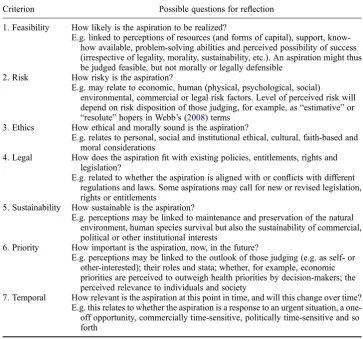
This illustrates that judgements about which aspirations to pursue may not be made in iso-lation but in reiso-lation to the perceived necessity to comprise.Table 2summarizes some of the criteria that might be used to inform such judgements, illustrating the idiosyncratic nature of the judgement process. It is argued here that the way that each individual reaches their jud-gement has to date been under-theorized in terms of the subjectivities and power dynamics at play. In addition, the social choice literature has foregrounded the difficulty in aggregat-ing individually rationalized preferences (Sen1977; Arrow, Sen, and Suzumura1997).
A crucial question is to what extent should criteria such as those outlined inTable 2infl u-ence judgements about the validity and choice of aspirations that are to be encouraged and supported? Even if it was thought that a set of criteria was helpful, Nussbaum argues feasi-bility should not determine aspirations (2015) but that aspirations should drive action. I agree that aspirations can act as powerful engines of progress and that we should absolutely not be limited in relation to the current status quo. For example in relation to civil rights (e.g. African-American civil rights movement), human endeavor (e.g. landing on the moon), sporting achievement (e.g. the four minute mile), changing the law (e.g. abolishing slavery, equal voting rights for men and women) and so forth. Changes would not have occurred without pushing the limits of what was known to be possible. So asking whether an aspiration is“feasible”does not necessarily help in determining whether or
E.g. relates to personal, social and institutional ethical, cultural, faith-based and moral considerations
4. Legal How does the aspirationfit with existing policies, entitlements, rights and legislation?
E.g. related to whether the aspiration is aligned with or conflicts with different regulations and laws. Some aspirations may call for new or revised legislation, rights or entitlements
5. Sustainability How sustainable is the aspiration?
E.g. perceptions may be linked to maintenance and preservation of the natural environment, human species survival but also the sustainability of commercial, political or other institutional interests
6. Priority How important is the aspiration, now, in the future?
E.g. perceptions may be linked to the outlook of those judging (e.g. as self- or other-interested); their roles and stata; whether, for example, economic priorities are perceived to outweigh health priorities by decision-makers; the perceived relevance to individuals and society
[image:12.493.64.428.73.412.2]not to support it. Similarly, in judging how“risky”an aspiration is, different individuals will potentially draw varied conclusions. So whilst the criteria inTable 2are offered as a model for reflection, it is by no means being suggested that they ought to be directive. Having said that Zak’s observation may be of concern to some that,“people will invest scarce cognitive resources in solving a decision problem only when the expected pay-off is sufficiently large”(55). Zak argues people are rationally rational in that they will only put the effort into rationalizing decisions when it is “worth” it (Zak 2011a). It might be that a greater awareness of the strategies, knowingly and unknowingly invoked, could reduce the often arbitrary nature of the judgement and pursuit of aspira-tions. It also might help decision-making bodies articulate the manner in which they have reached judgements about aspirations and related policies. For example, whether they are highly aspirational as Nussbaum advocates (2015) or low-risk options that might bring limited change.
Negotiation and Trade-offs
We also need to understand what the“non-negotiables”(hard lines) are when looking at feasibility. When a parent says no, when an employer asks for a qualification we do not possess, when a post is advertised full-time and not as a job share—some might be better at negotiating than others, thus bending the boundary for feasibility. Here is how Medicin Sans Frontiers approaches negotiation:
Negotiation frameworks do not include universal markers indicating the line that must not be crossed: and MSF must therefore pay attention to the developing dynamic of each situation and to its own ability to revoke compromises that were only acceptable because they were temporary’ …for example, keeping silent about oppressive policies in the interests of gaining access to a population. (Magone in Vogel2012, 1)
Trade-offs are common to secure what is perceived as the best possible combination of functionings even though this may result in a significant sacrifice.
An example of a political trade-off comes from Medicins Sans Frontiers who commen-ted,“if you take sides in Somalia, for example, your operations in Pakistan and Afghanistan will certainly be affected”and they report that by not criticizing,“MSF was able to carry off a large-scale HIV treatment program that otherwise might not have been possible”(Vogel
2012, 2).
In another example Deprez and Butler (2007) consider women’s access to higher education in the USA. They observe that welfare reforms have limited low-income access to higher edu-cation, particularly among females. In this case the trade-off for welfare reforms is that gender inequalities in access to higher education have been allowed to rise. It is possible that this is an unintended consequence of the policy change but nonetheless a trade-off occurs illustrating the interconnectedness of aspirations across different aspects of social life.
Fitzgerald asks, can we create a system, “within which cooperative stakeholders can interact while promoting the identification of mutually satisfactory and ‘fair’solutions, ideally one that minimizes the ability of the participants to ‘game’ the system in their favor” (2013, 344). An example is provided by looking at compromise solutions between conservation and road-building in the tropics. Tropical and sub-tropical countries, contain most of the world’s biodiversity and a wealth of other natural resources”(Caro et al.
driven by self-interest. It has been argued by Nyberg and Wright (2013) that rather than pro-tecting the environment, often corporate sustainability initiatives actually serve to,“ facili-tate the social corruption of the social good of the environment and its conversion into a market commodity”(405).
According to Zak it seems that the institutional context is also important since he argues that,“moral sentiments can be promoted or inhibited by the organizational environment in which onefinds oneself”(2011a, 62) and“designing institutions to foster trust and happi-ness is an important goal”(ibid., 63). So perhaps what this brief survey of the literature illustrates is that specific individuals may have a propensity to be self-interested, other-interested or be prepared to seek compromise. However, these individuals’ dispositions may be influenced both by long-standing habitus, and cultural preferences, as well as by the contemporaneous environment in which theyfind themselves.
How Do Aspirations Matter?
Aspirations matter as signifiers of what has come to have meaning and value for us, as indi-viduals, or as social groups. They offer guidelines and navigational reference points, lode stars for action. However, aspirations in themselves tell us little about the histories, power dynamics and discourses, norms, values and cultures that have shaped, enhanced, dimin-ished and adapted them. As Bourdieu reminds us our predispositions may be strongly infl u-enced by habitus, cultural and other forms of capital, our interactions with others and the configuration of power relations in a givenfield or social context. Thus aspirations mean little without origins and location in existing power structures, legal entitlements, customs and social practices, institutional and national priorities. The individual’s position in the power structures will be significant alongside their role as philanthropist, judge, manager and so forth.
Aspirations matter because they are a manifestation of the freedom to aspire which is valuable for humanflourishing in its own right. Aspirations also arguably constitute the kernels or precursors of many important capabilities which support human flourishing. The stifling or constraint of aspiration is ultimately linked to the constraint of at least some capability or other. The kinds of aspirations we have influence the kinds of capabili-ties for which we strive. Thus control in the development of aspirations can indirectly impact on an individual’s well-being freedom.
Social aspirations can set the course of public action, policy, investment, regulation, legis-lation or act as a rallying cry for justice and freedom. But whilst social aspirations can gal-vanize families, communities and nations, they can also polarize them. Communal or dominant social aspirations are not always good and we have seen this in relation to the persecution and subordination of minority or vulnerable groups in different societies throughout history. So not all shared aspirations have the public good or social justice at their heart and there may well be conflicting individual and shared aspirations within any given community. Thus group aspirations arguably matter for social justice only in as much as the benefits accruing in the pursuit and realization of the aspirations are distributed equitably, and the costs and risks borne are equitably shared. All too often corporate, civic, national and global dreams have been realized through the unjust hardship of particular sec-tions of society. In turn those who have made the greatest sacrifice have not enjoyed the fruits of their labour.
Concluding Remarks: The Future of Human Development
This paper has provided a stimulus for reflecting on and evaluating individual and collective practices in aspiration formation, cultivation and transformation. How individuals approach their roles as educators, policy-makers, parents and lawmakers is influenced by how aspirations are conceptualized. Acknowledging that not all aspirations can be realized and that choices have to be made, the discussion presented here challenges policy-makers and other community repre-sentatives to be more explicit about the criteria by which aspirations are both judged and deter-mined. Whose aspirations have the right toflourish above others? Who should have agency over children’s aspirations? How should judgements be made about which aspirations are to be constrained as not in the public interest? If governments take on the role of determining and shaping aspirations, then what is a just basis for that evaluation?
Feasibility is subjective, social situated (alongside other competing priorities of the indi-vidual, others known and unknown, institutions, governments and so forth). Feasibility varies according to the agent, for example, their know-how, contacts, ability to mobilize resources and different forms of capital, ability to trouble-shoot and problem-solve will differ. Thus in principle it isfine to set the aspiration bar high but we need to develop effec-tive strategies,14and milestones en route, to support the pursuit of those aspirations.
The capability approach enables us to articulate aspirations in a way that helps to counter narrow policy discourses on aspirations. In concluding this paper I suggest that aspirations are vital to human development and yet their complexity presents a number of challenges. There are challenges related to the development and protection of the freedom to aspire, the challenge of supporting the transformation of aspirations into capabilities, the dilemmas related to the judgement of feasibility and the roles of aspiring in relation to both capability and functioning.
Humans have achieved many seemingly impossible dreams underlining the difficulty of determining feasibility in a just manner. Indeed, the roles of science and technology are con-stantly challenging what may be possible in human endeavours. This may ultimately broaden the focus of attention on feasibility to include wider ethical issues, for example regarding artificial intelligence and the impact of our aspirations on other humans, other species and the natural world. Advances in science, medicine and technology call upon us to think cautiously about the consequences of our actions today and into the future. Although we may have the power to fulfil our own aspirations there is a moral question about the impact on the freedom of others to live long, healthy andflourishing lives.
The work is informed by a range of literature within and beyond the capability approach and it draws on empirical work conducted in the UK with young people transitioning from school and college to the wider world. I have also proposed a model for reflecting further on the ways in which individuals and groups might think about the merits of particu-lar aspirations and why they might favour some over others. This model is conceptual and unlikely to be exhaustive, but rather indicative of the strategies that inform common prac-tices in decision-making, consciously and unconsciously. Further research is needed to test this reflexive model in different contexts but in the first instance the aim is to stimulate debate in an important yet under-researched field. I have not been able to give much needed attention to questions of weighting or aggregation of individual preferences during collective decision-making processes. Indeed, the problems of the aggregation, com-parison and ordering of preferences, and choices, have been taken up in the social choice theory literature by others much better placed to do so (Sen1977; Arrow, Sen, and Suzu-mura1997). Suffice it to say here that if individuals and groups were to become more aware and reflexive about the means by which they arrive at aspiration preferences, both on an individual and collective basis (and pertaining to themselves as well as to others’ aspira-tions), this might have the possibility of reducing some of the prejudice in developing and realizing aspirations that often exists between social groups, across the life course and with regard to different national and international contexts. Human development might be the better for it.
Acknowledgements
This paper is based on a keynote paper I presented at theAspirations Symposiumof the Human Development and Capability Association annual conference held at Georgetown University, Washington, DC on 10 September 2015. I am grateful to the many colleagues and friends who have discussed ideas in this paper, within the HDCA and beyond. Special thanks to Ollie, Jasmine and Martha.
Disclosure Statement
No potential conflict of interest was reported by the authors.
Notes
2. Higher Education Funding Council for England.
3. Department for Education and Skills, a former UK government department.
4. Later in this paper the issue of who should judge aspirations and the criteria for such judgements will be further explored.
5. The dynamic multi-dimensional model of aspiration was developed in light of empirical work conducted in England in 2003–2004 (Hart2004). The survey sample included 14–17 year olds in an 11–18 comprehensive school in Bradford (N= 238, 82% response rate).
6. In other work I have considered the implications of adapted preferences on the formation and conversion of aspirations. This issue has also been taken up by others, see for instance Bridges (2006).
7. An aspiration set will include some but not all of the precursors to the capabilities an individual enjoys. Some capabilities will be enjoyed from birth or pre-aspiration, the freedom to life, to be treated with dignity, live in a Malaria-free country, etc.
8. Imagination and practical reason are both on Nussbaum’s list of central capabilities.
9. See Webb (2007,2008,2009) for more detail on modes of hoping and the relationship of hoping to utopias. His work offers a fascinating insight into literature on these subjects with potential to inform thinking on the nature of aspiring, aspirations and capabilities.
10. See Hart (2012, 49–64) for further elaboration.
11. Economic capital may be generated through inherited wealth, family income or engagement in the economy forfinancial return. Social capital is accrued through social networks, the family and wider community inter-actions. Symbolic capital is manifested as individual prestige and authority (Bourdieu1986). In terms of cul-tural capital, Bourdieu explained:
Cultural capital can exist in three forms: in the embodied state, i.e., in the form of long-lasting disposi-tions of the mind and body; in the objectified state, in the form of cultural goods (pictures, books, dic-tionaries, instruments, machines, etc.), which are the trace or realization of theories or critiques of these theories, problematics, etc.; and in the institutionalized state, a form of objectification which must be set apart because, as will be seen in the case of educational qualifications, it confers entirely original prop-erties on the cultural capital which it is presumed to guarantee. (Bourdieu1986, 7)
12. The National Institute for Health and Care Excellence (NICE) is a public body under the auspices of the UK Department of Health.
13. I was intrigued recently to hear how Sir David Attenborough had pursued his aspiration, in 1956, tofilm a Komodo dragon in its natural habitat. He was uncertain of how to get to the remote Indonesian island of Komodo, what means of transport might be available to get there and whether thefilm equipment and crew could survive the conditions. He recounted an incredible journey which on the face of it seemed unfeasible, risky and ethically questionable (Attenborough2016).
14. See Hart (2014) for further discussion of conversion factors and structures, processes and techniques of tran-sition (scoping, mapping, planning and navigation).“Possible combinations of functionings are mediated by synchronous and asynchronous configurations of conversion factors that shape the degree to which the indi-vidual is able to convert resources and other forms of capital into aspirations, capabilities and, ultimately, func-tionings”(Hart2014, 201).
References
Allen, K., and S. Hollingworth.2013.“Social Class Place and Urban Young People’s Aspirations for Work in the Knowledge Economy:‘Sticky Subjects’or‘Cosmopolitan Creatives’?”Urban Studies50 (3): 499–517. Appadurai, A.2004.“The Capacity to Aspire: Culture and the Terms of Recognition.”InCulture and Public
Action, edited by V. Rao and M. Walton, 59–84. Palo Alto, CA: Stanford University Press.
Arrow, K. J., A. Sen, and K. Suzumura.1997.“Social Choice Re-examined Volume I.”Proceedings of the IEA conference held at Schloss Hernstein, Berndorf.
Attenborough, D. 2016.“Zoo Quest in Colour.” BBC 4, M. Gunton (Executive Producer) & A. Schofield (Producer), BBC’s Natural History Unit, May 11, 2016.
Baldwin, J.1963.“The Fire Next Time.”InAcres of Aspiration—The All-black Towns in Oklahoma, edited by H. B. Johnson (2002), 104. Fort Worth: Eakin Press.
Barnett, R.2013.Imagining the University. London: Routledge.
Bendor, J., D. Mookherjee, and D. Ray.2001.“Aspiration-based Reinforcement Learning in Repeated Interaction Games: An Overview.”International Game Theory Review3 (23): 159–174.
Students. New York: Routledge Falmer.
Department for Education and Skills.2003.White Paper: The Future of Higher Education. London: DfES. Department for Education and Skills.2006.Widening Participation in Higher Education. Nottingham: DfES. Deprez, L. S., and S. S. Butler.2007.“The Capability Approach and Women’s Economic Security: Access to
Higher Education under Welfare Reform.” InAmartya Sen’s Capability Approach and Social Justice in Education, edited by M. Walker and E. Unterhalter, 215–236. Basingstoke: Palgrave Macmillan.
Fitzgerald, M. E., and A. M. Ross.2013.“Guiding Cooperative Stakeholders to Compromise Solutions Using an Interactive Tradespace Exploration Process.”Procedia Computer Science16: 343–352.
Fuller, C.2009.Sociology, Gender and Educational Aspirations: Girls and Their Ambitions. London: Bloomsbury. Hart, C. S.2004.“A Study of Students’Aspirations and Needs in Relation to Aim Higher Widening Participation
Policy.”MPhil thesis, University of Cambridge.
Hart, C. S.2012.Aspirations, Education & Social Justice—Applying Sen & Bourdieu. London: Bloomsbury. Hart, C. S. 2014.“Agency, Participation and Transitions Beyond School.” InAgency and Participation in
Childhood and Youth—International Applications of the Capability Approach in Schools and Beyond, edited by C. S. Hart, M. Biggeri, and B. Babic, 181–203. London: Bloomsbury.
Higher Education Funding Council for England.2003.HEFCE Strategic Plan 2003–2008. London: HEFCE. Higher Education Funding Council for England. 2005. Young Participation in Higher Education. London:
HEFCE.
Higher Education Funding Council for England.2012.Statement on Widening Participation. Accessed January. www.hefce.ac.uk.
Hodkinson, H., and A. Sparkes.1996.Triumphs and Tears: Young People, Markets and the Transition from School to Work. London: David Fulton Publishers.
Hoskins, K., and B. Barker.2014.Education & Mobility—Dreams of Success. London: Trentham Press. Ibrahim, S.2011.Poverty, Aspirations and Wellbeing: Afraid to Aspire and Unable to Reach a Better Life—Voices
from Egypt. BWPI Working Paper No. 141, University of Manchester.
Laureau, A., and E. M. Horvat.1999.“Moments of Social Inclusion and Exclusion, Race, Class and Cultural Capital in Family School Relationships.”Sociology of Education72: 37–53.
Magone, C. quote in Vogel, L.2012.“The Art of Necessary Compromise.”Canadian Medical Association Journal
184 (5): E252, 1–2.
Marjoribanks, K.1998.“Family Background, Social and Academic Capital and Adolescents’Aspirations: A Mediational Analysis.”Social Psychology of Education2: 177–197.
Marjoribanks, K.2002.Family and School Capital: Towards a Context Theory of Students’School Outcomes. Dordrecht: Kluwer.
Mettler, S.2014.Degrees of Inequity. Philadelphia, PA: Perseus Books Group.
National Careers Council.2013.“An Aspirational Nation—Creating a Culture Change in Careers Provision,”June. NICE (National Institute for Health and Care Excellence).2013.“Judging Whether Public Health Interventions
Offer Value for Money (NICE).”https://www.nice.org.uk/advice/lgb10/chapter/introduction.
Nussbaum, M. C.2005.“Capabilities as Fundamental Entitlements: Sen and Social Justice.”InAmartya Sen’s Work and Ideas—A Gender Perspective, edited by B. Agarwal, J. Humphries, and I. Robeyns, 35–62. London: Routledge.
Nussbaum, M. C.2011.Creating Capabilities. The Human Development Approach. Harvard: Belknap, Harvard University Press.
Nyberg, D., and C. Wright.2013.“Corporate Corruption of the Environment: Sustainability as a Process of Compromise.”The British Journal of Sociology64 (3): 405–424.
Oyserman, D., and H. R. Markus.1990.“Possible Selves and Delinquency.”Journal of Personality and Social Psychology59 (1): 112–125.
Ray, D.2003.Aspirations, Poverty and Economic Change. New York: New York University and Instituto de Analisis Economico (CSIC).
Reay, D.1998.“‘Always Knowing’and‘Never being Sure’: Familial and Institutional Habituses and Higher Education Choice.”Journal of Education Policy13 (4): 519–529.
Reay, D.2001.“Finding or Losing Yourself: Working Class Relationships to Education.”Journal of Education Policy16 (4): 333–346.
Reay, D., M. David, and S. Ball.2005.Degrees of Choice: Class, Race, Gender and Higher Education. Stoke on Trent: Trentham.
Rose, J., and J.-A. Baird.2013.“Aspirations and an Austerity State: Young People’s Goals for the Future.”London Review of Education11 (2): 157–173.
Sen, A. K.1977.“Social Choice Theory: A Re-examination.”Econometrica45 (1): 53–89. Sen, A. K.1992.Inequality Re-examined. Oxford: Clarendon Press.
Sen, A. K.1999.Development as Freedom. Oxford: Oxford University Press.
Sen, A. K.2004.“How Does Culture Matter.”InCulture and Public Action, edited by V. Rao and M. Walton, 37– 58. Stanford: Stanford University Press.
Sewell, W. H., and V. P. Shah. 1968. “Socioeconomic Status, Intelligence and the Attainment of Higher Education.”Sociology of Education40 (1): 1–23.
Skeggs, B.2005.“The Making of Class and Gender Through Visualizing Moral Subject Formation.”Sociology39: 965–982.
Slack, K.2003.“Whose Aspirations Are They Anyway?”The International Journal of Inclusive Education7 (4): 325–335.
Southgate, B.2012.Contentment in Contention: Acceptance Versus Aspiration. Basingstoke: Palgrave Macmillan. Sutton Trust.2009.The Educational Backgrounds of Leading Lawyers, Journalists, Vice Chancellors, Politicians, Medics and Chief Executives. The Sutton Trust (Submission to the Milburn Commission on Access to the Professions).
Unterhalter, E., J. Ladwig, and C. Jeffrey.2014.“Decoding Aspirations: Social Theory, the Capability Approach and the Multiple Modalities of Education.”British Journal of Sociology of Education 35 (1): 133–145 (Review Symposium: Aspirations, Education and Social Justice. Hart, C. S., London: Bloomsbury). Vogel, L.2012.“The Art of Necessary Compromise.”Canadian Medical Association Journal184 (5): E252–
E253.
Watts, M.2006. “Disproportionate Sacrifices: Ricoeur’s Theories of Justice and the Widening Participation Agenda for Higher Education in the UK.”Journal of Philosophy of Education40 (3): 301–312.
Watts, M., and D. Bridges.2004.Whose Aspirations? What Achievement? An Investigation of the Life and Lifestyle Aspirations of 16–19 Year Olds Outside the Formal Education System. Cambridge: Centre for Educational Research and Development, Von Hugel Institute.
Webb, D.2007.“Modes of Hoping.”History of the Human Sciences20 (3): 65–83.
Webb, D.2008.“Exploring the Relationship Between Hope and Utopia: Towards a Conceptual Framework.”
Politics28 (3): 197–206.
Webb, D.2009.“Where’s the Vision? The Concept of Utopia in Contemporary Educational Theory.”Oxford Review of Education35 (6): 743–760.
Zak, P. J.2011a.“The Physiology of Moral Sentiments.”Journal of Economic Behaviour & Organisation77: 53–65. Zak, P. J.2011b.“Moral Markets.”Journal of Economic Behaviour & Organisation77: 212–233.
About the Author