City, University of London Institutional Repository
Citation
:
Tsavdaridis, K. D., D'Mello, C. and Huo, B. Y. (2013). Experimental and computational study of the vertical shear behaviour of partially encased perforated steel beams. Engineering Structures, 56, pp. 805-822. doi: 10.1016/j.engstruct.2013.04.025This is the accepted version of the paper.
This version of the publication may differ from the final published
version.
Permanent repository link:
http://openaccess.city.ac.uk/14017/Link to published version
:
http://dx.doi.org/10.1016/j.engstruct.2013.04.025Copyright and reuse:
City Research Online aims to make research
outputs of City, University of London available to a wider audience.
Copyright and Moral Rights remain with the author(s) and/or copyright
holders. URLs from City Research Online may be freely distributed and
linked to.
City Research Online: http://openaccess.city.ac.uk/ [email protected]
EXPERIMENTAL AND COMPUTATIONAL STUDY OF THE VERTICAL SHEAR BEHAVIOUR OF
PARTIALLY ENCASED PERFORATED STEEL BEAMS
Konstantinos Daniel Tsavdaridis1*, Cedric D’Mello2
1School of Engineering and Mathematical Sciences, City University London, EC1V 0HB, UK, Office: C354, E-mail:
2 School of Engineering and Mathematical Sciences, City University London, EC1V 0HB, UK, Office: C173, E-mail:
1. Introduction
Structures such as high-rise buildings, benefit from shallow flooring systems since the floor-to-floor height is a significant factor. The fact that a conventional composite beam is deeper than a reinforced concrete beam is a strong disadvantage. Hence, in several situations it is important to reduce the overall depth of the floor using partially encased composite beams [1]. These fully composite beams also have other advantages such as increased fire resistance, load carrying capacity, local buckling stiffness and dramatic increase in the bending stiffness compared to conventional beams. Moreover, a lower construction cost compared to the reinforced concrete or the steel frame systems is achieved by using partially encased composite beams eliminating the construction time and amount of formwork and scaffolding [2, 3, 4, 5].
Comparing conventional composite flooring systems and partially encased composite beams it is seen that the concrete between flanges in the latter case increases the bending stiffness and reduces the vertical displacements. Despite the advantages in terms of structural behaviour and cost, the behaviour of encased perforated beam is not entirely understood yet.
Fig. 1: USFB used with profiled steel decking (top) and with precast concrete unit (bottom) (adopted by [8])
2. New composite flooring system
For conventional composite floor beams or down stand composite beams, the thickness of the flanges increases with the increase in span. Consequently, the steel sections are often heavier than needed [9]. The Ultra Shallow Floor Beam (USFB), is a new type of composite floor beam, which is fabricated by welding two highly asymmetric cellular tee-sections together along the web. Profiled steel decking or precast concrete floor units sit on the bottom flange, as shown in Fig. 1. The top and bottom tee-sections are cut from different parent sections where the top tee is much smaller than the bottom tee. This asymmetric section property reduces the weight of the beam and also increases the moment capacity. The circular or elongated web openings provide a channel for reinforcing tie-bars, building services and ducting through the structural depth of the beam, thus minimising the overall floor depth. Transverse reinforcing tie-bars can provide longitudinal shear strength by tying the concrete on both sides of the web. Shear studs can be also used, welded horizontally on the web of the steel beams. Full service integration can be achieved when deep profiled steel decking is employed, as pipes or ducks pass through between the ribs of the steel decking. As the floors are cast, the in-situ concrete passes through the web openings, which may or may not include a tie-bar or duct. This concrete plug forms a unique mechanism for transferring longitudinal shear force along the beam. A special end diaphragm is used for deep decking floor applications so that the concrete fully surrounds the steel section, apart from the bottom plate. ‘Arching’ action is occurred through the concrete partial encasement, which is resisted by the end plate connections.
3. Aim and objectives
The aim of this study is to investigate the contribution of concrete in perforated steel beams in resisting the vertical shear when the concrete is cast between the flanges of the steel beam. It should be noted that this experimental programme was intended to simulate a symmetric UB section without any mechanical shear connectors. The percentage of the section enhancement and its additional shear capacity when the web openings are in-filled with pure concrete was obtained. Consequently, the effect of the bond strength of the interface between the steel and the concrete, as well as the bearing strength of the open web area and the Vierendeel failure mechanism due to the confined concrete was explored in this research programme.
The main task was to validate the new approach and develop an elaborate model so it could be used for further studies such as vibration, dynamic analysis, etc. Hence, the sub-objectives of this research study are listed as follows:
To demonstrate significant shear enhancement due to the concrete infill.
To provide a minimum concrete vertical shear contribution that can be applied in all cases of USFBs based on the concrete encasement and the contact behaviour between the steel and the concrete.
To establish FE models which are capable of predicting the structural behaviour of simply supported USFBs with large isolated circular web openings.
To examine both the load carrying capacities and the failure modes of the USFBs. Also, to study the steel buckling behaviour, the concrete internal stresses (cracks), as well as the angles of the concrete cracks, both experimentally and through the FE analyses.
To perform a sensitivity FE study based on both concrete and steel material properties and their constitutive relationships.
To propose a simple design method of predicting the load carrying capacity of the particular steel-concrete beam arrangement.
4. Experimental work
Four USFBs were tested in this research programme. These are directly comparable with other experimental work conducted by the authors [12, 13]. Correspondingly, the web opening diameter, do, is
4.1 Test specimen and measurement devices
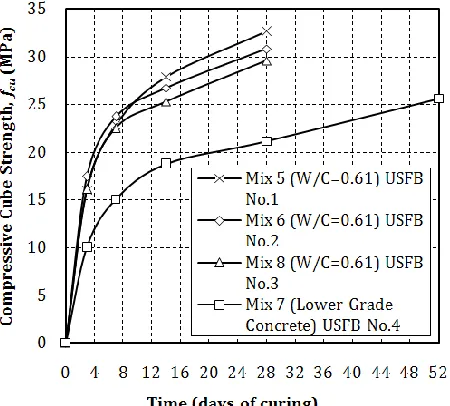
A UB305x165x40 with material physical properties shown in Table 1 was used. For precautionary reasons it was decided to test all the beams at the 14th day of curing, aiming for between 25 to 30MPa (to be no greater than 35MPa) concrete strength on the day of the test.
The load was applied through two hydraulic jacks and a spreader plate. The applied load and hence the bending moments were obtained from the load cells connected to the jacks. High shear forces were generated in the area of the web openings and so the existence of the concrete dramatically affected the results.
To measure vertical deflection three dial gauges were placed under the tension steel flange and aligned with the edge of the hole. Two dial gauges were applied at the high moment side (HMS) of each web opening (Dial Gauge 1 and 3) and one dial gauge at mid-span of the test beams (Dial Gauge 2).
4.2 Test cubes procedure
In this research programme a desirable maximum compressive strength was required to determine the possible section enhancement at low concrete strengths. The strength was determined from the 14th day of curing to try and test at the minimum possible compressive strength used by the standards (i.e. 25MPa).
A mix design was necessary for this experimental programme. Compression tests were undertaken on samples, removed from the forms and allowed to cure for predetermined periods such as 3, 7, 14 days etc.. The concrete strength tests are standardized and the method of making compressive specimens in the field is covered under BS EN197:Part 1:2000 [14]. Based on the guidelines of BRE [15],the fourteen days compressive strength is equal to 85% of the twenty-eight days compressive strength. Moreover, thirteen days of air-cured concrete compressive strength is equal to 70% of the thirteen days water-cured concrete compressive strength. The mix with the w/c ratio equal to 0.61 conformed to the requirements and this was used for casting the composite beams.
4.3 Casting the USFBs
The casting of the composite beams was not routine because the bearing plates at the supports and the web openings make the whole procedure more difficult. This was accomplished by casting the beams on the floor and pouring the concrete through the web openings (Fig. 2). Vibrators were used to ensure that the concrete was well compacted. The compaction of the concrete was also improved by the high water-cement ratio (0.61). Silicon was used to avoid water leakage between the steel and the framework.
[image:6.612.100.515.168.322.2]Fig. 2: Casting procedure of USFBs (i.e. USFB No. 1)
4.4 USFB with lower grade concrete
Three USFBs were cast with a w/c ratio equal to 0.61. Taking into consideration the usual uncertainties caused by human or climate interferences which occur when the beams are cast in situ, another composite section (USFB 4) was also cast with a slightly higher w/c ratio (and hence lower grade concrete). Segregation was observed when the concrete cubes of the latter specimen were tested. An additional aim of this test was to verify the percentage of the shear improvement and the failure mode due to concrete infill (i.e. concrete is a path to the load), and to clarify whether it is the concrete strength or the concrete itself that provides the enhancement to the perforated steel beam.
Fig. 3: Concrete cube compressive strength
Specimen Average Steel Yield Stress
fy (MPa)
Average Steel Tensile Strength
fult. (MPa)
14-Day Cube Compressive Strength of Concrete,
fcu (MPa)
USFB No.1
318.25 430.75 27.91
USFB No.2 26.77
USFB No.3 25.33
[image:7.612.195.420.70.273.2]USFB No.4 25.60 (at 52nd Day) Table 1: Material physical properties
4.5 Test procedure
After a preloading stage, the load was applied in steps at a low displacement rate and held at each step to allow load relaxation. All test specimens were loaded past the ultimate load to obtain a significant part of the post-failure curve. Concrete crack patterns were recorded throughout the tests.
4.6 Load-deflection relationships
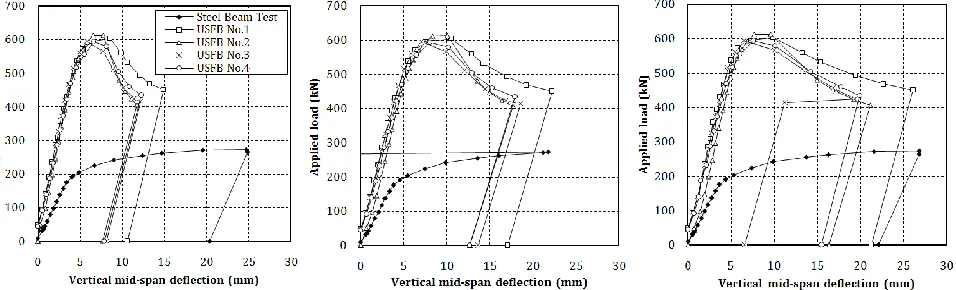
[image:8.612.67.545.352.497.2]Virtually linear behaviour was observed in all tests (Fig. 4) until around 500kN which is at approximately 89% of the ultimate load carrying capacity of the composite beams. The ultimate load was attained at around 600kN, after which unloading occurred. Failure occurred around 75%, 67%, 70% and 71% of the maximum load for USFB No.1, USFB No.2, USFB No.3 and USFB No.4, respectively. Generally, in the post-elastic region a significant and sudden drop of load occurred directly after reaching the ultimate load capacity. This is a result of large concrete cracks occurring in the vicinity of the web openings and their rapid propagation, due to the steel yielding. The deflections were found to be higher in USFB No.1, where the post-elastic behaviour is more gradual than the other tests. Finally, an unloading procedure was conducted in all composite tests in order to record the plastic-permanent deformation. It should be noted that all USFBs have the same steel section stiffness. A dissimilar proportion of cracks about the symmetry of the beam was observed, with few cracks forming on one side as compared to the other side which was totally crushed. Similarly, in the bare steel perforated beam asymmetrical behaviour was observed between the left and right side.
Fig. 4: Load-deflection curves for non-composite and composite beams for (Dial Gauge 1, 2 and 3)
4.7 Failure mechanism
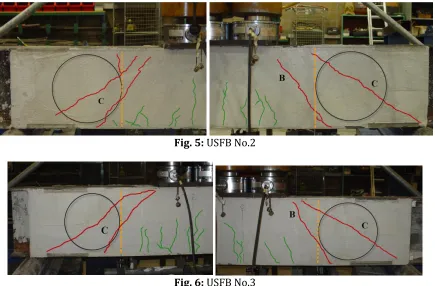
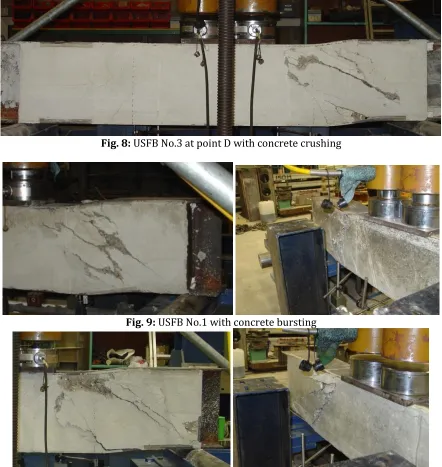
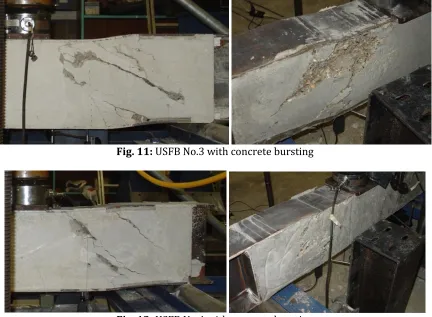
position of the principle diagonal cracks was not identical for all the USFBs. There is a slight variation of the angle of the cracks from 25o to 37o; however the failure mechanism was the same. Around 600kN the ultimate load carrying capacity was achieved followed by a post-elastic descending curve showing a considerable decrease of the load carrying capacity. This was accompanied by large cracks in the vicinity of the web openings and concrete bursting. This can be seen in Fig. 9 to 12 for the right half span of the USFBs, for both front and back face. Following the formation of the large cracks there was some residual strength in the concrete and the load carrying capacity was somewhat higher than that of the non-composite steel beam.
[image:9.612.91.526.429.715.2]Essentially, USFBs fail due to concrete crushing in the compression zone. Complete composite action up to the ultimate load carrying capacity, was found. Therefore, the proposed system enables the development of sufficient strength and consequently effective composite behaviour, without causing serviceability problems. Moreover, the longitudinal shear strength of the proposed system consists of the frictional force and the shear-bond strength between the steel and the concrete, as well as of the bearing strength of the web opening area. However, in this experimental study the concrete is partially encased since the bearing plates at the supports restrain the longitudinal movement of the concrete. In actual construction the end plate connections will play the same role. Also, it was observed that the plastic behaviour of the composite sections is mainly due to the steel beam’s low stiffness and high deformation. In general, the concrete provides a load path from the top to the bottom steel flange, as well as a restraint to the steel web.
Fig. 5: USFB No.2
Fig. 7: USFB No.2 at point D with concrete crushing
Fig. 8: USFB No.3 at point D with concrete crushing
Fig. 9: USFB No.1 with concrete bursting
Fig. 11: USFB No.3 with concrete bursting
Fig. 12: USFB No.4 with concrete bursting
4.8 Composite action due to partial encasement
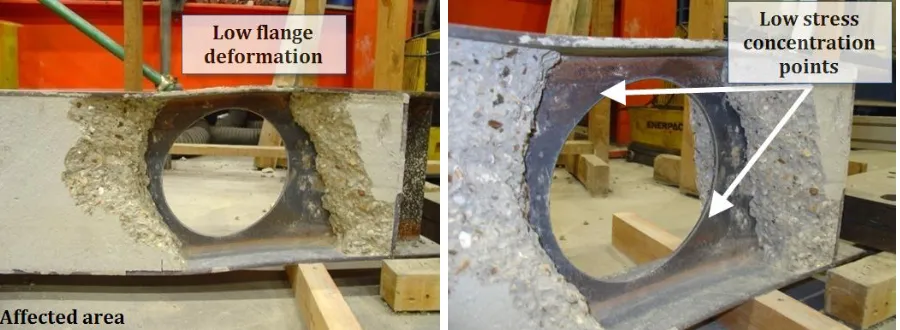
The effect of partial encasement on overall flexural action is dependent on the mechanism of shear transfer and the relative slip between the steel section and the concrete. These tests failed by high Vierendeel bending actions in the vicinity of the openings, as shown in Fig. 13 and 14. However, it is apparent that considerable ‘arching’ action occurred through the concrete encasement, which is resisted by the bearing plates at the supports of the relatively short span beams. Hence, the contribution of the confined concrete between the steel flanges in resisting vertical shear is achieved.
The steel beam was slightly deformed compared to the non-composite beam [12], while local web buckling is faintly observed on the diagonal line from the load spreader to the supports. This implies a transfer of shear forces across the web openings after the concrete crushed while loading was applied in the post-elastic region. The transfer of shear forces caused local bending moments and therefore local web buckling.
At the web opening the concrete encasement acts as a strut in compression, which is confined between the flanges and inclined diagonally across the web opening, as illustrated in Fig. 15. The magnitude of this strut action depends on the ability of the flanges to resist the local compression forces by transverse bending. The dimensions of the flanges contribute significantly to the bending and shear resistances of USFBs [16, 17]. It is worth noting that a symmetric section was used in the current research to simplify the investigation, whist asymmetric sections are used in practice. The transverse bending moment is shown in Fig. 16 when the bearing force applies on the flange. The vertical forces are resisted by tension in the web-post between the web openings. The horizontal forces act on the bottom flange with a combination of friction, due to the strut force and the shear-bond. The lower bound of the shear-bond strength with the partially encased flange is given as 0.2MPa in BS EN1994-1-1:2004 [18]. A coefficient of friction of 0.6 for concrete on steel may be assumed for the local strut action.
[image:12.612.84.532.408.575.2]
Fig. 14: Failure mode for partially encased USFB No.2 at opening after removal of the damaged concrete
[image:13.612.173.440.506.663.2]Fig. 15: Compression force acting in the concrete encasement across the web openings
A simple model for the vertical shear resistance of the concrete encasement is to consider the vertical component of this strut force as a bearing force which causes transverse bending in the flanges. From the above tests as well as others conducted at City University London [19], it was concluded that the shear force, Vc, that is resisted by the concrete encasement is dependent on the top flange dimensions and may
be taken as [10]:
(
)
Where bf, min is the lesser thickness of the top and bottom flanges. In using this formula, the ability of the
flanges to resist the horizontal component of the force is dependent on the frictional force and shear-bond resistance, which is not critical, given the inclination θ of the strut force to the vertical, where:
- ⁄
The compression resistance of the concrete strut may govern for thick steel flanges. It is given by the limit in the above equation, and it may govern when ⁄ .
5. Sensitivity FE study of the USFBs
5.1 Introduction
For the computational approach to the problem, a three-dimensional FE model was developed, in which contact elements were implemented at the interface of the concrete and steel. Several material model parameters were varied, such as the steel and concrete strength, the constitutive relationships which model the materials, as well as the steel and concrete contact capacity. Hence, the parameters that limit the beams’ load carrying capacity and their sensitivity to these changes are examined.
5.2 FE model and boundary conditions
Since a principal objective of this work was to predict a correct failure mode, it was important to develop a FE model as close to the physical system as possible (Fig. 19). Therefore, a 3D model was developed with a fine mesh of 20mm element size consisting of 68,569 elements. With regards to the concrete crack modelling with FE software, several researchers have studied the effect of the element size in the non-linear analysis of reinforced concrete structures [20, 21], and they have shown that the results are indeed dependent on the mesh. Whilst considering symmetry, it was decided to develop the full model in terms of its length and the half model in terms of its width, in order to accurately apply the support conditions. The load and the supports were directly applied to thesteel beam and not to the concrete in order to avoid early local concrete cracking. For better stress distribution, the load was applied as a pressure on an area and the supports were modelled as restrictions to the degrees of freedom on appropriate areas.
5.3 Contact element and contact algorithm
CONTA173 is a 4-node element that is intended for flexible contact analysis. In flexible-to-flexible contact, both contact and target surfaces are associated with deformable bodies. CONTA173 is also a surface-to-surface contact element. The contact detection points are the integration points and are located at Gauss points. The contact elements are constrained against penetration into the target surface, at its integration points.
A number of methods are available for modelling friction in contact analyses, but the most commonly used methods are based on a ‘Coulomb’ friction model. In this model the two contacting surfaces are permitted to carry shear stresses across their interface up to a defined value, before they begin sliding. The equivalent shear stress at which sliding begins is defined as:
Contact elements offer two models for ‘Coulomb’ friction: isotropic friction and orthotropic friction. The isotropic friction model is incorporated in this study as it uses a single coefficient of friction, based on the assumption of uniform stick-slip behaviour in all directions. When a penetrating node stays in contact with the target surface, it may either stick to the surface or slip along the surface.
5.4 Element types and material models
experimental study of the non-composite steel beam [12, 13, 22, 23]. The Young’s Modulus, E, and the Poisson’s Ratio, v, of steel are taken as 205GPa and 0.3 respectively. The yield strength, fy, as well as the
ultimate strength, fult., varies as given in Table 3. The variation of the material strength applies to the
sensitivity study of the material properties. In most analyses, an ultimate strain of around 0.25 was assumed for the structural steel [24], hence the Tangent Modulus, ET, was varied from 540 to 700MPa.
Concrete:8-node solid iso-parametric SOLID65 elements with the integration points for the cracking and crushing checks were used to model the concrete in ANSYS. SOLID65 models the non-linear response of brittle materials and is based on a constitutive model for the tri-axial behaviour of concrete after Williams and Warnke [25]. The element is capable of plastic deformation and cracking in three orthogonal directions. Once the principal stresses at the integration points reach the tensile and compressive strength, the cracking or crushing of concrete elements can be formed. These elements are also able to predict the non-linear behaviour of concrete materials using a smeared approach, which depends on five material parameters. Steel reinforcement was not present in the actual experiment in this research programme; hence default values were kept for the smeared reinforcement capabilities of SOLID54 elements.
Cracking and crushing are determined by a failure surface. The tensile strength, ft, is typically 8-15% of the
compressive strength, fc [26]. Investigating the sensitivity of the results, the ultimate concrete compressive
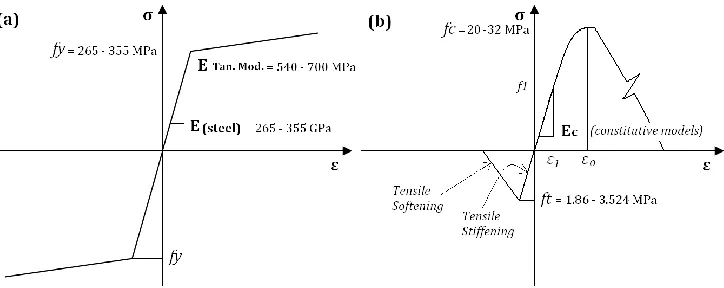
and tensile strengths for every beam model were calculated using various constitutive relationships found in the literature [25, 27, 28, 29, 30]. The concrete in compression was modelled as an elasto-plastic material (Fig. 17) either with or without strain softening. The concrete plasticity (crushing) in the compression zone was modelled using the multi-linear option from ANSYS with Von-Mises plasticity.
The compressive cylinder strength, fc, varied (eg. 20MPa, 21.12MPa: the average cylinder strength from
Table 1, 26.7MPa and 32MPa), whereas the other parameters such as Young’s Modulus, Ec, and tensile
strength of concrete, ft, are treated as generic data and evaluated by the applying constitutive relationships
(Table 2). In Table 2, fc is the stress at any strain ε, f1 is the stress at strain ε1 and εo is the strain at the
Fig. 17: Material models of uni-axial loading: (a) Steel and (b) concrete
Table 2: Constitutive relationships modelling the concrete material from the literature
Concrete compressive strength was varied in order to examine the percentage of shear enhancement of the USFBs. The concrete tensile strength was also varied taking into consideration the mesh size of the concrete elements and the value of fracture energy, Gf. It is worth noting that the interfacial fracture
energy is almost linearly related to the root of the tensile strength of concrete. In addition, various values of concrete Poisson’s ratio, v, were examined, as they are related to the condition (i.e. quality) of concrete and different values have been used by researchers.
Shear Transfer Coefficient for open/closed crack, β1,2: These are also known as “shear retention factors”
and can vary between ‘0.0’ for no aggregate interlock and 1.0 for full aggregate interlock. In the opening, β1
[image:17.612.61.557.234.523.2]Various shear transfer coefficients are used in this study for open cracks and closed cracks. High values were taken for the closed crack (e.g. 0.9, 1.0) so as to prevent possible fictitious crushing of the concrete before load transfer occurs through a closed crack.
Friction Coefficient, μ: Various friction coefficients were used in order to compare the results. The results showed an increase of the stiffness in the strain of the compressive top flange for beam with higher bond, but in the tensile flange the stiffness is nearly the same. A reason for this behaviour is the cracking of concrete in tensile zone, which starts from the first load steps. In the experiments the bond strength is also different in the compressive zone from that in the tensile zone of the composite beam, and this could be another reason for possible discrepancy between the experimental and the FE results. The local bond strength and the corresponding slip are almost linearly related to the tensile strength of concrete.
Solution Method: The full Newton-Raphson procedure was used, even though this requires the stiffness of the structure to be re-calculated for every iteration. A large-displacement and static analysis was implemented with the maximum number of sub-steps in a load step being 1,000-10,000 in order to apply the load increments very smoothly where it is necessary. Failure of the beam occurs when convergence fails, with a very small load increment. This method is comparable with the experimental data from Buckhouse [33]. The vertical deflection at mid-span of the composite beams and the FE divergence load was monitored.
5.5 FE results from sensitivity study
The failure loads obtained from this study are summarised in Table 3 and categorised mainly according to the constitutive relationships used to model the material properties. Sub-categories are also indicated, based on both the steel and concrete strengths.
It was observed that the numerical solutions are very sensitive to the steel strength in contrast to the concrete strength and small changes lead to significantly different results. It is found that the USFBs with steel yield strength of 265 to 285MPa compare well with the experimental behaviour, even though there is a reduction of 16.8 to 10.5% in the average steel yield strength (i.e. fy=318.25MPa), as obtained from the
coupon tests. This applies to the increased stiffness of the 3D solid elements as well as the complex failure mechanism of the USFBs. Essentially, it was verified that the ultimate load carrying capacity of the USFBs is governed by the steel strength and in particular when the concrete strength is low.
*MISO – Multi-linear Isotropic Hardening Plasticity is adopted **BISO – Bi-linear Isotropic Hardening Plasticity is adopted
Steel Cont. Concrete Results
FE Model fy (MPa) fult. (MPa) or ETan.
μ (MPa) fc (MPa) ft ν β1,2
Refer. Theory
Based
FFEA
(kN)
265* 410 1.0 26.70 1.86 0.20 0.3,1.0 [28] 627 59
265* 410 1.0 26.70 1.86 0.17 0.3,1.0 [28] 617 3
265* 410 0.8 26.70 1.86 0.17 0.3,1.0 [28] 611 7
265* 410 0.3 26.70 1.86 0.17 0.3,1.0 [28] 548 8
265* 410 1.0 26.70 1.86 0.15 0.3,1.0 [28] 547 58
265* 410 1.0 26.70 1.86 0.15 0.6,0.6 [28] 555 16
265* 410 1.0 26.70 1.86 0.15 0.1,0.9 [28] 607 18
265* 410 1.0 26.70 1.86 0.15 1.0,1.0 [28] 635 19
265*
275** ETan.410 =200
1.0
0.8 26.70 26.70 1.86 1.86 0.00 0.15 1.0,1.0 0.1,0.9 [28] [28] 648 618 20 25
355* 530 1.0 26.70 1.86 0.20 0.3,1.0 [28] 637 11
355* 530 1.0 26.70 1.86 0.17 0.3,1.0 [28] 633 12
355* 530 0.0 26.70 1.86 0.17 0.3,1.0 [28] 470 13
275* 410 0.9 20.00 2.786 0.2 0.3,1.0 [26] 577 B5
275* 410 0.6 20.00 2.786 0.2 0.3,1.0 [26] 563 B6
355* 499 0.9 20.00 2.786 0.2 0.3,1.0 [26] 730 B2
355* 530 0.9 20.00 2.786 0.2 0.3,1.0 [26] 733 B4
355** ETan.=20 0.9 20.00 2.786 0.2 0.3,1.0 [26] 734 B3
275* 410 1.0 21.12 2.863 0.2 0.3,1.0 [26] 591 B11
275* 410 0.9 21.12 2.863 0.2 0.3,1.0 [26] 584 B10
275* 410 0.7 21.12 2.863 0.2 0.3,1.0 [26] 578 B12
275* 410 0.4 21.12 2.863 0.2 0.3,1.0 [26] 508 C8
275* 410 1.0 21.12 2.863 0.2 1.0,1.0 [26] 599 B13
318.25* 430 1.0 21.12 2.863 0.2 0.3,1.0 [26] 630 D1
265* 410 0.9 32.00 3.524 0.2 0.3,1.0 [26] 588 C1
275* 410 0.9 32.00 3.524 0.2 0.3,1.0 [26] 611 C4
275* 410 0.6 32.00 3.524 0.2 0.3,1.0 [26] 574 C14
285** ETan.=20 0.9 32.00 3.524 0.2 0.3,1.0 [26] 622 C6
285* 350 0.9 32.00 3.524 0.2 0.3,1.0 [26] 641 C5
355* 499 0.9 32.00 3.524 0.2 0.3,1.0 [26] 742 B1
275* 410 0.9 21.12 1.839 0.3 0.3,1.0 [27] 545 B9
275* 410 0.9 32.00 2.260 0.3 0.3,1.0 [27] 621 C12
275* 410 0.6 32.00 2.260 0.3 0.3,1.0 [27] 597 C13
275* 410 0.7 21.12 2.505 0.15 0.3,1.0 [24] 571 C11
265* 410 1.0 32.00 3.083 0.15 0.3,1.0 [24] 629 31
265* 410 0.8 32.00 3.083 0.15 0.3,1.0 [24] 600 32
265* 275* 275* 410 410 410 0.5 0.9 0.9 32.00 32.00 32.00 3.083 3.083 3.083 0.15 0.15 0.15 0.3,1.0 0.3,1.0 0.0,1.0 [24] [24] [24] 565 615 243 33 B14 B15 BARE STEEL PERFORATED BEAM
265* 410 --- --- --- --- --- --- 331 60
318.25** 430 --- --- --- --- --- --- 352 75
[image:20.612.52.503.83.712.2]355** ETan.=2000 --- --- --- --- --- --- 352 61
5.6 Load-deflection relationships
Various load-deflection curves at the mid-span are plotted against the results of the experimental test of USFB No.1 (Fig. 18). In addition, the load-deflection curve of the non-composite perforated beam is plotted for comparison.
Most of the FE results correlate satisfactorily with the experimental results, while up to the ultimate load level insignificant steel deflection occurs. Thereafter, the steel yields following the large concrete strains and the formation of large cracks, whilst the load capacity drops considerably. For the USFB with the lower concrete compressive strength more cracks developed even though the capacity of the USFB remained the same. In the experimental tests large steel deflections ensue in the post-elastic curve.
There are several effects that might cause the deviation of the stiffness between the FE and the experimental beams. One reason could be the concrete micro-cracks in the experimental beams due to drying shrinkage in the concrete. Additionally, cracks generated from different elastic modulus of aggregate and cement, thermal effects, as well as human factors could cause reduction of the stiffness in the experimental beams.
[image:21.612.114.509.372.548.2]Fig. 18: Force-deflection curves comparison between experimental test (USFB No.1) and various numerical solutions from “Table 2”
5.7 Post-elastic behaviour in FEA
softening usually means a localisation of failure. Hence, some special techniques such as non-local mode, gradient or time dependent formulations (explicit solvers) need to be employed.
The Newton-Raphson method used in this research proved to be generally economical because much larger incremental steps were possible. However, in the regions of peak loads on the load-deflection response, numerical difficulties sometimes occurred and it is necessary to use the modified Newton-Raphson iteration scheme under which the stiffness of the structure is calculated only at the beginning of the increment, or the modified Riks (Arc-length) method in order to prevent local instabilities due to large amounts of cracking.
To trace a post-peak response, either a quasi-static (transient), a stabilisation solver usually with an energy dissipation factor, an arc-length method or a displacement load control is necessary. The most widely utilised is the arc-length method in ANSYS, which controls the load level together with the length of the displacement increment. This method permits to compute the post-critical load-deflection path.
5.8 Concrete crack patterns and failure modes
Thirty-nine numerical tests are presented simulating the particular USFB configuration using different constitutive relationships and parameters. It is worth noting that in all cases the flexural and the diagonal cracks were generated. Characteristic results of concrete cracks, slippage profiles and steel stresses at the contact surface between the steel and the concrete are plotted. By examining the stress distribution, it was seen that failure occurred due to substantial steel yielding, combined with concrete crushing.
In Fig. 19 the crack development is shown for four load steps. Nonlinear numerical solutions are capable of replicating the full range of cracks including the pure flexural, flexural shear and the critical shear crack. Smeared cracks are spread over the high shear stress region (Fig. 19 (c)) and occur mostly at the ends of the beam between the support and loading area. The path of shear cracks follows the trajectory of the principal stresses, as can also be seen in the experimental study. Depending on the geometric as well as the material properties of the USFB, the critical crack might extend to the top of the compression concrete fibres and then stabilise, as shown in Fig. 19 (d). At the ultimate load carrying capacity the vertical beam deflections were not large.
that the cracks begin at the mid-width of the beam section, where the concrete passes through the web openings and more specific cracks are initiated as the steel web starts to deflect. These cracks are fully developed in the vicinity of the web openings at approximately 450kN, while cracks move outwards (i.e. transverse to the web). Crack propagation and the steel stresses at the mid-width of a USFB are shown in Fig. 20.
The vertical deflection, contact stresses and the contact surface condition for the particular USFB FE model, when using a friction coefficient, µ, equal to 0.9, are presented in Fig. 21. The Von-Mises stresses of the steel beam for the particular USFB model are also presented in Fig. 21.
Fig. 19: Bending and shear crack development at the front side of the beam; (a) Purely flexural (bending) vertical cracks, no yielding in steel, no concrete plasticity (b) Developed flexural cracks, developed flexural/shear cracks, just before initiation of the critical shear cracks (c) Critical shear diagonal cracks are
clearly identified and (d) Full cracking state, yielding in steel, concrete plasticity, big displacements increment just before divergence of the FE model, there are splitting cracks at the upper part of the beam
due to compression 1
File: FINAL
MAR 15 2009 01:42:47 CRACKS AND CRUSHING
STEP=1 SUB =10 TIME=4
1
File: FINAL MAR 15 2009
01:31:36 CRACKS AND CRUSHING
STEP=1 SUB =15 TIME=21.507
1
File: FINAL
MAR 15 2009 01:27:36 CRACKS AND CRUSHING
STEP=1 SUB =17 TIME=40.775
1
File: FINAL
MAR 22 2009 02:22:56 CRACKS AND CRUSHING
STEP=1 SUB =43 TIME=64.489
a. Pure flexural cracks (≈100kN)
b. Flexural shear cracks (≈290kN)
c. Critical shear cracks (≈400kN)
Fig 20: Shear crack development (left) and Von-Mises stresses of the steel (right); in the vicinity of the right web opening at the mid-width of a USFB
1
File: FINAL
JUN 30 2009 02:27:11 CRACKS AND CRUSHING
STEP=1 SUB =15 TIME=5.431 1 File: FINAL .085615
29.545 59.004 88.464 117.923147.383176.842206.302235.761265.221
JUN 30 2009 02:37:00 ELEMENT SOLUTION
STEP=1 SUB =15 TIME=5.431 SEQV (NOAVG) DMX =1.722 SMN =.085615 SMX =265.221
1
File: FINAL
JUN 30 2009 02:28:23 CRACKS AND CRUSHING
STEP=1 SUB =16 TIME=6.931 1 File: FINAL .107254
29.622 59.13888.653 118.168147.683177.198206.713236.228265.744
JUN 30 2009 02:35:46 ELEMENT SOLUTION
STEP=1 SUB =16 TIME=6.931 SEQV (NOAVG) DMX =2.18 SMN =.107254 SMX =265.744
1
File: FINAL JUN 30 2009
02:29:46 CRACKS AND CRUSHING
STEP=1 SUB =17 TIME=8.431 1 File: FINAL .137588
29.721 59.305 88.888 118.472148.056177.639207.223236.806266.39
JUN 30 2009 02:34:29 ELEMENT SOLUTION
STEP=1 SUB =17 TIME=8.431 SEQV (NOAVG) DMX =2.66 SMN =.137588 SMX =266.39
1
File: FINAL
JUN 30 2009 02:19:26 CRACKS AND CRUSHING
STEP=1 SUB =38 TIME=10.443 1 File: FINAL .148263
29.85 59.55289.254 118.956148.658178.36 208.062237.764267.465
JUN 30 2009 02:38:25 ELEMENT SOLUTION
STEP=1 SUB =38 TIME=10.443 SEQV (NOAVG) DMX =3.739 SMN =.148263 SMX =267.465
Approx. at 270 to 310kN
Approx. at 310 to 400kN
Approx. at 400 to 485kN
Fig. 21: Vertical deflection (left), contact stresses (middle) and contact surface condition (right)
Fig. 21: Von-Mises stresses in the steel beam
6. Proposed design method evaluating vertical shear strength
The experimental programme and non-linear FE analyses showed that the concrete in-fill in the perforated sections and the composite action enhance the vertical shear strength of the USFB. Liang et al. [24] proposed a design method for the vertical shear strength of simply supported conventional un-perforated composite beams (where the concrete slab sits on top of the plain steel beam) with any degree of shear connection. This method is modified herein to include USFB sections. Comparison is then made amongst the different approaches for evaluating the vertical shear strength of the perforated sections.
The composite action as presented by Liang et al. [24] is as follows:
( √ )
When β > 1, the vertical shear strength is not affected by the degree of shear connection and this indicates that the composite beam exhibits full shear connection. According to BS5950 and EC3, for symmetric beams with spans up to 6m and 5m respectively, the minimum degree of shear connection is 0.4. In general, when no mechanical shear connection (i.e. reinforcement tie-bars, studs, ducting, etc.) is provided between the steel beam and the concrete slab, the two components work independently to resist vertical shear. However, in this particular FE study the degree of shear connection is assumed equal to the friction coefficient between the steel and the concrete, simulating the frictional force and shear-bond since no mechanical shear connection is provided.
1
MN MX
File: FINAL
-1.658
-1.474 -1.29 -1.105 -.921192-.736954-.552715-.368477-.1842380
JUL 7 2009 20:46:28 NODAL SOLUTION
STEP=1 SUB =18 TIME=50.948 CONTGAP (AVG) DMX =6.434 SMN =-1.658 1 MN MX File: FINAL 0
.203753.407505.611258.8150111.019 1.223 1.426 1.63 1.834 JUL 7 2009 20:45:49 NODAL SOLUTION STEP=1 SUB =18 TIME=50.948 CONTSLID (AVG) RSYS=0 DMX =6.434 SMX =1.834 1 MN MX File: FINAL NearContact Sliding Sticking
Hence, the vertical shear strength of such a beam is expressed by:
The contribution of the concrete is now taken as the shear strength of the concrete infill and it is proposed that:
⁄
The effective shear area of concrete is evaluated as:
( )( )
It should be mentioned that the concrete in the web opening, as well as the effect of longitudinal steel reinforcement in the concrete slab, are not considered in the above equation.
In order to better correlate the theoretical approach with FE analyses and experiments, the shear capacity of the steel beam is evaluated with various approaches such as the following:
1. The basic shear capacity from Chung et al. [17]:
[( ( )) ]
2. Another approach for the shear resistance for perforated beams (Lawson and Hicks, 2006) is shown below:
[
√ ]
Where the shear resistance, Vpl,Rd, for un-perforated beams EC3 EN1993-1-5 [35] is limited by either the
plastic shear resistance:
(
√ )
Where Av is taken as , and the value of is equal to 1.
Comparing the FE results with the results obtained from the theoretical formulae given above, it is found that:
The shear resistance approaches given by Lawson and Hicks [36] Eq. 7 and 8, slightly underestimate the results compared to the FE analyses, with average deviation ratios of 0.90 and 0.86, respectively. The most effective approach is when the shear resistance is limited by the plastic shear resistance for the un-perforated section (Eq. 7).
The comparison leads to the following conclusions:
The smaller the degree of shear connection, β, used in the FE models, the greater the deviation ratio is.
For steel grade S275, the FE results are closer to the theoretical design values. In contrast, when steel grade S355 is used, the FE results obtained are overestimated because of the increased stiffness of the FE model with solid elements.
7. Conclusions
The USFB offers lower structural depth inversely to conventional composite beams, where the concrete slab sits on top of the plain (or perforated) steel beam. The decrease of the structural depth for every floor, and the ease of construction for large spans, as heavy propping is not needed, makes USFBs worth studying. Although the capacity of the perforated beam is reduced by using large web openings (do=0.76h),
the designer can take advantage of the inherent double shear strength provided by the confined concrete between the flanges and the bearing plates at the supports. Hence, increased flexural strength of the composite beams as well as longitudinal shear strength due to the concrete passing throughout the web openings is achieved.
The following conclusions can be drawn from this study:
With the concrete in-fill, the ultimate vertical load carrying capacity of the USFB increases by up to 108% (i.e. double the capacity) compared to the corresponding non-composite perforated steel beam. This percentage is higher when the friction coefficient is closer to 1.0 (i.e. fully bonded). It is assumed that there will be a lower concrete contribution if bearing plates are not provided at the supports.
All four experimentally tested USFBs showed consistent behaviour in terms of the failure mode, stiffness and the ultimate load carrying capacity.
The failure mode of the non-composite beam changes when there is in-filled concrete between the flanges.
The last descending post-elastic branch of the load-deflection curve corresponds to the composite beam behaviour as a ‘mechanism’. Failure is accompanied with the appearance of wide diagonal concrete crushing.
Following the formation of large diagonal cracks, there is some residual strength in the concrete preventing local buckling of the perforated steel beams and the load carrying capacity is somewhat higher than that on the non-composite beam.
The shear resistance of the USFB, without using any mechanical shear connectors, is provided mainly of contributions from the concrete confinement and the steel flange thickness.
Strut action of the concrete confinement across the web openings reduces the Vierendeel bending effects and improves the vertical shear transfer in the vicinity of the web openings. Hence, the vertical shear force resisted by the concrete at a web opening is dependent on the on the flange dimensions.
The horizontal component of the strut action is dependent on the frictional force, shear-bond resistance and the bearing strength of the web opening area.
In order to study the parameters affecting the structural behaviour of simply supported USFBs with larger circular web openings, three-dimensional finite element models employing solid elements were developed. The FE results are summarised below:
The FE models accurately simulate the structural behaviour of the USFBs tested up to the ultimate load carrying capacity level. Comparison between the measured and the predicted load carrying capacities against the Vierendeel mechanism was found to be close.
Various constitutive relationships modelling the concrete material properties were found from the sensitivity-parametric studies to affect the load carrying capacity of USFBs differently.
As the composite beams examined did not contain confined reinforcement, the concrete tensile strength played a major role in defining the divergence load.
All cracks in the FE models develop at a higher load compared to those observed in the experiments.
A design method for simply supported conventional un-perforated composite beams presented by Liang et al. [24] was modified for the shear resistance of the both perforated sections and simply supported USFBs with any degree of shear connection between the steel and the concrete. The results compared well with those from the FE analyses.
Acknowledgements
The results from this research study are incorporated in ASD Westok’s Ltd. (2010) design software for USFBs (USFB-AutoMate v1.0) developed and certified by the Steel Construction Institute (SCI). The authors would like to thank the ASD Westok group for the supply of the steel perforated specimens and the SCI for the approval of the experimental setup, structural arrangements and geometrical configurations of the specimens.
Abbreviations
Aec Effective shear area of concrete
bf Width of the top flange of steel beam
CSR Specification of the Cohesion Sliding Resistance
do Web opening diameter
h Overall depth of the steel beam
PCon Contact pressure
r Root radius of steel UB section
tf Flange thickness
tw Web thickness
Vc Nominal shear strength (contribution of the concrete to the vertical shear strength)
Vo Shear strength of the beam in pure shear (with zero degree of shear connection)
VS Shear capacity of the web of the steel beam to the vertical shear strength
Vuo Ultimate shear strength of the composite beam in pure shear
μ Coefficient of friction
β Degree of shear connection at a cross-section
References
[1]De Nardin S, El Debs ALHC. Study of partially encased composite beams with innovative position of stud bolts. Journal of Constructional Steel Research 2009; 65:342-350.
[2]Bernuzzi C, Zandonini R. In: Buckner, D. and Shahrooz, B.M. editors. Slim floor steel-concrete composite systems, Composite construction in steel and concrete, vol. III. Germany: ASCE 1996; 486-99.
[3]Viest IM, Colaco JP. Composite construction design for buildings. ASCE, Reston, Va., 1997.
[5]Dipaola V, Prete F, Prete G. The elasto-plastic behaviour of encased composite beams for slim floors in multi-storey buildings. 2nd International congress-Fib, Naples, FIB, 2006; (ID 5-24):1-12.
[6]Wang Y, Yang L, Shi Y, Zhang R. Loading capacity of composite slim frame beams. Journal of Steel Constructional Research 2009; 65:650-661.
[7]Ju YK, Chun SC, Kim SD. Flexural test of a composite beam using asymmetric steel section with web openings. Journal of Structural Engineering ASCE 2009; 448-458.
[8]ASD Westok Ltd. “http://www.asdwestok.co.uk/Applications/Ultra+Shallow/” 2011.
[9]Hicks S. Current trend in modern floor construction. The Steel Construction Institute 2003; (11)1:32-32.
[10]Tsavdaridis KD, Giaralis A. Derivation of Dynamic Properties of Steel Perforated Ultra Shallow Floor Beams (USFB) via Finite Element Modal Analysis and Experimental Verification. 7th National Conference on Steel Structures, Volos, Greece 2011; (053)2:321-329.
[11]Tsavdaridis KD, D’Mello C. Optimisation of Novel Elliptically-Based Web Opening Shapes of Perforated Steel Beams. The Journal of Constructional Steel Research, 2011, accepted.
[12]Tsavdaridis KD. Failure modes of composite and non-composite perforated steel beams sections with various shapes and sizes of web openings. PhD thesis (supervised by Dr. C. D’Mello), School of Engineering and Mathematical Sciences, City University, London, 2010.
[13]BS EN197:Part 1:2000. Cement. Composition, specifications and conformity criteria for common cements, BSI, 2000.
[14]BRE Design of normal concrete mixes, BRE report, UK, 1988.
[15]Tsavdaridis KD, D’Mello C. Vierendeel Bending Study of Perforated Steel Beams with Various Novel Shapes of Web Openings, through Non-linear Finite Element Analyses. The Journal of Structural Engineering-ASCE, 2011, in revision.
[16]Chung KF, Liu TCH, Ko ACH. Steel beams with large web openings of various shapes and sizes: an empirical design method using a generalized moment-shear interaction. Journal of Constructional Steel Research 2003; 59:1117-1200.
[17]BS EN1994-1-1:2004 Eurocode 4. Design of composite steel and concrete structures. General rules and rules for buildings, BSI, 2004.
[19]Lawson M. Enhanced Design of Ultra Shallow Floor Beams. Technical Paper in New Steel Construction (NSC) Magazine, June, 2011.
[20]Shayanfar MA, Kheyroddin A, Mirza M.S. Element size effects in nonlinear analysis of reinforced concrete members. Computers & Structures1997; (62)2:339-352.
[21]Choi CK, Kwak HG. The effect of finite element mesh size in nonlinear analysis of reinforced concrete structures. Computers & Structures 1990; (36)5:807-815.
[22] Tsavdaridis KD, D’Mello C, Huo BY. Shear Capacity of Perforated Concrete-Steel Ultra Shallow Floor Beams (USFB). 16th National Concrete Conference, Paphos, Cyprus 2009; Ref no: 201101, 159.
[23] Tsavdaridis KD, D’Mello C, Hawes M. Experimental Study of Ultra Shallow Floor Beams (USFB) with Perforated Steel Sections. Nordic Steel Construction Conference - NSCC2009, Malmö, Sweden 2009, Ref. no:128, 312-319.
[24]Liang QQ, Uy B, Bradford MA, Ronagh HR. Strength analysis of steel-concrete composite beams in combined bending and shear. The Journal of Structural Engineering-ASCE 2005; (131)10: 1593-1600.
[25]William KJ, Warnke EP. Constitutive model for triaxial behaviour of concrete. International Association of Bridge and Structural Engineering Conference, Bergamo, Italy 1974, ISMES Press; 19, 174.
[26]Kachlakev, Miller T. FE Modeling of Reinforced Concrete Structures Strengthened with FRP Laminates. Final Report SPR 316, Oregon State University, Department of Transportation, 2001.
[27]Kaewunruen S, Remennikov A. Nonlinear finite element modelling of railway prestressed concrete sleeper, 10th East Asia-Pacific Conference on Structural Engineering and Construction - Real Structures: Bridges and Tall Buildings. Bangkok, Thailand 2006; 4:323-328.
[28]Parvanova SP, Kazakov KS, Kerelezova IG, Gospodinov GK, Nielsen MP. Modelling the nonlinear behaviour of R/C beams with moderate shear span and without stirrups using ANSYS. Faculty of Civil Engineering, Sofia, Research for the National Science Fund under the contract № TH-1406/04, Technical Report, 2004.
[29]Bangash MYH. Concrete and concrete structures: Numerical modelling and applications Elsevier Applied Science (London and New York), Book (ISBN 1851662944 ) 1989; PUB I:102-796-517.
[30] ACI Committee 318: Building Code Requirements for Reinforced Concrete. Detroit. American Concrete Institute. 1999.
[31]AS3600: Concrete Structures Standard. Standards Association of Australia, 2009.
[33]Buckhouse ER. External Flexural Reinforcement of Existing Reinforced Concrete Beams using Bolted Steel Channels. Master’s Thesis, Marquette University, Milwaukee, Wisconsin, 1997.
[34]Rust W, Schweizerhof K. Finite element limit load analysis of thin-walled structures by ANSYS (implicit), LS-DYNA (explicit) and in Combination. Copyright 2002 Elsevier Science Ltd., Thin Walled Structures, 2003; (41)2-3:227-244.
[35]EC3 EN1993-1-5: Design of steel structures – General rules; Supplementary rules for planar plated structures without transverse loading, 1993.
![Fig. 1: USFB used with profiled steel decking (top) and with precast concrete unit (bottom) (adopted by [8])](https://thumb-us.123doks.com/thumbv2/123dok_us/1558782.108486/3.612.110.506.63.179/fig-usfb-profiled-steel-decking-precast-concrete-adopted.webp)