International Journal of Innovative Technology and Exploring Engineering (IJITEE) ISSN: 2278-3075, Volume-8 Issue-9, July, 2019
Abstract: The main aim of this paper is to deal with a two person zero sum game involving fuzzy payoff matrix comprising of heptagonal and hendecagonal fuzzy numbers. Ranking of fuzzy numbers is a hard task. Many methods have been proposed to rank different fuzzy numbers such as triangular, trapezoidal, hexagonal, octagonal etc. In this paper, a matrix game is considered whose payoffs are heptagonal and hendecagonal fuzzy numbers and ranking method is used to solve the matrix game. By using this proposed approach the fuzzy game problem is converted into crisp problem and then solved by applying the usual game problem techniques. The validity of proposed method is illustrated with the help of two different practical examples; one where the two companies are venturing into online restaurant business and the other where the two political parties with conflicting interests during elections are competing with each other.
Index Terms: Heptagonal fuzzy numbers, Hendecagonal fuzzy numbers, Ranking function, Fuzzy game theory.
I. INTRODUCTION
Game theory deals with the study of decision making in
situations where two or more rational opponents attempts to maximise their gain in competitive situations. In this decision theory each player determines his course of action after considering the alternatives available to the opponent player. The objective of this theory is to know how the players optimize their payoffs by selecting their respective strategies. Game theory has wider applications in situations involving decision making viz. economics, management, defence, political science, etc. The technique of game theory was originated by John von Neumann, a mathematician and the Economist Oskar Morgenstren. Neumann‘s (1947) approach is based on the principle of best out of worst, that is, he described the principle of minimisation of the maximum losses. Nash (1949) proved that a finite game problem always has a point of equilibrium at which all players choose their best alternatives, when the opponent’s strategies are given. However due to the lack of certainty in environment the availability of exact payoffs is the obvious problem. Such an uncertain situation can be modelled using fuzzy set theory. Zadeh (1965) was the first to introduce fuzzy set theory. This concept of fuzzy decision that may be viewed as the intersection of given fuzzy goals and / or fuzzy constraints was illustrated by Bellman and Zadeh (1970). Jain (1976) presented a decision procedure to give the best alternative andRevised Manuscript Received on July 07, 2019.
Namarta, Department of Mathematics, Khalsa College Patiala, India.
Umesh Chandra Gupta, Department of Mathematics, Shivalik College
of Engineering, Dehradun, India.
Neha Ishesh Thakur, Department of Mathematics, Government
Mohindra College, Patiala, India.
the rating of other alternatives as compared to optimal alternative in the presence of fuzzy variables. Cevikel and Ahlatcioglu (2010) presented two models for studying two persons zero sum matrix games in which the payoffs and goals are fuzzy and obtained that the fuzzy relation approach and and the max-min solution are equivalent. Kumar et al.(2010) proposed an approach to rank the generalized trapezoidal fuzzy numbers. Li (2012) developed an effective method for solving games with payoffs of triangular fuzzy numbers. Li and Hong (2012) introduced the concept of alpha to solve constrained matrix games in which payoffs are triangular fuzzy numbers. Kumar et al. (2013) proposed a minimax principle to get an imprecise game and the concept of fuzzy ranking. Nan et al. (2014) proposed a ranking technique to solve matrix game in terms of a value and ambiguity of TIFNs. Rathi and Balamohan (2014) introduced a new form of non normal heptagonal fuzzy number and its arithmetic operation is defined. Selvakumari and Lavanya (2014) described an approach for solving fuzzy game problem by using octagonal fuzzy numbers. Dhanalaxmi and Kennedy (2014) proposed area based method for ranking of octagonal fuzzy numbers. Sharma and Kumar (2015) described an algorithm to get lower and upper bounds on fuzzy payoffs so that the value of the game in fuzzy environment can be obtained. Selvakumari and Lavanya (2015) gave a methodology for all fuzzy game matrix problems where all the payoffs are trapezoidal and triangular fuzzy number. Bhaumik et al. (2017) used robust ranking technique of fuzzy numbers to solve matrix game whose payoffs are triangular intuitionistic fuzzy numbers. Kumar and Kumaraghuru (2015) considered solution of fuzzy game problem with triangular fuzzy numbers. Hussain and Priya (2016) proposed hexagonal fuzzy numbers to solve fuzzy game problem. Namarta et al. (2017) proposed ranking of heptagonal fuzzy numbers by using incentre of centroids. Selvam et al. (2017) introduced a parametric method by using ranking of fuzzy numbers where parameters are dodecagonal and octagonal normal uncertain numbers having the trapezoidal shape. Majority of the existing research is available on triangular and trapezoidal fuzzy numbers and the different ranking techniques to use convert these fuzzy numbers into crisp numbers for solving optimizations problems. But not enough literature is available on heptagonal
Solving Game Problems involving Heptagonal
and Hendecagonal Fuzzy Payoffs
and hendecagonal fuzzy numbers and more specifically rare research is available on solving game problems where payoffs are expressed in fuzzy heptagonal or hendecagonal numbers. The paper emphasizes different sections which consists of basic definitions of fuzzy set and fuzzy numbers, describes the proposed ranking method with examples.
II. PRELIMINARIES
In this section, definitions of fuzzy set, fuzzy numbers, heptagonal and hendecagonal fuzzy numbers are presented.
Definition 2.1
(Zadeh L.A (1965)) Let X = {x} is a collection of objects denoted generally by x. Then a fuzzy set in X is a set of ordered pairs = {(x, (x)); x X} where (x) is termed as the grade of membership of x in A and : X → M is a function from X to a space M which is called membership space. When M contains only two points, 0 and 1 then A is non fuzzy and its membership function becomes identical with the characteristic function of a non fuzzy set.
Definition 2.2
(Zadeh L.A (1965)) A Fuzzy set of universe set X is
normal if and only if = 1.
Definition 2.3
(Zadeh L.A (1965)) A fuzzy set in universal set X is called
convex iff
for all ,
X and [0,1].
Definition 2.4
(Zadeh L.A (1965))A fuzzy set of universal set is a fuzzy
number if it has the following properties: is convex.
is normal.
is piecewise continuous.
Definition 2.5
Heptagonal fuzzy number [HFN] A generalised fuzzy number
( ) is a heptagonal fuzzy
number if its membership function is defined by
(x) =
Figure 1 Definition 2.6
The -cut of a normal heptagonal fuzzy number is defined by
= [ ] =
Where
,
,
,
Definition 2.7
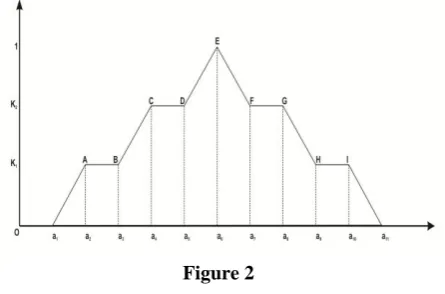
Hendecagonal fuzzy number (HnFN)
A generalised fuzzy number
( ) is said to
be Hendecagonal fuzzy number if its membership function
(x) is given below:
International Journal of Innovative Technology and Exploring Engineering (IJITEE) ISSN: 2278-3075, Volume-8 Issue-9, July, 2019
Figure 2 Definition 2.8
The -cut of a normal hendecagonal fuzzy number
( ) is
= Where
,
,
,
,
III. PROPOSEDRANKINGMETHOD
Lemma 3.1
Show that ranking of normal heptagonal fuzzy numbers by using cut is defined as
Proof:
+
+
+
+
Lemma 3.2
Show that ranking of normal hendecagonal fuzzy numbers
with cut is defined by
Proof:
+
IV. ALGORITHMTOSOLVEGAMEPROBLEMS
Consider a two person zero sum fuzzy game whose all the
entries in the payoffs matrix are heptagonal or hendecagonal
fuzzy numbers. Let player A is assumed to be the
maximisation player with ‘m’ strategies and player B is
assumed to be the minimisation player having ‘n’ strategies.
Each player has to select a strategy from the set of pure
strategies.
B
By using principle of dominance, a game problem of any
order matrix can be reduced in size. When there does not exist
an equilibrium point (where Maxmin = Minimax), then the
game solution has mixed strategies and arithmetic method is
used to find the value of the game.
Step1. Let A = ( a payoff matrix. Find the column
matrices each of order by subtracting
successive columns of matrix A from its proceeding columns.
Obtain a new matrix whose columns are
Step2. Find the row matrices each of order by subtracting successive rows of matrix A from its
proceeding rows. Obtain a new matrix whose
rows are
Step3. Determine the oddments corresponding to each row and is defined as the determinant , where is obtained
from by deleting its th row.
Similarly, find the oddments , where is obtained from
by deleting its th column and write the oddments against
their respective rows and columns.
Step4. Check whether the sum of row oddments is equal to sum of column oddments. If yes, go to step 5, otherwise
method fails.
Step5. Obtain the probabilities of applying mixed optimum strategies by dividing the corresponding oddments with the
oddments total.
Step6. Calculate the value of game corresponding to the optimum strategies by multiplying the probabilities of mixed strategies with their corresponding payoffs and obtaining the sum thereof.
V. FLOWCHARTFORSOLVINGFUZZYGAME
PROBLEMS
Figure 3
VI. APPLICATION OF PROPOSED METHOD TO GAME PROBLEMS
6.1 Solution of fuzzy game problems using ranking method of heptagonal fuzzy numbers:
Example: Online restaurant finder companies’ marketing
problem
Let there are two companies namely, Zocato and Figgy, venturing into online restaurant finding business almost at the same time, each trying to garner maximum customers at the cost of other. Both the companies list down their three major strategies in response to the strategies adopted by the counter company.
International Journal of Innovative Technology and Exploring Engineering (IJITEE) ISSN: 2278-3075, Volume-8 Issue-9, July, 2019
It will offer 50 per cent discount on first five orders to every customer subject to maximum discount of Rs. 200 per order. It will give 100 per cent cash back to customers on their first ten orders which can be used by the customers in the subsequent month orders.
It will give a flat 20 percent off to customers and complete waiver of delivery charge throughout the month.
In contrast Figgy has the following three strategies:
It will give credit of Rs. 200 as a reference bonus for introducing the company to their friends which the customers may use during their subsequent purchases.
It will give a complimentary surprise gift on every order placed with the company.
It will provide a flat 35 percent off on customers’ orders all throughout the first two months.
Let the resulting payoff to the player A is as follows B
By applying the proposed ranking technique as defined in lemma 3.1 the fuzzy pay off values are converted into crisp values and it is reduced into the crisp game problem as follows:
B
A
Minimum of 1st row = 2.25 Minimum of 2nd row = 2.13 Minimum of 3rd row = -4.25 Maximum of 1st column = 5.88 Maximum of 2nd column = 19.88 Maximum of 3rd column = 18.62 Max (min) = 2.25 and Min (max) = 5.88
Here Max (min) Min (max). Hence the saddle point does not exist.
The reduced crisp value problem is then solved by applying dominance principle. Since all the elements of third column are greater than first column thus the third column is dominated by the first column. Hence eliminating the third column, the crisp game problem is reduced to
B
A
Now, third row is dominated by the second row as all the elements of third row are less than the second row. Hence eliminating third row, the crisp game problem is further reduced into 2 X 2 payoff matrix as below:
B
A
The reduced matrix as above is solved further by applying
oddment method. The augmented payoff matrix so obtained is
B1 B2 Row
Oddments
Probability
A1 5.88 2.25 17.75 17.75/21.38
A2 2.13 19.88 3.63 3.63/21.38
Column
Oddments
17.63 3.75 21.38
Probability 17.63/21.38 3.75/21.38
Hence the player A chooses mix of two strategies to maximize their profits. So Player A will use his strategy of offering 50 per cent discount on first five orders to every customer subject to maximum discount of Rs. 200 with probability of 0.83 and the strategy of giving 100 per cash back to customers on their first ten orders with probability of On the other hand the player B will use strategy of offering credit of Rs. 200 as reference bonus with probability 0.82 and also the strategy of giving a complimentary surprise gift on every order with probability 0.18. So finally when the Player A uses above said strategies, he will get the benefit of
5.88 × 0.83 + 2.13 × 0.17 = 5.24 units.
6.2 Solution of fuzzy game problems using ranking method of hendecagonal fuzzy numbers:
Example: Election Problem:
In a country having two party system, the gain of one political party is generally the loss of other political party during elections. Under such system political parties try a vast variety of strategies during elections to snap the vote share of the opponent party and also to retain its own vote share. Let there are two political parties namely Janshakti Lok Party and Devsamaj Party, each trying to increase their vote share at the cost of opponent to win the elections. Both the parties list down their three major strategies in response to the strategies adopted by the opponent party.
Let Janshakti Lok Party (player A) has the following three strategies to increase its vote share;
It promises complete loan waiver of farmers having land size of less than two hectares.
It promises to provide guaranteed unemployment allowance of Rs. 5000/- p.m. to every unemployed youth between 25 years and 45 years of age.
It promises to provide completely free out-door and in-door treatment to every citizen up to the maximum of Rs. 5 lac per family in a year.
In contrast Devsmaj party (player B) plans to use the following three strategies to counter the moves of Janshakti Lok party:
It promises guaranteed employment to every unemployed youth between 20 years and 40 years of age.
It promises a free medical insurance for every family up to maximum Rs. 2 lac. per year.
In this situation the payoff matrix to Janshakti Lok Party in the form of Hendecagonal Fuzzy Numbers (HnFNs) is stated in matrix. The cell position (1,1) shows that when both the parties use their first strategy then the payoff to Janshakti Lok Party is (1,2,3,4,7,10,13,15,16,17,22) which implies a minimum gain of one percent and maximum gain of 22 percent to Janshakti Lok Party. The other cells in the pay off matrix represent gains to the Janshakti Lok Party under different possibilities. The resulting payoff matrix to the player A will be as follows:
B
By applying the proposed ranking technique as defined in lemma 3.2 the fuzzy pay off values are converted into crisp values and the given fuzzy game is reduced into crisp game problem and then solved by maximin-minimax criterion as follows:
B
A
Minimum of 1st row = 5.75 Minimum of 2nd row = 0.7 Minimum of 3rd row = 9.4 Maximum of 1st column = 15.95 Maximum of 2nd column = 21.75 Maximum of 3rd column = 12.2
Max (min) = 9.4 and Min (max) = 12.20
Here Max (min) Min (max). Hence the saddle point does not exist.
The reduced crisp value problem is then solved by applying dominance principle. Since all the elements of first column are greater than third column thus the first column is dominated by the third column. Hence eliminating the first column, the crisp game problem is reduced to
B
A
Now, second row is dominated by the first row as all the elements of second row are less than the first row. Hence eliminating second row, the crisp game problem is further reduced into 2 X 2 payoff matrix as below: B
A
The reduced matrix as above is solved further by applying
oddment method. The augmented payoff matrix so obtained
is:
B2 B3 Row
Oddmen
ts
Probability
A1 21.75 5.75 2.8 2.8/18.8
A3 9.4 12.2 16 16/18.8
Column
Oddments
6.45 12.35 18.8
Probability 6.45/18.8 12.35/18.8
Hence the player A chooses mix of two strategies to maximize his profits. So Player A will use his strategy of offering to complete loan waiver of farmers having land size of less than two hectares with probability of 0.15 and the strategy of giving completely free out-door and in-door treatment up to Maximum Rs. 5 lac to every citizen with probability 0.85 . On the other hand player B will use strategy of offering employment to every unemployed youth between age 20 years to 40 years with probability 0.34 and also the strategy of giving a free medical insurance for every family up to maximum Rs. 2 lac. per year with probability 0.66. So finally when the Player A uses above said strategies, he will get the benefit of 11.25 units (21.75 × 0.15 + 9.4 × 0.85).
VII. RESULTS AND DISCUSSION
The environment in the real life competing situations is always uncertain. Under such fuzzy environment when two opponents compete with each other the resulting pay offs may be fuzzy numbers of any order. The proposed ranking method for converting heptagonal and hendecagonal fuzzy numbers into crisp numbers is applied to two different real life competing situations. Results of first example reveal that when the two online restaurant finder companies namely Zocato and Figgy compete with each other to win more market share in environment where the payoffs are heptagonal fuzzy numbers the optimum strategies are obtained by first converting the fuzzy payoffs into crisp payoffs by following the proposed method in lemma 3.1.
The optimum result so obtained reveals that the Zocato company will use its two of the three strategies, that is, A1 and A2 with probability of 0.83 and 0.17, Figgy company will also use its two of three strategies, that is B1 and B2 with probabilities 0.82 and 0.18 and in this optimum solution of fuzzy game situation Zocato company will gain a market share of 5.24 units. In the second example where the political parties compete with each other in situation where the resulting payoffs are hendecagonal fuzzy numbers the solution to competing situation is obtained by converting the hendecagonal numbers into crisp numbers using lemma 3.2. The result so obtained reveals that the Janshakti lok party (Player A) will use its strategy A1 and A3 with probabilities 0.15 and 0.85 respectively. On the other hand the opponent Devsmaj party (Player B) will use its two strategies B2 and B3 with probabilities 0.34
International Journal of Innovative Technology and Exploring Engineering (IJITEE) ISSN: 2278-3075, Volume-8 Issue-9, July, 2019
VIII. CONCLUSION
In this paper, an algorithm is developed for ranking of heptagonal and hendecagonal fuzzy numbers and a solution procedure is proposed to get the value of game. This paper integrates the concept of fuzzy ranking and the maximin-minimax principle to solve fuzzy game problems for heptagonal and hendecagonal fuzzy numbers. In future this proposed ranking technique shall be very helpful in solving many practical problems involving situations having heptagonal and hendecagonal fuzzy numbers.
REFERENCES
1. Bellman, R.E. and Zadeh, L.A (1970). Decision making in fuzzy environment.Management Science, 17, 141-164.
2. Bhaumik ,A., Roy S.K. and Li, D.F.,(2017). Analysis of triangular intuitionistic fuzzy matrix games using robust ranking. Journal of intelligent & fuzzy systems,33, 327-336.
3. Cevikel,A.C. & Ahlatcioglu, M. (2010). Solution for fuzzy matrix games. Computer and mathematics with application,60, 399-410. 4. Dhanalakshmi, V and Kennedy, F.C (2014). Some ranking methods
for octagonal fuzzy numbers. International Journal of Mathematical Archive,5(6), 177-188.
5. Hussain, R.J and Priya, A (2016). Solving fuzzy game problem using hexagonal fuzzy number. Journal of Computer, 1(2), 53-59. 6. Jain, R (1976). Decision making in the presence of fuzzy
variables.IEEE Transactions on Systems, Man and Cybernetics, 6, 698-703.
7. S.,Chopra, R and Saxena, R.R (2013). Method to solve fuzzy game matrix. International Journal of Pure and Applied Mathematics, 89(5), 679-687.
8. Kumar, R.S and Kumaraghuru, S (2015). Solution of fuzzy game problem using triangular fuzzy number.International Journal of Innovative Science, Engineering & Technology, 2, 497-502. 9. Kumar,A., Singh,P., Kaur, P., Kaur, A (2010). A new approach for
ranking of generalized trapezoidal fuzzy numbers. International Journal of computer and information engineering, 4(8), 1217-1220. 10. Li Deng- Feng (2012). A fast approach to compute fuzzy values of
matrix games with payoffs of triangular fuzzy numbers. European journal of operational research, 223, 421-429.
11. Li and Hong (2012). Solving constrained matrix games with payoffs of triangular fuzzy numbers. Computers and Mathematics with applications,64, 432-446.
12. Namarta, Thakur, N. I, & Gupta, U.C. (2017). Ranking of heptagonal fuzzy numbers using incentre of centroids. International journal of advanced technology in engineering and science. 5( 7),248-255. 13. Nan, J. X., Zhang, M.U., and Li, D.F., (2014). A methodology for
matrix games with payoffs of triangular intuitionistic fuzzy number. Journal of intelligent & fuzzy systems, 26, 2899-2912.
14. Nash, J.S (1949). Equilibrum points in n-Person games. Princeton University Press,48-49.
15. Newmann, J.V and Morgenstern,(1947). Theory of games and economics behaviour. Princeton University Press, New Jersey. 16. Rathi, K. & Balamohan, S. (2014). Representation and ranking of
fuzzy numbers with heptagonal membership function using value and ambiguity index. Applied mathematical sciences, 8( 87), 4309-4321. 17. Selvakumari, K. and Lavanya, S. (2014). On solving fuzzy game problem using octagonal fuzzy numbers. Annals of Pure and Applied Mathematics,8(2), 211-217.
18. Selvakumari, K. and Lavanya, S. (2015). An approach for solving fuzzy game problem. Journal of Science and Technology, 8(15),1-6. 19. Selvam, P., Rajkumar, A. & Easwari, J.S.(2017). A fuzzy approach to
solve transportation problem by using trapezoidal, octagonal, dodecagonal uncertain numbers. International journal of pure and applied mathematics, 117(12), 113-122.
20. Sharma, S.C. & Kumar, G. (2015). An algorithm to solve the games under incomplete information. Annals of pure and applied mathematics, 10(2), 221-228.
21. Swarup, K., Gupta, P.K., Mohan,M., (2010). Operation Research. Sultanchand and sons.
22. Zadeh, L.A (1965). Fuzzy sets. Information and Control, 8(3), 338-353.