Final Report
Sarah Kitchen, Josie Dixon,
Angela McFarlane, Nel Roche,
Steven Finch
Prepared for Becta
Contents
SUMMARY ...2
Roll-out and implementation ...2
Impact on teaching, learning and leadership ...2
Impact on the market ...3
List of figures...3
Introduction ...5
1.1 Background...7
1.2 The evaluation ...7
1.2.1 Educational Impact ... 7
1.2.2 Operational Effectiveness... 8
1.2.3 Industry Impact ... 8
1.3 Structure of this report ...8
2
ROLL-OUT AND IMPLEMENTATION OF CURRICULUM ONLINE ...9
2.1 Communication and awareness ...9
2.1.1 Dissemination of information ... 9
2.1.2 Awareness and knowledge of Curriculum Online... 10
2.2 Implementation of the Curriculum Online website ...12
2.2.1 Views about the website... 12
2.2.2 Exposure to the website ... 14
3
IMPACT ON TEACHING, LEARNING AND LEADERSHIP ...16
3.1 Use of ICT in teaching and learning ...16
3.1.1 Use in the classroom ... 16
3.1.2 Use in lesson planning... 17
3.1.3 Educational impacts... 19
3.2 Leadership ...20
3.2.1 Strategic management of ICT... 20
3.2.2 Strategic procurement ... 21
4 IMPACT
ON
THE MARKET...24
4.1 Spend on digital materials ...24
4.2 Products available ...26
4.2.1 Criteria for purchasing products ... 26
4.2.2 Digital materials purchased ... 26
4.2.3 Views on available products ... 27
4.2.4 Product development... 29
4.3 Accessing digital materials ...29
4.3.1 Sources of information... 29
List of figures
Figure 1 Subject respondents awareness of Curriculum Online ... 11
Figure 2 Percentage rating Curriculum Online website as ‘very good/quite good’ for finding relevantproducts ... 13
Figure 3 Percentage of respondents who had visited the Curriculum Online website... 14
Figure 4 Changes in resources available to primary subject respondents... 17
Figure 5 Average proportion of teachers’ lesson planning using digital sources ... 18
Figure 6 Agreement with the statement ‘Using ICT resources can help in responding to different pupil abilities’... 19
Figure 7 Procedures for purchasing software in secondary schools... 22
Figure 8 Average spend per pupil on software for curriculum use in schools... 22
SUMMARY
Roll-out and implementation
Stakeholders believed that schools would have found out about Curriculum Online in various ways, including the press, information provided by DFES, LEA training days and commercial advertisements. Subject leaders in schools were most likely to have heard about Curriculum Online from a source within the school, most commonly the ICT co-ordinator. Suppliers of educational materials tended to have found out about Curriculum Online from information provided by the DfES or Becta.
Awareness of Curriculum Online among subject leaders increased substantially following the full launch of the website in 2003, but did not increase further between 2003 and 2005. The majority of ICT leaders felt knowledgeable about Curriculum Online by 2003, but this proportion had not significantly increased in 2005. Only a minority of subject leaders felt knowledgeable about Curriculum Online by 2005. Most subject leaders were aware of eLearning Credits (eLCs), but levels of knowledge depended on the extent to which the subject leaders were involved in spending eLCs.
Initially, many suppliers did not clearly understand how the eLC system worked, but understanding had improved by 2005.
The Curriculum Online website was initially thought by teachers to need some technical improvements, particularly to the search process which was thought to be time consuming and produced large numbers of results. Stakeholders suggested that, to make searches more relevant, suppliers should be prevented from blanket-tagging products.
Suppliers initially found the process of registering with the website difficult.
ICT leaders rated the website favourably for ease of use and information provided about products in 2003, but were less positive about its ability to find relevant
products. Following the relaunch of the website in December 2003, it was rated more favourably, although there was still thought to be room for further improvement to the search process.
Most ICT leaders in schools had visited the Curriculum Online website in 2005, while around half of subject leaders had done so. The majority of those who had visited the website did not do so frequently. ICT co-ordinators were more likely to be familiar with the website than other teachers, and some teachers who reported having visited the website could not accurately recall its function or content.
Impact on teaching, learning and leadership
2005 of more use of cross-curricular resources. There was increased recognition among subject leaders of the importance of ICT in delivering the curriculum at each of Key Stages 1–4.
The increased use of digital materials in the classroom was supported by increased availability of ICT resources, with particularly large growth seen in the number of interactive whiteboards. The location of ICT resources was thought to be an important factor in encouraging their more frequent use in lessons.
Teachers made more use of digital materials in lesson planning in 2005 than they had done in 2002, although paper sources remained more common. Teachers thought that a significant investment of time was needed to become sufficiently familiar with digital materials to use them for lesson planning, and some schools were addressing this need in different ways. Attitudes to using ICT in lesson planning became more positive between 2002 and 2005.
ICT was perceived by the majority of subject leaders to have positive educational impacts on attainment and the capacity to respond to different pupil abilities. Teachers and pupils referred to how digital materials could be used to appeal to a range of learning styles and support independent learning.
Schools adopted a range of approaches to the strategic management of ICT. In primary schools, ICT co-ordinators rarely had designated time for their role and worked in isolation, valuing external links. Primary schools tended to have formal ICT policies, including action and development plans. The ICT co-ordinator role in
secondary schools varied more than in primary schools, with some having
designated time for the role while others did not. ICT policies also varied between schools, from formal written policies to informal shared understandings.
Systems for purchasing digital materials became more centralised in secondary schools following the introduction of eLCs. The majority of primary schools already had centralised systems for procurement. The most common approaches to spending eLCs adopted in schools were that: the ICT co-ordinator or headteacher would make decisions; subject teachers would be invited to make requests to a central budget holder; or subjects would be allocated a certain proportion of the funding available.
Impact on the market
Spending on software for the curriculum increased substantially in primary and secondary schools following the introduction of eLCs.
Following the introduction of eLCs, there was a corresponding rise in satisfaction with the level of funding available for software, with the majority of schools in 2005 saying it was ‘about right’. The ring-fenced nature of eLCs was generally appreciated by teachers as it ensured funding was allocated to an area that was thought to have been neglected in the past.
Schools used a range of criteria to select which digital materials they purchased. They varied in how well-thought-out their purchases were. There were differences between primary and secondary schools in the kinds of digital materials that were purchased with eLCs and other sources of funding.
Ratings of the quality of software available for curriculum use improved between 2002 and 2005, both for relevant content and technical quality. Teachers reported that some digital materials purchased with eLCs were not being used regularly for a range of reasons, including not being sufficiently interactive or easy to use.
The Curriculum Online website was used as a source of information for accessing digital materials by the majority of ICT leaders in schools, but had not become the preferred source of information. Supplier catalogues were the source of information used most commonly by ICT and subject leaders to select software.
Recommendations from colleagues within school and contacts outside school were also a valued source of information.
Some suppliers made changes to their marketing approach when Curriculum Online was introduced, most often to catalogues, fliers and websites. However, few
1. Introduction
This report summarises findings from the evaluation of the Curriculum Online
programme conducted by the National Centre for Social Research (NatCen) and the University of Bristol.
1.1 Background
Curriculum Online has been developed as part of the Government’s drive to
encourage the use of ICT to help improve standards in schools. Curriculum Online is intended to provide access to a wide range of digital materials to support teaching and learning across the curriculum. A dedicated website was launched in January 2003, where teachers can search for digital materials from accredited suppliers to meet their specific requirements.
Additional funding has been released to schools in the form of eLearning Credits (eLCs), which can be used to purchase digital materials only from accredited
Curriculum Online suppliers. The first tranche of funding was released in the autumn of 2002, and £100 million was provided in each of the academic years between 2003 and 2006.
1.2 The
evaluation
The Department for Education and Skills (DfES) commissioned NatCen and the University of Bristol to conduct a four-year evaluation of Curriculum Online, beginning in 2002. Management of this study passed to the British Educational
Communications and Technology Agency (Becta) in 2005. The purpose of this evaluation was to assess:
• the educational impact of Curriculum Online in schools
• the operational effectiveness of the programme
• the impact that Curriculum Online had on industry (suppliers of educational materials).
The methods employed for each strand of the evaluation are described below.
1.2.1 Educational impact
The educational impact of Curriculum Online was measured through a series of surveys in schools, supported by qualitative work, conducted by NatCen. This research aimed to examine the impact that Curriculum Online had over time on teaching and learning styles and pupils’ motivation and attainment.
and final survey took place in the autumn of 2005 and was designed to provide evidence of the impacts of Curriculum Online over time.
At each survey, one questionnaire was completed by the member of staff responsible for ICT in each school, referred to in this report as the ‘ICT leader’ (these
respondents were most often ICT co-ordinators, but in some cases had other roles, such as headteacher). Questionnaires were also completed by subject leaders (usually subject co-ordinators or heads of department) for selected subjects. The results shown in this report are based on the schools that participated in all three surveys.
The qualitative work was conducted in a small number of schools that participated in the schools surveys. The first qualitative study was conducted in spring 2004, and the second, which revisited the same schools, took place in spring 2005. The qualitative work comprised interviews with ICT leaders and subject teachers to explore in greater detail how schools responded to the Curriculum Online programme. The second qualitative study also included interviews with pupils to explore their perspectives on the role of digital materials in learning.
1.2.2 Operational effectiveness
Research into the operational effectiveness of Curriculum Online was conducted by the University of Bristol and focused on the reliability, effectiveness and usability of the Curriculum Online website.
The first stage of this research took place in spring 2003 and included observations of teachers using the website and interviews with key stakeholders. A further stage of observations was conducted in 2004, following the relaunch of the Curriculum Online website.
1.2.3 Industry impact
The University of Bristol conducted two surveys among suppliers of educational materials to assess the impact of Curriculum Online on the industry.
The first survey, conducted in 2003, provided baseline measures of the activities of suppliers and examined initial views about, and expectations of, Curriculum Online. The second survey was conducted in 2004 to examine the impacts of Curriculum Online on product development, distribution, sales and marketing. Qualitative interviews were conducted with suppliers in 2005 to explore the survey findings in greater depth.
1.3 Structure of this report
2 ROLL-OUT AND IMPLEMENTATION OF CURRICULUM
ONLINE
This chapter examines the findings of the evaluation of the initial roll-out and implementation of the Curriculum Online programme. It begins by discussing the communication of information regarding Curriculum Online to schools and teachers, and awareness of Curriculum Online and eLearning Credits (eLCs). It also examines levels of understanding of Curriculum Online and how these changed over time. The chapter then goes on to examine the implementation of the Curriculum Online website.
2.1 Communication and awareness
2.1.1 Dissemination of information
Stakeholders believed that schools would have found out about Curriculum Online in various ways, including the press, information provided by the DfES, LEA training days and commercial advertisements. Subject leaders in schools were most likely to have heard about Curriculum Online from a source within the school, most commonly the ICT co-ordinator. Suppliers of educational materials tended to have found out about Curriculum Online from information provided by the DfES or Becta.
The key stakeholders interviewed in early 2003 believed that schools would have found out about Curriculum Online through the press, information provided directly to schools by the DfES, training days organised by LEAs, the BETT show and
commercial flyers and advertisements. The availability of funding in the form of eLCs was considered to be a major factor in making schools aware of Curriculum Online.
Concern was expressed by some stakeholders that communication had been
focused on ICT leaders in schools and that subject teachers had not been specifically targeted with information. Subject leaders in schools had most commonly heard about Curriculum Online from a source within their school. In primary schools, this was most likely to have been the ICT co-ordinator, with 44% of primary subject leaders in 2003 saying that they had found out in this way. Sources of information for secondary subject leaders were more varied, with just over a quarter (27%) of those aware of Curriculum Online in 2003 having heard about it from the ICT co-ordinator, and a similar proportion (23%) having heard about it from someone else in the school. Secondary subject leaders were more likely than those in primary schools to have first heard about Curriculum Online in the media (39% compared with 24%).
Classroom teachers who were aware of Curriculum Online had usually found out about it from their ICT co-ordinator. Information about Curriculum Online had been communicated at staff meetings or in written form in notices placed in staff
pigeonholes.
common sources of information for suppliers were industry contacts, customers and the educational press.
Stakeholders were concerned that clear messages had not been communicated prior to the launch of the Curriculum Online website. Premature announcements of the launch of the site, the countdown procedure, and unclear messages concerning funding to LEAs and marketing interests were cited as potential problems.
2.1.2 Awareness and knowledge of Curriculum Online
Awareness of Curriculum Online among subject leaders increased substantially following the full launch of the website in 2003, but did not increase further between 2003 and 2005. The majority of ICT leaders felt knowledgeable about Curriculum Online by 2003, but this proportion had not significantly increased in 2005. Only a minority of subject leaders felt
knowledgeable about Curriculum Online by 2005.
Most subject leaders were aware of eLCs, but levels of knowledge depended on the extent to which they were involved in spending eLCs. Initially, many suppliers did not clearly understand how the eLC system worked, but understanding had improved by 2005.
Fewer than half of subject leaders in primary and secondary schools (49% and 45% respectively) were aware of Curriculum Online in 2002, prior to the full launch of the website (Figure 1). Awareness had increased substantially by the autumn of 2003, with three-quarters of subject leaders (75% in primary schools and 78% in secondary schools) aware of Curriculum Online. However, awareness did not increase
Figure 1 Subject respondents’ awareness of Curriculum Online
49
45
75 77 78 80
0 10 20 30 40 50 60 70 80 90 100
Primary subject leader Secondary subject leader
% aware of COL
2002 2003
2005
Base: All subject leaders, excluding those who did not give an answer, at
baseline/second/third survey (primary subject leader, 664/636/648; secondary subject leader, 1,002/928/952).
Most ICT leaders felt knowledgeable about Curriculum Online by the autumn of 2003, with 53% in primary schools and 72% in secondary schools saying they knew ‘a lot’ or ‘a fair amount’. Perceived levels of knowledge among ICT leaders did not change significantly between 2003 and 2005. Only a minority of subject leaders felt
knowledgeable about Curriculum Online by 2005 (22% in primary schools and 18% in secondary schools), indicating that high levels of awareness were not supported by extensive knowledge.
There were high levels of awareness of eLCs among subject leaders by the autumn of 2003 and these increased further, so that by 2005 most subject leaders (95% in primary schools and 97% in secondary schools) had heard of eLCs. Among teaching staff, awareness and understanding of eLCs varied. The level of awareness was heavily influenced by whether the staff were involved in spending the eLCs; staff other than ICT co-ordinators tended to know more about eLCs only if they had been directly involved with spending them. The most well known fact about eLCs was that they were dedicated funding for digital materials, but some teachers were unclear about what eLCs could be spent on.
2.2 Implementation
of
the
Curriculum Online website
2.2.1 Views about the website
The Curriculum Online website was initially thought by teachers to need some technical improvements, particularly to the search process, which was thought to be time consuming and produced large numbers of results. Stakeholders suggested that, in order to make searches more relevant, suppliers should be prevented from blanket-tagging products.
Suppliers initially found the process of registering with the website difficult.
ICT leaders rated the website favourably for ease of use and information provided about products in 2003, but were less positive about its ability to find relevant products. Following the relaunch of the website in December 2003, it was rated more favourably, although there was still thought to be room for further improvement to the search process.
The Curriculum Online website was evaluated by a number of teachers (both experienced and novice evaluators) soon after its launch in early 2003. The initial feedback about the Curriculum Online website from these teachers was that the concept was potentially useful, but that improvements were needed to the operation of the website. In particular, the search facility was thought to be unsatisfactory. Searches were thought to be time consuming and produced a large number of results, which did not always reflect the search criteria. The results were not arranged in any particular order and this made navigation more difficult. The ‘refine search’ option did not adequately improve the search results and was thought to be too complex for some users to manage without assistance.
In 2003, teachers thought that the information provided about products was acceptable. Few evaluations of products were available at this stage, but it was thought that these would be useful, particularly when teachers were making a choice between products.
Stakeholders interviewed in 2003 also thought that the website could be useful for teachers, but raised similar concerns about the operation of the website. There were suggestions from stakeholders that, to make search results more relevant, suppliers should be prevented from blanket-tagging products.
Suppliers also encountered difficulties with the website initially; these difficulties may have contributed to the unsatisfactory tagging of products. Most suppliers in 2003 made negative comments about their experiences of registering with the website. Fewer than half of suppliers stated that they found the mechanisms for metatagging or uploading metadata, or the conditions and mechanisms to get products accredited, easy to understand. Nearly half (47%) of suppliers were concerned about equality of exposure of products on the website.
In the autumn of 2003, the Curriculum Online website was rated favourably by ICT leaders and subject leaders for ease of use and for the information provided about products. Four-fifths (80%) of subject leaders in primary schools and 72% in
55% of primary subject leaders and 58% of secondary subject leaders rating it as ‘very good’ or ‘quite good’ in this respect. The most common suggestion for improving Curriculum Online was to make searching for products less time consuming.
The Curriculum Online website was relaunched in December 2003, with a number of changes being made, including improvements to the search facility. Following the relaunch, teachers evaluating the site thought that it had improved in both
appearance and in clarity. The start of the search process was thought to be easier to navigate, and the search criteria offered were useful. However, problems were still encountered with the search process, with the results of searches including materials that did not match the search criteria, suggesting that problems with tagging had not been completely overcome. The website was still perceived as being very time consuming to use.
ICT leaders were more likely to give positive ratings of the Curriculum Online website in 2005 than they had been in 2003. Almost four-fifths (78%) of secondary ICT leaders rated the website as ‘very good’ or ‘quite good’ for ease of use compared with just over three-fifths (62%) in 2003. Around three-quarters of ICT leaders (72% in primary schools and 75% in secondary schools) rated the website positively for information provided about products, compared with 62% and 64% respectively in 2003. Ratings of the website for finding relevant products also improved among secondary ICT leaders, from 53% in 2003 to 68% in 2005 (Figure 2).
[image:13.595.100.492.499.658.2]Ratings of the website among subject leaders remained broadly similar from 2005 to 2003. Improving the search process to make it quicker was again the most common suggestion for improving Curriculum Online.
Figure 2 Percentage rating Curriculum Online website as ‘very good’ or ‘quite good’ for finding relevantproducts
61
53 55 58
69 68
62
58
0 20 40 60 80 100
Primary ICT Secondary ICT Primary subject Secondary subject
%
rati
ng very goo
d/qu
ite good
2003 2005
Base: All answering, who visited website, at second survey/third survey (primary ICT,
Suppliers were more positive in 2004 about the mechanisms for being accredited by Curriculum Online than they had been in 2003. Three-fifths (60%) reported that they found mechanisms for uploading metadata clear compared with 35% in 2003, while 51% found metatagging clear and easy to understand compared with 34% in 2003. Comments made about the registration process tended to describe problems with the original set-up but acknowledge that improvements had been made. However,
concerns were still raised about lack of granularity and abuse of metatagging by some suppliers, which meant that the website did not distinguish between resources as it should. Suppliers were more satisfied that products received equality of
promotion than they had been in the earlier survey, with fewer than a quarter
expressing concern about exposure within the portal or evaluation. However, the cost of evaluations was perceived to be a problem, particularly for smaller companies.
2.2.2 Exposure to the website
Most ICT leaders in schools had visited the Curriculum Online website, while around half of subject leaders had done so in 2005. The majority of those who had visited the website did not do so frequently. ICT co-ordinators were more likely to be familiar with the website than other teachers, and some teachers who reported having visited the website could not accurately recall its function or content.
[image:14.595.103.454.539.706.2]Most ICT leaders in 2005 reported that they had visited the Curriculum Online website on at least one occasion (80% in primary schools and 88% in secondary schools). Fifty-four per cent of primary subject leaders and just under half (49%) of secondary subject leaders had visited the website (Figure 3). The number of ICT and subject leaders who had visited the website did not increase between 2003 and 2005, with the exception of primary subject respondents among whom the proportion had increased from 46%.
Figure 3 Percentage of respondents who had visited the Curriculum Online website
40 62 20 18 81 92 46 45 80 88 54 49 0 10 20 30 40 50 60 70 80 90 100
Primary ICT Secondary ICT Primary subject Secondary subject
% who had visited website
2002 2003 2005
The Curriculum Online website was not visited frequently by the majority of those who had used it. Twenty-nine per cent of ICT leaders in primary schools who had ever visited the website and 44% of those in secondary schools reported in 2005 that they visited the website at least once a month. The website had been visited in the current term in 2005 by more than two-fifths of all ICT leaders (43% in primary schools and 42% in secondary schools) who had ever used the website. However, almost a quarter (23%) of primary ICT leaders who had visited the website stated that they had last done so over a year ago.
3 IMPACT ON TEACHING, LEARNING AND LEADERSHIP
This chapter discusses the findings of the evaluation concerned with the use of ICT in teaching, learning and leadership. It begins by examining changes in the use of ICT resources in the classrooms and attitudes to the role of ICT in teaching and learning. The chapter goes on to examine the impact that the introduction of
eLearning Credits (eLCs) had on the strategic management and procurement of ICT in schools.
3.1 Use of ICT in teaching and learning
3.1.1 Use in the classroom
Teachers became more likely to use ICT resources frequently in lessons
between 2002 and 2005, particularly in primary schools. Use of digital materials in primary schools tended to focus on literacy and numeracy, although there was evidence by 2005 of more use of cross-curricular resources. There was increased recognition among subject leaders of the importance of ICT in delivering the curriculum at each of Key Stages 1–4.
The increased use of digital materials in the classroom was supported by increased availability of ICT resources, with particularly large growth seen in the number of interactive whiteboards available. The location of ICT resources was thought to be an important factor in encouraging their more frequent use in lessons.
The frequency with which teachers used ICT resources in lessons increased substantially between 2002 and 2005, particularly in primary schools. There was a particularly large increase in the use of interactive whiteboards, with 69% of primary subject leaders reporting that interactive whiteboards were used in half or more lessons in 2005, compared with just 6% in 2002. Subject-specific software applications were used in at least half of lessons by 38% of subject leaders in primary schools and 30% in secondary schools, up from 20% and 10% respectively in 2002.
The use of digital materials in primary schools tended to be focused on delivering literacy and numeracy, although by 2005 there was evidence of more use of cross-curricular resources. In secondary schools, the extent of ICT use could vary between subject departments and between individual teachers. ICT co-ordinators thought that this variation was due to differences in levels of ICT facilities and digital materials, as well as differences in the ability to use resources effectively.
important at Key Stage 4; these proportions had increased from 55% and 60% respectively in 2002. The increased perception of the importance of ICT in delivering the curriculum was reflected in the decline in agreement with the statement ‘ICT is not relevant to every subject’ among primary subject leaders, from 35% in 2002 to 22% in 2005.
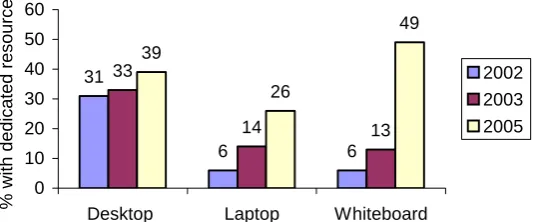
[image:17.595.106.376.334.445.2]Increased use of digital materials in lessons was supported by improvements in schools’ ICT infrastructure. Pupil to computer ratios improved in both primary and secondary schools between 2002 and 2005 as schools acquired more desktops and laptops. The largest increase in resources was in interactive whiteboards. In 2005, around half of subject leaders (49% in primary schools and 52% in secondary schools) reported having access to dedicated interactive whiteboards for their subject, a substantial rise from 6% in primary schools in 2002 (Figure 4) and 12% in secondary schools.
Figure 4 Changes in resources available to primary subject respondents
6 6
33
14 13
39
26
49
31
0 10 20 30 40 50 60
Desktop Laptop Whiteboard
% with dedicated resources
2002 2003
2005
Base: All primary subject leaders (2002, 669; 2003, 630; 2005, 650).
Teachers thought that the impact of ICT facilities on their use of digital materials depended on a wider range of factors than the quantities of resources available. For example, teachers often said that where they had interactive whiteboards
permanently located in their classrooms they used them more, integrated them with other teaching approaches and were more competent and innovative in using them. Portable interactive whiteboards were considered time consuming to set up and often difficult to locate conveniently in classrooms. ICT suites were highly useful but were sometimes difficult to book and disruptive for pupils to move to from their classrooms, and some teachers said it was difficult to adequately monitor pupils as they worked.
3.1.2 Use in lesson planning
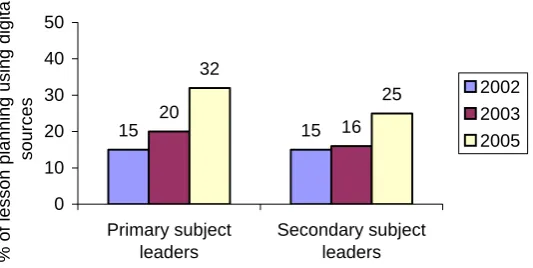
The proportion of teachers’ lesson planning done using digital sources increased between 2002 and 2005, although paper sources remained more common. Digital sources were used on average for 15% of primary subject leaders’ lesson planning in 2002, and this increased to 32% in 2005. Among secondary subject leaders, the average proportion of planning using digital sources rose from 15% to 25% (Figure 5).
Figure 5 Average proportion of teachers’ lesson planning using digital sources
15 15
20
16 32
25
0 10 20 30 40 50
Primary subject leaders
Secondary subject leaders
% of lesson planning using digital
sources
2002 2003 2005
Base: All subject leaders answering. (Primary: 2002, 626; 2003, 612; 2005, 627. Secondary: 2002, 948; 2003, 910; 2005, 920.)
Teachers thought that a significant initial investment of their time was needed to become familiar with new digital materials and prepare lessons using them, which could mitigate against the use of digital sources for lesson planning. Ways in which schools were addressing this need included an Inset day set aside for teachers to explore new digital materials, and the introduction of a guaranteed 10% non-contact time, which was expected to help teachers find time to familiarise themselves with digital materials and plan lessons. However, some teachers thought that they did not have adequate time to become familiar with new digital materials.
Attitudes towards using ICT in lesson planning became more positive between 2002 and 2005. In 2002, 55% of subject leaders in primary schools and 58% in secondary schools agreed with the statement ‘It is easier to find relevant material for teaching in textbooks than on the internet’, but in 2005 this had fallen to 31% in primary schools and 41% in secondary schools. There was further evidence of more positive views among primary subject leaders with the proportion agreeing with the statement ‘There is a lot of useful material for the curriculum on the internet’ rising from 77% to 87%.
3.1.3 Educational impacts
ICT was perceived by the majority of subject leaders to have positive educational impacts on attainment and the capacity to respond to different pupil abilities. Teachers and pupils referred to how digital materials could be used to appeal to a range of learning styles and support independent learning.
The majority of subject leaders believed that the use of ICT could have a positive impact on pupils’ attainment and the capacity to respond to different pupil abilities. Teachers mostly found it difficult to say to what extent the use of digital materials had affected attainment, but often said that although it was not possible to prove that use of digital materials improved attainment, they believed that it did make a significant contribution. In 2005, 87% of subject leaders in primary schools and 82% in
secondary schools agreed with the statement ‘Using ICT resources can improve the attainment of pupils’, an increase from 78% and 76% respectively in 2002.
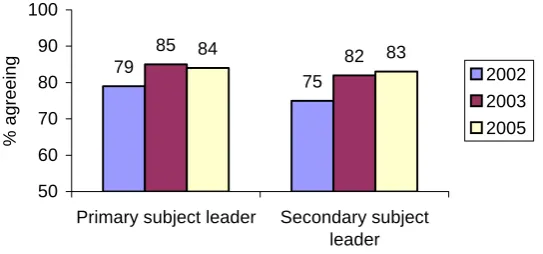
[image:19.595.108.380.439.566.2]Most subject leaders surveyed in 2005 (84% in primary schools and 83% in secondary schools) believed that use of ICT resources could help in responding to different pupil abilities (Figure 6). There were, however, lower levels of agreement with the statement that ‘ICT resources can help in giving individualised feedback to pupils’ (45% of primary subject leaders and 55% of secondary subject leaders agreed).
Figure 6 Agreement with the statement ‘Using ICT resources can help in responding to different pupil abilities’
79
75 85
82
84 83
50 60 70 80 90 100
Primary subject leader Secondary subject leader
% agreeing
2002 2003 2005
Base: All subject leaders answering. (Primary: 2002, 662; 2003, 632; 2005, 642. Secondary: 2002, 999; 2003, 923; 2005, 949.)
However, it was thought these benefits depended on the quality of the digital materials and the ability of the teacher to provide appropriate support.
3.2 Leadership
3.2.1 Strategic management of ICT
Schools adopted a range of approaches to the strategic management of ICT. In primary schools, ICT co-ordinators rarely had designated time for their role and worked in isolation, valuing external links. Primary schools tended to have formal ICT policies, including action and development plans. The ICT
co-ordinator role in secondary schools varied more, with some having designated time for the role while others did not. ICT policies also varied between schools, from formal written policies to informal shared understandings.
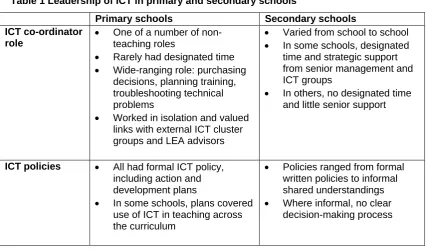
The qualitative studies in schools explored schools’ approaches to the strategic management of ICT, examining the role of the ICT co-ordinator and ICT policies (Table 1).
In primary schools, the ICT co-ordinator role was one of a number of additional non-teaching roles taken on by teachers, and there was rarely designated time for carrying out ICT co-ordinator duties. The ICT co-ordinator role in primary schools was wide-ranging and could include making purchasing decisions, organising training and troubleshooting technical problems. ICT co-ordinators in primary schools worked in isolation and valued their external links with ICT cluster groups and LEA advisors.
All the primary schools had formal ICT policies which included action and
development plans. In some schools, these plans covered the use of ICT in teaching across the curriculum, and in one case an action plan template had been provided by an LEA consultant.
In secondary schools, there was more variation in the role of ICT co-ordinators. In some schools, ICT co-ordinators had designated time for their roles and received strategic support from senior management and ICT strategy groups in the school. In other schools, however, no designated time was set aside for the role, and ICT co-ordinators received little support from senior management in the school.
Table 1 Leadership of ICT in primary and secondary schools
Primary schools Secondary schools
ICT co-ordinator role
• One of a number of
non-teaching roles
• Rarely had designated time
• Wide-ranging role: purchasing
decisions, planning training, troubleshooting technical problems
• Worked in isolation and valued
links with external ICT cluster groups and LEA advisors
• Varied from school to school
• In some schools, designated
time and strategic support from senior management and ICT groups
• In others, no designated time
and little senior support
ICT policies • All had formal ICT policy, including action and development plans
• In some schools, plans covered
use of ICT in teaching across the curriculum
• Policies ranged from formal
written policies to informal shared understandings
• Where informal, no clear
decision-making process
3.2.2 Strategic procurement
Systems for purchasing digital materials became more centralised in
secondary schools following the introduction of eLCs. The majority of primary schools already had centralised systems for procurement. The most common approaches to spending eLCs were that: the ICT co-ordinator or headteacher would make decisions; subject teachers would be invited to make requests to a central budget holder; or subjects would be allocated a certain proportion of the funding available.
The introduction of eLCs required schools to determine how they would spend their allocation, and this affected existing arrangements for procurement. It was found that schools tended to hold eLCs centrally, although secondary schools were more likely than primary schools to distribute eLCs between subjects (18% of secondary schools compared with 6% of primary schools).
Following the introduction of eLCs, systems for purchasing software in secondary schools appeared to have become more centralised. The proportion of secondary schools that reported that departments selected software independently fell from almost half (48%) in 2002 to just over a quarter (26%) in 2005 (Figure 7). There was a move towards teachers submitting requests to a central staff member, with more than two-thirds (68%) of secondary schools reporting that this was how purchasing decisions were made in 2005, an increase from 38% in 2002.
Figure 7 Procedures for purchasing software in secondary schools
6 1 3
38
61
68 8
8 48
30 26
2
0% 20% 40% 60% 80% 100%
2002 2003 2005
% of secondary schools
Departments select independently
Head/ ICT head selects all software
Teachers submit requests
Other
Base: All secondary schools answering (2002, 192; 2003, 194; 2005, 193).
The qualitative studies explored processes for procuring software in more depth and found that both primary and secondary schools usually organised the spending of eLCs in one of three ways:
• The ICT co-ordinator and/or headteacher decided how eLCs were to be spent, with varying degrees of consultation with teachers.
• Teachers were invited to make requests from a central budget holder.
• Budgets were allocated to subject departments.
In two primary schools, there was a mixed approach involving centralised payment for subscriptions to cross-curricular resources, with the remainder being, in one case, held by the ICT co-ordinator who invited requests from teachers and, in another, devolved to groups of subjects to spend as they wished.
Centralised approaches were used to sustain subscriptions to cross-curricular resources, to upgrade specific materials, and to ensure equal access to ICT by different groups of pupils. One ICT co-ordinator wanted to ensure that enough was spent in a single subject area to ensure that digital materials were used in all areas of work, and to ensure that digital materials were not used just by teachers with a personal interest in ICT. Some teachers who were unconfident with ICT or too busy to choose resources themselves preferred this approach.
only request digital materials that served more than one department, which resulted in the languages department not being able to purchase any digital materials.
4 IMPACT ON THE MARKET
This chapter looks at the impact that Curriculum Online has had on the market for educational digital materials, both for schools and for the industry. It begins by examining changes in spending on digital materials and schools’ views of eLearning Credit (eLC) funding. It goes on to look at what impact Curriculum Online has had on the products available for schools and then examines the impact on the ways in which products are selected and marketed.
4.1 Spend on digital materials
Spending on software for the curriculum increased substantially in primary and secondary schools following the introduction of eLCs. There was a corresponding rise in satisfaction with the level of funding available for software, with the majority of schools in 2005 saying it was ‘about right’. The ring-fenced nature of eLCs was generally appreciated by teachers as it ensured funding was allocated to an area that was thought to have been neglected in the past.
Suppliers reported that they experienced increased sales of digital materials, to a greater extent than they had anticipated.
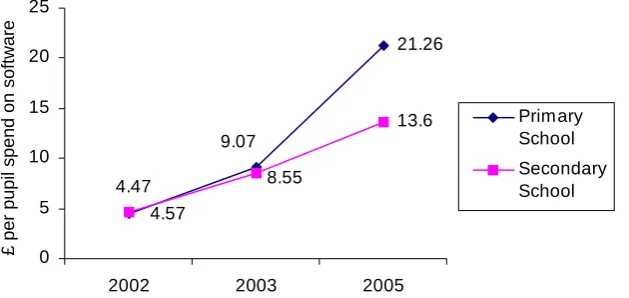
Data provided by the school surveys about spending on software for the curriculum indicated that the introduction of eLCs had driven a substantial increase in spending in both primary and secondary schools between 2002 and 2005.
The increase in spending on software for the curriculum was most dramatic in primary schools. The average spend on software packages in primary schools, rose from £823 in 2002 to £1,287 in 2003. It then almost doubled to £2,435 by the third survey in 2005. Spending on subscription services also rose substantially, from an average of £157 in 2002 to £1,552 in 2005. The average amount spent per pupil on software (packages and subscription services) in primary schools rose from £4.47 in 2002 to £9.07 in 2003 and £21.26 in 2005 (Figure 8).
Figure 8 Average spend per pupil on software for curriculum use in schools
21.26
13.6
4.47
9.07
4.57
8.55
0 5 10 15 20 25
2002 2003 2005
£ per pupil spend on software
Primary School
Secondary School
Base: All schools providing data. (Primary: 2002, 146; 2003, 114; 2005: 114. Secondary: 2002, 107; 2003, 93; 2005, 92.)
The rise in spending was supported by increased satisfaction in schools with the amount of funding available for software. In 2005, more than half of schools (59% of primary schools and 55% of secondary schools) said that the amount of funding for curriculum software was ‘about right’. Among primary ICT leaders, between 2002 and 2003, when eLCs were first introduced, there was a considerable increase in the proportion who said that the amount of funding for curriculum software was ‘about right’, from 29% to 53%. Among secondary school respondents, the proportion who thought the amount of funding for software was ‘about right’ increased more
gradually, rising from 20% to 36% between 2002 and 2003.
Most teachers interviewed in the qualitative study appreciated having ring-fenced funding for digital materials as this had ensured that money had been invested in an area that had attracted little significant funding in the past. Overall, eLC funding tended to be seen as more than adequate for schools’ needs. Some respondents thought that in principle they could rely on other sources of funding if they could not get the resources they wanted with eLCs, but in practice there was little evidence of teachers needing to use these alternative sources of funding.
Corresponding to the increase in spending in schools, suppliers experienced increased sales in educational digital materials between 2003 and 2004. When first interviewed in 2003, the majority (69%) of suppliers had anticipated that Curriculum Online would lead to an increase in their sales, and only slightly fewer (60%) reported in 2004 that there had been an impact on the volume of sales. In 2004, suppliers’ estimates of the increase in volume sales they had experienced was higher than their estimates of anticipated increases in 2003. Seven per cent fewer companies in 2004 estimated an increase below 20%, while 16% more companies estimated an
increase between 20% and 60% in volume sales.
teacher confidence in using ICT and the establishment of broadband internet connections in schools.
Some suppliers were concerned that eLC funding could be diverted to other areas as ring-fencing was not strictly monitored. The different levels of purchasing throughout the year also had cash-flow implications for small companies.
Most suppliers did not think that Curriculum Online had had an impact on pricing.
4.2 Products
available
4.2.1 Criteria for purchasing products
Schools used a range of criteria to select which digital materials they purchased and varied in how well-thought-out their purchases were.
Teachers and ICT co-ordinators discussed a range of criteria that they used when selecting digital materials. Schools and teachers varied in how well-thought-out their purchases seemed to be. Some teachers spoke very vaguely about the kinds of criteria they had used to select digital materials, while others had very explicit and clear approaches to selecting materials. The reasons that were mentioned were that the materials chosen:
• fitted with curriculum and schemes of work
• offered value for money
• were easy to use
• were suitable for all abilities
• were engaging for pupils
• had a clear educational purpose
• added value to other teaching
• were unique – there was nothing similar available on the internet for free
• were to update and sustain digital materials.
4.2.2 Digital materials purchased
There were differences between primary and secondary schools in the kinds of digital materials that were purchased with eLCs and other sources of funding.
The qualitative research found some key differences between primary and secondary schools in the kinds of materials purchased with eLCs and other funding, as
Table 2 Types of digital materials purchased
Primary schools Secondary schools
• Focus on whole-school resources
• Special focus on safe and secure
internet-style searches
• Specialist subject software mentioned,
but strong focus on literacy and numeracy
• More use of standard Microsoft packages
and professional software by pupils
• More subject-specific digital materials
• More use of internet and email by pupils,
including subject-specific and exam revision resources on the internet
• More focus on making own digital
materials, such as presentations, quizzes and exercises
• Use of source material such as online
access to original historical and legal documents
4.2.3 Views on available products
Ratings of the quality of software available for curriculum use improved between 2002 and 2005, both for relevant content and technical quality. Teachers reported that some digital materials purchased with eLCs were not being used regularly for a range of reasons, including not being sufficiently interactive or easy to use.
Figure 9 Percentage of subject respondents rating software as ‘very good/quite good’ for relevant content
74 75 76 74
86 87 86
82 75 81
77
82
0 20 40 60 80 100
KS1 Teachers KS2 Teachers KS3 Teachers KS4 Teachers
% rating very good/quite good
2002 2003 2005
Base: All primary and secondary teachers answering at baseline/second survey/third survey (Key Stage 1 teachers, 521/492/509; Key Stage 2 teachers, 565/549/564; Key Stage 3 teachers, 972/900/933; Key Stage 4 teachers, 933/867/905).
Most subject leaders rated software highly for technical quality. The proportion of subject leaders in primary schools who rated software as ‘very good’ or ‘quite good’ for technical quality improved from around eight-tenths in 2002 (79% at Key Stage 1 and 80% at Key Stage 2) to around nine-tenths in 2005 (90% at Key Stage 1 and 91% at Key Stage 2). Improvements in ratings for technical quality were slightly lower in secondary schools, with 88% of subject leaders at both Key Stage 3 and Key Stage 4 rating software as ‘very good’ or ‘quite good’ in 2005 compared with 82% at Key Stage 3 and 79% at Key Stage 4 in 2002.
At Key Stage 1, subject leaders for science were less likely than those for English and maths to give positive ratings of software for relevant content and technical quality. Just over three-quarters (77%) of science subject leaders rated software for Key Stage 1 as ‘very good’ or ‘quite good’ in 2005, compared with 91% of maths and 90% of English subject leaders.
The qualitative study found that while many of the digital materials purchased with eLCs were being actively used in schools, and some teachers said that materials had fallen from use or were not used regularly. The main reasons given for materials not being used were that:
• materials were faulty
• materials were not as interactive as expected
• materials were too text-based
• teachers had found better free resources on the internet
• materials were not as easy to use as expected
• network problems made it difficult to access the resource
• there were delays in getting materials loaded on to school network
• changes had been made to the operating system so some packages could no longer be used
• it was not always easy to find relevant information when using cross-curricular resources
• teachers had not had time to learn how to use the materials.
4.2.4 Product development
Curriculum Online was perceived by some suppliers to have had a positive impact on product development, particularly on the level of investment in development, the number of new resources and the quality of content.
The areas of product development where suppliers were most likely to think that Curriculum Online had had a positive impact were the level of investment in
development, the number of new resources and the quality of content. Forty-two per cent of suppliers in 2004 reported that Curriculum Online had influenced their company’s investment in development, while 39% thought it had influenced the number of new resources, and 38% thought it had influenced the content of products. More than two-fifths of suppliers reported that they were changing the content design to fit the tagging requirements of Curriculum Online. It is worth noting, however, that the majority of suppliers did not think that Curriculum Online had had an impact on their product development in any of these ways.
Suppliers reported some concerns about the long-term influence of Curriculum Online on the market, for example citing fears of schools becoming ‘awash’ with software, and the effects that this would have on investment in product development.
4.3 Accessing digital materials
4.3.1 Sources of information
The Curriculum Online website was used as a source of information for accessing digital materials by the majority of ICT leaders in schools, but had not become the preferred source of information. Supplier catalogues were the source of information used most commonly by ICT and subject leaders to select software. Recommendations from colleagues within school and contacts outside school were also a valued source of information.
The most commonly used source of information about software was suppliers’ catalogues, with most ICT leaders (93% in primary schools and 85% in secondary schools) reporting that they used these. More than three-quarters of subject leaders (77% in primary schools and 84% in secondary schools) used catalogues to select software. For ICT leaders and subject leaders who used more than one source of information, supplier catalogues were the most commonly used source.
Catalogues were popular because teachers valued being able to browse through them quickly in a variety of locations. However, teachers tended not to rely solely on catalogues to select software. They might, for example, discuss the products with internal or external colleagues, and it was becoming increasingly common for teachers to try to get products on trial or obtain demonstrations to see how they worked.
Recommendations from colleagues in schools and from contacts outside school were also used by more than three-quarters of ICT leaders and more than half of subject leaders. Teachers valued finding out about products through word-of-mouth
recommendations as this reduced the time they needed to spend searching for information and there was a perception that recommendations meant that products were more likely to be easy to use and of high quality. However, recommendations were not always found to be reliable.
4.3.2 Marketing
Some suppliers made changes to their marketing approach when Curriculum Online was introduced, most often to catalogues, fliers and websites. However, few suppliers reported having made further changes to their marketing
approach in 2004. Most suppliers reported making explicit reference to
Curriculum Online in marketing materials and including the Curriculum Online logo in these materials.
Changes in marketing approach as a result of Curriculum Online were reported by some companies in 2003. Most commonly, changes had been made to company catalogues, fliers and websites.
However, in 2004, few suppliers reported changes to marketing approaches because of Curriculum Online, indicating that activity at the point when Curriculum Online was launched was not followed up with further changes. Although the majority of suppliers had not made changes to their marketing focus, a minority were focusing marketing more on those who had the ability to spend eLCs, such as ICT co-ordinators and subject leaders.
Most suppliers reported that they made explicit reference to Curriculum Online in their marketing materials (91%) and included the Curriculum Online logo in their marketing materials (86%).
had focused their sales. Several suppliers thought that Curriculum Online gave credibility to their products, while others thought it gave the buyers more confidence.