
Asynchronous,
Distributed
Optimisation
for
Cooperative
Agents
in
a
Smart
Grid
Benjamin
Samuel
Millar
supervised by
Dr. Danchi Jiang and Dr. Md Enamul Haque
Submitted in fulfilment of the requirements for the
degree of N9A - Doctor of Philosophy, Engineering
Acknowledgements
I would like to express my sincere gratitude to my primary supervisor Dr Danchi Jiang for his patience and perseverance throughout my candidature. I appreciate our countless discussions and his guidance that saw each prob-lem solved.
I would also like to thank my secondary supervisor Dr Md Enamul Haque for his support and assistance early in my candidature.
I thank the School of Engineering and the University of Tasmania staff who supported me during my time at the university.
I appreciate the financial support provided by the University of Tasmania and the Commonwealth Government through the Elite Australian Post Graduate Award (APA) scholarship.
Declarations
Declaration of Originality
This thesis contains no material which has been accepted for a degree or diploma by the University or any other institution, except by way of back-ground information and duly acknowledged in the thesis, and to the best of my knowledge and belief no material previously published or written by another person except where due acknowledgement is made in the text of the thesis, nor does the thesis contain any material that infringes copyright.
Signed:
Benjamin Millar
Date:
Authority of Access
The publishers of the papers comprising Chapters 3to 7 hold the copyright for that content, and access to the material should be sought from the re-spective journals. The remaining, non published content of the thesis may be made available for loan and limited copying and communication in accor-dance with the Copyright Act 1968.
Signed:
Benjamin Millar
Date:
Statement of Co-authorship
The following people and institutions contributed to the publication of work undertaken as part of this thesis:
Benjamin Samuel Millar, University of Tasmania = Candidate Danchi Jiang, University of Tasmania = Author 1
Md Enamul Haque, University of Tasmania = Author 2
Author details and their roles:
Paper 1, A Novel Partitioning Strategy for Distribution Networks Featuring Many Small Scale Generators:
Located in chapter 2
Candidate was the primary author and with author 1 contributed to the idea, its formalisation and development. Candidate contributed approximately 80% and author 1 15%.
Author 2 assisted with refinement and presentation; approximately 5%.
Paper 2, Constrained Coordinated Distributed Control of a Smart Grid with Asynchronous Information Exchange:
Located in chapter 3
Candidate was the primary author and with author 1 contributed to the idea, its formalisation and development. Candidate contributed approximately 75% and author 1 20%.
Author 2 assisted with refinement and presentation; approximately 5%.
Paper 3, Smart Grid Optimization Through Asynchronous, Distributed Pri-mal Dual Iterations:
Located in chapter 4
Candidate was the primary author and with author 1 contributed to the idea, its formalisation and development. Candidate contributed approximately 80% and author 1 20%.
Paper 4, Asynchronous Consensus for Optimal Power Flow Control in Smart Grid with Zero Power Mismatch:
Located in chapter 5
Paper 5, An Asynchronous, Distributed Protocol for DC Power Management in a Smart Building:
Located in chapter 6
Candidate was the primary author and with author 1 contributed to the idea, its formalisation and development. Candidate contributed approxi-mately 80% and author 1 20%.
We the undersigned agree with the above stated proportion of work under-taken for each of the above published (or submitted) peer-reviewed manuscripts contributing to this thesis:
Signed:
Danchi Jiang Andrew Chan
Supervisor Head of School
School of Engineering and ICT
School of Engineering and ICT
University of Tasmania University of Tasmania
Date: 30/08/2017 2nd September 2017
Abstract
This thesis addresses a number of issues present in the modern and future power distribution system where high penetration of distributed generation (DG) and smart sensors change the environment in which power flow must be managed. The shift in balance of power supply from the centralized to the distributed can lead to network constraint breaches such as voltage and frequency limits, fault ride through capability, system security, reliability and stability. Common regulation approaches may be inadequate in address-ing these network regulation problems, leadaddress-ing to inefficient use of DG and unnecessary high voltage (HV) grid imports. Furthermore, the increase in intelligent Smart Grid components will lead to the transmission and pro-cessing of large volumes of data making the optimal control of a network a more challenging problem. Optimisation methods must take into consid-eration the increase and distributed nature of data, and account for data synchronization, latency, and privacy issues.
However, if these challenges can be overcome, then the increase in the con-trollability and observability of smart grid components, such as distributed generators, storage and controllable demands, offers great potential for the improvement of network optimality and stability. In this thesis, a set of in-novative distributed algorithms are presented that solve the optimal power flow problem of a distribution network featuring advanced nodal monitor-ing and control of DG, storage and loads. These algorithms exploit the network structure to produce iterative solutions to solve the global optimisa-tion problem. They are carefully developed taking into account the realistic limitations where each node can only exchange information with adjacent neighbours but does not have sufficient information about the other nodes in a large scale system.
min-imising HV grid imports. The second strategy is based on sets of strongly coupled buses, where the coupling of buses is characterised according to the potential for a change in power at one bus to impact the state estimation error at another, therefore improving solution optimality.
Subsequently, a distributed predictive optimal control algorithm is pro-posed, through the method of approximate dynamic programming, that utilises a central coordinator to improve network state estimation and con-trol sequence optimality. The centrally coordinated solution has the bene-fit of a near optimal solution without burdening controllers with the high-dimensional state of the entire distribution network, but rather utilising only a summary of global information.
Improvements to the centrally coordinated scheme are then developed through a fully distributed optimal power flow algorithm that requires no central coordination. The fully distributed approach maintains the reduced computational requirements of controllers but improves on the centrally co-ordinated configuration by restricting data communication to local neigh-bourhoods. Three variants of the distributed OPF solution are suggested for application to three distinct scenarios: Optimal DG control in a distribution network, DG optimal control in an islanded distribution network, and opti-mal power management in a home energy management system. These three approaches address significant issues associated with distributed control. An optimal solution to the global problem is achievable in each case, and itera-tions of the algorithm are shown to be stable and convergent through the use of an augmented Lagrange formulation. Global information necessary for a feasible solution is shared through the development of a new asynchronous consensus protocol, and a communication protocol is presented to enable instantiation, execution and conclusion of fully distributed optimisation ses-sions.
For each studied approach, algorithms are carefully developed that con-cisely define the method of application. For each presented algorithm, a reasonable amount of computer simulation is applied to verify their applica-bility to a range of relevant scenarios. The simulations study the algorithms’ convergence and scalability, solutions’ optimality in a local sense, and so-lution feasibility. In each case the simulations successfully demonstrate the presented methods’ practicality for the studied scenarios.
Contents
List of Tables 1
List of Figures 2
1 Introduction 4
1.1 Thesis Problems 5
1.2 Research Outcomes 5
1.3 Publications 7
1.4 Thesis Outline 8
2 Literature Review 10
2.1 The Smart Grid – A Brief Review 11
2.1.1 Energy System 12
2.1.2 Communication System 13
2.1.3 Information System 14
2.2 Distributed Smart Grid Optimisation and Control 16
2.2.1 Network Partitioning 16
2.2.2 Distributed Control 17
3 A Novel Partitioning Strategy for Distribution Networks Featuring Many
Small Scale Generators 20
3.1 Introduction 21
3.2 Network Model 22
3.2.1 Power Flow 22
3.2.2 Capacitors 23
3.2.3 Transformers 23
3.2.4 Constraints 24
3.2.5 Zone Power Imbalance 24
3.2.6 DSO Regulation 24
3.3 DSO Sub-layer: Zones 25
3.4 Partitioning Strategies 25
CONTENTS
3.4.2 Lagonette’s Partitioning Algorithm 26
3.4.3 Power Balancing 26
3.5 Zone Regulation 27
3.6 Case Study 28
3.6.1 Geographical Partitioning 29
3.6.2 Electrical Distance Partitioning 29
3.6.3 Power Balanced Partitioning 30
3.6.4 HV Import 31
3.6.5 Voltage Profile 33
3.7 Conclusion 34
4 Constrained Coordinated Distributed Control of a Smart Grid with
Asynchronous Information Exchange 36
4.1 Introduction 37
4.2 Preliminaries 40
4.2.1 Approximate Power Flow 40
4.2.2 The Dynamic Smart Grid Problem: DP 40
4.2.3 The Dynamic Smart Grid Solution: ADP 41
4.3 The Distributed Smart Grid Problem 43
4.3.1 Distributed Dynamic OPF 43
4.3.2 Distributed Power Flow 44
4.3.3 Distributed Voltage Approximation Error 45
4.4 Proposed Coordinated Distributed Solution 46
4.4.1 Power Flow Based Decomposition 46
4.4.2 Distributed Optimization Through ADP With Partial State
Information 48
4.4.3 Refining Distributed Estimates Through Central
Coordi-nation 49
4.4.4 The Convergence of Dampened Information Exchange 52
4.5 Case Study 54
4.5.1 Scenarios 54
4.5.2 Localization 55
4.5.3 Results 56
4.6 Conclusion 60
5 Smart Grid Optimization Through Asynchronous, Distributed Primal
Dual Iterations 62
5.1 Introduction 63
5.2 Problem Formulation 65
5.3 Augmented Lagrangian Optimization 67
5.4 Distributed Solution 69
CONTENTS
5.4.1 Synchronous Distributed Algorithm 72
5.4.2 Distributed Backtracking Line Search 72
5.4.3 Asynchronous Distributed Algorithm 73
5.5 Simulation Results 74
5.6 Conclusions 77
6 Asynchronous Consensus for a Distributed Primal Dual Solution to the
Smart Grid OPF Problem 80
6.1 Introduction 81
6.2 Problem Formulation 84
6.3 Augmented Lagrangian Optimization 86
6.4 Asynchronous, Distributed Solution 87
6.4.1 Asynchronous Consensus Protocol 88
6.4.2 Asynchronous, Distributed Algorithm 92
6.5 Simulation Results 93
6.6 Conclusion 97
7 An Asynchronous, Distributed Protocol for DC Power Management in
a Smart Building 98
7.1 Introduction 99
7.2 Problem Formulation 101
7.3 HEMMA Protocol 103
7.3.1 Discover Neighbours (DN) 104
7.3.2 Identify Neighbour (IN) 104
7.3.3 Start Session (SS) 104
7.3.4 Start Session Accepted (SSA) 105
7.3.5 Start Session Rejected (SSR) 105
7.3.6 Cancel Session (CS) 106
7.3.7 Finish Session (FS) 106
7.3.8 Finish Session Accepted (FSA) 106
7.3.9 Finish Session Rejected (FSR) 107
7.3.10 Variable Update (VU) 107
7.4 Distributed Optimal HEMS 108
7.4.1 Augmented Lagrangian Optimization 108
7.4.2 Asynchronous, Distributed HEMS Optimization 110
7.4.3 Convergence Consensus in Asynchronised Optimisation 112
7.5 Simulation Results 113
7.6 Conclusions 117
8 Conclusion 119
CONTENTS
8.2 Contributions 120
8.2.1 Partitioning Strategies 121
8.2.2 Optimisation Algorithms 122
8.2.3 Protocols 123
8.3 Future Directions 124
Bibliography 125
List of Tables
4.1 Network Decomposition 55
4.2 Process Times 59
7.1 State Transition Actions 109
7.2 Network Specifications 113
List of Figures
3.1 Case Study network [22] 29
3.2 Electrical Distance Partitions – High Demand 30
3.3 Electrical Distance Partitions – Medium to Low Demand 31
3.4 Power Balanced Partitions – High Demand 32
3.5 Power Balanced Partitions – Diverse Demand 33
3.6 High Voltage Grid Power Import 34
3.7 Voltage Profile – Low Demand 35
3.8 Voltage Profile – Diverse Demand 35
4.1 Distributed Network Structure 46
4.2 Central Iterations 49
4.3 12 Hour Forecast 55
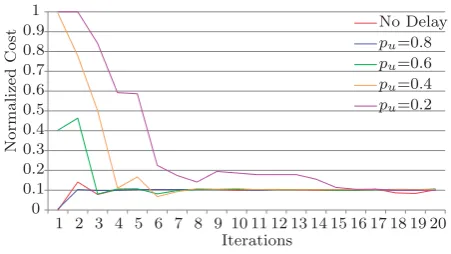
4.4 Cost Comparison of Optimization Methods 57
4.5 Maximum Voltage at Each Iteration 57
4.6 Cost Convergence With Information Exchange Delays 58
4.7 Effects of Dampening Controls of Cost 59
4.8 Process Duration For a Single Central Iteration 60
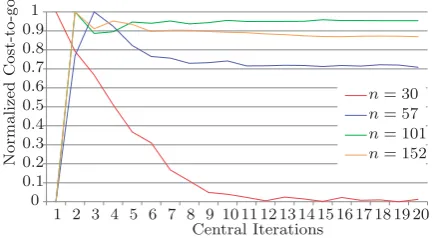
4.9 Cost-to-go Convergence for Networks with n Local Controllers 60
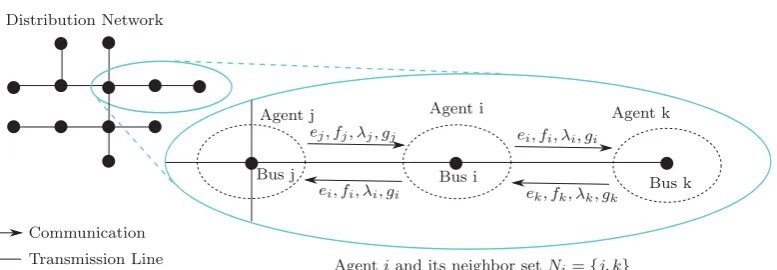
5.1 Example of inter-agent communication: Each bus within the dis-tribution network is equipped with an agent which communicates
with its neighbours. 70
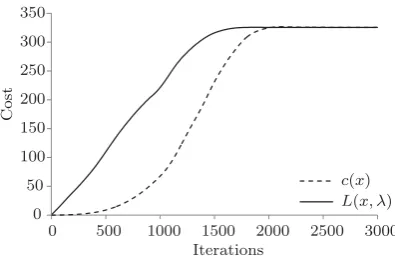
5.2 Convergence of Lagrange function L(x, λ) to cost function c(x)
over iterations of algorithm 5 76
5.3 Nodal voltages after optimization through algorithm 5; voltage magnitudes are constrained between [0.95 1.05] p.u. 77
5.4 Convergence of normalized Lagrange gradients (∇xL(x, λ)) to
zero over iterations of algorithm 5 77
5.5 Convergence of optimal power estimates for each agent over
it-erations of algorithm 5 78
5.6 CPU time per agent per iteration over iterations of algorithm 5 78
6.1 Asynchronous neighbour communication: Each agent represents a single bus within the distribution network and communicates only with its neighbours while preserving the privacy of local power
production and demand. 88
6.2 Convergence of Lagrange function and cost function to solution of centralized OPF, L∗, over iterations of algorithm 7. 94
6.3 Convergence of power flow constraints, g(x), to zero over
itera-tions of algorithm 7. 94
6.4 Consensus tracking of average active power mismatch by agents through algorithm9, and convergence of power mismatch to zero
over iterations of algorithm 7. 95
6.5 Nodal voltages after convergence of algorithm 7. 95
6.6 Convergence of optimal DG power estimates for each agent over
iterations of algorithm 7. 96
6.7 Convergence of normalized Lagrange gradients to zero over
iter-ations of algorithm 7. 96
7.1 A simple network example featuring a controlled voltage source, a constant current load, and a constant power load connected via
transmission lines. 102
7.2 HEMMA Protocol state transition diagram. 108
7.3 Simulation circuit. 114
7.4 Nodal Voltages. 114
7.5 Ground Voltages. 116
7.6 Voltage Source Power. 116
7.7 Equality constraint norm g(x). 117
7.8 Convergence consensus: Average convergence measure 1 |N |
hi(x),
and consensus estimates ˜hi ∀i∈ N. 117
7.9 Convergence with communication disruption for agent VS1 from
iteration 50 to 450. 118
7.10 Convergence with a change in agent CP1’s load at iteration 700
CHAPTER 1
Introduction
Intelligent power networks provide opportunities for improved power supply through solutions that draw from increased commu-nication and information processing capabilities present in the smart grid. Additionally, the increased monitoring and control within components of the smart grid may be employed to improve observability, controllability and optimality of distributed compo-nents such as distributed generators (DG), storage, sensors and smart home devices. The shift towards these distributed com-ponents gives opportunities for improved cooperation between smart grid agents, however it also requires increased monitoring and control to avoid network constraint breaches, in particular in the case of high DG penetration. The integration of communi-cation and intelligence into a distribution network also gives rise to new problems relating to network scalability and high data volumes, and new solutions in the form of distributed monitoring and control are required. In this section these problems are for-mally defined in the context of the thesis’ research, and the thesis contributions are presented at a high level.
To provide an overview of this thesis, the associated problems addressed are defined in Section 1.1, its research outcomes are presented in Section 1.2, its associated publications in Section
1.3, and its outline in Section1.4.
1. Introduction
1.1 Thesis Problems
Recent research into the advancements and future potential in power net-works has seen a shift from centralised scheduling and control methods to various distributed approaches (for numerous examples, refer to Section2.2). These distributed approaches aim to address the issues associated with high data volumes, and to reduce centralized communication and processing bur-dens, while maintaining privacy and optimal or near-optimal grid operation. As such, this thesis’ focus is to investigate and provide solutions to the following problems with a focus on optimal power flow in smart distribution networks:
Problem 1 The logical structure of a traditional distribution network is un-likely to be conducive to the convenient application of distributed optimisation methods.
Problem 2 Distributed optimisation approaches do not accurately consider the power flow and regulatory constraints within smart distribu-tion networks.
The objective of this thesis, with regards to Problem 1, is to identify the relevant aspects of network structure, and to find optimal network partitions, for the purpose of optimal network operation. Additionally, the sub-problem of shifting optimal partition structure due to changes in network state over time will also be addressed. Problem 1is complex to solve due to the dynamic nature of an active distribution network and the optimality of a partitioned structure will vary depending on the operating state.
The objective of this thesis, with regards to Problem 2, is to develop distributed optimal power flow algorithms that both select a feasible and an optimal or near optimal operating state. Additionally, the sub-problems of distributed handling of global values of interest, and asynchronous communi-cation without central coordination will be addressed. Problem 2 is difficult to solve without knowledge of the full network state since solution feasibility at any bus is dependent on the state of all other network buses. The difficulty of the problem is further increased due to the non-convexity of the optimal power flow problem.
1.2 Research Outcomes
1. Introduction
exploited to solve the economic dispatch of distributed generators, storage and loads. This provides the benefit of more extensible and scalable smart grids that are not overburdened by high data volumes.
In order to develop distributed solutions capable of efficient optimisation, the distributed agents must first be defined. Two approaches are taken to ad-dress this requirement: Network partitioning to form zones, and application of a non-hierarchical multi-agent system (MAS). The presented partitioning algorithms extend the method of sensitivity matrix decomposition to ac-count for the forecast balance of generation capacity and loads within each zone, and voltage estimation errors due to power flow approximations. This partitioning approach better enables zone controllers to optimally manage resources and to better approximate state within their scope of control and observation.
Application of a non-hierarchical MAS to the optimal power flow (OPF) problem is explored in depth through three formulations, each of which is specifically applicable to different scenarios and addresses different challenges specific to each case. Careful formulation of the economic dispatch problem within the smart grid context allows for a fully distribution OPF solution to be developed. The presented solution is capable of calculating power flow without any central coordination, and of reaching an optimal solution of the global OPF problem, accounting for voltage, current and power limits, through neighbourhood communication only.
To assist the solution of OPF within an isolated network, a new asyn-chronous averaging consensus algorithm is developed. The consensus al-gorithm enables agents within the network to discover the mismatch be-tween generated power and loads in cooperation with the asynchronous dis-tributed OPF solution. The developed consensus algorithm features some benefits over its predecessors: No leader agent is required, neighbourhood synchronisation is not required, neighbouring agents are implicitly paired asynchronously, and an average consensus is achieved and tracked.
Finally, an application level communication protocol is developed that en-ables the MAS to initiate, conduct and conclude optimisation sessions with-out the need for a central coordinator or synchronisation. The protocol is an enabler for implementing the presented distributed optimisation algorithms in a practical scenario. A home energy management system (HEMS) is cho-sen for a demonstration of the protocol applied to managing the distributed optimisation.
The following points highlight the contributions of this work:
1. Partitioning systems are proposed that improve upon previous work by accounting for forecasts and power balance, and minimising likely
1. Introduction
voltage errors.
2. A centrally coordinated, distributed smart grid optimisation algorithm is presented that accounts for uncertain future states, the capacity of agents to manage information within their zones, the likely voltage estimation errors, and the scalability of the solution.
3. An asynchronous, distributed algorithm built on a primal dual iterative optimisation process is presented that is able to solve the global OPF problem of optimal DG control without any central coordination or synchronisation.
4. An asynchronous averaging consensus algorithm is developed which re-quires no leader agent, no synchronisation, and no explicit agent pair-ing, and is then combined with the asynchronous, distributed OPF solution.
5. An asynchronous inter-agent communication protocol is developed that enables agents to begin, execute and conclude optimisation sessions.
1.3 Publications
The research publications listed below were written during my PhD candida-ture and submitted to or published in fully refereed international conference proceedings or journals. Chapters 3 to 7 are based on the content of these papers, which were the contribution of the author, and are organised in a manner consistent with the thesis context.
• B. Millar, D. Jiang, and M. E. Haque. “A novel partitioning strategy for distribution networks featuring many small scale generators”. 2013 IEEE PES Innovative Smart Grid Technologies Conference (ISGT). Feb. 2013, pp. 1–6. doi: 10.1109/ISGT.2013.6497813
• B. Millar, D. Jiang, and M. E. Haque. “Constrained coordinated distributed control of smart grid with asynchronous information ex-change”. Journal of Modern Power Systems and Clean Energy 3.4 (Dec. 2015), pp. 512–525. issn: 2196-5420. doi: 10.1007/s40565-015-0168-1. url: https://doi.org/10.1007/s40565-015-0168-1 • B. Millar and D. Jiang. “Smart Grid Optimization Through
Asyn-chronous, Distributed Primal Dual Iterations”. IEEE Transactions on Smart Grid 8.5 (Sept. 2017), pp. 2324–2331. issn: 1949-3053. doi:
1. Introduction
• B. Millar and D. Jiang. “Asynchronous Consensus for Optimal Power Flow Control in Smart Grid with Zero Power Mismatch”. Accepted for Publication in Journal of Modern Power Systems and Clean Energy
(2017)
• B. Millar and D. Jiang. “An Asynchronous, Distributed Protocol for DC Power Management in a Smart Building”. IEEE International Conference on Communication Technology. Oct. 2017
1.4 Thesis Outline
The advent of the smart grid brings many benefits but also many new chal-lenges. Of interest in this thesis is the challenge presented by large data volumes requiring transmission and processing. The remainder of this thesis investigates distributed solutions to smart grid optimal power flow and re-lated problems, with a particular focus on the thesis problems and objectives defined in Section 1.1.
Chapter 2presents a review of literature relating to the smart grid, with a particular focus on the thesis problems.
In Chapter 3 a partitioning strategy is introduced in order to enable a sub-layer of control over distributed generators (DG), and contributes to the objective of finding optimal network structure to address Problem 1. The proposed partitioning better enables zone controllers to manage DG, especially in the case of an imbalance between generation and load.
In Chapter 4 a centrally coordinated distributed approximate dynamic program (ADP) with asynchronous information exchange between local and central nodes is presented. The presented methods include algorithms for partitioning and optimal power flow with a focus on the impacts of state changes over time to address Problem 1 and its sub-problem, and Problem 2. The proposed distributed ADP algorithm is able to reduce the optimal power flow (OPF) problem dimensionality, improve local state estimation, and handle delays in information exchange.
In Chapter5an asynchronous, localised primal dual method to solving the OPF problem is developed, in order to addressProblem 2and its objective of optimal control. The localised OPF form uses only local and neighbourhood communication allowing for a completely distributed implementation that is able to reach an optimal solution to the global problem without use of a central agent.
In Chapter6a new asynchronous averaging consensus protocol is applied to the distributed OPF solution presented in the previous chapter in order to extend the capability of the asynchronous, distributed OPF method. The
1. Introduction
consensus protocol addresses Problem 2’s sub-problem of distributed han-dling of global values of interest. This allows the inclusion of inseparable global constraints, such as network power mismatch, into the OPF problem.
In Chapter 7 the Home Energy Management Multi-Agent (HEMMA)
protocol is developed to enable the coordination of agents within a smart building for the purpose of solving the distributed DC OPF problem. The HEMMA protocol addresses Problem 2’s sub-problem of needing an chronous communication mechanism without central coordination. The asyn-chronous protocol allows the distributed optimisation to be managed while being tolerant to network structural changes.
CHAPTER 2
Literature Review
The smart grid has seen extensive research across a broad range of problems in modern literature. The introduction and expansion of communication and computing resources present within a smart grid, provides new opportunities for improved monitoring and control, and in turn can lead to increased observ-ability, controllobserv-ability, and optimality. These exciting possibili-ties have lead to an explosion of research in the field of smart grid advanced monitoring and optimal control.
To give a clearer context to these smart grid issues, the compo-nents of a smart grid and their associated problems are reviewed in Section 2.1, and a review of distributed smart grid problems and solutions is provided in Section 2.2.
2. Literature Review
2.1 The Smart Grid – A Brief Review
The future power transmission and distribution system is envisioned to in-corporate many intelligent components connected by communication infras-tructure. Smart sensor and actuator agents may utilise the communication infrastructure to report network state back to central nodes for monitoring purposes, transmit sensor data to other agents for cooperative processing, and apply the information locally for decentralised optimisation. Such a power network with integrated communication and intelligence is referred to in the literature as a smart grid [6,7,8,9,10]. The smart grid plays an essen-tial role in fulfilling future power needs and provides the infrastructure and mechanisms to achieve improved reliability, security, economics, efficiency, environmental impact, safety, and automation [11, 12, 9].
In recent years governments and energy utilities have provided incentives to push power supply away from fossil fuel based generation to the use of re-newable energy sources [13]. This has in turn seen a dramatic increase in the use of small scale power generation, for example through rooftop solar and other distributed generators (DG). Beyond the reduced environmental im-pacts of renewable DG, there are numerous benefits to the use of distributed power generators [12]. DG can provide power directly to its neighbourhood and therefore reduce the need for transmission over large distances from high voltage transmission to low voltage distribution. This has the added benefit of reducing power loss due to transmission and ultimately improves perfor-mance [14].
However, there are also a number of issues introduced by the presence of DG that must be carefully considered [15,16,17]. High penetration of DG is likely to introduce periods of reverse power flow within the distribution net-work, in particular in residential areas where high solar irradiance coincides with low demand. Older infrastructure is typically not designed for reverse power flow and may cause network operational constraints to be breached, in particular due to voltages exceeding their upper limits. Traditional transmis-sion and distribution networks were not designed to accommodate localised generation and the resultant non-hierarchical power flow between regions. This is expected to be especially evident in rural areas [12]. The result of this is congestion and potentially the need to curtail power generation within the transmission and distribution systems.
2. Literature Review
limited observability which makes network state estimation unreliable, espe-cially in the presence of intermittent generation and load [19]. This limits the ability of existing networks to support improved optimisation techniques that take advantage of distributed generation, intelligent appliances within homes and businesses, and active demand management by consumers.
As such, smart grid development aims to accommodate a move from traditional hierarchical power generation and delivery structures, to a less centralised system allowing for bidirectional power flow, greater observability and controllability [20], and improved efficiency.
A typical smart grid infrastructure can be divided into three intercon-nected systems: The energy system, communication system, and informa-tion system [9]. The energy system produces, distributes and consumes power within the grid. The communication system links the components of the energy system allowing for sharing of monitoring information and the possibility of remote, cooperative and optimal control. The information system provides the computing infrastructure that intelligently implements analysis and control of components within the energy system, based on the information received through the communication system. Further details are provided in the following Sections.
2.1.1 Energy System
The energy system consists of the power generation, transmission, distribu-tion and storage and the physical infrastructure required to support it. The smart grid infrastructure’s energy system incorporates both traditional cen-tralised generation (e.g. fossil fuel and nuclear plants, large scale solar and wind farms), and distributed generation (e.g. rooftop and small-scale solar), producing two-way power flow in order to meet demand. The energy system includes a range of heterogeneous power sources, storage and loads which must operate in a heavily dependent manner, and in the context of a smart grid should work in order to better serve consumers. The following lists some components of the energy system commonly studied in recent research.
Distributed generators (DG): Benefits of DG include the provision of ancil-lary services [21, 22], reduction of line loss due to localised supply of power [14], increased use of renewable power generation, reduced costs for con-sumers, improved reliability and voltage support, improved security, reduced reserve requirements and numerous potential environmental benefits [23]. Methods of DG control include through aggregation to form a virtual power plant [9, 24, 25], constrained economic dispatch [26, 27, 28, 29, 30, 31], and overvoltage regulation [32,33].
2. Literature Review
Distributed storage: The use of distributed storage devices is set to increase [34]. Applications of distributed storage include peak shaving [35, 36, 37,
38], frequency control support [39], economic dispatch [40, 30, 28, 41, 42], and compensation for renewable generation fluctuations [35, 43]. A review of distributed storage technologies can be found in [44].
Electric vehicles: Plugin electric vehicles (PEV) present an addition signifi-cant load, albeit typically at traditional off-peak times. Solutions to manage the addition of PEV to the power system include the coordination of multiple PEV with DG [45,46,47,48], and the use of vehicle batteries as dispatchable storage referred to as Vehicle to Grid (V2G) [49, 50,51].
2.1.2 Communication System
The communication system consists of the wired and wireless physical in-frastructure used for information transmission within the smart grid and also the protocols involved. The communication systems used must account for the range of components within the hierarchy of the energy system, in-cluding plant-wide networks for communication between control centres and generation plant equipment, wide area networks for communication between geographically distant smart grid agents, field area networks for transmission of monitoring and control data between controllers and distributed devices, and premise networks for the communication between energy management components within a home energy management system (HEMS). A wide range of existing communication technologies have been suggested as appro-priate for application within the smart grid. The following provides a brief review of some of these technologies.
Wireless Technologies: Numerous wireless communication technologies have been suggested for application to the smart grid including Zigbee, Wi-Fi, Bluetooth, 6LowPAN, Z-wave, Wireless Mesh and Cellular. Reviews of these technologies can be found in [52,10]. A subset of these are emphasised in he following three technologies in this category.
2. Literature Review
Wireless Technologies - Wireless mesh: Nodes in a wireless mesh network route traffic via their neighbours without central coordination. Applications of wireless mesh technology in the smart grid includes its use in advanced metering infrastructure (AMI) through installation of radio receivers and transmitters into each meter [55, 56, 57,58].
Wireless Technologies - Cellular Networks: The existing cellular networks can be applied to the transmission of AMI data. Numerous telecommunica-tion companies have already agreed to this applicatelecommunica-tion, and new networks are also being set up for the specific purpose of AMI communication [52]. A review of the application of cellular networks to smart grid neighbourhood area network communications can be found in [59].
Wired Technologies: Power line communication (PLC) and digital subscriber lines (DSL) have the benefit of reusing existing infrastructure and are a pre-ferred choice for AMI communications [60, 52]. Reviews of PLC technology, its modelling, and its application to the smart grid can be found in [61, 62].
Smart Meter Communication: Protocols for use within AMI must take into consideration privacy and the potential for large data volumes. Common solutions to these problems include meter data aggregation and encryption, and authentication protocols which reduce data size and preserves privacy through obfuscation [63,64,65,66]. Reviews of security and privacy concerns can be found in [67, 68], and a review of automated meter reading protocols can be found in [69].
Protocols: Interoperability of heterogeneous devices is essential for the op-eration of the smart grid. Smart grid protocols must consider security [70,
71], routing efficiency [72,73], device diversity, and quality of service require-ments [74]. A review of routing, and in particular IPv6 Routing Protocol for Low Power and Lossy Networks (RPL) can be found in [75], and a review of Internet of Things (IoT) protocols is presented in [76] with a focus on its application to the smart grid.
2.1.3 Information System
The information system consists of the computing infrastructure at central and distributed nodes within the smart grid used for data management, opti-misation and high-level network control, and the algorithms, platforms, ser-vices and software used within that infrastructure. Vast quantities of data
2. Literature Review
are likely to be available from devices within the energy system, delivered through the communication system, and will require processing by the in-formation system in order to implement smart grid monitoring and control. In order to realise the smart grid goals of improved monitoring and opti-mal grid operation the information system must implement computational paradigms that can handle the interoperability of large volumes of data such as distributed and cooperative processing. Listed below are components of the information system prominent in recent literature.
Distributed Computing: By distributing computing resources both data vol-umes and computing requirements at each processor can be reduced. Coordi-nation of distributed computing resources is commonly through a multi-agent system (MAS) which relies on the communication subsystem to form links between agents [77,78,79,80,81]. Common control, optimisation and state estimation techniques employed by MAS include consensus [82, 31, 83, 39,
84, 30, 32, 85], particle swarm optimisation (PSO) [86, 87, 88], and game theory [89, 40, 90, 91, 92]. A review of multi-agent systems in microgrid applications can be found in [93].
Cloud Computing: Due to its ability to handle transmission, storage and processing of large volumes of data, cloud computing has been proposed as a major component of the smart grid information subsystem [16, 94]. Reviews of cloud computing application to the smart grid can be found in [95, 96].
Home Energy Management Systems (HEMS): HEMS provide infrastructure for the optimal management of energy sources and loads in a smart home environment [97, 98]. Benefits include the optimal management of power consumption through DG and appliance scheduling, real-time control, and demand response [99, 100, 101, 102]. A review of HEMS goals and applica-tions can be found in [103].
2. Literature Review
of AMI developments can be found in [111].
Active distribution network monitoring: Monitoring of distribution networks is minimal in most cases [12]. This presents a problem for many of the pro-posed smart grid technologies since system observability is required in order to obtain adequate input into the algorithms and processes, and use of pseudo measurements based on historical information is likely to be inadequate [19]. As such, additional monitoring in future smart distribution networks is ex-pected in order to improve observability [20].
2.2 Distributed Smart Grid Optimisation and Control
Smart grids provide extensive opportunities to improve reliability, security, economics, efficiency, environmental impact, safety, and automation. How-ever, achieving this potential requires intelligent management of potentially large volumes of data, especially as more DG and smart meters are rolled out. In this regard a centralised system meets limitations due to high data transmission and processing requirements, data synchronization and latency issues, and privacy concerns. In response to this, many distributed solutions to smart grid optimisation and control have been proposed. Distributed solu-tions aim to reduce centralized communication and processing burdens while maintaining privacy and optimal or near-optimal grid operation.
The focus of this thesis is on the distributed optimisation of smart grids. In particular the problems of network partitioning (Problem 1) and dis-tributed optimal control (Problem 2) are addressed, and accordingly the following sections provide a brief review of the associated literature.
2.2.1 Network Partitioning
The structure of a traditional power system is hierarchical and extremely uni-directional: Power flows from large scale generator, through the trans-mission system into the distributions system before being delivered to con-sumers. However in the presence of increasing distributed generation (DG) a bi-directional system is required [13] – this is Problem 1 addressed in this thesis.
The increase of DG can have the benefit of improved network performance [14], however there is a limit to how much DG any bus within a network can support DG [15, 112], leading to potential voltage and fault current breaches [15]. In addition to DG, smart grids introduce complexity in the form of a range of heterogeneous components [16]. This motivates the need
2. Literature Review
for more advanced regulation approaches for the smart grid, which requires a logical sub-structure to be applied. Numerous solutions to defining this logical structure have been proposed in the literature.
The following lists some of the relevant approaches to implementing a logical substructure to the smart grid commonly studied in recent research.
Virtual Power Plant (VPP) A VPP consists of multiple power sources log-ically connected to enable coordination, with the goal of reducing generation costs and increasing profits [9, 24]. VPP can provide ancillary services [21,
22], and assist in balancing demand with generation [24]. VPP operating models can take advantage of a liberalised market to aggregate distributed energy sources, irrespective of the underlying technologies, and provide an interface to the electricity market [113, 114]. This approach to aggregation allows for a service-centric model that accounts for uncertainty in resources availability, which is especially important when considering renewable re-sources [115, 116, 117].
Epsilon Decomposition Partitioning The process of epsilon decomposition operates on the sensitivity matrix and divides it into tightly and loosely coupled matrices [118]. By identifying tightly coupled buses, loosely couple buses can be ignored and regional calculations can be performed. Partitioned networks can then account for DG influence and regulate voltages to avoid breaching operating limits [119]. Due to the reliance on the sensitivity ma-trix which is inherently dynamic, the epsilon decomposition approach may meet limitations in the smart grid context where network state may fluctuate significantly.
2. Literature Review
2.2.2 Distributed Control
The smart grid offers the potential for significant increases in optimal control through the intelligent utilisation of increased information. This information may be collected from a wide range of smart grid devices, then must be transmitted through the smart grid communication system and processed by the smart grid information system. The communication and processing of this data presents a problem for the centralised structure present in the traditional power system, which is limited in its scalability, especially as more DG and smart meters are rolled out [16,17]. As such, distributed approaches have found favour in recent research. However, many distributed approaches presented within the literature do not accurately consider the power flow and regulatory constraints within smart distribution networks – this is Problem 2 addressed in this thesis.
The methods of distributed processing can be categorised into three main approaches: Independent regions (also referred to as zones or microgrids), centrally controlled regions, and cooperative regions without a central con-troller. The following expands on these approaches.
Independent Regions By taking advantage of network structure and elec-trical characteristics, approximations can be made by breaking smart grid problems into a simplified set of sub-problems or zones and allowing a dis-tributed solution [123, 124]. This approach removes the central bottleneck by moving all processing to within the regions. For example, the sensitivity matrix can be decomposed through epsilon decomposition identifying loosely coupled zones which can be operated independently[119]. Once the regions are formed, local processing can be applied to voltage regulation [77], and to day-ahead scheduling for smart DG, storage and loads [92, 90, 91,125,87].
Through such region dividing algorithms, distributed solutions can be for-mulated that are highly scalable. However, the approximations required may be excessive in the context of a complex smart grid leading to sub-optimal solutions, and regions have the potential to compete with one another leading to oscillations. Furthermore, zone controllers must take into consideration information transmission delays from sensors [126], and errors in local esti-mations of state [127].
Centrally Coordinated Regions To overcome the issues present in a fully distributed solution varying levels of coordination can be utilised in order to improve estimates and optimality. In order to manage such coordination, each entity within the smart grid can be assigned an intelligent agent to form a multi-agent system (MAS), each agent of which can utilise the smart
2. Literature Review
grid communication system to form links between agents [77, 78, 79, 80,
81]. One possible structure is the hierarchical MAS which utilises a central agent as a leader, keeping the central node’s role separate to the roles of the distributed controllers. For example, optimisation can be performed by distributed agents in parallel while the leader plays a coordination role by updating global information such as Lagrange multipliers and aggregated load profiles [28, 26,128,125,90, 92, 91].
The hierarchical MAS succeeds in distributing computational require-ments but it does not remove the central bottleneck or fully alleviate com-munication burdens since all information exchange must pass through the central node. Communication burdens can be broken up by allowing inter-agent communication at lower levels of the MAS hierarchy. For example, the leader agent can drive the direction of the MAS in terms of an optimal operating point, while agents at lower levels of the hierarchy perform the optimisation in a distributed manner [87, 129]. This approach splits com-munication into transmission of optimisation related data and coordination signals, removing major regions of communication congestion.
Cooperative Regions A final improvement to the MAS communication struc-ture is to remove the hierarchy altogether to form agents into a connected graph. Under this structure DG can cooperate through algorithms such as consensus to manage voltage regulation [77, 32,33], economic dispatch [83], frequency control [130], and reactive power control [78, 27, 82], loads can be optimally scheduled or shed [89, 131, 132, 31], storage can be economi-cally managed [39], and a range of heterogeneous smart grid agents can work together to conduct distributed control [133, 85,84].
Considerations for the complete interdependence of buses and their as-sociated agents within a smart distribution network has received limited at-tention in the literature. For example, the non-linear power flow constraints must be maintained and regulatory requirements such as nodal voltage limits must be observed [82, 84]. Such solutions can employ techniques including the alternating direction method of multipliers (ADMM) and consensus pro-tocols in order to share information and distribute processing. However these issues are often not well addressed.
C
hapter
3
ha
s
been removed for
copyright or proprietary reasons.
It has been published as:
Millar, B., Jiang,
D., Haque, M. E., A novel partitioning
strategy for distribution networks
featuring many small scale generators,
2013 IEEE PES Innovative Smart Grid
Technologies Conference
CHAPTER 4
Constrained Coordinated Distributed Control of
a Smart Grid with Asynchronous Information
Ex-change
Smart grid constrained optimal control is a complex issue due to the constant growth of grid complexity and the large volume of data available as input to smart device control. In this context, traditional centralized control paradigms may suffer in terms of the timeliness of optimization results due to the volume of data to be processed and the delayed asynchronous nature of the data transmission.
4. Constrained Coord. Dist. Con. of a Smart Grid with Asynch. Info. Exchange
4.1 Introduction
In recent years research into the broad field of smart grids has been extremely active. The exciting and powerful opportunities arising from new monitoring and controlling infrastructure has given rise to many new ideas and appli-cations. However, the smart grid has also provided many new challenges, for example, the limitation of existing networks to accommodate new dis-tributed generators (DG) [15, 112], and the added complexity from a wide range of heterogeneous components [16]. The research focus has included optimization of networks with high DG penetration [26, 42], optimization through direct control of storage and loads [134, 35, 135, 36, 37, 38], the application of the extensive smart grid monitoring and control devices for fault and breach management [43, 136], communication, data management and smart meters [10, 52, 137], the use of grid connected vehicles as both postponable loads and potential storage devices [47, 48, 45, 138, 46, 139], and optimal control of smart buildings [86, 99, 140, 101].
New methods are required to solve the range of optimization problems arising from this new and evolving environment. Many traditional meth-ods employ centralized solutions which are limited in their ability to solve some of the larger and more complex problems presented by the smart grid. In particular their scalability, especially as more DG and smart meters are rolled out, increasing the demand on data transmission infrastructure and centralized computing resources [16, 17]. In such cases the volume of data and delays in the asynchronous data transmission may adversely affect the timeliness of centralized optimization results. As such distributed approaches are often beneficial.
Distributed approaches can utilize local data by partitioning the network according to such factors as the electrical properties of the network and the forecast power flow [1,123,124]. For example, in [119] epsilon decomposition is used to determine the range of influence of the network’s DG, which is then utilized to control voltages should they exceed operating limits. Distributed approaches also benefit from the local optimization that is independent of a central bottleneck. For example in [77] a distributed approach is taken to voltage regulation utilizing the smart grid’s set of intelligent and cooperative smart entities. And in [92,90,91,125] a distributed game theoretic approach is taken to produce optimal day-ahead schedules for DG, storage and loads, and in [87] the optimal generation schedule for DG is evaluated through particle swarm optimization.
In spite of their benefits, many distributed approaches must make ap-proximations in order to operate with either complete or partial indepen-dence from a central controller, leading to varying levels of sub-optimality.
4. Constrained Coord. Dist. Con. of a Smart Grid with Asynch. Info. Exchange
Purely distributed solutions then aim to solve these sub-problems without the benefit of global state information or observation of changes in global state. Design of distributed algorithms must therefore be careful that these approximations don’t lead to instability due to competing controls between neighbouring regions, and must take into consideration communication de-lays between sensors and local controllers [126], and inaccuracies in local estimates of state information [127]. Distributed solutions can therefore ben-efit greatly from some form of coordination in order to improve estimations. The following list summarizes the key benefits of distributed, coordinated control:
• Local data: Utilization of local data reduces data size and improves privacy by reducing requirements for data sharing.
• Local optimization: Local controllers apply local data to their op-timization routines which can improve the timeliness of opop-timization results.
• Reduced Central Burden: Computational requirements for the cen-tral controller are greatly reduced, even as the network dimension in-creases, since much of the burden is taken by the numerous local con-trollers.
In addition to these considerations, in the presence of controllable storage and postponable loads, optimization is no longer possible if only the current state is considered since actions taken in the present will affect future states and costs, resulting in the change of the original optimization problem. In this case, the optimization problem must consider the cost of operation into the future, and therefore a timely model is desirable which also considers the uncertainty introduced by the DGs, and to predict the future states based on the present state and future controls. Dynamic programming (DP) offers benefits over other methods in solving this type of problem due to its abil-ity to reduce the problem’s computational complexabil-ity by the combination of instantaneous decision making along the state trajectory and the optimal cost-to-go function associated with each state. In the case of a stochastic op-timization problem, in particular problems where the expectation of future costs is difficult or impossible to calculate, approximate dynamic program-ming (ADP) can be applied to estimate the future costs. In addition to its ability to handle difficult stochastic problems, ADP has the added benefit of reducing a problem’s dimensionality by summarizing the future states by a feature set.
4. Constrained Coord. Dist. Con. of a Smart Grid with Asynch. Info. Exchange
problem with grid-level storage, including a rigorous proof of the algorithm’s convergence. The increased observability and controllability of the smart grid is utilized to apply a dual heuristic dynamic program to solving the dynamic stochastic optimal power flow (OPF) problem in [143]. Q-learning is applied to the optimal routing of shipboard power, storing discrete values for state-action value pairs in [144]. In [145] the problem of optimising DG output and storage is tackled by balancing supply and demand at the customer level through DP. In [146] operation of a micro-grid featuring both DG, heat supply and storage is optimised through DP. In [147] DP is applied to the multi-objective problem of optimally allocating DG to an existing network.
Application of ADP by power system operators has largely focused on the economic dispatch of power [141]. A review of the economic dispatch literature since 1990 is presented in [148]. These focus on resource allocation from the generation point of view and not the distribution system point of view. When applying ADP to the distribution system it is important to consider the added complexities of the network structure. Applying ADP to a distributed smart grid problem while considering the implications of reduced and delayed global state information exchange is the focus of this chapter.
In this chapter we present a coordinated, distributed algorithm based on distributed, local controllers and a central coordinator for exchanging summarized global state information, with the aim of optimizing resource allocation of DG and storage, and managing deterministic loads in the smart grid, while maintaining network operating constraints and allowing for delays in data exchange. The coordinated, distributed algorithm’s objectives are to:
• Reduce the problem dimensionality compared to centralized methods,
• Improve local state estimation over purely distributed approaches,
• Be resistant to instability from competing local controllers, and
• Be robust in the presence of delayed information exchange.
This chapter is organized as follows: Section 4.2 provides the network analysis and dynamic programming framework on which the study’s algo-rithms are built. Then in Section 4.3our smart grid optimization problem is formulated as a distributed Optimal Power Flow problem. In Section4.4our proposed solution is presented through a centrally coordinated distributed approximate dynamic program with asynchronous information exchange be-tween local and central nodes. Finally, a case study is presented illustrating the feasibility of this approach in Section 4.5, followed by the study’s con-clusion in Section 4.6.
4. Constrained Coord. Dist. Con. of a Smart Grid with Asynch. Info. Exchange
4.2 Preliminaries
In this section we provide the relevant background to power flow analysis and dynamic programming, and the approximations to their solutions on which the distributed problem and solution of the chapter are built.
4.2.1 Approximate Power Flow
In preparation of the distributed problem formulation of Section4.3.2we seek approximations of the power flow equations. Power flow analysis of a network aims to find its steady-state operation, where network state is defined as bus power and voltage and line current. Newton-Raphson power flow analysis can calculate the network state given the bus admittance matrix and bus power for all busses. However this may not be possible if only a subset of the network’s bus powers is known – such as in the case of a distributed optimization problem. In this case an approximation can be made.
From the Jacobian matrix of the Newton-Raphson power flow analysis the sensitivity matrix can be calculated:
Λ =
∂δ
∂P ∂Q∂δ ∂|v|
∂P ∂|v|
∂Q
.
The sensitivity matrix provides a linear approximation of the relationship between changes in nodal power and voltage as follows:
δt
|vt|
=
δ0
|v0|
+ Λ
ΔPt ΔQt
, (4.1)
where |vt|∠δt is the complex voltage at all busses at time t, and ΔPt and ΔQtare vectors of the change in active and reactive power at all busses since time t = 0. Once these approximations are made, Λ no longer needs to be recalculated for each change in network state considered by the optimization process. This greatly reduces the burden on the distributed controller.
The period for which this approximation is appropriate will depend on the magnitude of any variations in network state. If significant changes occur in the network then the sensitivity matrix may require recalculation.
4.2.2 The Dynamic Smart Grid Problem: DP
4. Constrained Coord. Dist. Con. of a Smart Grid with Asynch. Info. Exchange
For an initial statex0, the optimization problem is defined as follows:
MinimizeJu(x0)
Subject Tou={u0, u1, . . . , uT−1}
xt+1 =fx(xt, ut, wt),
G(xt, ut)≤0, ∀t ∈[0, T),
(4.2)
where Ju(·) is the cost-to-go function to minimize, given state sequencex=
{x0, x1, . . . , xT} resulting from control sequence u. The receding prediction
horizon, T, can be chosen such that the variance of the expected state of the system at t =T is large, for example when forecast loads and available intermittent energy supplies are uncertain.
Given the dynamic nature of this problem, we apply the principals of dynamic programming (DP). DP selects the best decisions recursively from the last step backwards based on the cost of the present decision and the expected future cost. We define the cost-to-go recursively for a given control sequence u={u0, u1, . . .}:
Ju(xt) = g(xt, ut) +E
w [Ju(xt+1)|xt, ut], (4.3) where g(xt, ut) is the cost of applying control ut when in state xt, and the expectation term E[·] is the expected future cost.
Dynamic programming aims to minimise Ju, that is, find the control sequence that solves
J(xt) = min u∈Ut(xt)
g(xt, u) +E
w [J(xt+1)|xt, u]
, (4.4)
whereUt(xt) is the set of admissible controls when in statextand is governed by the inequality constraints, G(xt, ut), of (4.2).
4.2.3 The Dynamic Smart Grid Solution: ADP
In preparation of the coordinated, distributed optimization approach of sec-tion 4.4, we seek an approximation of the expectation term in (4.4). Since state transitions are dependant on the previous state, action and random variables, the smart grid optimization problem may present a large number of reachable states for which the expectation of the future cost-to-go must be calculated. Specifically, computational requirements will grow exponen-tially with respect to the time horizon T. This is known as the “curse of dimensionality”. In the complex environment of the smart grid it is there-fore appropriate to make some approximations.
4. Constrained Coord. Dist. Con. of a Smart Grid with Asynch. Info. Exchange
As such, we replace the expectation from (4.4) with an approximation defined as ˜Vt(xt):
˜
J(xt) = min u∈Ut(xt)
g(xt, u) + ˜Vt(xut)
(4.5)
where xut is the post decision state at time t (i.e. the state after applying controls u but before applying the stochastic variations wt [149]), and ˜Vt(·) is the expectation approximation. We no longer need to calculate the cost an exponentially increasing number of times, however we do need to find an appropriate approximation model for ˜Vt(xut) and find a process of training it. In Section 4.4.2 we present a distributed ADP algorithm that trains ˜Vt(·) and approximates ˜J(xt).
Below we discuss some considerations when choosing training sample paths and some convergence issues.
Policy Iteration: When dealing with high-dimensional problem spaces it can be difficult or impossible to evaluate all control policies that visit each state. As such a common solution to training the approximation (and the one used in this study) is to analyse a series of sample paths through Monte-Carlo sim-ulation. Each sample path defines a control sequence u(k) = [u0(k), . . . , u(Tk−)1] that is refined over a series of iterations (k). The sample paths can be chosen randomly forming an exploration policy. However, this approach can form a good approximation only if an appropriate representative sample set is taken from the state space. In other cases it may be possible to exploit the struc-ture of the problem and follow an exploitation policy. If the sample paths are chosen according to a pure exploitation policy, then
u(tk+1) = arg min u∈Ut(k)(xt)
g(x(tk), u) + ˜Vt(xut(k))
, (4.6)
where the choice of control at iteration k + 1 is chosen according to the approximation of the optimum at iteration k. While some applications such as those studied in [141] can obtain optimal results from a pure exploitation policy, it is often required that a combination of exploration and exploitation be used to search for a broad approximation and then refine it.
4. Constrained Coord. Dist. Con. of a Smart Grid with Asynch. Info. Exchange
sufficient accuracy. Even though ADP is developed in this intuitive way, numerous proofs of both convergence and optimality have been developed for specific applications. Generally the nature of the approximation will de-termine the convergence and optimality of the ADP algorithm. According to [149], experimental results have shown the importance of the approxi-mation’s form being capable of capturing the true value function and new samples being able to improve the estimate of not only the sample state but also a large number of other states. In [150] a number of convergence results are reviewed for various continuous function approximations and in [141] and [142] the concavity of resource allocations is exploited to form a convergent algorithm.
4.3 The Distributed Smart Grid Problem
Here we formulate the distributed smart grid optimization problem as a dis-tributed dynamic OPF problem. To this end the disdis-tributed dynamic smart grid problem and distributed approximate power flow is presented. This sec-tion then concludes with the calculasec-tion of voltage estimasec-tion errors as a measure of the limitation of a distributed approach.
4.3.1 Distributed Dynamic OPF
We consider a distribution network with sensitivities Λ, and featuring con-trollable DG and storage. The goal of dynamic OPF is to minimize costs
tg(xt, ut) over a time window [0, T], by changing the control sequence
{ut}∀t ∈ [0, T], subject to state transition xt+1 = fx(xt, ut, wt). We
there-fore define the cost-to-go according to (4.3) for control sequence u = {ut}
recursively as
Ju(xt) = g(xt, ut) +Ewt[Ju(xt+1)|xt, ut], (4.7) where Ju(xt) represents the cost of network operation and power generation and, in the case of a deregulated competitive market, includes power im-port from third parties, and may also include bias towards renewable and distributed generation. Sequence {xt} and {ut} define the real and reactive power output and consumption of DG, loads, storage and smart devices, and storage capacities.
The vector of bus powers corresponding to generator busses is defined as
SDG and is constrained by minimum and maximum complex magnitudes
SDG− ≤ |SDG| ≤SDG+ . (4.8)
4. Constrained Coord. Dist. Con. of a Smart Grid with Asynch. Info. Exchange
Similarly, bus powers corresponding to storage are defined as SS and are constrained by
SS−≤ |SS| ≤SS+. (4.9)
The control vector is then defined as ut = [SDG,t SS,t]. The vector of bus powers corresponding to load busses is defined asSL, and the vector of storage capacities is defined as q and is subject to constraints
0≤q≤q+. (4.10)
The control vector is then defined as xt = [SL,t qt]. Finally we define the noise vector as wt = [ΔSL,t ΔSDG,t], where ΔSL,t is a random variation in load power, and ΔSDG,t is a random variation in DG output.
The network must be operated within the regulatory voltage limits spec-ified by
δ− ≤δ˜t≤δ+, |vt|− ≤ |v˜t|t≤ |vt+|,
(4.11)
where the voltage approximations [˜δt |v˜t|] in (4.13) have be used. Con-straints (4.8), (4.9), (4.10) and (5.3) together form the inequality constraints
G(xt, ut).
To present to the distributed dynamic OPF problem we assume that costs, controls and state are separable and can therefore be calculated by local controllers. Then given the subset of network busses B with a strong coupling to the local controller the problem is formally presented as follows:
min
uB JuB(xB,0) s.t.
xB,t+1 =fx(xB,t, uB,t, wB,t),
GB(xB,t, uB,t)≤0, ∀t ∈[0, T),
(4.12)
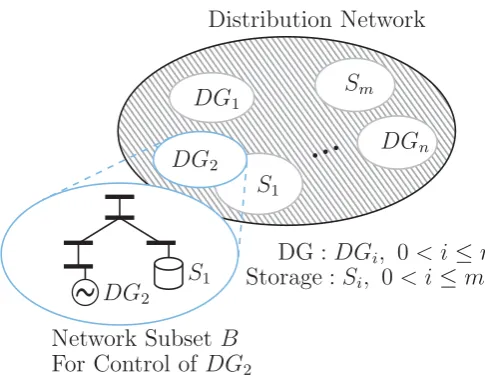
where uB = {uB,0, uB,1, . . . , uB,T}, uB,t ∈ ut, xb,t ∈ xt and wB,t ∈ wt. An illustration of a network’s subset structure is given in Figure4.1. The solution to this distributed optimal power flow problem is defined in Section4.4where approximate dynamic programming is applied.
4.3.2 Distributed Power Flow

![Figure 5.3: Nodal voltages after optimization through algorithm 5; voltagemagnitudes are constrained between [0.95 1.05] p.u.](https://thumb-us.123doks.com/thumbv2/123dok_us/8401611.325728/74.595.200.398.368.449/figure-nodal-voltages-optimization-algorithm-voltagemagnitudes-constrained-p.webp)
