A Chikungunya Virus
trans
-Replicase System Reveals the
Importance of Delayed Nonstructural Polyprotein Processing
for Efficient Replication Complex Formation in Mosquito Cells
Koen Bartholomeeusen,aAge Utt,bSandra Coppens,aKai Rausalu,bKatleen Vereecken,aKevin K. Ariën,a,c Andres Meritsb
aDepartment of Biomedical Sciences, Institute of Tropical Medicine, Antwerp, Belgium
bInstitute of Technology, University of Tartu, Tartu, Estonia
cDepartment of Biomedical Sciences, University of Antwerp, Wilrijk, Belgium
ABSTRACT Chikungunya virus (CHIKV) is a medically important alphavirus that is transmitted by Aedes aegypti and Aedes albopictus mosquitoes. The viral replicase complex consists of four nonstructural proteins (nsPs) expressed as a polyprotein precursor and encompasses all enzymatic activities required for viral RNA replication. nsPs interact with host components of which most are still poorly understood, espe-cially in mosquitos. A CHIKV trans-replicase system that allows the uncoupling of RNA replication and nsP expression was adapted to mosquito cells and subsequently used for analysis of universal and host-specific effects of 17 different nonstructural polyprotein (ns-polyprotein) mutations. It was found that mutations blocking nsP en-zymatic activities as well as insertions of enhanced green fluorescent protein (EGFP) into different nsPs had similar effects on trans-replicase activity regardless of the host (i.e., mammalian or mosquito). Mutations that slow down or accelerate ns-polyprotein processing generally had no effect or reduced trans-replicase activity in mammalian cells, while in mosquito cells most of them increasedtrans-replicase ac-tivity prominently. Increased RNA replication in mosquito cells was counteracted by an antiviral RNA interference (RNAi) response. Substitution of the W258 residue in the membrane binding peptide of nsP1 resulted in a temperature-sensitive defect, in the context of both the trans-replicase and infectious CHIKV. The defect was com-pensated for by secondary mutations selected during passaging of mutant CHIKV. These findings demonstrate the value of alphavirus trans-replicase systems for stud-ies of viral RNA replication and virus-host interactions.
IMPORTANCE Chikungunya virus is an important mosquito-transmitted human
pathogen. This virus actively replicates in mosquitoes, but the underlying molecular mechanisms and interactions of viral and host components are poorly understood. This is partly due to the lack of reliable systems for functional analysis of viral non-structural polyproteins (ns-polyproteins) and nonnon-structural proteins (nsPs) in mos-quito cells. Adaption of a CHIKV trans-replicase system allowed study of the effects of mutations in the ns-polyprotein on RNA replication in cells derived from mamma-lian and mosquito hosts. We found that a slowdown of ns-polyprotein processing fa-cilitates replication complex formation and/or functioning in mosquito cells and that this process is antagonized by the natural RNAi defense system present in mosquito cells. The mosquito-adapted CHIKV trans-replicase system represents a valuable tool to study alphavirus-mosquito interactions at the molecular level and to develop ad-vanced antiviral strategies.
KEYWORDS chikungunya, RNA interference, alphavirus, mosquito, polyprotein, processing, replicase, temperature sensitive
Received26 January 2018Accepted23 April
2018
Accepted manuscript posted online25
April 2018
CitationBartholomeeusen K, Utt A, Coppens S,
Rausalu K, Vereecken K, Ariën KK, Merits A. 2018. A chikungunya virustrans-replicase system reveals the importance of delayed nonstructural polyprotein processing for efficient replication complex formation in mosquito cells. J Virol 92:e00152-18.https://doi .org/10.1128/JVI.00152-18.
EditorMichael S. Diamond, Washington
University School of Medicine
Copyright© 2018 American Society for
Microbiology.All Rights Reserved.
Address correspondence to Koen
Bartholomeeusen, [email protected], or Andres Merits, [email protected].
K.B. and A.U. contributed equally to this article. K.K.A. and A.M. should be considered joint last authors.
For a companion article on this topic, see
https://doi.org/10.1128/JVI.00151-18.
OF VIRAL GENE EXPRESSION
crossm
on November 6, 2019 by guest
http://jvi.asm.org/
C
hikungunya virus (CHIKV) is an arthropod-borne virus (arbovirus) from the genus Alphavirus (family Togaviridae) and is transmitted by Aedes aegypti and Aedes albopictusmosquitoes. It is the causative agent of chikungunya fever, which is charac-terized by acute fever, rash, myalgia, and arthritic joint pains. While the acute infection clears rapidly, a significant proportion of patients experience chronic arthritic pains that can last for months to years. CHIKV has reemerged on a global scale since 2004 with outbreaks in the Indian Ocean region and has become endemic in the Caribbean region and the Americas since 2013, affecting millions in its wake (1). CHIKV is considered an emerging threat for the United States and Europe, as all prerequisites for autochtho-nous transmission of the virus are present (2). CHIKV infections, including human-mosquito-human infection cycles, were documented recently in Florida as well as in northern Italy and southern metropolitan France in Europe (3–5). To date, no effective antivirals or approved vaccines are available (6).CHIKV is an enveloped, positive-sense RNA virus with a 12-kb genome containing two open reading frames that encode the nonstructural proteins (nsP1 to -4) and structural proteins. The nsPs are translated from the incoming viral genomic RNA and are required for replicase formation. CHIKV nsPs are initially produced as a nonstruc-tural polyprotein (ns-polyprotein) precursor (P1234) which is processed by the viral protease (7). Enzymatic functions of the nsPs are required for viral genome replication and transcription. nsP4 contains the core RNA-dependent RNA polymerase (RdRp) (8). nsP2 contains RNA triphosphatase, nucleoside triphosphatase (NTPase), and RNA heli-case functions (9) as well as a cysteine protease region (10) that is responsible for the processing of P1234. Intermediates of this process are absolutely required for the stepwise completion of viral replicase complex formation (11–14). Specifically, the processing intermediate P123 together with nsP4 forms a short-lived early replicase that is required for synthesis of a genome-length negative-strand RNA (15, 16). P123 and/or another processing intermediate, P23, is also required for formation of specific membranous invaginations known as spherules (17), the physical structures of alpha-virus replicase complexes. Targeting of the replicase proteins to cellular membranes is dependent on the presence of an amphipathic membrane binding peptide and pal-mitoylation of nsP1 (18–21). Following complete processing of the ns-polyprotein, the replicase shifts to the late form, which is responsible for synthesis of the viral genomes and production of the subgenomic (SG) RNAs that encode the viral capsid and envelope proteins (11).
Significant amounts of synthesized nsPs do not become part of the replicase complexes. They function in engaging and diverting cellular functions to create a favorable cellular environment for viral replication. The antiviral host factor tetherin is counteracted by nsP1 (22), nsP3 is able to hydrolyze ADP-ribose groups from mono-ADP-ribosylated proteins (23), and nsP4 functions to counteract the unfolded-protein response to relieve translation inhibition (24). In infected vertebrate cells, nsP2 coun-teracts interferon beta production at the transcriptional level (25). One of the under-lying mechanisms is based on nuclear translocation of nsP2 leading to degradation of the RNA polymerase II catalytic subunit Rpb1 (26). Thus far, most of the available data about alphavirus-host interactions come from experiments performed using vertebrate cells. However, it is clear that the need for replication in cells of evolutionarily distinct organisms, i.e., their vertebrate hosts and arthropod vectors, presents arboviruses with distinct environments in which to complete the necessary steps for viral genome replication. These differences between cellular systems include the presence or absence of similar or different cellular cofactors (27–29) or restriction factors (22, 30) and a marked temperature difference as well as distinct membrane compositions (31).
Studying the functional relevance of mutations in the nsPs in the context of CHIKV infection can be prohibitive due to a negative feedback loop, as the production of viral genomic RNA is dependent on the expression of the nsPs from that same viral RNA. For mutations resulting in defects in RNA replication, this leads to diminished (or abolished) nsP expression and complications due to rapid reversion or emergence of compensa-tory mutations (32, 33). The use oftrans-replicase systems that separate expression of
on November 6, 2019 by guest
http://jvi.asm.org/
the nsPs from the viral RNA production bypasses these problems (34, 35) and allows for convenient reporter gene-based screening (35). Therefore,trans-replicase systems have provided valuable insight in the role of mutations in viral nsPs and replicating RNAs for replicase complex formation (36) and its membrane association (34) and functioning (35, 37–40).trans-Replicase systems have also revealed the existence of novel replicase-generated double-stranded RNAs (dsRNAs) recognized by innate immune sensing pathways (41). Aside from the alphaviruses Semliki Forest virus (SFV), Sindbis virus (SINV), and CHIKV, thetrans-complementation system has also been used for studies of Kunjin flavivirus (38, 39). However, the use of arbovirus trans-replicase systems has mostly been limited to mammalian cells. Thus far, this approach has been used to study only SFV inDrosophilacells (42) and SINV in mosquito cells (43).
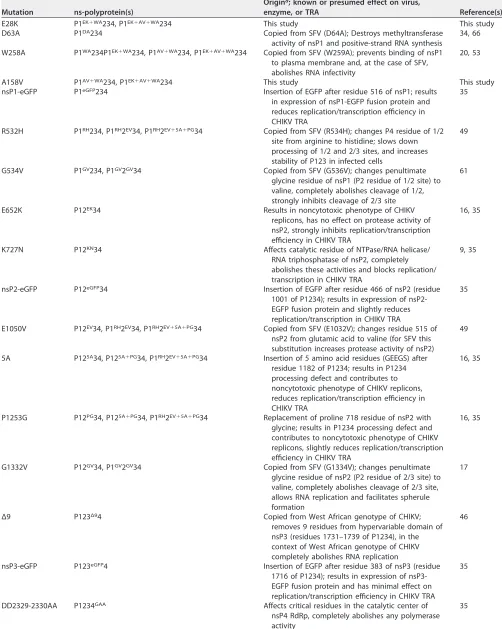
In this study, we adapted the CHIKVtrans-replicase system originally designed for analysis of replicase activity in mammalian cells (35) for use in mosquito cells. We describe the validation of this system by comparing the impacts of 17 different mutations and their combinations (Table 1) in the CHIKV nsPs in mammalian and mosquito cell lines. Most of the mutations were found to have a neutral or negative effect on replicase activity, and such effects were generally similar in all cell types. The clear exception was a group of mutations impairing the processing of the ns-polyprotein which strongly increased CHIKVtrans-replicase activity in mosquito cells. It was also observed that an intact RNA interference (RNAi) system in mosquito cells reduces the RNA replicative advantage that is conferred by these mutations. In addi-tion, comparison of the activities of CHIKVtrans-replicase in human and mosquito cells allowed the identification of the W258A substitution in the nsP1 membrane binding peptide and the E1050V substitution in the nsP2 protease as temperature-sensitive (ts) and cold-sensitive mutations, respectively. The ts phenotype was observed also in the context of infectious CHIKV. Rescue of CHIKV harboring the W258A mutation at restrictive temperatures occurred via the acquisition of compensatory mutations in the N-terminal part of nsP1.
RESULTS
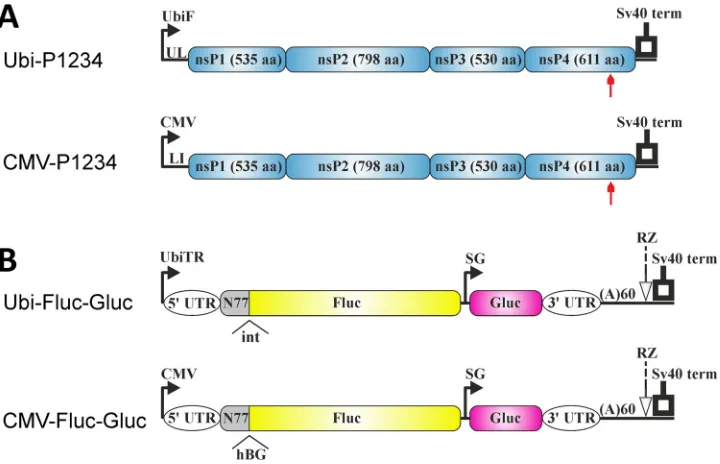
Construction of a CHIKV trans-replicase system for mosquito cells. We have previously described a CHIKVtrans-replicase systems based on plasmids containing the immediate early promoter of human cytomegalovirus (CMV) or the promoter of bac-teriophage T7 RNA polymerase to drive production of the reporter-carrying replication-competent RNA template and the viral ns-polyprotein (35). The use of such systems is restricted to cell types where the CMV promoter is active or to cells engineered to express bacteriophage T7 RNA polymerase, but neither of these conditions is met in available mosquito cell lines. To overcome this limitation, we first attempted cotrans-fection of mosquito cells with T7-P1234 and T7-Fluc-Gluc (35) and autogene plasmids (44) designed for enhanced expression of T7 RNA polymerase in mosquito cells. Compared to cells transfected only by T7-Fluc-Gluc, an increase in Fluc and Gluc activities, indicating RNA replication/transcription, was observed in both C6/36 and Aag2 cells cotransfected with T7-P1234. However, independent experiments had poor reproducibility, possibly as a result of inefficient cotransfection of mosquito cells with four different plasmids. Therefore, we decided to use theAedes aegyptipolyubiquitin promoter, which had previously been demonstrated to be suitable for expression of replication-competent SINV template RNAs (43), in our CHIKVtrans-replicase constructs. The Ubi-P1234 plasmid contained the full-length polyubiquitin promoter region, including a naturally occurring intron (45), a humanized sequence encoding the CHIKV ns-polyprotein (35), and the simian virus 40 (SV40) late polyadenylation signal (Fig. 1A). The control plasmid Ubi-P1234GAA, which expresses a polymerase-inactive replicase
variant, was also constructed. To find out whether the humanized sequence encoding the CHIKV ns-polyprotein is suitable for use in mosquito cells, a plasmid containing the sequence in its native form (Ubi-P1234NAT) was constructed. Comparison of the activities of CHIKV replicases expressed from Ubi-P1234 and Ubi-P1234NAT in C6/36 cells failed to reveal consistent differences (data not shown), indicating that altered
on November 6, 2019 by guest
http://jvi.asm.org/
TABLE 1Mutations in CHIKV ns-polyprotein analyzed in this study
Mutation ns-polyprotein(s)
Origina; known or presumed effect on virus,
enzyme, or TRA Reference(s)
E28K P1EK⫹WA234, P1EK⫹AV⫹WA234 This study This study
D63A P1DA234 Copied from SFV (D64A); Destroys methyltransferase
activity of nsP1 and positive-strand RNA synthesis
34, 66
W258A P1WA234P1EK⫹WA234, P1AV⫹WA234, P1EK⫹AV⫹WA234 Copied from SFV (W259A); prevents binding of nsP1 to plasma membrane and, at the case of SFV, abolishes RNA infectivity
20, 53
A158V P1AV⫹WA234, P1EK⫹AV⫹WA234 This study This study
nsP1-eGFP P1eGFP234 Insertion of EGFP after residue 516 of nsP1; results in expression of nsP1-EGFP fusion protein and reduces replication/transcription efficiency in CHIKV TRA
35
R532H P1RH234, P1RH2EV34, P1RH2EV⫹5A⫹PG34 Copied from SFV (R534H); changes P4 residue of 1/2 site from arginine to histidine; slows down processing of 1/2 and 2/3 sites, and increases stability of P123 in infected cells
49
G534V P1GV234, P1GV2GV34 Copied from SFV (G536V); changes penultimate glycine residue of nsP1 (P2 residue of 1/2 site) to valine, completely abolishes cleavage of 1/2, strongly inhibits cleavage of 2/3 site
61
E652K P12EK34 Results in noncytotoxic phenotype of CHIKV
replicons, has no effect on protease activity of nsP2, strongly inhibits replication/transcription efficiency in CHIKV TRA
16, 35
K727N P12KN34 Affects catalytic residue of NTPase/RNA helicase/
RNA triphosphatase of nsP2, completely abolishes these activities and blocks replication/ transcription in CHIKV TRA
9, 35
nsP2-eGFP P12eGFP34 Insertion of EGFP after residue 466 of nsP2 (residue 1001 of P1234); results in expression of nsP2-EGFP fusion protein and slightly reduces replication/transcription in CHIKV TRA
35
E1050V P12EV34, P1RH2EV34, P1RH2EV⫹5A⫹PG34 Copied from SFV (E1032V); changes residue 515 of nsP2 from glutamic acid to valine (for SFV this substitution increases protease activity of nsP2)
49
5A P125A34, P125A⫹PG34, P1RH2EV⫹5A⫹PG34 Insertion of 5 amino acid residues (GEEGS) after residue 1182 of P1234; results in P1234 processing defect and contributes to noncytotoxic phenotype of CHIKV replicons, reduces replication/transcription efficiency in CHIKV TRA
16, 35
P1253G P12PG34, P125A⫹PG34, P1RH2EV⫹5A⫹PG34 Replacement of proline 718 residue of nsP2 with glycine; results in P1234 processing defect and contributes to noncytotoxic phenotype of CHIKV replicons, slightly reduces replication/transcription efficiency in CHIKV TRA
16, 35
G1332V P12GV34, P1GV2GV34 Copied from SFV (G1334V); changes penultimate glycine residue of nsP2 (P2 residue of 2/3 site) to valine, completely abolishes cleavage of 2/3 site, allows RNA replication and facilitates spherule formation
17
Δ9 P123Δ94 Copied from West African genotype of CHIKV;
removes 9 residues from hypervariable domain of nsP3 (residues 1731–1739 of P1234), in the context of West African genotype of CHIKV completely abolishes RNA replication
46
nsP3-eGFP P123eGFP4 Insertion of EGFP after residue 383 of nsP3 (residue 1716 of P1234); results in expression of nsP3-EGFP fusion protein and has minimal effect on replication/transcription efficiency in CHIKV TRA
35
DD2329-2330AA P1234GAA Affects critical residues in the catalytic center of nsP4 RdRp, completely abolishes any polymerase activity
35
aIf not CHIKV of ECSA genotype.
on November 6, 2019 by guest
http://jvi.asm.org/
codon usage did not have negative effects on CHIKV ns-polyprotein expression and replicase activity in mosquito cells. Therefore, all constructs used in this study were based on the humanized sequence, as this allowed easy transfer of mutations/inser-tions present in the previously constructed plasmids CMV-P1eGFP234, CMV-P12eGFP34,
CMV-P123eGFP4, CMV-P12EK34, CMV-P12KN34, CMV-P12PG34, CMV-P125A34, and
CMV-P125A⫹PG34 to Ubi-P1234 (35) and simplified insertions of new mutations and their
combinations.
The reporter plasmid used for expression of template RNA for CHIKV replicase in mosquito cells consisted of the same elements as the CMV-Fluc-Gluc plasmid (35) except that the-globin intron was not present in the nsP1-encoding region and the CMV promoter was replaced with a truncatedAedes aegyptipolyubiquitin promoter. The truncation in the promoter used for template RNA expression was caused by the necessity to position the first residue of the template RNA at the start site of the promoter. This resulted in loss of the native intron normally located in the downstream (transcribed) part of the polyubiquitin promoter region, and the obtained plasmid was designated Ubi-Fluc-Gluc-NI. To compensate for removal of the native intron, an intron from Drosophila was inserted between the sequences encoding the 77 N-terminal amino acids from nsP1 and Fluc. The resulting plasmid was designated Ubi-Fluc-Gluc (Fig. 1B). When mosquito cells were cotransfected with Ubi-P1234 and Ubi-Fluc-Gluc or Ubi-Fluc-Gluc-NI, the levels of both reporter proteins were consistently at least 2-fold higher with Ubi-Fluc-Gluc. As a result Ubi-Fluc-Gluc was used in all subsequent exper-iments with mosquito cells.
Mutations affecting enzymatic functions as well as enhanced green fluorescent protein (EGFP) insertions have similar impact on CHIKV replicase activity in mammalian and mosquito cells. Three mammalian (U2OS and HEK293T of human origin and COP-5 of mouse origin) and two mosquito (C6/36 ofAedes albopictusorigin FIG 1Schematic representation of polyubiquitin and CMV promoter-basedtrans-replicase plasmids. (A) Expression constructs for CHIKV ns-polyprotein. UbiF, full-lengthAedes aegyptipolyubiquitin promoter; UL, transcribed leader of polyubiquitin gene containing naturally occurring intron; CMV, CMV promoter; LI, leader region of herpes simplex virus thymidine kinase gene with an artificial intron; SV40, SV40 late polyadenylation region. Arrows below the drawings point to the position of the inactivating mutation in the catalytic site of nsP4. (B) Constructs expressing template RNAs. UbiTR, truncated polyubiquitin promoter. The 5=and 3=UTRs are from CHIKV. N77, region encoding the 77 N-terminal amino acid residues of nsP1; SG, CHIKV SG promoter; RZ, antisense-strand ribozyme of HDV. The positions of the second intron of theDrosophila melanogasteralcohol dehydrogenase gene (int) and the second intron of the human beta globin gene (hBG), removed by splicing, are marked. The drawings
are not to scale.
on November 6, 2019 by guest
http://jvi.asm.org/
[image:5.585.43.403.71.303.2]and Aag2 ofAedes aegyptiorigin) cell lines were chosen for analysis of potential host specificity of effects caused by different mutations in the CHIKV nsPs. Because inacti-vation of the catalytic activity of the viral RNA polymerase by the DD2329-2330AA substitution is detrimental to CHIKV replicase activity in all cell lines, plasmid CMV-P1234GAAor Ubi-P1234GAAwas used as a normalization control. It was also reasoned
that mutations inactivating other crucial enzymatic functions of CHIKV nsPs (Table 1) should block the ability of thetrans-replicase to perform viral RNA synthesis regardless of the host. Therefore, all selected cell lines were first cotransfected with appropriate plasmids expressing the RNA template (CMV-Fluc-Gluc for mammalian and Ubi-Fluc-Gluc for mosquito cells) and plasmids expressing wild-type (wt) P1234, P1DA234,
P1WA234, or P12KN34. In mammalian cells, the boost of Fluc expression obtained by
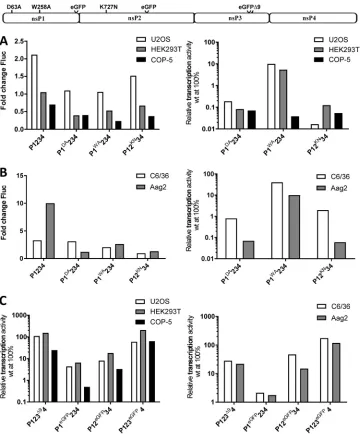
coexpression of wt P1234 and template RNA was moderate (U2OS) or absent (HEK293T and COP-5) (Fig. 2A). This was due to high background levels of Fluc activity caused by translation of this reporter from capped transcripts made by cellular RNA polymerase II; this activity masks that of the reporter made from replicase-generated RNAs (35). Even though the boost in mosquito cells, especially in Aag2, was somewhat more prominent (Fig. 2B), we concluded that Fluc activity is not a sensitive enough marker to measure RNA replication efficiency. Therefore, in most subsequent experiments, Fluc activities were used only to control transfection efficiencies. In contrast, a large (500- to 10,000-fold) boost of Gluc activity was observed in all mammalian cell lines expressing template RNA together with wt P1234. The boost was slightly lower in mosquito cells but still very prominent (100- to 2,000-fold). This is in line with our previous observa-tions (35) confirming that an increase of Gluc activity serves as a sensitive marker for CHIKV replicase activity in all selected cell lines.
Not surprisingly, inactivation of the NTPase/RNA helicase activities of nsP2 (K727N mutant) was detrimental for replicase activity regardless of the cell line used. The same was also observed when the methyltransferase activity of nsP1 (D63A) was blocked (Fig. 2A and B). Interestingly, in the SFV trans-replicase system, the corresponding D64A substitution does not block viral negative-strand RNA synthesis and may allow pro-duction of low levels of noncapped positive-strand RNAs (34). If this was also the case for the methyltransferase-inactive CHIKV mutant, the synthesis of viral SG RNA (and/or its translation) was too low for reliable detection. Of note, the W258A substitution in the membrane binding peptide of nsP1 caused a relatively mild (about 10-fold) but significant (for HEK293T cells,P⬍0.001) reduction of replicase activity in human cells but almost completely abolished RNA replication in murine cells (Fig. 2A), suggesting a host-specific effect. The impact of the W258A substitution was even less prominent in C6/36 cells, with an approximately 50% and statistically not significant (P⫽ 0.27) reduction in replicase activity compared to the wt (Fig. 2B).
Next we analyzed the impact of a deletion in nsP3 and that of an insertion of an EGFP reporter into different nsPs. In the deletion mutant designated P123Δ94, the
9-amino-acid-residue long SH3-ligand like region in the hypervariable region of nsP3, which has been shown to bind amphiphysins and to be crucial for replication of West African genotype CHIKV (46, 47), was removed. Interestingly, it was found that this deletion had no negative impact on CHIKV replicase activity in either of the human cell lines tested, but a slight decrease (approximately 5-fold,P⬍0.05) in replicase activity was observed in mouse cells (Fig. 2C). This finding highlights clear differences between two CHIKV genotypes (West African versus East Central South African [ECSA]) and could also indicate a higher dependency of CHIKV replicase activity on amphiphysin binding and/or the absence of compensating cofactors in mouse cells. Removal of the am-phiphysin binding region also had a mild (less than 5-fold) but significant (P⬍0.01) inhibitory effect in both mosquito cell lines (Fig. 2C). Thus, similar to the case for murine cells, the formation of a functional replicase complex in mosquito cells was dependent on the interaction of nsP3 with amphiphysins and/or other proteins with SH3 domains. The effect of EGFP insertions on CHIKV replicase activity was similar in all mammalian and mosquito cells tested. An insertion was best tolerated when it was placed in the hypervariable region of nsP3, followed by insertions in the central part of nsP2 and the
on November 6, 2019 by guest
http://jvi.asm.org/
C-terminal region of nsP1 (Fig. 2C). This finding indicates that the defect caused by reporter insertion was not host specific.
Inhibition or delay of ns-polyprotein processing specifically increases activity of the CHIKV trans-replicase in mosquito cells. Correct processing of the ns-polyproteins is crucial for alphavirus replication complex formation and RNA replication (32). Furthermore, individual nsP2 is responsible for cytotoxic effects in mammalian FIG 2Effects of EGFP insertions and mutations affecting enzymatic activities of nsPs or their interactions with the host cell. Names and localizations of mutations in the ns-polyprotein are shown above the panels. (A) U2OS, HEK293T and COP-5 cells were cotransfected with CMV-Fluc-Gluc and CMV-P1DA234, CMV-P1WA234, or CMV-P12KN34; control cells were cotransfected with CMV-Fluc-Gluc and CMV-P1234 (wt) or CMV-P1234GAA. Fluc and Gluc activities in lysates of transfected cells were measured and normalized to these measured for CMV-P1234GAA -transfected control cells. Left panel, normalized Fluc activities. Right panel, Gluc activities in cells -transfected with expression plasmid for mutant replicase shown relative to Gluc activity in wt replicase-expressing cells (set to 100% for each cell line). (B) C6/36 and Aag2 cells were cotransfected with Ubi-Fluc-Gluc and Ubi-P1DA234, Ubi-P1WA234, or Ubi-P12KN34; control cells were cotransfected with Ubi-Fluc-Gluc and Ubi-P1234 (wt) or Ubi-P1234GAA. Fluc and Gluc activities were analyzed and presented as described for panel A. (C) U2OS, HEK293T, and COP-5 cells were cotransfected with CMV-Fluc-Gluc and CMV-P123Δ94, CMV-P1eGFP234, CMV-P12eGFP34, or CMV-P123eGFP4; control cells were cotransfected with CMV-Fluc-Gluc and CMV-P1234 (wt) or CMV-P1234GAA. C6/36 and Aag2 cells were transfected with plasmids expressing the same template RNA or ns-polyproteins from polyubiquitin promoters. Gluc activities in lysates were measured, analyzed, and presented as described for panel A (note logarithmic scale). Data from one out of three independent reproducible experiments are shown in each panel.
on November 6, 2019 by guest
http://jvi.asm.org/
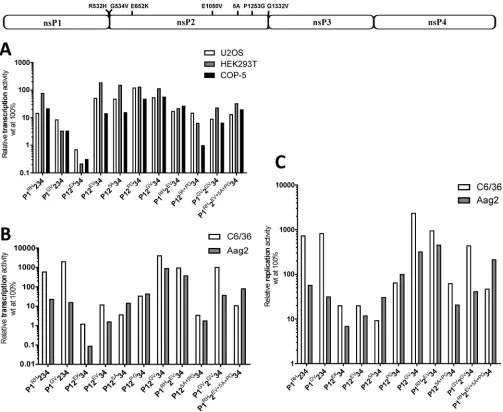
[image:7.585.42.402.69.503.2]cells but not in mosquito cells (26, 48). To study the effect of ns-polyprotein processing and activities of nsP2 on the CHIKV replicase activity using atrans-replicase assay (TRA), a panel of constructs expressing CHIKV ns-polyprotein harboring mutations in nsP2, in the processing site between nsP1 and nsP2 (1/2 site), and in the 2/3 site was con-structed (Table 1). As expected, none of these mutations had an effect on Fluc expression in mammalian cells (data not shown). In line with previous observations (35), the E652K mutation had a strong negative effect on CHIKV replicase activity in both mammalian and mosquito cells (Fig. 3A to C). The effects of the 5A insertion and most of the single-residue substitutions (R532H, E1050V, P1253G, and G1332V) on Gluc expression varied minimally between different mammalian cell lines (Fig. 3A). The negative effect of the G534V substitution was more prominent in mammalian cells (up to a 40-fold reduction in HEK293T cells [P ⬍0.01] and COP-5 cells [P⬍0.0001]). A similar effect was seen with the combination of G534V and G1332V substitutions
FIG 3Effects of mutations affecting protease activity of nsP2 and/or ns-polyprotein processing on the CHIKVtrans-replicase activity. Names and localizations of mutations introduced in the ns-polyprotein are shown above the panels. (A) U2OS, HEK293T, and COP-5 cells were cotransfected with CMV-Fluc-Gluc and CMV-P1RH234, CMV-P1GV234, CMV-P12EK34, CMV-P12EV34, CMV-P125A34, CMV-P12PG34, CMV-P12GV34, CMV-P1RH2EV34, CMV-P1RH2EV⫹5A⫹PG34, CMV-P125A⫹PG34, or CMV-P1GV2GV34; control cells were cotransfected with CMV-Fluc-Gluc and CMV-P1234 (wt) or CMV-P1234GAA. Gluc activities in lysates were measured, analyzed, and presented as described for Fig. 2A. (B and C) C6/36 and Aag2 cells were cotransfected with the same set of plasmids as listed for panel A except that all these plasmids harbored polyubiquitin promoters. (B) Gluc activities in lysates of transfected cells were measured and presented as described for Gluc in Fig. 2A. (C) Fluc activities were analyzed and presented as described for Fig. 2A. Data from one out of three independent reproducible experiments are shown in each panel.
on November 6, 2019 by guest
http://jvi.asm.org/
[image:8.585.42.545.70.482.2](Fig. 3A). As previously observed (35), combining the 5A and P1253G mutations resulted in a decrease of CHIKV replicase activity. This effect was most prominent and highly significant (P⬍0.0001) in COP-5 cells (Fig. 3A). A combination of the R532H and E1050V substitutions had an effect similar to that of the R532H substitution alone in mammalian cells (Fig. 3A). Interestingly, in both HEK293T and COP-5 cells, these substitutions compensated for the defect caused by combining the 5A and P1253G mutations, and consequently, the replicase activities of ns-polyproteins harboring R532H⫹E1050V or R532H⫹E1050V⫹5A⫹P1253G mutations were similar (Fig. 3A). This may indicate that the decreased nsP2 protease activity of the 5A⫹P1253G mutant (16) was compensated for by the E1050V substitution (49).
In striking contrast to the observations in mammalian cells, the trans-replicases harboring R532H, G534V, R532H⫹E1050V, G1332V, or G534V⫹G1332V substitutions were highly active in C6/36 mosquito cells (Fig. 3B and C). Each of these supported RNA replication (boosted Fluc activity) more prominently then wt replicase (Fig. 3C; for all mutants,P⬍0.0001). The boosting effect on SG RNA synthesis (Gluc expression) was similarly prominent (Fig. 3B). The highest activity was observed for replicase harboring the G1332V substitution (an approximately 60-fold increase compared to wt, P ⬍ 0.0001), followed by replicases containing the G534V substitution or the combination of R532H and E1050V substitutions (Fig. 3B and C). All these mutants were also active in Aag2 cells. However, activities exceeding that of wt replicase were detected only for replicases with G1332V or R532H⫹E1050V substitutions, and even there the increase in replicase activity was less pronounced (approximately 10-fold [P⬍0.05] for replicase with G1332V and approximately 3-fold [P⬍0.0001] for replicase with R532H⫹E1050V) than in C6/36 cells (Fig. 3B and C). In contrast to the nsP2 mutations that slow down or impede ns-polyprotein processing, the replicase harboring the E1050V substitution (which is expected to increase the speed of ns-polyprotein processing) had a reduced (in C6/36 cells, approximately 8-fold [P⬍0.001]; in Aag2 cells, approximately 70-fold [P ⬍ 0.0001]) activity in mosquito cells (Fig. 3B and C). Taken together, these data suggest that a slower processing of the ns-polyprotein allows optimal formation/ stability of processing intermediates, resulting in increased production of genomic and SG RNAs in mosquito cells. However, the effects observed with the 5A insertion mutant and the combination of 5A and P1253G mutations suggest that alternative mechanisms are also at play: both of these mutations (and to a lesser degree also P1253G alone) resulted in a decrease of replicase activity in mosquito cells (Fig. 3B and C). This suggests that the positive impact from ns-polyprotein processing slowdown was abolished by another defect(s) of nsP2 activities resulting from these mutations (16).
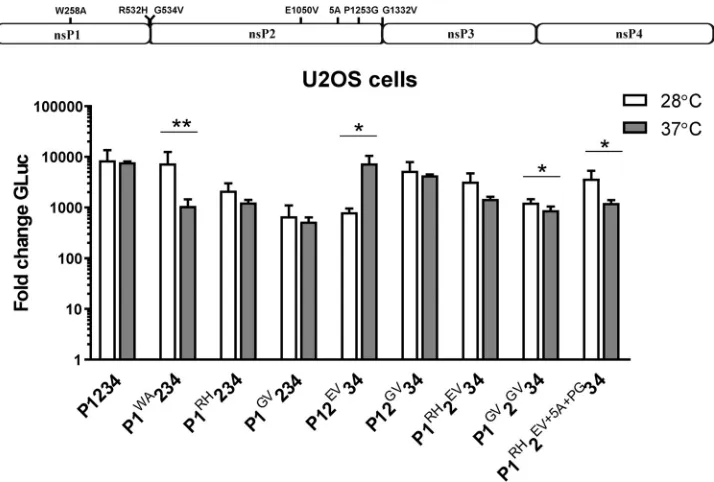
Mosquito cells were cultivated at 28°C, a temperature close to the optimum of 30°C for nsP2 protease activity (50) and thus conducive for accelerated (premature) process-ing of the ns-polyprotein in these cells. Mutations that slow the processprocess-ing would also allow more time for replicase precursors to bind the RNA template, which is available only in trans in the TRA. To reveal the impact of temperature alone on the CHIKV trans-replicase activity, the experiment with replicases harboring mutations that affect ns-polyprotein processing (i.e., R532H, G534V, E1050V, G1332V, R532H⫹E1050V, R532H⫹E1050V⫹5A⫹P1253G, and G534V⫹G1332V [Table 1]) was performed using U2OS cells grown at two different temperatures (28°C and 37°C). In addition, ns-polyprotein with the W258A substitution, hampering replicase activity in mammalian cells (Fig. 2A), was also tested. None of the mutants was capable of boosting Fluc expression at 28°C (data not shown), confirming the lack of enhanced genomic RNA synthesis in mammalian cells. Consistent with the observation that CHIKV replicates to higher titers at 28°C than at 37°C in mammalian cells, the wt P1234-driven Gluc expression was shown to be slightly (approximately 2-fold) more efficient at 28°C than at 37°C; this difference did not reach statistical significance (Fig. 4). With two exceptions, all mutant replicases followed a similar pattern (Fig. 4), indicating that the enhanced replication/ transcription (Fig. 3B and C) was specific for mosquito cells and not caused exclusively by a lower temperature (note that unlike for wt P1234, the difference was statistically significant, but still small, for P1GV2GV34 and P1RH2EV⫹5A⫹PG34). The exceptions were
on November 6, 2019 by guest
http://jvi.asm.org/
the replicase with the E1050V substitution, which appeared to be significantly (approx-imately 5-fold) less efficient at the reduced temperature, and the replicase with the W258A substitution, which showed activity very similar to that of the wt replicase at 28°C (in agreement with previous observations) (Fig. 2A) and significantly (about 10-fold) reduced activity at 37°C (Fig. 4). These findings confirm that the W258A substitution in CHIKV replicase results in a ts phenotype.
A functional RNAi system suppresses CHIKV replicase activity in mosquito cells. The observed increases in Fluc and Gluc expression with the replicases harboring mutations slowing down ns-polyprotein processing were exacerbated in the Aedes albopictus-derived C6/36 cell line, whereas in general this was not the case inAedes aegypti-derived Aag2 cells (Fig. 3B and C). This could indicate that boosted replication was specific toAedes albopictus. However, the C6/36 cell line has also been shown to be unable to produce virus-derived small interfering RNAs (siRNAs) (51). A boosted RNA replication should also include elevated synthesis of dsRNAs (the replication form of alphavirus RNA), which in turn can be processed into siRNAs. Therefore, we hypothe-sized that the elevated RNA replication was masked by antiviral siRNA activity in Aag2 cells, a mechanism that is lacking in C6/36 cells.
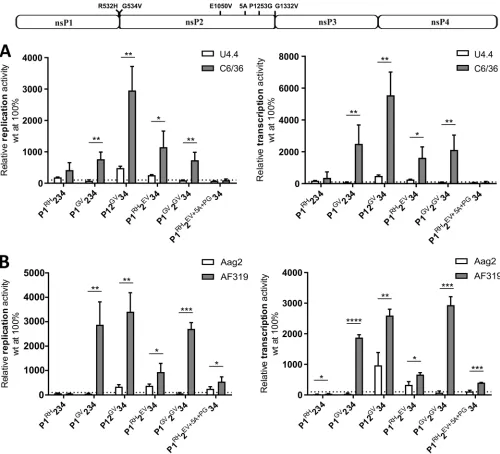
To verify the impact of a functional RNAi system on our TRA observations, two additional cell lines were used, i.e., U4.4 cells (anAedes albopictus-derived cell line with an intact RNAi system) and AF319 cells (an Aag2-derived Dicer2 knockout cell line) (52). Using these cell lines, nearly identical pictures emerged for both mosquito species. Absolute expression levels of Gluc and Fluc in the presence of wt P1234 were always higher in cell lines with impaired RNAi (data not shown). Corroborating data from previous experiments (Fig. 3B and C), expression of ns-polyproteins with processing defects (most prominently the one with the G1332V substitution) caused increased production of Gluc and Fluc. The boosting was, however, invariably much higher in the cells with a dysfunctional RNAi system (Fig. 5A and B). For some mutant replicases, i.e., FIG 4W258A or E1050V substitutions result in temperature-dependent effects. Names and localizations of mutations introduced in the ns-polyprotein are shown above the panels. U2OS cells were cotransfected with CMV-Fluc-Gluc and CMV-P1234 (wt), CMV-P1WA234, CMV-P1RH234, CMV-P1GV234, CMV-P12EV34, CMV-P1RH2EV34, CMV-P1RH2EV⫹5A⫹PG34, CMV-P12GV34, or CMV-P1GV2GV34; control cells were cotransfected with CMV-Fluc-Gluc and CMV-P1234GAA. Cells were incubated either at 28°C for 42 h or at 37°C for 18 h. Gluc activities in lysates of transfected cells were measured and normalized to these measured for control cells (set to 1). The average from three independent experiments is shown; error bars represent standard deviation. *, P⬍ 0.05;**,P⬍ 0.01 (Student’s unpairedttest).
on November 6, 2019 by guest
http://jvi.asm.org/
[image:10.585.44.401.70.311.2]the ones with G534V or G534V⫹G1332V substitutions, the activating effect could generally not be observed in Aag2 or U4.4 cells but was clearly evident in AF319 and C6/36 cells (Fig. 5A and B). These data strongly support the hypothesis that an active RNAi response counteracts the activation of RNA replication caused by mutations that slow down ns-polyprotein processing. Thus, our findings further implicate the RNAi system as an important part of the innate immune response to CHIKV infection in mosquito cells and validate the TRA as a useful tool to further study this antiviral system.
The W258A substitution in the membrane binding peptide of CHIKV nsP1 results in virus with a ts defect. Experiments using TRA revealed that the W258A
FIG 5In mosquito cells, increased activity of CHIKVtrans-replicases with mutations affecting nsP2 protease activity and/or ns-polyprotein processing is counteracted by the RNAi system. Names and localizations of mutations introduced in the ns-polyprotein are shown above the panels. U4.4 and C6/36 cells (A) and Aag2 and AF319 cells (B) were cotransfected with Ubi-Fluc-Gluc and Ubi-P1234 (wt), Ubi-P1RH234, Ubi-P1GV234, Ubi-P1RH2EV34, Ubi-P1RH2EV⫹5A⫹PG34, Ubi-P12GV34, or Ubi-P1GV2GV34; control cells were cotransfected with Ubi-Fluc-Gluc and Ubi-P1234GAA. Fluc and Gluc activities in lysates of transfected cells were measured and presented as described for Gluc in Fig. 2A. Dotted lines indicate the normalized activity of wt replicase (set to 100%). Left panels, relative Fluc activities (replication); right panels, relative Gluc activities (transcription). The average from three independent experiments is shown; error bars represent standard deviation.*,P⬍0.05;**,P⬍0.01;***,P⬍0.001;****,P⬍0.0001 (Student’s unpairedttest).
on November 6, 2019 by guest
http://jvi.asm.org/
[image:11.585.42.542.70.524.2]substitution located at the C terminus of the membrane binding peptide of nsP1 hampers activity of CHIKV replicase at 37°C but has little effect at 28°C (Fig. 4). As a corresponding W259A mutation in the SFV genome was reported to abolish release of infectious virus fromin vitrotranscripts (here called “RNA infectivity”) (53), this substi-tution was also introduced into the CHIKV infectious cDNA (icDNA) clone pICRES1. Rescue of wt CHIKV and mutant CHIKVWAwas performed using hamster-derived BHK-21
cells (incubated at 28°C or 37°C) and mosquito-derived C6/36 cells. Similar to the case for its SFV counterpart, no rescue of mutant CHIKVWAoccurred at 37°C. This is in line
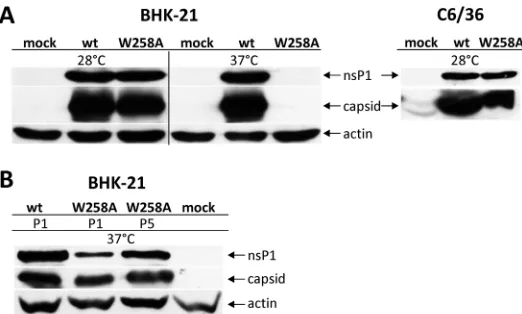
with the observation that the defect caused by the W258A substitution is especially prominent in rodent (COP-5) cells (Fig. 2A). In contrast, the mutant virus was efficiently rescued at 28°C in both BHK-21 and C6/36 cells (Fig. 6A). In line with our findings in the CHIKV TRA (Fig. 4), this observation confirms that the W258A substitution causes a ts defect also in the context of infectious replication-competent virus.
To the best of our knowledge, no ts mutant of CHIKV has been previously described. Therefore, we performed additional analysis of the properties of CHIKVWA. Advantage
was taken from the fact that replacement of the alanine by tryptophan would require three simultaneous nucleotide substitutions (GCC¡TGG), making natural reversion highly unlikely and facilitating the appearance of pseudoreversions or secondary compensatory mutations (32, 33, 54). Here we used the CHIKVWAP0 stock, rescued in
C6/36 cells, to infect BHK-21 cells at 37°C. During the first passage, the cells infected with CHIKVWAdid not develop detectable cytopathic effects (CPE) by 24 h postinfection
(p.i.), in contrast to the case for wt CHIKV-infected cells. Nevertheless, Western blot analysis revealed limited, but clear, expression of CHIKV nsP1 and CP in CHIKVWA
-infected cells (Fig. 6B). In contrast, BHK-21 cells -infected with the CHIKVWA P4 stock
displayed CPE at 24 h p.i., and the levels of CHIKV proteins in these cells were comparable to these observed in wt CHIKV-infected cells (Fig. 6B), suggesting success-ful adaptation of CHIKVWAto growth at 37°C.
Reverse transcription-PCR (RT-PCR) and sequencing confirmed that the primary substitution (W258A) was preserved in the adapted virus stock. In order to identify secondary compensatory mutations, four individual plaque-purified viruses were ob-tained from the CHIKVWA P5 stock. For each of these viruses, the genomic region
spanning from nucleotide position 95 to 1770 (corresponding to amino acid residues 7 to 565 of the CHIKV ns-polyprotein) was RT-PCR amplified and sequenced. Two FIG 6Western blot analysis of proteins expressed by CHIKVWAupon virus rescue (A) or during and after adaptation to growth at 37°C (B). BHK-21 cells were transfected within vitro-synthesized transcripts of wt pICRES1 and pICRES1WAusing electroporation, and C6/36 cells were transfected using Lipofectamine 2000. At 24 h p.t. (wt virus in BHK-21 cells) or at 72 h p.t. (all other samples), transfected cells were collected and lysed by boiling in SDS gel-loading buffer. BHK-21 cells harvested after collection of P1 and P5 stocks of CHIKVWAadapted to growth at 37°C were also collected and lysed as described above. Proteins were separated by SDS-PAGE, transferred to nitrocellulose membranes, and detected using antibodies against CHIKV nsP1 and capsid protein. In lysates of BHK-21 cells, antibody against-actin was used to detect the loading control (for C6/36 cells, the corresponding antibody was not available).
on November 6, 2019 by guest
http://jvi.asm.org/
[image:12.585.74.335.70.227.2]common missense mutations were found in all four clones: one mapped to the N-terminal region of nsP1, changing glutamic acid at position 28 to lysine (E28K), while the other mutation was located at position 158, replacing alanine with valine (A158V). Though neither of these mutations mapped to regions known to interact with host cell membranes, both of these substitutions have the potential to facilitate binding of nsP1 to the inner surface of the plasma membrane by increasing either electrostatic (E28K) or hydrophobic (A158V) interactions.
To analyze the functional significance of these putative compensatory mutations, they were introduced in pICRES1WA (resulting in pICRES1EK⫹WA, pICRES1AV⫹WA,
and pICRES1EK⫹AV⫹WA) and CMV-P1WA234 (resulting in CMV-P1EK⫹WA234,
CMV-P1AV⫹WA234, and CMV-P1EK⫹AV⫹WA234), and the obtained constructs were analyzed
using infectious-center assay (ICA) and TRA. The results of ICA clearly demonstrated that both secondary mutations as well as their combination fully restored RNA infectivity (Fig. 7A). The results from the TRA strongly corroborated this finding. Compared to their wt counterpart, replicases with W258A, E28K⫹W258A, A158V⫹W258A, or E28K⫹A158V⫹W258A substitutions harbored minor defects at 28°C. At 37°C, the difference between wt replicase and the replicase with the W258A was prominent (the mutant had more than 10-fold-lower activity) and highly significant. Furthermore, the replicase with the W258A mutation was also significantly less active than replicases harboring E28K⫹W258A, A158V⫹W258A, or E28K⫹A158V⫹W258A substitutions. Fi-nally, at 39°C, the W258A mutant displayed only minimal activity with a prominent (more than 100-fold) and highly significant difference from replicases harboring addi-tional compensatory mutations (Fig. 7B).
DISCUSSION
trans-replicase systems, designed to overcome limitations imposed by the intrinsi-cally linked viral RNA replication and expression of the replicase proteins, have become FIG 7The ts phenotype of CHIKVWAand correspondingtrans-replicase is compensated for by second-site mutations in the N-terminal part of nsP1. (A) Location of the primary W258A mutation and secondary adaptive mutations (E28K and A158V) in nsP1 of CHIKV and results of ICA performed usingin vitro
transcripts of pICRES1, pICRES1WA, pICRES1EK⫹WA, pICRES1AV⫹WA, and pICRES1EK⫹AV⫹WA. Infectivity is shown in PFU/g of RNA transcript; ND, not detectable. (B) U2OS cells were cotransfected with CMV-Fluc-Gluc and CMV-P1234, CMV-P1WA234, CMV-P1EK⫹WA234, CMV-P1AV⫹WA234, CMV-P1EK⫹AV⫹WA234, or CMV-P1234GAA and incubated at 28°C, 37°C, or 39°C. At 18 h p.t. (37°C and 39°C) or at 42 h p.t. (28°C), cells were lysed; Gluc activities were measured, analyzed, and presented as described for Fig. 4. The average from three independent experiments is shown; error bars represent standard deviation.*,P⬍0.05;**,P⬍0.01;***,
P⬍0.001;****,P⬍0.0001 (Student’s unpairedttest).
on November 6, 2019 by guest
http://jvi.asm.org/
[image:13.585.60.353.71.300.2]invaluable tools for studies of alphavirus RNA replication (17, 34, 35, 37, 40) and for validation of mechanisms of action of antialphaviral drugs (55). However, thus far the use of TRA has been mostly limited to BRS-T7/5 cells expressing bacteriophage T7 RNA polymerase (56), reducing its value for analysis of virus-host interactions and the host specificity of defects caused by mutations in viral replicases. To enable such analysis, we designed CHIKV ns-polyprotein and template RNA expression vectors for mosquito cells using theAedes aegyptipolyubiquitin promoter and applied the TRA for analysis of a large panel of CHIKV nsP mutants using three mammalian and four mosquito cell lines. In general, the TRA based on the use of a polyubiquitin promoter had properties similar to those of the TRA based on the use of the mammalian RNA polymerase II promoter. In both cases, high levels of translation of Fluc reporter from RNA polymerase II-generated (capped) transcripts typically masked the Fluc expression from genomic RNAs synthesized by the CHIKV replicase. However, a notable exception existed in mosquito cells. When the activity of mutant replicase exceeded that of wt replicase, an increase of Fluc signal became prominent and informative (Fig. 3 and 5). Thus, the high Fluc background prevented analysis of effects of these mutations that resulted in reduction of genomic RNA synthesis and might also mask more subtle increases in this activity. This problem can be circumvented by the use of systems generating non-capped template RNAs that are inefficient for Fluc translation (compared to non-capped genome copies made by viral replicase) (35). One option may be the generation of mosquito cell lines that express bacteriophage T7 RNA polymerase, allowing the use of T7 promoter-based expression constructs. However, mosquito cell lines tend to silence heterologous transgene expression. Therefore, alternative approaches such as gener-ation of noncapped template RNAs using hammer-head ribozymes and/or promoters for cellular RNA polymerase I are under investigation in our laboratories.
In general, mutations in CHIKV nsPs caused similar replication defects in all mam-malian cell lines tested. However, there was the tendency for more pronounced effects in mouse cells (COP-5) than in human cells (Fig. 2 and 3), reflecting possible differences in cofactors and restriction factors present in these cell types. COP-5 cells also harbor a functional type I interferon system, while different defects in innate immune re-sponses have been reported for both U2OS and HEK293T cells (57, 58). This could, in part, explain why replicases harboring G1332V (preventing the release and nuclear entry of nsP2) or 5A⫹P1253G (blocking the ability of CHIKV to counteract the type I interferon response) (our unpublished data) were more attenuated in COP-5 cells. However, the reasons for the increased attenuation resulting from other mutations (such as W258A) in COP-5 cells remain unknown.
Differences between mammalian and mosquito cells were more prominent. Muta-tions inhibiting ns-polyprotein processing typically had negative effects on viral RNA synthesis in mammalian cells and often strong positive effects in mosquito cells (Fig. 3). The activation of replication/transcription achieved by some of these mutants was up to 60-fold more prominent (compared to that for wt replicase) in mosquito cells. This replication-enhancing effect of this magnitude has never been observed in any mam-malian cell line. To further elucidate the mechanism behind this elevated activity, two mutually nonexclusive processes can be proposed.
First, with exception of G1332V mutant, all ns-polyprotein possessing mutants harboring enhanced replicase activity evidence a slowdown of 1/2 site processing (16, 49). This should result in increased stability of the P123 processing intermediate and, in turn, activation of negative-strand RNA synthesis. We have recently observed that similar stabilization of P123 for the related Ross River virus results in an overall increase of viral RNA synthesis (67). However, it remains unclear why these mutants have such an effect only in mosquito cells and not in mammalian cells. Because we ruled out that differences in temperature underlie this dichotomy (Fig. 4), a more likely explanation would be differences in cellular host factor expression. Proper timing of 1/2 site cleavage is crucial for functional replicase complex formation (59), and one can therefore expect that both viral and host components are used to control this event. Furthermore, the pathways of alphavirus replicase complex formation in mammalian
on November 6, 2019 by guest
http://jvi.asm.org/
and mosquito cells are different. In mammalian cells, replicase complexes are formed at the plasma membrane (40), while most likely this in not the case in mosquito cells. In addition, in mammalian cells membrane-bound nsP3 plays an important role in stim-ulation of the PI3K-Akt-mTOR pathway, which in turn has an impact on intracellular dynamics of viral replication complexes (60). It is unclear whether a similar mechanism exists in mosquito cells and to what extent this affects the efficiency of replicase complex formation and functioning.
Alternatively, the key for increased activity of mutant replicases may be an inhibi-tion/slowdown of 2/3 site cleavage caused by mutations in this cleavage site (G1332V and G534V⫹G1332V) or because of the absence/delay of release of the N terminus of nsP2 (G534V, R532H, R532H⫹E1050V, and R532H⫹E1050V⫹5A⫹P1253G). Slower cleavage of the 2/3 site would delay the switch of ns-polyprotein processing from the P123⫹nsP4 pathway to the P12⫹P34 pathway, which does not result in functional replicase complex formation (61). Furthermore, it has been recently shown that the uncleaved P23 part of the ns-polyprotein is critical for spherule formation (17). Thus, it is likely that the increased stability of P23 results from the mutations introduced and facilitates formation of these membrane-bound replicase complexes. The importance of P23 stability was likely further increased by the very nature of TRA. During natural infection, the binding of the RNA template (virus genome) by the ns-polyprotein may occur in cis; e.g., the replicase precursor may bind to its own mRNA and initiate replication complex formation. In the TRA, however, the ns-polyprotein needs to find suitable RNA provided in trans, which is likely more time-consuming and/or less efficient thancisbinding, and if so, the higher stability of the ns-polyprotein could be advantageous. In line with this, we have recently observed that mutations that speed up processing of the 2/3 site of SFV have little effect on virus infection but greatly reduce the activity of the correspondingtrans-replicase in mammalian cells (59).
The levels of reporter activities surpassing wt levels indicate production of increased amounts of viral RNAs in transfected cell cultures. However, the analysis of luciferase reporter expression does not reveal how exactly this is achieved. It is possible that the number of cells in which RNA replication is initiated is increased by G1332V and other mutations. It is less likely, but not impossible, that in mosquito cells the replicase complexes containing unprocessed P23 are more active than complexes containing mature nsP2 and nsP3 and produce more genomic and SG RNAs. However, the observation that an intact RNAi response suppresses the enhanced replication caused by these mutations does not directly support either of these possibilities. In order for the RNAi response to become more active, the amount of dsRNA (substrate for Dicer2) per individual cell must be increased. Only in this case will the concentration of siRNAs in these cells also be increased and lead to elevated destruction of viral genomic and SG RNAs. This condition would, for example, be met if G1332V and other mutations would increase the number of replicase complexes (and thus the number of dsRNA copies) formed per replication-positive cell. Therefore, it is likely that stabilization of the ns-polyprotein does result in formation of increased numbers of CHIKV replicase complexes per replication-positive cell. Unfortunately, alphavirus replicase complexes can be detected only using electron microscopy, making direct quantification of their numbers very challenging.
The experiments using mosquito cells draw our attention to the unusual pheno-types resulting from the W258A or E1050V substitution. The defects caused by both of these mutations were clearly temperature dependent. The W258A substitution results in a classical ts phenotype, while E1050V results in an opposite, mildly cold-sensitive phenotype. The tryptophan 258 residue has been shown to function as a membrane-embedded anchor for nsP1 (20). Our data indicate that for CHIKV nsP1, this interaction is crucial at high (37°C and 39°C) but dispensable at lower (28°C) temperature. It may also indicate that the mode of replicase-membrane interaction is different in vertebrate and mosquito cells and/or that strong contact of nsP1 with the membrane is required for replication only in vertebrate cells. Interestingly, even in vertebrate cells the lack of a natural membrane anchor was efficiently compensated for by changes that
on November 6, 2019 by guest
http://jvi.asm.org/
duced additional positive charge on the surface of nsP1 and/or increased the hydro-phobicity of the protein. Remarkably, both of these substitutions were located in the N-terminal part of nsP1, which has not, to our knowledge, been implicated in interac-tion with membranes. Thus, it is likely that interacinterac-tion of nsP1 with membranes is more complex and that regions located distantly from the membrane binding peptide and palmitoylation site have a significant role in this process. Alternatively, or in addition, it may indicate that in the three-dimensional (3D) structure of nsP1, the E28, A158, and W258 residues are located close to each other. Interestingly, both compensatory mutations were found in one and the same genome, but they did not have an additive effect on the viral RNA synthesis or on the RNA infectivity (Fig. 7). As it is very unlikely that two functionally similar mutations cooccurred, there should be a reason why genomes harboring the combination of these two changes were selected. It is therefore likely that at least one of these substitutions has an additional effect on the virus infection that was not revealed by assays performed in this study.
The cold-sensitive phenotype resulting from the E1050V substitution was less prominent (Fig. 4). Infectious CHIKV harboring the E1050V substitution (CHIKVEV)
replicates normally in BHK-21 cells grown at 37°C and is, in this regard, different from analogous mutants of SFV, which show reduced infectivity and replication efficiency under the same conditions (59). CHIKVEVwas also able to replicate in BHK-21 cells at
28°C, indicating that the observed reduction of replicase activity (Fig. 4), a phenomenon possibly caused by hyperactivation of nsP2 protease harboring the E1050V substitution, was not prominent enough to hamper viral infection. At the same time, CHIKVEVfailed
to grow in C6/36 cells (our unpublished data), indicating that the defect caused by the E1050V substitution (similar to effects of many mutations affecting ns-polyprotein processing) was mostly mosquito specific. Clearly, CHIKVWA and CHIKVEV represent
important, and currently unique, conditionally defective mutants of CHIKV. Condition-ally lethal mutants of alphaviruses have historicCondition-ally been important tools for basic studies and have more recently been applied to study mechanisms of action of antiviral drugs (62, 63). In this regard, CHIKVWAhas already been successfully applied for the
analysis of CHIKV interaction with host factors having an opposite effect on translation of incoming virus genomes and their subsequent replication (R. Matkovic, S. Fontanel, P. Eldin, E. Bernard, D. H. Hersi, A. Merits, J.-M. Péloponèse, L. Briant, unpublished data). Similarly, the TRA optimized for mosquito cells can be applied for analysis of alphavirus replicase-RNA template interactions or virus-mosquito interactions. This offers new possibilities to study poorly understood aspects of alphavirus infection in mosquitoes, such as replicase complex formation and inter-action of the virus with host cell defense systems.
MATERIALS AND METHODS
Cell lines.COP-5 murine fibroblasts (64) and U2OS human bone osteosarcoma cells (ATCC HTB-96) were maintained in Iscove’s modified Dulbecco’s medium (Gibco) containing 10% fetal bovine serum (FBS) and 2 mM L-glutamine at 37°C in a 5% CO2 atmosphere. HEK293T cells were maintained in Dulbecco’s modified Eagle medium (DMEM)–2 mML-glutamine–10% FBS at 37°C in a 5% CO2 atmo-sphere. BHK-21 cells (ATCC CCL-10) were grown in Glasgow’s minimal essential medium (Gibco) containing 10% FBS, 2% tryptose phosphate broth (TPB), and 200 mM HEPES (pH 7.2) at 37°C in a 5% CO2 atmosphere. C6/36 cells were maintained in Eagle’s minimum essential medium–10% FBS at 28°C. U4.4 cells were maintained in DMEM–10% FBS–2 mM glutamine–2% TPB at 28°C. Aag2 cells and the Aag2-derived Dicer2 knockout cell line AF319 (52) were maintained in Leibowitz’s L-15 medium (PAN Biotech) containing 10% (Aag2) or 20% (AF319) heat-inactivated FBS and 10% TPB. All media were supplemented with 100 U/ml penicillin and 0.1 mg/ml streptomycin.
Construction of CHIKVtrans-replicase system for mosquito cells.The sequence encoding the ns-polyprotein of CHIKV isolate LR2006 OPY1 (East Central South African [ECSA] genotype) was previ-ously optimized for expression in human cells (35) and was used in all ns-polyprotein expression plasmids except control plasmid Ubi-P1234NAT, which contained the native ns-polyprotein-coding sequence. CMV-P1234, an expression vector for the CHIKV ns-polyprotein in mammalian cells, has been previously described (35). To construct the plasmid for expression of the CHIKV ns-polyprotein in mosquito cells, a cassette containing the full-lengthAedes aegyptipolyubiquitin promoter (45), the sequence encoding the CHIKV ns-polyprotein, and the simian virus 40 (SV40) late polyadenylation signal was inserted into the pMC.BESPX vector (65); the obtained plasmid was designated Ubi-P1234 (Fig. 1A). Plasmid Ubi-P1234GAA, expressing a polymerase-inactive form of the CHIKV ns-polyprotein, was obtained
on November 6, 2019 by guest
http://jvi.asm.org/
by replacement of aspartic acids in the active site of nsP4 (positions 2329 to 2330 of P1234) with alanine residues (Table 1).
Plasmid CMV-Fluc-Gluc (35) was used for production of replication-competent template RNA in mammalian cells (Fig. 1B). The cassette for expression of similar template RNA in mosquito cells was constructed with the following elements: (i) a truncatedAedes aegyptipolyubiquitin promoter, (ii) the full-length 5=untranslated region (UTR) of CHIKV, (iii) a region encoding the 77 N-terminal amino acid residues of nsP1, (iv) the sequence encoding firefly luciferase (Fluc) cloned in frame with the nsP1 fragment, (v) the CHIKV SG promoter (residues⫺78 to⫹69 with respect to the start position of SG RNA), (vi) the sequence encodingGaussialuciferase (Gluc), (vii) the 110 last residues of the 3=UTR of CHIKV followed by 60 adenine residues, and (viii) hepatitis delta virus (HDV) antisense strand ribozyme followed by the late polyadenylation signal of SV40. The obtained construct was designated Ubi-Fluc-Gluc-NI. In the final construct, designated Ubi-Fluc-Gluc (Fig. 1B), a second intron of theDrosophila melanogaster
alcohol dehydrogenase gene (Adh-h3 allele) was inserted between elements 3 and 4 in such a way that the reading frame for the nsP1-Fluc fusion protein was restored following splicing. Sequences containing all these elements were constructed from synthetic DNA (GenScript, USA) and PCR fragments and were subsequently cloned into the pUC57Kan vector. All constructs were verified by Sanger sequencing.
Construction of mutanttrans-replicases for mammalian and mosquito cells.Plasmids CMV-P1eGFP234, CMV-P12eGFP34, and CMV-P123eGFP4, harboring an EGFP insertion after codon 516 of nsP1, after codon 466 of nsP2, and after codon 383 of nsP3, respectively, and plasmids containing E652K (CMV-P12EK34), K727N (CMV-P12KN34), and P1253G (CMV-P12PG34) substitutions, an insertion of GEEGS sequence after amino acid residue 1182 (CMV-P125A34), and the combination of last two mutations (CMV-P125A⫹PG34) (Table 1) have been previously described (35). Additional point mutations were made in CMV-P1234 using site-directed mutagenesis (D63A [CMV-P1DA234], W258A [CMV-P1WA234], R532H [CMV-P1RH234], G534V [CMV-P1GV234], E1050V [CMV-P12EV34], and G1332V [CMV-P12GV34]), and a deletion mutant (CMV-P123Δ94) was made where residues 1731 to 1739 of the ns-polyprotein were removed. Finally, three constructs harboring combinations of mutations were made: R532H⫹ E1050V (CMV-P1RH2EV34), G534V⫹G1332V (CMV-P1GV2GV34), and R532H⫹E1050V⫹5A⫹P1253G (CMV-P1RH2EV⫹5A⫹PG34) (Table 1). All these mutations and their combinations were transferred to Ubi-P1234 by subcloning procedures (the resulting plasmids were designated Ubi-P1eGFP234, etc.). For verification of the effects of potential compensatory mutations on the ts phenotype of CHIKV replicase expressed by CMV-P1WA234, mutations E28K and A158V and their combination were introduced into CMV-P1WA234, resulting in constructs CMV-P1EK⫹WA234, CMV-P1AV⫹WA234, and CMV-P1EK⫹AV⫹WA234.
trans-replicase assay.Thetrans-replicase assay (TRA) in U2OS and COP-5 cells was performed as described previously (35). Briefly, cells grown on 35-mm dishes were cotransfected with 1 g of CMV-Fluc-Gluc and 1g of CMV-P1234 (or its mutant variants) using Lipofectamine LTX (Thermo Fisher Scientific) for U2OS cells or Lipofectamine 2000 (Thermo Fisher Scientific) for COP-5 cells. Transfected cells were incubated at 37°C for 18 h. In the experiments involving CMV-P1WA234, CMV-P1RH234, CMV-P1GV234, CMV-P12EV34, CMV-P12GV34, CMV-P1GV2GV34, CMV-P1RH2EV34, CMV-P1RH2EV⫹5A⫹PG34, and control plasmids, the transfected U2OS cells were also incubated at 28°C for 42 h. In experiments with ts mutants (CMV-P1WA234, CMV-P1EK⫹WA234, CMV-P1AV⫹WA234, and CMV-P1EK⫹AV⫹WA234), U2OS cells were incubated at 28°C for 42 h or at 37°C and 39°C for 18 h. Aag2 and AF319 cells grown in 12-well plates were cotransfected with 0.5g Ubi-Fluc-Gluc and 0.5g of Ubi-P1234 (or its mutant variants) using Lipofectamine LTX (Thermo Fisher Scientific) and incubated at 28°C for 48 h. All assays were repeated at least twice.
The TRA was adapted to a microplate format when using HEK293T, C6/36, and U4.4 cells. Briefly, 40,000 cells per well of a 96-well plate were cotransfected with 0.05g of the appropriate template plasmid and 0.05g of wild-type (wt) or mutant ns-polyprotein expression plasmids. Transfections were performed using Fugene 6 (Promega) for HEK293T and C6/36 cells or Effectene (Qiagen) for U4.4 cells; TPB was omitted from the medium during transfections. HEK293T cells were incubated at 37°C for 18 h, and mosquito cells were incubated at 28°C for 36 h. All transfections were performed in triplicate, and assays were repeated at least twice.
After incubation, cells were lysed and Fluc and Gluc activities were measured using the dual-luciferase reporter assay (Promega). Luminescence from lysates of HEK293T, C6/36, and U4.4 cells was measured in white OptiPlates (PerkinElmer) for 1 s using a TriStar luminometer (Berthold), and a Glomax SIS luminometer (Promega) was used to measure Fluc and Gluc activities in lysates of U20S, COP-5, Aag2, and AF319 cells. Unless stated otherwise, all Fluc and Gluc activities were first normalized to these obtained for cells cotransfected with plasmids expressing template RNA and ns-polyproteins harboring the DD2329-2330AA substitution (CMV-P1234GAAor Ubi-P1234GAA for mammalian and mosquito cell experiments, respectively). Luminescence data were then presented as a percentage of wt replicase activity (CMV-P1234 or Ubi-P1234) in the corresponding cell lines. For simplicity, the full-length RNA serving as the template for Fluc expression is termed “genomic RNA” (and its synthesis is termed “replication”), RNA synthesized from the SG promoter served as the template for Gluc expression and is termed “SG RNA” (and its synthesis is termed “transcription”), and all RNAs synthesized by CHIKV
trans-replicase are referred to as “viral RNAs.”
Construction and rescue of mutant viruses. The pICRES1 (62) backbone was used to obtain plasmids containing the infectious cDNAs (icDNAs) of CHIKV with W258A, E28K⫹W258A, A158V⫹W258A, and E28K⫹A158A⫹W258A substitutions in the nsP1 region. First, substitutions and their combinations were introduced into a BamHI-StuI subfragment of pICRES1 (corresponding to residues 79 to 1378 of the CHIKV LR2006 OPY1 genome) using site-directed mutagenesis. Second, replacement of the wt