decentralized environment, scalable approach and communicate with neighbors through reactive and proactive routing protocol. Due to frequent topology changes, fluctuating link capacity and limited resources there is significant packet loss which may directly degrade QoS parameter. In this article denial of service attack like blackhole and grayhole behavior is considered as security threat and analyzed with reactive routing protocol AODV.Due to reliable nature and congestion control behavior of TCP variants like New Reno which continues under fast recovery until window gets deflated and Vegas which is based on queuing delay based mechanism is considered. QoS parameter can be improved under abnormal behavior using TCP variants is analyze with the help of NS-2 in mobile Adhoc environment.
Index Terms: Mobile Adhoc Networks, AODV, Denial of Service, TCP Variants, QoS.
I. INTRODUCTION
Mobile Ad Hoc network can be established at any time and at any place without any planning or infrastructure when mobile node with wireless communication support come into radio range of other nodes. Nodes performs responsibility of host as well as router and forwards data to/from other nodes. Decentralized environment, scalability, flexibility and low cost makes MANET popular for many applications like battle-field, disaster management and social community networks [01]. However fluctuating link capacity, dynamic network topology and limited resources makes it highly challenging to perform efficient operations and routing [02], [03]. AODV (Adhoc On Demand Distance Vector) reactive routing protocol helps to achieve dual role. Wireless Adhoc networks due to its flexibility are usually susceptible to different security threats which may cause degradation to various QoS parameters.
In Section 2 reactive routing protocol is explained and security attacks like Blackhole attack and Grayhole attack is explained in Section 3 and Section 4. To analyze QoS parameter performance TCP New Reno packet loss probability based mechanism and TCP Vegas queuing delay based approach is considered in Section 5 and Section 6.
Revised Manuscript Received on May 28, 2019.
Bimal Patel, Department of Information Technology,CHARUSAT,Changa,India.
Dr. Parth Shah, Department of Information Technology,CHARUASAT,Changa,India.
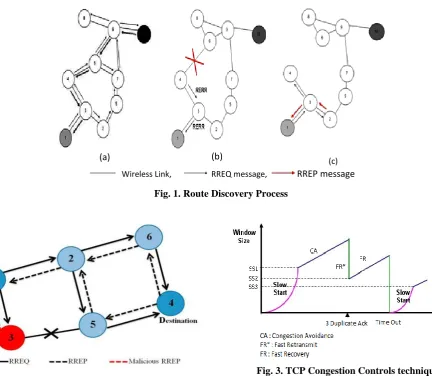
II. AD-HOC ON DEMAND DISTANCE VECTOR (AODV) Reactive routing protocol which discovers routes only when it is required. It discovers routes using route discovery process.Fig.1 (a) shows how RREQ broadcast message is used while discovery and RREP unicast message is used for reply. AODV repairs link breakages and thus provides loop free routes with the help of RERR message which is shown in Fig. 1(b) and Fig. 1(c). AODV doesn’t include or add any packet overhead if route is already available [04].
When any node sends a RREQ message, the intermediate node either sends Reply message if it is having a valid route or forward the request message to the destination node. The role of broadcast identifier and Source id is to detect if the node has achieved the copy of Request message or not.
It may happen that source node gets more than one reply message about the valid node, in that case, source node decides choosing the message with the most prior hop count. Each node stores the previous node number and broadcast identifier before sending the message to another node. To maintain the information of message received and send, AODV uses timer that detects about the timing of sent message and received message to and from a particular node. The link failure situation is handled by observing and sequentially determining ACK and BEACON message packet [05], [06].
(a) (b) (c)
[image:2.595.76.509.89.465.2]Wireless Link, RREQ message, RREP message
Fig. 1. Route Discovery Process
Fig. 2. Single Node Blackhole attack IV. GRAY HOLE ATTACK
Grayhole attack works in two steps. In first step, selfish node acting as gray hole exploits AODV protocols and act as if it has valid direction to destination node with intention to intercept packets despite of having invalid path. In second step it may drop packets coming from source destined towards certain specific node(s) in the network. A gray hole may show its malicious behavior in different ways at different situation [12]. In another type it may show selfish/malicious behavior for some time by dropping packets and then act normally or as honest node as if nothing has hap-pen. This attack is more difficult to catch than other denial of service attack like black hole where in, it drops received packets for certain amount of time continuously. Due to selfish behavior it may degrade network performance and eventually QoS parameters is affected [13], [14].
V.TCPNEW RENO
[image:2.595.308.534.318.448.2]TCP variants generally follows four phases as shown in Fig. 3 given below which are Slow Start, Congestion Avoidance, Fast Retransmit and Fast recovery with the help of addictive increase and multiplicative decrease mechanism on congestion window size(cwnd)[15],[16].
Fig. 3. TCP Congestion Controls techniques New Reno works on packet loss probability based mechanism. Reno exit fast recovery when multiple packets are dropped but New Reno continues fast recovery mode for outstanding packets despite of partial acknowledgement is received [17]. After all outstanding packets are acknowledged it exit fast recovery reduces window size and then follow linear increase mechanism [18], [19].
VI. TCPVEGAS
TCP Vegas is queuing delay based variant which sets window size based on flow of data rates. As shown in Fig. 4 it depends on low and high threshold values (α and β). Based on difference between expected and actual it updates congestion window size (cwnd) [19], [20].
It updates window size based on following equations: “diff. (Estimated backlog in queue) = (cwnd/Minimum Round trip time)-(cwnd/Actual round trip time)”
Using estimated backlog value window size is adjusted as follows:
Fig. 2. TCP Vegas Congestion Avoidance
[image:3.595.309.545.65.193.2] [image:3.595.315.555.289.393.2]Table 1 shows the comparison of selected approach based on four technique of congestion control [21], [22].
Table 1.Comparison of Proposed Variants Algorithm/TCP Variants New Reno Vegas
Slow Start Yes EV
Congestion Avoidance Yes EV
Fast Retransmit Yes Yes
Fast Recovery EV Yes
Retransmission N NM
Congestion Control N NM
N- Normal, E V-Enhanced Version, N M- New Mechanism
VII.SIMULATION ENVIRONMENT AND RESULTS In order to analyze abnormal behavior adaptive TCP variants is consider i.e. Vegas and New Reno to improve QoS parameter. Since due to TCP traffic there is not much degradation of PDF and increase in NRL so only throughput parameter is considered under the abnormal behavior of Grayhole and Blackhole attack using NS2[23],[24]. The simulation is based on tcp traffic which is generated dynamically using cbrgen and setdest parameters.
• Traffic generated using cbrgen.tcl
ns cbrgen.tcl -type tcp -nn (10,30,50) -seed 0.0 -mc (8,15,35) -rate 4.0 > tcpfiles
• Node movement using setdest parameters
. /setdest -n (10,30,50) -p 2.0 -s 10.0 -M 40.0 -t (200) -x 500 -y 500 > nodefiles.
Case-1 (Grayhole attack with 1 grayhole nodes)
There is not much degradation in case of grayhole/blackhole attack so variable blackhole attack and grayhole attack with one grayhole attack is considered. The common simulation parameter is shown in Table 2.
3
Table 3: Comparison of QoS parameters under fixed grayhole node
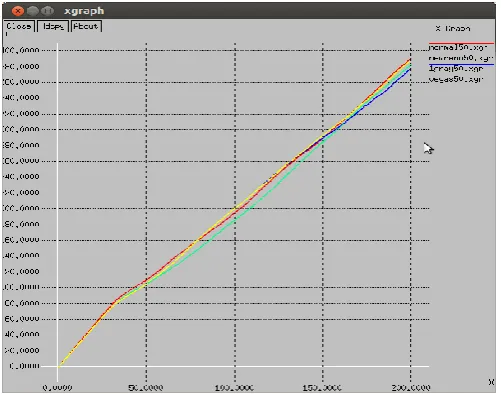
[image:3.595.62.280.329.434.2]By using tcp variants there is 3% to 7% improvement in case of throughput for fixed grayhole attack. The graph generated for throughput is shown in Fig. 5 and Fig. 6 using Xgraph facility. Red line in Fig. 5 indicate normal throughput for AODV while throughput gets degraded when denial of service gray hole attack is applied. TCP variants in form of New Reno and Vegas shown in yellow and green shows some improvement.
Fig. 5. Throughput for fixed grayhole nodes (50nodes, 1gray)
Avg. Throughput
1 Gray hole node (200 simulation time) No of
Nodes AODV Gray hole New Reno Vegas 10(1) 401.67 355.84 362.58 377.69
30(1) 423.67 408 417.42 419.55
[image:3.595.304.555.506.703.2]Fig. 6. Avg. Throughput for fixed Grayhole nodes (50nodes, 1gray)
Case-2 (Variable Black Hole nodes)
The result comparison of variable blackhole nodes and its enhancement in form of throughput using tcp variants is shown in Table 4.
Table 4. Comparison of throughput under variable blackhole nodes
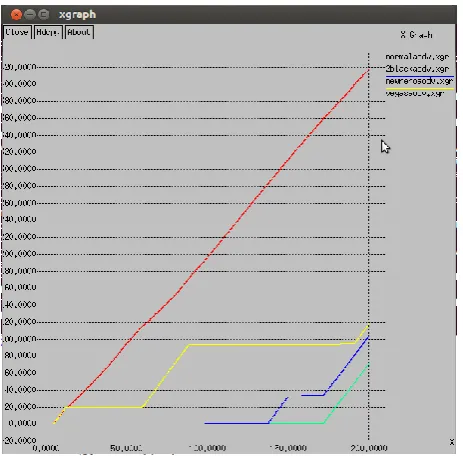
[image:4.595.312.538.47.217.2]In case of variable blackhole attack there is 3% to 5% improvement in throughput using adaptive tcp variants. The graph generated for throughput is shown in Fig. 7 and Fig. 8 using Xgraph facility.
Fig. 7. Throughput for variable blackhole nodes (30nodes, 2black)
Fig. 8. Avg.Throughput for variable blackhole nodes
VIII. 8 CONCLUSION AND FUTURE ENHANCEMENT Due to flexibility and decentralized environment securing MANET is one of the major concern. In this study, the performance of AODV under different abnormal behavior is tested i.e. under black hole attack and grayhole attack. By applying adaptive TCP Variants like New Reno and Vegas there is roughly 3% to 7% improvement of throughput under abnormal behavior of AODV.
As a future work other denial of service attacks like wormhole attack can be considered on AODV and performance can be analyzed with the help of other adaptive TCP variants like Tahoe, SACK and Westwood.
REFERENCES
1. Zhou H. A survey on routing protocols in MANETs. Department of Computer Science and Engineering, Michigan State University, East Lansing, MI. 2003 Mar 28:48824-1027.
2. L. Chen and W. Heinzelman, "A Survey of Routing Protocols that Support QoS in Mobile Ad Hoc Networks", IEEE Network, vol. 21, no. 6, pp. 30-38, 2007. Available: 10.1109/mnet.2007.4395108.
3. B. Patel, P. Shah, H. Jethva and N. Chavda, "Issues and Imperatives of Adhoc Networks", International Journal of Computer Applications, vol. 62, no. 13, pp. 16-21, 2013. Available: 10.5120/10139-4945. 4. E. Belding-Royer and C. Perkins, "Evolution and future directions of the
ad hoc on-demand distance-vector routing protocol", Ad Hoc Networks, vol. 1, no. 1, pp. 125-150, 2003.
5. N. Bobade, "Performance Evaluation of AODV and DSR On-Demand Routing Protocols With Varying MANET Size", International Journal of Wireless & Mobile Networks, vol. 4, no. 1, pp. 183-196, 2012. Available: 10.5121/ijwmn.2012.4113.
6. S. Taneja and A. Kush, "A survey of routing protocols in mobile ad hoc networks", International Journal of innovation, Management and technology, vol. 1, no. 3, p. 279, 2010. [Accessed 14 May 2019]. 7. B. Kannhavong, H. Nakayama, Y. Nemoto, N. Kato and A. Jamalipour,
"A survey of routing attacks in mobile ad hoc networks", IEEE Wireless Communications, vol. 14, no. 5, pp. 85-91, 2007. Available: 10.1109/mwc.2007.4396947.
8. D. Mishra, Y. Jain and S. Agrawal, "Behavior analysis of malicious node in the different routing algorithms in mobile ad hoc network (MANET)", InAdvances in Computing, Control, & Telecommunication Technologies, 2009. ACT'09. International Conference on, 2009, pp. 621-623.
9. S. Kurosawa, H. Nakayama, N. Kato, A. Jamalipour and Y. Nemoto, "Detecting blackhole attack on AODV-based mobile ad hoc networks by dynamic learning
method", International Journal of Network Security, vol. 5, no. 3, pp. 338-46, 2007.
Avg. Throughput
[image:4.595.54.286.507.735.2]"Comparative Analysis of Different TCP Variants in Mobile Ad-Hoc Network", International Journal of Computer Applications, vol. 52, no. 13, pp. 19-22, 2012. Available: 10.5120/8262-1802.
16. M. Islam Khan, "A Survey Of Tcp Reno, New Reno And Sack Over Mobile Ad-Hoc Network", International Journal of Distributed and Parallel systems, vol. 3, no. 1, pp. 49-63, 2012. Available: 10.5121/ijdps.2012.3104.
17. L. Grieco and S. Mascolo, "Performance evaluation and comparison of Westwood+, New Reno, and Vegas TCP congestion control", ACM SIGCOMM Computer Communication Review, vol. 34, no. 2, p. 25, 2004. Available: 10.1145/997150.997155.
18. A. Gurtov, T. Henderson,S. Floyd,Y. Nishida,”The NewReno Modification to TCP's Fast Recovery Algorithm”. RFC 6582, October; 2015 Oct.
19. B. Sardar and D. Saha, "A survey of tcp enhancements for last-hop wireless networks", IEEE Communications Surveys & Tutorials, vol. 8, no. 3, pp. 20-34, 2006. Available: 10.1109/comst.2006.253273. 20. L. Brakmo, S. O'Malley and L. Peterson, "TCP Vegas", ACM
SIGCOMM Computer Communication Review, vol. 24, no. 4, pp. 24-35, 1994. Available: 10.1145/190809.190317.
21. A. Al Hanbali, E. Altman and P. Nain, "A survey of TCP over ad hoc networks", IEEE Communications Surveys & Tutorials, vol. 7, no. 3, pp. 22-36, 2005. Available: 10.1109/comst.2005.1610548.
22. S. Biradar, S. Sarkar and C. Puttamadappa, "A Comparison of the TCP Variants Performance over different Routing Protocols on Mobile Ad Hoc Networks", International Journal on Computer Science and Engineering, pp. 340-344, 2010.
23. E. Altman and T. Jiménez, "NS Simulator for Beginners", Synthesis Lectures on Communication Networks, vol. 5, no. 1, pp. 1-184, 2012. Available: 10.2200/s00397ed1v01y201112cnt010.
24. The Network Simulator-ns-2, http://www.isi.edu / nsnam/ns/index.html
AUTHORSPROFILE
Bimal Patel received B.E. in Information Technology from Charotar Institute of Technology Changa, Gujarat University, India, in 2000. He received M.Tech in Information Technology from prestigious L.D. College of Engineering, Ahmedabad, Gujarat Technological University in 2013 with gold medal. He has guided more than 3 students at master level and published more than 7 papers in Journal and International Conferences. His research interest include MANET, Wireless Sensor Networks and Internet of Things. Currently a Ph.D. student at Charotar University of Science and Technology, Changa, India.