International Journal of Innovative Technology and Exploring Engineering (IJITEE) ISSN: 2278-3075,Volume-8 Issue-11, September 2019
Abstract: Smart cities are one of the upcoming trends in the world. These smart cities include smart traffic light system, smart cars, smart homes, smart traffic monitoring system. As environmental pollution has become the major cause of various problems like climatic changes, improper irrigation methods, depletion of the ozone layer etc. “Automated Pollution Detection System using IoT and AWS Cloud” provides an architecture for integrating IoT and Cloud Computing and an application which is used to detect air pollution by fitting in arduino devices at public places like traffic lights, industrial areas, construction areas etc., and transferring the data using GSM modem to a cloud database server AWS RDS. The cloud server is linked with the EC2 instance (Ubuntu server) in order to publish the web application using EC2. Web Application which is created using Word press and a Mobile application using Android Studio. The Web application shows the value of pollutant at a particular place along with the map facility by using GPS in the Arduino. This is also linked to a mobile application which sends a push notification service (SNS) to our mobile application.
Keywords :Amazon AWS, EC2instance, Word press, Arduino, AWS RDS.
I. INTRODUCTION
Air Pollution is the major cause of many problems in today’s world. The pollutants from construction areas, industries, vehicles are considered to be the main reasons for air pollution. Ozone Layer which is considered crucial for living in our system is depleting. Air pollution effects include climatic changes, depletion of the ozone layer, inappropriate farming, etc, Air quality index which is the measure of how pure an air shows that the 300+ value air is hazardous to breathing. Therefore measuring the pollutants in the air is necessary and this helps in bringing the proper control measure for pollution. IoT (Internet of Things) is a new tool which can be used for both academic and engineering world. IoT is recognized as a network of things, each of which can be labeled using a unique ID and express based on communication protocols. The unique addresses of sensors are connected to the web, and the data can be sent using the communication protocol from computers to the internet. Since the sensors can detect environment pollution and communicate the data through the web application without human interference. IoT can be extended to any sort of conventionally authentic devices and everyday things.
Revised Manuscript Received on September 05, 2019. * Correspondence Author
A.Sheryl Oliver*, Department of CSE, St.Joseph’sCollege of Engineering,, Chennai,India. Email: [email protected]
M.Anuradha, Department of CSE, St.Joseph’sCollege of Engineering,, Chennai,India.Email: [email protected]
J.Ramya, Department of CSE, St.Joseph’sCollege of Engineering,, Chennai,India Email: [email protected]
These devices can commune and interrelate over the Internet, and they can be monitored and controlled without human intervention. IoT collects and analyse data from internet-connected devices and gets the sensor values from all of them. All the objects (everything that surrounds us and can communicate) interconnected to the Internet by IoT [2][9]. They are used in various applications like Home automation, Military purpose, Computer Systems. There are various benefits like tracking the behavior of real-time marketing, less human interaction, interoperability and communication, sensor-driven decision analytics and diverse applications. Cloud computing approach is interfaced along with IoT. Cloud computing is used to load, store and process all the data’s which are collected from the outside world. IoT and Cloud computing is a new approach of collecting, linking, transferring data to a limitless end of the application. IoT and Cloud computing is used to detect these pollutants value. Cloud computing approach is interfaced along with IoT. Cloud computing is used to load, store and process all the data that is collected from the outside world. In AWS, the number of servers can be increased if a demand for the service increases. When the system setup is at different places then, the data increases in size. Therefore, a large amount of data can be stored into AWS because of its scalable performance [4]. High-speed network connections involved within AGS components result in the increase of speed and as a result, the speed of this system is comparatively high. Elastic Bean Stalk is also used to test this application and shows the CPU performance, scalability, the amount of data usage etc. These benefits are therefore used to connect to IoT and it has been interfaced between IoT and cloud. Therefore ‘Automated Pollution Detection system using IoT and AWS cloud’ involves automatic monitoring and detecting pollution that comes mainly from vehicles [8] and from public places like main roads, industries, construction areas etc., [4]. GPS is also installed with this system to get the exact location. Previous papers use RFID technique [11] and microprocessors [7] in detecting the pollution from vehicles. Several disadvantages of the previous papers are identified and corrected in our system. This paper was methodized as follows; Section 2 of this paper reveals the literature, while Section 3 presents System Architecture and finally section 4 approaches with the conclusion and Scope for Future Enhancement.
Automated Pollution Detection System using
IoT and AWS Cloud
II. RELATED WORK
The review of literature in this section traces the work carried out on using IoT for Pollution detection and contains reviews of works related to communicating with IoT
2.1 Pollution Detection
Related papers enable in finding air pollution uses RFID [11]. The high-cost RFID based automation is designed and it is connected to the remote server. This will enable an accurate measurement of pollution from the vehicle and remotely transferring of data to the server [1]. The setup is installed in vehicles and several vehicles consisting of the readers are connected to a GSM modem which can be further reduced in our system. The RFID must be fitted into the vehicles[20] which may require millions of such devices that in turn increase the cost. RFID tags may fail if there is a severe climatic change, and it might detect the wrong values. The device should also be frequently charged and the batteries should also be frequently changed and it is limited to a particular range [7].
The system helps environmental scientists to find out and manage various sensors, and share the data concerning about the pollution impacts [12]. The automatic pollution observation system analyzes the information using front-end perception system [2]. World Health Organization (WHO) claims that air pollution shows adverse effects on the human beings. The quality of air present in indoor is measured by the atmosphere device, and correlate with a mechanical signal which is essential for ventilation and improves the quality of air by performing certain time period using observation system[6]. In [3] air pollution monitoring which uses CO sensors, smoke sensors and temperature detectors connected to a microcontroller unit. This data are finally displayed in the LCD display unit.
2.2. Communication
In the previous works, pollution control circuit was a micro-controller chipboard which is integrated into one single system. An SMS [1] is sent to a mobile device using the GSM system. GPS module was also used to locate the position of the vehicle at the place where it is halted. This mainly demonstrates an effective utilization of technology but microcontroller has a serious disadvantage of minimal API’s. Micro-controllers become memory-inefficient, complex devices. Monitoring these[21][22] devices was also done using a longitude system. Few did not relate to connecting to a remote server. The graphically based testing was tried [5]. Communications were done through Zigbee which is less power, less data range, and low data consistency. Zigbee provides only a range of 10 meters [7]. This kind of communication results in failure or data range limit. There are possibilities for node failure. Wi-fi provides a limited range for the device to communicate to the gateway. RFID tags are also used to integrate the data into the remote server. RFID tags posses a data range of only 10 meters [10][14][17] which can be improvised using our system. The RFID tags may fail if there are severe climatic changes and it might detect wrong values. The device should also be frequently charged and the batteries should also be frequently changed and it is limited to a particular range.
Many devices to the same server are not explained [11] properly in the previous papers. To overcome the issues such as performance and operational efficiency, the integration of cloud computing into the mobile environment is imperative. Various cloud mobile platforms do not specify the best alternative in the previous papers [8]. A Bluetooth technology is also used in the previous methods which provide very less range of transmission. The sensor techniques are tried to be implemented in our system [13]. ‘ArduEmission’ which uses the microcontroller for functioning is used as a sensor for monitoring pollution. This device is user-friendly and the data obtained can be easily analyzed [14][15]. Proposed cloud based data security using distributed minhash algorithm and NLP technique[5][16].The objectives of this work are enlisted in the principal motivation and the technique of detecting pollution can be implemented using the easy interface between the users with IoT.
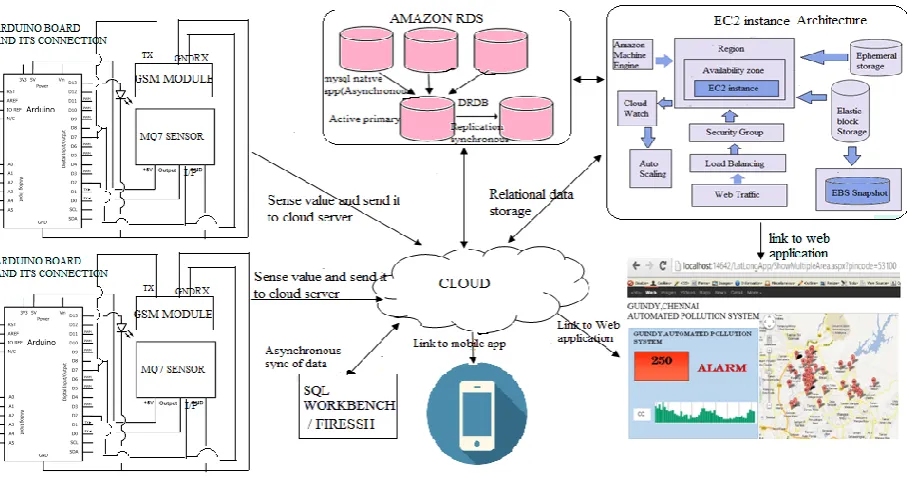
In the proposed system, “Automated Pollution Detection System using IoT[18][19] and AWS cloud” involves automatic monitoring and detecting pollution that comes mainly from public places like main roads, industries, construction areas etc., These pollutants are emitted into an environment is detected using Arduino boards and sensors ( say MQ7 sensor). Detected values are then transferred to the cloud server using GSM modem. The cloud server is linked to the web application and to a mobile application. Web application displays the location and the amount of monoxide content at a particular location. The mobile application also enables the Push Notification service which is developed using Phone gap. Amazon RDS (Relational Database) and Amazon EC2 (Elastic Compute Cloud) [10] is an online instance service offered by the Amazon Web Service. They provide a securable interface of sensor values to cloud instance as they provide with many Security groups and IAM roles for the users and TLS security and a cheaper way of automation. For easy detection of the polluted area, GPS was incorporated and the results can be read either in the web application or mobile application.[23]
III. A MODEL OF ARCHITECTURE FOR AUTOMATED POLLUTION DETECTION SYSTEM USING IOT AND AWS
CLOUD
International Journal of Innovative Technology and Exploring Engineering (IJITEE) ISSN: 2278-3075,Volume-8 Issue-11, September 2019
The data store is thus the cloud storage which performs various functions like backing up, storing, managing the database.
3.1 Physical Connectivity of Hardware Components Stack, the GSM module upon the Arduino board and then the MQ7 sensor is connected to the Arduino board using male-female wires. Later the board is powered up using the USB cable and then the code is uploaded to the board. This setup is placed in construction areas, industries, public places, etc.
3.1.1. MQ-7 Carbon Monoxide Sensor
[image:3.595.373.480.80.179.2]MQ-7 is an easy interface sensor that can detect the amount of Carbon monoxide (CO) present in the air. It can detect CO intensity ranges from 20 to 200 ppm. It encompasses high sensitivity and fast response time. The MQ7 Sensor is as represented in Figure 2. This sensor is a portable gas monitor used to detect dangerous levels of hazardous gases. Even though MQ-7 sensors have much scope in the field of processing industries, aviation sectors etc, and this sensor is mainly focused on automobile applications that emit Carbon monoxide.
Figure. 2 MQ7 sensor
3.1.2. ARDUINO
To convert the output the Arduino board is shown in Figure.3 which are used to sense the inputs in the form of light, through button or twitter message. The variables record the value of the analog pin (AOUT) and digital pin (DOUT). The fixed baud rate is assigned as the input (DOUT) pin and the cloud server saves the output. This result shows the fact that the sensor is an input for the Arduino board to reveal the sensor values. Then Carbon Monoxide value is printed, in the form of statistical value between 0 to35ppm. The limit will be given as output and it be will be either high or low. If CO level is lowered below the threshold value the output is visible as low and if CO value is higher than the threshold value the output is displayed as high.
Figure. 3 Arduino
3.1.3. GSM Modem (SIM 900A module)
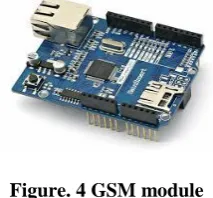
GSM modem supports GPRS technology and provides a range of 25 km. The GSM and the gateway are connected to the same network and they are connected to the Cloud server using the HTTP protocol is shown in Figure.4. The SIM 900A is a complete dual-band GSM/GPRS solutions that can be embedded in customer applications with minimum dimension, cost-effective method. The SIM 900A delivers GSM/GPRS in 900/1800 MHZ for voice, SMS and Fax with
minimal power consumption. It can be fit in any space because of its slim and compact design.
Figure. 4 GSM module
3.2. Launching and Configuration of Cloud Instance
3.2.1. Elastic Compute Cloud (EC2)
[image:3.595.129.219.323.370.2]Figure. 1 A Model of Architecture for Automated Pollution Detection System using IoT and AWS Cloud
Figure. 5 EC2 Architecture
3.2.2. AWS RDS
It is an AWS cloud infrastructure which provides the facility of scaling a relational database in the cloud. When a server is configured all its configuration features are configured together. AWS RDS provides with the functionality of scaling individual components. The sensor value from it is sent to the RDS server and it is stored using HTTP protocol. Security groups and VPC’s determine the major part of linking RDS with many components. They must lie in the same VC and security group.
Figure. 6 RDS Architecture
3.2.3. Launching and Linking of AWS EC2 and RDS This module involves three methods which are launching of an RDS instance using Amazon RDS, launching of a cloud instance using Amazon AWS EC2 instance and linking of these two instances together. RDS instance is a database server and MYSQL engine is selected among the many available DB’s. An Ubuntu server is launched using the EC2 instance. Configuring EC2 instance involves the installation of TASKSEL. This provides in choosing the right server, here a LAMP server (LINUX, APACHE, MYSQL, PHP). In order to link EC2 and RDS instances, they must lie in the same region and VPC for them to be connected. The security groups must include the same PORT’s (SSH port, HTTP port, MYSQL port). Linking of an EC2 instance and RDS involves sensor value to be directly linked to a single web page and therefore this reduces the system architecture in creating multiple web pages for many Arduino devices.
3.3. Integration of IoT With Cloud Instances
[image:4.595.65.266.652.773.2]International Journal of Innovative Technology and Exploring Engineering (IJITEE) ISSN: 2278-3075,Volume-8 Issue-11, September 2019
3.3.1. Pseudo Code
Begin
Include header files
Initialize pin, sensor_value, MAC, IP address and Server
address Initialize the Ethernet server library
Begin function setup()
Serial.begin starts the serial connection between computer
and Arduino start the Ethernet connection
End function
Begin function loop()
Read the sensor_value from analog Reading
Connect to the server (your computer or web page)
Begin if
Check whether the board can connect to cloud server
Get the write_data.php using the GET method
Closing connection to the server
Begin else
If Arduino can't connect to the server print Connection failed
End endif
End
3.4. GPS Module Integration with Hardware
The GPS module continuously indicates the set of data relates to the position of the earth surface in terms of Latitude and Longitude. It is possible to decode the data and print in the form which is readable with the assistance of a microcontroller only. MQ-7 sensors associated with GPS have the ability to sense the Carbon Monoxide at every 20km. The exact location of the device is displayed by GPS is integrated with the hardware and the mapping facility. Since large devices are connected to the same database the location is used as the primary key for distinguishing the value of the sensor at different values.
3.5. Web Application Development using WordPress
This module mainly involves in the creation of Web application using Wordpress. Wordpress is installed in the cloud server while configuring it. Therefore this involves mainly in the look and feel of the web application.
Many available templates and options for editing the web page are available which shows the value in a real GUI manner. The MQ-7 sensor detects the amount of carbon monoxide. The values are sent to the cloud server using SIM 900A. The cloud server sends the data to the mobile application and to the web application. The GPS founds the exact location of pollution and it is displayed in the web application and in the mobile application using the hardware in the mapping facilities.
The major results and contributions of this research are: Simplifies the entire integration of IoT and cloud.
MQ7 Arduino which detects the carbon monoxide in the air is perfectly used for measuring air pollution.
Securable interface of sensor values to cloud instance as AWS provides many security groups and IAM roles for the users and TLS security and a cheaper way of automation.
For easy detection of the polluted area, GPS was incorporated and the results can be read either in the web application or mobile application.
The web application pollution system thus developed enables with the proper detection of the pollutant and gives the exact location.
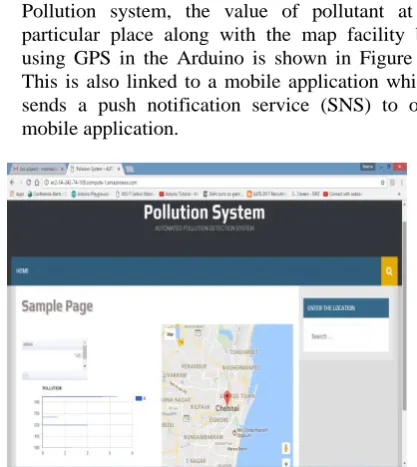
[image:5.595.330.539.207.441.2] The output of the Web application Pollution system, the value of pollutant at a particular place along with the map facility by using GPS in the Arduino is shown in Figure 7. This is also linked to a mobile application which sends a push notification service (SNS) to our mobile application.
Figure. 7 Web application Pollution System
IV. CONCLUSION AND FUTURE ENHANCEMENT
Thus the parameters from the Arduino board are directly connected to the cloud server (EC2 instance) using GSM modem. This architecture simplifies the entire integration of IoT and cloud. MQ7 Arduino which detects the carbon monoxide in the air is perfectly used for measuring air pollution. The web application thus developed enables with the proper detection of the pollutant and gives the exact location. Thus this system satisfies all the constraints and is well supported to implement our key idea. This system can be used in the field of processing industries, aviation sectors etc, and it is mainly focused on automobile applications that emit Carbon monoxide.
REFERENCES
Author-1 Photo
Author-2
Author-3 2. Chen Xiaojun, Liu Xianpeng, Xu Peng(2015), “IOT-based air
pollution monitoring and forecasting system”, 2015
3. Himadri Nath Saha(2017), “Comparative Performance Analysis between nrf24l01+ and XBEE ZB Module Based Wireless Ad-hoc Networks”, 2017
4. Himadri Nath Saha, Supratim Auddy, Avimita Chatterjee etal(2017), “Pollution Control Using Internet of Things”, IEEE Conference Publications 2017 ,8th International Conference on Industrial Automation and Electromechanical Engineering Conference (IEMECON).
5. http://docs.aws.amazon.com/AmazonRDS/latest/UserGuide/CHAP_G ettingStarted.CreatingConnecting.MySQL.html
6. Kelly.S.D.T, Suryadevara.N.K, and Mukhopadhyay.S.C(2013),” Towards the implementation of IoT for environmental condition monitoring in homes” IEEE sensors journal(Volume:13,Issue:10,Oct.2013) 16th May 2013 date.Accession number:13747701.
7. Oh, Chang-Se; Seo, Min-Seok; Lee, Jung-Hyuck; Kim, Sang-Hyun; Kim, Young-Don; Park, Hyun-Ju(2015), “Indoor Air Quality Monitoring Systems in the IoT Environment”, 2015
8. Rajalakshmi .A, S.Karthick, Dr.S.Valarmathy(2015), Vehicular Pollution and Status Monitoring Using RFID” International Journal of Advanced Research in Science,Engineering and Technology Vol. 2, Issue 4 , April 2015.
9. Ranga Reddy M ,Sarath Chandra(2013) ,” An Intelligent air pollutant vehicle tracker system using gas sensor and GPS” in “intelligent systems modeling and simulation 2013,4th International Conference. 10.Saha HN, A Mandal, S Abhirup(2017), “Recent trends in the Internet
of Things”, 2017
11.Siva Shankar Chandrasekaran, Sudharshan Muthukumar, Sabeshkumar Rajendran(2013), “Automated Control System for Air Pollution Detection in Vehicles” IEEE Conference Publications 2013, 4th International Conference on Intelligent Systems, Modelling and Simulation.
12.Souvik Manna , Suman Sankar Bhunia , Nandini Mukherjee(2014), “Vehicular pollution monitoring using iot”, 2014Souvik Manna,SumanSankar Bhunia,Nandini Mukherjee,” Vehicular pollution monitoring using IoT “Recent Advances and Innovations in Engineering (ICRAIE), 2014Date of Conference: 9-11 May 2014Date Added to IEEE Xplore: 25 September 2014.
13.Sulayman K. Sowe , Takashi Kimata , Mianxiong Dong , Koji Zettsu(2014), “Managing Heterogeneous Sensor Data on a Big Data Platform: IoT Services for Data-Intensive Science”, 2014
14.Tsow, F., Forzani, E.; Rai, A., Rui Wang; Tsui, R.; Mastroianni, S.; Knobbe, C.; Gandolfi, A.J.; Tao, N.J.(2009), "A Wearable and Wireless Sensor System for Real-Time Monitoring of Toxic Environmental Volatile Organic Compounds," Sensors Journal, IEEE , vol.9, no.12, pp.1734,1740, Dec. 2009.
15.Wan-Young Chung, Sung-Ju Oh, “Remote monitoring system with wireless sensors module for room environment”(2006), International Journal of Sensors and Actuators B : Chemical, Volume 113, Issue 1, 17 January2006, Pages 64-70.
16.Anita kulkarni , T. Ravi Teja(2014),” Automated System for Air Pollution Detection and Control in Vehicles” International Journal of Advanced Research in Electrical, Electronics and Instrumentation Engineering Vol. 3, Issue 9, September 2014.
17. Aleena Mary Anson , Dr. Priti Singh(2017), “Automated Pollution Control System in Vehicles: A Review” International Journal on Recent and Innovation Trends in Computing and Communication,2017 Volume: 5 Issue: 5.
18. ChaitanyaHP, H.PrasannaKumar(2016), “Automataed System For Air Pollution Detection And Control Of Speed In Vehicles”,International Journal of Advances in Engineering & Technology, Aug., 2016, Vol. 9, Issue 4 , 443-450.
19. Ruhi Kiran Bajaj,Madhuri Rao , Himanshu Agrawal , “Internet Of Things (IoT) In The Smart Automotive Sector: A Review”,IOSR Journal of Computer Engineering (IOSR-JCE) e-ISSN: 2278-0661,p-ISSN: 2278-8727, PP 36-44.
20. Poonam Pal , Ritik Gupta , Sanjana Tiwari , Ashutosh Sharma(2017),”IOT BASED AIR POLLUTION MONITORING SYSTEM USING ARDUINO”,International Research Journal of Engineering and Technology (IRJET),Volume: 04 Issue: 10 | Oct -2017 www.irjet.net p-ISSN: 2395-0072.
21. Lalit Mohan Joshi ,Research paper on IOT based Air and Sound Pollution Monitoring System(2017)”,International Journal of Computer Applications (0975 – 8887) Volume 178 – No.7, November 2017.
22. Prof. BasavarajHunshal, Daneshwari Patil , Kavita Surannavar , MansuraBegum Tatwanagi ,Saniya Patel Nadaf (2017),”Vehicular Pollution Monitoring System and Detection of Vehicles Causing Global Warming”,IJESC,2017, Research Article Volume 7 Issue No.6. 23. A.Sheryl Oliver,M.Anuradha.J.Jean Justus, Maheswari N ,”Optimized low computational algorithm for elderly fall detection based on machine learning techniques” Biomedical Research,2018 Volume 29, Issue 20.
AUTHORS
PROFILE
A.Sheryl Oliver obtained her B.E degree in Computer Science and Engineering from Bharathidasan University.She completed her P.G degree in IASE DU in Information Technology. She pursued her PhD in VIT university, Chennai Campus. Her thesis title is Human Activity Recognition using wearable electrodes. Her area of expertise are Data mining, Machine learning, Wearable computing and Data Science. Currently she is working in St.Joseph’s College of Engineering as Associate Professor and has 14 years of experience. Now she is in actively working in Deep Learning and Artificial Intelligence for some real time applications.
Dr. M. Anuradha had received B.E. degree from Bharathidasan University in Electronics and Communication Engineering in 1992, M.E. Degree in Computer Science and Engineering from Anna University in 2008 and Ph.D. from Anna University in 2017.Currently working as Associate Professor in St.Joseph’s College of Engineering. She has published 20 technical papers in various international journals/conferences. She has 20 years of teaching experience on both graduate and post-graduate level. Her area of interest includes Wireless Networks,Natural Language Processing, Data Mining, Image Processing and Grid Computing.