Water content modifies the structure of sodium metasilicate activated slag binders 30
Water content modifies the structural development of sodium metasilicate-activated slag
binders.
S. A. Bernal1*, R. San Nicolas2, J. S. J. van Deventer3,4, J. L. Provis1
1Department of Materials Science & Engineering, The University of Sheffield, Sheffield S1 3JD, United Kingdom
*Email: [email protected]
2Department of Infrastructure Engineering, University of Melbourne, Victoria 3010, Australia
3Department of Chemical and Biomolecular Engineering, University of Melbourne, Victoria 3010, Australia 4Zeobond Pty Ltd, P.O. Box 23450, Docklands, Victoria 8012, Australia
© 2015 ALCONPAT Int.
ABSTRACT
The effect of modifying the water content of an alkali-activated slag binder was assessed, in terms of the kinetics of reaction and the structural development of the material. There is not a systematic correlation between the water content of the mix and the rate of reaction, indicating that there is an optimal value that favours dissolution of the slag and precipitation of reaction products. A higher water content reduced the crystallinity and density of the reaction products, especially at advanced age. Small changes in the water content can have a significant impact on the compressive strength development of alkali-silicate activated slag mortars, suggesting that when producing materials based on alkali-activated binders, it is essential to carefully control the water content.
Keywords: alkali-activated slag, water content, calorimetry, X-ray diffraction
RESUMEN
Se evaluó el efecto de modificar el contenido de agua en un cemento de escoria activada alcalinamente, en términos de la cinética de reacción y su desarrollo estructural. No hay una correlación sistemática entre el contenido de agua y la velocidad de reacción, indicativo que hay un valor óptimo que favorece la disolución de la escoria y la precipitación de productos de reacción. Un contenido de agua elevado redujo la cristalinidad y densidad de los productos de reacción, especialmente a edades avanzadas. Cambios menores en el contenido de agua pueden impactar el desarrollo de la resistencia a la compresión de morteros de escoria activada alcalinamente, lo que sugiere que cuando se producen materiales con cementantes de activación alcalina, es esencial controlar los contenidos de agua en la mezcla.
Palabras clave: escoria activada alcalinamente, contenido de agua, calorimetría, DRX
RESUMO
Foi avaliado o efeito de modificar o conteúdo de água em um cimento de escória atividade de forma alcalina, em termos de cinética da reação e seu desenvolvimento estrutural. Não existe uma correlação sistemática entre o teor de água e a velocidade de reação, o que indica que há um valor óptimo que favorece a dissolução da escória e a precipitação de produtos de reação. Um elevado teor de água reduz a cristalinidade e densidade dos produtos da reação, especialmente em idades mais avançadas. Pequenas mudanças no conteúdo de água podem ter impacto no desenvolvimento de resistência à compressão de argamassas de escória ativadas, sugerindo que quando são produzidos os materiais cimentícios com ativação alcalina, é essencial controlar o teor de água da mistura.
Palavras-chave: escória ativada, teor de água, calorimetria, difração de raios-X. __________________________________________________________ Corresponding author: Susan Bernal
Journal of the Latin-American Association of Quality Control, Pathology and Recovery of Construction
ALCONPAT Journal
http://www.mda.cinvestav.mx/revista_alconpateISSN 2007-6835
Article information
Article received on november 11th 2014,
reviewed under publishing policies of ALCONPAT Journal and accepted on march 9th 2015. Any
discussion, including authors reply, will be published on the third number of 2015 if received before closing the second number of 2015.
Legal Information
ALCONPAT Journal, year 5, No. 1, January-April 2015, is a quarterly publication of the Latinamerican Association of quality control, pathology and recovery of construction- International, A.C.; Km. 6, Antigua carretera a Progreso, Mérida, Yucatán, C.P. 97310, Tel.5219997385893,
[email protected], Website:
www.mda.cinvestav.mx/alconpat/revista Editor: Dr. Pedro Castro Borges. Reservation of rights to exclusive use No.04-2013-011717330300-203, eISSN 2007-6835, both awarded by the National Institute of Copyright. Responsible for the latest update on this number, ALCONPAT Informatics Unit, Eng. Elizabeth Maldonado Sabido, Km. 6, Antigua carretera a Progreso, Mérida Yucatán, C.P. 97310, last updated: April 30th, 2015.
The views expressed by the authors do not necessarily reflect the views of the publisher.
1.
INTRODUCTION
Alkali-activation of industrial by-products such as blast furnace slag, derived from the iron making industry, and fly ashes derived from the coal combustion process in thermoelectric stations, has been the object of much study over the past century (Provis and Bernal, 2014, Provis and van Deventer, 2014). These materials are produced via a chemical reaction between an aluminosilicate precursor and an alkaline activator, forming a hardened solid. When properly formulated and cured, alkali-activated slag binders can develop advantageous properties such as high mechanical strength, low permeability, and high resistance to aggressive environments (Shi et al., 2011, Bernal and Provis, 2014); however, it has been identified that these properties vary significantly from study to study, which is mainly associated with the differences in chemistry between raw materials from different sources, the dose and type of the alkaline activator used, and the curing conditions, among other factors that can significantly affect the reactivity of the precursors and the phase assemblage of the hardened cements (Provis, 2014).
Most studies in this area have been focused on the optimisation of the activation conditions for a specific precursor, and selection of an alkaline activator, in order to obtain the best possible outcomes in terms of strength and durability. Little detailed attention has been given to the potential effect on the chemistry and mineralogy of the binder when varying the water content of the mix. Water content is a relevant factor when scaling up the production of these materials, as this parameter is often described to be fixed at a value which gives acceptable workability of the fresh mix, with less consideration of the impact of the water content on physicochemical properties of the hardened binder. Workability of mortars and concretes is one of the main criteria defining the possibility of large-scale utilisation of any type of binder, and is usually controlled by manipulation of the content of mix water.
In alkali-activated binders, the role of water differs from that which is known for Portland cement, as the reaction is not driven solely by a hydration mechanism. Instead, the alkali activating solution promotes the dissolution and consequent polycondensation of reaction products, leading to the hardening of these binders (Provis and Bernal, 2014). The content of water in the system modifies the concentration of the alkali activator, which can potentially affect the type and structure of the reaction products formed, as well as the rates at which the key chemical reaction steps proceed (Provis and van Deventer, 2007). Consequently, materials formulated with different water contents can develop different mechanical and transport properties, for a given type and concentration of alkali activator, which can significantly affect the long-term performance of these materials (Ismail et al., 2011).
It has been reported (Wang et al., 1994) that, similar to the case for Portland cement, an increased content of water leads to a reduced mechanical strength in alkali-activated slag binders. An increase in the liquid (activating solution)/slag ratio results in higher alkali concentrations as more of the alkaline component is introduced into the system, and simultaneously leads to an increase in permeability, as more water is also present (Wang et al., 1994). Thus, a good balance between activating solution and slag content needs to be found in order to favour high early strength, good mechanical strength at later ages and reduced permeability, by controlling the microstructural features of the binders produced. However, the reduction of water content in the activator can also cause an increased viscosity in the fresh paste, which may be problematic in terms of the rheology of a mortar or concrete product (Provis and Bernal, 2014).
amount of water available, along with the concentration of the alkali cation, influences the composition and structure of the reaction products formed. In that study, an increased concentration of alkalis and water in the system promoted the formation of poorly polymerised species, and hindered polymerisation of the reaction products. This elucidates that in addition to its well-known role in creating extra pore volume in a hardened binder, the water content of an alkali-activated material will also modify the durability and local structural properties of these binders. This will further influence the durability performance, both through having a significant impact in the microstructure of alkali-activated binders, and also at a chemical level.
In this study an alkali metasilicate activated slag, dosed with a constant content of activator and varying water/binder ratios, was evaluated. Isothermal calorimetry and X-ray diffraction results, and microscopic examination of the binders, show differences in the binder chemistry as a function of water content and curing duration, and this also influences the compressive strength results obtained for mortars produced with similar binder formulations.
2.
EXPERIMENTAL PROGRAMME
2.1.Materials and sample preparation.
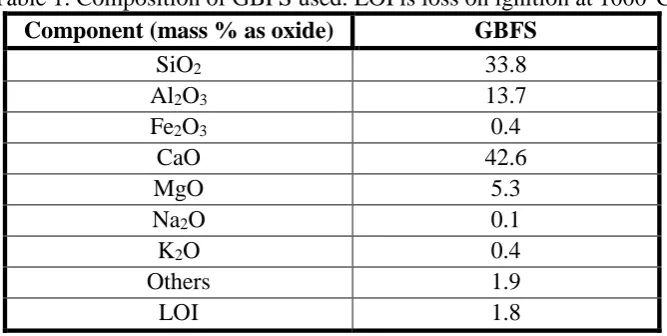
As primary raw material, a granulated blast furnace slag (GBFS) was used, with oxide composition as shown in Table 1. Its specific gravity is 2800 kg/m3 and Blaine fineness 410±10
[image:3.612.154.488.372.540.2]m2/kg, with a d50 of 15 m.
Table 1. Composition of GBFS used. LOI is loss on ignition at 1000°C
Component (mass % as oxide) GBFS
SiO2 33.8
Al2O3 13.7
Fe2O3 0.4
CaO 42.6
MgO 5.3
Na2O 0.1
K2O 0.4
Others 1.9
LOI 1.8
Paste samples were prepared using a blend of NaOH pellets, distilled water, and a commercial silicate (PQ Grade D) solution, to achieve a molar ratio of SiO2/Na2O of 1.0, an activator dose of
8 g Na2SiO3 per 100g of slag, and a water/binder (slag+activator) ratio of 0.40, 0.44 and 0.48. All
paste specimens were cured in sealed centrifuge tubes at 23°C until testing. Mortar cubes, 50 mm in size, were used for compressive strength testing. These were formulated with a sand:binder ratio of 2.75:1, and a binder formulation matching the paste specimens.
2.2.Tests conducted.
The hardened paste specimens were analysed after periods of up to 180 days of curing, through:
X-ray diffraction (XRD), using a Bruker D8 Advance instrument with Cu Kα radiation and a nickel filter. The tests were conducted with a step size of 0.020º, over a 2θ range of 5º to 70º.
Thermogravimetry was carried out in a Perkin Elmer Diamond instrument, using a heating rate of 10ºC/min between 40ºC and 1000ºC.
Environmental scanning electron microscopy (ESEM) was carried out using a FEI Quanta instrument with a 15 kV accelerating voltage and a working distance of 10 mm. Polished samples were evaluated in low vacuum mode, using a backscatter detector to avoid the need for carbon coating of the samples.
Compressive strength testing, using an ELE International Universal Tester, at a loading rate of 1.0 kN/s for the 50 mm mortar cubes.
3. RESULTS AND DISCUSSION
3.1. Isothermal calorimetry.
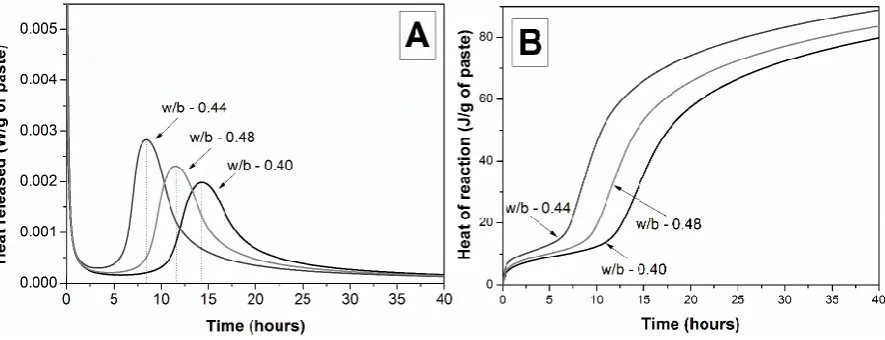
In all cases, the shapes of the heat evolution curves measured by isothermal conduction calorimetry (Figure 1A) are consistent with what has been reported previously for silicate-activated slags (Fernández-Jiménez and Puertas, 1997, Shi, 1997, Bernal et al., 2014). A pre-induction period (first peak) is observed during the first hours of reaction (2.5 h), followed by a short induction period, and a high intensity acceleration and deceleration period (second peak) corresponding to the nucleation, growth and precipitation of reaction products. The content of water in the mix clearly modifies the onset time, intensity and duration of the peak assigned to the acceleration/deceleration period, so that a w/b ratio of 0.44 promotes the highest heat release over the testing time, followed by pastes formulated with w/b ratios of 0.48 and 0.40 respectively. Comparable heats of reaction (Figure 1B) are identified in the first 7 h of testing in pastes with w/b ratios of 0.40 and 0.48. At all times of reaction beyond 4 hours (the onset of the acceleration period for the sample with w/b = 0.44), significant differences in the cumulative heat of reaction are observed as a function of the water content, so that higher reaction heats are observed at all testing times for pastes with w/b = 0.44, followed by pastes with a w/b ratio of 0.48, and the paste with w/b = 0.40 showing the lowest heat release. This is particularly notable when considering that the heat release data are normalised to the total paste mass, meaning that the heat release per mass of slag in the mixes is actually much lower for the paste with the lowest water content, indicating a much lower degree of reaction in this system. The w/b 0.44 sample still shows a higher maximum heat release rate and a higher reaction heat than the w/b 0.48 mix when these data are compared on a basis of slag mass, indicating this effect must be associated with a chemical one.
In Portland cement (PC), it has been identified that the water/cement ratio influences the kinetics of reaction (Lin and Meyer, 2009), and determines the degree of hydration at early age, so that higher or lower hydration rates are identified as the content of water increases, depending on the content of C3A and C2S in the clinker. This is consistent with the fact that hardening of Portland
negative capillary pressures, as hydration proceeds. The possible self-desiccation effects in activated binders are not yet well understood, but the fact that the reaction products of alkali-activation generally seem to have less strong water binding than those in Portland cement systems, may indicate that the degree of self-desiccation would be limited, reducing the impact of this phenomenon on the rate of reaction at lower w/b ratios in these binders.
Figure 1.(A) Isothermal calorimetry curves and (B) cumulative heats of reaction of alkali metasilicate activated slag binders, as a function of the water content
Dissolution rates of PC clinker components in concentrated aqueous solutions representing a fresh paste environment do not follow a smooth relationship with respect to the saturation state of the solution, as different mechanisms of dissolution can become rate-controlling depending on the saturation state of the solution (Bullard et al., 2011). However, in PC the timing of the onset of the acceleration period depends on the availability of enough regions for nucleation and growth of calcium silicate hydrate (C-S-H) to give an appreciable hydration rate that can be detectable via isothermal calorimetry. Solid-state nuclear magnetic resonance (NMR) results have indicated (Bellmann et al., 2010) that the polymerisation of silicate species may be an important mechanism in the transition to nucleation and growth kinetics, so that the formation of dimers in C-S-H products has been associated with the onset of the acceleration period. As reaction proceeds, the deceleration period commences, triggered by factors which are still the subject of active research but possibly including the consumption of small particles leaving only large particles available to react, a lack of space, and/or a lack of water in the system (Bullard et al., 2011).
water contents (w/b = 0.48) the acceleration period begins sooner, which might indicate that the less alkaline conditions reached in this system promote the faster formation of reaction products, either as a consequence of a change in the concentration of the alkalis and the silicate in the pore solution, or related to the increased space available for nucleation and growth of reaction products. The fastest reaction of the slag was identified when using a w/b ratio of 0.44, indicating that this amount of activating solution is sufficient to promote both dissolution of the slag and nucleation and growth of reaction products, at early times of reaction.
3.2. X-ray diffraction.
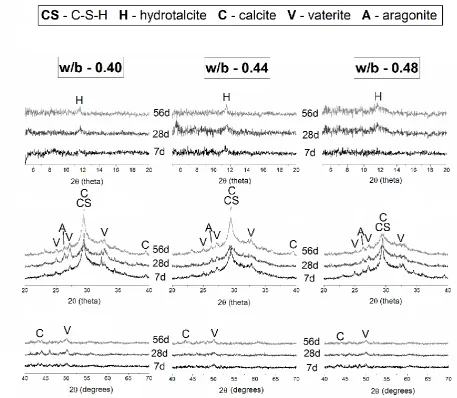
In the alkali-activated slag binders, independent of the water content in the mix, the main reaction product identified by XRD (Figure 2) is an aluminium-substituted calcium silicate hydrate (C-S-H) phase (Powder Diffraction File, PDF, #045-1480) resembling a disordered form of tobermorite-11Å. Additionally, layered double hydroxides in the hydrotalcite group (similar to Mg6Al2CO3(OH)16·4H2O, PDF#014-0191, but potentially with variations in Mg/Al and CO3
2-/OH- ratios) were observed. Hydrotalcite is one of the main reaction products in many alkali-activated slag pastes, when sufficient MgO content is available in the slag (Bernal et al., 2014), independent of the activator used (Ben Haha et al., 2011, Escalante-Garcia et al., 2003, Fernández-Jiménez et al., 2003). The calcium carbonate (CaCO3) polymorphs calcite (PDF
#005-0586), vaterite (PDF #002-0261) and aragonite (PDF #04-013-9616) are also identified. Carbonate formation in these specimens is associated with superficial carbonation of the samples during handling, crushing and/or analysis.
The main differences in the diffractograms in Figure 2, as a function of the water content and time of curing, are identified in the breadth and intensity of the peak at 11.3 2θ associated with the main reflection of a hydrotalcite type phase, and the peak at 29.4° 2θ assigned to the main reflection of the C-S-H product and calcite. Both of these peaks become more intense with extended curing, but less intense and broader with the addition of more water to the mix. It is worth noting that the secondary reflection of calcite (39.4, 43.2, 47.5, 48.5 2θ) do not significantly vary over the time of curing, or as a function of water content. Therefore, any changes in the peak at 29.5° 2θ can be mainly associated with structural changes of the C-S-H. The sharpening and intensification of this peak, as a function of time in each mix, is attributed to an increased degree of structural ordering of the C-S-H type product as the reaction progresses, and particularly at advanced times of reaction. The mix with the highest water content (w/b = 0.48) shows a much less intense peak in this region, which could either reflect a lower degree of structural ordering in the C-S-H, and/or a lower extent of formation of this phase, than in the other systems studied.
Figure 2.X-ray diffractograms ofalkali metasilicate activated slag binders formulated with w/b ratios 0.40, 0.44 and 0.48.
3.3. Thermogravimetry
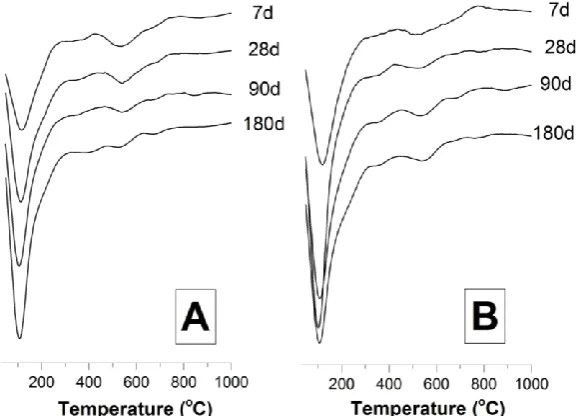
significantly higher than in pastes with w/b = 0.40, which might suggest the formation of a larger quantity of hydrated products in pastes with higher water contents as reaction progresses. This is somehow consistent with the calorimetry results (Figure 1), indicating a faster reaction of the samples with w/b=0.48 than those formulated with a w/b=0.40.
Figure 3. Differential thermograms (mass loss downwards) of alkali-activated slag pastes formulated with w/b ratios of (A) 0.40 and (B) 0.48, as a function of the time of curing.
3.4.Scanning electron microscopy.
Selected backscattered electron (BSE) micrographs of the alkali-activated slag pastes are shown in Figure 4. These micrographs show that all of the materials tested develop a cohesive and relatively homogeneous continuous matrix, in agreement with the formation of space-filling reaction products such as C-(A)-S-H type gel (main grey region), as identified by X-ray diffraction (Figure 2). The large angular particles (light grey) embedded in the matrix correspond to unreacted slag. As the water content of the binder changes, differences in the greyscale intensity (related to the mass density of the material) are observed, so a darker grey colour is observed in specimens formulated with higher water content. In cementitious materials this is attributed either to changes in the chemistry of the reaction products, where lower contents of Ca lead to darker colours as this is the heaviest element among those comprising the gel, or to changes in bulk density (Ben Haha et al., 2011, Zhang et al., 2002, Kjellsen, 1996, Famy et al., 2002), so that darker colours are related to more porous materials.
inner and outer products were observed in alkali-activated slag concretes formulated with varying w/b ratios (San Nicolas et al., 2014), and therefore changes in the greyscale intensity of the specimens examined in this study are most likely to be associated with changes in the bulk density (and thus porosity) of the binding phases forming in these systems.
Figure 4. Backscattered electron images (top) ofalkali metasilicate activated slag binders after 56 days of curing, formulated with w/b ratios of (A) 0.40, (B) 0.44 and (C) 0.48. Beneath each image, the results of its segmentation of the images into solid (white) and pore (black) regions
using a simple threshold (fixed at the same value for all images) are also presented.
For identification of any differences in porosity across the binders produced, segmentation of the BSE images was carried out. This procedure involved the selection of a threshold value allowing discrimination between pore space and binder (solid) phases. The threshold selection was based on the line shape of the image histograms, which show peaks of higher and lower greyscale values, where the lower greyscale pixels are assigned to internal void space (Wong et al., 2006, Scrivener, 2004). In the segmented images (Figure 4) it is possible to identify a higher fraction of porous areas as the water/ binder ratio of the binder increases, consistent with what would be expected in Portland cement materials.
3.5. Compressive strength.
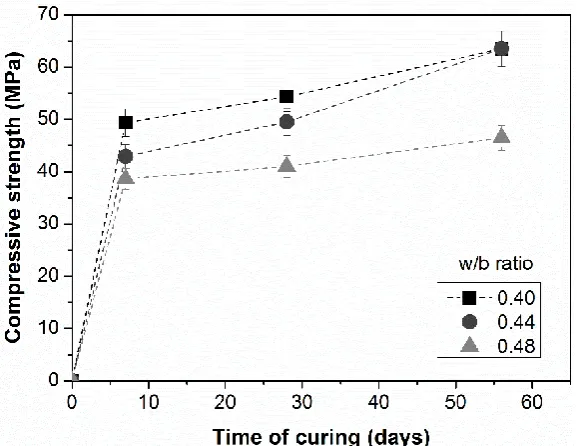
Compressive strength results for the mortars produced are shown in Figure 5. After 7 days of curing, the strength is lower in samples formulated with w/b = 0.44 and 0.48, consistent with the increased porosity identified in the binders with higher water contents. However, as reaction progresses the compressive strengths of the mortars with w/b = 0.40 and 0.44 reach comparable values, so that at advanced times of curing (56 days) these mortars exhibit similar values of strength, both around 60 MPa. The increase in the content of water in the mortars also modifies the compressive strength development of the samples, so that mortars with the highest w/b ratio tested, 0.48, do not gain significant strength between 7 and 56 days of curing, unlike the increasing trend in strength observed in specimens produced with lower water contents.
Figure 5.Compressive strength development of alkali metasilicate activated slag mortars, as a function of the water content
Despite the slightly reduced degree of reaction identified in samples formulated with w/b 0.40 compared with binders dosed with w/b 0.44 (Figure 1), the strength and microscopy data indicate that there is a coupled, but possibly indirect, relationship between structural development of the binders and the macroscopic properties of alkali-activated materials.
4. CONCLUSIONS
5. ACKNOWLEDGEMENTS
This work has been funded by the Australian Research Council, through a Linkage Project co-sponsored by Zeobond Pty Ltd, including partial funding through the Particulate Fluids Processing Centre. JLP and SAB received funding from the European Research Council under the European Union's Seventh Framework Programme (FP/2007-2013) / ERC Grant Agreement no. 335928 (GeopolyConc).
6. REFERENCES
Bellmann F., Damidot, D., Möser, B., Skibsted, J. (2010), Improved evidence for the existence of
an intermediate phase during hydration of tricalcium silicate, Cement and Concrete Research 40,
pp. 875-884.
Ben Haha M., Le Saout, G., Winnefeld, F., Lothenbach, B. (2011), Influence of activator type on hydration kinetics, hydrate assemblage and microstructural development of alkali activated
blast-furnace slags, Cement and Concrete Research 41, pp. 301-310.
Bernal S. A. & Provis, J. L. (2014), Durability of alkali-activated materials: progress and
perspectives, Journal of the American Ceramic Society 97, pp. 997-1008.
Bernal S. A., Provis, J. L., Rose, V., Mejía De Gutiérrez, R. (2013), High-resolution X-ray diffraction and fluorescence microscopy characterization of alkali-activated slag-metakaolin
binders, Journal of the American Ceramic Society 96 pp. 1951-1957.
Bernal S. A., San Nicolas, R., Myers, R. J., Mejía De Gutiérrez, R., Puertas, F., Van Deventer, J. S. J., Provis, J. L. (2014), MgO content of slag controls phase evolution and structural changes
induced by accelerated carbonation in alkali-activated binders, Cement and Concrete Research
57, pp. 33-43.
Brough A. R. & Atkinson, A. (2002), Sodium silicate-based, alkali-activated slag mortars: Part
I. Strength, hydration and microstructure, Cement and Concrete Research 32, pp. 865-879.
Bullard J. W., Jennings, H. M., Livingston, R. A., Nonat, A., Scherer, G. W., Schweitzer, J. S., Scrivener, K., Thomas, J. J. (2011), Mechanisms of cement hydration, Cement and Concrete Research 41, pp. 1208-1223.
Escalante-Garcia J., Fuentes, A. F., Gorokhovsky, A., Fraire-Luna, P. E., Mendoza-Suarez, G. (2003), Hydration products and reactivity of blast-furnace slag activated by various alkalis., Journal of the American Ceramic Society 86, pp. 2148-2153.
Famy C., Scrivener, K. L., Crumbie, A. K. (2002), What causes differences of C-S-H gel grey
levels in backscattered electron images?, Cement and Concrete Research 32, pp. 1465-1471.
Fernández-Jiménez A. & Puertas, F. (1997), Alkali-activated slag cements: Kinetic studies, Cement and Concrete Research 27, pp. 359-368.
Fernández-Jiménez A., Puertas, F., Sobrados, I., Sanz, J. (2003), Structure of calcium silicate
hydrates formed in alkaline-activated slag: Influence of the type of alkaline activator, Journal of
the American Ceramic Society 86, pp. 1389-1394.
Flatt R. J., Scherer, G. W., Bullard, J. W. (2011), Why alite stops hydrating below 80% relative
humidity, Cement and Concrete Research 41, pp. 987-992.
Kjellsen K. O. (1996), Heat curing and post-heat curing regimes of high-performance concrete:
Influence on microstructure and C-S-H composition, Cement and Concrete Research 26, pp.
295-307.
Lecomte I., Henrist, C., Liégeois, M., Maseri, F., Rulmont, A., Cloots, R. (2006),
(Micro)-structural comparison between geopolymers, alkali-activated slag cement and Portland cement,
Journal of the European Ceramic Society 26, pp. 3789-3797.
Lin F. & Meyer, C. (2009), Hydration kinetics modeling of Portland cement considering the
effects of curing temperature and applied pressure, Cement and Concrete Research 39, pp.
255-265.
Provis J. L. (2014), Geopolymers and other alkali activated materials: why, how, and what?, Materials and Structures 47, pp. 11-25.
Provis J. L. & Bernal, S. A. (2014), Geopolymers and related alkali-activated materials, Annual Reviews of Materials Research 44, pp. 299-327.
Provis J. L. & Van Deventer, J. S. 2014. Alkali Activated Materials: State-of-the-art Report,
RILEM TC 224-AAM, Springer Dordrecht.
Provis J. L. & Van Deventer, J. S. J. (2007), Geopolymerisation kinetics. 2. Reaction kinetic
modelling, Chemical Engineering Science 62, pp. 2318-2329.
Ruiz-Santaquiteria C., Skibsted, J., Fernández-Jiménez, A., Palomo, A. (2012), Alkaline
solution/binder ratio as a determining factor in the alkaline activation of aluminosilicates,
Cement and Concrete Research 42, pp. 1242-1251.
San Nicolas R., Bernal, S. A., Mejía De Gutiérrez, R., Van Deventer, J. S. J., Provis, J. L. (2014),
Distinctive microstructural features of aged sodium silicate-activated slag concretes, Cement and
Concrete Research 65, pp. 41-51.
Scrivener K. L. (2004), Backscattered electron imaging of cementitious microstructures:
understanding and quantification, Cement and Concrete Composites 26, pp. 935-945.
Shi C. 1997. Early hydration and microstructure development of alkali-activated slag cement pastes. Proceedings of the 10th International Congress on the Chemistry of Cement. Gothenburg, Sweden.
Shi C., Fernández-Jiménez, A., Palomo, A. (2011), New cements for the 21st century: The pursuit
of an alternative to Portland cement, Cement and Concrete Research 41, pp. 750-763.
Wang S.-D., Scrivener, K. L., Pratt, P. L. (1994), Factors affecting the strength of
alkali-activated slag, Cement and Concrete Research 24, pp. 1033-1043.
Wong H. S., Head, M. K., Buenfeld, N. R. (2006), Pore segmentation of cement-based materials
from backscattered electron images, Cement and Concrete Research 36, pp. 1083-1090.
Zhang Z., Olek, J., Diamond, S. (2002), Studies on delayed ettringite formation in heat-cured
mortars: II. Characteristics of cement that may be susceptible to DEF, Cement and Concrete