0022-538X/95/$04.0010
Copyrightq1995, American Society for Microbiology
Role of Mutations G-480 and C-6203 in the Attenuation
Phenotype of Sabin Type 1 Poliovirus
ADRIAN MCGOLDRICK,1ANDREW J. MACADAM,2GLYNIS DUNN,2ALISON ROWE,2
JOHN BURLISON,2PHILIP D. MINOR,2JANET MEREDITH,1DAVID J. EVANS,1
ANDJEFFREY W. ALMOND1*
School of Animal and Microbial Sciences, University of Reading, Whiteknights, Reading RG6 2AJ,1
and National Institute of Biological Standards and Control, South Mimms, Potters Bar,
Hertsfordshire EN6 3QG,2United Kingdom
Received 10 May 1995/Accepted 14 August 1995
Of the 55 point mutations which distinguish the type 1 poliovirus vaccine strain (Sabin 1) from its neurovirulent progenitor (P1/Mahoney), two have been strongly implicated by previous studies as determi-nants of the attenuation phenotype. A change of an A to a G at position 480, located within the 5*noncoding region, has been suggested to be the major attenuating mutation, analogous to the mutations at positions 481 and 472 in poliovirus types 2 and 3, respectively. In addition, the change of a U to a C at position 6203, resulting in an amino acid change in the polymerase protein 3D, has also been implicated as a determinant of attenuation, albeit to a lesser extent. To assess the contributions of these mutations to attenuation and temperature sensitivity, reciprocal changes were generated at these positions in infectious cDNA clones of Sabin 1 and P1/Mahoney. Assays in tissue culture and primates indicated that the two mutations make some contribution to the temperature sensitivity of the Sabin 1 strain but that neither is a strong determinant of attenuation.
Poliovirus, the type member of the enterovirus genus of the
Picornaviridae family, exists as three immunologically defined
serotypes (types P1, P2, and P3). The virion is composed of an icosahedral symmetric protein shell 30 nm in diameter sur-rounding a polyadenylated single-stranded messenger sense RNA genome. The genome is approximately 7,500 nucleotides long, 90% of which compose a large open reading frame en-coding a single polyprotein. The open reading frame is flanked by 59 and 39 noncoding regions of approximately 750 and 72 bases, respectively, which are involved in the control of poly-protein translation and genome replication.
Poliovirus invades and destroys neuronal cells of the central nervous system, resulting in paralytic disease. The incidence of poliomyelitis has diminished dramatically since the late 1950s following the introduction of first the Salk inactivated vaccine and subsequently the preferred Sabin live-attenuated vaccine (24, 25). Use of the Sabin vaccines, however, carries a small risk of disease caused by reversion of the vaccine virus to a neurovirulent phenotype. It has been reported that all three attenuated serotypes of poliovirus undergo genetic reversion to some extent in vaccinees from as few as 24 h postvaccination (3, 13) and that this results in a small number of cases of poliomyelitis, either in the vaccinees themselves or in their close contacts (7, 17, 29). The propensity to undergo reversion seems to vary among the three serotypes of virus constituting the live-attenuated vaccine, with the type 3 virus being most fre-quently associated with disease in vaccinees and type 1 the least. To improve the safety of the Sabin vaccine strains, it would be desirable to develop vaccine strains with reduced capacities to revert to neurovirulence upon passage through the human gut. An important step to this end is the elucidation of the molecular basis of attenuation phenotypes in the existing strains. Comparison of the nucleotide sequences of the
atten-uated Sabin strains and their virulent progenitors revealed that in all cases, only a small number of point mutations have occurred in the derivation of the vaccine strains (15, 20, 27). For Sabin types 2 and 3, the vaccine strains differ from their progenitors by 23 and 11 mutations, respectively, and there is evidence in both cases that attenuation is determined by just 2 or 3 of these (4, 11, 12, 20, 22, 31, 32). For type 1, the atten-uated strain (Sabin 1) and its virulent progenitor strain, P1/ Mahoney, differ by 55 point mutations which are distributed throughout the genome and give rise to 21 amino acid substi-tutions (15). The higher number of mutations than in type 2 and type 3 strains may contribute to the relative genetic sta-bility of the type 1 strain (13).
Previous studies on type 1 strains have included the analysis of P1/Sabin-Mahoney recombinants and site-directed mutants of both strains in both monkeys and transgenic mice expressing the human poliovirus receptor. Studies have also been carried out in nontransgenic mice with virus strains that have been adapted for growth in such mice by alterations in the BC loop of VP1 (30). These studies have suggested that no single mu-tation is responsible for the full attenuated phenotype, but major determinants are located within domain V of the 59 noncoding region at nucleotide (nt) 480 (Fig. 1) and at nt 6203, within the region encoding the 3D polymerase protein (2, 6, 8, 14, 16, 18, 30). To verify and further quantify the contributions of these mutations to attenuation, reciprocal base changes at these locations were generated by site-directed mutagenesis within infectious Sabin 1 and P1/Mahoney cDNA clones. In contrast to previous conclusions, our experiments indicate that G-480 and C-6203 do not make major contributions to the attenuated phenotype of Sabin 1.
MATERIALS AND METHODS
Cells and viruses.Monolayers of HEp2c cells were grown as described by Macadam et al. (11). Virus propagation and RNA extraction for sequencing were done as described by Macadam et al. (9).
* Corresponding author. Phone: 44 1734 318902. Fax: 44 1743 316671. Electronic mail address: [email protected]
7601
on November 9, 2019 by guest
http://jvi.asm.org/
Construction of infectious clones of Sabin 1 and P1/Mahoney.The construc-tion of full-length cDNAs of the genomes of Sabin 1 (P1/LS-c,2ab) and P1/ Mahoney has been described previously (21, 28). The Sabin 1 cDNA sequence in plasmid pOLIO 1 was subcloned and placed under the control of a T7 promoter, and a unique MluI site was engineered at the 39end immediately downstream of the poly(A) tract. The resultant clone was designated pT7/Sabin1. The derivation of pT7/S1F from pT7/Sabin1 is described below (Results). The P1/Mahoney cDNA in plasmid pVR106 (21) was subcloned in a similar way to generate pT7/Mahoney.
Construction and recovery of site-directed mutations.Plasmids were grown in
Escherichia coli MC1061 and purified by cesium chloride gradient centrifugation.
Restriction endonuclease digestions and DNA ligations were carried out as recommended by the manufacturer (Promega). Restriction fragments were pu-rified from 1% agarose gels with Prep-A-Gene (Bio-Rad). Mutagenesis of nt 480 was carried out with oligonucleotides 20 bases in length on 2.5-kb fragments (EcoRI [nt 10076]-NheI [nt 2470]) of pT7/S1F or pT7/Mahoney, subcloned into the M13pMD16 vector, with the Mutagene in vitro mutagenesis Kit (Bio-Rad). After verification by sequencing, the mutated fragments were reintroduced into the full-length infectious clones at the same sites.
Mutagenesis of nt 6203 was carried out with oligonucleotides 20 bases in length on a 2.5-kb fragment (MluI [nt 7467]-NcoI [nt 4911]) subcloned into M13pMD16. The mutated fragments were reintroduced into Sabin 1 or Ma-honey clones, after being verified by sequencing, at the unique MluI and BglII (nt 5601) sites. Constructs mutated at either nt 480 or nt 6203 were initially screened with restriction endonucleases AvaI and BsiHKA (HgiAI), respectively. Substi-tution of a G for an A, in S1F, at nt 480 removes an AvaI site, and the substiSubsti-tution of a C for a T, in S1F, at nt 6203 removes an HgiAI site. Those constructs which screened correctly were then sequenced by the Sequenase version 2 protocol (United States Biochemical).
Viruses were recovered by transfection of HEp2c monolayers with T7 RNA transcripts at 348C (11) from plasmids linearized with MluI. After one passage, RNA was extracted and sequenced to verify changes at nt 480 and/or 6203 (11).
Temperature sensitivity (Rct phenotype).Temperature sensitivity was assayed by plaque formation on BGM cells (derived from African green monkey kidney cells) at different temperatures as described by Macadam et al. (10).
Neurovirulence.Viruses were assayed by intraspinal inoculation of cynomol-gus macaques by the standard World Health Organization approved test for vaccine safety (33) except that fewer animals were used per virus.
RESULTS
Infectious clones of P1/LS-c,2ab. The construction of the infectious clone of P1/LS-c,2ab (recloned and designated pT7/ Sabin1 in this study) has been described previously (28). The complete nucleotide sequence of this clone was determined and compared with that of the Sabin 1 cDNA clone [pVS(1)IC-0] constructed by Nomoto and colleagues (15). At positions where the two sequences differed, the sequence of the P1/LS-c,2ab vaccine virus RNA was also determined (Table 1). The two clones differed at three nucleotide positions in the coding region, two of which (nt 5350 and 6187) did not affect the amino acid sequence. However, the G in the pT7/Sabin1 clone at nt 2749 resulted in an Ile-to-Met change in VP1 at position 90 (1090), the methionine residue being the same as that present in the P1/Mahoney genome. In the 59 noncoding re-gion, pT7/Sabin1 was found to have an extra T residue between nucleotides 22 and 23 compared with the other sequences. Nt 26 of pT7/Sabin1 was a G, as originally reported for Sabin 1 clone pVS(1)IC-0 (15), and not an A, as published in the GenBank database (accession number V01133). However, vac-cine stocks were found to have an A at this position. In the 39
noncoding region, pT7/Sabin1 differed from all other se-quences at nt 7395 (Table 1).
Virus recovered from pT7/Sabin1 gave smaller plaques and was more temperature sensitive and attenuated than reference stocks of the type 1 vaccine strain (results not shown). Conse-quently, the cDNA clone was mutated at the three positions thought likely to determine these differences from the original phenotype. The resulting clone, designated pT7/S1F, had an A at nt 2749 and a G at nt 7395 (like the vaccine strain RNA), and the T insertion between nt 22 and 23 in pT7/Sabin1 was deleted (Table 1). The virus recovered from pT7/S1F was in-distinguishable from the type 1 vaccine strain reference stocks (Tables 2 and 3). Analysis of intermediate mutants differing at only nt 22/23, 2749, or 7395 showed that phenotypic differences between the viruses recovered from the pT7/Sabin1 and pT7/ S1F clones were due to substitutions at both nt 2749 and 7395 (results not shown). The insertion at nt 22 had no detectable effect.
Reversion of G-480 and C-6203 in a Sabin 1 background.
Previous studies have suggested that of the 55 nucleotide dif-ferences between the virulent progenitor P1/Mahoney and the attenuated Sabin type 1 strain P1/LS-c,2ab, the A-to-G change at nt 480 is a significant determinant of attenuation (2, 6, 8, 14, 16, 18). In addition, the U-to-C change at nt 6203, resulting in a Tyr-to-His substitution at amino acid 73 of polymerase pro-tein 3D, has been implicated, albeit to a lesser degree (2, 30). Although there is evidence that other mutations contribute to the attenuation phenotype of P1/LS-c,2ab, the identity of these and the relative contributions that they make have not been precisely defined. It was therefore of interest to assess the relative contributions of G-480 and C-6203 by backmutating them in the pT7/S1F clone to the P1/Mahoney-like A and U, respectively.
The neurovirulence results for strain S1F/480A, which had the Mahoney-like A at nt 480 but was otherwise Sabin-like,
[image:2.612.315.555.93.168.2]FIG. 1. Predicted RNA secondary structure of the base of stem-loop V located within the 59noncoding region (adapted from Skinner et al. [26]).
TABLE 1. Sequence differences between Sabin 1 cDNA clones and vaccine strain RNAa
Nucleotide pVS(1)IC-0 pT7/Sabin 1 pT7/S1F Vaccine strain RNA
22/23 No insert T inserted No insert No insert
26 A G G A
2749 A (1090Ib) G (1090M) A (1090I) A (1090I)
5350 T C C U
6187 T C C U
7395 G T G G
aSequences are identical to that of pVS(1)IC-0 except at the positions
indi-cated. Note that pVS(1)IC-0 differs from the published Sabin 1 sequence (15) (GenBank accession number V01133) at nt 26 (A to G), 355 (U to C), and 6734 (G to A) (5, 7, 29).
[image:2.612.317.555.625.718.2]b1090I, VP1 at position 90 Ile.
TABLE 2. Neurovirulence of vaccine, wild-type, and recombinant strains
Virus No. of animals with
paralysis/no. tested Mean lesion score
Sabin 1a 0/4 0.56
S1F 0/6 0.63
S1F/480A 1/4 0.92
S1F/6203U 1/3 0.86
S1F/480A/6203U 1/4 0.94
M1/480G/6203C 4/4 2.37
P1/Mahoneya 4/4 2.50
a
Results from previous tests (2).
on November 9, 2019 by guest
http://jvi.asm.org/
indicated that backmutation at this position led to only a small increase in virulence. This virus had an average lesion score of 0.92, with a range of 0.77 to 1.13, whereas for S1F, the scores ranged from 0.25 to 1.07, with an average of 0.63. Paralysis was observed in one of four monkeys inoculated with S1F/480A, whereas no paralysis was observed in animals inoculated with strain S1F (Table 2).
Introduction of the P1/Mahoney-like U at nt 6203 into the S1F genome (in strain S1F/6203U [Table 2]) resulted in an amino acid reversion of His to Tyr at position 73 within the 3D polymerase gene. On the basis of clinical effect, this reversion appeared to increase virulence, since paralysis was observed in one of three monkeys inoculated with strain S1F/6203U, whereas no paralysis was observed in animals inoculated with strain S1F (Table 2). However, the lesion scores showed only minor differences; for strain S1F/6203U, scores ranged from 0.28 to 1.39, with an average of 0.86, whereas for S1F, the scores ranged from 0.25 to 1.07, with an average of 0.63. Thus, on the basis of histopathology, the backmutation of nt 6203 had only a small effect on the attenuation phenotype. Further-more, clinical and mean lesion scores for S1F/480A/6203U were not statistically different from those for S1F/480A (Table 2). Thus, a total of eight animals were inoculated with viruses in which the nucleotide at 480 was an A. These gave an aggre-gate clinical score of two of eight animals showing paralysis and a mean lesion score of 0.93. In view of these unexpected re-sults, RNA was extracted from batches of inoculum of the site-directed mutant viruses, and the nucleotides at 480 and 6203 were determined again. In all cases, these were found to be correct.
The lesion scores for the S1F/480A/6203U virus were well below those typical of P1/Mahoney (Table 2) and other viru-lent polioviruses (2, 4, 11–14, 16, 18, 20). Thus, backmutation at these two positions in Sabin 1 in vivo would be insufficient to cause reversion to full virulence.
Mutation of nt 480 and 6203 in P1/Mahoney.The results described above prompted us to examine the effects of recip-rocal changes in P1/Mahoney. Neurovirulence assays were therefore also carried out on a mutant of P1/Mahoney in which Sabin-like nucleotides had been introduced at positions 480 and 6203. The sequence of this virus (M1/480G/6203C) was verified at the RNA level prior to neurovirulence testing. The virus caused paralysis in all animals within 4 days, so the clin-ical signs were similar to those of P1/Mahoney (Table 2). M1/480G/6203C had lesion scores with a mean of 2.37, again similar to the mean lesion score of 2.5 for P1/Mahoney (Table 2). Thus, these two Sabin 1-specific mutations at nt 480 and 6203 together exerted no apparent influence on neuroviru-lence, consistent with the results above showing that backmu-tation at nt 480 and 6203 in S1F had little effect on attenuation.
Temperature sensitivity.P1/LS-c,2ab (Sabin 1) and P1/Ma-honey display differences in biological properties other than neurovirulence, some of which have been used as in vitro markers to monitor the quality of new batches of vaccine prior to monkey neurovirulence assays. Studies on the genetic de-terminants of these biological differences have demonstrated that only temperature sensitivity (the Rct marker), the deter-minants for which seemed to be scattered throughout the ge-nome, correlated to some extent with attenuation (16, 18). Sensitivity of virus replication to elevated temperatures (Rct2) is common to all vaccine strains, but the molecular basis of this phenotype in Sabin 1 is only partly understood. We therefore assessed the contributions of the mutations at nt 480 and nt 6203 to the Rct phenotype. These were analyzed by compari-son of growth properties of site-specific mutant strains with those of parental P1/Mahoney and Sabin 1 strains at several
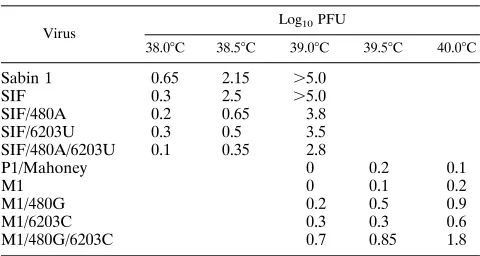
temperatures. Plaque assays in BGM cells were carried out at least twice for each virus, and mean values are shown in Table 3.
The phenotypes of viruses recovered from infectious clones pT7S1F and pT7/Mahoney were indistinguishable from those of the reference Sabin 1 and P1/Mahoney strains in terms of temperature sensitivity (Table 3) and plaque size (not shown). Mutations at nt 480 and 6203 both contributed to the temper-atusensitive phenotype of Sabin 1, as illustrated by the re-sults for S1F, S1F/480A, and S1F/6203U at 38.58C. The titers of Sabin 1 and S1F were reduced by more than 2.0 log10at
38.58C, whereas those of the single-point mutants were re-duced by less than 1.0 log10at this temperature. However, the
titers of S1F/480A/6203U were reduced by more than 2.5 log10
at 39.08C, whereas those of P1/Mahoney were hardly affected by temperatures of up to 40.08C, so other temperature sensi-tivity determinants must be present in the rest of the Sabin 1 genome. A similar conclusion is reached by comparison of the results for M1/480G/6203C with those for S1F at 39.08C.
Neither a G at 480 nor a C at 6203 appeared to determine temperature sensitivity when incorporated alone into a Ma-honey genomic background. However, the effects of the G-480 and C-6203 mutations were apparently synergistic, since strain M1/480G/6203C was slightly more temperature sensitive than P1/Mahoney at 40.08C. These results are consistent with those of Tardy-Panit et al. (30), who found that a C-to-U substitution at nt 6203 in a Sabin 1 3D polymerase genomic background reduced temperature sensitivity, whereas a U-to-C change at nt 6203 in a Mahoney background had no measurable effect. These authors also found that the effects of mutations at nt 480 and 6203 were additive.
Thus, G-480 and C-6203 do not appear to be strong deter-minants of the Rct phenotype, and it is clear that another temperature-sensitive mutation(s) must exist to account for the full Rct phenotype of the Sabin type 1 vaccine strain. Such mutations may also contribute to attenuation.
DISCUSSION
[image:3.612.315.555.90.218.2]The rarity of type 1 vaccine-associated cases of poliomyelitis compared with those of type 2 and type 3 indicates that the attenuation phenotype of the Sabin 1 strain is comparatively stable. This is probably due to a greater number of genetic determinants of attenuation in this strain. It is noteworthy that there are 55 nucleotide differences between the Sabin 1 vaccine strain and its neurovirulent progenitor, P1/Mahoney (15), whereas there are fewer differences between the corresponding type 2 and 3 strains (20 and 27, respectively). A previous study
TABLE 3. Temperature sensitivity of vaccine, wild-type, and recombinant virusesa
Virus
Log10PFU
38.08C 38.58C 39.08C 39.58C 40.08C
Sabin 1 0.65 2.15 .5.0
SIF 0.3 2.5 .5.0
SIF/480A 0.2 0.65 3.8
SIF/6203U 0.3 0.5 3.5
SIF/480A/6203U 0.1 0.35 2.8
P1/Mahoney 0 0.2 0.1
M1 0 0.1 0.2
M1/480G 0.2 0.5 0.9
M1/6203C 0.3 0.3 0.6
M1/480G/6203C 0.7 0.85 1.8
a
Values represent log10(PFU @ 358C/PFU @ T8C).
on November 9, 2019 by guest
http://jvi.asm.org/
of the neurovirulence of recombinants between Sabin 1 and P1/Mahoney in primates (8, 14, 18) supported the conclusion that there are multiple determinants of attenuation, in that all genomic regions recombined into a P1/Mahoney strain appar-ently contained attenuating determinants, the strongest of which was in the 591,122 nt. Further analysis by Kawamura and colleagues (8) suggested that the G at nucleotide 480 was the principal attenuating determinant in this region, although other mutations also contributed. A role for the mutation at nucleotide 480 was also suggested by the observation that a U-to-C mutation at nt 525 in combination with a G-to-A mu-tation at nt 7441 increased the neurovirulence of Sabin 1 to a lesion score of approximately half of that of P1/Mahoney (2). The C at nt 525 is presumed to compensate for the presence of G-480 by restoring base-pairing in the stem-loop structure depicted in Fig. 1. Further studies in transgenic mice express-ing the human poliovirus receptor (6) with the same constructs that were tested in monkeys (8) again identified determinants of attenuation in all genomic regions of Sabin 1 when recom-bined into a P1/Mahoney background. Strong determinants were again found in the 591,122 nt, but further analysis of this region suggested that the contribution of nt 480 to neuroviru-lence may have been overestimated by previous work. In ad-dition, the study by Christodoulou and colleagues (2) sug-gested that a further mutation at nt 6203 (C to U), when included with the nt 525 and 7441 mutations, conferred a fully virulent phenotype on the virus. However, this conclusion was at variance with the previous suggestions that there are a large number of attenuating determinants. It may be significant that the strain on which this conclusion was based was not se-quenced in its entirety, and it is therefore possible that other backmutations and/or suppressor mutations could have been present (2). Moreover, the recent results of Bouchard et al. (1) did not reveal any attenuation determinants in the 3D poly-merase gene when Sabin 1/Mahoney recombinants similar to those discussed above were used in a different transgenic mouse line. This study did not address the contribution of the 59noncoding region to virulence. In a third study, both G-480 and C-6203 were found to attenuate the virulence of a mouse-adapted variant of Mahoney in nontransgenic mice (30), al-though the importance of the contributions of these changes to the attenuation of Sabin 1 could not be assessed because a mouse-adapted Sabin 1 strain was not tested.
In an attempt to verify the conclusions concerning the roles of the nt 480 and nt 6203 mutations, we used site-directed mutagenesis to generate mutants of Sabin 1 and P1/Mahoney with reciprocal nucleotide changes at these positions, followed by neurovirulence testing in primates. In contrast to previous findings, our results indicated that backmutation of the G at nt 480 in Sabin 1 to the P1/Mahoney-like A resulted in only a slight increase in virulence. Moreover, backmutation at nt 6203 in this strain had little further effect on the level of neuroviru-lence, as shown by the results for the double backmutant S1F/ 480A/6203U. Interestingly, both G-480 and C-6203 are se-lected against in vivo (5, 13, 19). However, consistent with the results reported here, these reversions did not correlate with increased virulence of vaccine batches (23). In support of the above observations, the introduction of the G-480 and C-6203 mutations together into P1/Mahoney did not have a significant attenuating effect.
In view of the consistency of the results obtained for the reciprocal Sabin 1 and P1/Mahoney constructs in this study, the discrepancy between our results and those published previ-ously is unlikely to be due to genetic variation in our stocks of virus. Moreover, we are satisfied that our cDNA clone, pS1F, has a sequence which produces virus that is phenotypically
indistinguishable from the Sabin 1 reference stocks. All rele-vant studies of the genetic basis of attenuation of Sabin 1 have demonstrated a measurable effect on virulence of a G-to-A mutation at nt 480 in a Sabin 1 background (2, 6, 8; this study), although the relative strength of the effect differed. These differences are unlikely to reflect the animal models used, since the biggest difference was between two studies with the pri-mate model (this study and that of Kawamura et al. [8]). This difference is hard to explain at present. The importance of C-6203 to the attenuation phenotype of Sabin 1 has also been variously estimated as nonexistent (1), weak (30; this study), and intermediate (2), although the last study used less well characterized strains and the other studies used different mod-els.
The results presented here are based on the intraspinal inoculation of cynomolgus macaques by the standard test for vaccine safety (33) except that fewer animals were used per virus. Although some animal-to-animal variation is observed, this test has proved sufficiently responsive in our hands to identify the determinants of attenuation in the Sabin 2 and Sabin 3 strains (20, 32). Moreover, the test consistently distin-guishes between viruses of high neurovirulence, such as P3/ Leon and P1/Mahoney (lesion scores typically.2.2), and vi-ruses of intermediate neurovirulence containing only a single major determinant of attenuation, such as SV3/L (32) and P117/S59(20) (lesion scores typically;1.5) and Sabin vaccine strains (lesion scores usually,0.7). The test does not readily distinguish slight differences between highly virulent strains and can only distinguish differences between highly attenuated strains with the use of larger numbers of animals and concur-rent testing of a reference strain. The conclusions presented here are based on the ability to identify, using a smaller num-ber of animals than in vaccine safety tests, attenuation deter-minants similar in effect to those observed in Sabin types 2 and 3. We are confident that if G-480 and C-6203 had contributed significantly to attenuation, this would have been revealed by our experiments, in which reciprocal constructs were exam-ined.
Mutations G-480 and C-6203 were found to determine only a weak temperature-sensitive phenotype in P1/Mahoney, ei-ther individually or in combination, and the backmutations in Sabin 1 produced only a small reduction in temperature sen-sitivity. In this regard, our conclusions were similar to those drawn from other studies (2, 8, 23, 30). These slight effects are probably sufficient to account for the selection against both G-480 and C-6203 at elevated temperatures in vitro (2, 23).
Identification of the precise genetic basis of the attenuation of Sabin 1 has proved more difficult than that for type 2 (11, 12, 20, 22) and type 3 (4, 31, 32) vaccine strains. This possibly relates to the greater genetic differences between the virulent parent and the vaccine strain. In addition, unlike the situation for types 2 and 3, in vivo revertant strains of type 1 are un-available for analysis. Clearly, attenuation determinants exist elsewhere in the Sabin 1 genome, possibly in the structural proteins (2, 19) and/or other positions in the 59 noncoding region (6, 8, 14, 18). The results presented here underline the need for further genetic analysis of Sabin 1.
REFERENCES
1. Bouchard, M. J., D.-H. Lam, and V. R. Racaniello. 1995. Determinants of attenuation and temperature sensitivity in the type 1 poliovirus Sabin vac-cine. J. Virol. 69:4972–4978.
2. Christodoulou, C., F. Colbere Garapin, A. Macadam, L. F. Taffs, S.
Mars-den, P. D. Minor, and F. Horaud.1990. Mapping of mutations associated with neurovirulence in monkeys infected with Sabin 1 poliovirus revertants selected at high temperature. J. Virol. 64:4922–4929.
3. Dunn, G., N. T. Begg, N. Cammack, and P. D. Minor. 1990. Virus excretion and mutation by infants following primary vaccination with live oral
on November 9, 2019 by guest
http://jvi.asm.org/
vaccine from two sources. J. Med. Virol. 32:92–95.
4. Evans, D. M., G. Dunn, P. D. Minor, G. C. Schild, A. J. Cann, G. Stanway,
J. W. Almond, K. Currey, and J. V. Maizel, Jr.1985. Increased neuroviru-lence associated with a single nucleotide change in a noncoding region of the Sabin type 3 poliovaccine genome. Nature (London) 314:548–550. 5. Furione, M., S. Guillot, D. Otelea, J. Balanant, A. Candrea, and R. Crainic.
1993. Polioviruses with natural recombinant genomes isolated from vaccine-associated paralytic poliomyelitis. Virology 196:199–208.
6. Horie, H., S. Koike, T. Kurata, Y. Sato-Yoshida, I. Ise, Y. Ota, S. Abe, K.
Hioke, H. Kato, and C. Taya.1994. Transgenic mice carrying the human poliovirus receptor: new animal model for study of poliovirus neuroviru-lence. J. Virol. 68:681–688.
7. Joce, R., D. Wood, D. Brown, and N. Begg. 1992. Paralytic poliomyelitis in England and Wales, 1985–91. Br. Med. J. 305:79–82.
8. Kawamura, N., M. Kohara, S. Abe, T. Komatsu, K. Tago, M. Arita, and A.
Nomoto.1989. Determinants in the 59noncoding region of poliovirus Sabin 1 RNA that influence the attenuation phenotype. J. Virol. 63:1302–1309. 9. Macadam, A. J., C. Arnold, J. Howlett, A. John, S. Marsden, F. Taffs, P.
Reeve, N. Hamada, K. Wareham, J. W. Almond, and P. D. Minor.1989. Reversion of the attenuated and temperature-sensitive phenotypes of the Sabin type 3 strain of poliovirus in vaccinees. Virology 172:408–414. 10. Macadam, A. J., G. Ferguson, J. Burlison, D. Stone, R. Skuce, J. W. Almond,
and P. D. Minor.1992. Correlation of RNA secondary structure and atten-uation of Sabin vaccine strains of poliovirus in tissue culture. Virology
189:415–422.
11. Macadam, A. J., S. R. Pollard, G. Ferguson, G. Dunn, R. Skuce, J. W.
Almond, and P. D. Minor. 1991. The 59noncoding region of the type-2 poliovirus vaccine strain contains determinants of attenuation and temper-ature sensitivity. Virology 181:451–458.
12. Macadam, A. J., S. R. Pollard, G. Ferguson, R. Skuce, D. Wood, J. W.
Almond, and P. D. Minor.1993. Genetic basis of attenuation of the Sabin type-2 vaccine strain of poliovirus in primates. Virology 192:18–26. 13. Minor, P. D., A. Macadam, N. Cammack, G. Dunn, and J. W. Almond. 1990.
Molecular biology and the control of viral vaccines. FEMS Microbiol. Im-munol. 64:207–213.
14. Nomoto, A., N. Kawamura, M. Kohara, and M. Arita. 1989. Expression of the attenuation phenotype of poliovirus type 1, p. 297–305. In B. L. Semler and E Ehrenfeld (ed.), Molecular aspects of picornavirus infection and detection. American Society for Microbiology, Washington, D.C. 15. Nomoto, A., T. Omata, H. Toyoda, S. Kuge, H. Horie, Y. Kataoka, Y. Genba,
Y. Nakano, and N. Imura.1982. Complete nucleotide sequence of the at-tenuated poliovirus Sabin 1 strain genome. Proc. Natl. Acad. Sci. USA
79:5793–5797.
16. Nomoto, A., and E. Wimmer. 1987. Genetic studies of the antigenicity and the attenuation phenotype of poliovirus, p. 107–134. In W. C. Russell and J. W. Almond (ed.), Molecular basis of virus disease. Cambridge University Press, Cambridge.
17. Ogra, P. L., H. S. Faden, R. Abraham, L. C. Duffy, M. Sun, and P. D. Minor. 1991. Effect of prior immunity on the shedding of virulent revertant virus in feces after oral immunization with live attenuated poliovirus vaccines. J. Infect. Dis. 164:191–194.
18. Omata, T., M. Kohara, S. Kuge, T. Komatsu, S. Abe, B. L. Semler, A.
Kameda, H. Itoh, M. Arita, E. Wimmer, and A. Nomoto.1986. Genetic analysis of the attenuation phenotype of poliovirus type 1. J. Virol. 58:348– 358.
19. Otelea, D., S. Guillot, M. Furione, A. A. Combiescu, J. Balanant, A. Candrea,
and R. Crainic.1993. Genomic modifications in naturally occurring neuro-virulent revertants of Sabin 1 polioviruses. Dev. Biol. Stand. 78:33–38. 20. Pollard, S. R., G. Dunn, N. Cammack, P. D. Minor, and J. W. Almond. 1989.
Nucleotide sequence of a neurovirulent variant of the type 2 oral poliovirus vaccine. J. Virol. 63:4949–4951.
21. Racaniello, V. R., and D. Baltimore. 1981. Cloned poliovirus complementary DNA is infectious in mammalian cells. Science 214:916–919.
22. Ren, R., E. G. Moss, and V. R. Racaniello. 1991. Identification of two determinants that attenuate vaccine-related type 2 poliovirus. J. Virol. 65: 1377–1382.
23. Rezapkin, G. V., K. M. Chumakov, Z. Lu, Y. Ran, E. M. Dragunsky, and I. S.
Levenbook.1994. Microevolution of Sabin 1 strain in vitro and genetic stability of poliovirus vaccine. Virology 202:370–378.
24. Sabin, A. B. 1965. Oral poliovirus vaccine. JAMA 194:872–876.
25. Salk, J. E., U. Krech, J. S. Younger, B. L. Bennett, L. J. Lewis, and P. L.
Bazeley.1954. Formaldehyde treatment and safety testing of experimental poliomyelitis vaccines. Am. J. Public Health 44:563.
26. Skinner, M. A., V. R. Racaniello, G. Dunn, J. Cooper, P. D. Minor, and J. W.
Almond.1989. New model for the secondary structure of the 59non-coding RNA of poliovirus is supported by biochemical and genetic data that also show that RNA secondary structure is important in neurovirulence. J. Mol. Biol. 207:379–392.
27. Stanway, G., P. J. Hughes, R. C. Mountford, P. Reeve, P. D. Minor, G. C.
Schild, and J. W. Almond.1984. Comparison of the complete nucleotide sequence of the genomes of the neurovirulent poliovirus P3/Leon/37 and its attenuated Sabin vaccine derivative P3/Leon 12a1b. Proc. Natl. Acad. Sci. USA 81:1539–1543.
28. Stanway, G., P. J. Hughes, G. D. Westrop, D. M. Evans, G. Dunn, P. D.
Minor, G. C. Schild, and J. W. Almond.1986. Construction of poliovirus intertypic recombinants by use of cDNA. J. Virol. 57:1187–1190. 29. Sutter, R. W., P. A. Patriarca, S. Brogan, P. G. Malankar, M. A. Pallansch,
O. M. Kew, A. G. Bass, S. L. Cochi, J. P. Alexander, D. B. Hall, A. J. M. Suleiman, A. A. K. Alghassany, and M. S. Elbualy.1991. Outbreak of paralytic poliomyelitis in Oman—evidence for widespread transmission among fully vaccinated children. Lancet 338:715–720.
30. Tardy-Panit, M., B. Blondel, A. Martin, F. Tekaiu, F. Horaud, and F.
Delpey-roux.1993. A mutation in the RNA polymerase of poliovirus type 1 contrib-utes to attenuation in mice. J. Virol. 67:4630–4638.
31. Weeks-Levy, C., J. M. Tatem, S. J. DiMichele, W. Waterfield, A. F. Georgiu,
and S. J. Mento.1991. Identification and characterisation of a new base substitution in the vaccine strain of Sabin 3 poliovirus. Virology 185:934–937. 32. Westrop, G. D., K. A. Wareham, D. M. Evans, G. Dunn, P. D. Minor, D. I.
Magrath, F. Taffs, S. Marsden, M. A. Skinner, G. C. Schild, and J. W. Almond.1989. Genetic basis of attenuation of the Sabin type 3 oral polio-virus vaccine. J. Virol. 63:1338–1344.
33. World Health Organization. 1990. Requirements for poliomyelitis vaccine (oral). W. H. O. Tech. Rep. Ser. 800:30–65.