This is a repository copy of Mesolithic Northern England : Environment, Population and
Settlement.
White Rose Research Online URL for this paper:
http://eprints.whiterose.ac.uk/134018/
Version: Submitted Version
Book:
Spikins, Penny orcid.org/0000-0002-9174-5168 (2000) Mesolithic Northern England :
Environment, Population and Settlement. British Archaeological Reports British Series .
Archaeopress , Oxford .
[email protected] https://eprints.whiterose.ac.uk/ Reuse
Items deposited in White Rose Research Online are protected by copyright, with all rights reserved unless indicated otherwise. They may be downloaded and/or printed for private study, or other acts as permitted by national copyright laws. The publisher or other rights holders may allow further reproduction and re-use of the full text version. This is indicated by the licence information on the White Rose Research Online record for the item.
Takedown
If you consider content in White Rose Research Online to be in breach of UK law, please notify us by
Population and Adaptation
During the Mesolithic period of Western Europe a number of ongoing processes is manifest. These achieve their full expression in the latter half of the period when we observe an increase in population
(Constandse-Westermann and Newell 1984), an increase in territoriality, border maintenance, and in the number of social units... These changes correspond to the progression towards the tribal level of social organisation for some, if not most Mesolithic societies.
Newell and Constandse-Westermann (1986a: 295)
A
BSTRACT
C
HAPTERO
NE2
In this volume, we will be focusing on the concept of gradual population increase throughout the Mesolithic, as an example of one of the most commonly accepted generalisations associated with Mesolithic populations. A discussion, essentially a critique, of the concept of population increase forms the ‘core’ of the volume. However, it is hoped that by addressing in detail the different lines of evidence and types of interpretations which contribute to this concept, we will also reveal the weaknesses in many of our preconceptions about Mesolithic societies. Building on the problems defined, it is hoped to view Mesolithic societies with a new perspective, and to suggest possible new approaches to interpretations.
Gradual population increase is often seen as one of the common adaptations that become evident in the Mesolithic, apparently related to changing environmental conditions. Thus in this chapter the role of the concept of adaptations, in particular the common adaptations which appear to unite almost all Mesolithic societies, in structuring our interpretations of the Mesolithic is briefly discussed. Gradual population increase is introduced in the context of these accepted adaptations, and within its broader context as a common preconception brought to bear on hunter-gatherer societies. The background to interpretations of gradual population increase in the study region – northern England – is also outlined.
C
OMMON
A
DAPTATIONS
The idea of adaptation, that is, ‘the fact, act, process or result of adapting (to adapt – to make fit or suitable): ...
adjustment’ 1became important within archaeology through
perspectives brought in by the New Archaeology and in particular through cultural ecology (Trigger 1989: 294-303; Kelly 1995: 41-50). Discussions of adaptations have often been associated with a narrow environmentally deterministic standpoint, through which environmental characteristics determine aspects of society – such as population densities and settlement structures. Thus, at an extreme, the cultural ecological approach to adaptation viewed almost all cultural changes as adaptations to environmental change, and as such, culture as largely predictable by environment. However, today most Mesolithic researchers tend to interpret adaptation in its broader sense, as an adjustment to both environmental and social changes. In this sense, for example, the rise of social complexity in the Mesolithic is often seen as an adaptation, but to factors such as increasing population stress or a demand for certain goods rather than directly to a specific environmental change.
Any adaptation, such as, for example, an increased consumption of shellfish, when other coastal resources become scarce – perhaps due to environmental changes or overexploitation, may be very locally specific. However, common adaptations play a particularly important role in the study of the Mesolithic. Broadly speaking, common adaptations are essentially widespread changes in aspects of society – population or settlement for example – which appear to be related to changes in common social or environmental contexts. Of these, changes in the exploitation of resources (specifically an apparent diversification and specialisation of the resource base), gradual population increase, and rising social complexity are the three main themes.
One reason why these common adaptations are an important area for Mesolithic studies is straightforward – the Early Holocene was a time of significant environmental changes, such that an obvious focus of study becomes the common response of human societies to widespread changes.
However, there is also a much more complicated reason why common adaptations play such a key role. The roots of this explanation lie in common perceptions of Mesolithic research as a discipline. Essentially, a paucity of distinctive Mesolithic material culture or achievements (with diminutive microliths often seen as an appropriate symbol of the period, Clark 1978:3) has been widely acknowledged as leading to a poor public perception of the Mesolithic for some time (Zvelebil 1986; Rowley-Conwy 1986). Price thus described the wider academic perspective of the Mesolithic in late 80s as having a ‘certain disregard for the period as one of
relatively little importance’ (1987: 229). Paradoxically, this poor popular perception of the period has generated a certain atmosphere of camaraderie amongst researchers within the discipline, which whilst promoting much collaborative work
has also led to a certain lack of criticism of accepted ideas. On the other hand however, it has also resulted in a search for what might be distinctive about the Mesolithic, and a resultant emphasis on adaptations to environmental changes as a major distinguishing feature of the period. Newell even suggests that the Mesolithic itself be defined as an
‘adaptation ... to the rapid ecological changes which marked
the Pleistocene-Holocene boundary’ (1984: 71). Thus, in many respects, the very identity of the Mesolithic as a period could be said to be built upon the common adaptations of Mesolithic societies.
As a common adaptation, population increase sits between changes in the exploitation of resources, and an increase in social complexity (for many, not only thematically, but also causally). Both changes in resource exploitation and the rise of social complexity have been discussed in detail elsewhere (Price and Brown 1985; Zvelebil 1986; Rowley-Conwy 1983; 1984; 1986; Rowley-Conwy and Zvelebil 1989; Mithen 1990). The former is typified by the notion of a diversification of the resource base (to include a range of avian and aquatic resources (Binford 1968: 317), including inland fish (LeGall 1996), as well as an increased range of plant foods (Zvelebil 1994). However, with rising sea-levels submerging what might exist of previous evidence for marine exploitation, the precise timing of such a diversification is difficult to define. Likewise, evidence for more specialised exploitation may also be affected by a lack of previous evidence. The evidence for rising social complexity, in the form of large-scale, apparently permanent settlement and cemeteries (see for example O’Shea and Zvelebil 1984; Larsson 1989) is however clear-cut, although extremely localised (particularly in certain coastal areas). Within the apparent changes taking place, population increase clearly plays a important role, particularly since there appears to be unambiguous evidence for gradually increasing populations in both inland and coastal groups.
P
OPULATIONI
NCREASEA gradual and progressive increase in population has many implications (as described by Constandse-Westermann and Newell, quoted on the opening page of this chapter).
Firstly, population rise has traditionally been linked to a rise in social complexity (Testart 1982; Perlman 1980; Rowley-Conwy 1980, 1983, 1986; Rowley-Rowley-Conwy and Zvelebil 1989; Price and Brown 1985), although, as Keeley (1988) points out, population has become somewhat less fashionable as a causal factor in recent years. Nonetheless, Keeley’s analysis does show a clear statistical relationship between population pressure (in relation to resources) amongst known hunter-gatherers and social complexity. The relationship between population and complexity is not the theme addressed here, but arguments for such a relationship clearly illustrate the importance of considering population changes in discussions of rising complexity.
Secondly, even in those regions where any major change in social complexity is not evident (such as in northern England), population changes are commonly associated with the adoption of agriculture (Flannery 1969; Harner 1970; Smith and Young 1972; Cohen 1977; Hassan 1978; MacNeish 1977; Binford 1968). Binford (1968) for example sees pressures from population increase and movements of populations into areas already ‘at the resource limit’ as driving the intensification of resource production and the adoption of agriculture. In his model population pressure either results from increases of sedentary communities at coastal locations or from increases in inland groups placing pressure on coastal resources. Again, particularly since the 1970s, many other factors have also been put forward, but population rise still remains a ‘major player’, and population an important part of the context of increased intensification of resources, if not the cause.
In almost every case, population increase is also linked to other processes which relate to almost all aspects of society, such as changes in settlement systems, a decrease in territory sizes and increased territoriality.
For Mesolithic Western Europe, the evidence for gradual population increase during the Mesolithic appears convincing.
The ecological explanation for population expansion is found within the apparently developing wealth of abundant and storable marine resources at the coast, and a gradual transition from a pine type forest to oak inland, which would represent, in crude terms, an ‘improvement’ of woodland resources for hunter-gatherers, with more undergrowth vegetation to support large game mammals. Myers (1989: 89), states that
‘the period between 7000 and 6000bc also coincides with the
sequence of major vegetational changes during which the pine and birch forest was being replaced with an increasingly diverse mixed deciduous woodland cover and
dense understorey vegetation.’
C
HAPTERO
NE4
Firstly, there are changes in the numbers of dated sites with each progressive period in many regions. In the Northwest European Plain, Newell (1973: 408) documents increases in the numbers of sites, with a threefold increase in the Late Mesolithic. The same pattern is also evident elsewhere. In the British Isles as a whole, Smith (1992b) demonstrates an increase in the numbers of radio-carbon dated sites. In England and Wales, Jacobi (1976), Morrison (1980: 136) and Myers (1986) also document clear increases in the numbers of sites which can be typologically assigned to the Early or Late Mesolithic.
A further source of evidence comes from a decrease in the size of ‘style zones’ through time. Since particular styles of items (tools, shelters, clothing) are often associated with a ‘tribe’ or ‘maximal band’ (Wiessner 1983; Sackett 1982; Wobst 1974; 1976), the appearance and increase in the numbers of identifiable regional industries has been interpreted in terms of increasing numbers of these bands (which would each cover a smaller area) and increases in absolute population numbers. Thus Vang Petersen (1984) documents the development of clearly delimited zones of flint flake axe heads in the Late Mesolithic of Eastern Denmark, these zones being only about 45 km in diameter. Price (1980: 220) also suggests a trend towards smaller social territories in the North European Plain, documenting a change from three distinct ‘technocomplexes’ in the Late Upper Palaeolithic to 8-10 distinct groups in the Early Mesolithic and over 15 identifiable groups in the Late Mesolithic. Likewise, Rozoy (1988) notes the appearance of 20 distinctive groups in the Late Mesolithic of France, and in Britain Jacobi (1979) suggests the appearance of regional social territories after 7,000bp in England on the basis of more regionalised artefact distributions (with smaller style zones). This increasing regionalisation in the British material has also been confirmed by other studies (such as Care 1982; Myers 1986).
Justifications for slow but inexorable population rise amongst hunter-gatherers generally also come from ethnographic literature. Discussions at the Man the Hunter conference, Chicago (Lee and DeVore 1968) in particular inspired a global model of hunter-gatherers as consciously controlling population numbers. Thus infanticide and long birth intervals (maintained through various means such as the suppression of ovulation through extended breast feeding) are widely accepted as mechanisms which in the past served to keep population stable or much limit potential increases. These mechanisms have been interpreted as a vital factor which allow ‘primitive affluence’ (Sahlins 1972), by keeping populations well below the carrying capacity of the environment and preventing the ‘boom and bust’ cycles which appear to characterise population numbers of other species.
These latter generalisations from ethnographic studies have however recently been called into scrutiny. A closer consideration of ethnographic literature revealed little secure evidence for the conscious ‘dampening’ of long-term population increase amongst hunter-gatherer societies. Thus, a number of authors have questioned the supposed anthropological evidence for widespread and effective population controls. Caldwell et al. (1987) for example
questioned the ubiquity and effectiveness of practices such as infanticide in limiting population increase. Kelly (1995: 239 , after Blurton Jones and Sibly 1978; Blurton Jones 1986, 1987) also noted that the wide birth spacing noted amongst the Jo’houansi (!Kung) actually functioned to maximise overall reproductive success in conditions of high mobility (and hot arid climates). Put simply, hunter-gatherers may have fewer offspring than the ‘biological potential’ but quite ‘low’ birth rates (perhaps five offspring per generation) can produce marked increases in conditions of low infant mortality. The resultant changes in population may be slow on anthropological timescales, but are extremely rapid on archaeological ones. Rather than being characterised by low birth rates and low mortality as the ‘affluence’ model might imply, high birth and mortality rates appear to be typical (Caldwell et al 1987). This change in perspective is important as it implies that as a species, humans should be sensitive to changes in resources abundance with population numbers capable of marked changes, certainly in timescales of millennia. Rapid population adjustments and oscillations is not however what the archaeological record (nor the perception of Mesolithic adaptations) appears to imply.
The idea of gradual population increase throughout the period appears to be an appropriate notion through which to call into question our concepts of the Mesolithic. To tease out the weaknesses (and strengths) of our present perceptions and means of interpretation, we will focus on a specific region – that of northern England. Then we can address in detail the varying lines of evidence for population change and for related concepts such as changes in settlement patterns or the evidence for territoriality.
Population Increase in northern England
Northern England has been chosen as a suitable region in this study for several reasons. For one thing, there has been a long history of research into the Mesolithic occupation of northern England. Northern England has been the focus of, or included within, several key publications including Mellars (1976), Jacobi (1976; 1979), Myers (1986; 1987; 1989) and Simmons (1996). There are clear increases in the numbers of Mesolithic sites whether recorded typologically (Jacobi 1976; Morrison 1980; Myers 1986) or by radio-carbon dating (Smith 1992), and clear evidence for increasing regionalisation (or a reduction in the size of territories) (Jacobi 1977; 1979; Myers 1986). Moreover, several publications and interpretations have drawn on the idea of population increase, specifically Jacobi (1976), Smith (1992b) and gradual population increase is also a component of adaptations described by Myers (1986; 1989).
lowland arable farming. The scale of northern England (approximately 180km by 240km) is also an appropriate one for considering large scale hunter-gatherer settlement systems.
The timespan of Mesolithic occupation in this region is defined here by the appearance of the earliest sites characterised by microliths (in this case Star Carr, at 9,700 ± 160 bp, Day and Mellars 1994) and the latest (in this case March Hill Trench B, at 5190 ± 45 bp (OxA-6306))2. The
former date appears about 500 years after that of ‘Upper Palaeolithic’ sites, which are in any case only recorded in the south of the region. In fact, the period between the Upper Palaeolithic and Mesolithic in northern England coincides with the Younger Dryas cold phase, and may possibly have been one of depopulation. In contrast, the latter date is clearly later than many Neolithic sites in the region, (although the relationship between Mesolithic and Neolithic populations is largely beyond the scope of the questions addressed here).
In effect, if the region was unoccupied prior to the first Mesolithic occupation then populations must have increased by the Neolithic. The idea of gradual population increase through time is however largely separate from the issue of any initial influx of populations at the start of the Mesolithic. In considering gradual population increase as an adaptation
2To convert dates to ‘real years’ by calibrating can be confusing as many of the dates for the Mesolithic occur on radio-carbon plateaux and can have several possible ‘means’ (the calibrated date, using the marine coral calibration curve and CALIB 3.0, for 9,500bp for example has three means - 10540BP, 10510BP and 10480BP - each date associated with a different probability that it may be closest to the ‘real’ date). For clarity radio -carbon years are used, with calibrated dates added where the actual length of a period is considered.
any population changes must be taken from after the first influx of Early Mesolithic colonists – i.e. from the earliest settled Early Mesolithic occupation to the latest Late Mesolithic.
D
EFINING AS
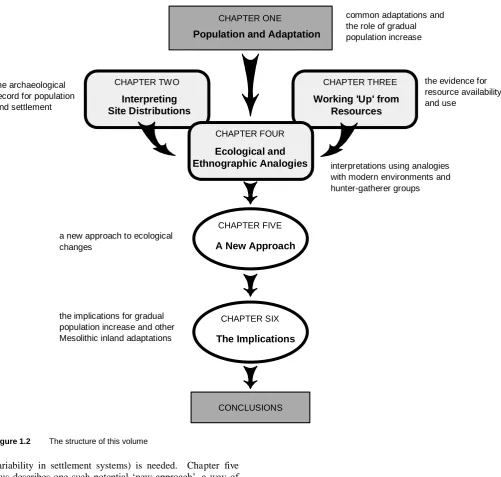
TRATEGYIn what follows, the suitability of the concept of gradual population increase throughout the Mesolithic of northern England will be addressed in detail. The strategy used will be to begin by considering the evidence for Mesolithic adaptations (figure 1.2). First, the 'top-down' evidence for settlement systems and population, working from the evidence left behind by these activities, then, the 'bottom up' evidence for resources and resource exploitation from the nature of resources themselves and how they might have been exploited, and finally, the means of interpreting these two elements, using analogies with modern environments and modern hunter-gatherer populations. Following these considerations, a 'fresh approach' to the question of gradual population increase and of other potential adaptations, based on models of spatial changes in resource environments, will be developed. The models used will aim to provide a link between general adaptations and the local or regional archaeological record by being based on regional environments. On the basis of this new approach, the question of gradual population increase will be re-addressed.
Structure
In this chapter, the importance of the concept of gradual population increase, both as a means of structuring our understanding of the evidence for other changes in societies, and as a means of defining the Mesolithic as a period, has been discussed. The archaeological evidence for past population and adaptations, and the biases operating on this record, are considered in Chapter two (see figure 1.2). Unfortunately, the influence of biases on interpretations of site patterning, taken both temporally and at three different spatial scales, are found to be pervasive and the potential for using this record alone as a means of understanding adaptations is found to be poor. Consequently, the evidence for available resources and their use, as a basis for ‘building up’ and understanding of subsistence practices and settlement patterns is addressed in Chapter three. No obvious resource provides the ‘key’ to subsistence practices, and Chapter four thus considers the means of interpreting the evidence from both the available resources and the archaeological record, using analogies with modern environments and populations. However, the use of these analogies, the main means of understanding Mesolithic societies, is found to be much biased by simple preconceptions
Having discussed the evidence and the range of interpretations of the Mesolithic occupation of northern England, it becomes clear that many of our common perceptions of the Mesolithic in this region are much influenced by biases and preconceptions. Moreover, almost all approaches tend to ignore potential variability in both environments and settlement patterns. It is concluded that a new approach, aiming to address questions of change and sensitive to regional environmental variability (and potential
North Pennines
Central Pennines
North York Moors Lake
District
South Pennines North East
[image:6.595.49.293.59.329.2]Wolds
C
HAPTERO
NE6
variability in settlement systems) is needed. Chapter five thus describes one such potential ‘new approach’, a way of moving forward from the present level of interpretations, through the development of an alternative model of changes in terrestrial environments (applied to northern England). Chapter six concludes with the implications of these changes for the idea of gradual population increase, and suggests alternative potential adaptations which may characterise inland groups. The wider relevance of this research for our understandings of some of the key concepts that structure our ideas about the Mesolithic is addressed in the Conclusions.
If there is a unique approach that structures this research, it is the ‘spatial’ or ‘geographical’ perspective of the work, applied to both present biases, and past ecological changes. The use of Geographical Information Systems (GIS) has played an important role in this respect, but since it is the approach, rather than the technique, which is important (and almost all analyses included could have been carried out without the use of GIS) the workings, methods and limitations of these systems are not discussed (they are in any case amply covered in several recent publications).
CHAPTER TWO
Interpreting Site Distributions
CHAPTER THREE
Working 'Up' from Resources
CHAPTER FOUR
Ecological and Ethnographic Analogies
CHAPTER ONE
Population and Adaptation
CHAPTER FIVE
A New Approach
CHAPTER SIX
The Implications
CONCLUSIONS
common adaptations and the role of gradual population increase
the archaeological record for population and settlement
the evidence for resource availability and use
interpretations using analogies with modern environments and hunter-gatherer groups
a new approach to ecological changes
[image:7.595.50.552.54.531.2]the implications for gradual population increase and other Mesolithic inland adaptations