0022-538X/90/052411-05$02.00/0
Copyright © 1990,AmericanSocietyfor Microbiology
Promoter
Evolution in
BK
Virus:
Functional Elements Are
Created
at
Sequence
Junctions
RHEA-BETH MARKOWITZ,* SARAH TOLBERT, AND WILLIAM S. DYNAN Departmentof Chemistry and Biochemistry, Campus Box215,
University
of
Colorado, Boulder,
Colorado 80309-0215Received 13 October1989/Accepted 8 January 1990
The archetypal strain ofBK virus directed very little early gene expression compared with rearranged
laboratorystrainsof the virus. One laboratory strain thatwasanalyzed in detail contained newly created AP-1
binding enhancer modules spanning the junction between adjacent sequence repeats. Introduction of these
sequencesinto the archetype activated the previously quiescent earlypromoter.
Thegenomeof the human polyomavirus BK (BKV)
con-sists ofa noncoding promoter-and-enhancer region located
betweenthe early and late transcription units (1-6, 10, 13, 20, 23, 26, 30, 32). Recentbiochemical and genetic studies have identifiedan assortmentof individualgenetic elements thatcontributes tothebiological activity of this region (1-5, 10, 15, 30). One of the interesting aspects of BKV is that differentstrainsof thevirusvaryconsiderablyinthe number andboundaries of directDNAsequence repeats present in theregulatory region. Anewperspective onthis variability
recently emerged with the suggestion that the different strains of BKVevolved from a commonarchetype (24, 33). Thishypothesis fits nicely with availablesequencedata,asit
is possible to envision the derivation of all known strains from the archetype as resulting from small numbers of
duplication and deletion events.
Thesequence of theBK(WW) strain corresponds closely
to thetheoretical archetype (24). It hasbeenproposed that BK(WW) mayrepresentthe predominant form ofthevirus in infected individuals and that many of the other known
strains ofBKV represent theoutgrowth of population vari-ants duringisolation in culture (24). BK(WW) was isolated
bymolecularcloning ofviralDNAfrom urine andreportedly willnotgrowinculture (24). In thisstudy,weshow that the
BK(WW) early promoter is virtually quiescent in transfec-tion assays, whereas sequence rearrangements in other strains increase the level ofearlygene expression byup to 100-fold. The specific mechanism ofactivation was
deter-mined by a detailed analysis of one rearranged strain,
BK(Dun), and was shown toreflect theformation ofnovel geneticelementsatthejunctionsof directsequencerepeats. The formation of new elements at repeat junctions may
provide afacile,general mechanismfor therapid evolution
ofnewcharacteristics in BKV andotherpolyomaviruses.
Transcription experimentsusedDNA from thearchetypal strain, BK(WW), andtworearranged strains, BK(MM)and BK(Dun). Maps oftheregulatory regionsand transcription factor binding sites of these different strains are shown in
Fig. 1. All three strains are identicalfrom the earlymRNA startsitethroughthefirst Psequenceblock, which ends113 basepairs(bp)upstreamof the earlystart site. Beyondthis point, the sequence arrangements differ. BK(MM) and BK(Dun) have imperfect triplications of P and Q block
sequencesand deletionsofQand Rblocksequences(Fig. 1).
Despite the rearrangements, the regulatory regions of all
*Correspondingauthor.
three strainsareroughlythesamesize(170to271bp).Each strain contains multiple binding sites for the known tran-scription factor NF-1 (3, 10, 15, 16, 18), and some strains contain binding sites for the transcription factors Spl and AP-1 (3, 15). Because all strains contain multiple binding sites forknown positivelyacting transcription factors, it is not possible to make a priori judgments about relative
transcriptional efficiency.
To determine the transcriptional activity of the different strains, we used a DNA transfection assay. The BKV regulatory region was fused in the early orientation tothe chloramphenicolacetyltransferase (CAT)gene,and levels of
CATenzymeactivity were measured asindicators ofearly
RNA accumulation (9, 17). Table 1 shows a comparison of
CAT expressionfrom different BKV strains after transfec-tion into WI-38 human embryonic lung fibroblasts. The BK(WW) regulatory region was nearly quiescent for early gene expression, whereas the regulatory regions of the laboratory strains,BK(Dun)andBK(MM), showed
approx-imately 100-fold-greater activity. The striking difference in the level of CAT expression in the different BKV strains suggests thatthe upstream deletions and duplications
con-tribute tothe formation ofan effective promoter-enhancer unit.
Therearetwopossibleexplanationsfor thestrain-specific differences in gene expression. Sequences inhibitory for transcription mightbe present inBK(WW)but deleted from theevolvedstrains. Forexample, suchinhibitorysequences
mightbepresentin the Rsequenceblockatthe late side of the regulatory region. Alternatively, positively acting
se-quences might be duplicated or formed de novo in the
rearranged strains. To discriminate between thesetwo
pos-sibilities, reconstruction experiments were carried out in which DNA fragments isolated from the high-expression strain, BK(Dun), were inserted into the low-expression strain, BK(WW). Figure 1 shows the fragments that were
used. BK(Dun) regulatory DNA was digested with the restrictionenzymeBsu361, which releases DNAfragments of 50 and 68 bp. We have previously shown, by DNase 1 footprint analysis, that each of these fragments contains single binding sites for the transcription factors AP-1 and NF-1 (15). These fragments were inserted in their natural
orientation into the unique Bsu 361 site of pWWCAT. A 118-bp fragment containing all four protein-binding sites, obtainedby partialBsu 361 digestion ofBK(Dun), was also
inserted intopWWCAT.
Recombinantscontaining singleandmultiple copiesof the
2411
on November 10, 2019 by guest
http://jvi.asm.org/
o~~~~~~~~~~~~~~~~~~c
El~~~~~~~~~~~~~~~0C
40
cEM~4C3
88~~~~~~~~~~~~~~e
0~~~~~~~~~~
-0
40
-OD u~~~
0re
0.)U
-oZ 0.).0 Q.
O r.
U,-.
0
CZ 0 0
-0
C,,~~~~~~~~~~~~~~~~~~~~~C
In~~~
E~~~~~
-cr-.
F~~~~~~~~~~~~4
OF
Oi~~~~~~~~
a~~~~~~~~-E .2Z O
cc CD 0 u
I
on November 10, 2019 by guest
http://jvi.asm.org/
:8a
aa..
00
10M
II ffima -..
*4 d
-
-a imi
-
-tp
tooAs
-a * -,
4-a saatmo
,",I
_
__ _ _
;
Is*w
_B
:S-r_)
.2-c5
30
20
10
0
0 1 2 3
Numberof inserts
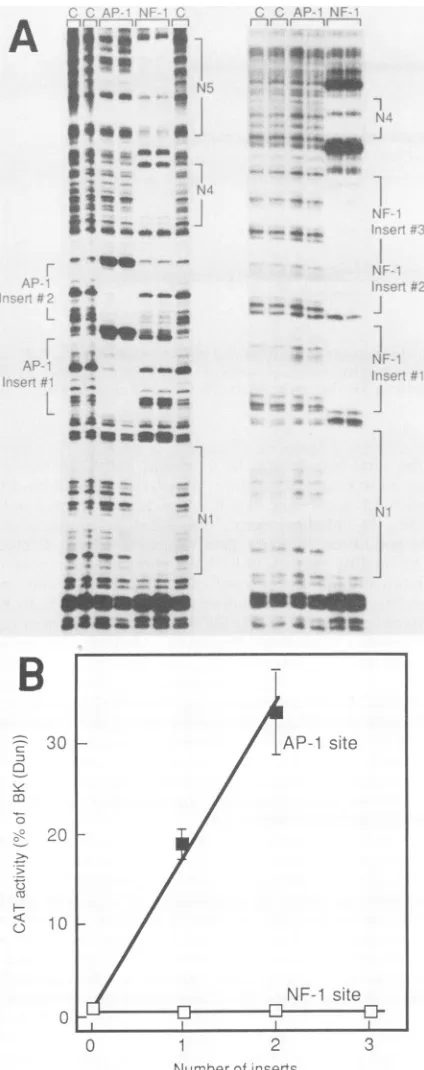
FIG. 2. ActivityofpWWCAT recombinants containing synthetic AP-1orNF-1bindingsites. Complementaryoligonucleotides con-tainingrecognition sequences for AP-1or NF-1 wereinserted into theuniqueBsu361siteofpWWCATasshown inFig.1.(A)DNase IfootprintingofpWWCAT recombinants.DNase Ifootprintingwas
carried out as described elsewhere (7, 15) for the recombinants containing two copies of the AP-1 oligonucleotide (left panel) or
[image:3.612.76.288.74.609.2]three copies of the NF-1 oligonucleotide (right panel). A
10-pLl
volume of DNAaffinity-purified AP-1 orNF-1 (15) wasadded to bindingreactions where indicated. Noproteinextract wasaddedfor lanes marked C. Protectedregionsaremarkedbybrackets.(B)CAT activityofpWWCATrecombinants. RecombinantscontainingoneTABLE 1. Analysis of BKV early promoter activity invivoa
CATactivity No. of
BKVstrain [%of BK(Dun)] expts
(mean± SD)
Natural
pWWCAT 1.0 1.1 4
pDunCAT lOOb 4
pMMCAT 100± 13 4
Recombinants
pW50DCAT-1 41 ± 12 3
pW68DCAT-1 23 +5 1
pW118DCAT-1 85 ± 25 4
pW118DCAT-2 294 ± 4 2
aRegulatory regionsof BKVstrainsweresubclonedin apromoterlessCAT
expressionvectorin the earlyorientationviaa StuI site conserved in the
different BKV strains. Thesite offusion is 53nucleotides downstreamof the
BKV early RNA startsite showninFig.1 (4)and isproximalto thenormal
initiation codon forT-antigensynthesis. Recombinantswereconstructedas
describedin thetextand weredesignatedpW5ODCAT-1,pW68DCAT-1, and pW118DCAT-1,where thenumbers50, 68, and 118 indicate the size of the
insertedBK(Dun)fragment (Fig.1) and thefinal digitindicates thenumberof
copies ofthe insert. Transfection ofsupercoiled plasmid DNAinto WI-38
humanembryonic lung fibroblastswascarriedoutby usingamodification of
the method described by Sompayrac and Danna (27). Analysis of CAT
enzymeactivitywascarriedoutbyusing the method of Nordeenetal.(17).
Background was determined by assaying mock-transfected cells and was
subtracted. Ineachexperiment,duplicateortriplicate plateswereassayed, averaged, and normalizedtoBK(Dun) activity. Resultsshown arenormalized
values from multipleindependentexperiments,asindicated,except for results
forpW68DCAT-1, whicharefromduplicate plateswithin anexperiment.
bStandard deviation is notapplicable.
insertedfragments were tested for their ability to direct CAT
activityin transfectionexperiments (Table 1; other datanot shown). All recombinants tested showed substantially in-creased levels ofactivity. The insertion of singlecopies of the 50- and68-bp fragments increased geneexpressionof41 and23%of theBK(Dun)level,respectively. Insertionof the 118-bp fragment increased BK(WW) activity to essentially thesame level asBK(Dun) activity. These results strongly suggest that the high level of transcriptional activity ob-served for BK(Dun) is attributable to positively acting se-quence elements present in both the 50- and 68-bp frag-ments. Ourexperiments show no evidence that negatively acting elementsarepresentin the R block ofBK(WW)since the recombinantcontainingthe118-bp insertionwasrescued to nearly the BK(Dun) level of activity. However, these
experiments do not formally rule out negatively acting
elements that might become apparent if sequences were
joined in other arrangements. In this respect,we note that other investigators have reported evidence for cell-type-specific negativeelements in adifferent strain ofBKVthat was nottested in ourexperiments(10).
Each of the test fragments used in this experiment con-tained more than one binding site for known transcription
factors and, in addition, could have contained regulatory
elementsnotdetected in thebinding studies. Toidentifythe
precisesequencesresponsiblefortranscriptional activation, synthetic21-bp oligonucleotides representingAP-1 or NF-1
or twocopiesof the AP-1 oligonucleotidesand one, two, orthree copiesof the NF-1 oligonucleotides weretransfected into human WI-38 cells by using a modification of the method described by Sompayracand Danna(27).CATactivitywasassayedasdescribed inthelegendtoTable 1. Error bars represent the rangeof observa-tions intriplicate samples.
-0 -.-.,.
aa
--!2 It
6,..40 it. *a#a
g -malow
-.1 .6 _46
"a - .
- .46
-;* ".
4106
- '-*34*
.:. -,Im.
on November 10, 2019 by guest
http://jvi.asm.org/
[image:3.612.316.558.88.213.2]A.archetypalparent
GGICACAG
ATGACjGGGCA
----early _
GGdCACAG
ATGACIGGGCAB. evolving progeny
4~ ~
-o-- early GCACI CAG
AP-1 consensus
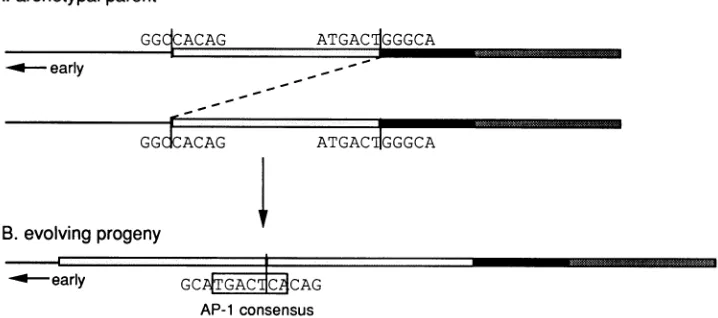
FIG. 3. Evolutionof AP-1 binding sites across repeat junctions. (A) Regulatoryregion of the proposedarchetype,BK(WW).P,Q, andR blocksare drawn asinFig.1. DNA sequences atjunctionsareindicated. (B) The progenymoleculecontains twoadjacentPblocks. TheDNA sequence spanningthe new junction is shown. Abinding site (boxed sequence) forthe transcriptionfactor AP-1was generated bythe rearrangement.
protein-bindingsequencesfrom BK(Dun) were inserted into BK(WW). The method of construction and, in particular, the Bsu 361 site used for insertion were the same as in the previous set of experiments. DNase 1 footprint analysis was
carriedoutfor recombinants containingtwosyntheticAP-1
sites or three synthetic NF-1 sites (Fig. 2A). Both the naturally occurring and the synthetic protein binding sites werebound by the appropriate purified protein.
The addition of a single AP-1 binding site to BK(WW)
resulted in a largeincrease in early geneactivity (Fig. 2B). The addition of two AP-1 binding sites increased gene expressionfurther, to 36%of the level seen with BK(Dun). When one, two, or three additional NF-1 protein binding sites wereinserted, noincreaseinactivitywas seen. These
experiments demonstrate that the inserted AP-1 sites can
complement the sequences already present in BK(WW) to
form the functional unit required for high levels of BKV
earlygeneexpression. Theincreaseinactivity cannot be due to aspacing effect alone, since insertion ofNF-1 oligonucle-otides ofthe same size showed no increase in activity. It
should be notedthat, although the increase inactivity was
clear, the absolute level of expression in templates recon-structed with synthetic oligonucleotides did not reach the same levelaswith naturalrestrictionfragments. This
possi-bly reflects the effects oftranscription factor binding site
spacing and context, both of which differed significantly in the oligonucleotide reconstructed strains from the pattern seenin BK(Dun).
Ithas been proposed that laboratory strains of BKV are derived from a common BK(WW)-like archetype (24). We suggest that the first step in the evolution ofthe BK(Dun) enhancer was the illegitimate recombination event dia-grammedinFig. 3, which juxtaposed two distant sequences from the regulatory region of a BK(WW)-like ancestor. Five base pairs of a consensus AP-1 site are contributed by sequences totheleft of thejunction, and two base pairs are
contributedbysequencestotheright of the junction.
Affin-ity-purified AP-1 binds to this sequence junction (Fig. 2A) (15) but does not bind under the same conditions to any sequences present in the BK(WW) regulatory region (15). We expect that this intermediate containing a single AP-1
sitewould havesubstantiallygreatertranscriptional activity thanits parent and potentially could have been selected for
in the viral population. In a second recombination event requiredtocreateBK(Dun), the AP-1 site would have been
duplicated, increasing the level of transcriptional
activity
further. In the third event, nonessential sequences at the right end of the controlregion would have been deleted.
Our finding that the BK(WW) control region was tran-scriptionally quiescent conflicts with the original report describing an active enhancer in BK(WW) (24). In these earlierexperiments, the BK(WW) upstream enhancerregion
wasfused inreverseorientationto atruncatedsimian virus 40promotercontaininganAP-1 site adjacent to thepoint of fusion. It is likely that the activity of this construct is attributabletothejuxtaposition of BK(WW) sequences with thesimian virus 40 AP-1 site rather than to theactivity of the BK(WW) enhancer perse. Our present resultsarein agree-mentwith those of a recent study which concluded that a number ofindependently isolated BK(WW)-like strainswere defective forgrowth, probably because they lackan active promoter-enhancer region(28).
A number of previous studies have reported sequence duplications leadingtoformation of active enhancers (11,12,
29-31). For the most part, these experiments have been interpreted in terms of duplication of enhancer modules internal to the repeated sequences rather than formation of new enhancer modules at repeatjunctions. In simian virus 40, subsequent experiments have indeed proven that en-hancer modules are present internal to the repeated se-quences in some cases (19, 25; reviewed in reference 8). In other cases, the situation isnot soclear, because follow-up experiments have not been performed (11, 12, 29-31). In BKV, thereareanumber ofvariants that contain extensive sequenceduplicationsbut that showlow levels ofearlygene expression or lowgrowth rates. These include BK(RS) (R.
Steinman, R.-B. Markowitz, A. Del Vecchio, U. Shabon, W. S. Dynan, and R. Ricciardi, submitted forpublication), BK(pm526) (30), and multiple variants isolated froma sys-temiclupuserythematosus patient(28). These observations suggestthatduplications aloneare notsufficienttoactivate
transcription in BKV. Our studies argue that, at least in some cases, specific junctions formed between duplicated sequences arecritical for increasedtranscriptionalactivity. We do not yet know to what extent the results with BK(Dun)can be generalized toother strains ofBKV or to
on November 10, 2019 by guest
http://jvi.asm.org/
[image:4.612.133.492.78.237.2]other viruses. Preliminaryexperiments show that restriction fragments spanning repeat junctions in BK(MM) contain positively acting enhancer elements, although the precise sequences responsible have not yet been identified. The formation of a new promoter element spanning a repeat junctionwasalso notedsome years agoinabacterial virus. The c17mutantof bacteriophage A contains a9-bp duplica-tion which allows constitutive expression of DNA replica-tion funcreplica-tions (21).
WethankJ. Schneringer fortechnical assistance and R. Sclafani forbringingtoourattention theXc17 mutant.
This work was supported by Public Health Service grant CA 44958from the NationalCancerInstitutetoW.S.D.
LITERATURE CITED
1. Cassill, J. A., K. L.Deyerle,and S. Subramani. 1989. Unidirec-tionaldeletionand linker scananalysis ofthe late promoterof thehumanpapovavirus BK.Virology 169:172-181.
2. Cassill, J. A., and S. Subramani. 1988. The late promoter of the humanpapovavirusBKis contained within the earlypromoter enhancerregion. Virology 166:175-185.
3. Chakraborty, T., and G. C. Das. 1989. Identification ofHeLa cell nuclearfactorsthatbindtoand activate the earlypromoterof humanpolyomavirus BK invitro. Mol. Cell. Biol. 9:3821-3828. 4. Deyerle,K.L., J. A.Casill,and S. Subramani.1987. Analysis of
the early regulatory region of the human papovavirus BK. Virology 158:181-193.
5. Deyerle,K.L., and S.Subramani. 1988.Linker scananalysis of theearly regulatory regionofhumanpapovavirusBK. J.Virol. 62:3378-3387.
6. Dhar, R., C. Lai, and G. Khoury. 1978. Nucleotidesequenceof the DNA replication origin forhuman papovavirus BKV: se-quenceandstructural homology with SV40. Cell13:345-358. 7. Dynan, W. S. 1987. DNase I footprinting as an assay for
mammaliangeneregulatory proteins,p.75-87.InJ. K.Setlow (ed.), Genetic engineering. Plenum Publishing Corp., New York.
8. Dynan, W. S. 1989. Modularity in promoters and enhancers. Cell58:1-4.
9. Gorman, C. M., L. F. Moffat, and B. H. Howard. 1982. Recombinantgenomes whichexpress chloramphenicol acetyl-transferase in mammalian cells. Mol. Cell. Biol.2:1044 1051. 10. Grinneil, B. W., D. T. Berg, and J. D. Walls. 1988. Negative
regulation of the human polyomavirus BK enhancerinvolves cell-specific interaction with a nuclear repressor. Mol. Cell. Biol. 8:3448-3457.
11. Hara, K., Y. Oya, H. Kinoshita, F. Taguchi, and Y. Yogo. 1986. Sequence reiteration required for the efficient growth ofBK virus. J.Gen. Virol. 67:2555-2559.
12. Herr,W., and J. Clarke.1986. The SV40 enhancer iscomposed of multiple functional elements that can compensate for one another. Cell 45:461-470.
13. Howley, P. M. 1980.Molecular biology ofSV40and the human polyomavirusesBKandJC,p.489-550.InG. Klein(ed.),Viral oncology. Raven Press,NewYork.
14. Jones, K. A., J. T. Kadonaga, P. J. Rosenfeld, T. J. Kelly, and R. Tjian. 1987. A cellular DNA-binding protein that activates eukaryotic transcription andDNAreplication. Cell48:79-89. 15. Markowitz, R.-B., and W. S. Dynan. 1988. Binding of cellular
proteins to the regulatory regionofBK virus DNA. J. Virol. 62:3388-3398.
16. Markowitz, R.-B., J. Schneringer, S. Tolbert, A. Kuppers, and W. S. Dynan. 1989. Functional organization of the BK virus transcriptional control region, p. 191-206. In L. P. Villarreal (ed.), Common mechanisms of transformation by small DNA tumor viruses. American Society for Microbiology, Washing-ton, D.C.
17. Nordeen, S. K., P. P. Green Ill, and D. M. Fowlkes. 1987. A rapid, sensitive, and inexpensive assay for chloramphenicol acetyltransferase. DNA6:173-178.
18. Nowock, J., U. Borgmeyer, A. W. Puschel, R. A. W. Rupp, and A. E. Sippel. 1985. The TGGCAprotein binds tothe MMTV-LTR, the adenovirus origin ofreplication, and the BK virus enhancer. Nucleic AcidsRes. 13:2045-2061.
19. Ondek, B., A. Shepart, and W. Herr. 1987. Discreteelements withinthe SV40enhancerregiondisplay different cell-specific enhanceractivities. EMBO J.6:1017-1025.
20. Padgett, B.1981.Humanpapovaviruses,p.339-370. InJ.Tooze (ed.), DNA tumor viruses. Cold Spring Harbor Laboratory, ColdSpring Harbor,N.Y.
21. Rosenberg, M., D. Court, H.Shinatake, C.Brady, andD.L. Wulff. 1978. The relationship between function and DNA
se-quenceinanintercistronicregulatory region in phageX. Nature (London)272:414-423.
22. Rosenfeld, P. J., and T. J. Kelly. 1986. Purificationof nuclear factor 1 by DNA recognition siteaffinity chromatography. J. Biol.Chem. 261:1398-1408.
23. Rosenthal, N., M. Dress, P. Gruss, and G. Khoury. 1983. BK viral enhancerelement and a human cellularhomolog. Science 222:749-755.
24. Rubinstein, R., N. Pare, and E. H. Harley. 1987. Structure and function ofthe transcriptional control region ofnonpassaged BKvirus. J.Virol. 61:1747-1750.
25. Schirm, S., J. Jiricny, and W. Schaffner. 1987. The SV40 enhancercanbe dissected intomultiplesegments, eachwitha
different celltypespecificity. GenesDev. 1:65-74.
26. Seif,I., G. Khoury, and R. Dhar. 1979.The genomeofhuman papovavirusBKV.Cell18:963-977.
27. Sompayrac,L.M., and K. J. Danna. 1981.Efficient infection of monkey cells withDNAof simian virus 40. Proc. Natl.Acad. Sci. USA 78:7575-7578.
28. Sugimoto, C.,K.Hara, F.Taguchi,and Y.Yogo.1989.Growth efficiencyofnaturally occurringBKvirusvariantsin vivoandin vitro. J. Virol. 63:3195-3199.
29. Swimmer, C., and T. Shenk. 1984. A viable simian virus 40 variant that carries anewly generated sequencereiterationin place ofthe normalduplicated enhancer element. Proc. Natl. Acad. Sci. USA 81:6652-6656.
30. Watanabe, S.,and K.Yoshiike. 1986. Evolutionary changes of transcriptional controlregion inaminute-plaque viable deletion mutantofBKvirus.J. Virol.59:260-266.
31. Weber, F., J. de Villiers, and W. Schaffner. 1984. An SV40 "enhancertrap" incorporates exogenous enhancers or gener-atesenhancersfromitsownsequences.Cell36:938-992. 32. Yang, R. C.A., and R. Wu. 1979. BKvirus DNA: complete
nucleotide sequence of a human tumor virus. Science 206: 456-462.
33. Yoshiike, K.,and K. Takemoto.1986.Studieswith BK virus and monkey lymphotrophic papovavirus, p. 295-326. In N. P. Salzman (ed.), The papovaviridae. Plenum Publishing Corp., NewYork.