quantum processor architecture.
White Rose Research Online URL for this paper: http://eprints.whiterose.ac.uk/2649/
Article:
Spiller, Timothy P. orcid.org/0000-0003-1083-2604, D'Amico, Irene
orcid.org/0000-0002-4794-1348 and Lovett, Brendon W. (2007) Entanglement distribution for a practical quantum-dot-based quantum processor architecture. New Journal of
Physics. 20. ISSN 1367-2630
https://doi.org/10.1088/1367-2630/9/1/020
[email protected] https://eprints.whiterose.ac.uk/
Reuse
Items deposited in White Rose Research Online are protected by copyright, with all rights reserved unless indicated otherwise. They may be downloaded and/or printed for private study, or other acts as permitted by national copyright laws. The publisher or other rights holders may allow further reproduction and re-use of the full text version. This is indicated by the licence information on the White Rose Research Online record for the item.
Takedown
If you consider content in White Rose Research Online to be in breach of UK law, please notify us by
T h e o p e n – a c c e s s j o u r n a l f o r p h y s i c s
New Journal of Physics
Entanglement distribution for a practical
quantum-dot-based quantum processor architecture
Timothy P Spiller1,4, Irene D’Amico2 and Brendon W Lovett3
1Hewlett-Packard Laboratories, Filton Road, Stoke Gifford,
Bristol BS34 8QZ, UK
2Department of Physics, University of York, York YO10 5DD, UK 3Department of Materials, Oxford University, Oxford OX1 3PH, UK
E-mail:[email protected]
New Journal of Physics9(2007) 20 Received 27 October 2006
Published 29 January 2007 Online athttp://www.njp.org/
doi:10.1088/1367-2630/9/1/020
Abstract. We propose a quantum dot (QD) architecture for enabling universal quantum information processing. Quantum registers, consisting of arrays of vertically stacked self-assembled semiconductor QDs, are connected by chains of in-plane self-assembled dots. We propose an entanglement distributor, a device for producing and distributing maximally entangled qubits on demand, communicated through in-plane dot chains. This enables the transmission of entanglement to spatially separated register stacks, providing a resource for the realization of a sizeable quantum processor built from coupled register stacks of practical size. Our entanglement distributor could be integrated into many of the present proposals for self-assembled QD-based quantum computation (QC). Our device exploits the properties of simple, relatively short, spin-chains and does not require microcavities. Utilizing the properties of self-assembled QDs, after distribution the entanglement can be mapped into relatively long-lived spin qubits and purified, providing a flexible, distributed, off-line resource.
4 Author to whom any correspondence should be addressed.
Contents
1. Introduction 2
2. The entanglement distributor 3
3. Fidelity of the distribution process 8
4. Summary and conclusion 8
Acknowledgments 9
References 9
1. Introduction
It is now well known that information technology (IT) which processes information according to quantum rules could have security and computational advantages over conventional IT. Over the last decade there have been a great many proposals for the building blocks of such new technology—how to realize qubits and do gates between them—and the emergence of promising experimental results for many of these proposals. The next steps towards useful quantum IT are further experimental investigations, and theoretical considerations of outstanding practical issues. The study we present here is of the latter variety, showing how to distribute entanglement and thus connect together small quantum dot (QD) registers, of realistic size, to enable a larger, useful, quantum processor architecture.
3 InstituteofPhysics
⌽
DEUTSCHE PHYSIKALISCHE GESELLSCHAFTspots Independent laser
BAB CAB
QRB
QRA BAA
CAA
QDB QDD
[image:4.595.149.410.110.266.2]QDC QDA
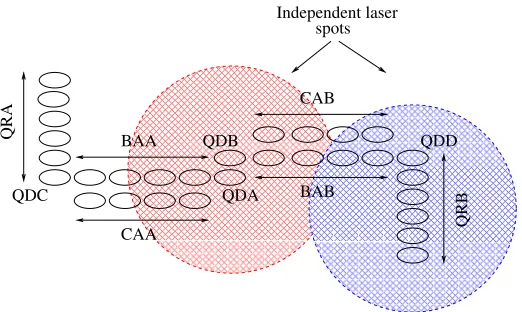
Figure 1. Schematic entanglement distributor: entangled excitons are produced in QDA and QDB, which are connected to in-plane dot quantum buses BAA and BAB respectively. The transfer is controlled by dot control arrays CAA and CAB, as indicated. The buses connect to dots QDC and QDD, which are located at the ends of the stacked registers QRA and QRB. These registers and the dot-pair (QDA, QDB) can be addressed by different laser spots, as shown.
2. The entanglement distributor
The key to our proposal is an entanglement distributor, an all-QD device for generating maximally entangled qubits on demand and distributing them to spatially separate regions. The system we envisage is shown schematically in figure 1. Registers of stacked QDs are connected by entanglement distributors consisting of in-plane chains of QDs.
The entanglement distribution starts with the generation of a Bell state|ψ =2−1/2(|00+ |11) in QDA and QDB. For excitonic encoding, the computational basis is the absence (|0i ≡ |vaci) and presence (|1i ≡ |Xi) of a ground state exciton in QDi. Due to strain
propagation [1] the QD energy spectra differ in the vertical (stacked) direction, i.e., between QDA and QDB, between each dot in the buses (BAA and BAB) and its corresponding partner dot in the control array (CAA and CAB), and also along each of the quantum registers QRA and QRB (as shown in figure 1). These energetically distinct dots may be addressed by laser pulses of different frequency. Furthermore, since the excitons in vertically adjacent QDs have different energies, resonant Förster coupling [22, 23] is strongly inhibited in this direction. The initial entangled state in QDA and QDB is generated by a two-colour laser pulse sequence [2,3]; this can be done on a picosecond timescale. The first pulse is aπ/2-pulse between the vacuum and ground state exciton in QDA. This is equivalent to a Hadamard operationHAapplied to an empty QDA, whereHi|0i = 2−1/2(|0i + |1i). (Note, for later use, thatHi|1i= 2−1/2(|0i− |1i).) The
second laser pulse performs a controlled-NOT (C-NOT) gate on QDB, flipping QDB conditional on the presence of an exciton in QDA, due to the direct Coulomb coupling [2,3] between these excitons. Clearly the roles of QDA and QDB can be interchanged.
As mentioned above, in-plane QDs can be almost monodisperse, so that we can assume adjacent QDs in each bus (BAA and BAB) and each control array (CAA and CAB) are very similar. This means that resonant Förster energy transfer [22, 23] takes place along the buses shown in figure1. In addition, the relative stacked position of bus and control arrays allows us to
CAA
CAB
CAA
CAB QDB
QDA (2)
(1)
(3)
QAA
CAB
CAA
QAB
Gate Gate
QDC QDD
BAB BAA
(4)
(5)
(6)
Figure 2. The entanglement distributor: (1) The bus arrays BAA and BAB are set off resonance through the creation of an exciton in each control array (CAA and CAB) QD. (2) The entangled pair is created in QDA and QDB. (3) The bus arrays BAA and BAB are set on resonance through the annihilation of the excitons in control arrays CAA and CAB. (4) The entangled qubits propagate down the buses. (5) When the qubits reach QDs QDC and QDD, the bus arrays BAA and BAB are again set off resonance through the creation of an exciton in each control array (CAA and CAB) QD. (6) The entanglement is delivered to the registers QRA and QRB.
address the control arrays CAA and CAB both (i) separately and (ii) without exciting excitons also in the corresponding bus arrays. Finally, the length of the bus arrays is made greater than the laser wavelength(s), so the central coupled QD pair (QDA and QDB) and the two quantum registers QRA and QRB can each be addressed with independent laser spots, as illustrated in figure1.
Once generated, the entanglement needs to be distributed. The Hamiltonian for a chain of
N QDs, with zero or one exciton in each dot, is given by
H =
N
i=1
Ei|1i1|i+
N−1
i=1
(VFi,i+1|1i0|i⊗|0i+11|i+1+ h.c.), (1) whereVFi,i+1is the Förster coupling [21]. This Hamiltonian governs the transfer of the entangled pair from QDA(B) to register QRA(B). For uniform in-plane chains, we shall assume that Ei
5 InstituteofPhysics
⌽
DEUTSCHE PHYSIKALISCHE GESELLSCHAFT0 2 4 6 8 10 12 14
t 0.00
[image:6.595.146.415.86.498.2]0.25 0.50 0.75 1.00
Population |00000
〉
0.00 0.25 0.50 0.75 1.00
Population |XXXXX
〉
=0.01 meV =0.1 meV =1.0 meV = 10 meV
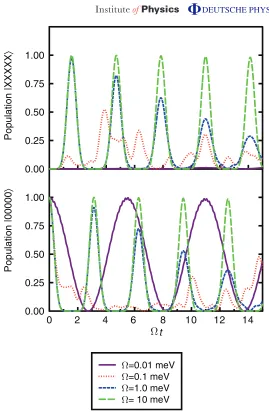
Figure 3. Population of the ground state (|00000) and state with an exciton on every QD (|XXXXX) in a five QD chain, for various values of dot-laser coupling.VF =0.2 meV for all plots.
In the first step (panel (1)) the bus arrays BAA and BAB are set off resonance with respect to excitations in QDA and QDB, by generating an exciton in each QD in the control arrays CAA and CAB. This multiple-excitation process, done with a single laser pulse, is not straightforward, and care must be taken when considering the system parameters. In our caseEi≫VFin equation (1) and the Hamiltonian has a series of eigenstate manifolds, each of which corresponds to a different total exciton number for the chain. The typical energy range covered by each manifold is on the order of VF. Excitons are created in the dots by applying pulses centred on energies ¯
hωcAand ¯hωcBthat correspond to theEifor each chain. The coupling between the laser field and
each individual dot is(which determines the Rabi frequency of the exciton creation process). For creation of an exciton on each dot ≫VF; in this case becomes the dominant energy in the system and the dots behave as though they are uncoupled (to first order). We show how the population of the ground state of a five-QD chain, and the population of the state with an exciton on all dots of a five-QD chain varies as a function of time, and Rabi frequency, in figure3.
Ψ
a
2
∆ε/VFi,i+1 a
|
[image:7.595.149.410.91.274.2]〈
10...0| (
t
)
〉
|
1
0 4 8
0.990.95 0.97 0.99
10 12 14 16 18
8 20
t (ps)
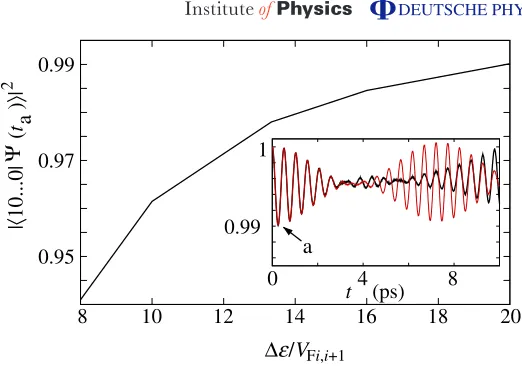
Figure 4. Overlap between the evolution of the state (QDA + bus BAA + QDC) and its initial state, corresponding to (one exciton in QDA + empty bus BAA + empty QDC), calculated at time t=ta, at which such an overlap is minimum. This is plotted as a function of the ratio (biexcitonic shift/Förster coupling), the dimensionless shift in the excitonic transition of a QD in the bus BAA due to the presence of an exciton in the corresponding QD in control array CAA. Inset: the time evolution of the overlap for a ratio of 20, for the cases of five (thin line) and seven (thick line) QDs in (QDA + BAA + QDC). The difference in chain length only has an effect after several oscillations, and this is typical for a dimensionless shift≫1. Point ‘a’ marks the minimum used in the main figure for calculating the overlap.
Notice that, for realistic Förster couplings (VF =0.2 meV [23]), it is possible to drive the desired control-array dynamics |00000 ↔ |XXXXX with very high accuracy on a sub-picosecond timescale.
The excitons created in the control bus couple to the excitonic transitions in BAA and BAB, causing a biexcitonic energy shift EXX and effectively detuning them from resonance with respect to QDA and QDB. The biexcitonic shift can be enhanced by applying an in-plane electric field to the structure and can be tailored up to several meV [2, 3]. This shift inhibits Förster processes between QDA (QDB) and the QDs forming the bus BAA (BAB). This inhibited dynamics is shown in figure 4. When bus BAA is off resonance, due to the excitons in control array CAA, an initial state of an exciton in QDA (with bus BAA empty) remains in that state with at least 99% probability as it evolves, for a ratio EXX/VF=20. This ratio could be achieved with a shift of 4 meV and a Förster coupling of 0.2 meV, so very good confinement of an exciton is possible for practical parameters.
The second step (panel 2) is to generate a maximally entangled pair of excitons, one in QDA and one in QDB. Since QDA and QDB are stacked QDs, they can be individually addressed using sub-ps laser pulses of different colour, and creation of the required state proceeds through Hadamard and C-NOT gates as we discussed earlier. Owing to the confinement discussed above, the entangled excitons do not propagate along the buses.
7 InstituteofPhysics
⌽
DEUTSCHE PHYSIKALISCHE GESELLSCHAFTcontrol arrays by the same laser pulses as those used in step 1. Now the entangled excitons in QDA and QDB are free to travel along BAA and BAB, respectively (panel 4); the time evolution follows the dynamics of relatively short chains described in [21] and governed by equation (1). In plane QDs have nearest-neighbour couplings that are typicallyun-modulated. Chains of such QDs can be used for state transfer, and this avoids complexity and adds to the practicality of our scheme; the dynamics of exciton transfer down these chains has been studied in [21]. These dynamics are characterized by a series of resonances, corresponding to different fidelities of the transfer, the very first of which has a fidelity greater than 94% for the chains required for our entanglement distributor (which is <10-QDs long). The actual transfer time depends on the strength of the Förster coupling between in-plane QDs, and it is foreseen that such QD structures can be optimized to have a Förster coupling of the order of 1 meV [23]—and hence a time of transfer between QDA(B) and QDC(D) of the order of a picosecond [21]. For the example discussed earlier (where VF =0.2 meV) the transfer time is still less than 10 ps for a bus with nine-QDs. We underline that this transfer time is, on one hand, much longer than the characteristic time corresponding to the control-array dynamics (whose population/de-population can therefore be viewed as instantaneous), but on the other hand it is still much shorter than the relevant decoherence times (of the order of a nanosecond), allowing for the possibility of further manipulations.
When the time elapsed is equal to the transfer time [21], the two entangled excitons will be in QDC and QDD, i.e., at the bases of the two different quantum registers QRA and QRB. Using laser pulses to once again set the buses BAA and BAB out of resonance with respect to QDA, B, C and D, will confine the two entangled excitons in QDC and QDD (panel 5). Thus the entangled pair has now been distributed to spatially separated regions, which can be addressed separately, e.g., by using laser pulses. Using optical control, quantum operations can be performed on such a pair (panel 6) and the entanglement can be transferred to different degrees of freedom, e.g., other excitons, spatially distinguishable photons, or electronic spins. These may be characterized by much longer decoherence times than the original excitons.
As an example of this transfer, we outline how a qubit encoded in the exciton basis in a QD can be swapped into the spin of an excess electron in an adjacent Pauli-blockade QD. In terms of the spin, the qubit computational basis is|0 ≡ |↑ and|1 ≡ |↓. In a Pauli-blockade QD [9] a suitably polarized optical π-pulse will create (or remove) an exciton conditionalon the spin state of the excess electron, so, for example, a qubit with its ancillary exciton state is represented as|0 ≡ |↑, vacand|1 ≡ |↓, Xin such a QD after conditional creation. If such a QD is adjacent to another QD (QDC or QDD in our scheme) containing an excitonic qubit, a two-qubit gate equivalent to a controlled-phase gate (which flips the sign of the |11computational basis amplitude and leaves the others alone) can be achieved [9] using the biexcitonic shift, through conditional creation of an exciton for a chosen time. We denote this gate byPij where
ilabels the dot C or D andjlabels the appropriate adjacent Pauli-blockade QD containing the spin qubit. If this latter qubit is set to a known initial state, say |0, a SWAP gate (denoted by
Sij) between the two qubits can be achieved through two C-NOT gates, which decomposes to
Sij =HiPijHiHjPijHj. Through this gate sequence an excitonic qubit that has been distributed
to QDC or QDD can be swapped into a (relatively) long-lived spin qubit in an adjacent QD. We note that the two Hadamard operations Hj have to be performed on the spin qubit. However,
fast optical techniques exist for performing such gates [9,24], so in principle the whole SWAP operation can be done on a fast optical/excitonic timescale (i.e. no more than a few ps), to mediate against the effects of decoherence acting on the excitons.
3. Fidelity of the distribution process
From a practical quantum processing perspective, the swapping of the entangled qubits into spins, to create a long-lived entangled resource, is very important. The fidelity of our distribution scheme is set by a product of factors. First, the chain transfer fidelity of 94%, second the control chain blocking fidelity of around 99%, third, the SWAP gate fidelity—which can also be greater than 99% [24]—and fourth, the natural decoherence of excitons due to spontaneous emission of photons, or exciton–phonon interactions.5 The decoherence of excitons in QDs consists of two main features: an initial sub-picosecond pure dephasing (caused by the excitons’ interaction with acoustic phonons), which leaves a remnant polarization that persists until excitonic recombination occurs, after about 1 ns. (See [27]–[30] for a comprehensive description of these effects and a comparison of experimental data with theory.) For the purposes of our discussion, we will take the exciton recombination to be the principal source of qubit decoherence. This is for two main reasons. Firstly, the value of the residual polarization strongly depends on temperature, applied electric field and material parameters but is generally much larger than the lost polarization at low temperature [29]. Secondly, the initial decay corresponds to the formation of exciton–phonon dressed states, and in this basis there is no initial decay.
We estimate that the total time for one entanglement distribution operation is no more than 20 ps, whereas the exciton decay time is about 1 ns [31] (giving a ‘natural’fidelity of around 99%). Thus an estimate of the overall fidelity of distribution is 91%. Such a good fidelity is certainly adequate for initial experimental investigations. It could be used to demonstrate teleportation and it might even be useful in certain few-qubit applications, which are run probabilistically with rather limited qubit resources. However, for practical quantum processing and a scalable processing architecture, very high fidelity entanglement is desirable. This could be achieved by purification [32]. A number of good fidelity pairs can be distilled to a smaller number of higher fidelity pairs using local qubit operations. This is feasible if distributed excitonic entanglement is mapped into long-lived spin entanglement prior to purification, as we propose. Building up the entanglement resource off-line and using it to link together separate parts of the quantum device clearly has a practical advantage over trying to propagate a computation directly from one register to another, since it prevents errors caused by imperfect gate operations.
4. Summary and conclusion
We have presented a practical all-QD architecture for quantum information processing. The key ingredient to this is an entanglement distributor, which provides a resource of distributed entangled states on demand. This enables the connection of stacked QD processors, of modest and practical size, to form a larger quantum processor. Entangled exciton states are transported to different regions of a semiconductor based quantum information device using chains of in-plane QDs, at which point they can, for example, be swapped into long-lived spin qubits, or used to create entangled photons. The fidelity of the distributed entanglement is good, and could be further increased through purification. Such entanglement is a generic and
5 We neglect three further decoherence mechanisms as they act only on a much slower timescale: single particle
9 InstituteofPhysics
⌽
DEUTSCHE PHYSIKALISCHE GESELLSCHAFTflexible resource. For example, it could be used for teleportation of quantum states, to enable distributed quantum gates, or to build distributed cluster states [33], so it can be utilized in a variety of approaches to quantum processing. Our QD-based entanglement distributor should integrate with and thus enhance many of the current QD-based quantum proposals. Given the impressive progress with QD structures [11]–[20], entanglement distribution forms a realistic experimental goal in the relatively short term and a route to scalable solid state QC in the long term.
Acknowledgments
BWL acknowledges support from the QIPIRC www.qipirc.org (GR/S82176/01), DSTL, St Anne’s College, Oxford and the Royal Society.
References
[1] Petroff P M, Lorke A and Imamoglu A 2001Phys. Today5446
[2] Biolatti E, Iotti R C, Zanardi P and Rossi F 2000Phys. Rev. Lett.855647
[3] Biolatti E, D’Amico I, Zanardi P and Rossi F 2002Phys. Rev.B65075306
[4] De Rinaldis S, D’Amico I, Biolatti E, Rinaldi R, Cingolani R and Rossi F 2002Phys. Rev.B65081309
[5] Nazir A, Lovett B W, Barrett S D, Spiller T P and Briggs G A D 2004Phys. Rev. Lett.93150502
[6] Nazir A, Lovett B W and Briggs G A D 2004Phys. Rev.A70052301
[7] Feng M, D’Amico I, Zanardi P and Rossi F 2003Phys. Rev.A67014306
[8] Feng M, D’Amico I, Zanardi P and Rossi F 2004Europhys. Lett.6614
[9] Pazy E, Biolatti E, Calarco T, D’Amico I, Zanardi P, Rossi F and Zoller P 2003Europhys. Lett.62175
[10] Sherwin M S, Imamoglu A and Montroy T 1999Phys. Rev.A603508
[11] Moritz A, Wirth R, Hangleiter A, Kurtenbach A and Eberl K 1996Appl. Phys. Lett.69212
[12] Su Y K, Chang S J, Ji L W, Chang C S, Wu L W, Lai W C, Fang T H and Lam K T 2004Semicond. Sci. Technol.19389
[13] Edwards P R, Martin R W, Watson I M, Liu C, Taylor R A, Rice J H, Na J H, Robinson J W and Smith J D 2004Appl. Phys. Lett.854281
[14] Gao Q, Buda M, Tan H H and Jagadish C 2005Electrochem. Solid-State Lett.8G57
[15] Wang Z M, Holmes K, Mazur I Yu and Salamoet G J 2004Appl. Phys. Lett.841931
[16] Deneke Ch, Jin-Phillipp N-Y, Loa I and Schmidt O G 2004Appl. Phys. Lett.844475
[17] Kiravittaya S, Heidemeyer H and Schmidt O G 2004PhysicaE23253
[18] Kiravittaya S and Schmidt O G 2005Appl. Phys. Lett.86206101
[19] Kiravittaya S, Heidemeyer H and Schmidt O G 2005Appl. Phys. Lett.86263113
[20] Rastelli A, Stufler S, Schliwa A, Songmuang R, Manzano C, Costantini G, Kern K, Zrenner A, Bimberg D and Schmidt O G 2004Phys. Rev. Lett.92166104
[21] D’Amico I 2005Preprintcond-mat/0511470
[22] Knox R S and Van Amerongen H 2002J. Phys. Chem.B1065289
[23] Crooker S A, Hollingsworth J A, Tretiak S and Klimov V I 2002Phys. Rev. Lett.89186802
[24] Lovett B W 2006New J. Phys.869
[25] Nazir A, Lovett B W, Barrett S D, Reina J H and Briggs G A D 2005Phys. Rev.B71045334
[26] Petta J R, Johnson A C, Taylor J M, Laird E A, Yacoby A, Lukin M D, Marcus C M, Hanson M P and Gossard A C 2005Science3092180
[27] Bayer M and Forchel A 2002Phys. Rev.B65041308
[28] Krummheuer B, Axt V M and Kuhn T 2002Phys. Rev.B65195313
[29] Krummheuer B, Axt V M, Kuhn T, D’Amico I and Rossi F 2005Phys. Rev.B71235329
[30] Vagon A, Axt V M, Kuhn T, Langbein W, Borri P and Woggon U 2004Phys. Rev.B70201305
[31] Borri P, Langbein W, Schneider S, Woggon U, Sellin R L, Ouyang D and Bimberg D 2001Phys. Rev. Lett. 87157401
[32] Bennett C H, Brassard G, Popescu S, Schumacher B, Smolin J A and Wootters W K 1996Phys. Rev. Lett. 76722