Are engineering students’ interests and attitudes to study
different from scientists?
Janelle Wilkesa; Lorelle Burtonb, Rex Glencross-Granta and Majella Albionb.
School of Environmental and Rural Science University of New Englanda, University of Southern Queenslandb , Corresponding Author Email:[email protected]
Structured Abstract
BACKGROUND
Results presented in this paper are part of a national project aimed to develop strategies to enhance enrolment, progression, and graduation rates in engineering programs. The implementation of these strategies is hoped to help the critical shortages of engineers in Australia. It is well documented that transition to university study can be difficult for students and with increasingly diverse cohorts it is vital that learning and teaching be aimed at a wide audience. In smaller institutions it is commonplace for engineering students to study the same subjects as students enrolled in other courses. It is important to document the similarities and/or differences in learning approaches and motivations of these different cohorts to determine whether accommodations via adaptive teaching strategies are needed.
PURPOSE
The purpose of this paper is to compare and contrast the interests and motivations to study
engineering of first year Bachelor of Engineering Technology (Civil and Environmental) students with those of applied science students.
DESIGN
The project team developed an online battery of self-assessment tests to measure non-cognitive abilities and motivations and interests in studying engineering. A total of 76 first year students at a regional university completed the self-tests. Comparisons between engineering and applied science student profiles allowed the similarities and differences in their respective approaches to learning and career interests to be documented.
RESULTS
Analysis of the data showed that engineering students were significantly less likely to be surface learners than their applied science peers (p < .05). Engineering students also showed significantly higher scores than applied science students on the total measure of interest and motivation for studying engineering (p < .01).
CONCLUSIONS
The self-assessments enabled the first year engineering and applied science students to identify their motivations for studying engineering. They also received feedback on their learning approaches. A follow-up class discussion enabled the students to reflect on the benefits and potential limitations of each learning approach. The importance of conversing with students about how to self-manage their learning and being linked to support to address any identified gaps was discussed in the context of experiencing success in first year studies.
KEYWORDS
Introduction
An increasing participation rate and pathways into higher education, coupled with a skills shortage in engineering, has led to a more diverse student cohort. With increasing participation rates comes increased diversity which needs to be managed. Kavanagh, O’Moore, and Samuelowicz (2009) at the University of Queensland, found with increasing quotas of students admitted into engineering there was a decrease in student satisfaction and an increased attrition rate. At the University of Southern Queensland with lowering tertiary entrance scores, students who would not have previously been admitted into engineering were often “at risk” of failure or dropping out by the end of first year (Dowling & Burton 2005). However, these students must be supported if they are admitted into
university.
Factors for success in engineering have been identified from previous Australian research as previous academic success (Burton & Dowling 2005; Burton & Dowling 2009). Others have found over 50% of the variance in student outcomes is related to factors other than cognitive abilities (O’Connor & Paunonen, 2007), such as learning approaches and motivations for study.
For successful and satisfying study it is important students understand their learning approaches and have a strong sense of purpose. By students understanding their learning approaches they can become strategic in their learning efforts and develop problem solving capabilities in their professional careers (Lizzio & Wilson, 2004). Thus, curricula should be designed to incorporate meta-learning strategies that enable students to critically reflect on their own goals and learning experiences. This reflection then helps to build students’ sense of purpose, which is the highest predictor of student satisfaction, and also significantly predicts retention and academic success, as measured by grade point average (GPA; Lizzio & Wilson, 2010). Many students enter their tertiary studies via pathways other than directly from school, and may lack self-efficacy (seeing themselves as successful completing studies and in the workplace) in the academic setting. Therefore, proactive and targeted
interventions are essential to keep students on track and to persist with their studies (Taylor & Lawrence, 2007; Wilson & Lizzio, 2008).
To engage the commencing engineering and applied science first years at a regional
university, students were encouraged to complete a battery of non-cognitive measures (e.g., motivations and interests for studying engineering and learning approaches) prior to the start of semester. They received detailed individual feedback and were linked to support to
address any gaps in knowledge. The purpose of this paper is to compare and contrast the interests and motivations to study engineering of first year Bachelor of Engineering
Technology (Civil and Environmental) students with those of applied science students.
Methods
The online battery of non-cognitive tests included measures of learning approaches and a self-report measure of interest and motivation for studying engineering which was newly developed for application in this research project (Burton and Albion 3013).
student and two applied science students (Table 1). By the end of semester, of those
[image:3.595.71.528.135.225.2]completing the questionnaire, no engineering students and only one applied science student had withdrawn from their degree.
Table 1. Gender, age and language of participants
Streams Female Male Total
participants
Median age English as second language
Engineering 0 12 12 19 1
Applied Science 43 21 64 19 2
Total 43 33 76 3
Learning approaches
The Approaches to Study Skills Inventory for Students (ASSIST, Entwistle, 1981) comprised 52 items measuring three approaches to learning – deep, strategic, and surface. Deep approaches to learning involve finding meaning in what is being studied to maximise understanding. Strategic approaches involve being guided by the assessment criteria and enhancing self-esteem through competition.Surface approaches involve investing little time in the academic task and memorising information with rote-learning. These learning
approaches were assessed as part of the questionnaire for students.
Psychometric evaluation of the Interest and Motivation for Studying
Engineering (IMSE) Scale
Further details of how the IMSE scale was developed have been reported separately by Burton and Albion (in press) presented at this conference (see also Burton & Dowling, 2013). In summary, traits identified by Lowe and Johnston (2008) that were relevant to professional engineers and demonstrated predictions of academic success, were rewritten for online application for the IMSE Scale. Professional and industry organisations were also consulted and the scale was first administered in 2012; and further refined in 2013. The questionnaire uses a Likert response scale, and student responses to these questions were then scored on a scale from 0 to 5 (strongly disagree to strongly agree), based on relevance and the extent to which responses related to the nature and understanding of engineering as a discipline.
Through Principal Axis Factoring six sub-scales were defined:
Functional Creativity included questions such as “I like to know how things work”, “I like to design and build things” and about creativity, drawing diagrams and problem solving.
Collaboration assessed student’s enjoyment of team work, communication and managing projects.
Conceptual Engagement asked if students loved maths, found physics fun, were logical and persistent solving problems.
Idealism included two questions, “I want to have a job that could change the world” and “I want to adapt systems so that they are more sustainable and have less environmental impact”.
Ambition showed students had high standards for academic work and have academic goals.
Statistics
Results presented in this paper were statistically analysed using IBM SPSS computer program Version 21. Due to the non-normal distribution of the data, non-parametric tests were used for analysis. All figures are shown with medians and standard error of the mean. Significance was tested at 95 and 99% confidence limits using Mann-Whitney U Test.
Results and discussion
Learning approaches
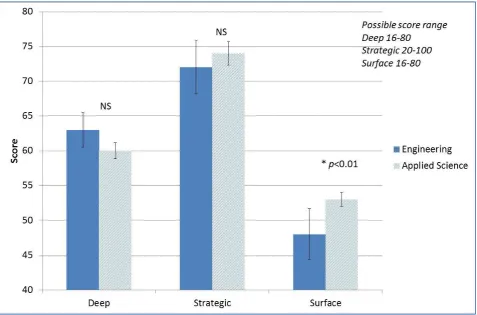
Data analysis indicated that students enrolled in engineering and applied science degrees showed no significant differences (NS) in their deep or strategic learning approaches, respectively (Figure 1). However, applied science students showed a significantly higher preference for surface learning than did engineering students (p < .01). Burton, Albion, Shepherd, McBride, and Kavanagh (2013) found that the surface approach to learning was significantly negatively correlated with academic success (p < .01). Therefore students need to be supported through academic skills unit staff and first year mentors and tutors, to apply a more strategic and deep approach to their learning. However, most students had a
[image:4.595.73.551.342.657.2]preference for deep and strategic learning approaches. Therefore first year assessment needs to be designed to encourage deep approaches for learning and meaning, and understanding the concepts being studied.
Figure 1. Learning approaches of first year students enrolled in Bachelor of Engineering Technology and applied science courses.
Interest and motivations for studying engineering
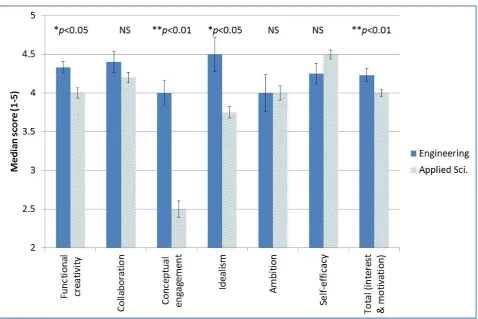
engineering students also showed a significantly higher scale score than their applied science counterparts (p < .05).
Functional creativity is a measure of how much the students want to know how things work, including an interest in designing and building things. These are skills assumed to underpin success in the engineering profession (Lowe and Johnson 2008). As expected, engineering students scored significantly higher than applied science students on this sub-scale (p < .05).
Although engineering students scored higher than applied science students on collaboration, showing an interest in working as part of a team, managing projects and being open to new ideas, this difference was not statistically significant. The applied science students included disciplines such as agriculture, environmental science and animal science students, and it is expected that they too would have an interest in these team skills in their respective
[image:5.595.73.552.236.555.2]professions.
Figure 2. Interest and motivation for studying engineering of first year students enrolled in Bachelor of Engineering Technology and other applied science courses
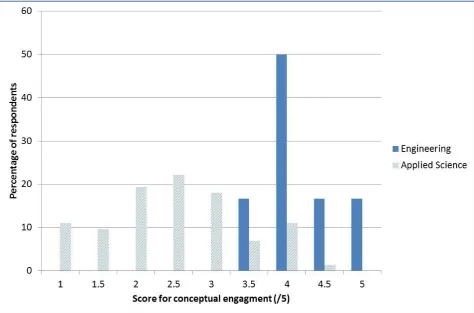
Figure 3. Participant responses to the conceptual engagment sub-scale
Idealism was significantly higher for engineering students compared with applied science students (p < .05), reflecting a keen interest in wanting to change the world and adapting systems to have less environmental impact. Investigating the data further it was found that students enrolled in environmental based degrees had a similar outlook as those in
agriculture. To these questions, the difference in scores was not significant between
environmental and agriculture students, “I want to have a job that could change the world” (p
> .05) and “I want to adapt systems so that they are more sustainable and have less
environmental impact” (p > .05). It was expected that environmental students would be more idealistic towards the environment; however, anecdotal evidence shows these students want to manage the environment, not change it. So one size does not fit all and curriculum needs to be made relevant for each group in this subject when discussing environmental issues. In first year it is important to inspire engineering students to consider issues about the
environment as being relevant to their career in engineering. This notion is supported by Engineers Australia who requires graduates to “demonstrate commitment to sustainable engineering practices and the achievement of sustainable outcomes in all facets of engineering project work” (Engineers Australia, n.d.).
Engineering students were not shown to be more ambitious than their applied science counterparts, nor were any statistically significant differences in self-efficacy evident. Finally, the total scale measure of interest and motivation for studying engineering, showed that engineering students scored significantly higher than their applied science counterparts (p < .01). This indicates that this self-report measure can differentiate the interests and
motivations of engineering students from those of applied science students, supporting the discriminant validity of the scale.
engineering students are not streamed until second year, data was collected for applied science students too. This has allowed a richer understanding about the similarities and differences between these cohorts. Findings from this research project were presented to the lecturers and administrative staff of the engineering and applied science students in a
seminar. This led to an interesting discussion where lecturers were able to align anecdotal observations with the data presented. Having this conversation about student diversity allowed staff to share strategies that work in their class and to have a greater understanding of the cohorts they are teaching.
Conclusion
First year engineering students often study alongside applied science students, and
educators should be aware of the potential for significant differences in learning approaches and motivations for study. Engineering students were less likely to apply a surface learning approach compared with their applied science counterparts. Given that the surface learning approach is negatively correlated with academic success, strategies are needed to
encourage the applied science students to engage with more deep and/or strategic learning approaches to help them experience success in first year studies. Additionally, interests and motivations for studying engineering showed that the commencing engineering students scored significantly higher than their applied science counterparts in functional creativity, idealism, and conceptual engagement sub-scales. There was also a significant difference evident on the total interest and motivation scale score. Therefore when designing curriculum for engineers it is important not only to include maths and physics that is challenging, but also include examples that inspire students about the environment, apply design principles and allow them to solve problems. This will potentially help to tap into their interest and motivation for studying, thus enabling them to persist and experience success beyond first year.
References
Burton, L. J., and Albion, M. (in press). Developing a self-report measure of students’ interest and motivation for studying engineering. Proceedings of the 2013 AAEE Conference, Gold Coast, Queensland, Australia.
Burton, L. J., Albion, M., Shepherd, M., McBride, W., & Kavanagh, L. (2013). Helping first year engineering students get set for success in their studies. Proceedings of the 2013 Higher Education Research & Development Association Conference, Auckland, New Zealand.
Burton, L. J., & Dowling, D. G. (2005). In search of the key factors that influence student success at university. Proceedings of the Higher Education Research and Development Conference, Sydney, 2005.
Burton, L. J., & Dowling, D. G. (2009). Key factors that influence engineering students’ academic success: A longitudinal study. Proceedings of the Research in Engineering Education Symposium, Palm Cove, Qld.
Burton, L. J., & Dowling, D. G. (2013). Towards an engineering career appraisal tool for secondary school students. Proceedings of the 41st SEFI Conference, 16-20 September 2013, Leuven, Belgium.
Dowling, D. G., & Burton, L. J. (2005). The end of the pipeline: Profiling commencing students to ease their transition into and engineering school. Proceedings of the Australasian Association of
Engineering Education Conference, Sydney 2005.
Engineers Australia (nd). Stage 1 Competency Standard for Professional Engineer. Accessed June 10, 2013, at
http://www.engineersaustralia.org.au/sites/default/files/shado/Education/Program%20Accreditation/ 110318%20Stage%201%20Professional%20Engineer.pdf
Kavanagh, L., O’Moore, L., & Samuelowicz, K. (2009). Characterising the first year cohort knowledge. Proceedings of the Australasian Association of Engineering Education conference, Adelaide 2009. Lizzio, A., & Wilson, K. (2004). Action learning in higher education: An investigation of its potential to
develop professional capability. Studies in Higher Education, 29, 469-488.
Lizzio, A., & Wilson, K. (2010). Strengthening commencing students’ sense of purpose: Integrating theory and practice. Accessed April 10 2013 at
Lowe, D., & Johnston, A. (2008). Engineering admissions criteria: Focussing on ultimate professional success. WACE/ACEN Asia Pacific Conference 2008 E-Proceedings.
O’Connor, M., & Paunonen, S. (2007). Big Five personality predictors of post-secondary academic performance, Personality and Individual Differences, 43, 971–990.
Taylor, J., & Lawrence, J. (2007). making students AWARE: An online strategy for students given academic warning. Studies in Learning, Evaluation Innovation and Development, 4(2), 39-52. Wilson, K. (2009). Success in first year: The impact of institutional, programmatic and personal
intervention on an effective and sustainable first-year student experience. Paper presented at the 12th First Year in Higher Education Conference, Brisbane, Australia. Accessed April 10, 2013, at http://www.griffith.edu.au/__data/assets/pdf_file/0007/409084/FYHE-2009-Keynote-Keithia-Wilson.pdf
Wilson, K., & Lizzio, A. (2008). A ‘just in time intervention’ to support the academic efficacy of at-risk first-year students. Paper presented at the 11th Pacific Rim First Year in Higher Education Conference, Hobart, Australia. Accessed April 10, 2013, at http://www.griffith.edu.au/__data/ assets/pdf_file/0005/224762/Wilson-and-Lizzio-FYE-Pacific-Rim-Conference-2008.pdf
Acknowledgements
This national project was funded by the Australian Government Office for Learning and Teaching - Get set for success: using online self-assessments to motivate first year engineering students to engage in and manage their learning.