i
UNIVERSAL TIME AND CALENDAR SYSTEM IN FIELD PROGRAMMABLE GATE ARRAY (FPGA)
FATIN SHAJ BINTI AHMAD JAMAL
This Report is Submitted in Partial Fulfillment of Requirements for the Bachelor Degree of Electronic Engineering (Computer Engineering)
Fakulti Kejuruteraan Elektronik dan Kejuruteraan Komputer Universiti Teknikal Malaysia Melaka
ii
UNIVERSTI TEKNIKAL MALAYSIA MELAKA
FAKULTI KEJURUTERAAN ELEKTRONIK DAN KEJURUTERAAN KOMPUTER
BORANG PENGESAHAN STATUS LAPORAN PROJEK SARJANA MUDA II
Tajuk Projek : Universal Time and Calendar System in FPGA.
Sesi Pengajian
:
Saya FATIN SHAJ BINTI AHMAD JAMAL.
(HURUF BESAR)
Mengaku membenarkan Laporan Projek Sarjana Muda ini disimpan di Perpustakaan dengan syarat-syarat kegunaan seperti berikut:
1. Laporan adalah hak milik Universiti Teknikal Malaysia Melaka.
2. Perpustakaan dibenarkan membuat salinan untuk tujuan pengajian sahaja.
3. Perpustakaan dibenarkan membuat salinan laporan ini sebagai bahan pertukaran antara institusi
pengajian tinggi.
4. Sila tandakan ( √ ) :
SULIT*
*(Mengandungi maklumat yang berdarjah keselamatan atau kepentingan Malaysia seperti yang termaktub di dalam AKTA RAHSIA RASMI 1972)
TERHAD** **(Mengandungi maklumat terhad yang telah ditentukan oleh
organisasi/badan di mana penyelidikan dijalankan)
TIDAK TERHAD
Disahkan oleh:
__________________________ ___________________________________ (TANDATANGAN PENULIS) (COP DAN TANDATANGAN PENYELIA)
iii
“Saya akui laporan ini adalah hasil kerja saya sendiri kecuali ringkasan dan petikan yang tiap-tiap satunya telah saya jelaskan sumbernya.”
Tandatangan : ………. NamaPenulis : ……….
iv
“Saya/kami akui bahawa saya telah membaca karya ini pada pandangan saya/kami karya ini adalah memadai dari skop dan kualiti untuk tujuan penganugerahan Ijazah
Sarjana Muda Kejuruteraan Elektronik (Kejuruteraan Komputer).”
Tandatangan : ……….
NamaPenyelia : ……….
v
vi
ACKNOWLEDGMENT
vii
ABSTRAK
viii
ABSTRACT
ix
TABLE OF CONTENTS
CHAPTER TOPIC PAGE
PROJECT TITLE i
RECOGNITION iii
DEDICATION v
ACKNOWLEDGMENT vi
ABSTRAK vii
ABSTRACT viii
LIST OF TABLES xiii
LIST OF FIGURES xiv
LIST OF SYMBOL/ABBREVIATION/TERM xvi
I INTRODUCTION 1
1.1 Project Introduction 2
1.2 Project Objectives 3
1.3 Problem Statement 3
1.4 Scope of Work 4
1.5 Methodology 4
II LITERATURE REVIEW 5
2.1 Cadence Design of Clock/Calendar
using 240*8 Bit RAM using Verilog HDL 6 2.2 FPGA Based Digital Electronic
x
TABLE OF CONTENTS
CHAPTER TOPIC PAGE
2.3 Design of Calendar Clock Based on
DS12C887 Chip 8
2.4 Design and Construction of a
Four-Hourly Digital Alarm Clock 10 2.5 Real Time Calendar Applications
in Actel Fusion Devices 11
2.6 Universal Time and Calendar System
in FPGA 12
2.7 Summary of Project Reviews 13
III METHODOLOGY 14
3.1 Flow Chart of Project 15
3.2 Block Diagram of Weekly Timer 16 3.3 Block Diagram of Universal Time
and Calendar System 18
3.4 Flow Chart of Universal Time and
Calendar Verilog Program 19
3.5 Hardware Setting 21
IV RESULTS AND DISCUSSION 23
4.1 Design Summary 24
xi
TABLE OF CONTENTS
CHAPTER TOPIC PAGE
4.2.1 Counter 60 26
4.2.2 Counter 24 27
4.2.3 Counter 7 27
4.2.4 Counter 2 29
4.2.5 Counter 12 29
4.2.6 Counter 9999 30
4.2.7 Counter 10 31
4.2.8 Counter X 31
4.2.9 Clock Division Counter 32 4.2.10 10MHz Clock Division Counter 33
4.3 Binary-Coded Decimal Module 33
4.3.1 BCD67 34
4.3.2 BCD56 34
4.3.3 BCD45 35
4.3.4 BCD14_16 36
4.4 Decimal-to-Binary Module 37
4.4.1 Dec2Bin with Booth Algorithm 38
4.5 7-Segment Display Module 39
4.6 Multiplexer Module 40
4.7 Selector Module 41
4.8 Synchronizer Module 42
4.8.1 Synchronizer 43
4.9 Top Module 44
4.10 Time and Calendar on Trainer Board 45
4.10.1 Time Display 45
xii
TABLE OF CONTENTS
CHAPTER TOPIC PAGE
4.10.3 Year Display 47
V CONCLUSION AND FUTURE WORK 48
5.1 Conclusion 49
5.2 Future Work 49
5.3 Business Opportunity 50
xiii
LIST OF TABLES
NUM TITLE PAGE
2.1 Summary of project reviews 13
4.1 LED Display for Days 28
4.2 7-Segment Display with Dot and without Dot 40
xiv
LIST OF FIGURES
NUM TITLE PAGE
2.1 Block diagram of clock/calendar 6
2.2 The full counting circuit block 7
2.3 The structure of system hardware 8
2.4 The four-hourly digital alarm clock 10
2.5 Top-level block diagram 11
3.1 Flow chart of full project 15
3.2 Schematic diagram of weekly timer 17
3.3 Schematic diagram of universal time and
calendar system 18
3.4 Flow chart of universal time and calendar 20
3.5 Flow chart of hardware setting. 21
3.6 Trainer board LP-2900 22
4.1 Design summary of project 24
4.2 Simulation waveform of counter 60 26
4.3 Simulation waveform of counter 24 27
4.4 Simulation waveform of counter 7 27
4.5 Simulation waveform of counter 2 29
4.6 Simulation waveform of counter 12 29
4.7 Simulation waveform of counter 9999 30
4.8 Simulation waveform of counter 10 31
4.9 Simulation waveform of counter X 31
4.10 Simulation waveform of clock division counter 32 4.11 Simulation waveform of 10MHz clock division counter 33
4.12 Simulation waveform of BCD67 34
4.13 Simulation waveform of BCD56 34
xv
LIST OF FIGURES
NUM TITLE PAGE
4.15 Simulation waveform of BCD14_16 36
4.16 Block diagram of Dec2bin with Booth’s algorithm 37
4.17 Booth’s algorithm 38
4.18 Block diagram of 7-segment display 39 4.19 Input output block diagram of multiplexer 41 4.20 Block diagram of synchronizer circuit 43
4.21 Synchronizer simulation 43
4.22 Simulation waveform of top module block 44
4.23 Time display on 7-segment 45
4.24 Date, Month and Year display 46
xvi
LIST OF SYMBOL / ABBREVIATION / TERM
FPGA - Field Programmable Gate Array. IC - Integrated Circuit.
PIC - Programmable Interface Controller. HDL - Hardware Description Language.
VHDL - Very High Speed Hardware Description Language. LED - Light Emitting Diode.
BCD - Binary-coded-decimal. RAM - Random Access Memory. SDA & SCL - Serial data signal in I2C bus RTC - Real-time Clock
PC - Personal Computer
SCM - Software Configuration Management software Iobd - Input output block diagram
Am - Ante Meridiem (before noon) Pm - Post Meridiem (after noon)
Cntr - Counter
LUT - Look-up Table
1
CHAPTER I
INTRODUCTION
This chapter will discuss on the introduction of the project Universal Time and
Calendar System using Field Programmable Gate Array (FPGA). This chapter includes
the project introduction, objectives, scope of work, problem statement and
methodology. The project introduction is the summary of all the important parts inside
this chapter. There will be three objectives listed for this project. The problem statement
stated on the problem occurred and why this project is proposed. The scope of work
focused on what this project will likely involved and done until this project is
successful. Last but not least, the methodology parts states the important point inside
2
1.1 PROJECT INTRODUCTION
In FPGA, time and calendar system is a part of a bigger system that is
implemented in our daily life such as in alarm clock, database system, registration
system, punch card system and many more. This time and calendar system also known
as the real time and calendar system that needs to keep the accurate time and day and
has benefits such as low power consumption and more accurate than other methods.
Besides, time and calendar system is often used in the form of an integrated circuit such
as the PIC microcontroller. However, most of the time and calendar system were used
in a discrete component that are bigger in size and expensive. This is because of the
different interface use in the embedded system that used many ICs for just a simple
system. Using FPGA, this problem can be solved because it does not involve any
discrete component.
FPGA is also an integrated circuit that was designed for a designer to configure
their design after device manufacturing. The FPGA generally used with the hardware
description language to specify the configuration. Along with the Verilog Hardware
Description Language (VHDL), it is the most popular and standard hardware that were
used among the designers [1]. This is because Verilog offers benefits of digital
hardware design with a general-purpose hardware description language same as the C
programming. Thus, it is making it user friendly and easy to understand.
Therefore, in this project a Time and Calendar System in Field-Programmable
Gate Array is proposed through hardware description language (Verilog) without using
discrete components. The scope of this project is to display a maximum of 7 days
weekly timer with months and year. The time will read from zero to a maximum year =
9999, day = 6, hour = 23, minutes = 59, seconds = 59. In addition, it is also can read
from one to a maximum month = 12 and day of the month = 31. The system will run by
a standard quartz crystal clock 10MHz. A LP-2900 trainer board is used to test the
prototype with a Xilinx FPGA chip. The FPGA is programmed using Verilog. A real
time clock and calendar system that can display through 7-segment LEDs is expected to
3
1.2 PROJECT OBJECTIVES
The aim of this project is to produce a universal time and calendar system using
Field Programmable Gate Array (FPGA).
The objectives of this project are:
i. To design a Time and Calendar System in Field-Programmable Gate Array.
ii. To simulate and synthesize the program using Xilinx XST.
iii. To display a Time and Calendar System through 7-segment LEDs on the
LP-2900 trainerboard.
1.3 PROBLEM STATEMENT
A basic time and calendar system is usually designed by constructing a lot of
gates and counters to obtain and control the functions of time and calendar. An existing
basic time and calendar with a basic function such as showing time, day, month and
year may need circuit constructions which consist of a few gates,
BCD-to-seven-segment decoder, multiplexer, counter or some other specific ICs.These complicated
structures were added more with lots of wire and ICs chip and could not be reduced due
to the complex circuit.
Most of the time and calendar system were used in a discrete component that are
bigger in size and therefore expensive in the matter of construction, maintenance and
manufacturing. This is because of the different interface use in the embedded system by
using many ICs for just a simple system. However, using FPGA can solved all of these
problems because it only used the hardware description language, Verilog. With the
FPGA, designer will only have to debug the code written in hardware description
language if any errors occur before producing it massively. Besides, it will save the
4
1.4 SCOPE OF WORK
The scope of this project is to display a maximum of 7 days weekly timer with
months and year. The time will read from zero to a maximum year = 9999, day = 6,
hour = 23, minutes = 59, seconds = 59. In addition, it is also can read from one to a
maximum month = 12 and day of the month = 31. The system will run by a standard
quartz crystal clock 10MHz. A LP-2900 trainer board is used to test the prototype with
a Xilinx FPGA chip. The FPGA is programmed using Verilog.
1.5 METHODOLOGY
The flow chart of overall project and flow chart of the Verilog program in
designing the universal time and calendar system with explanation are covered in
5
CHAPTER II
LITERATURE REVIEW
This chapterwill discuss about the research and reviews on works of other
researchers that have done to this related project. This chapter contained six subtopic
which include the review on Cadence Design of clock/calendar using 240*8 bit RAM
using Verilog HDL. This paper is from K.L University, Guntur by K.R.N. Karthik et.al.
Second subtopic is about FPGA Based Digital Electronic Education Clock-Calendar
Design. This paper is from Turgut Ozal University, Turkey by Vedat Kiray. Third
subtopic is about Design of Calendar Clock Based on DS12C887 Chip. This paper is
from Nanjing University of Information Science and Technology by Xiao Chen. Forth
subtopic is about Design and Construction of a Four-hourly Digital Alarm Clock. This
paper is from Pelagia research Library by Ochala, I, Momoh, O. Y, and Gbaorun, F.
The fifth subtopic is about Real Time Calendar Applications in Actel Fusion Devices.
This paper is from the Actel Corporation. At the end of this chapter, it is briefly explain
on the difference between the proposed project and other work that has been discussed
6
[image:22.612.144.535.100.350.2]2.1 Cadence Design of clock/calendar using 240*8 bit RAM using Verilog HDL.
Figure 2.1: Block Diagram of clock/calendar.
In this paper, it is about Cadence design clock calendar using 2048 bit RAM
using Verilog HDL. This design is organized as 256 words by 8 bits with address and
data are transferred serially via the two-line bidirectional I2C-bus [2]. This module is
using the Verilog language with Xilinx and Cadence 90nm in Linux environment.
From the above block diagram, it consists of six modules which are counter,
alarm register, sound alarm, update register, RAM and I2C. It is also included the SDA
and SCL line which consist of nine clock pulse of 8 bit data. This module has a standard
clock of 100 kHz.
As a conclusion, this paper is about designing a clock calendar using Cadence
with Verilog HDL. It can be used in various digital circuitry at the same time reduces
the design time of the digital circuits. Practically, it designs its layout using Cadence
7
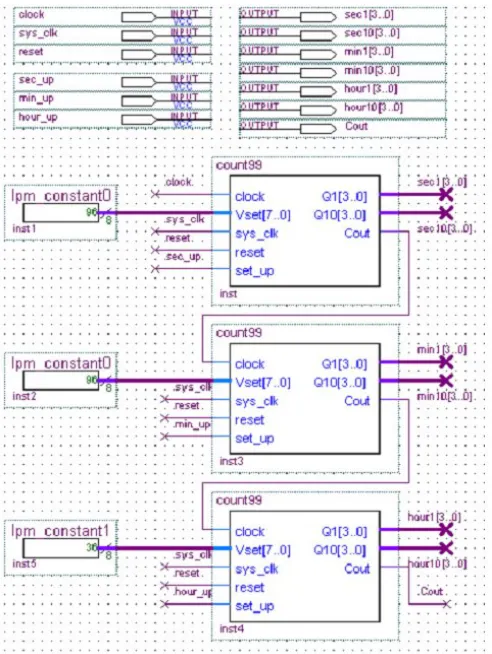
[image:23.612.224.470.96.423.2]2.2 FPGA Based Digital Electronic Education, Clock Calendar Design.
Figure 2.2: The full counting circuit block.
This paper is a case study based on the Project Based Learning for the
Electronics and Computer Engineering students to design a circuit and implemented it
in the FPGA. It involved with building a block from a circuit and putting the block
together to get new blocks. The designed is divided into three sub block as counting,
setting and display.
In the counting block, it taught the students to design a comparator, convert the
circuit into counter and obtain the block to have a counter for seconds, minutes, hour,
day, month and year. It then used the simulation results to evaluate the performance.The
difference between the clock and calendar is from the signal that was sent to calendar
8
In the setting block, this is where the students will have to add something for the
design according to the other blocks. This section is to help the students understand the
function of the block better. It shows steps to set for the block such as using the AND
gate, multiplexer, counter and decoder to be add in their design. The last task given to
the student is to solve the up counting problem where it causes difficulty in usage and
waste time.
The last sub block is the display block. This is the most difficult part for the
student as to display the results in a flash with intervals of a second for indicating the
selected unit. It used many of multiplexer in the designed thus make it more complex.
This part is to analyze the results on the board and understand if the clock calendar is at
normal working condition.
As for conclusion of this paper, it contains the information to study the graphic
design of clock calendar system. It teaches from the basic of what circuits are involved
and steps in designing a clock calendar system.This graphic design can be redesigned
again using HDL codes.
[image:24.612.173.529.460.665.2]